


 Скачать презентацию What is Growth Management 1 Provided under state
7c4912b024357729f6bfc9d6e2445625.ppt
- Количество слайдов: 28
 What is Growth Management? 1. Provided under state legislative enactment 2. Mandates or encourages local governments to prepare plans 3. It mandates or encourages submittal of plans for review 4. It maintains a systems of incentives and disincentives 5. History Resource 6. Stuart Meck - Growing Smart Legislative Guidebook 7. APA website with login and Google books
 How Do States Stack Up Nelson/Duncan 1. Strong State Role Oregon Florida Maine New Jersey Rhode Island Washington 2. Weak State Role California Vermont Georgia
 Quiet Revolution Growth Management Events 1. 1961 – Hawaii state planning law 2. 1965 – HUD COGs eligible for planning funds - Funded regional planning review of federally funded projects 3. 1966 – ASPO – Connecticut review local plans. Recommended state/federal review of local plans 4. 1971 – Oregon/Washington – Plan the coasts. Early actions to comprehensive plan coasts 5. 5. 1972 – FL – Critical areas and DRIs
 Quiet Revolution Growth Management Events 1. 1972 – GA – MRPA – Chattahoochee River 2. 1973 – Oregon – SB 100 - Prepare plans, consistent with state goals and adopt regulations 3. 1974 – America Law Institute – MLDC - Critical areas and DRIs 4. 1975 – FL – LGCPA – review local plans 5. 1974 – 1976 Oregon – Statewide planning goals
 Second Wave Growth Management Expands 1. FL 1980 – RPC act – strengthened RPCs – Governor 1/3 appointments 2. FL 1981 – DCA most plans inadequate – varied in quality 3. FL ELMS 1, 2, 3 – Continuous reevaluation 4. FL 1984 – Planning Act – Regional plan development and local plans reviewed for consistency 5. FL 1985 Omnibus GM Act – 3 “Cs” – Top down vertical consistency, concurrency and compact development. Local plans revised per state standards. 6. GA 1982 – Commission of Growth – 1987 Growth Strategies Commission
 Third Wave Growth management matures 1. FL state land development plan – Guide for DRIs and limited impact on state and regional plans 2. FL 1989 – TF on UGP – Recommendations to curb sprawl 3. FL 1992 – 276 good, 101 non compliant 4. GA – 1989 – Planning Act 5. GA – 1990 – Part 5 and Impact Fees 6. SB 590 – GDC 7. Washington – 1990 – GM act – plans, consistency, critical areas
 GM History Conclusions Conclusion 1. Influence of MLDC 2. Ambitious deadlines 3. Inconsistency and enforcement 4. Local standards 5. Technical Assistance 6. Information systems 7. Public facilities 8. Permit streamlining 9. Continuous reexamination
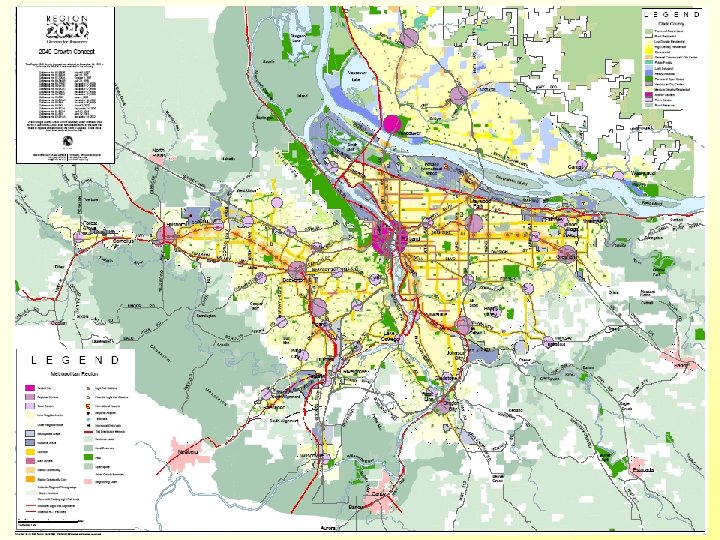
 Oregon’s Planning Approach Brief History: Oregon’s GM efforts resulted from the Land Conservation Act of 1973. One of the earliest state-level GM efforts. The Basic Mechanisms Behind GM: 1) A comprehensive plan directed towards established state goals is required of all cities and counties. 2) In addition, the act requires the designation of 20 year Urban Growth Boundaries (UGB) outside of which land is to remain undeveloped. 3) The Land Conservation and Development Commission reviews all plans for conformance with state goals. Local decision making must be consistent with an “acknowledged” plan. The Carrot and/or Stick: Loss of state revenues from gas, cigarette, and liquor taxes can be withheld with no plan developed or acting inconsistently with the plan. For more info: www. lcd. state. or. us/
 Oregon’s Prop. 37 Nov. 2, 2004, Oregon voters passed Ballot Measure 37 – required owners prior to GM could request permits or compensation. November 2007, Measure 49, modifies Measure 37 to offer: • ‘Express Option’ allowing eligible claimants to develop up to three home sites; • ‘Conditional Option, ’ which has more stringent requirements, allowing eligible claimants to develop up to 10 home sites; or • ‘Vested Option, ’ which allows a Measure 37 claimant to proceed with his/her land development project if he/she incurred substantial costs in good faith to carry out a Measure 37 waiver. • Strong link between transportation investments and land use.
 Florida Growth Management Brief History: Florida’s Omnibus GM act of 1986 overhauled and established the modern GM statues. The Basic Mechanisms Behind GM: 1) Mandated consistency of local, regional and state plans 2) CIE, adequate facilities and concurrency 3) Consistency of development regulations The Carrot and/or Stick: State can withhold funds for lack of compliance and inconsistency. Florida Hometown Democracy ballot – Would require all local comprehensive plan amendments. For more info: http: //www. dca. state. fl. us/
 Florida GM Issues Update: Growth Management Study Commission & Growth Management Initiative Florida Forever World's largest conservation land buying program - collectively, the State of Florida has protected over 535, 643 acres of land with $1. 8 billion in Florida Forever funds through December 2006. 10, 000 Friends of Florida -CQGRD recommendations • • • Expand Florida Forever Adopt New Policy on Conversion of Rural Lands to Urban Use Create a 100 Year Legacy Plan. Identify Leaders and Galvanize Support
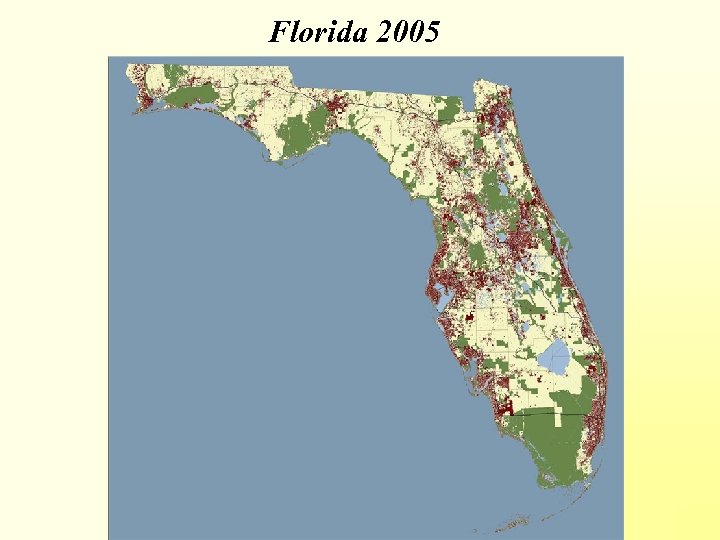 Florida 2005
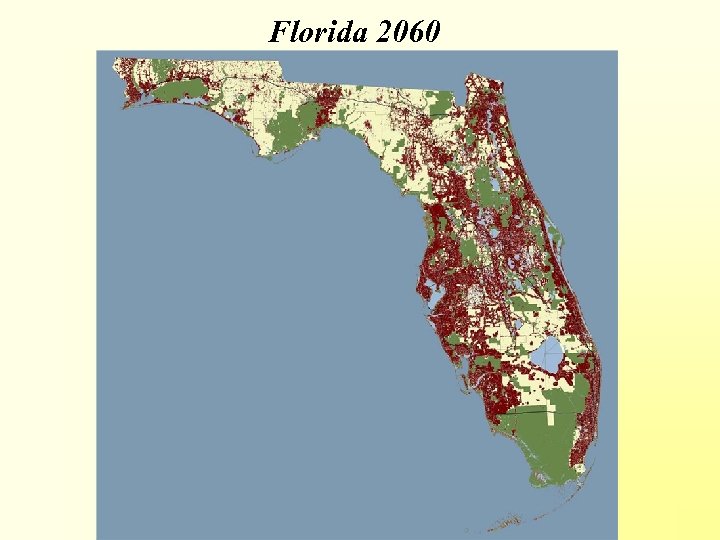 Florida 2060
 Washington’s Planning Brief History: In 1990, Washington state passed their GM Act. The Basic Mechanisms Behind GM: 1) All cities/counties must have a comp plan, but only large and/or fast growing cities and counties must adopt “consistent” comprehensive plans. 2) Twenty-year urban growth areas need to be identified, outside of which only non-urban growth is allowed. 3) Regional commissions review “triggered” plans for consistency with state goals. Commission also resolves disputes. 4) Consistent development regulations required The Carrot and/or Stick: Incentives include financial and technical assistance. Disincentives include loss of sin tax and gas tax revenues, as well as loss of state infrastructure funds. For more info: http: //www. gmhb. wa. gov/gma/index. html or www. mrsc. org/subjects/planning/compplan. aspx? r=1
 Washington’s Approach The GMA requires state and local governments to manage Washington’s growth by identifying and protecting critical areas and natural resource lands, designating urban growth areas, preparing comprehensive plans and implementing them through capital investments and development regulations.
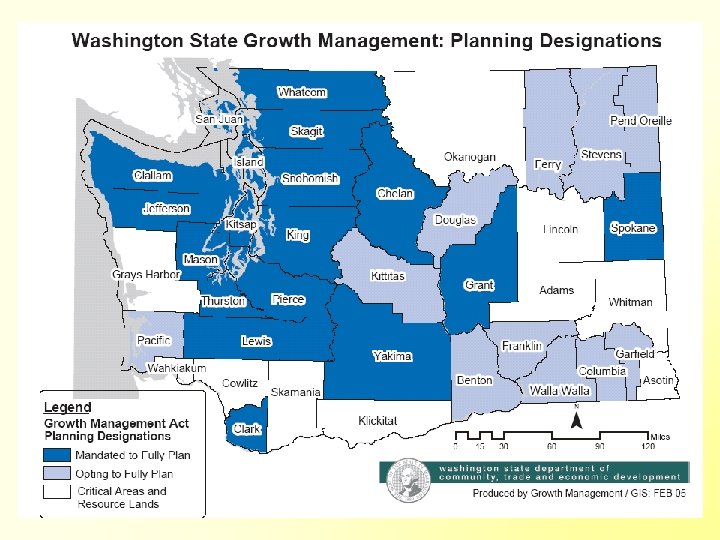 Washington’s “Triggered” Planning Approach
 Washington’s Hearing Boards Overview The Washington State Legislature passed the Growth Management Act (GMA) in 1990 to encourage wise land use and planning. In 1991, it created growth management hearings boards to resolve land use disputes quickly - rather than a single state-wide board, three independent boards were established in order to reflect regional diversity. The jurisdictional regions for the three boards are as follows: • Central Puget Sound Growth Management Hearings Board • Eastern Washington Growth Management Hearings Board • Western Washington Growth Management Hearings Board Website: www. gmhb. wa. gov/
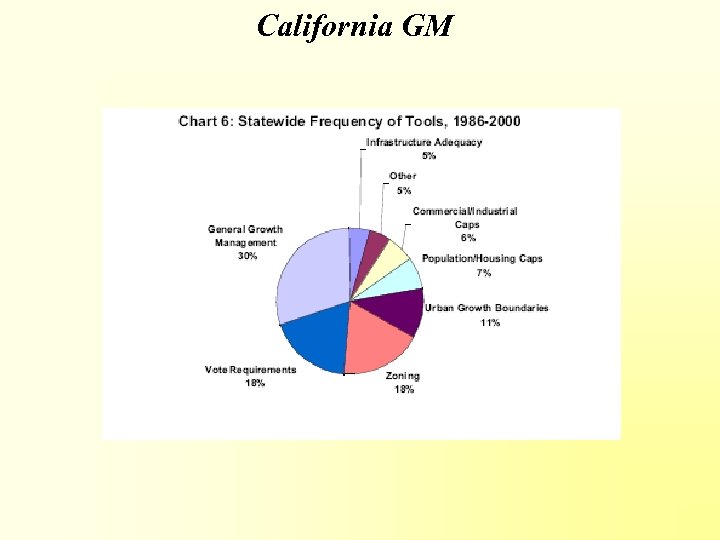
 California GM Brief History: 1971 referred to as the "Mc. Carthy Legislation, ”which required that land-use decisions be consistent with comprehensive plans. Smart growth and planning issues from the ballot box to the state house are fixtures on California's political landscape. The Basic Mechanisms Behind GM: 1) Comprehensive plans 2) Housing elements 3) UGBs 4) Ballot measures 5) The Carrot and/or Stick: State legislation supports ballot measures. Greater citizen participation mostly as a result of growth pressures. For more info: www. dca. state. ga. us/planning/coordinated. html
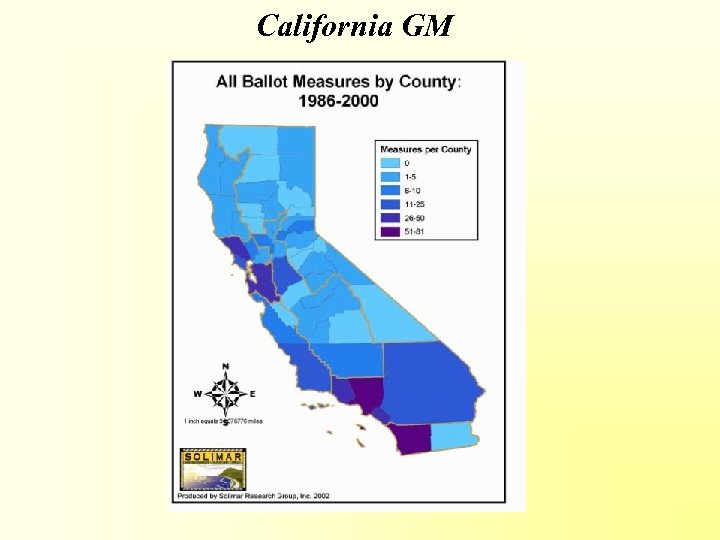 California GM
 California GM
 Maryland Approach The Basic Mechanisms Behind GM: 1) Priority Funding Areas in 1997 2) Adequate Public Facility Ordinances (AFPO) 3) Resources for redevelopment and preservation 4) The Carrot and/or Stick: State funds provided in PFAs 5) For more info: http: //www. mdp. state. md. us/
 Maryland Approach 1. 1992 Planning Act required that the following visions be incorporated into County and Municipal Comprehensive (or General or Master) Plans and then implemented through consistent ordinances and local laws by July 1, 1997. 2. Development is concentrated in suitable areas 3. Sensitive Areas are protected 4. In rural areas, growth is directed to existing population centers and resource areas are protected 5. Stewardship of the Chesapeake Bay and the land is a universal ethic 6. Conservation of resources, including a reduction in resource consumption, is practiced 7. To assure the achievement of [the] above, economic growth is encouraged and regulatory mechanisms are streamlined 8. Funding mechanisms are addressed to achieve these visions
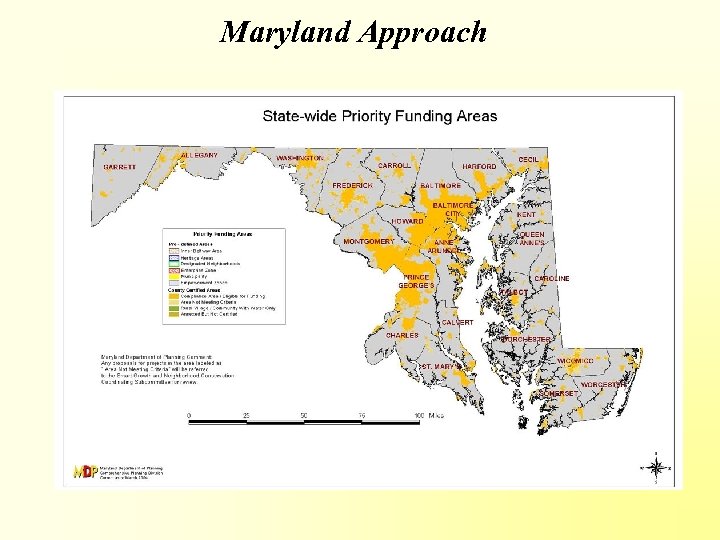 Maryland Approach
 Georgia’s Bottom-Up Approach Brief History: Georgia passed the Georgia Planning Act in 1989. A three-tiered system was established to coordinate planning efforts (similar to Florida’s approach). The Basic Mechanisms Behind GM: 1) The state sets goals and minimum standards for development. 2) Regional areas (mandatory) make plans consistent with these, with plans and input from local governments (optional). 3) Regional agencies review the plans for consistency across plans and with state goals. 4) Capital improvement plans (CIP) are required, consistent with comp plans. 5) A State Plan was intended after local plans are developed. The Carrot and/or Stick: State has provided funds to assist RDCs with planning and has pushed adoption of plans by certain dates. After plans have been approved, impact fees/exactions can be levied. Certain funds can be withheld, not GDOT. For more info: www. dca. state. ga. us/planning/coordinated. html
 Georgia’s Ad-hoc GM Activities Major Players: Georgia DCA, ARC, GDOT, GRTA, GT, ULI, Georgia Conservancy, GQGP, Georgia Planning Association (GPA), etc. Major Activities: Local and regional planning, federal, state and local funding, technical assistance, training, etc. What, Where and When: Livable Centers Initiative (LCI), CPA and CPI, Quality Growth Resource Teams, Blueprints for Successful Communities, Community Choices Toolkit, Conferences and Workshops. LCC - www. livablecommunitiescoalition. org GQGP- www. georgiaqualitygrowth. org GPA - www. georgiaplanning. org ARC - www. atlantaregional. com GC - www. georgiaconservancy. com
 Review of Common GM Components 1. Mandated local plans 2. State and regional review 3. State or regional standards and goals 4. Incentives and disincentives 5. Urban Growth Boundaries (UGBs) 6. Concurrency 7. Development of Regional Impact (DRIs) 8. Critical areas protection 9. Coastal management and protection 10. Plan and regulatory consistency 11. Technical assistance 12. Priority funding areas (PFAs)
 Review of Common GM Components Which state’s growth management was most effective? Does Georgia bottoms-up planning work? What aspects of growth management are most successful? What is missing in Georgia?