


 Скачать презентацию What is GAIT GAIT stands for GSM ANSI-136
f12d1d05232e54ab5243a3e66462b2fa.ppt
- Количество слайдов: 29
 What is GAIT? GAIT stands for GSM/ ANSI-136 (TDMA) Interoperability Team 1
 GSM/TDMA Interoperability Penny Bright Lucent Technologies +1 630 -713 -7531 plbright@lucent. com Setting the pace of Global Wireless Communications. 2
 Introduction n GAIT Formation: structure, background, deliverables n Drivers for GAIT (e. g. Roaming) n Requirements and Timeline n Interoperability Elements n Mobile Station / SIM Capabilities n Network IIF Capabilities n Example message flows n Issues on NW and Handset-side 3
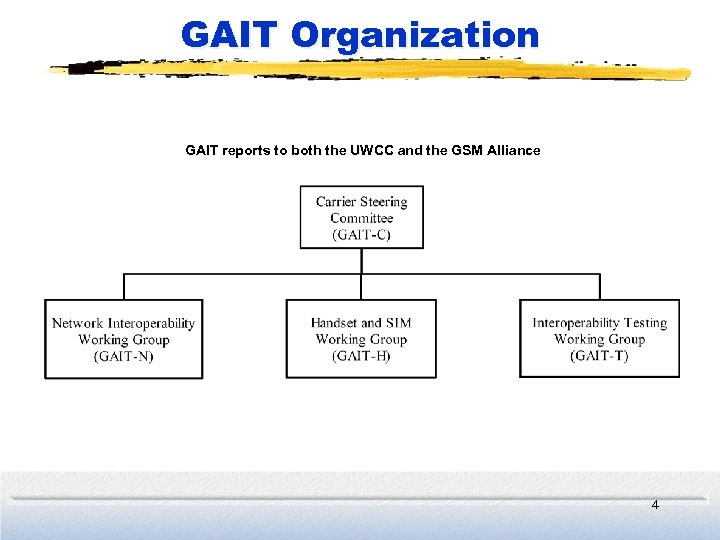 GAIT Organization GAIT reports to both the UWCC and the GSM Alliance 4
 GAIT Background n GSM/ANSI-136 Interoperability Team (GAIT) formed in February - March 1999 to address deliverables from the GSM Alliance/UWCC n Scope and Charter: u Develop mobile station (including Subscriber Identity Module) and network functional requirements and specifications for the interoperability and interworking of GSM and ANSI-136 based cellular/PCS systems u Work with other industry bodies and the appropriate standards bodies to standardize the GSM/ANSI-136 interoperability service 5
 GAIT Deliverables n Network Spec. primarily addresses the GSM/ANSI-41 Interworking/Interoperability Function (IIF) u as well as others: e. g. SMSC and ANSI-41 HLR n Common Mobile Terminal Specification addresses the GSM/ANSI-136/AMPS Multi-Mode Mobile and SIM n Test Plan Spec. In Progress -- needs stage 3 detail n Detailed specification and standardization required to meet July 2000 targeted general availability 4 Specifications will be frozen in November 1999 4 Network Spec. Submission to T 1 P 1 in Nov. ‘ 99 4 Some portions of the detailed handset specifications have been submitted to TR-45. 3 4(for GHOST and SIM files and procedures) 6
 GSM/ANSI-136 Interoperability: Key Drivers n Support for international roamers u GSM and/or ANSI-136 coverage exists in every developed city in the world u 290 million GSM and ANSI-136 subscribers worldwide n Support for GSM subscribers in regions that are otherwise predominately ANSI-136 n Support for ANSI-136 subscribers in regions that are otherwise predominately GSM n Seamless Service (features and user interface) 7
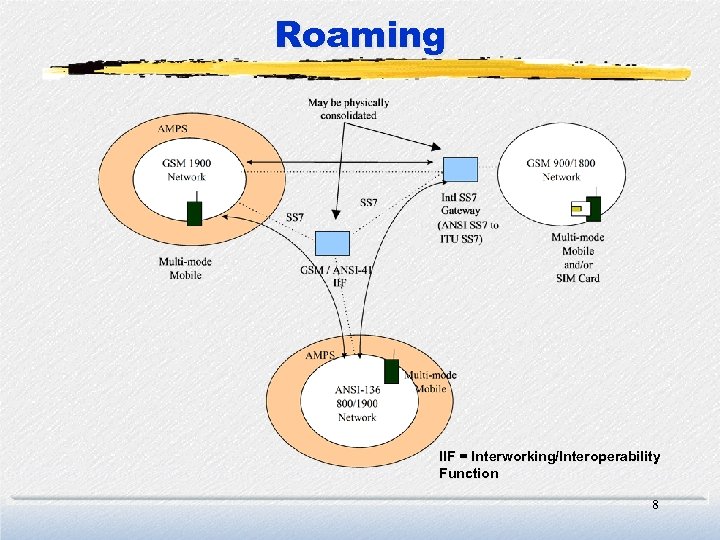 Roaming IIF = Interworking/Interoperability Function 8
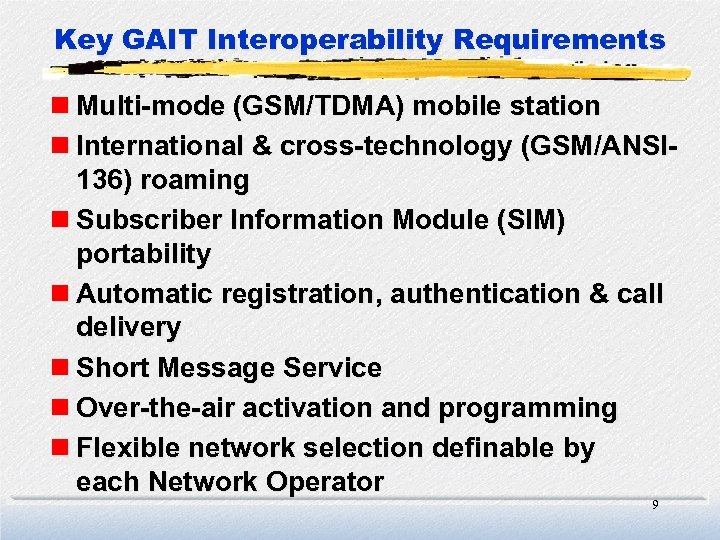 Key GAIT Interoperability Requirements n Multi-mode (GSM/TDMA) mobile station n International & cross-technology (GSM/ANSI 136) roaming n Subscriber Information Module (SIM) portability n Automatic registration, authentication & call delivery n Short Message Service n Over-the-air activation and programming n Flexible network selection definable by each Network Operator 9
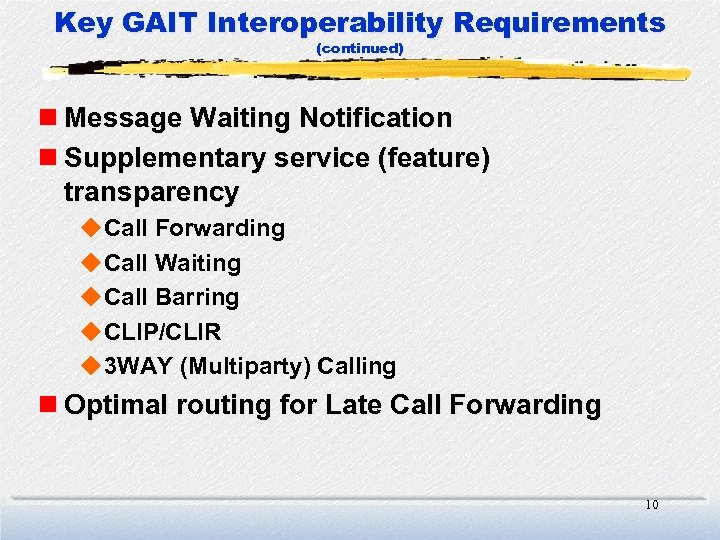 Key GAIT Interoperability Requirements (continued) n Message Waiting Notification n Supplementary service (feature) transparency u Call Forwarding u Call Waiting u Call Barring u CLIP/CLIR u 3 WAY (Multiparty) Calling n Optimal routing for Late Call Forwarding 10
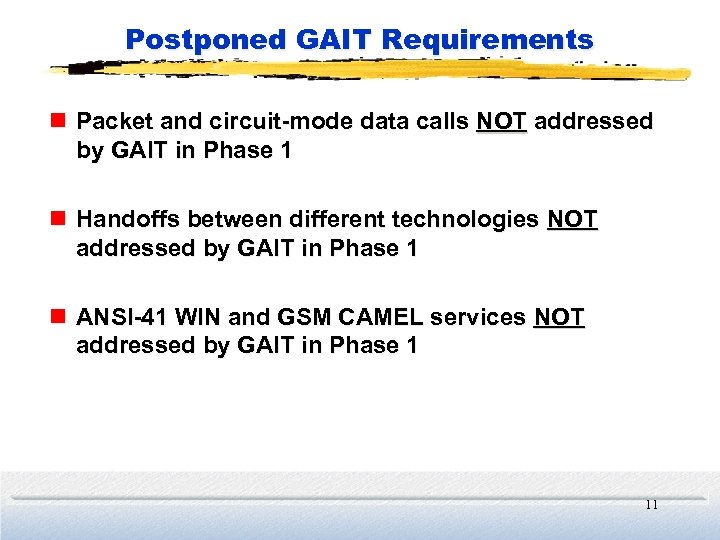 Postponed GAIT Requirements n Packet and circuit-mode data calls NOT addressed by GAIT in Phase 1 n Handoffs between different technologies NOT addressed by GAIT in Phase 1 n ANSI-41 WIN and GSM CAMEL services NOT addressed by GAIT in Phase 1 11
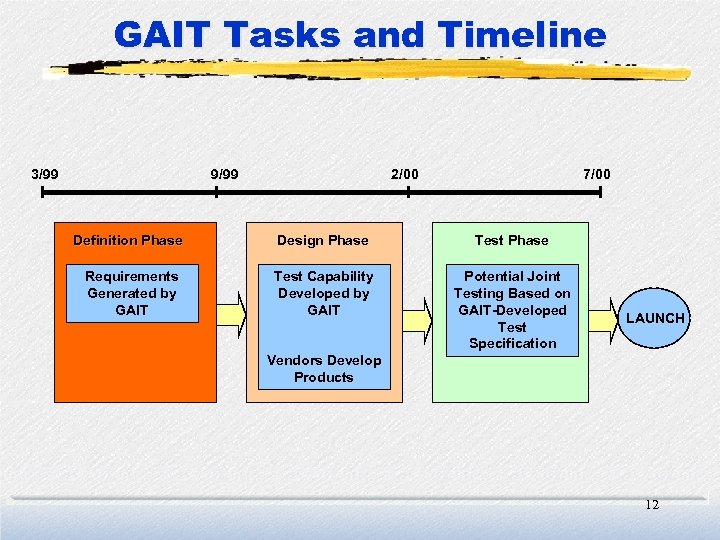 GAIT Tasks and Timeline 3/99 9/99 2/00 7/00 Definition Phase Design Phase Test Phase Requirements Generated by GAIT Test Capability Developed by GAIT Potential Joint Testing Based on GAIT-Developed Test Specification LAUNCH Vendors Develop Products 12
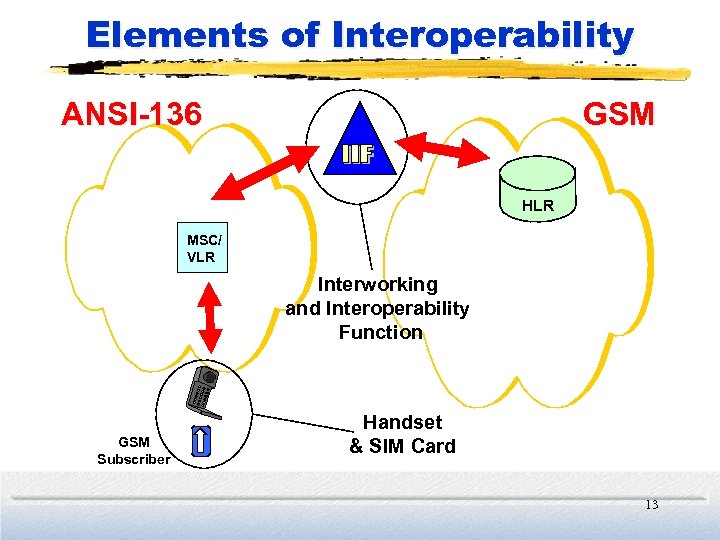 Elements of Interoperability ANSI-136 GSM HLR MSC/ VLR Interworking and Interoperability Function GSM Subscriber Handset & SIM Card 13
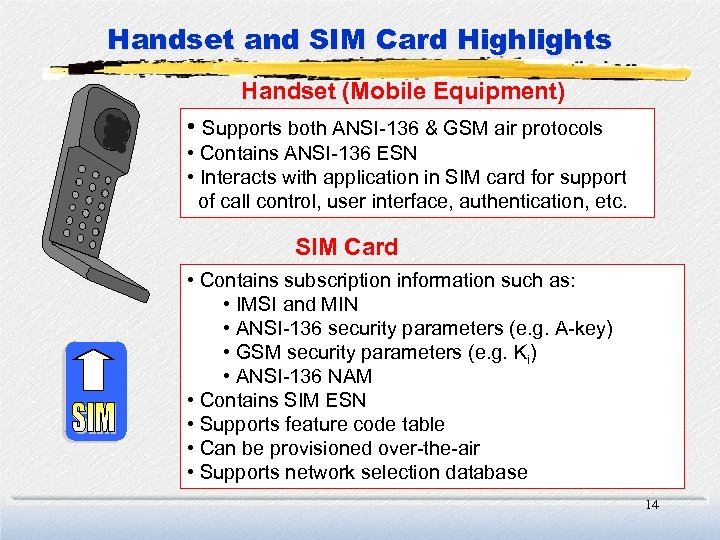 Handset and SIM Card Highlights Handset (Mobile Equipment) • Supports both ANSI-136 & GSM air protocols • Contains ANSI-136 ESN • Interacts with application in SIM card for support of call control, user interface, authentication, etc. SIM Card • Contains subscription information such as: • IMSI and MIN • ANSI-136 security parameters (e. g. A-key) • GSM security parameters (e. g. Ki) • ANSI-136 NAM • Contains SIM ESN • Supports feature code table • Can be provisioned over-the-air • Supports network selection database 14
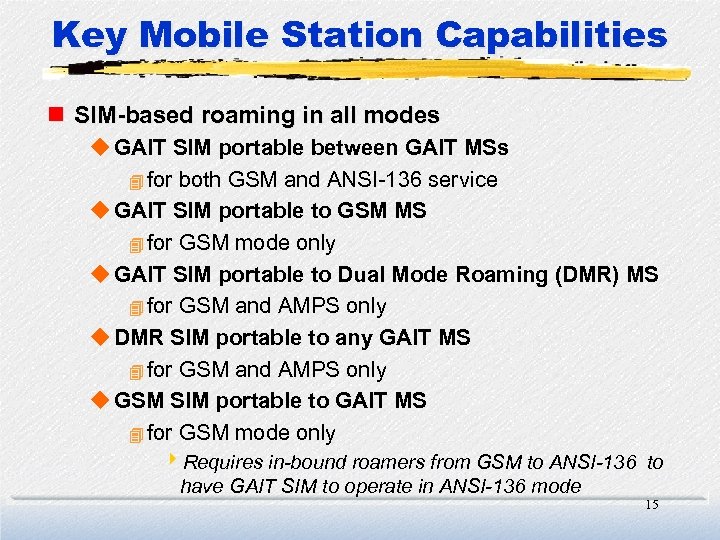 Key Mobile Station Capabilities n SIM-based roaming in all modes u GAIT SIM portable between GAIT MSs 4 for both GSM and ANSI-136 service u GAIT SIM portable to GSM MS 4 for GSM mode only u GAIT SIM portable to Dual Mode Roaming (DMR) MS 4 for GSM and AMPS only u DMR SIM portable to any GAIT MS 4 for GSM and AMPS only u GSM SIM portable to GAIT MS 4 for GSM mode only 4 Requires in-bound roamers from GSM to ANSI-136 to have GAIT SIM to operate in ANSI-136 mode 15
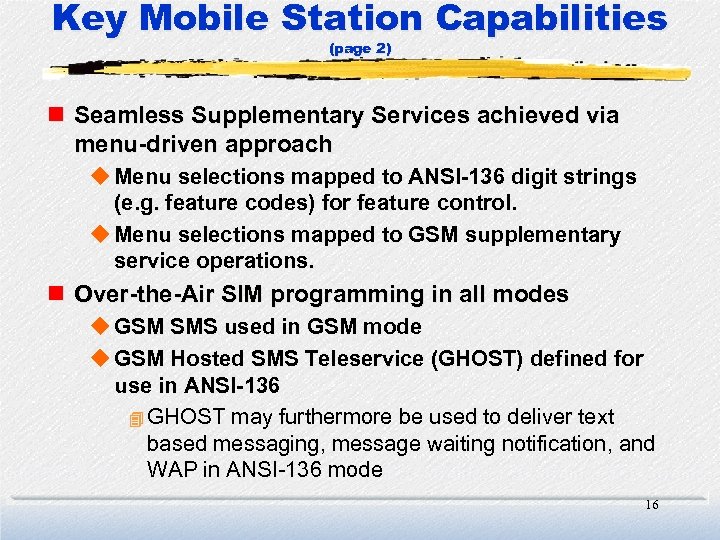 Key Mobile Station Capabilities (page 2) n Seamless Supplementary Services achieved via menu-driven approach u Menu selections mapped to ANSI-136 digit strings (e. g. feature codes) for feature control. u Menu selections mapped to GSM supplementary service operations. n Over-the-Air SIM programming in all modes u GSM SMS used in GSM mode u GSM Hosted SMS Teleservice (GHOST) defined for use in ANSI-136 4 GHOST may furthermore be used to deliver text based messaging, message waiting notification, and WAP in ANSI-136 mode 16
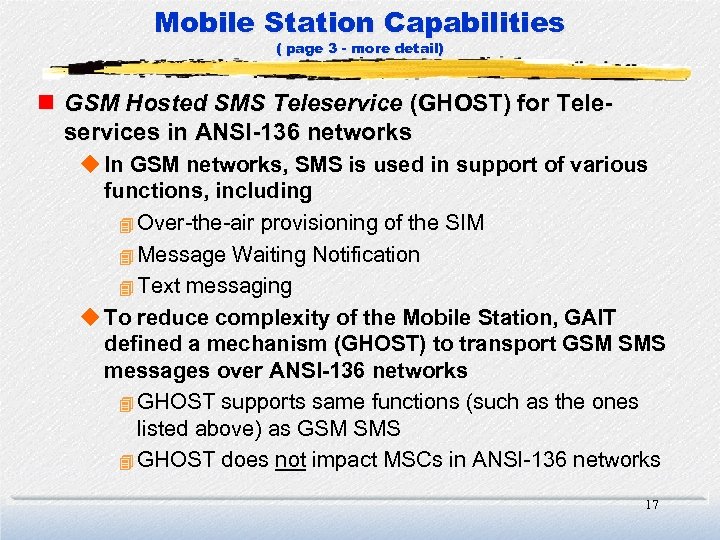 Mobile Station Capabilities ( page 3 - more detail) n GSM Hosted SMS Teleservice (GHOST) for Teleservices in ANSI-136 networks u In GSM networks, SMS is used in support of various functions, including 4 Over-the-air provisioning of the SIM 4 Message Waiting Notification 4 Text messaging u To reduce complexity of the Mobile Station, GAIT defined a mechanism (GHOST) to transport GSM SMS messages over ANSI-136 networks 4 GHOST supports same functions (such as the ones listed above) as GSM SMS 4 GHOST does not impact MSCs in ANSI-136 networks 17
 IIF Highlights (Interworking and Interoperability Function) 18
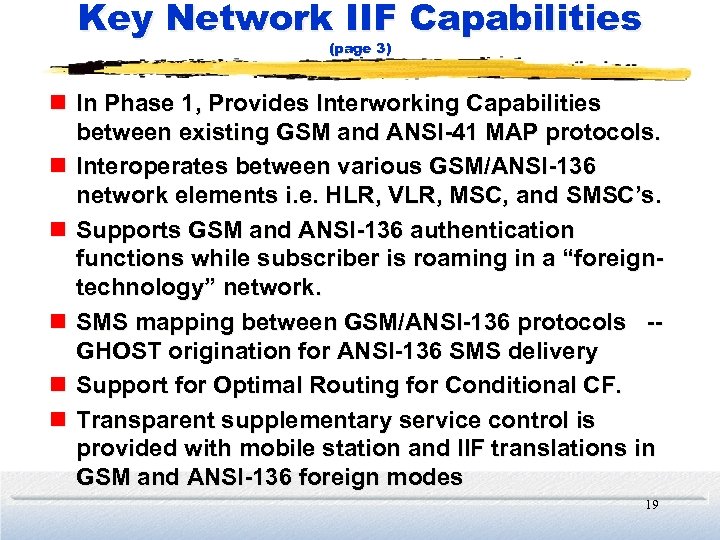 Key Network IIF Capabilities (page 3) n In Phase 1, Provides Interworking Capabilities between existing GSM and ANSI-41 MAP protocols. n Interoperates between various GSM/ANSI-136 network elements i. e. HLR, VLR, MSC, and SMSC’s. n Supports GSM and ANSI-136 authentication functions while subscriber is roaming in a “foreigntechnology” network. n SMS mapping between GSM/ANSI-136 protocols -GHOST origination for ANSI-136 SMS delivery n Support for Optimal Routing for Conditional CF. n Transparent supplementary service control is provided with mobile station and IIF translations in GSM and ANSI-136 foreign modes 19
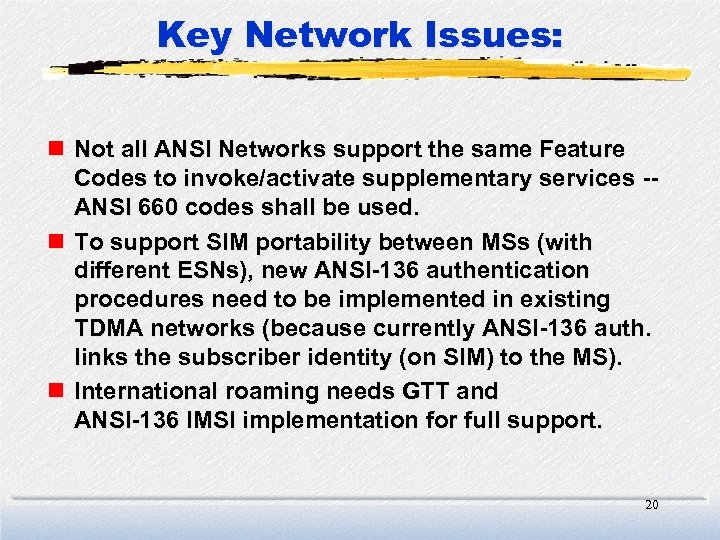 Key Network Issues: n Not all ANSI Networks support the same Feature Codes to invoke/activate supplementary services -ANSI 660 codes shall be used. n To support SIM portability between MSs (with different ESNs), new ANSI-136 authentication procedures need to be implemented in existing TDMA networks (because currently ANSI-136 auth. links the subscriber identity (on SIM) to the MS). n International roaming needs GTT and ANSI-136 IMSI implementation for full support. 20
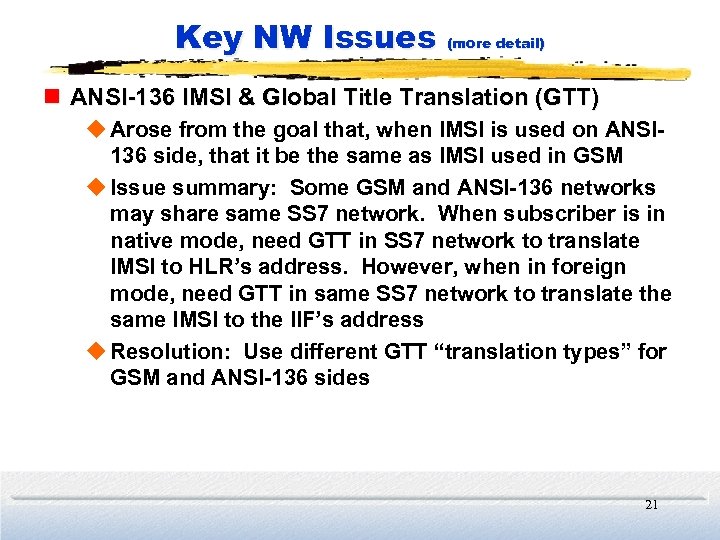 Key NW Issues (more detail) n ANSI-136 IMSI & Global Title Translation (GTT) u Arose from the goal that, when IMSI is used on ANSI 136 side, that it be the same as IMSI used in GSM u Issue summary: Some GSM and ANSI-136 networks may share same SS 7 network. When subscriber is in native mode, need GTT in SS 7 network to translate IMSI to HLR’s address. However, when in foreign mode, need GTT in same SS 7 network to translate the same IMSI to the IIF’s address u Resolution: Use different GTT “translation types” for GSM and ANSI-136 sides 21
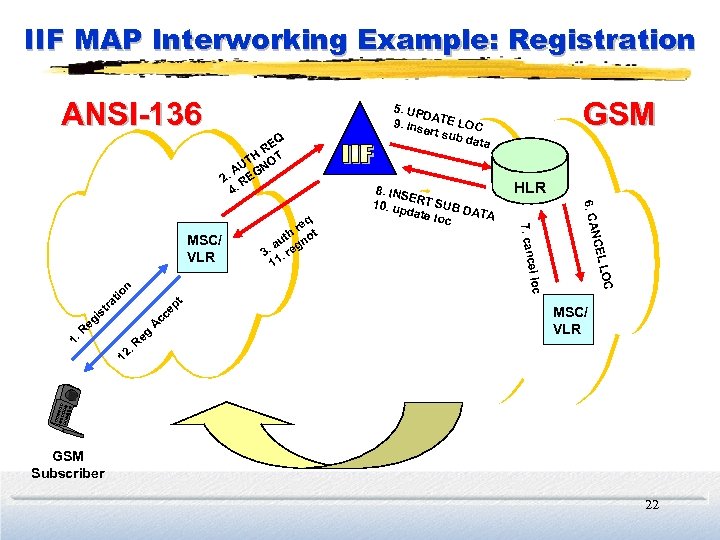 IIF MAP Interworking Example: Registration ANSI-136 Q RE TH OT AU GN 2. RE 4. n ep t tio ra MSC/ VLR 12. R eg A cc eg is t LOC R NCEL el loc 1. HLR 6. CA 8. INS E 10. u RT SUB DATA pdate loc 7. canc MSC/ VLR q re h ot ut n. a reg 3. 11 GSM 5. UP DA 9. ins TE LOC ert su b dat a GSM Subscriber 22
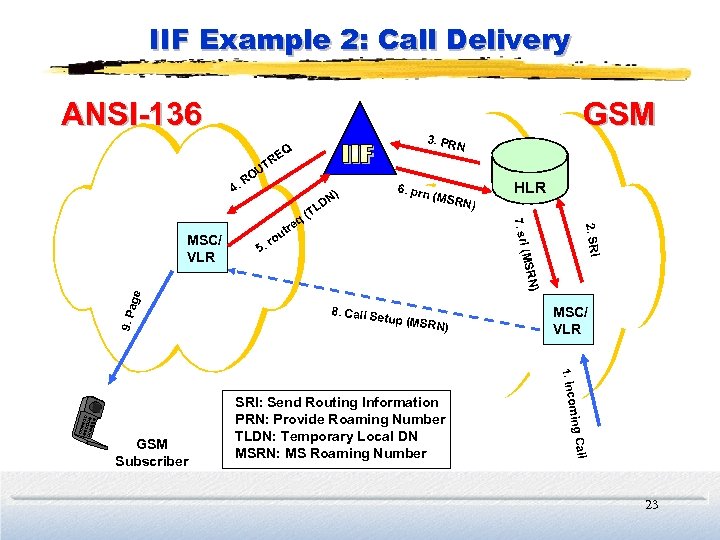 IIF Example 2: Call Delivery ANSI-136 3. PR N Q RE 4. T OU R age ( N) HLR r 5. N) (MSR 9. P (MSR 2. SRI tre ou N LD T 7. sri 8. Call S etup (MS RN) all ming C SRI: Send Routing Information PRN: Provide Roaming Number TLDN: Temporary Local DN MSRN: MS Roaming Number MSC/ VLR 1. Inco GSM Subscriber 6. prn ) q MSC/ VLR GSM 23
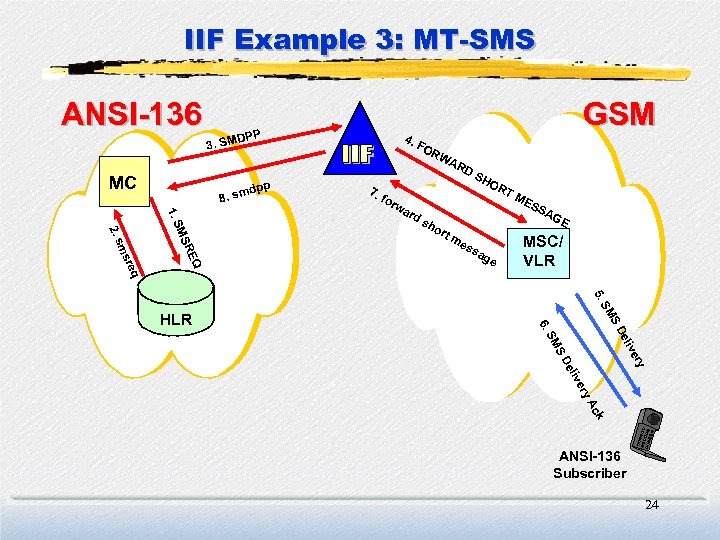 IIF Example 3: MT-SMS ANSI-136 PP. SMD 4. 3 GSM FO RW AR MC 8. pp smd DS 7. for rd Q RE MS sh ort RT ME SS AG E me ss ag e MSC/ VLR q sre m 2. s 1. S wa HO 5. S SM ery liv De ery liv S SM De 6. HLR Ac k ANSI-136 Subscriber 24
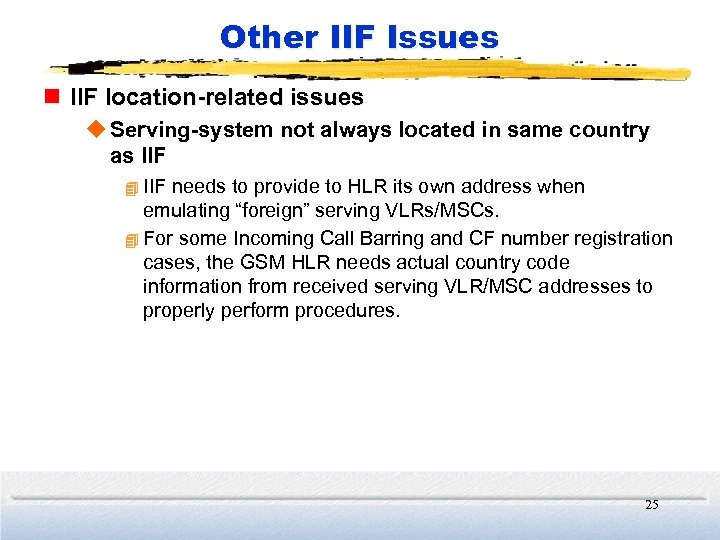 Other IIF Issues n IIF location-related issues u Serving-system not always located in same country as IIF 4 IIF needs to provide to HLR its own address when emulating “foreign” serving VLRs/MSCs. 4 For some Incoming Call Barring and CF number registration cases, the GSM HLR needs actual country code information from received serving VLR/MSC addresses to properly perform procedures. 25
 Other IIF Issues (page 2) n MAP translatability-related issues u Authentication and Encryption 4 GSM and ANSI-136 authentication/encryption procedures too different to allow simple “protocol translation” by IIF. Instead, IIF itself will provide the full authentication/ encryption functionality (either GSM or ANSI-41) for subscribers roaming in a foreign-technology network u Outgoing Call Barring 4 ANSI-41 outgoing call restrictions not completely equivalent to GSM MAP outgoing call barring capabilities. u Call Forwarding Busy 4 Current GSM MAP versions do not support “busy” indication in call delivery signaling u CLIP 4 NW Implementation of GSM MAP release ‘ 98 is needed inclusion of calling party number information during call 26 delivery
 Other Mobile Station Issues n ANSI-136 Parameters in SIM u ETSI SIM standards already support some AMPSrelated parameters (e. g. MIN) u ETSI SIM standards to be extended to support additional parameters needed by GAIT 27
 Other Mobile Station Issues n Feature transparency (almost) achieved via menudriven approach u Complete feature transparency not possible because of differences in capabilities between GSM and ANSI 136 networks. Examples: 4 3 WAY, Multiparty (GSM networks can support more than three parties in multi-party call) 4 Call Waiting (ANSI-136 networks cannot release active call & respond to CW call simultaneously) 28
 Summary n GAIT Formation: structure, charter, deliverables n Drivers for GAIT (e. g. Roaming) n Requirements and Timeline n Interoperability Elements n MS/ SIM Capabilities n IIF Capabilities n Example message flows n Issues 29