


 Скачать презентацию What is culture A system of values
6382da699037f8f923c2121257a787ae.ppt
- Количество слайдов: 21
 What is culture? • A system of values and norms that are shared among a group of people. • The collective programming of the mind which distinguishes the members of one category of people from another (Hofestede, 2001). • Culture is acquired naturally early in life through interaction with others. 1
 What is culture? • Values: Abstract ideas about what a society believes to be good, right, and desirable. . • Norms are social rules and guidelines that prescribe the appropriate behavior in particular situations. – Folkways: the routines conventions of everyday life, but generally have little moral significance. E. g. , dress, eating habits – Mores are more serious standards of behavior. It would be considered illegal or very inappropriate if mores are not followed. 2
 Dimensions of national culture • Edward T. Hall: The “silent languages” of culture • Geert Hofstede: Indices of work-related values – based on the study of more than 100, 000 IBM employees in more than forty countries 3
 The silent language of culture • The language of time • The language of space – e. g. , social distance • The language of material goods (to signal status and power) • The language of friendship • The language of agreement High context and low context cultures 4
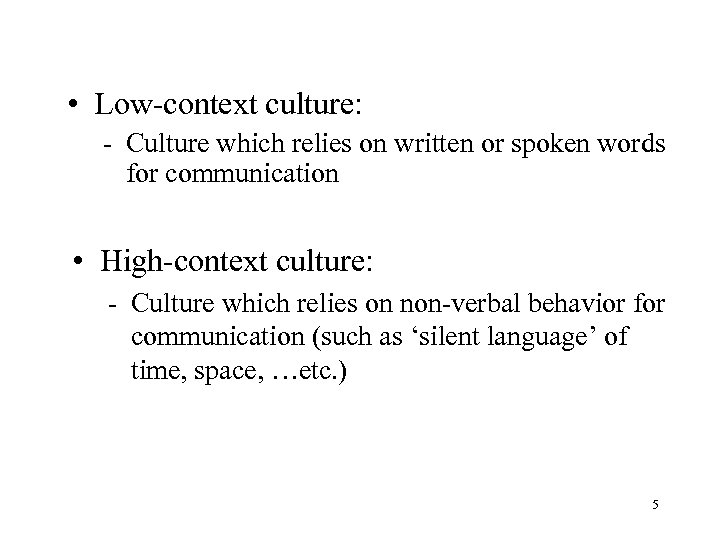 • Low-context culture: - Culture which relies on written or spoken words for communication • High-context culture: - Culture which relies on non-verbal behavior for communication (such as ‘silent language’ of time, space, …etc. ) 5
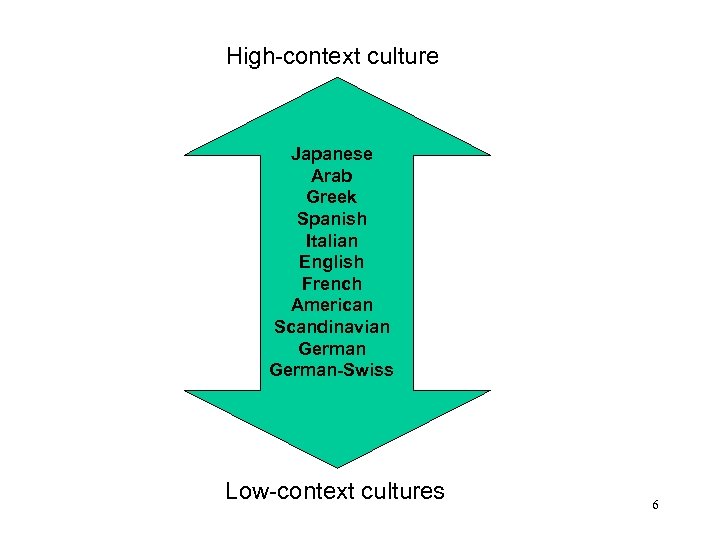 High-context culture Japanese Arab Greek Spanish Italian English French American Scandinavian German-Swiss Low-context cultures 6
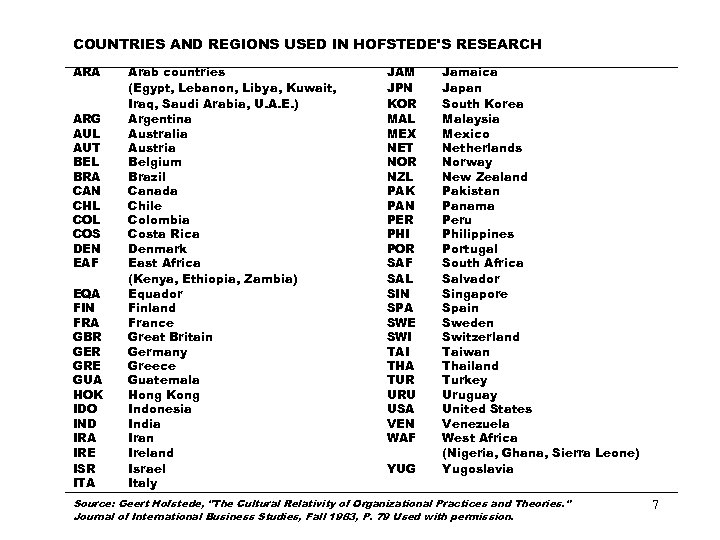 COUNTRIES AND REGIONS USED IN HOFSTEDE'S RESEARCH ARA ARG AUL AUT BEL BRA CAN CHL COS DEN EAF EQA FIN FRA GBR GER GRE GUA HOK IDO IND IRA IRE ISR ITA Arab countries (Egypt, Lebanon, Libya, Kuwait, Iraq, Saudi Arabia, U. A. E. ) Argentina Australia Austria Belgium Brazil Canada Chile Colombia Costa Rica Denmark East Africa (Kenya, Ethiopia, Zambia) Equador Finland France Great Britain Germany Greece Guatemala Hong Kong Indonesia India Iran Ireland Israel Italy JAM JPN KOR MAL MEX NET NOR NZL PAK PAN PER PHI POR SAF SAL SIN SPA SWE SWI TAI THA TUR URU USA VEN WAF YUG Jamaica Japan South Korea Malaysia Mexico Netherlands Norway New Zealand Pakistan Panama Peru Philippines Portugal South Africa Salvador Singapore Spain Sweden Switzerland Taiwan Thailand Turkey Uruguay United States Venezuela West Africa (Nigeria, Ghana, Sierra Leone) Yugoslavia Source: Geert Hofstede, "The Cultural Relativity of Organizational Practices and Theories. " Journal of International Business Studies, Fall 1983, P. 79 Used with permission. 7
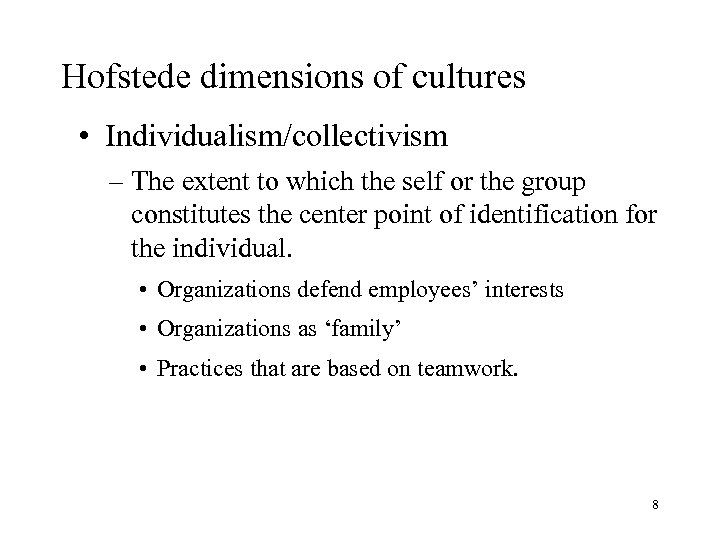 Hofstede dimensions of cultures • Individualism/collectivism – The extent to which the self or the group constitutes the center point of identification for the individual. • Organizations defend employees’ interests • Organizations as ‘family’ • Practices that are based on teamwork. 8
 • Power distance – The extent to which hierarchical differences are accepted in society. • (do subordinates ask questions? , do subordinates wait for orders? ) 9
 • Uncertainty avoidance – The extent to which uncertainty and ambiguity are tolerated. • High UA: more structuring of activities, more written rules, more specialists, standardization, less willing to take risk, younger people are suspect, a stronger need for consensus, greater concern with security in life 10
 • Masculinity/feminity – Masculinity (MAS) focuses on the degree the society reinforces, or does not reinforce, the traditional masculine work role model of male achievement, control, and power. – In a masculine society, the dominant values are assertiveness, the acquisition of money and material things, independence, ambition (you live to work). – In a feminine society, more focus is on the quality of life, interaction between people (you work to live). 11
 • Long term orientation (confucian Dynamism) – longer planning horizon, delay gratification • Indulgence versus Restraint (IVR) -Indulgence: relatively free gratification of basic and natural human drives related to enjoying life and having fun. - Restraint: a society that suppresses gratification of needs and regulates it by means of strict social norms. 12
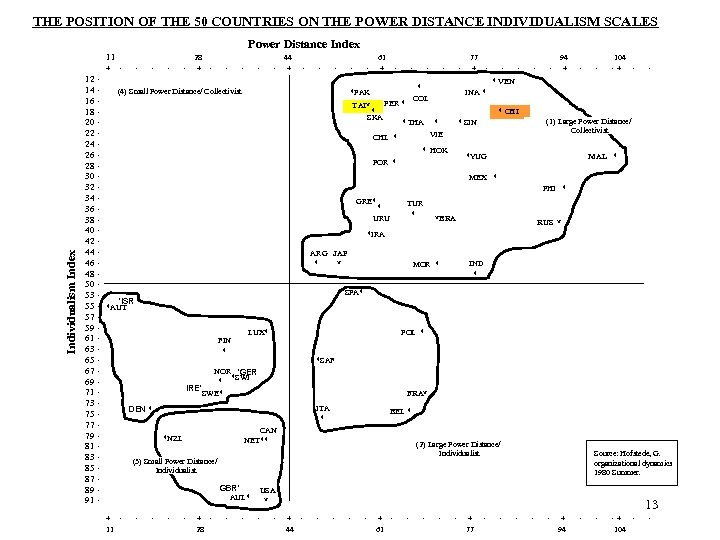 THE POSITION OF THE 50 COUNTRIES ON THE POWER DISTANCE INDIVIDUALISM SCALES Power Distance Index 11 Individualism Index 28 44 61 77 94 104 + . . . . . + . . . + . . .+ . . 12. 14. (4) Small Power Distance/ Collectivist 16. 18. 20. 22. 24. 26. 28. 30. 32. 34. 36. 38. 40. 42. 44. 46. 48. 50. 53. *ISR 55. *AUT 57. 59. LUX* 61. FIN 63. * 65. NOR *GER 67. *SWI * 69. IRE* 71. SWE* 73. DEN * 75. 77. CAN 79. *NZL * NET* 81. 83. (3) Small Power Distance/ 85. Individualist 87. GBR* 89. USA AUL* * 91. * VEN * COL *PAK INA * PER * TAI* * SKA * THA * VIE CHL * * HOK POR * * CHI * SIN (1) Large Power Distance/ Collectivist *YUG MAL * MEX * PHI * GRE* * URU TUR * *BRA RUS * *IRA ARG JAP * * MOR * IND * SPA* POL * *SAF FRA* ITA * BEL * (2) Large Power Distance/ Individualist Source: Hofstede, G. organizational dynamics 1980 Summer. 13 + . . . . . + . . . + . . .+ . . 11 28 44 61 77 94 104
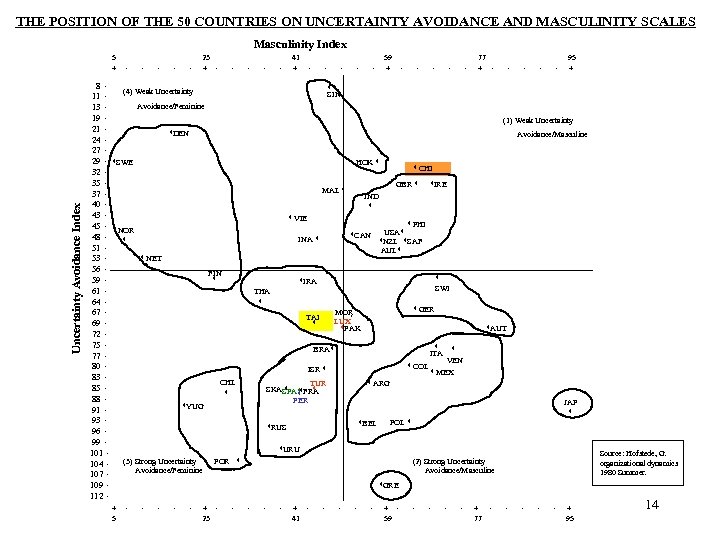 THE POSITION OF THE 50 COUNTRIES ON UNCERTAINTY AVOIDANCE AND MASCULINITY SCALES Masculinity Index Uncertainty Avoidance Index 5 23 41 59 77 95 + . . . . . + . . . + 8. (4) Weak Uncertainty 11. Avoidance/Feminine 13. 19. 21. *DEN 24. 27. 29. *SWE 32. 35. 37. 40. 43. 45. NOR 48. * 51. * NET 53. 56. FIN * 59. 61. 64. 67. 69. 72. 75. 77. 80. 83. CHL 85. * 88. *YUG 91. 93. 96. 99. 101. POR * 104. (3) Strong Uncertainty Avoidance/Feminine 107. 109. 112. * SIN (1) Weak Uncertainty Avoidance/Masculine HOK * GBR * MAL * *IRE IND * * VIE *CAN INA * * CHI * PHI USA* *NZL *SAF AUL* * SWI *IRA THA * TAI * * GER MOR LUX* *PAK * *AUT * * ITA VEN * COL * MEX BRA* ISR * TUR SKA * *FRA SPA* * * PER *RUS * ARG *BEL JAP * POL * *URU (2) Strong Uncertainty Avoidance/Masculine Source: Hofstede, G. organizational dynamics 1980 Summer. *GRE + . . . . . + . . . + 5 23 41 59 77 95 14
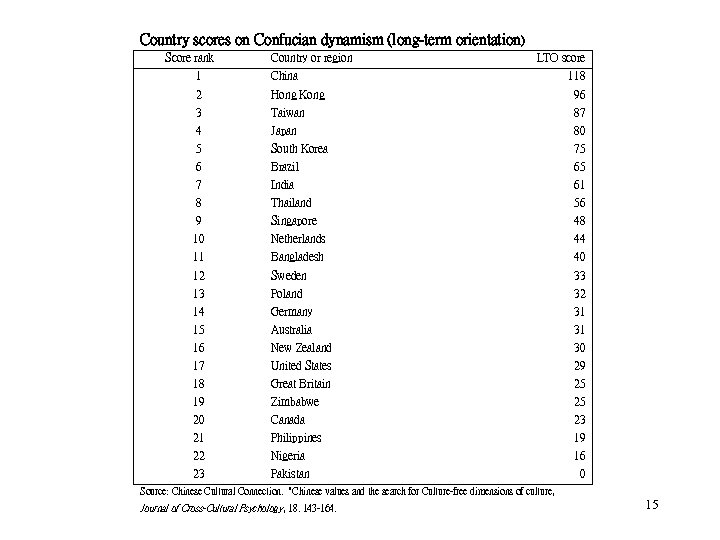 Country scores on Confucian dynamism (long-term orientation ) Score rank Country or region LTO score 1 China 118 2 Hong Kong 96 3 Taiwan 87 4 Japan 80 5 South Korea 75 6 Brazil 65 7 India 61 8 Thailand 56 9 Singapore 48 10 Netherlands 44 11 Bangladesh 40 12 Sweden 33 13 Poland 32 14 Germany 31 15 Australia 31 16 New Zealand 30 17 United States 29 18 Great Britain 25 19 20 Zimbabwe Canada 25 23 21 Philippines 19 22 Nigeria 16 23 Pakistan 0 Source: Chinese Cultural Connection. "Chinese values and the search for Culture-free dimensions of culture, Journal of Cross-Cultural Psychology , 18. 143 -164. 15
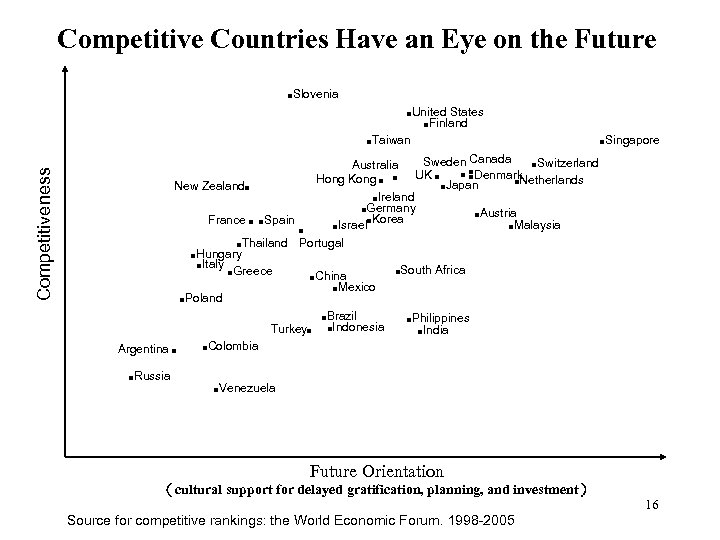 Competitive Countries Have an Eye on the Future ■Slovenia ■United States ■Finland Competitiveness ■Taiwan Sweden Canada ■Switzerland Australia ■ ■Denmark UK ■ ■ ■ Hong Kong ■ ■Netherlands ■Japan ■Ireland ■Germany ■Austria ■Korea ■Israel ■Malaysia New Zealand■ France ■ ■Spain ■Thailand ■Hungary ■Italy ■Greece ■Poland ■ Portugal ■China ■Mexico Turkey■ Argentina ■ ■Russia ■Singapore ■Brazil ■Indonesia ■South Africa ■Philippines ■India ■Colombia ■Venezuela Future Orientation (cultural support for delayed gratification, planning, and investment) Source for competitive rankings: the World Economic Forum. 1998 -2005 16
 Criticisms of Hofstede 17
 Other Layers of of culture • Ethnicity • Industry • Demographics • Ideology 18
 Culture in management settings 19
 Culture in management settings 20
 People of different cultures often perceive and solve problems differently: A survey with MBA students from Germany and France. 21