


 Скачать презентацию What Is Criminology Latin Criminology from Latin crīmen
What Is Criminology.pptx
- Количество слайдов: 6
 What Is Criminology? Latin Criminology (from Latin crīmen, "accusation"; Greek -logia and Greek -λογία, -logia) is the scientific study of crime, including its causes, responses by law enforcement, and methods of prevention. It is a subgroup of sociology, which is the scientific study of social behavior. There are many fields of study that are used in the field of criminology, including biology, statistics, psychology, psychiatry, economics, and anthropology.
 Just as criminology is a sub-group of sociology, criminology itself has several sub-groups, including: - Penology: the study of prisons and prison systems - Biocriminology: the study of the biological basis of criminal behavior - Feminist criminology: the study of women and crime - Criminalistics: the study of crime detection
 The History of Criminology As long as there have been people, there has been crime. Criminology as a discipline is the study of crime and the criminal element, its causes, and the suppression and prevention of it. The history of criminology is in many ways the history of humanity. As human society has evolved over thousands of years, so, too, has our understanding of the causes of crime and societies’ responses to it. As is often the case, the modern history of criminology finds its roots in ancient times.
 modern history of criminology While modern criminology has as its roots many of the philosophies espoused by Aristotle and his mentor, Plato, the ideas that set the stage for its rapid development can be found in the same concepts that brought about the American and French revolutions. The idea of the social contract, which late Renaissance and revolutionary period writers understood to describe the role and function of government, brought about resistance towards the abuses by the ruling authorities of the time.
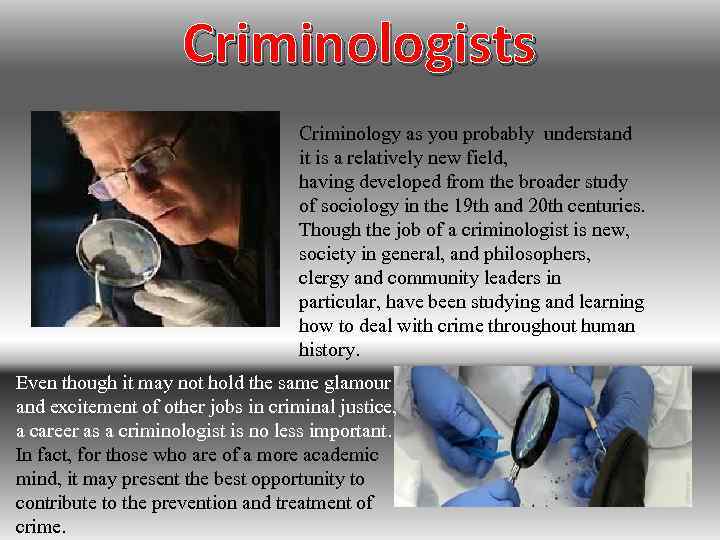 Criminologists Criminology as you probably understand it is a relatively new field, having developed from the broader study of sociology in the 19 th and 20 th centuries. Though the job of a criminologist is new, society in general, and philosophers, clergy and community leaders in particular, have been studying and learning how to deal with crime throughout human history. Even though it may not hold the same glamour and excitement of other jobs in criminal justice, a career as a criminologist is no less important. In fact, for those who are of a more academic mind, it may present the best opportunity to contribute to the prevention and treatment of crime.
 Career Potentials in Criminology has emerged as a highly diversified field, which contains elements of sociology, biology, and psychology. Careers for those who study criminology include police officers, researchers, crime scene and forensic lab technicians, lawyers, judges, security professionals, and psychologists. The field of criminology continues to grow, and you can find career opportunities in almost any area of interest you may have.