


 Скачать презентацию What is Case Management The content and
49db78afcc8a062e180936198b080c0b.ppt
- Количество слайдов: 26
 What is Case Management?
 The content and views presented in this program are those of the independent speaker, while CMSNE endorses the pursuit of educational opportunities participants should exercise their own professional and independent judgment when interpreting the content of the program. Presenters are not paid representatives of CMSA or CMSNE Copyright, 2013. Case Management Society of New England. All rights reserved. No portion of this material may be used in any form without the advance written permission of CMSNE, the speaker and the sponsor.
 Definition of Case Management Case management is a collaborative process of assessment, planning, facilitation, care coordination, evaluation, and advocacy for options and services to meet an individual’s and family’s comprehensive health needs through communication and available resources to promote quality cost effective outcomes. (CMSA 2010)
 Philosophy of Case Management The underlying premise of case management is based in the fact that when an individual reaches the optimum level of wellness and functional capability, everyone benefits: the individuals being served, their support systems, the health care delivery systems and the various reimbursement sources. • Case management serves as a means for achieving client wellness and autonomy through advocacy, communication, education, identification of service resources and service facilitation. The case manager helps identify appropriate providers and facilities throughout the continuum of services, while ensuring that available resources are being used in a timely and cost-effective manner in order to obtain optimum value for both the client and the reimbursement source. Case management services are best offered in a climate that allows direct communication between the case manager, the client, and appropriate service personnel, in order to optimize the outcome for all concerned. • Certification determines that the case manager possesses the education, skills and experience required to render appropriate services based on sound principles of practice. (CMSA 2010) •
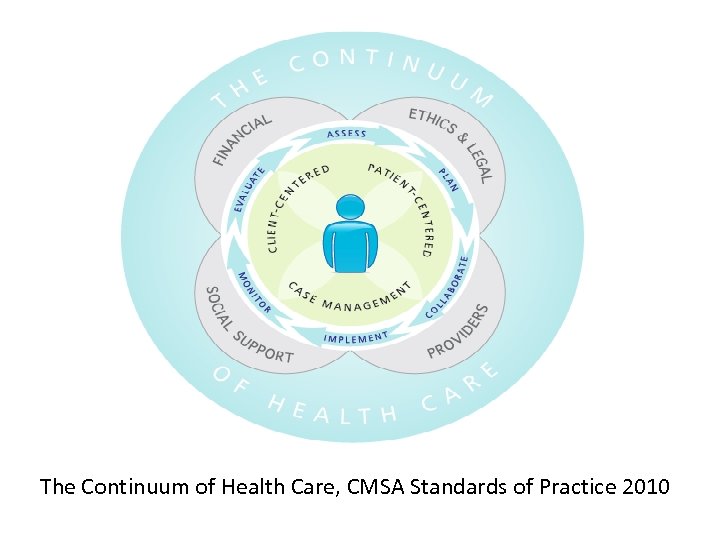 The Continuum of Health Care, CMSA Standards of Practice 2010
 Case Management Organizations • CMSA-Case Management Society of America (www. cmsa. org) -National Association for Case Managers -Founded in 1990 -75 Local Chapters throughout US -Over 11, 000 members -Develop CMSA Standards of Practice -Networking and Support for CM field
 Case Management Organizations • CMSNE—Case Management Society of New England (www. cmsne. org) – 25 years old – Largest Chapter of CMSA – Multidisciplinary, interdisciplinary network of healthcare professionals – Promotion of optimal case management practice – Provides education to membership – All NE States except CT
 Qualities of a Case Manager? Nursing, Social Workers, Therapists, Rehab Counselors Organized, critical thinker Strong Clinical Background in various settings Strong communication/interpersonal Skills Excellent Assessment Skills Ability to Teach Negotiation Skills Understanding of discharge planning, utilization management, performance improvement • Understanding of health care systems and ability to navigate complexities and transitions • Mutual respect for care delivery team • •
 How do you get into CM Field • • Detail-Oriented Team Player Self-directed, independent worker Flexibility and adaptability Resourceful Goal Oriented Respect and trust of peers Willingness to Learn
 What do Case Managers do?
 Training and Orientation Best method is preceptor/mentor Shadowing CM staff CMSA and CMSNE websites Textbooks and Journals Overview of Insurance Regulations Criteria Sets (Interqual, Milliman) Utilization Review and Utilization Management • Discharge Planning • •
 CM Standards of Practice • Provide practice guidelines for profession of CM • Foundational knowledge and skills of CM • Revised and Updated as needed • Newest Revision 2010 • Get copy: www. cmsa. org/SOP • Legal document used in court proceedings • Standard for Certified Case Manager (CCM) practice
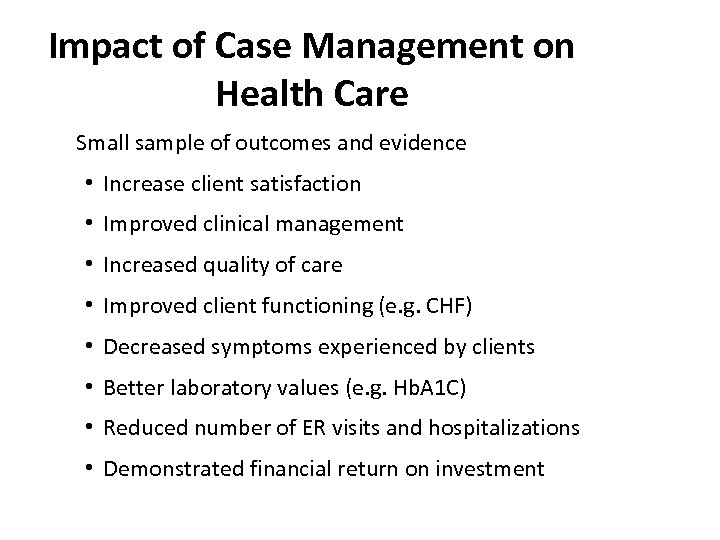 Impact of Case Management on Health Care Small sample of outcomes and evidence • Increase client satisfaction • Improved clinical management • Increased quality of care • Improved client functioning (e. g. CHF) • Decreased symptoms experienced by clients • Better laboratory values (e. g. Hb. A 1 C) • Reduced number of ER visits and hospitalizations • Demonstrated financial return on investment
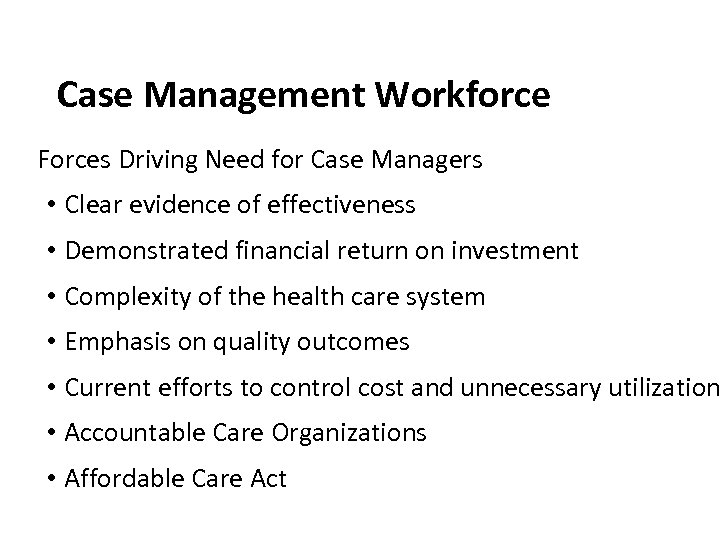 Case Management Workforce Forces Driving Need for Case Managers • Clear evidence of effectiveness • Demonstrated financial return on investment • Complexity of the health care system • Emphasis on quality outcomes • Current efforts to control cost and unnecessary utilization • Accountable Care Organizations • Affordable Care Act
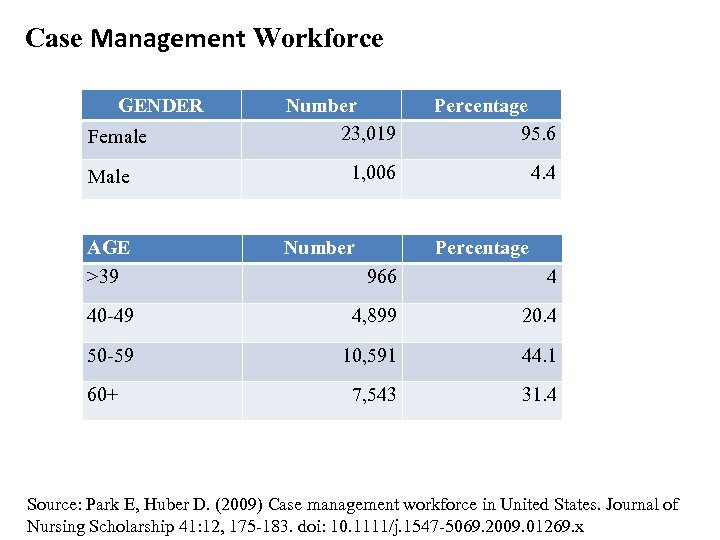 Case Management Workforce GENDER Female Male AGE >39 Number 23, 019 Percentage 95. 6 1, 006 4. 4 Number Percentage 966 4 40 -49 4, 899 20. 4 50 -59 10, 591 44. 1 7, 543 31. 4 60+ Source: Park E, Huber D. (2009) Case management workforce in United States. Journal of Nursing Scholarship 41: 12, 175 -183. doi: 10. 1111/j. 1547 -5069. 2009. 01269. x
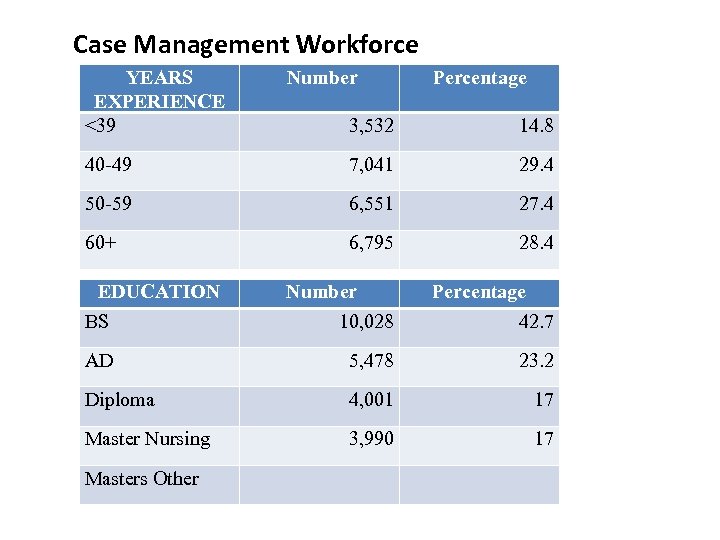 Case Management Workforce YEARS EXPERIENCE <39 Number Percentage 3, 532 14. 8 40 -49 7, 041 29. 4 50 -59 6, 551 27. 4 60+ 6, 795 28. 4 Number 10, 028 Percentage 42. 7 AD 5, 478 23. 2 Diploma 4, 001 17 Master Nursing 3, 990 17 EDUCATION BS Masters Other
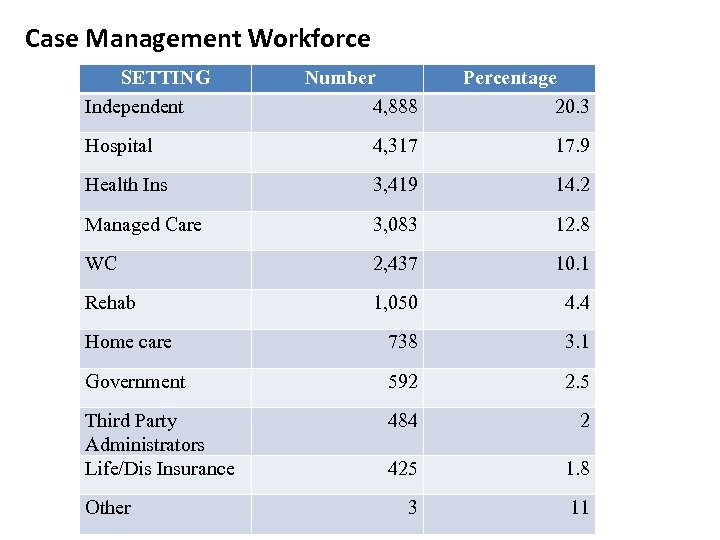 Case Management Workforce SETTING Independent Number 4, 888 Percentage 20. 3 Hospital 4, 317 17. 9 Health Ins 3, 419 14. 2 Managed Care 3, 083 12. 8 WC 2, 437 10. 1 Rehab 1, 050 4. 4 Home care 738 3. 1 Government 592 2. 5 Third Party Administrators Life/Dis Insurance 484 2 425 1. 8 3 11 Other
 What educational backgrounds and work settings do CMs have?
 Tools and Resources CMSA has many tools and resources for Case managers. A sampling are included here • Extensive Resource Library with over 170 Courses that have been presented at CMSA conferences and other CMSA-sponsored events. Free to members and CEUS are available. • Case Management Adherence Guidelines. CMAGs were developed by and for CMs. They contain tools to help case managers assist and coach their patients to change health behaviors for improved adherence and outcomes. Tools to monitor and track motivation and learning. • Career and Knowledge Pathways are education modules for Case Managers. Utilizes contextual learning and allows participants to share and to apply theory to practical day to day situations.
 Journals and Publications • CMSA Today CMSA's Official Magazine A quarterly publication that delivers important news and information direct f rom CMSA • Professional Case Management: The Leader in Evidence- Based Practice CMSA’s Official Journal The official journal of the CMSA. This is a peer-reviewed, contemporary journal that crosses all case management settings.
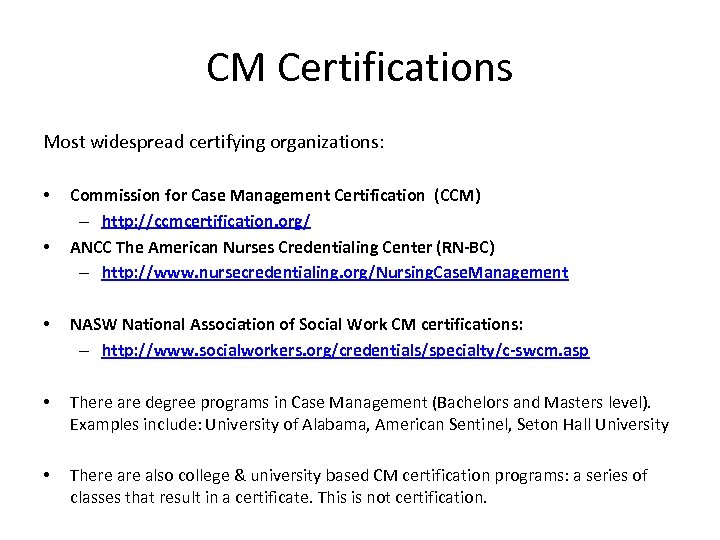 CM Certifications Most widespread certifying organizations: • • Commission for Case Management Certification (CCM) – http: //ccmcertification. org/ ANCC The American Nurses Credentialing Center (RN-BC) – http: //www. nursecredentialing. org/Nursing. Case. Management • NASW National Association of Social Work CM certifications: – http: //www. socialworkers. org/credentials/specialty/c-swcm. asp • There are degree programs in Case Management (Bachelors and Masters level). Examples include: University of Alabama, American Sentinel, Seton Hall University • There also college & university based CM certification programs: a series of classes that result in a certificate. This is not certification.
 What do Case Mangers love about their work?
 Resources and References • A comprehensive literature review of studies on care coordination and other health management programs. (2007) Reden & Anders Ingenix company white paper: Musich S & Paralkar M. • Congressional Budget Office. (2007) Research on the comparative effectiveness of medical treatments. December. Washington, DC: US Government Printing office. • Norris S Nichols et al (2002) The effectiveness of disease and case management for people with diabetes. A systematic review. American Journal Preventative Medicine (4 S): 15 -38. • Park EJ & Huber D. (2009) Case management workforce in the United States. Journal of Nursing Scholarship, 41(2), 175– 183. • Standards of practice for case management. (2010) Little Rock, Arkansas: Case Management Society of America. • Zander K: Nursing Case Management in the 21 st Century: Intervening Where Margin Meets Missions. Nursing Administration Quarterly 2002; 26(5): 58 -67 • Powell, S. K. , & Tahan, H. A. (Eds. ) (2008) CMSA Core Curriculum for Case Management (2 md Ed) Philapdelphia, PA: Lippincott Williams ad Wilkins
 Resources and References continued • Roberts, Albert (2009) Social Workers Desk Reference (2 nd Ed). New York, New York: Oxford University Press Incorporated • Kathol, RG & R. Perez. (2010) The Integrated Case Management Manual New York, JS Cohen Springer Publishing Company • Roberts, Albert, R. (2009) Social Workers Desk Reference (2 nd Ed) New York, New York: Oxford University Press Incorporated • Tahan, HA. Evidence Based Case Management Practice, CMSA Today issue 2 2011 pp 22 -24 • Stutz, L. Case Management as Foundation for an Accountable Care Organization Professional Case management vol 16 No. 3 pp 152 -155 • Treiger, T. M. Ready to Launch: An update on Career and Knowledge Pathways. 2013 Issue 4 pp 1635
 Resources and References continued • www. cmsa. org • www. cmsne. org • http: //nursingworld. org/ancc/certification/certs/specialty. html. • ccmcertification. org/ • http: //www. socialworkers. org/practice/naswstandards/Case. Management Standards 2013. pdf
 Thank You Questions & Discussion