



 What is C O D E X A L I M E N T A R I U S ? C O D E X ALIMENTARIUS International Food Standards
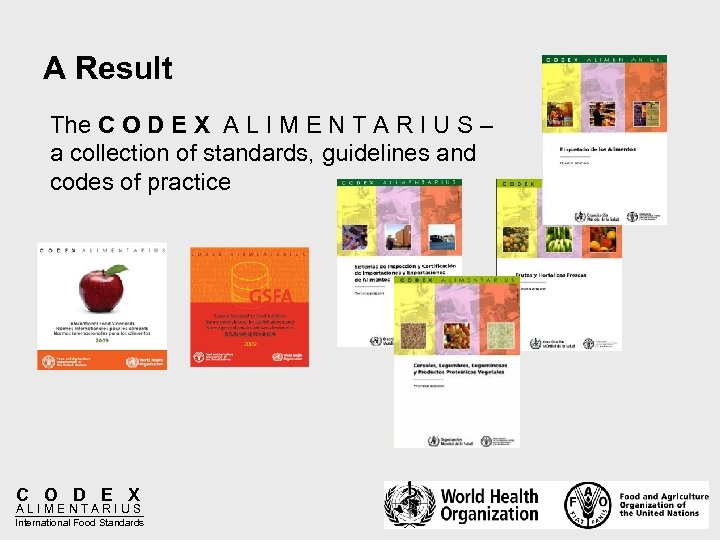 A Result The C O D E X A L I M E N T A R I U S – a collection of standards, guidelines and codes of practice C O D E X ALIMENTARIUS International Food Standards
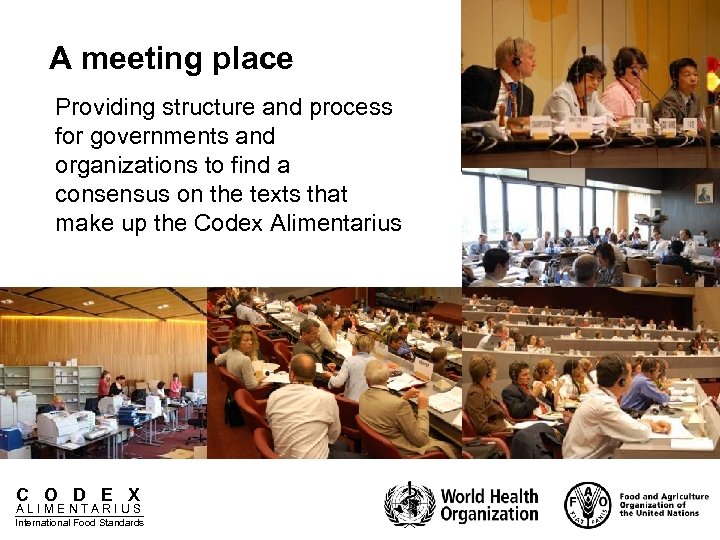 A meeting place Providing structure and process for governments and organizations to find a consensus on the texts that make up the Codex Alimentarius C O D E X ALIMENTARIUS International Food Standards
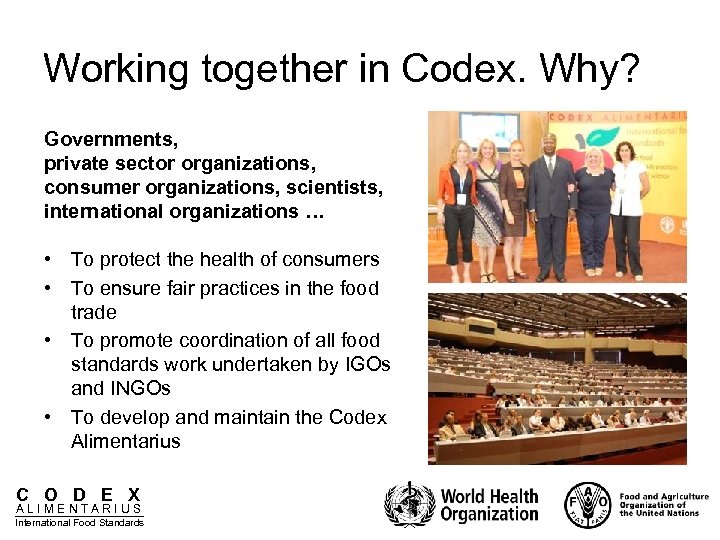 Working together in Codex. Why? Governments, private sector organizations, consumer organizations, scientists, international organizations … • To protect the health of consumers • To ensure fair practices in the food trade • To promote coordination of all food standards work undertaken by IGOs and INGOs • To develop and maintain the Codex Alimentarius C O D E X ALIMENTARIUS International Food Standards
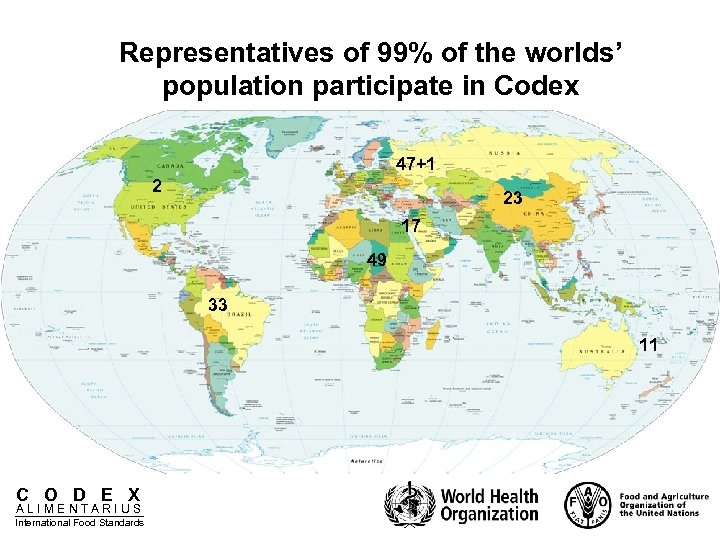 Representatives of 99% of the worlds’ population participate in Codex 47+1 2 23 17 49 33 11 C O D E X ALIMENTARIUS International Food Standards
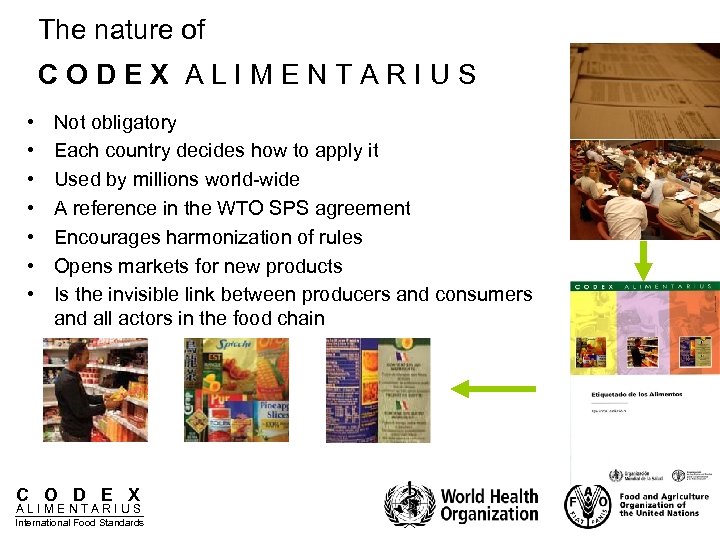 The nature of CODEX ALIMENTARIUS • • Not obligatory Each country decides how to apply it Used by millions world-wide A reference in the WTO SPS agreement Encourages harmonization of rules Opens markets for new products Is the invisible link between producers and consumers and all actors in the food chain C O D E X ALIMENTARIUS International Food Standards
 A reference in the WTO SPS agreement WTO SPS defines International standards, guidelines and recommendations: “for food safety, the standards, guidelines and recommendations established by the Codex Alimentarius Commission relating to food additives, veterinary drug and pesticide residues, contaminants, methods of analysis and sampling, and codes and guidelines of hygienic practice”; (Annex A, 3. a)) C O D E X ALIMENTARIUS International Food Standards
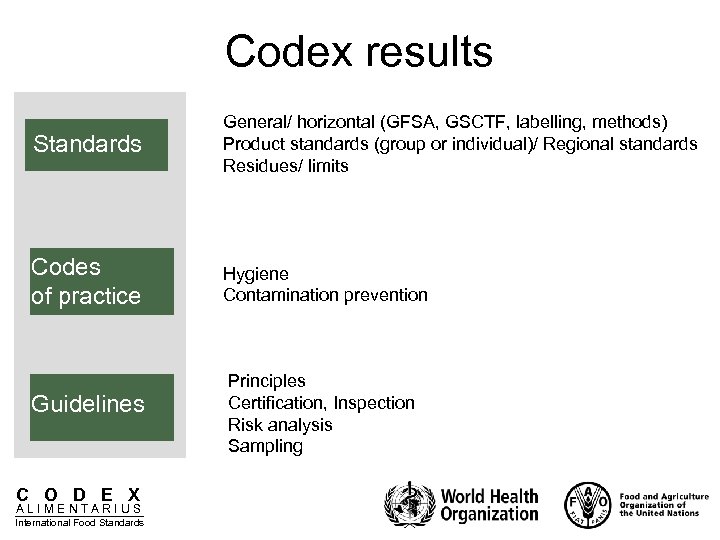 Codex results Standards General/ horizontal (GFSA, GSCTF, labelling, methods) Product standards (group or individual)/ Regional standards Residues/ limits Codes of practice Hygiene Contamination prevention Guidelines C O D E X ALIMENTARIUS International Food Standards Principles Certification, Inspection Risk analysis Sampling
 Stucture, standard setting, C O D E X ALIMENTARIUS International Food Standards
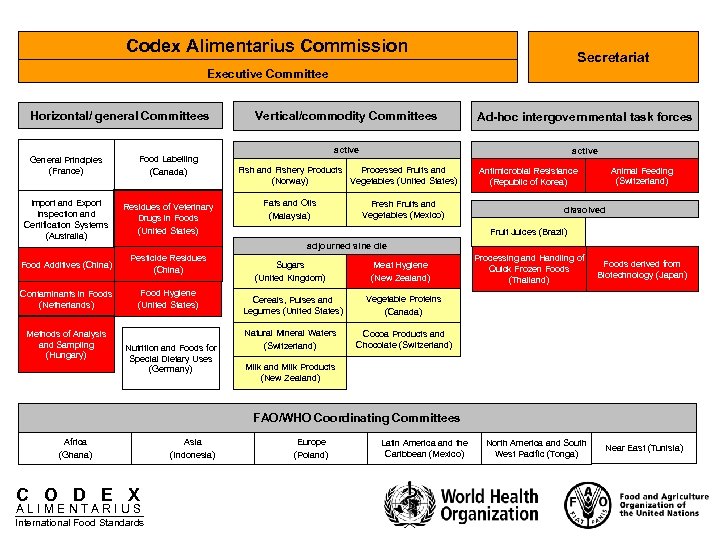 Codex Alimentarius Commission Secretariat Executive Committee Horizontal/ general Committees General Principles (France) Food Labelling (Canada) Import and Export Inspection and Certification Systems (Australia) Residuos de Medicamentos Residues of Veterinary Veterinarios en los Drugs in Foods Alimentos (United States) (Estados Unidos) Pesticide Plaguicidas Aditivos Alimentarios Residuos de. Residues Food Additives (China) Contaminantes de los Contaminants in Foods Alimentos (Países (Netherlands) Bajos) Methods of Analysis and Sampling (Hungary) Higiene de los Food Hygiene Alimentos (United States) (Estados Unidos) Nutrition and Foods for Special Dietary Uses (Germany) Vertical/commodity Committees Ad-hoc intergovernmental task forces active Fish and Fishery Products Processed Fruits and (Norway) Vegetables (United States) Fats and Oils (Malaysia) Fresh Fruits and Vegetables (Mexico) Animal Feeding (Switzerland) Antimicrobial Resistance (Republic of Korea) dissolved Fruit Juices (Brazil) adjourned sine die Sugars (United Kingdom) Cereals, Pulses and Legumes (United States) Natural Mineral Waters (Switzerland) Meat Hygiene (New Zealand) Processing and Handling of Quick Frozen Foods (Thailand) Foods derived from Biotechnology (Japan) Vegetable Proteins (Canada) Cocoa Products and Chocolate (Switzerland) Milk and Milk Products (New Zealand) FAO/WHO Coordinating Committees Africa (Ghana) C O D E X ALIMENTARIUS International Food Standards Asia (Indonesia) Europe (Poland) Latin America and the Caribbean (Mexico) North America and South West Pacific (Tonga) Near East (Tunisia)
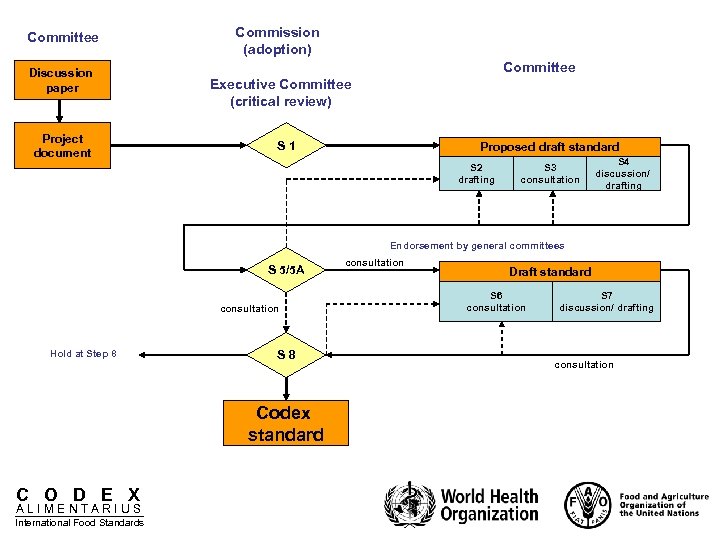 Committee Discussion paper Project document Commission (adoption) Committee Executive Committee (critical review) S 1 Proposed draft standard S 2 drafting S 3 consultation S 4 discussion/ drafting Endorsement by general committees S 5/5 A consultation Hold at Step 8 S 8 Codex standard C O D E X ALIMENTARIUS International Food Standards consultation Draft standard S 6 consultation S 7 discussion/ drafting consultation
 CODEX ALIMENTARIUS COMMISSION AND THE WORLD TRADE ORGANIZATION C O D E X ALIMENTARIUS International Food Standards
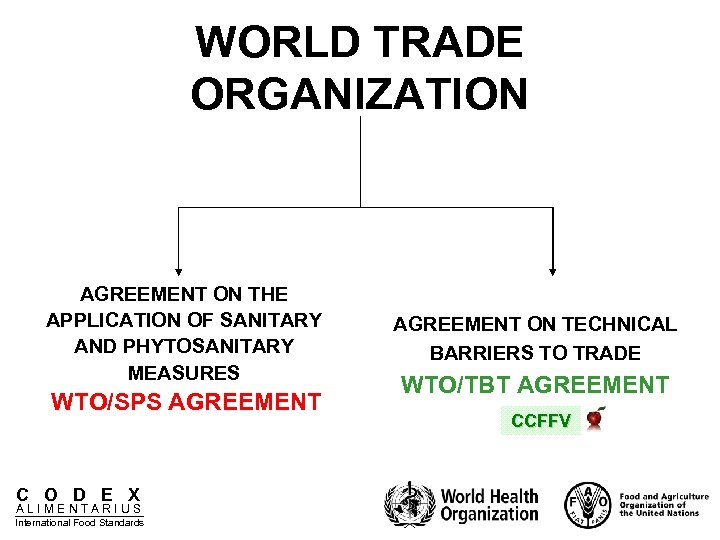 WORLD TRADE ORGANIZATION AGREEMENT ON THE APPLICATION OF SANITARY AND PHYTOSANITARY MEASURES WTO/SPS AGREEMENT C O D E X ALIMENTARIUS International Food Standards AGREEMENT ON TECHNICAL BARRIERS TO TRADE WTO/TBT AGREEMENT CCFFV
 WTO Agreement and Codex • Agreement on the Application of Sanitary and Phytosanitary Measures (The SPS Agreement) - The SPS Agreement calls on countries to harmonize their national standards with “international standards, guidelines or recommendations ”(Article 3. 1). - Codex Standards are defined as “international standards, guidelines or recommendations” for food safety (Annex A). • Agreement on Technical Barriers to Trade (The TBT Agreement) - The TBT Agreement calls on countries to use relevant international standards when they exist (Article 2. 4). C O D E X ALIMENTARIUS International Food Standards
 WTO/SPS AGREEMENT & CODEX 3 Sisters: International Organizations recognized by the SPS Agreement as reference point for: • Animal health: World Organization for Animal Health (OIE) • Plant health: International Plant Protection Convention (IPPC) – FAO • Human health: Codex Alimentarius Commission (Codex Alimentarius) – Joint FAO/WHO Food Standards C O D E X ALIMENTARIUS Programme International Food Standards
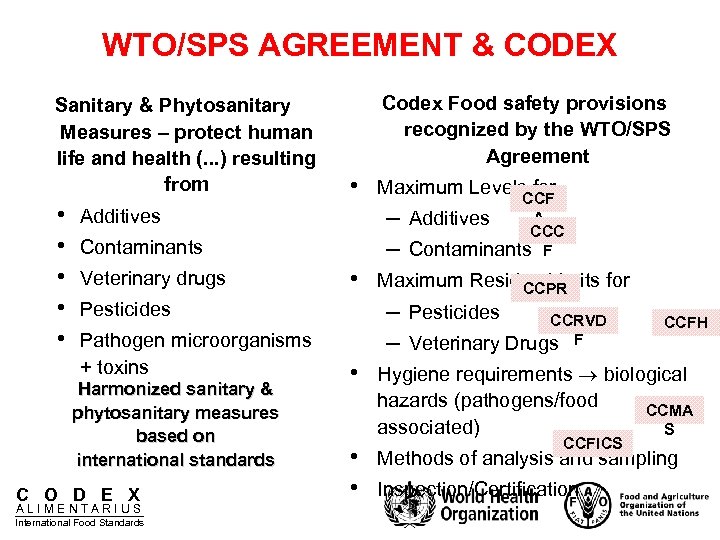 WTO/SPS AGREEMENT & CODEX Sanitary & Phytosanitary Measures – protect human life and health (. . . ) resulting from • • • Additives Contaminants Veterinary drugs Pesticides Pathogen microorganisms + toxins Harmonized sanitary & phytosanitary measures based on international standards C O D E X ALIMENTARIUS International Food Standards Codex Food safety provisions recognized by the WTO/SPS Agreement • Maximum Levels for CCF A – Additives CCC – Contaminants F • Maximum Residue Limits for CCPR – Pesticides CCRVD CCFH – Veterinary Drugs F • Hygiene requirements biological hazards (pathogens/food associated) CCFICS CCMA S • Methods of analysis and sampling • Inspection/Certification
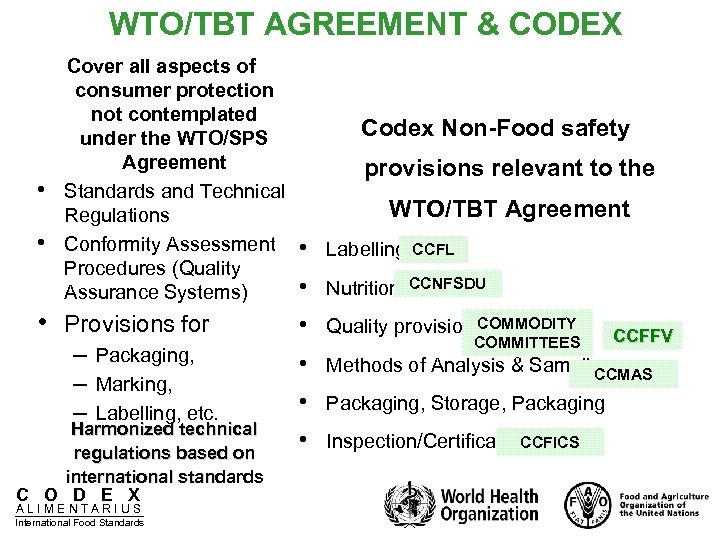 WTO/TBT AGREEMENT & CODEX • • Cover all aspects of consumer protection not contemplated under the WTO/SPS Agreement Standards and Technical Regulations Conformity Assessment Procedures (Quality Assurance Systems) • Provisions for – Packaging, – Marking, – Labelling, etc. Harmonized technical regulations based on international standards C O D E X ALIMENTARIUS International Food Standards Codex Non-Food safety provisions relevant to the WTO/TBT Agreement • Labelling CCFL • Nutrition CCNFSDU COMMODITY • Quality provisions COMMITTEES CCFFV • Methods of Analysis & Sampling CCMAS • Packaging, Storage, Packaging CCFICS • Inspection/Certification
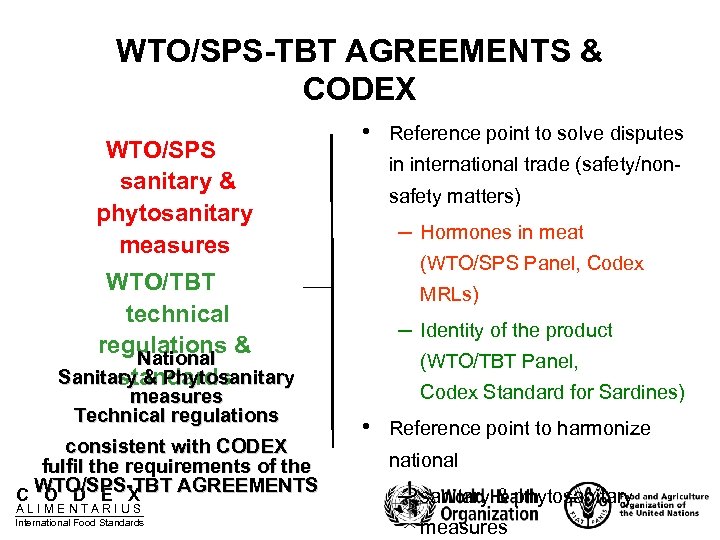 WTO/SPS-TBT AGREEMENTS & CODEX WTO/SPS sanitary & phytosanitary measures WTO/TBT technical regulations & National Sanitary & Phytosanitary standards measures Technical regulations consistent with CODEX fulfil the requirements of the WTO/SPS-TBT AGREEMENTS C O D E X ALIMENTARIUS International Food Standards • Reference point to solve disputes in international trade (safety/nonsafety matters) – Hormones in meat (WTO/SPS Panel, Codex MRLs) – Identity of the product (WTO/TBT Panel, Codex Standard for Sardines) • Reference point to harmonize national – sanitary & phytosanitary measures
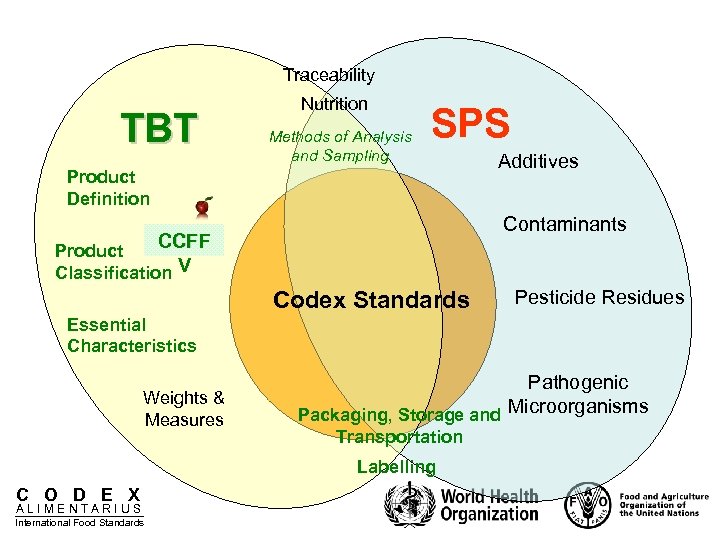 Traceability TBT Nutrition Methods of Analysis and Sampling SPS Product Definition Additives Contaminants CCFF Product Classification V Codex Standards Pesticide Residues Essential Characteristics Weights & Measures Pathogenic Packaging, Storage and Microorganisms Transportation Labelling C O D E X ALIMENTARIUS International Food Standards
 Codex Committee on Fresh Fruits and Vegetables C O D E X ALIMENTARIUS International Food Standards
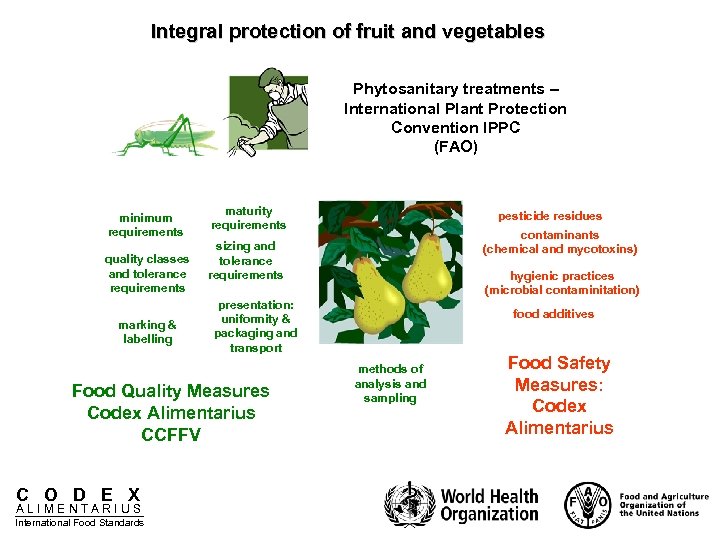 Integral protection of fruit and vegetables Phytosanitary treatments – International Plant Protection Convention IPPC (FAO) minimum requirements quality classes and tolerance requirements marking & labelling maturity requirements C O D E X International Food Standards contaminants (chemical and mycotoxins) sizing and tolerance requirements hygienic practices (microbial contaminitation) presentation: uniformity & packaging and transport Food Quality Measures Codex Alimentarius CCFFV ALIMENTARIUS pesticide residues food additives methods of analysis and sampling Food Safety Measures: Codex Alimentarius
 CODEX COMMITTEE ON FRESH FRUITS AND VEGETABLES - standards • Develop worldwide Mandate and related texts for fresh fruits and vegetables • Cooperate with the UNECE Working on Agricultural Quality Standards Specialized Section on Standardization of Fresh Fruits & Vegetables: Vegetables − avoid duplication of work − harmonize presentation of agricultural quality standards • Cooperate with other international organizations C O D E X ALIMENTARIUS International Food Standards active in the area of FFV OECD Scheme for the Application of International Standards for Fruit & Vegetables
 CODEX COMMITTEE ON FRESH FRUITS AND VEGETABLES (CCFFV) • Host Government: Mexico - Overview • Establishment: – 17 th Session of the CAC (1987) Codex Committee on Tropical Fruits and Vegetables – 21 st Session of the CAC (1995) Codex Committee on Fresh Fruits and Vegetables • Meeting Interval: 18 months • Number of meetings: 15 – 1 st Session June 1988 – 15 th Session October 2008 – 16 th Session May 2010 C O D E X ALIMENTARIUS International Food Standards
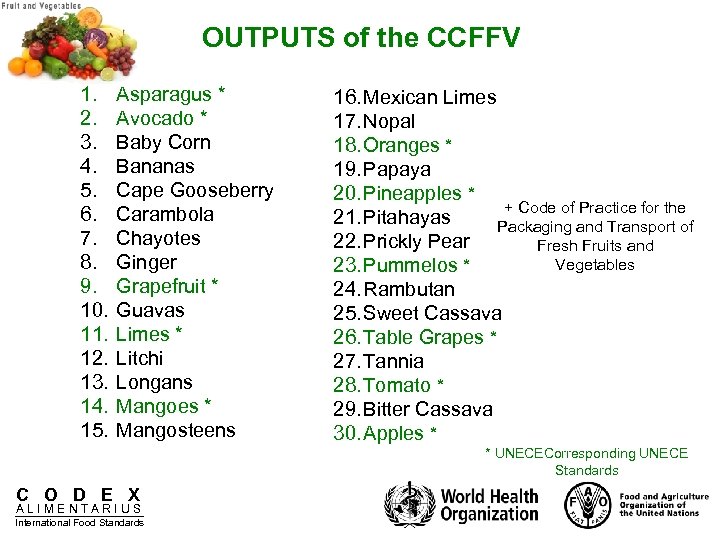 OUTPUTS of the CCFFV 1. 2. 3. 4. 5. 6. 7. 8. 9. 10. 11. 12. 13. 14. 15. Asparagus * Avocado * Baby Corn Bananas Cape Gooseberry Carambola Chayotes Ginger Grapefruit * Guavas Limes * Litchi Longans Mangoes * Mangosteens 16. Mexican Limes 17. Nopal 18. Oranges * 19. Papaya 20. Pineapples * + Code of Practice for the 21. Pitahayas Packaging and Transport of 22. Prickly Pear Fresh Fruits and Vegetables 23. Pummelos * 24. Rambutan 25. Sweet Cassava 26. Table Grapes * 27. Tannia 28. Tomato * 29. Bitter Cassava 30. Apples * * UNECECorresponding UNECE Standards C O D E X ALIMENTARIUS International Food Standards
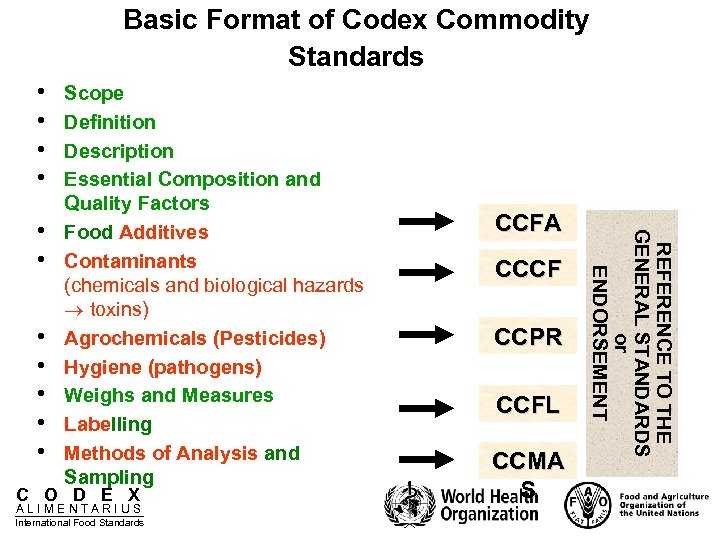 Basic Format of Codex Commodity Standards • • • C O D E X ALIMENTARIUS International Food Standards CCFA CCCF CCPR CCFL CCMA S REFERENCE TO THE GENERAL STANDARDS or ENDORSEMENT • • Scope Definition Description Essential Composition and Quality Factors Food Additives Contaminants (chemicals and biological hazards toxins) Agrochemicals (Pesticides) Hygiene (pathogens) Weighs and Measures Labelling Methods of Analysis and Sampling
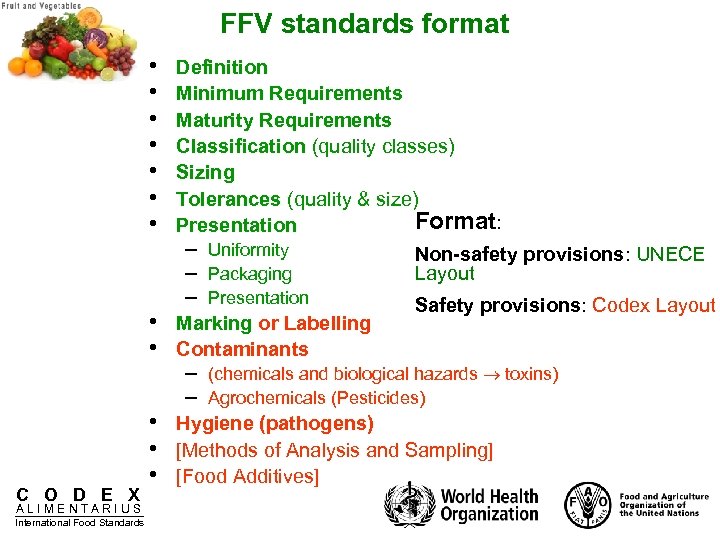 FFV standards format • • Definition Minimum Requirements Maturity Requirements Classification (quality classes) Sizing Tolerances (quality & size) Format: Presentation – Uniformity Non-safety provisions: UNECE – Packaging Layout – Presentation • Marking or Labelling • Contaminants Safety provisions: Codex Layout – (chemicals and biological hazards toxins) – Agrochemicals (Pesticides) C O D E X ALIMENTARIUS International Food Standards • Hygiene (pathogens) • [Methods of Analysis and Sampling] • [Food Additives]
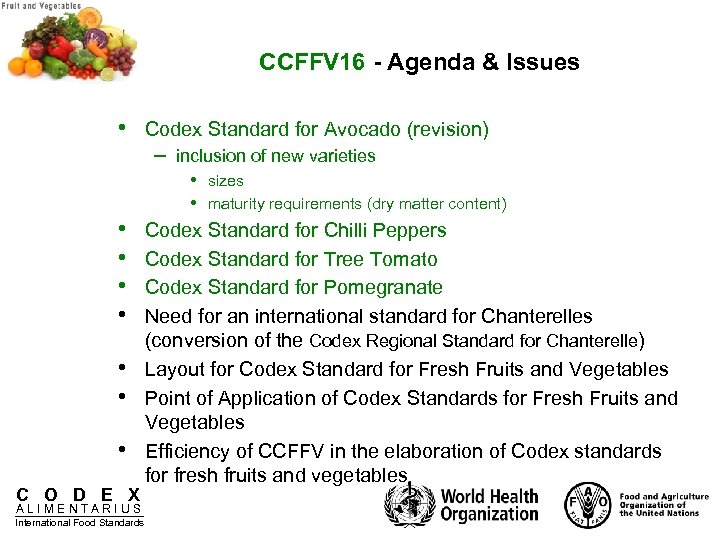 CCFFV 16 - Agenda & Issues • Codex Standard for Avocado (revision) – inclusion of new varieties • • C O D E X ALIMENTARIUS International Food Standards • sizes • maturity requirements (dry matter content) Codex Standard for Chilli Peppers Codex Standard for Tree Tomato Codex Standard for Pomegranate Need for an international standard for Chanterelles (conversion of the Codex Regional Standard for Chanterelle) Layout for Codex Standard for Fresh Fruits and Vegetables Point of Application of Codex Standards for Fresh Fruits and Vegetables Efficiency of CCFFV in the elaboration of Codex standards for fresh fruits and vegetables
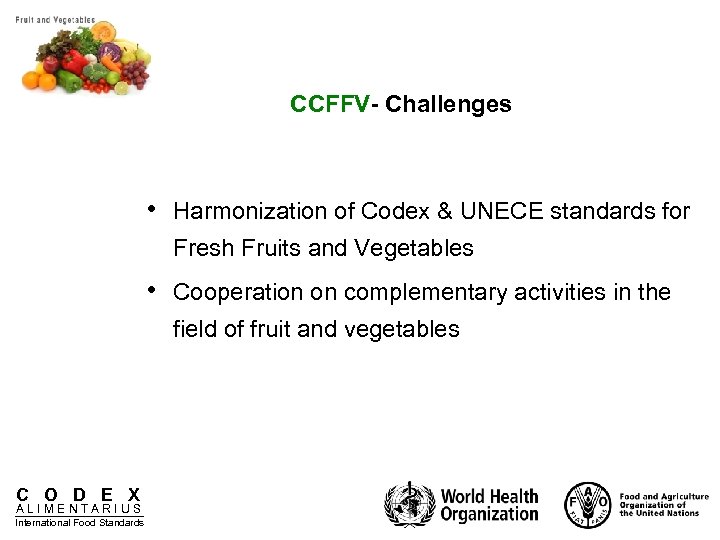 CCFFV- Challenges • Harmonization of Codex & UNECE standards for Fresh Fruits and Vegetables • Cooperation on complementary activities in the field of fruit and vegetables C O D E X ALIMENTARIUS International Food Standards
 CODEX COMMITTEE ON PROCESSED FRUITS AND VEGETABLES - Overview - • Mandate: Elaborate worldwide standards and related texts for all types of processed fruits and vegetables dry/dried fruits & vegetables • Host Government: The United States of America • Meeting Interval: 24 months • Number of meetings: 25 – 1 st Session May 1964 – 25 th Session October 2010 – 26 th Session October 2012 C O D E X ALIMENTARIUS International Food Standards
 CODEX COMMITTEE ON PROCESSED FRUITS AND VEGETABLES - Outputs – Dry/Dried Produce • • International Food Standards Unshelled Pistachio Nuts (CODEX STAN 131 -1981) • C O D E X Dried Apricot (CODEX STAN 130 -1981) • ALIMENTARIUS Raisins (CODEX STAN 67 -1981) Dates (CODEX STAN 143 -1985)
 CODEX COMMITTEE ON FOOD LABELLING Guidelines for the Production, Processing, Labelling and Marketing of Organically Produced Foods including food from plant origin C O D E X ALIMENTARIUS International Food Standards
 C O D E X ALIMENTARIUS International Food Standards Thank you!