 Скачать презентацию What is an Internet Remote Base Operate
32a75839034774a74d8f34c9ddf4f676.ppt
- Количество слайдов: 14



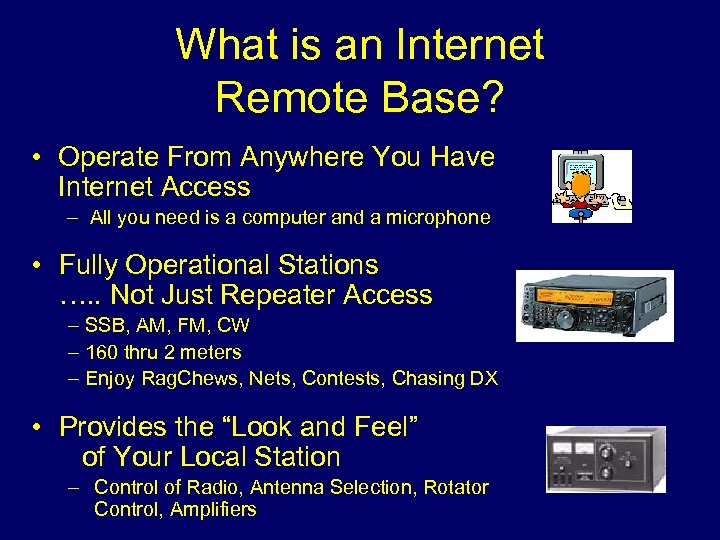
What is an Internet Remote Base? • Operate From Anywhere You Have Internet Access – All you need is a computer and a microphone • Fully Operational Stations …. . Not Just Repeater Access – SSB, AM, FM, CW – 160 thru 2 meters – Enjoy Rag. Chews, Nets, Contests, Chasing DX • Provides the “Look and Feel” of Your Local Station – Control of Radio, Antenna Selection, Rotator Control, Amplifiers
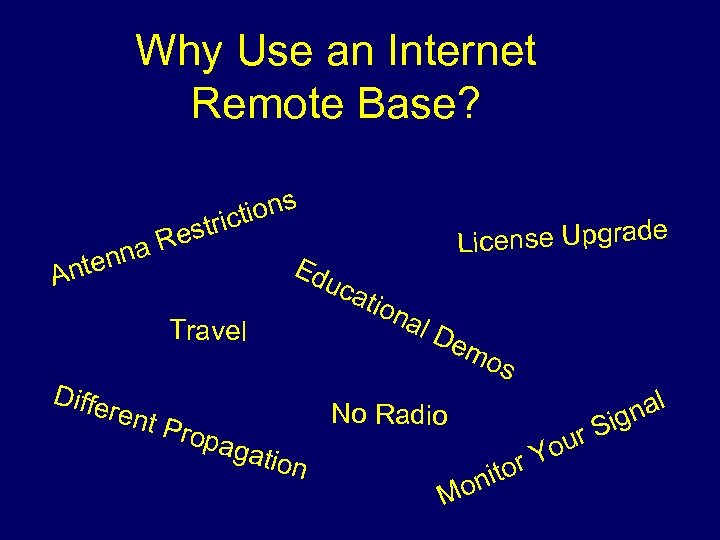
Why Use an Internet Remote Base? ions trict s a Re n nten A Ed uca Travel Diffe rent P ropa icense Upgrade L tion al D em os nal ig No Radio gatio n M itor on ur S Yo
How Are Hams Using the Internet Remote Bases? • Overcoming a Restricted Location – Condo, Apartment, Hotel, Hospital • Overcoming Equipment Problems – Continue Net Ops After Storm Damages Antenna – Continue Scheduled Ops During House Move • Optimizing Propagation – Continue Skeds After Moving Across Country – Work Europeans on 75 meters from the West Coast – Foreign Hams Enjoying North America QSOs Anytime
How Are Hams Using the Internet Remote Bases? • Getting Experience to Upgrade License – No-Code Tech Listening to HF Bands and Getting Code Proficiency • Special Operations – Blind Operators Operating HF Without Special Equipment • Monitoring Station Performance – On Air Testing of New Antennas – Audio Checks
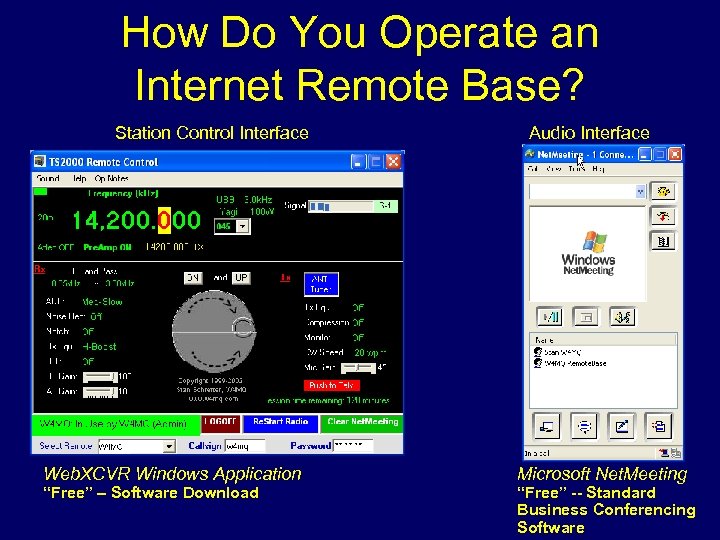
How Do You Operate an Internet Remote Base? Station Control Interface Web. XCVR Windows Application “Free” – Software Download Audio Interface Microsoft Net. Meeting “Free” -- Standard Business Conferencing Software
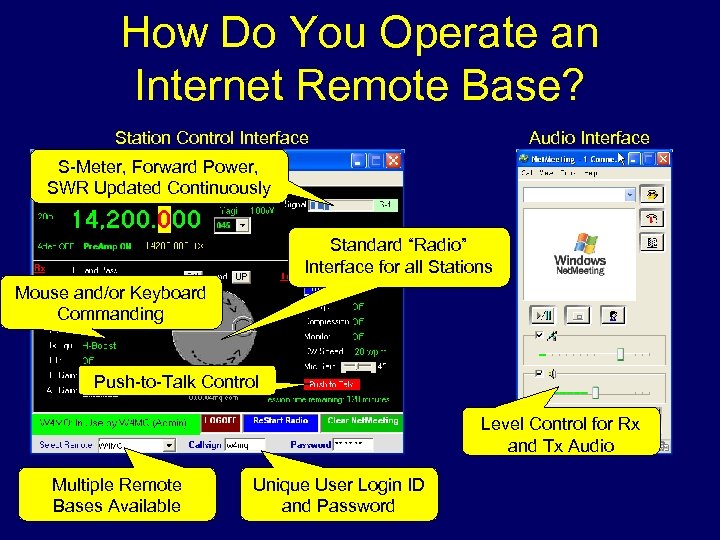
How Do You Operate an Internet Remote Base? Station Control Interface Audio Interface S-Meter, Forward Power, SWR Updated Continuously Standard “Radio” Interface for all Stations Mouse and/or Keyboard Commanding Push-to-Talk Control Level Control for Rx and Tx Audio Multiple Remote Bases Available Unique User Login ID and Password
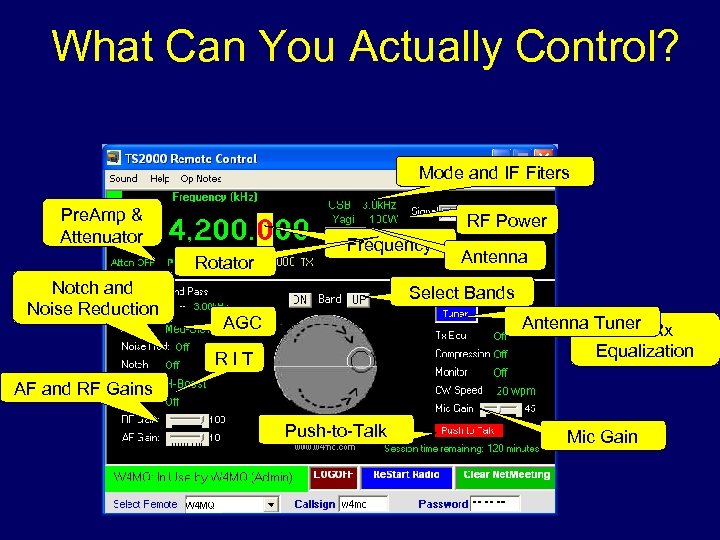
What Can You Actually Control? Mode and IF Fiters Pre. Amp & Attenuator RF Power Rotator Notch and Noise Reduction Frequency Antenna Select Bands AGC Antenna Tuner/ Rx Tx Equalization RIT AF and RF Gains Push-to-Talk Mic Gain
Who Can Use an Internet Remote Base? • Based on FCC Regulations • Any Licensed U. S. Ham • Limited to the Privileges of Their Own License • Any Foreign Amateur From a Country Having a Reciprocal Operating Agreement With the US • Limited to the Privileges of their Own License and the Reciprocal Agreement • The Station Owner May Impose Other Restrictions • Limit Users Based On Station Objectives, e. g. Club • Station Unique Operational Guidelines
Who Is the Control Operator? • Each User Is Assigned A Unique Login And Password • The Remote User Is The “Control Operator” • Has Full Control Over Transmissions – Freq, Mode, Power, Duration • The Internet Acts As a “Long Microphone Cord” Between The Control Operator and The Station • The Remote Users Sign Their Own Callsigns • They Must Indicate That The Transmissions Are Actually Via The Internet Remote Base Stations • They Must Abide By The Callsign Requirements in the Reciprocal Agreements
Currently Operational Internet Remote Base Stations • W 7 DXX – North Easton MA – http: //www. lamonica. com – TS 2000, AL-1200 (80 meters), Dipole, Vertical, 2 meter Beam – Supports operation 80 through 2 meters • W 4 MQ – Reston VA – http: //www. w 4 mq. com – TS 2000, AL-811(40 meters), Dipole, Mini-Beam – Supports operations 160 through 10 meters • KA 3 ODJ – Bangor PA – http: //ka 3 odj. servemp 3. net – Pegasus, Vertical – Supports operations 80 through 10 meters
Where Do We Go From Here? • IRBs Could Make Club and Contest Stations Always Available to their Members • IRBs Facilitate Demonstration and Operation of Amateur Radio at ANY School – Expand the ARISS Program by Providing Access to Space Station Astronauts For Longer than the 8 -10 Minutes Visibility Window – Talk Around the World Directly From the School • IRBs Facilitate Demonstration of Amateur Radio at Public Events – Museum Exhibits – Shopping Malls, etc. . – Special Events, Conventions, etc. .
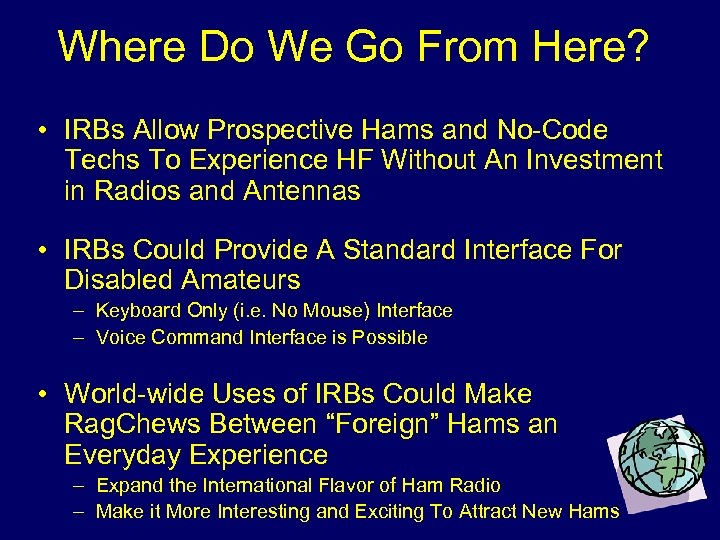
Where Do We Go From Here? • IRBs Allow Prospective Hams and No-Code Techs To Experience HF Without An Investment in Radios and Antennas • IRBs Could Provide A Standard Interface For Disabled Amateurs – Keyboard Only (i. e. No Mouse) Interface – Voice Command Interface is Possible • World-wide Uses of IRBs Could Make Rag. Chews Between “Foreign” Hams an Everyday Experience – Expand the International Flavor of Ham Radio – Make it More Interesting and Exciting To Attract New Hams

The End
Скачать презентацию What is an Internet Remote Base Operate
32a75839034774a74d8f34c9ddf4f676.ppt