



 What is an ecosystem, and how can we study one? Is the earth an open or closed system with respect to energy and elements? How do we define "biogeochemical cycles, " and how are they important to ecosystems? What are the major controls on ecosystem function? What are the major factors responsible for the differences between ecosystems?
 An ecosystem consists of the biological community that occurs in some locale, and the physical and chemical factors that make up its non-living or abiotic environment. There are many examples of ecosystems -- a pond, a forest, an estuary, a grassland.
 Energy transformations and biogeochemical cycling are the main processes that comprise the field of ecosystem ecology.
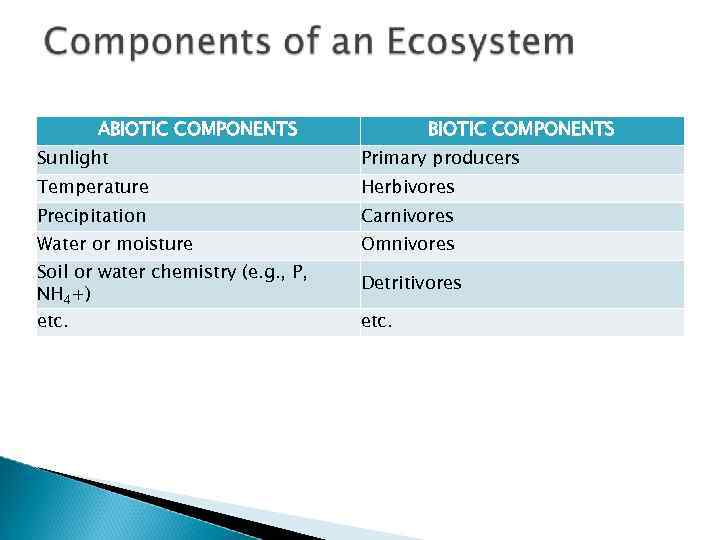 ABIOTIC COMPONENTS Sunlight Primary producers Temperature Herbivores Precipitation Carnivores Water or moisture Omnivores Soil or water chemistry (e. g. , P, NH 4+) etc. Detritivores etc.
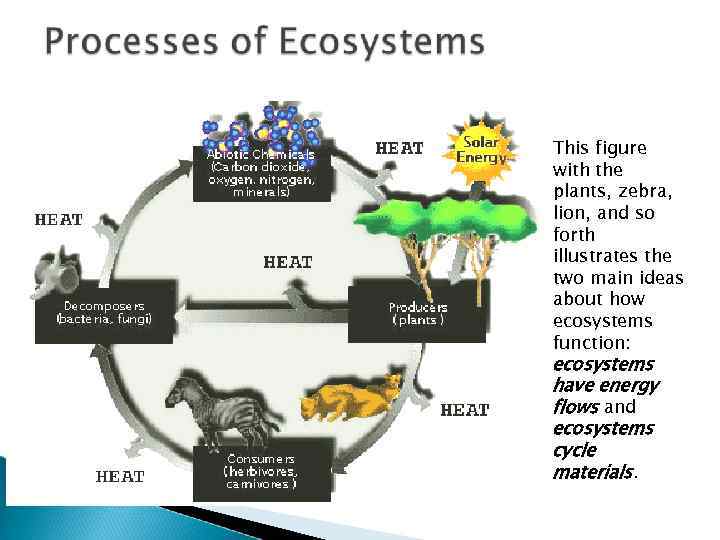 This figure with the plants, zebra, lion, and so forth illustrates the two main ideas about how ecosystems function: ecosystems have energy flows and ecosystems cycle materials.
 Elements such as carbon, nitrogen, or phosphorus enter living organisms in a variety of ways. Plants obtain elements from the surrounding atmosphere, water, or soils. Animals may also obtain elements directly from the physical environment, but usually they obtain these mainly as a consequence of consuming other organisms. These materials are transformed biochemically within the bodies of organisms, but sooner or later, due to excretion or decomposition, they are returned to an inorganic state. Often bacteria complete this process, through the process called decomposition or mineralization
 During decomposition these materials are not destroyed or lost, so the earth is a closed system with respect to elements (with the exception of a meteorite entering the system now and then). The elements are cycled endlessly between their biotic and abiotic states within ecosystems. Those elements whose supply tends to limit biological activity are called nutrients.
 The transformations of energy in an ecosystem begin first with the input of energy from the sun. Energy from the sun is captured by the process of photosynthesis. Carbon dioxide is combined with hydrogen (derived from the splitting of water molecules) to produce carbohydrates (CHO). Energy is stored in the high energy bonds of adenosine triphosphate, or ATP (see lecture on photosynthesis).
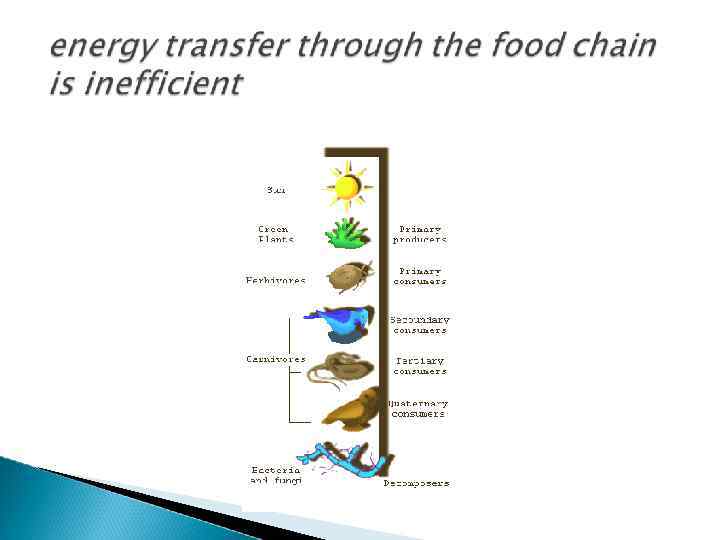
 The prophet Isaah said "all flesh is grass", earning him the title of first ecologist, because virtually all energy available to organisms originates in plants. Because it is the first step in the production of energy for living things, it is called primary production. Herbivores obtain their energy by consuming plants or plant products, carnivores eat herbivores, and detritivores consume the droppings and carcasses of us all.
 The term Biogeochemistry is defined as the study of how living systems influence, and are controlled by, the geology and chemistry of the earth. Thus biogeochemistry encompasses many aspects of the abiotic and biotic world that we live in.
 The principles and tools that we use can be broken down into 3 major components: element ratios, mass balance, element cycling.
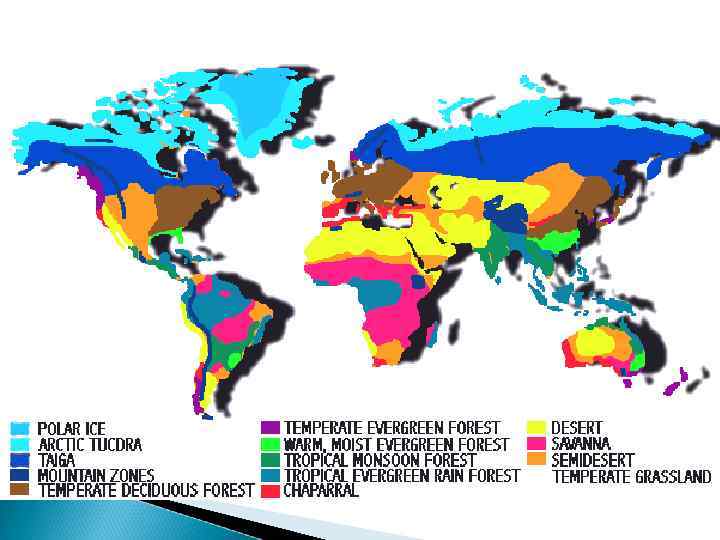
 There are many different ecosystems: rain forests and tundra, coral reefs and ponds, grasslands and deserts. The word "biome" is used to describe a major vegetation type such as tropical rain forest, grassland, tundra, etc. , extending over a large geographic area (Figure). It is never used for aquatic systems, such as ponds or coral reefs.
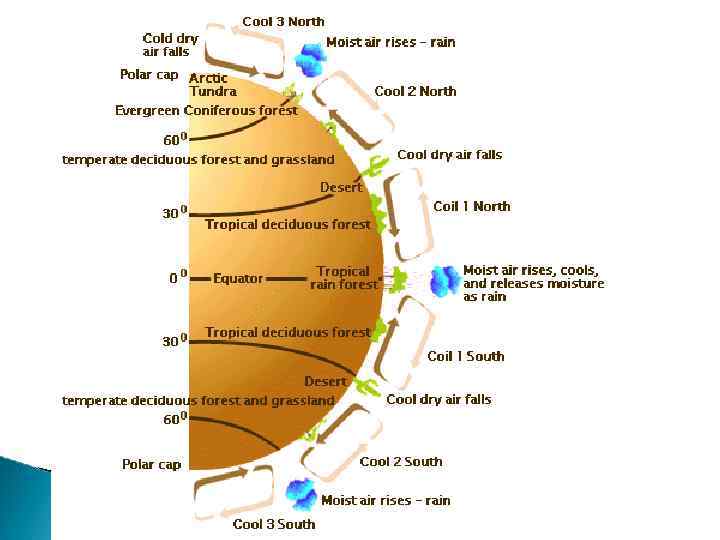
 A schematic view of the earth shows that, complicated though climate may be, many aspects are predictable (Figure). High solar energy striking near the equator ensures nearly constant high temperatures and high rates of evaporation and plant transpiration.
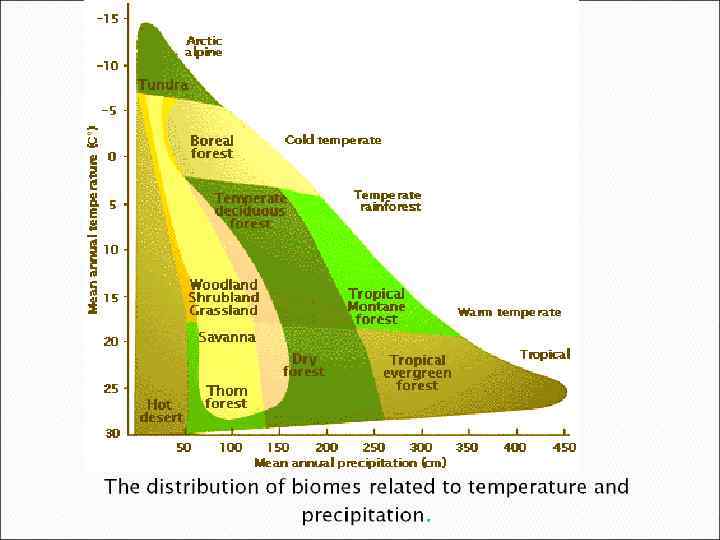
 Ecosystems are made up of abiotic (non-living, environmental) and biotic components, and these basic components are important to nearly all types of ecosystems. Ecosystem Ecology looks at energy transformations and biogeochemical cycling within ecosystems. Energy is continually input into an ecosystem in the form of light energy, and some energy is lost with each transfer to a higher trophic level. Nutrients, on the other hand, are recycled within an ecosystem, and their supply normally limits biological activity. So, "energy flows, elements cycle". Energy is moved through an ecosystem via a food web, which is made up of interlocking food chains. Energy is first captured by photosynthesis (primary production). The amount of primary production determines the amount of energy available to higher trophic levels. The study of how chemical elements cycle through an ecosystem is termed biogeochemistry. A biogeochemical cycle can be expressed as a set of stores (pools) and transfers, and can be studied using the concepts of "stoichiometry", "mass balance", and "residence time". Ecosystem function is controlled mainly by two processes, "top-down" and "bottom-up" controls. A biome is a major vegetation type extending over a large area. Biome distributions are determined largely by temperature and precipitation patterns on the Earth's surface.
 The terms "ecological system" and "biogeocoenosis" are not synonymous. Ecosystem - is any set of organisms and their environment, including, for example, a flower pot, an anthill, an aquarium, a swamp, a manned spacecraft. In these systems there is no sign of a number of definitions V. N. Sukachev, first and foremost element of "geo" - the Earth. Biocenosis - it's only natural formations. However biocenosis in full can be viewed as an ecosystem. Thus, the term "ecosystem" is broader and fully embraces the concept of "biogeocoenosis" or "biogeocoenosis" - a special case of "ecosystem
 Existing diverse ecosystems on Earth. Allocate microecosystem (eg rotting trunk of a tree), mezoekosistemy (forest, pond, etc. ) makroekosistemy (continent, ocean, etc. ) and global - biosphere. Large terrestrial ecosystems are called biomes. The largest natural ecosystem on Earth - the biosphere.
 Biomes - the largest terrestrial ecosystems, corresponding to the main areas of the Earth's climate (desert, grass and forest), aquatic ecosystems - key ecosystems that exist in the field of water (hydrosphere).
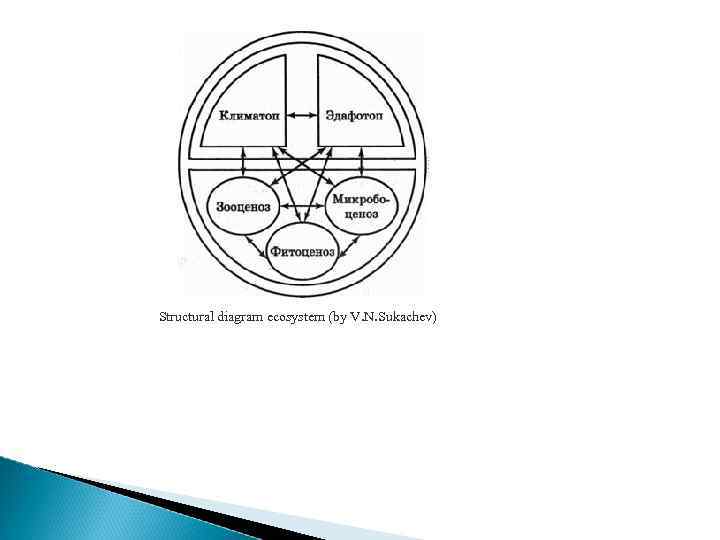 Structural diagram ecosystem (by V. N. Sukachev)
 From a biological point of view, in the ecosystem are the following components: 1. Inorganic substance (C, N, CO 2, H 2 O, etc. ) included in the cycle; 2. Organic compounds (proteins, carbohydrates, lipids, humic substances, etc. ), binding of the biotic and abiotic; 3. Air , water and substrate environment that includes the climate regime and other physical factors; 4. Producers, autotrophic organisms (green plants, blue-green algae, photo-and chemosynthetic bacteria) that produce food from simple inorganic substances; 5. Consuments or fagotrofov (from the Greek. phagos - eater) heterotrophic organisms, mainly animals that feed on other organisms or particles of organic matter; 6. Decomposers and detritus feeders - heterotrophic organisms, mainly bacteria and fungi receive energy or by the decomposition of dead tissue, or by absorption of dissolved organic matter released spontaneously or saprophytes extracted from plants and other organisms.
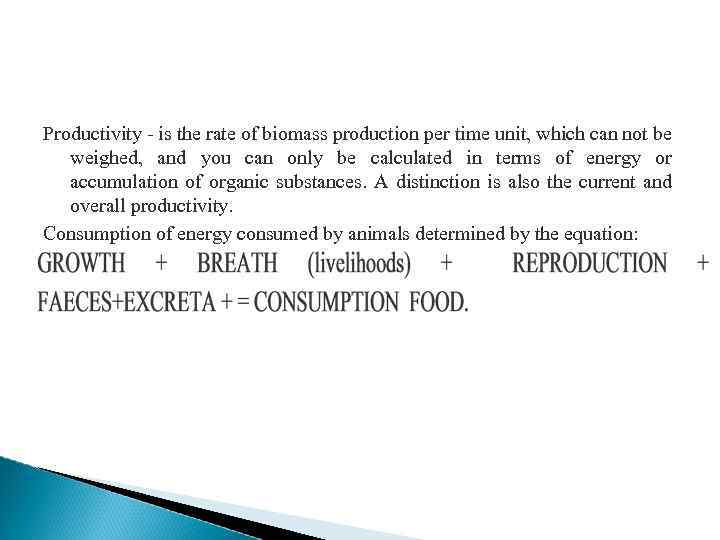 Productivity - is the rate of biomass production per time unit, which can not be weighed, and you can only be calculated in terms of energy or accumulation of organic substances. A distinction is also the current and overall productivity. Consumption of energy consumed by animals determined by the equation:
 gross primary productivity - the total rate of accumulation of organic matter producers (photosynthesis rate), including those that were used for respiration and secretory functions. Plants on the processes of life are spending about 20% of the products of chemical energy; • Net primary productivity - the rate of accumulation of organic matter minus those that were consumed during respiration and secretion over the study period. This energy can be used in the next trophic level organisms. •
 Depending on the circumstances preceding the start of the process of succession is divided into the following: man-made, caused by human activities, including laborogennye related to employment; • catastrophic associated with any catastrophic for the natural ecosystem or human factors; pyrogenic caused by fire, regardless of its cause; • zoogenic (Phytogenic) caused by an unusually strong influence of animals (vegetation), usually as a result of their mass reproduction (importation of alien species by humans).
 The structure of the living part of ecosystem is defined Trophy energy ties and relations, according to which there are three main functional components: • complex autotrophic organisms-producers providing organic matter and, therefore, the energy remaining organisms (phytocoenosis (green plants) as well as photo-and chemosynthetic bacteria); • complex heterotrophic organisms consuments living off the nutrients created by producers (Zoocenosis (animals) as well as nongreen plants); • complex organisms decomposers which decompose organic compounds to mineral status (microbocenosis, as well as fungi and other organisms that feed on dead organic matter).