


 Скачать презентацию What is a Trademark Trademark n n A
4a29072a25533e75d40c8bf1c52dfb24.ppt
- Количество слайдов: 44
 What is a Trademark? Trademark: n n A distinctive sign which identifies the goods and services of one company from those of another A trademark helps consumers to identify and choose between products/services based on their reputation and quality ® Coca-Cola registered since 1887 Nike registered since 1971
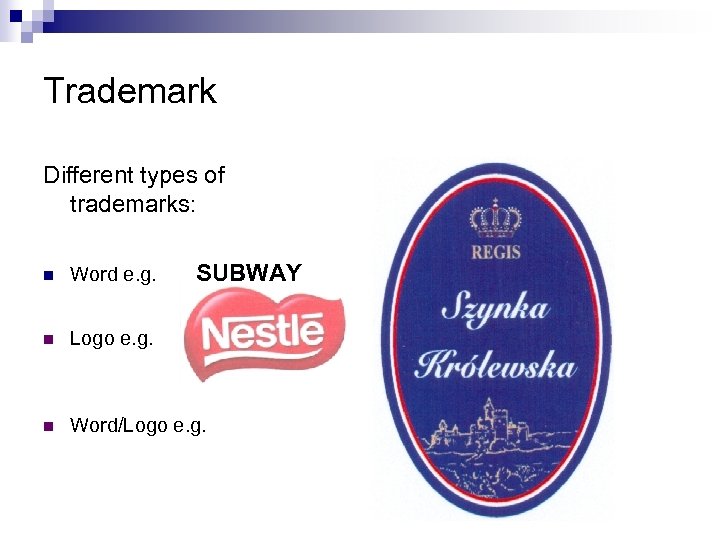 Trademark Different types of trademarks: n Word e. g. SUBWAY n Logo e. g. n Word/Logo e. g.
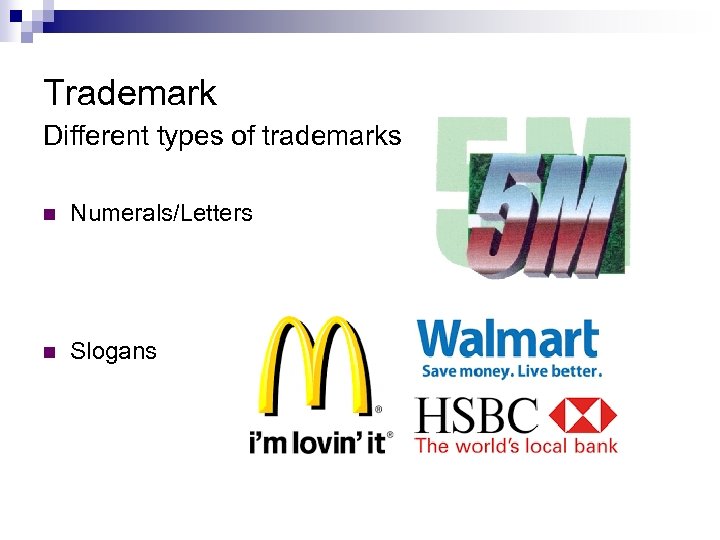 Trademark Different types of trademarks n Numerals/Letters n Slogans
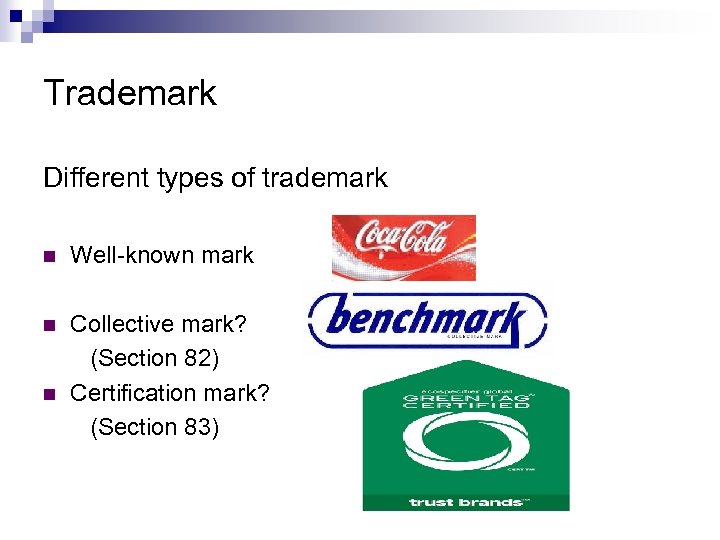 Trademark Different types of trademark n Well-known mark Collective mark? (Section 82) n Certification mark? (Section 83) n
 Requirements for a Good Trademark n Distinctive (unique) n Not descriptive n Not similar or identical
 Distinctive (unique) and not descriptive for the type of product or service being registered but if descriptive, it can be registered only if sufficient evidence of use is presented - acquired distinctiveness
![(Nestlé v Cadbury [2016] EWHC 50 (Ch)), n acquired distinctiveness through use n The](https://present5.com/presentation/4a29072a25533e75d40c8bf1c52dfb24/image-7.jpg "(Nestlé v Cadbury [2016] EWHC 50 (Ch)), n acquired distinctiveness through use n The") (Nestlé v Cadbury [2016] EWHC 50 (Ch)), n acquired distinctiveness through use n The sign for which registration was sought corresponded to to the shape of Nestlé's four-finger Kit. Kat product except that it lacked the Kit. Kat logo embossed onto each of the fingers of the actual product.
(Nestlé v Cadbury [2016] EWHC 50 (Ch)), n acquired distinctiveness through use n The sign for which registration was sought corresponded to to the shape of Nestlé's four-finger Kit. Kat product except that it lacked the Kit. Kat logo embossed onto each of the fingers of the actual product.
 "in order to demonstrate that a sign has acquired distinctive character, the applicant or trade mark proprietor must prove that, at the relevant date, a significant proportion of the relevant class of persons perceives the relevant goods or services as originating from a particular undertaking because of the sign in question (as opposed to any other trade mark which may also be present). " (para 57)
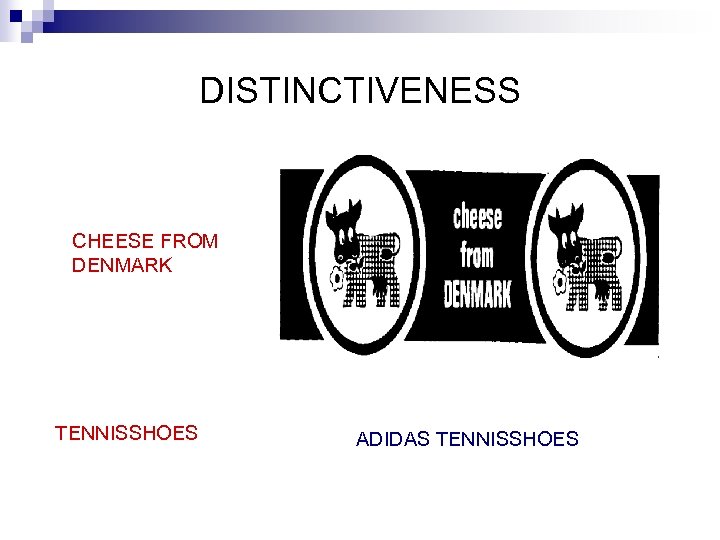 DISTINCTIVENESS CHEESE FROM DENMARK TENNISSHOES ADIDAS TENNISSHOES
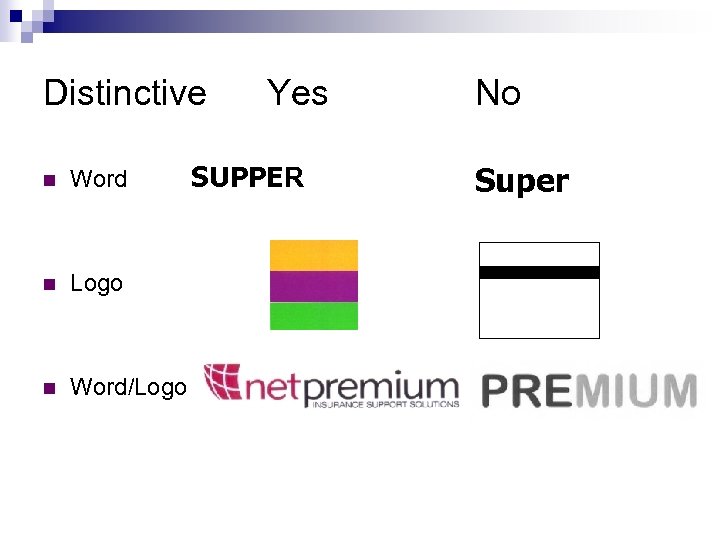 Distinctive Yes n Word SUPPER n Logo n Word/Logo No Super
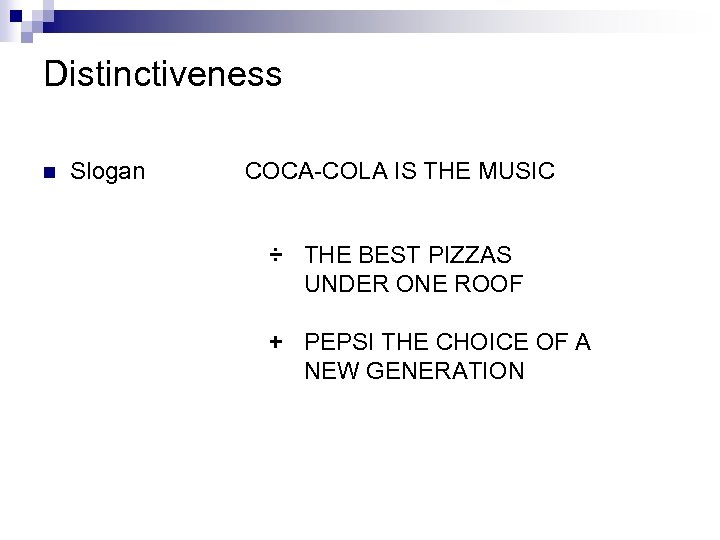 Distinctiveness n Slogan COCA-COLA IS THE MUSIC ÷ THE BEST PIZZAS UNDER ONE ROOF + PEPSI THE CHOICE OF A NEW GENERATION
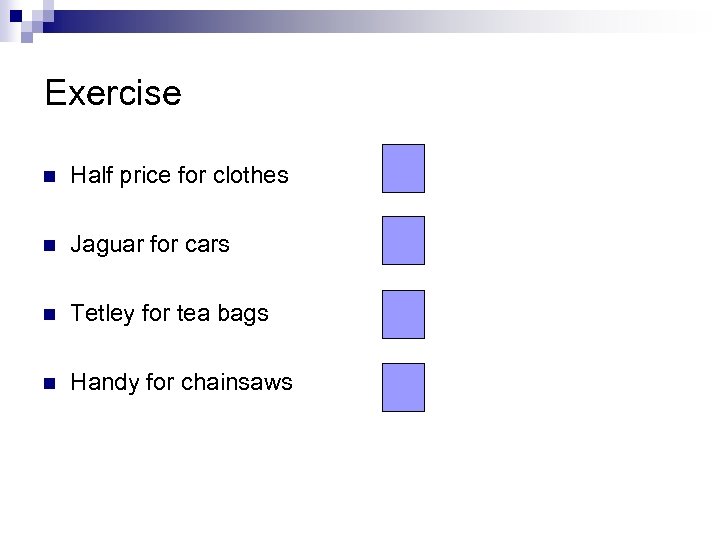 Exercise n Half price for clothes X n Jaguar for cars n Tetley for tea bags n Handy for chainsaws X
 Similar/Identical n If it concerns the same or similar/identical products and services: The name of product/service cannot be similar or identical to a previous mark however n The same similar/identical brand name can be used for different products/services in different classes but n Well-known marks have a broader scope
 Similar/Identical Meaning the way the mark is: n Written n Looks n Phonetic (sounding) n Conceptual similarity (Rocket vs Pocket)
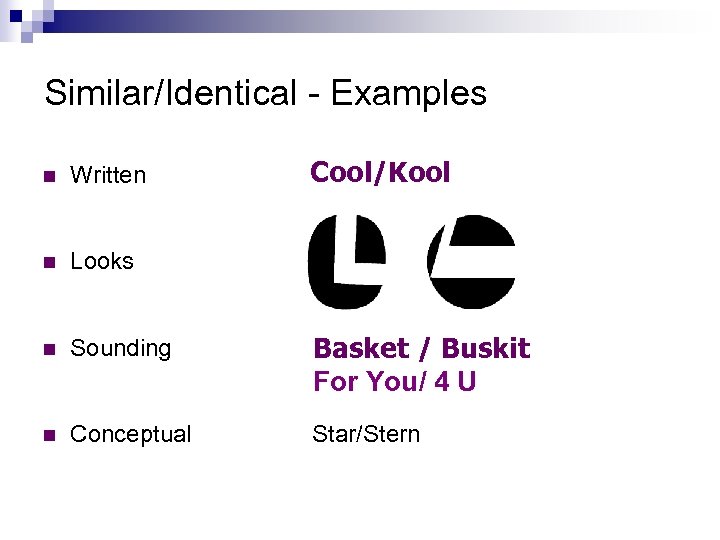 Similar/Identical - Examples n Written n Looks n Sounding n Conceptual Cool/Kool Basket / Buskit For You/ 4 U Star/Stern
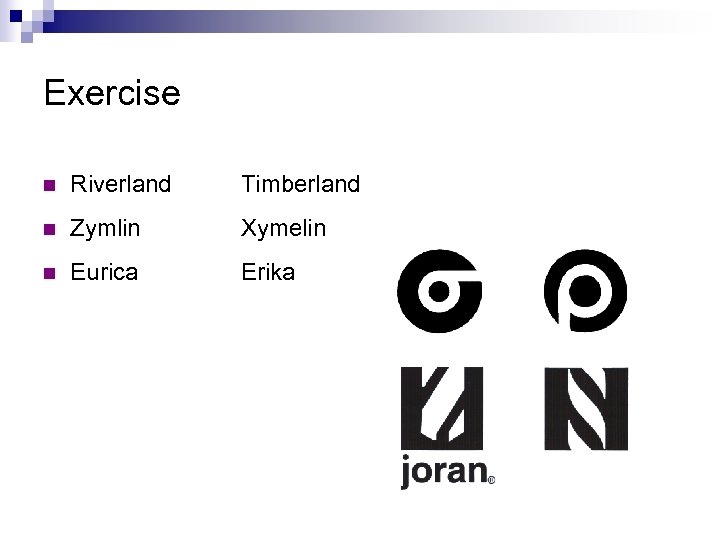 Exercise n Riverland Timberland n Zymlin Xymelin n Eurica Erika
 Varied Protection of a trademark How close can you get to another trademark? n n Strong trademark gives wider protection Weak trademark gives less protection
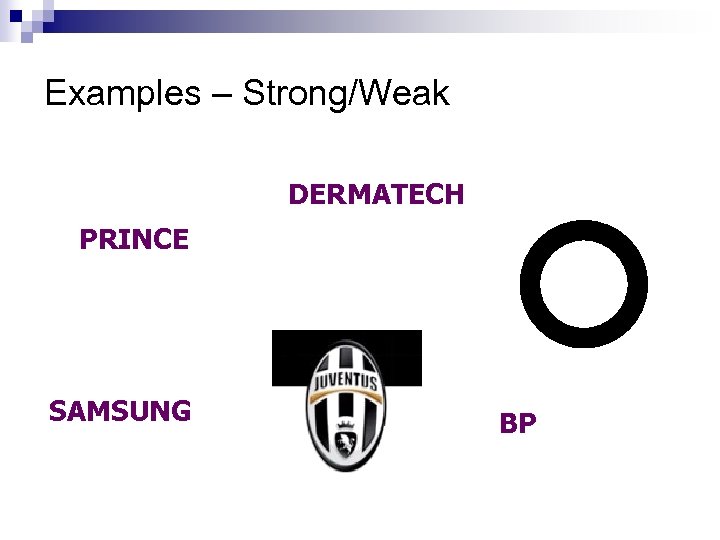 Examples – Strong/Weak DERMATECH PRINCE SAMSUNG BP
 What type of protection is given to trademarks? Generic – It describes a category of product. (Aspirin, Heroin) n Descriptive – descriptive terms, because they are not inherently distinctive, (Electronic Land) n Suggestive – A suggestive trademark is so named because it suggests a quality or characteristic of goods and services; (Microsoft – Citi Bank) n
 Arbitrary marks: Arbitrary marks have real words that are meaningless with respect to the product or service. Example Apple… meaning does not related to product. Fanciful Mark: marks are completely made up words. Example : Kodak.
 Distinction – Trademark & Trade name Trademark denotes the manufacture or quality of the goods to which it is attached. (attached to Goods themselves) n Tradename denotes the ownership of them. (attached to proprietor of said Goods) n (PLD 1961 Kar. 158 – Abdul Ghani vs Registrar of Trade Marks)
 Classification system n Like a library system n 42 classes n Important to make a good list of goods and services n Think 5 years ahead
 History of Trademakr Blacksmith who made SWORDS in the Roman Empire are thought of as being the first users of trademarks. n The first trademark legislation was passed by the Parliament of England under the reign of King Henry III in 1266, which required all bakers to use a distinctive mark for the bread they sold. n
 TRADEMARK ORDINANCE 2001 Trade Mark Act 1940 n Important Definitions (Section 2) n (xxiv) "mark" includes, in particular, a device, brand, heading, label, ticket, n name including person name, signature, word, letter, numeral, figurative elements, colour, sound or and combination thereof ; n (xlvii) "trade mark" means any mark capable of being represented graphically which is capable of distinguishing goods or services of one undertaking from those of other undertakings; n (xlix) "trade names" means names used by a person to denote his trade or calling and includes firms' and companies' names;
 Definitions (xiii) "dilution" means the lessening of the capacity of a well known trade mark to identify and distinguish the goods or services, regardless of the presence or absence of competition between owner of the well know trade mark or other parties. or likelihood of confusion or deception: n Blurring and tarnishment "blurs" a mark from association with only one product to signify other products in other markets (such as "Kodak shoes"); “tarnishment”, which is the weakening of a mark through unsavory or unflattering associations. n
 Starbucks Corp. v. Wolfe’s Borough Coffee, Inc. , 559 F. Supp. 2 d 472, 477 (S. D. N. Y. 2008). Starbucks alleged that Wolfe’s use of the marks CHARBUCKS BLEND and MISTER CHARBUCKS diluted its STARBUCKS marks. n The district court, concluded that “Starbucks” and “Charbucks” were not substantially similar, and that as a result “[t]his dissimilarity alone is sufficient to defeat [Starbucks’] blurring claim. Starbucks Corp. v. Wolfe’s Borough Coffee, Inc. , 2011 WL 6747431, at *3 n The Second Circuit reversed and remanded, holding that the district court erred by requiring “substantial similarity” for Starbucks to prevail on its dilution claim. On remand, however, the district court ultimately rejected Starbucks’ blurring claim, noting “[t]he minimal degree of similarity between the marks as they are used in commerce. ”
 Levi Strauss & Co. v. Abercrombie & Fitch Trading Co 633 F. 3 d 1158, 1172 (9 th Cir. 2011). n a showing of dilution does not require the junior mark is identical, nearly identical or substantially similar to the senior mark. n In light of these recent decision, owners of famous marks should take comfort that their marks are protected against dilution by not only virtually identical or substantially similar marks but also marks of lesser degrees of similarity. Thus, when considering bringing dilution claims, trademark holders should cast a wider net, looking to factors beyond similarity of marks, and prepare their cases accordingly.
 PASSING OFF n n n i. iii. Making some false representation likely to induce a person to believe that the goods or services are those of another. used to enforce unregistered trade mark rights. The tort of passing off protects the goodwill of a trader from a misrepresentation. Passing off has significance where an action for trade mark infringement based on a registered trade mark is unlikely to be successful (due to the differences between the registered trade mark and the unregistered mark). Reckitt & Colman Products Ltd v Borden Inc [1990] 1 All E. R. Goodwill owned by a trader Misrepresentation Damage to goodwill
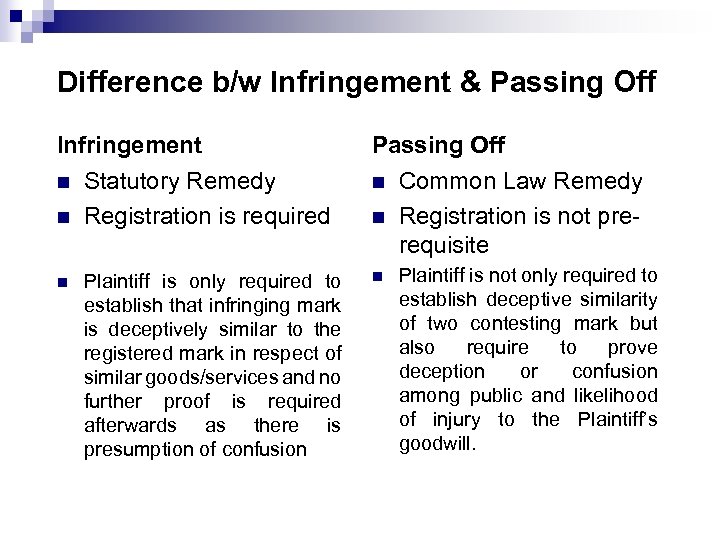 Difference b/w Infringement & Passing Off Infringement n n n Passing Off Statutory Remedy Registration is required n Plaintiff is only required to establish that infringing mark is deceptively similar to the registered mark in respect of similar goods/services and no further proof is required afterwards as there is presumption of confusion n n Common Law Remedy Registration is not prerequisite Plaintiff is not only required to establish deceptive similarity of two contesting mark but also require to prove deception or confusion among public and likelihood of injury to the Plaintiff’s goodwill.
 Section 14 – Absolute Grounds For Refusal of Registration n n n n Substantive requirement of distinguishing goods from one undertaking to another. Devoid of any distinctive character Designate the kind, quality, quantity and intended purpose. Marks become customary in language Shape – nature of goods themselves Technical result Add substantial value to goods Contrary to Public Policy
 Section 17 = Relative Grounds of Refusal n Identical and similar marks in same class n Identical and similar marks in different class n Concept of Likelihood of Confusion
 (Polaroid Corp. v. Polarad Elecs. Corp. , 287 F. 2 d 492 (2 d Cir. 1961). n “Polaroid factors, ” Ø Strength of the senior user’s mark. The stronger or more distinctive the senior user’s mark, the more likely the confusion. Similarity of the marks. The more similarity between the two marks, the more likely the confusion. Similarity of the products or services. The more that the senior and junior user’s goods or services are related, the more likely the confusion. Likelihood that the senior user will bridge the gap. If it is probable that the senior user will expand into the junior user’s product area, the more likely there will be confusion. Ø Ø Ø
 “Polaroid factors, ” n n n The junior user’s intent in adopting the mark. If the junior user adopted the mark in bad faith, confusion is more likely. Evidence of actual confusion. Proof of consumer confusion is not required, but when the trademark owner can show that the average reasonably prudent consumer is confused, it is powerful evidence of infringement. Sophistication of the buyers. The less sophisticated the purchaser, the more likely the confusion. Quality of the junior user’s products or services. In some cases, the lesser the quality of the junior user’s goods, the more harm is likely from consumer confusion. related products and services.
 Pakistan Case Laws n 2015 SCMR 1230 (Farooq Hayat vs Hayat) n 2012 CLD 905 (Dera vs Fazal-e-Haq Dera)
 Honest Concurrent Use Section 19 n n n 1. 2. 3. 4. 5. Ground to Overcome the Refusal of Trademark Registration. when the owner of a mark has obtained registration but has never used or has very limited use of it. However, during the term of the registration, another person or company has honestly and concurrently used an identical mark in similar goods or products Factor to determine The quantum of the concurrent use of the trademark in connection with the goods concerned and the duration, area and volume of the trade. The degree of confusion likely to ensue from the resemblance of the marks, which is to an indication of the measure of public inconvenience. The honesty of the concurrent use Whether any instances of confusion have in fact been proved. The relative inconvenience, which would be caused if the marks were registered, subject if necessary to any conditions and limitations.
 Section 21 & 32 Disclaimer n The proprietor shall either disclaim any right to the exclusive use of such part or of all or any portion of such matter, as the case may be, to the exclusive use of which the tribunal holds him not to be entitled, or make such other disclaimer as the tribunal may consider necessary for the purposes of defining the rights of the proprietor under the registration: Divisional Application n n A divisional application means an other application by a person who has already made an application under section 22 for registration of a trade mark in respect of certain goods, services or both and made, in accordance with this section for- (a) the registration of a part only of the trade mark in respect of any or all those goods. services or both; or (b) the registration of the trade mark in respect of some of the goods, services or both in respect of which registration is sought under the application made under section 22.
 68. Misleading and comparative advertisement. n 2(iv) "comparative advertisement" means and advertisement which explicitly or by implication identifies a competitor or goods or services offered by a competitor; n 2(xxv) "misleading advertising" means any advertising which in any way. including its presentation, deceives or its likely to deceive the persons to whom it is addressed or whom it reaches and which. by reason of its deceptive nature, is likely to affect their behavior or which, for those reasons. injures or is likely to injure a competitor:
 Conditions of Comparative Advertisement n n n n (a) it is not misleading according to clause (xxiv) of section 2, and sub-section (2); (b) it compares goods or services meeting the same needs or intended for the same purpose; (c) it objectively compares one or more material, relevant, verifiable and representative features of those goods and services, which may include price; (d) it does not crate confusion in the market place between the advertise and a competitor or between the advertiser's trade mark. trade names, other distinguishing marks, goods or services and those of the competitor; (e) it does not discredit or disparage the trade marks, trade names, other distinguishing marks, goods, services, activities or circumstance of a competitor; (f) for products with designation of origin, it relates in each case to products with same designation; (g) it does not take unfair advantage of the reputation of a trade mark, trade name or other distinguishing marks of a competitor or of the designation of origin of competing products; and (h) it does not present goods or services as imitations or replicas of goods or services bearing a protected trade mark or trade name.
 2008 CLD 190 (Hub Pak Salt Refinery vs National Foods n n Disparaging Advertisement Lady picked up the Defendant’s product and put off treating the same as dangerous to health and human consumption Offensive advertisement have been made in such a manner as to amount defaming the Defendant and its product. Advertisement campaign on electronic media have immediate impact on viewers.
 International filing n Madrid n National Applications e. g. in Australia, USA n Priority claimed for a Polish application within 6 months
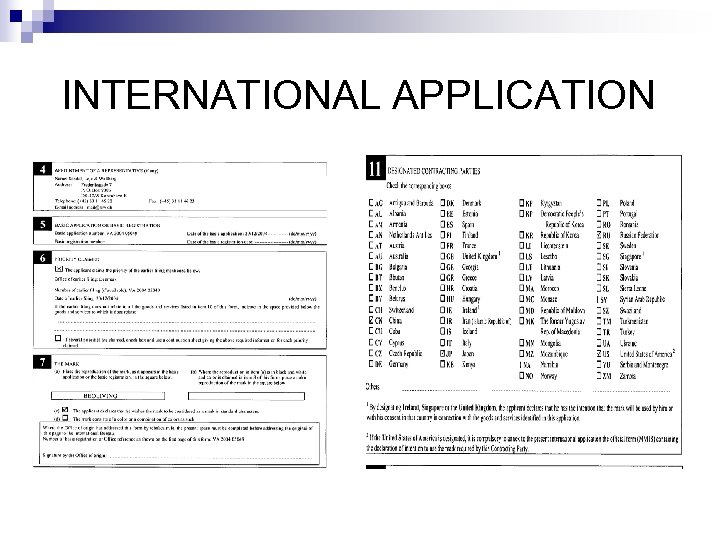 INTERNATIONAL APPLICATION
 Consequences of infriging n n If you infringe someone else’s trademark or design, you may risk: Injunction, which means that all the infringer’s products with the infringing trademark on or the same design can be removed from the marked Destruction of products Being given a fine Being sentenced to imprisonment (in gross cases)
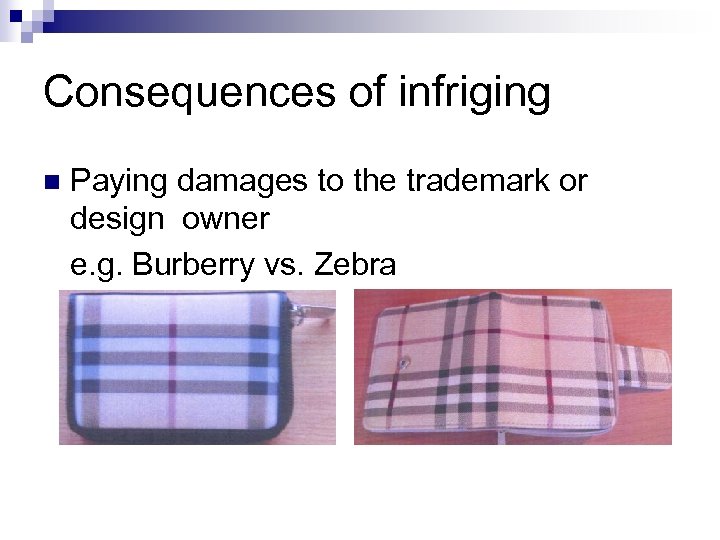 Consequences of infriging n Paying damages to the trademark or design owner e. g. Burberry vs. Zebra
 Why register? n To have an exclusive right n Stop others from copying n Certificate of ownership ®