


 Скачать презентацию What is a suffix A suffix is
db3a20b96566e22e10a0397616cdb8cd.ppt
- Количество слайдов: 15
 What is a suffix? • A suffix is a word part that is added to the end of a word. Sometimes it changes the meaning of a word and its part of speech.
 Suffix -ed • The suffix –ed is added to verbs (action words) to place the action in the past. (For example: Today I clean, yesterday I cleaned the house. )
 Phonics Rules
 -ed has three sounds. If a base word ends in the sound /d/ or /t/, adding -ed makes another syllable that says /ed/ and is pronounced as an extra syllable. For example: faint. ED
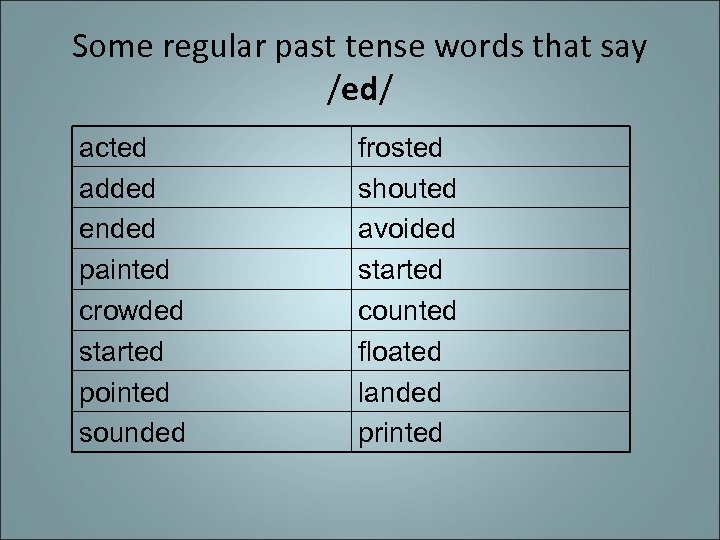 Some regular past tense words that say /ed/ acted added ended painted crowded started pointed sounded frosted shouted avoided started counted floated landed printed
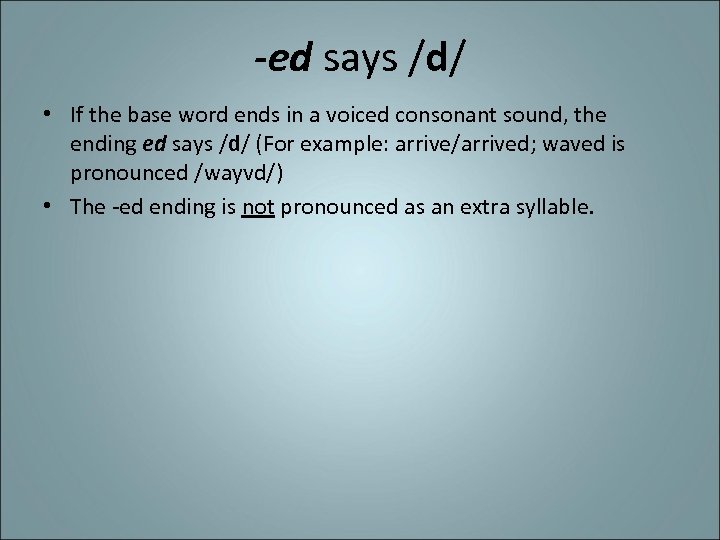 -ed says /d/ • If the base word ends in a voiced consonant sound, the ending ed says /d/ (For example: arrive/arrived; waved is pronounced /wayvd/) • The -ed ending is not pronounced as an extra syllable.
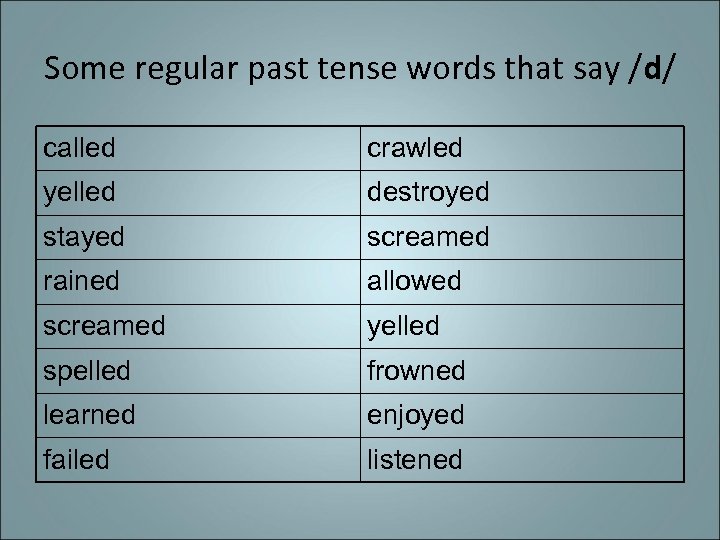 Some regular past tense words that say /d/ called crawled yelled destroyed stayed screamed rained allowed screamed yelled spelled frowned learned enjoyed failed listened
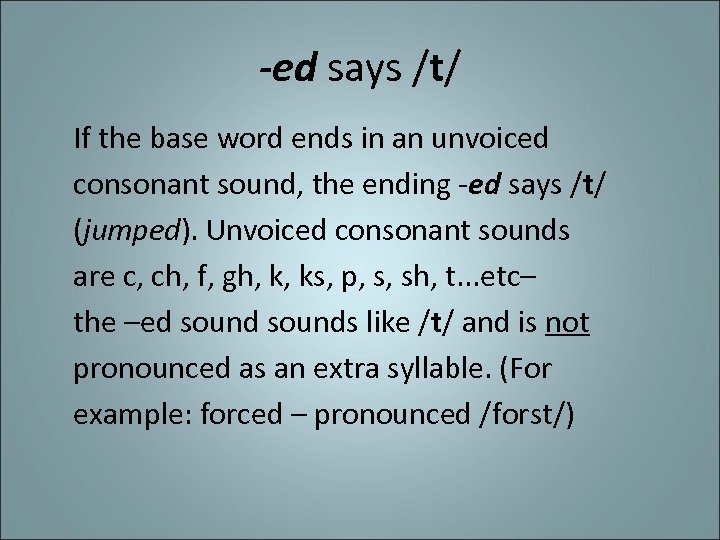 -ed says /t/ If the base word ends in an unvoiced consonant sound, the ending -ed says /t/ (jumped). Unvoiced consonant sounds are c, ch, f, gh, k, ks, p, s, sh, t. . . etc– the –ed sounds like /t/ and is not pronounced as an extra syllable. (For example: forced – pronounced /forst/)
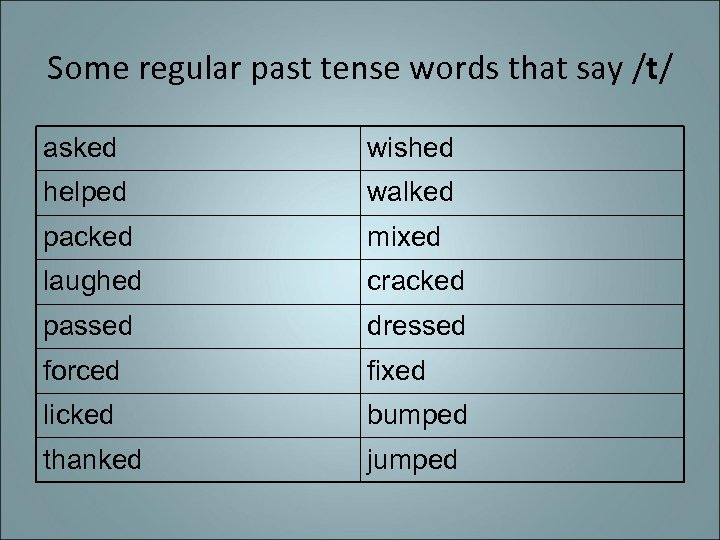 Some regular past tense words that say /t/ asked wished helped walked packed mixed laughed cracked passed dressed forced fixed licked bumped thanked jumped
 Spelling Rules
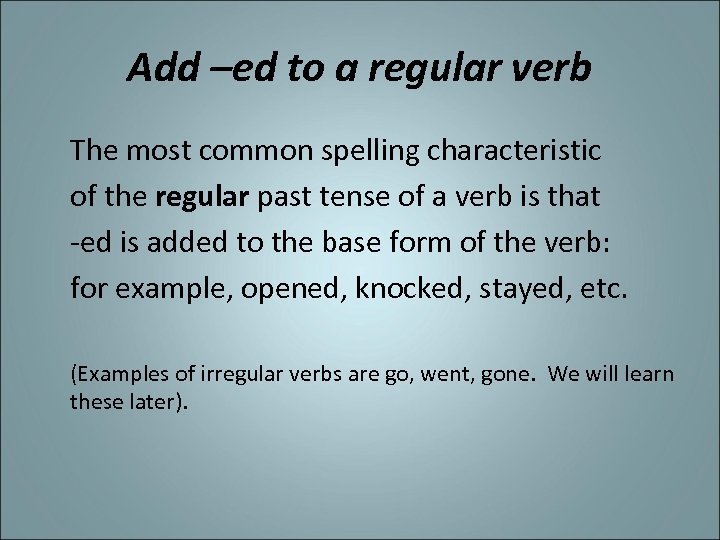 Add –ed to a regular verb The most common spelling characteristic of the regular past tense of a verb is that -ed is added to the base form of the verb: for example, opened, knocked, stayed, etc. (Examples of irregular verbs are go, went, gone. We will learn these later).
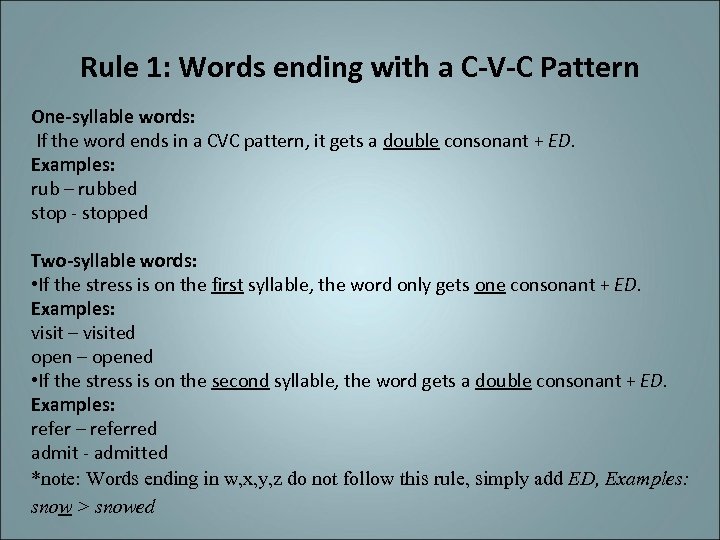 Rule 1: Words ending with a C-V-C Pattern One-syllable words: If the word ends in a CVC pattern, it gets a double consonant + ED. Examples: rub – rubbed stop - stopped Two-syllable words: • If the stress is on the first syllable, the word only gets one consonant + ED. Examples: visit – visited open – opened • If the stress is on the second syllable, the word gets a double consonant + ED. Examples: refer – referred admit - admitted *note: Words ending in w, x, y, z do not follow this rule, simply add ED, Examples: snow > snowed
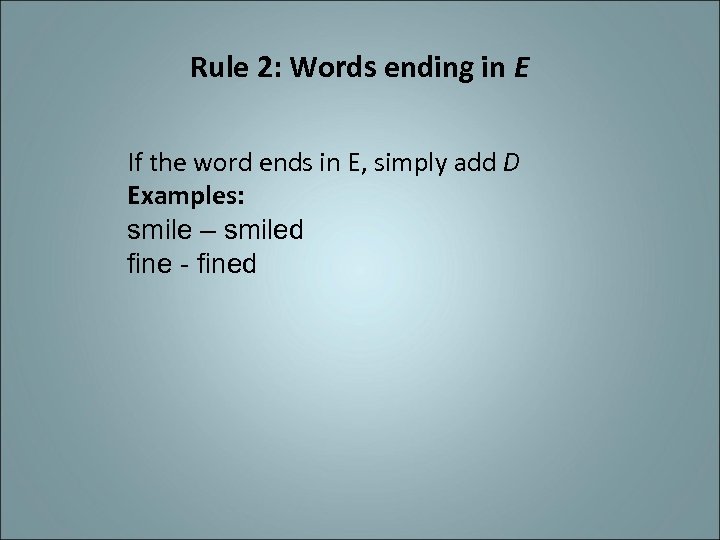 Rule 2: Words ending in E If the word ends in E, simply add D Examples: smile – smiled fine - fined
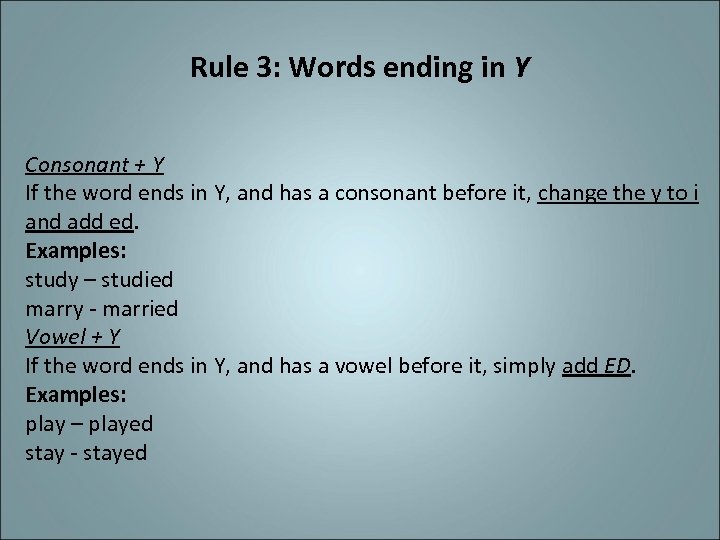 Rule 3: Words ending in Y Consonant + Y If the word ends in Y, and has a consonant before it, change the y to i and add ed. Examples: study – studied marry - married Vowel + Y If the word ends in Y, and has a vowel before it, simply add ED. Examples: play – played stay - stayed
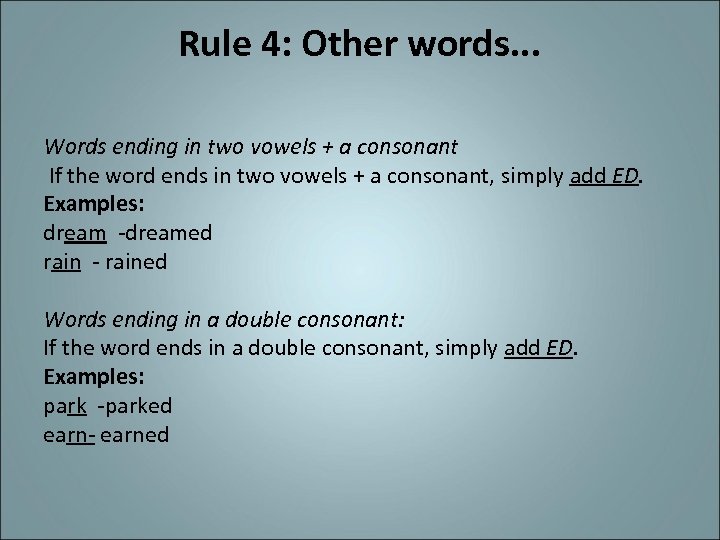 Rule 4: Other words. . . Words ending in two vowels + a consonant If the word ends in two vowels + a consonant, simply add ED. Examples: dream -dreamed rain - rained Words ending in a double consonant: If the word ends in a double consonant, simply add ED. Examples: park -parked earn- earned