


 Скачать презентацию What is a Political Party A political party
political_parties.pptx
- Количество слайдов: 34
 What is a Political Party? A political party is a group of voters, activists, candidates, and office holders who identify with a party label and seek to elect individuals to public office.
 The main difference between Parties and Interest Groups • Political Parties want to win control of government, not just influence it.
 If you look around the world, all democratic systems have political parties. • This tells us that they are doing something important, they must be performing some important function.
 Functions of Parties • Recruit and Educate new political talent. • Help organize elections. • Provide interest aggregation and articulation. • Provide additional structure in government (esp. important for Federalism and divided government).
 The Evolution of American Party Democracy • Hamilton and Jefferson, as heads of the Federalist and Anti-Federalist groups respectively, are often considered “fathers” of the modern party system. • By 1800, this country had a party system with two major parties that has remained relatively stable ever since.
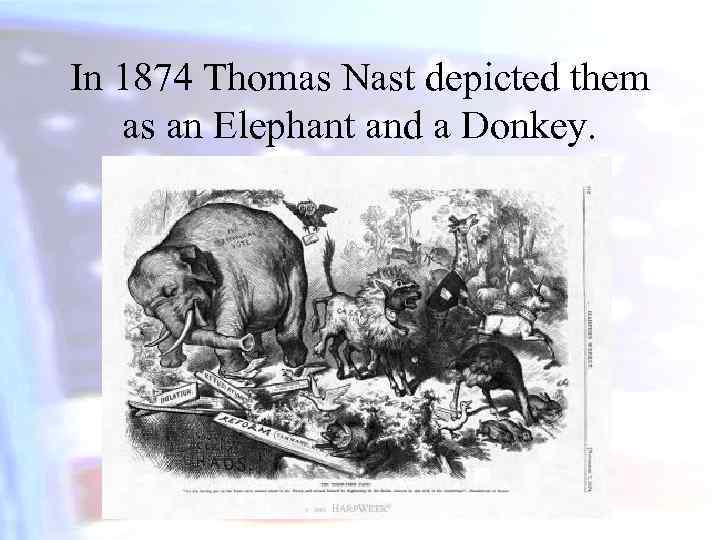 In 1874 Thomas Nast depicted them as an Elephant and a Donkey.
 Democrats and Republicans: The Golden Age • From the presidential elections of 1860 to the present, the same two major parties have contested elections in the United States: Democrats and Republicans. • • • Reconstruction -- Republican dominance 1876 -1896 -- closely competitive 1896 -1929 -- Republican dominance 1930 s and 1940 s -- Democratic dominance 1950 s and 1960 s -- closely competitive 1970 -present -- neither party dominant
 Why does the U. S. have a two party system? • Most democracies have several parties.
 One possible answer is simply our history. • Some observers argue that our political culture has simply developed into a system that uses two parties to organize politics.
 A better answer is our electoral system. • The United States uses a Majoritarian system often called SMDP. • SMDP=Single Member District Plurality.
 In plainer English: • We vote in specific districts or states for one representative who is tied to that place. • For example: • George W. Bush (R) for President • John Kerry (D) for President
 There are of course 3 rd party candidates • George W. Bush (R) • John Kerry (D) • Ralph Nader (Green Party) • Does Nader have much of a chance? Why not?
 In countries that use SMDP like the U. S. and Great Britain • You usually end up with two dominant political parties. This is known as Duverger’s Law.
 In contrast, most democracies use a system known as Proportional Representation (PR) • In a PR system voters cast a ballot not for individual candidates, but political parties. • A simple example is my favorite small country, Latvia.
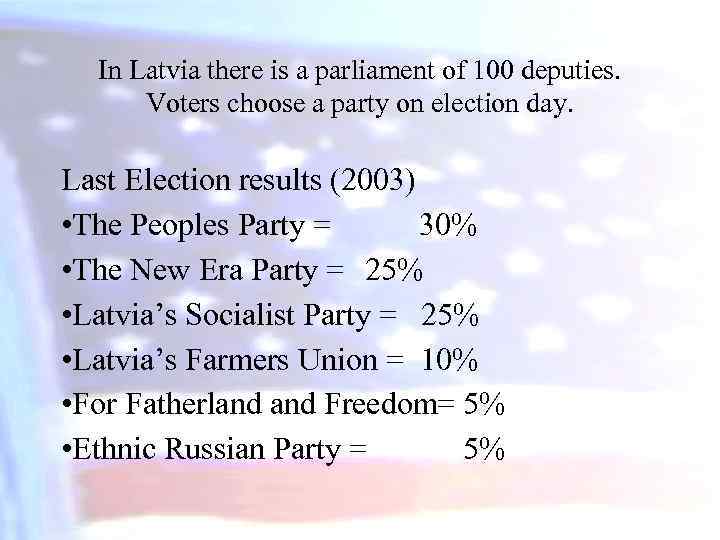 In Latvia there is a parliament of 100 deputies. Voters choose a party on election day. Last Election results (2003) • The Peoples Party = 30% • The New Era Party = 25% • Latvia’s Socialist Party = 25% • Latvia’s Farmers Union = 10% • For Fatherland Freedom= 5% • Ethnic Russian Party = 5%
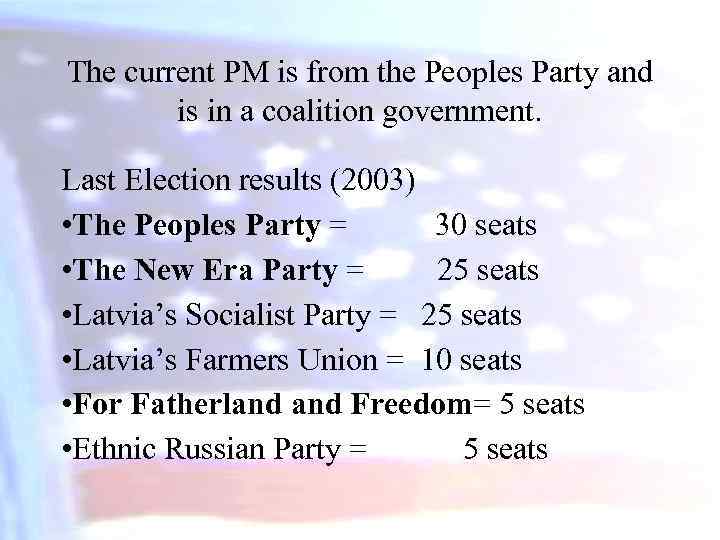 The current PM is from the Peoples Party and is in a coalition government. Last Election results (2003) • The Peoples Party = 30 seats • The New Era Party = 25 seats • Latvia’s Socialist Party = 25 seats • Latvia’s Farmers Union = 10 seats • For Fatherland Freedom= 5 seats • Ethnic Russian Party = 5 seats
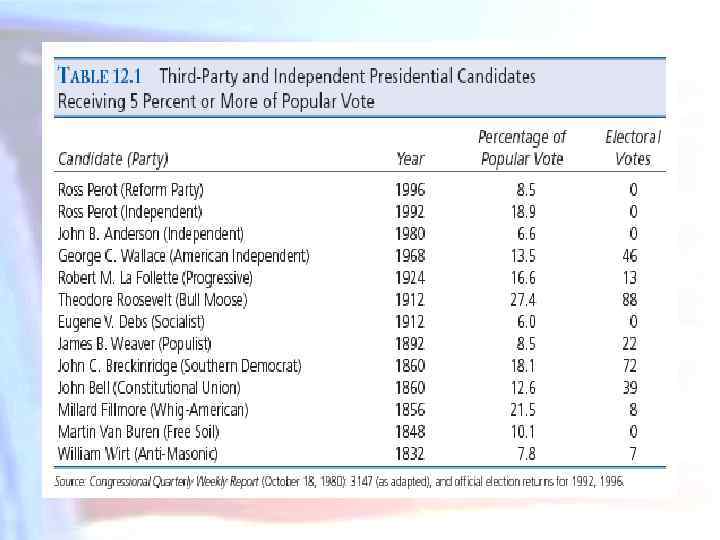
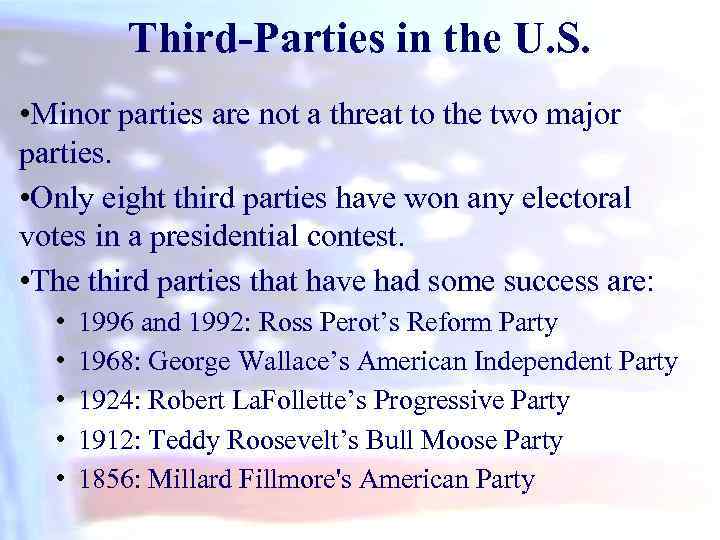 Third-Parties in the U. S. • Minor parties are not a threat to the two major parties. • Only eight third parties have won any electoral votes in a presidential contest. • The third parties that have had some success are: • • • 1996 and 1992: Ross Perot’s Reform Party 1968: George Wallace’s American Independent Party 1924: Robert La. Follette’s Progressive Party 1912: Teddy Roosevelt’s Bull Moose Party 1856: Millard Fillmore's American Party
 When do third parties do well in the United States ? • When they have a celebrity candidate. • When the candidate has his/her own money to use for campaigning. • When the two major parties have suffered from some scandal.
 The Basic Structure of American Political Parties • The organizational structure of America’s political parties remains fairly simple with aspects of national, state, and local influence: • National Committees/Conventions • State Central Committees • Local City/Precinct Committees • Informal Groups: Think Tanks and Reform Groups
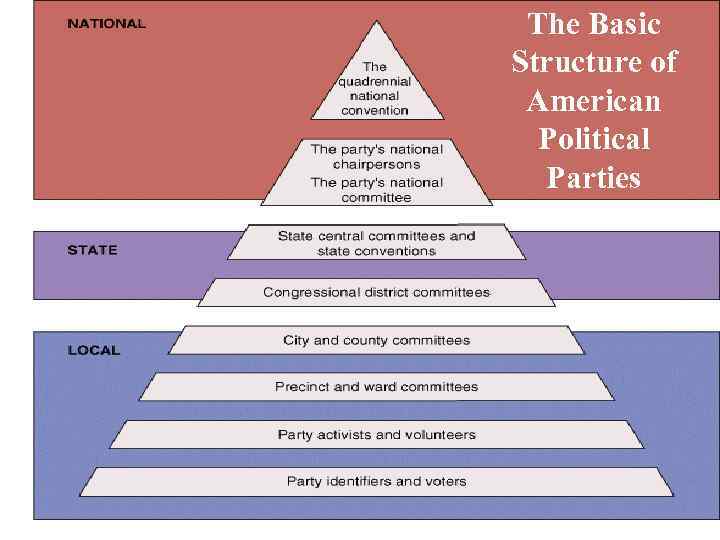 The Basic Structure of American Political Parties
 The Party in Government • The Congressional Party • The Presidential Party • The Parties and the Judiciary • The Parties and State Government
 The Modern Transformation of Party Organization Republican Party Strengths: • Party Staff – several hundred operatives stationed in key districts • Voter Contact – telephone canvassing and bulk mailings • Polling • Media Advertising – in-house media division • Staff Training and Research
 Republicans worked hard in these areas • Because Democratic candidates were the dominant incumbents in Congress in the 60’s, 70’s, and 80’s.
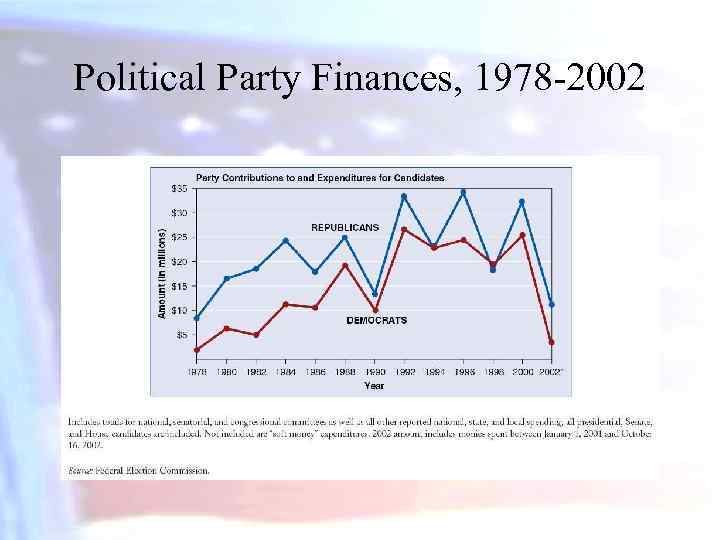 Political Party Finances, 1978 -2002
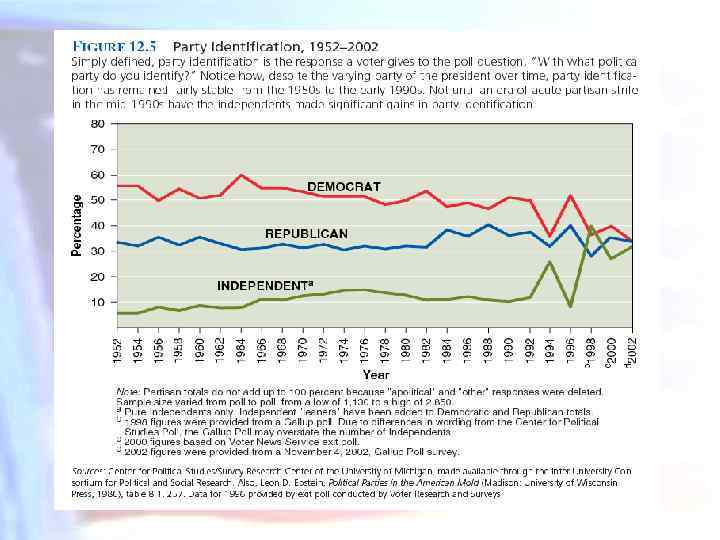
 The Party In The Electorate • The ‘party in the electorate’ is the mass of potential voters who identify with a specific party. • American voters often identify with a specific party, but rarely belong formally. • Party identification is often a voter’s central political reference symbol.
 Party identification appears to start early on in the socialization process • Party identification generally comes from one’s parents. • However, party identification can be affected by a number of factors such as education, peers, charismatic personalities, cataclysmic events, and intense social issues.
 Party Loyalty? • The number of independents in the U. S. rose from 19% in 1958 to 37% twenty years later. • However, identification with the two major parties today is in the mid 80% range.
 Further polling has revealed “Leaners” • Pollsters often find that many self-declared independents often “lean” quite strongly to either the Democratic or Republican party. • “Leaners” do feel party affiliations, but choose not to self-identify with a party.
 Loyalty Trends - Democratic • Labor union members tend to vote Democratic. • Democrats have a lead in garnering the women's vote. • Over 80% of African Americans and Hispanics vote Democratic. • Young people are once again more Democratic. • Most blue-collar workers and unemployed are Democrats. • The widowed are mostly Democrats. • Liberals tend to be Democrats.
 Loyalty Trends - Republican • Chambers of Commerce members tend to vote Republican. • The West tends to be more Republican. • Men tend to split fairly evenly between the two parties. • Cuban-Americans are generally Republicans (anti. Castro). • Professionals, executives, and white-collar workers tend to be Republican. • Married couples tend to be Republican. • Conservatives tend to be Republican.
 One-Partyism and Split Ticket Voting • A significant trend of recent times is the demise of one-partyism (one-party dominance of elections in a given region). • The formerly "Solid South" is no longer only Democratic. • Many individuals split their vote between the parties, and sometimes vote for third parties.
 • There are no exclusively Republican or Democratic states at this time. • However, thanks to Gerrymandering and other trends, many congressional districts and counties tend to lean in one direction or the other.