 Скачать презентацию What Immunization Providers Need to Know about Vaccine
50a6873c9da6b549340247a3738d82a5.ppt
- Количество слайдов: 46



What Immunization Providers Need to Know about Vaccine Safety and Talking to Concerned Parents Melinda Wharton, M. D. , M. P. H. Centers for Disease Control and Prevention Phoenix, Arizona 22 April 2009
Overview of Presentation • Overview of the U. S. vaccine safety system • Updates on a number of current vaccine safety issues • Vaccines and autism (April 2009 edition) • What are parents concerned about, and how to better address those concerns
Vaccine Safety • When the vaccine is under development, studies are done to find out if it is safe and effective • FDA review: if safe and effective, vaccine can be licensed • Other issues (manufacturing etc. ) also considered by FDA • Ongoing monitoring by both CDC and FDA and by the manufacturer after licensure • Post-licensure studies by the manufacturer • Vaccine Adverse Event Reporting System (VAERS) • Special studies • If vaccine safety issues are identified, actions are taken
What Do VAERS Reports Mean? • VAERS has led to early identification of serious adverse events • Not every adverse event caused by the vaccine is reported to VAERS • Just because something is reported to VAERS, it doesn’t mean it’s caused by the vaccine • Publicly accessible database: http: //vaers. hhs. gov/info. htm
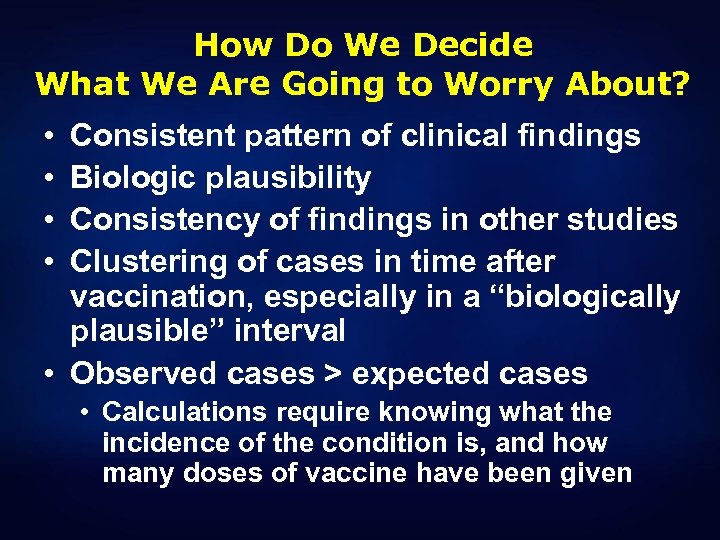
How Do We Decide What We Are Going to Worry About? • • Consistent pattern of clinical findings Biologic plausibility Consistency of findings in other studies Clustering of cases in time after vaccination, especially in a “biologically plausible” interval • Observed cases > expected cases • Calculations require knowing what the incidence of the condition is, and how many doses of vaccine have been given
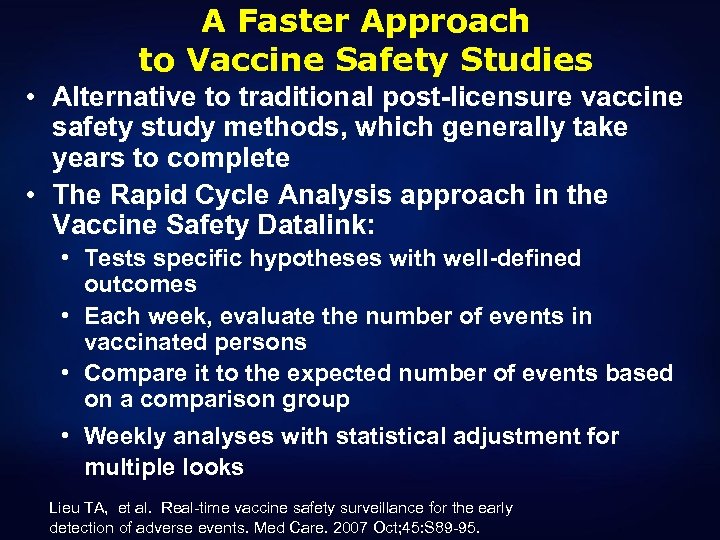
A Faster Approach to Vaccine Safety Studies • Alternative to traditional post-licensure vaccine safety study methods, which generally take years to complete • The Rapid Cycle Analysis approach in the Vaccine Safety Datalink: • Tests specific hypotheses with well-defined outcomes • Each week, evaluate the number of events in vaccinated persons • Compare it to the expected number of events based on a comparison group • Weekly analyses with statistical adjustment for multiple looks Lieu TA, et al. Real-time vaccine safety surveillance for the early detection of adverse events. Med Care. 2007 Oct; 45: S 89 -95.
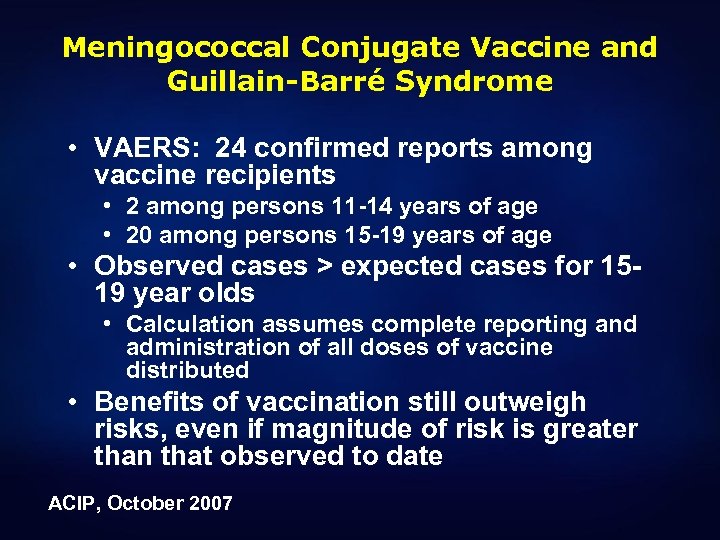
Meningococcal Conjugate Vaccine and Guillain-Barré Syndrome • VAERS: 24 confirmed reports among vaccine recipients • 2 among persons 11 -14 years of age • 20 among persons 15 -19 years of age • Observed cases > expected cases for 1519 year olds • Calculation assumes complete reporting and administration of all doses of vaccine distributed • Benefits of vaccination still outweigh risks, even if magnitude of risk is greater than that observed to date ACIP, October 2007
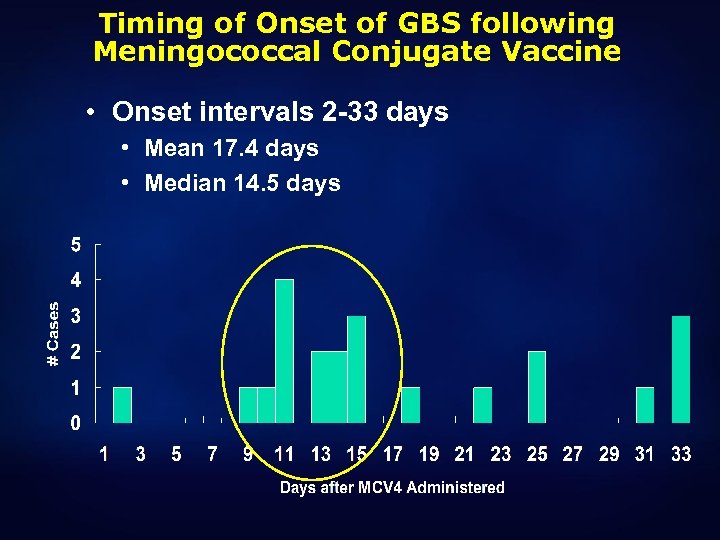
Timing of Onset of GBS following Meningococcal Conjugate Vaccine • Onset intervals 2 -33 days • Mean 17. 4 days • Median 14. 5 days
Update on Safety of Varicella Vaccine • Varicella vaccine strain can establish latency like wildtype varicella and later reactivate as zoster • Available data suggest that risk of reactivation less than for wildtype virus
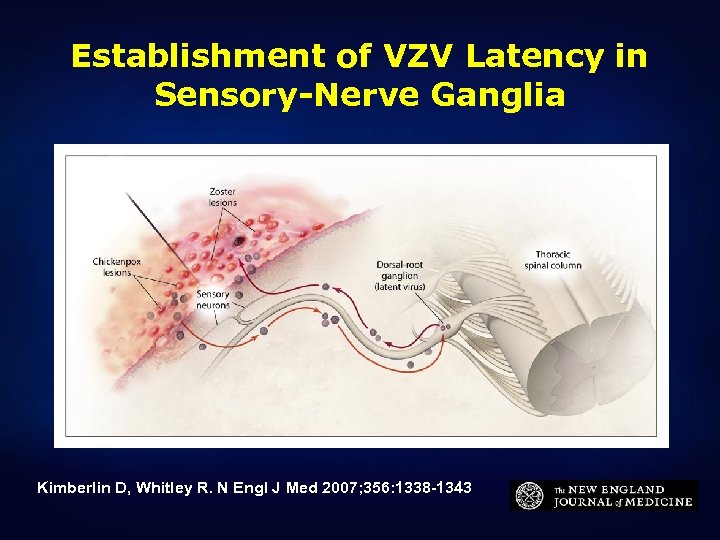
Establishment of VZV Latency in Sensory-Nerve Ganglia Kimberlin D, Whitley R. N Engl J Med 2007; 356: 1338 -1343
Herpes Zoster among Recipients of Varicella Vaccine • VAERS: 981 reports of herpes zoster • 47 of 981 were hospitalized • Median age: 2. 5 years (range 12 mo-12 yr) • Median interval from vaccination to zoster: 7. 3 months (range 3 days-4. 3 years) • 21 of 43 were on the face • Of 17 with viruses typed, 10 vaccine type • Of 12 episodes associated with meningitis, 4 vaccine type

Judicial Watch Investigates Side -Effects of HPV Vaccine Wed, 05/14/2008 - 14: 05 — gstasiewicz "The FDA adverse event reports on the HPV vaccine read like a catalog of horrors. Any state or local government now beset by Merck’s lobbying campaigns to mandate this HPV vaccine for young girls ought to take a look at these adverse health reports. " -Tom Fitton http: //www. judicialwatch. org/story/2008/may/judicial-watch-investigates-sideeffects-hpv-vaccine
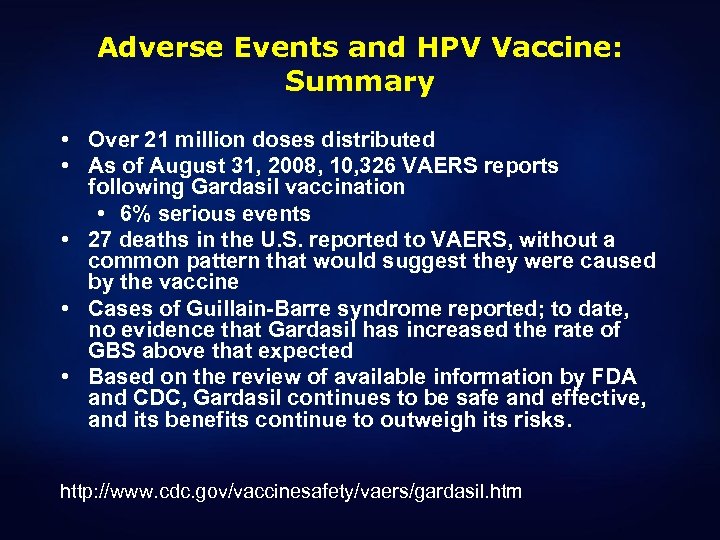
Adverse Events and HPV Vaccine: Summary • Over 21 million doses distributed • As of August 31, 2008, 10, 326 VAERS reports following Gardasil vaccination • 6% serious events • 27 deaths in the U. S. reported to VAERS, without a common pattern that would suggest they were caused by the vaccine • Cases of Guillain-Barre syndrome reported; to date, no evidence that Gardasil has increased the rate of GBS above that expected • Based on the review of available information by FDA and CDC, Gardasil continues to be safe and effective, and its benefits continue to outweigh its risks. http: //www. cdc. gov/vaccinesafety/vaers/gardasil. htm
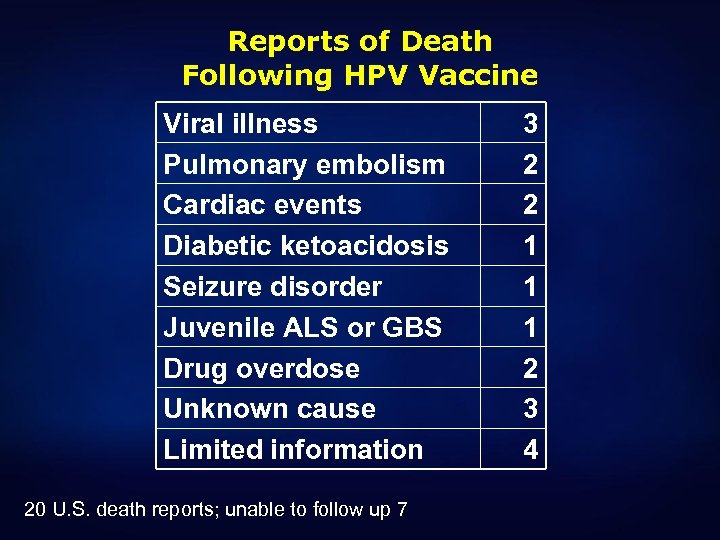
Reports of Death Following HPV Vaccine Viral illness Pulmonary embolism Cardiac events Diabetic ketoacidosis Seizure disorder Juvenile ALS or GBS Drug overdose Unknown cause Limited information 20 U. S. death reports; unable to follow up 7 3 2 2 1 1 1 2 3 4
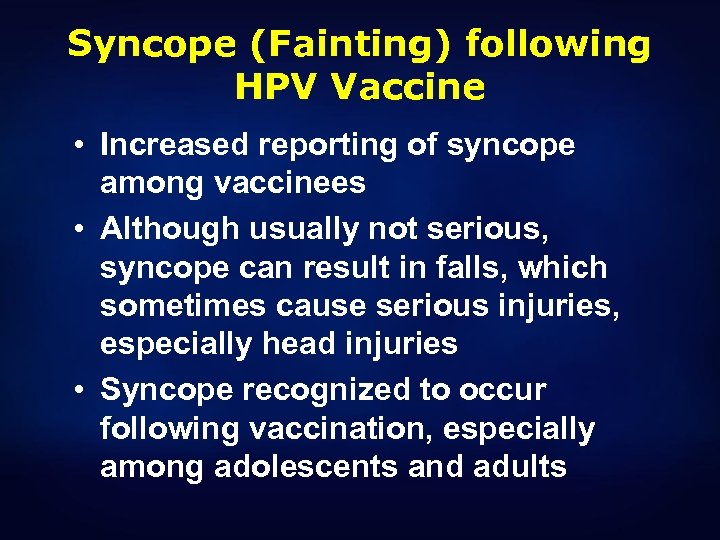
Syncope (Fainting) following HPV Vaccine • Increased reporting of syncope among vaccinees • Although usually not serious, syncope can result in falls, which sometimes cause serious injuries, especially head injuries • Syncope recognized to occur following vaccination, especially among adolescents and adults
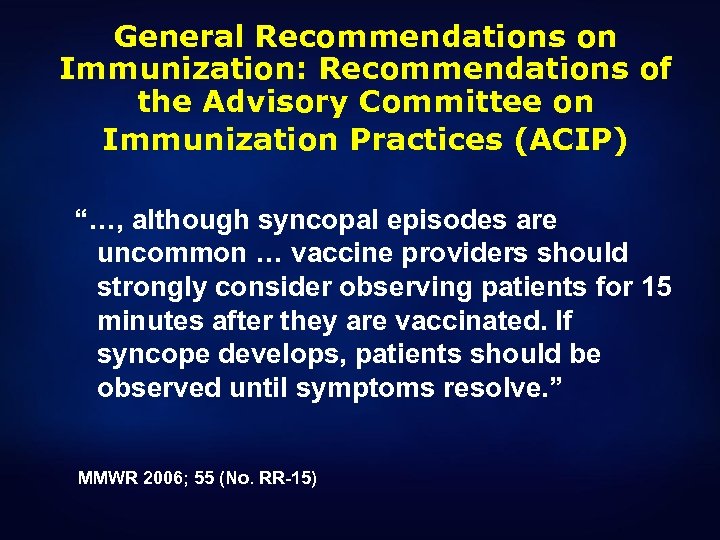
General Recommendations on Immunization: Recommendations of the Advisory Committee on Immunization Practices (ACIP) “…, although syncopal episodes are uncommon … vaccine providers should strongly consider observing patients for 15 minutes after they are vaccinated. If syncope develops, patients should be observed until symptoms resolve. ” MMWR 2006; 55 (No. RR-15)
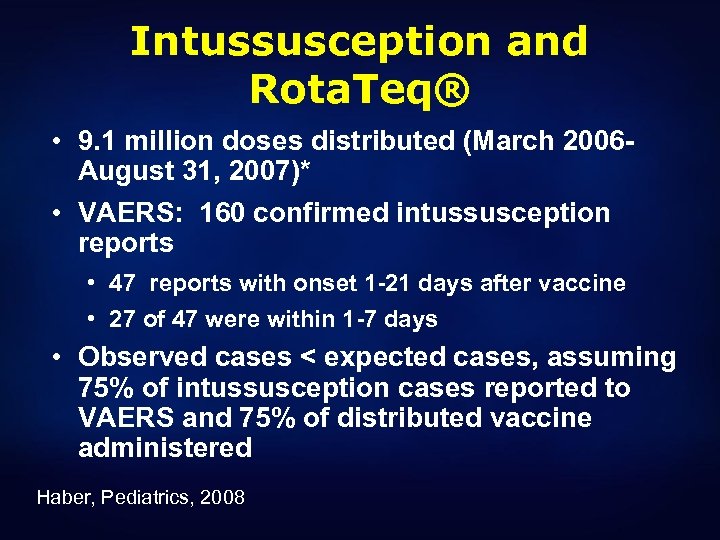
Intussusception and Rota. Teq® • 9. 1 million doses distributed (March 2006 August 31, 2007)* • VAERS: 160 confirmed intussusception reports • 47 reports with onset 1 -21 days after vaccine • 27 of 47 were within 1 -7 days • Observed cases < expected cases, assuming 75% of intussusception cases reported to VAERS and 75% of distributed vaccine administered Haber, Pediatrics, 2008
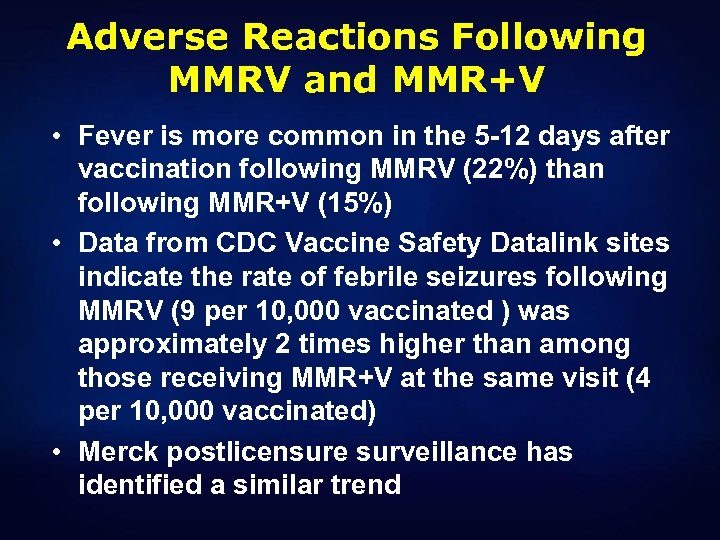
Adverse Reactions Following MMRV and MMR+V • Fever is more common in the 5 -12 days after vaccination following MMRV (22%) than following MMR+V (15%) • Data from CDC Vaccine Safety Datalink sites indicate the rate of febrile seizures following MMRV (9 per 10, 000 vaccinated ) was approximately 2 times higher than among those receiving MMR+V at the same visit (4 per 10, 000 vaccinated) • Merck postlicensure surveillance has identified a similar trend
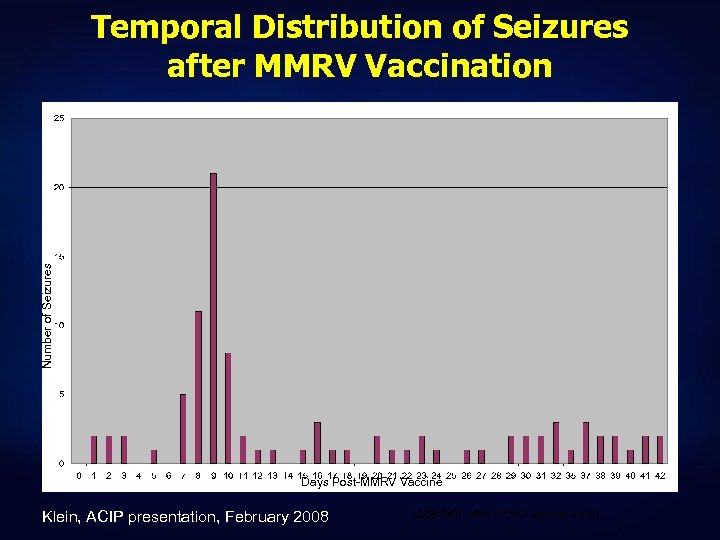
Number of Seizures Temporal Distribution of Seizures after MMRV Vaccination Days Post-MMRV Vaccine Klein, ACIP presentation, February 2008 (2/06 -9/07, after 47, 137 vaccine visits)
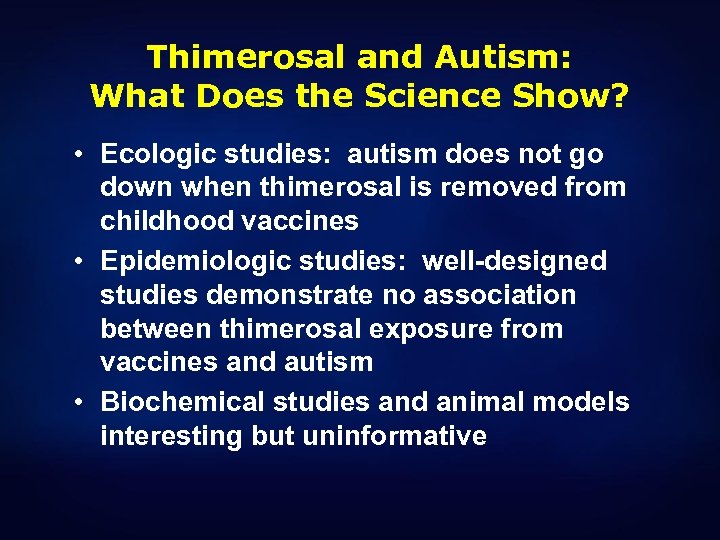
Thimerosal and Autism: What Does the Science Show? • Ecologic studies: autism does not go down when thimerosal is removed from childhood vaccines • Epidemiologic studies: well-designed studies demonstrate no association between thimerosal exposure from vaccines and autism • Biochemical studies and animal models interesting but uninformative
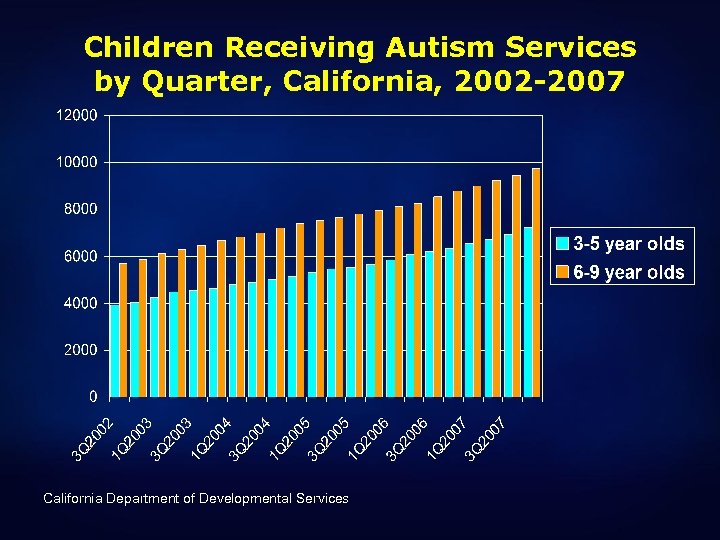
Children Receiving Autism Services by Quarter, California, 2002 -2007 California Department of Developmental Services
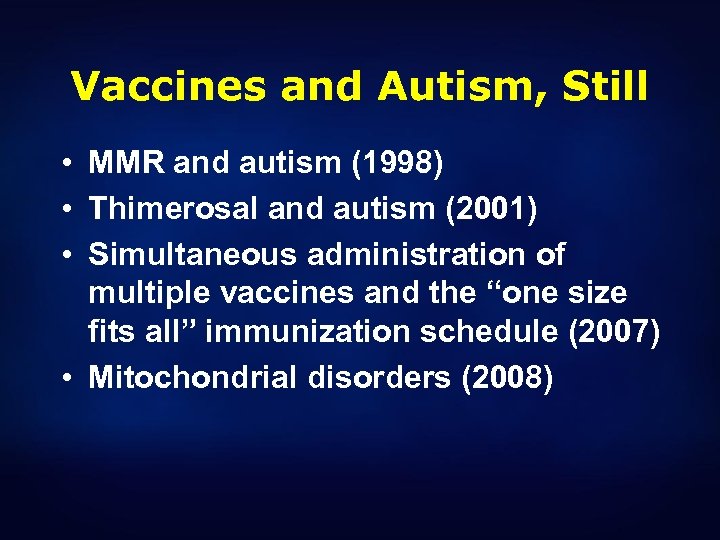
Vaccines and Autism, Still • MMR and autism (1998) • Thimerosal and autism (2001) • Simultaneous administration of multiple vaccines and the “one size fits all” immunization schedule (2007) • Mitochondrial disorders (2008)
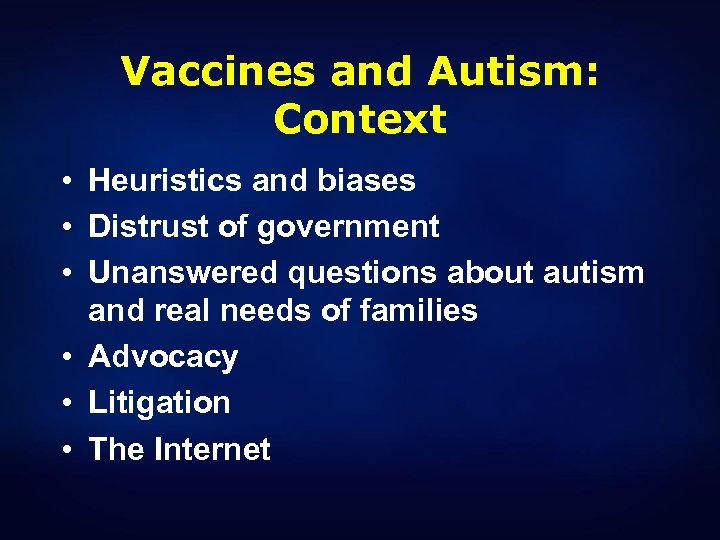
Vaccines and Autism: Context • Heuristics and biases • Distrust of government • Unanswered questions about autism and real needs of families • Advocacy • Litigation • The Internet
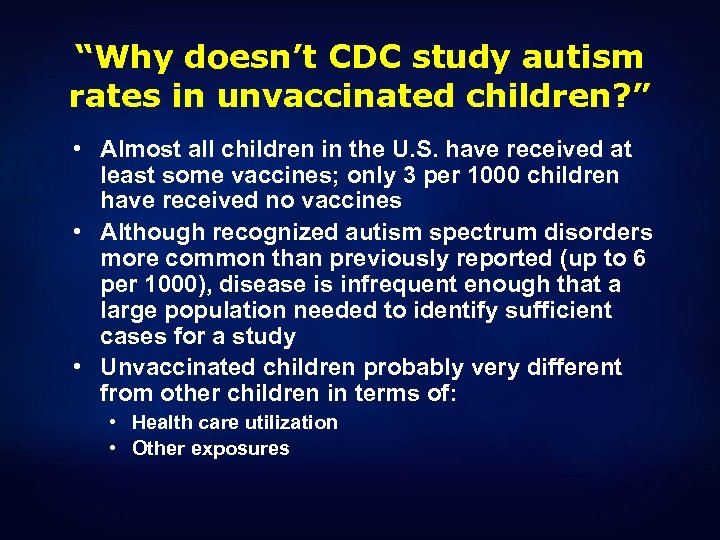
“Why doesn’t CDC study autism rates in unvaccinated children? ” • Almost all children in the U. S. have received at least some vaccines; only 3 per 1000 children have received no vaccines • Although recognized autism spectrum disorders more common than previously reported (up to 6 per 1000), disease is infrequent enough that a large population needed to identify sufficient cases for a study • Unvaccinated children probably very different from other children in terms of: • Health care utilization • Other exposures
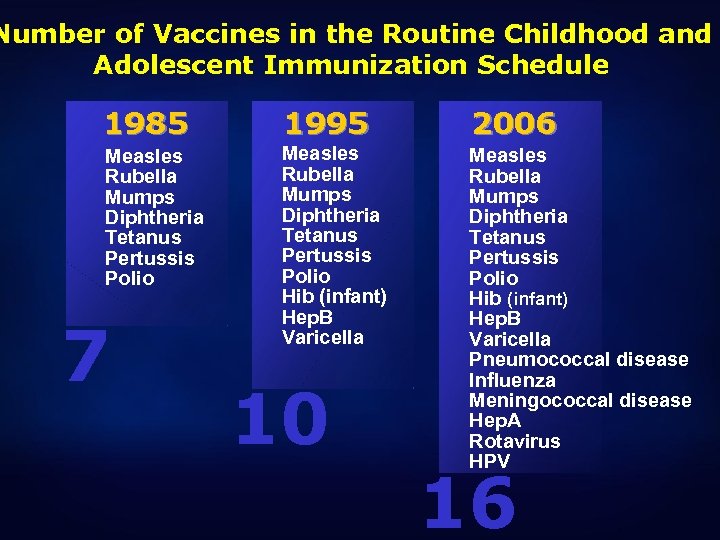
Number of Vaccines in the Routine Childhood and Adolescent Immunization Schedule 1985 1995 2006 Measles Rubella Mumps Diphtheria Tetanus Pertussis Polio Hib (infant) Hep. B Varicella Pneumococcal disease Influenza Meningococcal disease Hep. A Rotavirus HPV 7 10 16
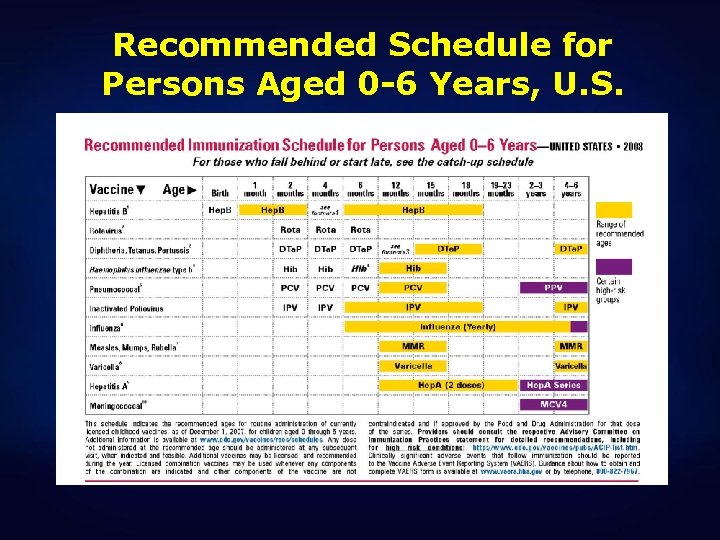
Recommended Schedule for Persons Aged 0 -6 Years, U. S.
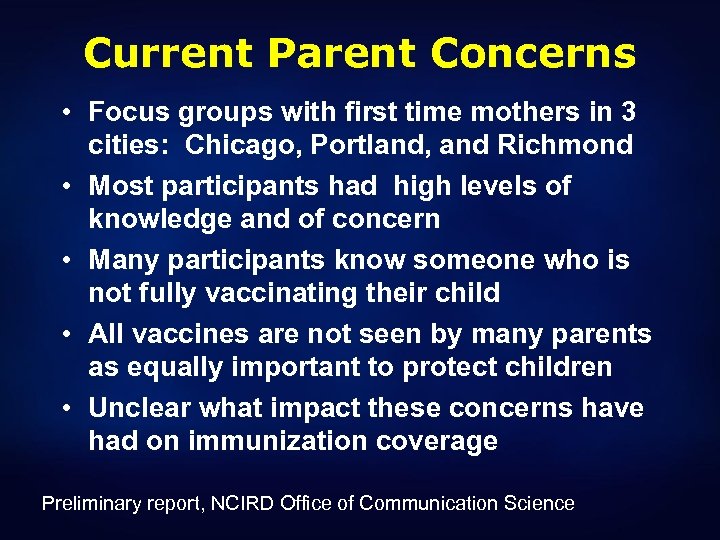
Current Parent Concerns • Focus groups with first time mothers in 3 cities: Chicago, Portland, and Richmond • Most participants had high levels of knowledge and of concern • Many participants know someone who is not fully vaccinating their child • All vaccines are not seen by many parents as equally important to protect children • Unclear what impact these concerns have had on immunization coverage Preliminary report, NCIRD Office of Communication Science
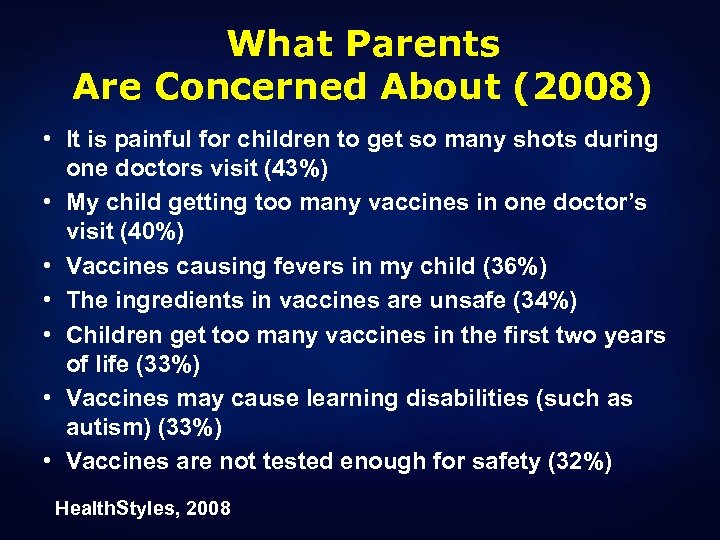
What Parents Are Concerned About (2008) • It is painful for children to get so many shots during one doctors visit (43%) • My child getting too many vaccines in one doctor’s visit (40%) • Vaccines causing fevers in my child (36%) • The ingredients in vaccines are unsafe (34%) • Children get too many vaccines in the first two years of life (33%) • Vaccines may cause learning disabilities (such as autism) (33%) • Vaccines are not tested enough for safety (32%) Health. Styles, 2008
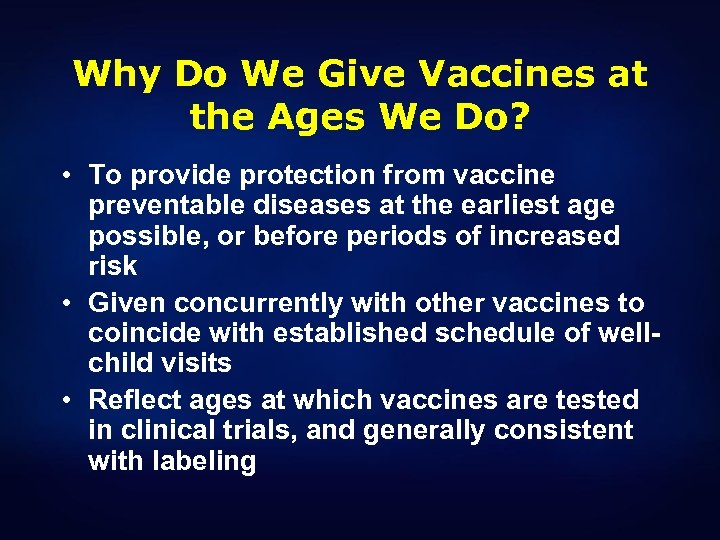
Why Do We Give Vaccines at the Ages We Do? • To provide protection from vaccine preventable diseases at the earliest age possible, or before periods of increased risk • Given concurrently with other vaccines to coincide with established schedule of wellchild visits • Reflect ages at which vaccines are tested in clinical trials, and generally consistent with labeling
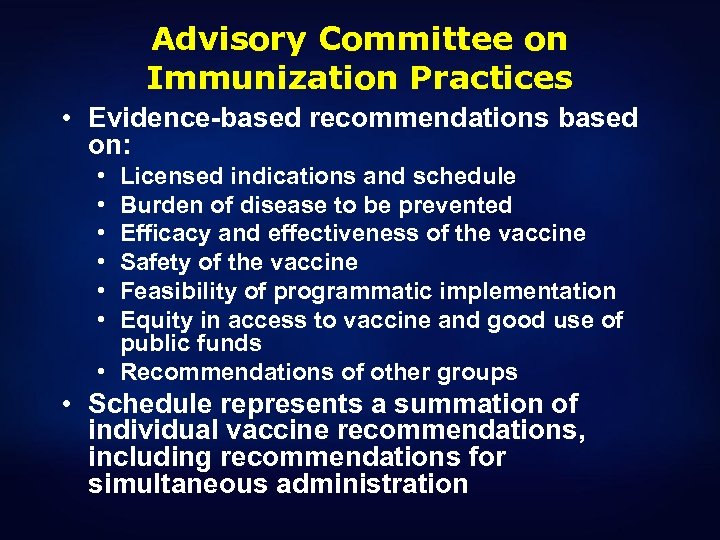
Advisory Committee on Immunization Practices • Evidence-based recommendations based on: • • • Licensed indications and schedule Burden of disease to be prevented Efficacy and effectiveness of the vaccine Safety of the vaccine Feasibility of programmatic implementation Equity in access to vaccine and good use of public funds • Recommendations of other groups • Schedule represents a summation of individual vaccine recommendations, including recommendations for simultaneous administration
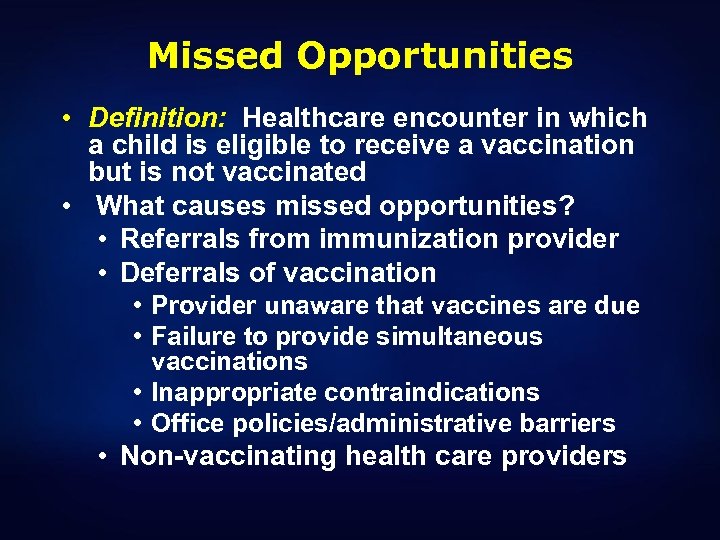
Missed Opportunities • Definition: Healthcare encounter in which a child is eligible to receive a vaccination but is not vaccinated • What causes missed opportunities? • Referrals from immunization provider • Deferrals of vaccination • Provider unaware that vaccines are due • Failure to provide simultaneous vaccinations • Inappropriate contraindications • Office policies/administrative barriers • Non-vaccinating health care providers
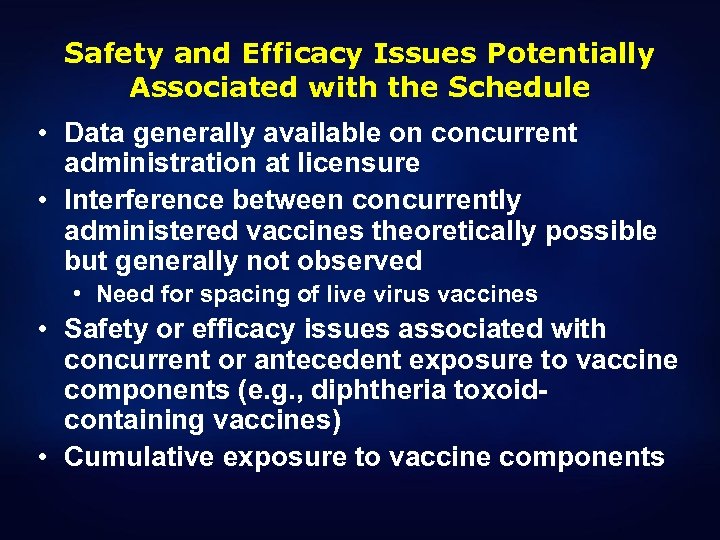
Safety and Efficacy Issues Potentially Associated with the Schedule • Data generally available on concurrent administration at licensure • Interference between concurrently administered vaccines theoretically possible but generally not observed • Need for spacing of live virus vaccines • Safety or efficacy issues associated with concurrent or antecedent exposure to vaccine components (e. g. , diphtheria toxoidcontaining vaccines) • Cumulative exposure to vaccine components
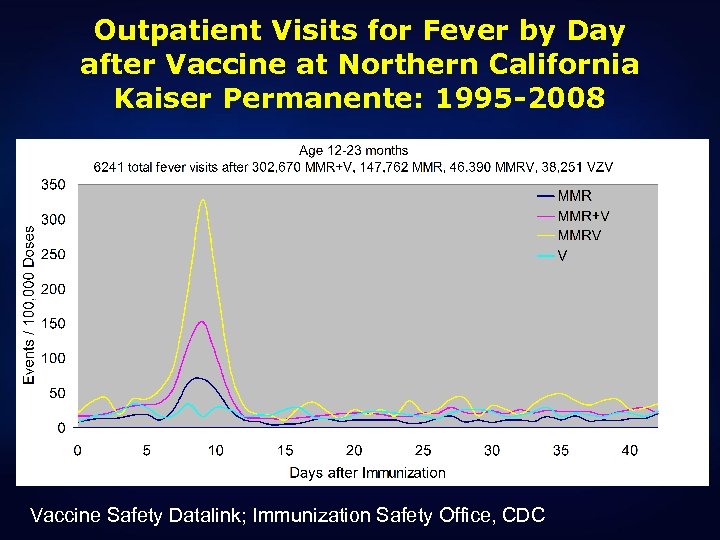
Outpatient Visits for Fever by Day after Vaccine at Northern California Kaiser Permanente: 1995 -2008 Vaccine Safety Datalink; Immunization Safety Office, CDC
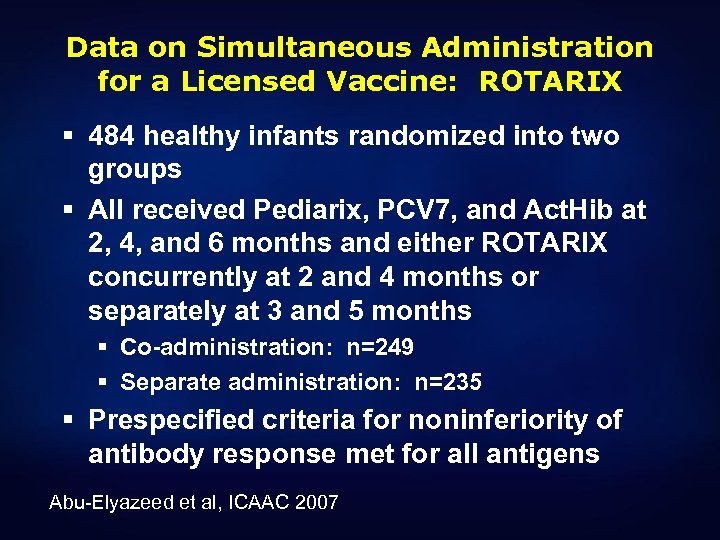
Data on Simultaneous Administration for a Licensed Vaccine: ROTARIX § 484 healthy infants randomized into two groups § All received Pediarix, PCV 7, and Act. Hib at 2, 4, and 6 months and either ROTARIX concurrently at 2 and 4 months or separately at 3 and 5 months § Co-administration: n=249 § Separate administration: n=235 § Prespecified criteria for noninferiority of antibody response met for all antigens Abu-Elyazeed et al, ICAAC 2007

The Science of Studying More than One Thing at a Time § Rapid advances in multiple fields of biology have made it possible to study complex biological reactions at the cellular level § These new “systems biology” approaches are beginning to be applied to questions about vaccines
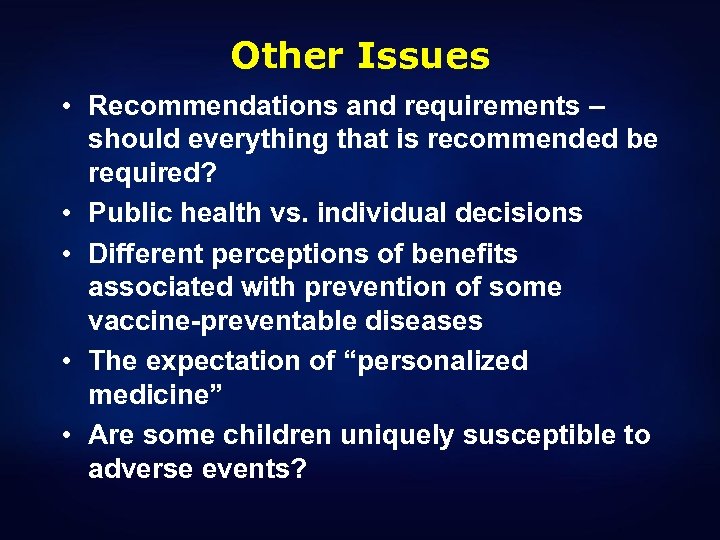
Other Issues • Recommendations and requirements – should everything that is recommended be required? • Public health vs. individual decisions • Different perceptions of benefits associated with prevention of some vaccine-preventable diseases • The expectation of “personalized medicine” • Are some children uniquely susceptible to adverse events?
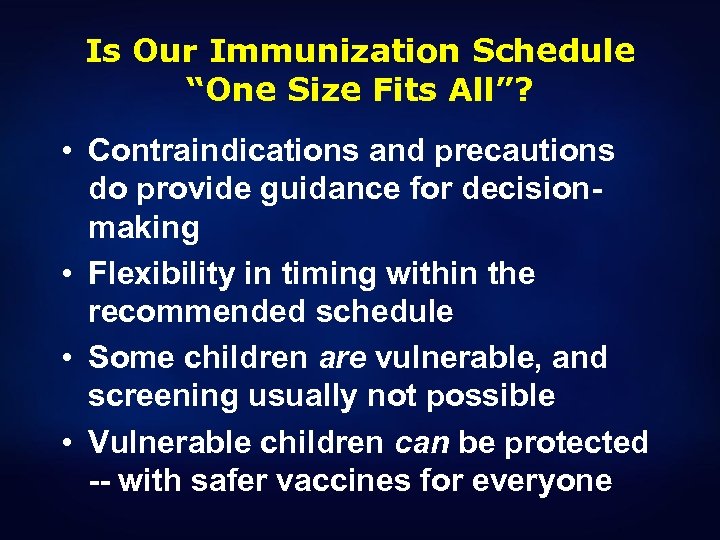
Is Our Immunization Schedule “One Size Fits All”? • Contraindications and precautions do provide guidance for decisionmaking • Flexibility in timing within the recommended schedule • Some children are vulnerable, and screening usually not possible • Vulnerable children can be protected -- with safer vaccines for everyone
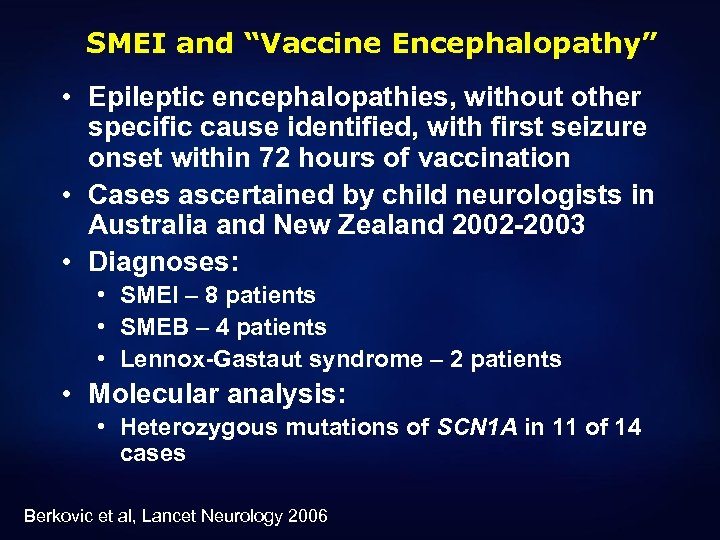
SMEI and “Vaccine Encephalopathy” • Epileptic encephalopathies, without other specific cause identified, with first seizure onset within 72 hours of vaccination • Cases ascertained by child neurologists in Australia and New Zealand 2002 -2003 • Diagnoses: • SMEI – 8 patients • SMEB – 4 patients • Lennox-Gastaut syndrome – 2 patients • Molecular analysis: • Heterozygous mutations of SCN 1 A in 11 of 14 cases Berkovic et al, Lancet Neurology 2006
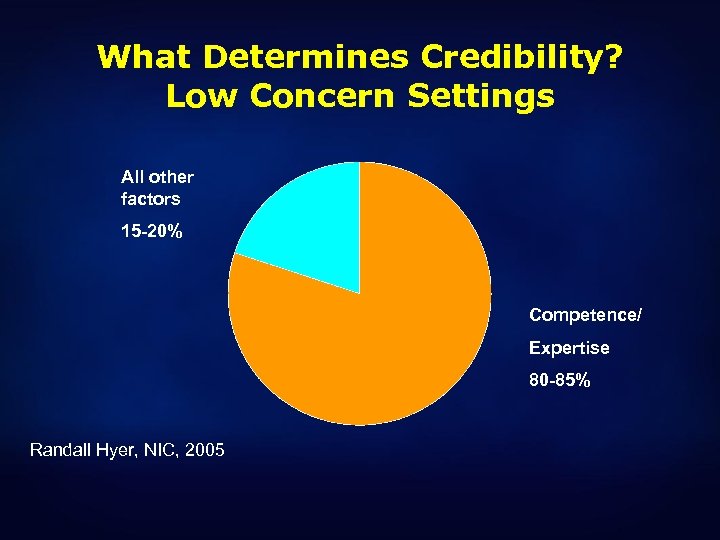
What Determines Credibility? Low Concern Settings All other factors 15 -20% Competence/ Expertise 80 -85% Randall Hyer, NIC, 2005
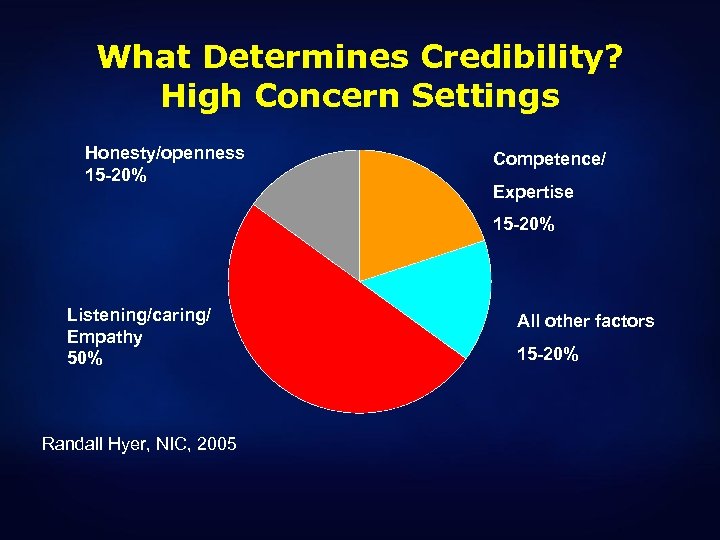
What Determines Credibility? High Concern Settings Honesty/openness 15 -20% Competence/ Expertise 15 -20% Listening/caring/ Empathy 50% Randall Hyer, NIC, 2005 All other factors 15 -20%
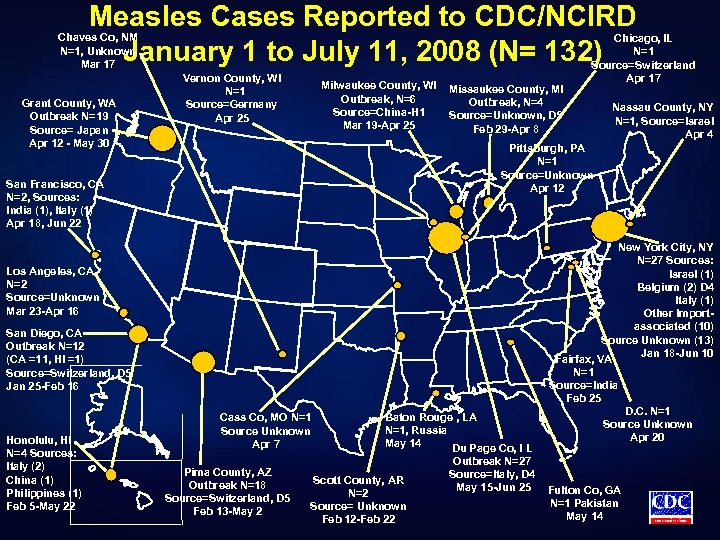
Measles Cases Reported to CDC/NCIRD January 1 to July 11, 2008 (N= 132) Chaves Co, NM N=1, Unknown Mar 17 Grant County, WA Outbreak N=19 Source= Japan Apr 12 - May 30 Vernon County, WI N=1 Source=Germany Apr 25 Milwaukee County, WI Outbreak, N=6 Source=China-H 1 Mar 19 -Apr 25 Missaukee County, MI Outbreak, N=4 Source=Unknown, D 5 Feb 29 -Apr 8 Nassau County, NY N=1, Source=Israel Apr 4 Pittsburgh, PA N=1 Source=Unknown Apr 12 San Francisco, CA N=2, Sources: India (1), Italy (1) Apr 18, Jun 22 Los Angeles, CA N=2 Source=Unknown Mar 23 -Apr 16 San Diego, CA Outbreak N=12 (CA =11, HI =1) Source=Switzerland, D 5 Jan 25 -Feb 16 Honolulu, HI N=4 Sources: Italy (2) China (1) Philippines (1) Feb 5 -May 22 Chicago, IL N=1 Source=Switzerland Apr 17 Cass Co, MO N=1 Source Unknown Apr 7 Pima County, AZ Outbreak N=18 Source=Switzerland, D 5 Feb 13 -May 2 Baton Rouge , LA N=1, Russia May 14 Du Page Co, I L Scott County, AR N=2 Source= Unknown Feb 12 -Feb 22 Outbreak N=27 Source=Italy, D 4 May 15 -Jun 25 New York City, NY N=27 Sources: Israel (1) Belgium (2) D 4 Italy (1) Other Importassociated (10) Source Unknown (13) Jan 18 -Jun 10 Fairfax, VA N=1 Source=India Feb 25 D. C. N=1 Source Unknown Apr 20 Fulton Co, GA N=1 Pakistan May 14
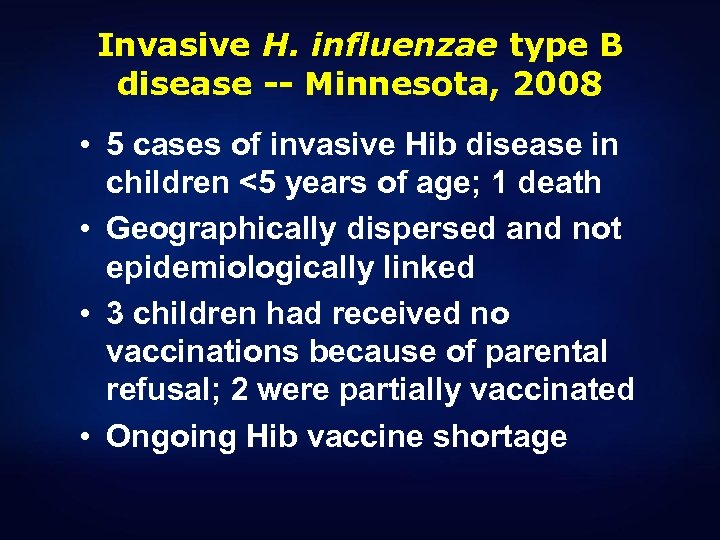
Invasive H. influenzae type B disease -- Minnesota, 2008 • 5 cases of invasive Hib disease in children <5 years of age; 1 death • Geographically dispersed and not epidemiologically linked • 3 children had received no vaccinations because of parental refusal; 2 were partially vaccinated • Ongoing Hib vaccine shortage
Where That Leaves Us • When we do more than one thing at a time, it’s complicated - and we should acknowledge that • We need to help immunization providers help parents deal with a very complex set of decisions • Vaccination is the best way to protect children from 16 vaccine-preventable diseases
www. cdc. gov/vaccinesafety
Скачать презентацию What Immunization Providers Need to Know about Vaccine
50a6873c9da6b549340247a3738d82a5.ppt