 Скачать презентацию What Have we Learned from the Commercial Buck
e30f8b8eeb8db7b185148797b27740dd.ppt
- Количество слайдов: 1



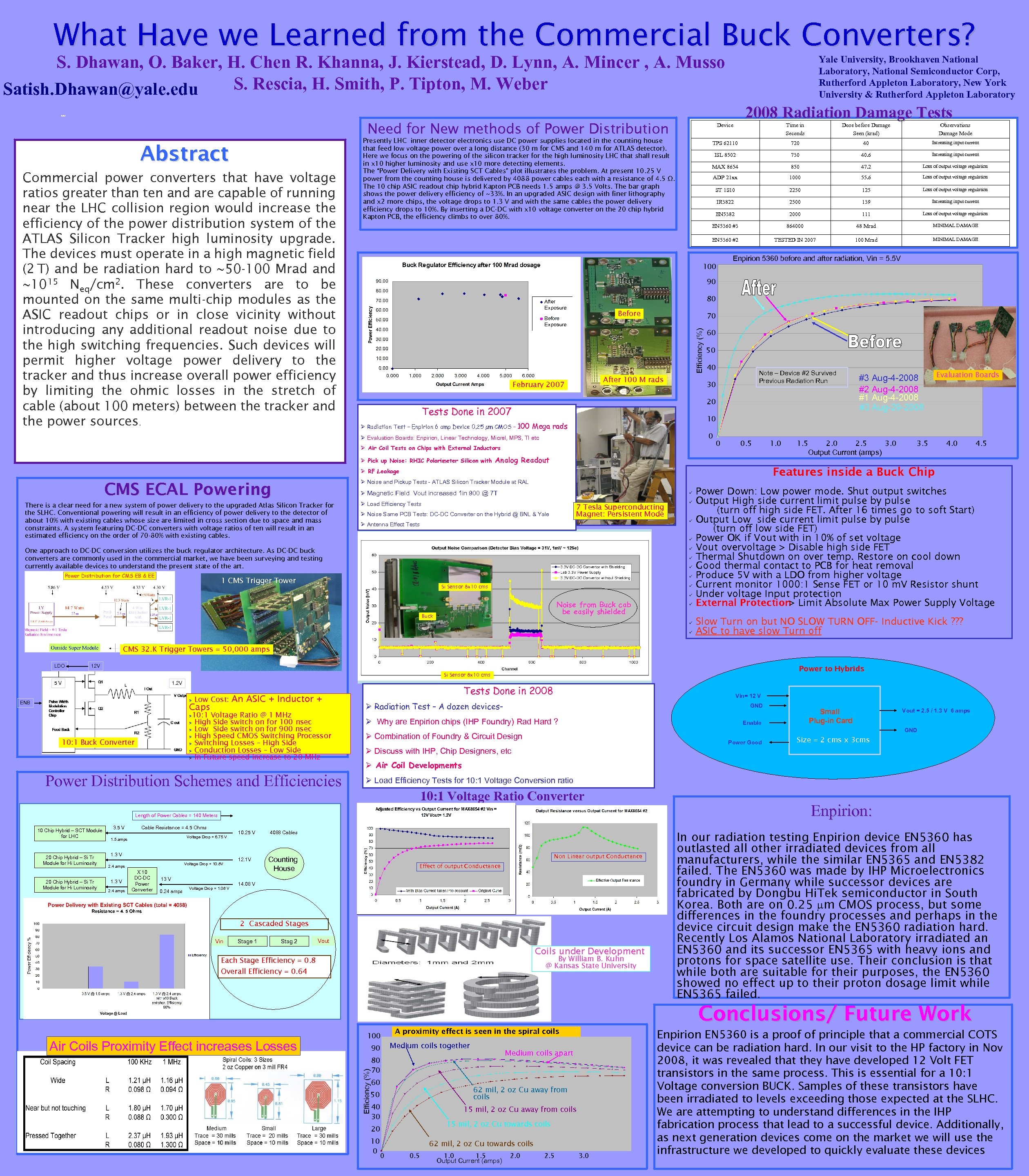
What Have we Learned from the Commercial Buck Converters? S. Dhawan, O. Baker, H. Chen R. Khanna, J. Kierstead, D. Lynn, A. Mincer , A. Musso S. Rescia, H. Smith, P. Tipton, M. Weber Satish. Dhawan@yale. edu 2008 Radiation Damage Tests Need for New methods of Power Distribution Commercial power converters that have voltage ratios greater than ten and are capable of running near the LHC collision region would increase the efficiency of the power distribution system of the ATLAS Silicon Tracker high luminosity upgrade. The devices must operate in a high magnetic field (2 T) and be radiation hard to ~50 -100 Mrad and ~1015 Neq/cm 2. These converters are to be mounted on the same multi-chip modules as the ASIC readout chips or in close vicinity without introducing any additional readout noise due to the high switching frequencies. Such devices will permit higher voltage power delivery to the tracker and thus increase overall power efficiency by limiting the ohmic losses in the stretch of cable (about 100 meters) between the tracker and the power sources. Device Time in Seconds Dose before Damage Seen (krad) Observations Damage Mode TPS 62110 720 40 Increasing input current ISL 8502 730 40. 6 Increasing input current MAX 8654 850 47. 2 Loss of output voltage regulation ADP 21 xx 1000 55. 6 Loss of output voltage regulation ST 1 S 10 2250 125 Loss of output voltage regulation IR 3822 2500 139 Increasing input current EN 5382 2000 111 Loss of output voltage regulation EN 5360 #3 864000 48 Mrad MINIMAL DAMAGE EN 5360 #2 Presently LHC inner detector electronics use DC power supplies located in the counting house that feed low voltage power over a long distance (30 m for CMS and 140 m for ATLAS detector). Here we focus on the powering of the silicon tracker for the high luminosity LHC that shall result in x 10 higher luminosity and use x 10 more detecting elements. The “Power Delivery with Existing SCT Cables” plot illustrates the problem. At present 10. 25 V power from the counting house is delivered by 4088 power cables each with a resistance of 4. 5 Ω. The 10 chip ASIC readout chip hybrid Kapton PCB needs 1. 5 amps @ 3. 5 Volts. The bar graph shows the power delivery efficiency of ~33%. In an upgraded ASIC design with finer lithography and x 2 more chips, the voltage drops to 1. 3 V and with the same cables the power delivery efficiency drops to 10%. By inserting a DC-DC with x 10 voltage converter on the 20 chip hybrid Kapton PCB, the efficiency climbs to over 80%. TESTED IN 2007 100 Mrad MINIMAL DAMAGE 100 Enpirion 5360 before and after radiation, Vin = 5. 5 V 90 80 Before 70 Efficiency (%) Abstract Yale University, Brookhaven National Laboratory, National Semiconductor Corp, Rutherford Appleton Laboratory, New York University & Rutherford Appleton Laboratory After 100 M rads February 2007 40 Note – Device #2 Survived Previous Radiation Run 20 #3 Aug-4 -2008 #2 Aug-4 -2008 #1 Aug-4 -2008 #3 Aug-29 -2008 Evaluation Boards 10 Mega rads 0 Ø Evaluation Boards: Enpirion, Linear Technology, Micrel, MPS, TI etc Ø Air Coil Tests on Chips with External Inductors Ø Pick up Noise: RHIC Polarimeter Silicon with 50 30 Tests Done in 2007 Ø Radiation Test – Enpirion 6 amp Device 0. 25 µm CMOS – 100 60 0 0. 5 Analog Readout 1. 0 1. 5 2. 0 2. 5 3. 0 Output Current (amps) 3. 5 4. 0 4. 5 Features inside a Buck Chip Ø RF Leakage Ø Noise and Pickup Tests - ATLAS Silicon Tracker Module at RAL CMS ECAL Powering Ø Magnetic Field Vout increased 1 in 900 @ 7 T There is a clear need for a new system of power delivery to the upgraded Atlas Silicon Tracker for the SLHC. Conventional powering will result in an efficiency of power delivery to the detector of about 10% with existing cables whose size are limited in cross section due to space and mass constraints. A system featuring DC-DC converters with voltage ratios of ten will result in an estimated efficiency on the order of 70 -80% with existing cables. ü Ø Load Efficiency Tests 7 Tesla Superconducting Magnet: Persistent Mode Ø Noise Same PCB Tests: DC-DC Converter on the Hybrid @ BNL & Yale ü ü Ø Antenna Effect Tests ü ü One approach to DC-DC conversion utilizes the buck regulator architecture. As DC-DC buck converters are commonly used in the commercial market, we have been surveying and testing currently available devices to understand the present state of the art. ü ü ü 1 CMS Trigger Tower ü Si Sensor 8 x 10 cms ü Noise from Buck cab be easily shielded Buck ü ü ü Power Down: Low power mode. Shut output switches Output High side current limit pulse by pulse (turn off high side FET. After 16 times go to soft Start) Output Low side current limit pulse by pulse (turn off low side FET) Power OK if Vout with in 10% of set voltage Vout overvoltage > Disable high side FET Thermal Shutdown on over temp. Restore on cool down Good thermal contact to PCB for heat removal Produce 5 V with a LDO from higher voltage Current monitor 1000: 1 Sense FET or 10 m. V Resistor shunt Under voltage Input protection External Protection Limit Absolute Max Power Supply Voltage > Slow Turn on but NO SLOW TURN OFF- Inductive Kick ? ? ? ASIC to have slow Turn off CMS 32. K Trigger Towers = 50 K amps 50, 000 amps LDO 12 V Power to Hybrids Si Sensor 8 x 10 cms 5 V 1. 2 V Ø ENB Low Cost: Caps An ASIC + Inductor + 10: 1 Voltage Ratio @ 1 MHz Ø High Side switch on for 100 nsec Ø Low Side switch on for 900 nsec Ø High Speed CMOS Switching Processor Ø Switching Losses – High Side Ø Conduction Losses – Low Side Ø In Future speed increase to 20 MHz Ø 10: 1 Buck Converter Power Distribution Schemes and Efficiencies Tests Done in 2008 Vin= 12 V Ø Radiation Test – A dozen devices- GND Ø Why are Enpirion chips (IHP Foundry) Rad Hard ? Enable 20 Chip Hybrid – Si Tr Module for Hi Luminosity 3. 5 V Cable Resistance = 4. 5 Ohms Voltage Drop = 6. 75 V 1. 5 amps 1. 3 V Voltage Drop = 10. 8 V 2. 4 amps 1. 3 V 2. 4 amps X 10 DC-DC Power Converter 13 V 0. 24 amps Voltage Drop = 1. 08 V 10. 25 V 12. 1 V Ø Combination of Foundry & Circuit Design Power Good Ø Air Coil Developments Ø Load Efficiency Tests for 10: 1 Voltage Conversion ratio 10: 1 Voltage Ratio Converter 4088 Cables Non Linear output Conductance Counting House Effect of output Conductance 14. 08 V Stage 1 Stag 2 Size = 2 cms x 3 cms Ø Discuss with IHP, Chip Designers, etc 2 Cascaded Stages Vin Vout = 2. 5 / 1. 3 V 6 amps GND Length of Power Cables = 140 Meters 10 Chip Hybrid – SCT Module for LHC Small Plug-in Card Vout Coils under Development By William B. Kuhn @ Kansas State University Each Stage Efficiency = 0. 8 Overall Efficiency = 0. 64 Enpirion: In our radiation testing Enpirion device EN 5360 has outlasted all other irradiated devices from all manufacturers, while the similar EN 5365 and EN 5382 failed. The EN 5360 was made by IHP Microelectronics foundry in Germany while successor devices are fabricated by Dongbu Hi. Tek semiconductor in South Korea. Both are on 0. 25 mm CMOS process, but some differences in the foundry processes and perhaps in the device circuit design make the EN 5360 radiation hard. Recently Los Alamos National Laboratory irradiated an EN 5360 and its successor EN 5365 with heavy ions and protons for space satellite use. Their conclusion is that while both are suitable for their purposes, the EN 5360 showed no effect up to their proton dosage limit while EN 5365 failed. Conclusions/ Future Work 90 Efficiency (%) Air Coils Proximity Effect increases Losses 100 A proximity effect is seen in the spiral coils Medium coils together Medium coils apart 80 70 60 50 62 mil, 2 oz Cu away from coils 40 30 15 mil, 2 oz Cu away from coils 15 mil, 2 oz Cu towards coils 20 10 0 62 mil, 2 oz Cu towards coils 0 0. 5 1. 0 1. 5 Output Current (amps) 2. 0 2. 5 3. 0 Enpirion EN 5360 is a proof of principle that a commercial COTS device can be radiation hard. In our visit to the HP factory in Nov 2008, it was revealed that they have developed 12 Volt FET transistors in the same process. This is essential for a 10: 1 Voltage conversion BUCK. Samples of these transistors have been irradiated to levels exceeding those expected at the SLHC. We are attempting to understand differences in the IHP fabrication process that lead to a successful device. Additionally, as next generation devices come on the market we will use the infrastructure we developed to quickly evaluate these devices
Скачать презентацию What Have we Learned from the Commercial Buck
e30f8b8eeb8db7b185148797b27740dd.ppt