


 Скачать презентацию What have we learned from RHIC Mark D
c0fc3c85c05b27fc6e59899911bff693.ppt
- Количество слайдов: 39
 What have we learned from RHIC? Mark D. Baker Chemistry Department Thanks to: W. Busza, Axel Drees, J. Katzy, B. Lugo, P. Steinberg, N. Xu, F. Wolfs BSA Lecture Committee Particle Data Group http: //Particle. Adventure. org/ Mark D. Baker
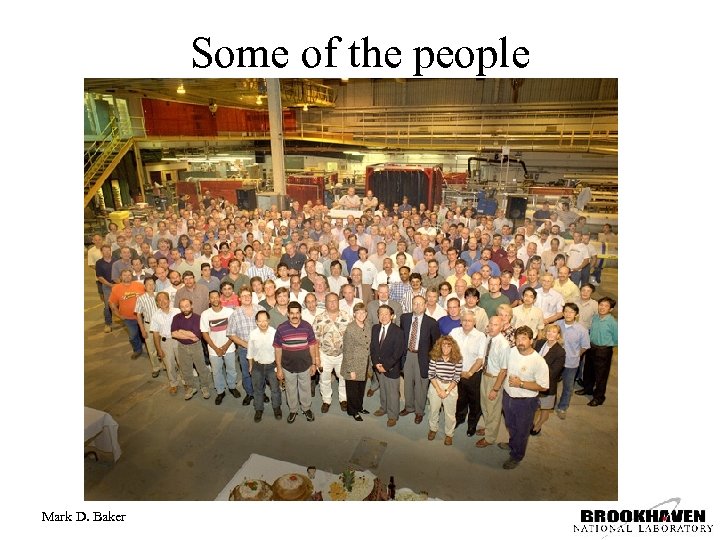 Some of the people Mark D. Baker
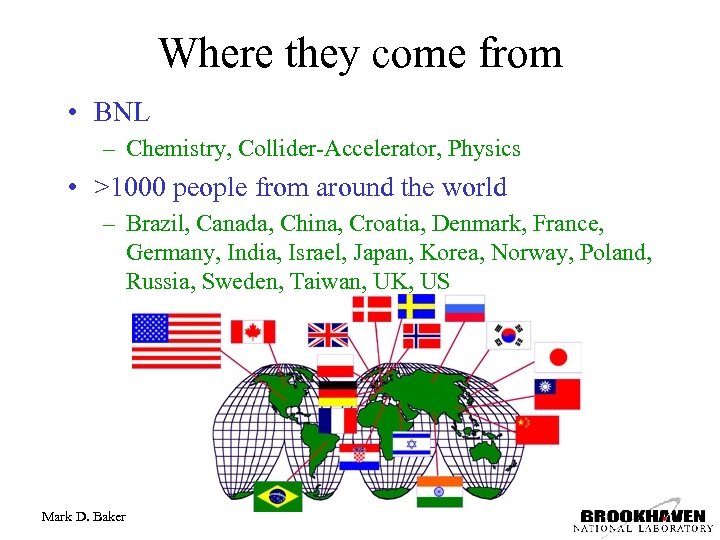 Where they come from • BNL – Chemistry, Collider-Accelerator, Physics • >1000 people from around the world – Brazil, Canada, China, Croatia, Denmark, France, Germany, India, Israel, Japan, Korea, Norway, Poland, Russia, Sweden, Taiwan, UK, US Mark D. Baker
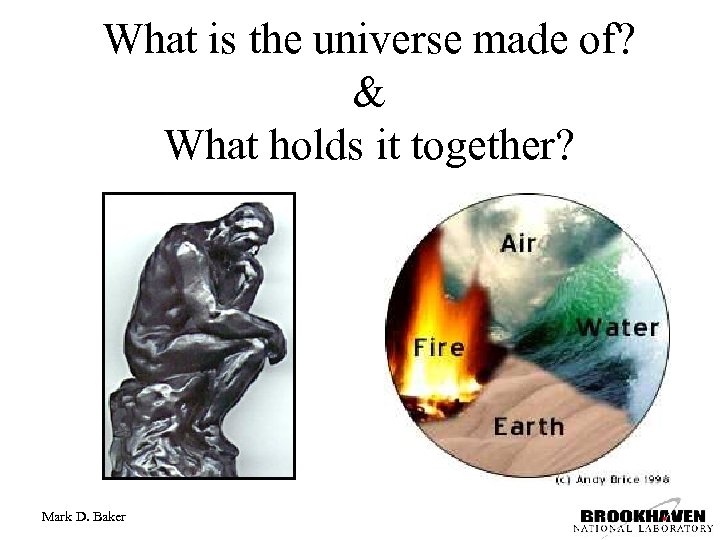 What is the universe made of? & What holds it together? Mark D. Baker
 What is the universe made of? Placeholder Mark D. Baker
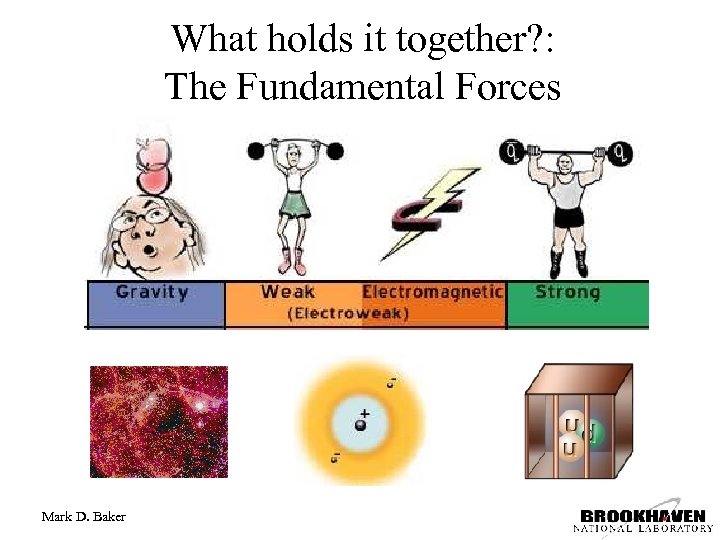 What holds it together? : The Fundamental Forces Mark D. Baker
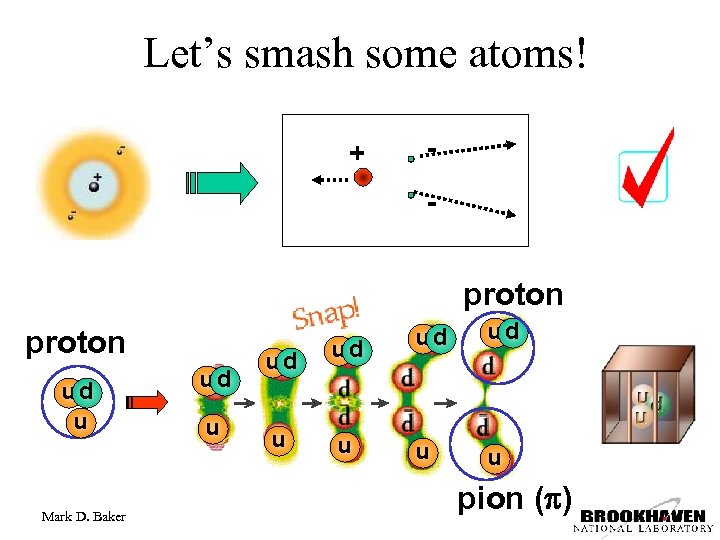 Let’s smash some atoms! + - proton ud u Mark D. Baker ud ud ud u pion (p)
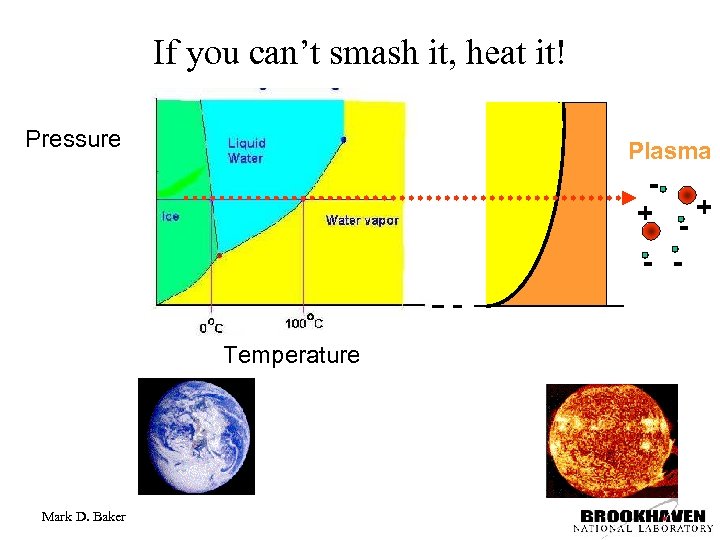 If you can’t smash it, heat it! Pressure Plasma + -+ - Temperature Mark D. Baker
 Sideways slide - How much heat? Placeholder Mark D. Baker
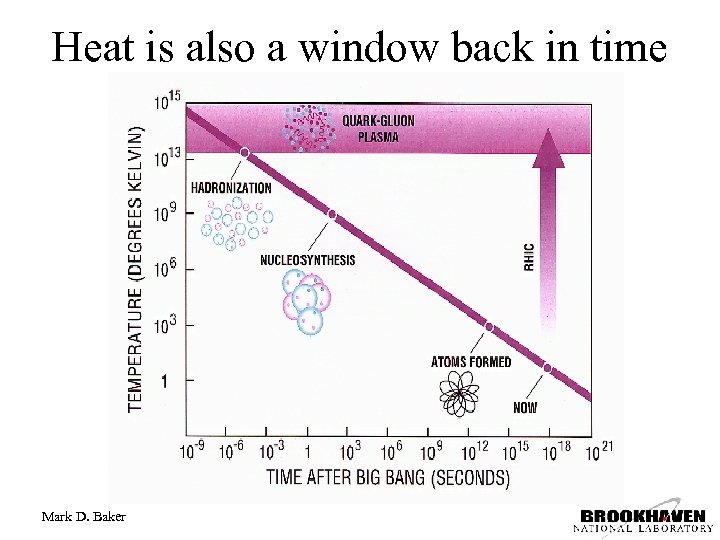 Heat is also a window back in time Mark D. Baker
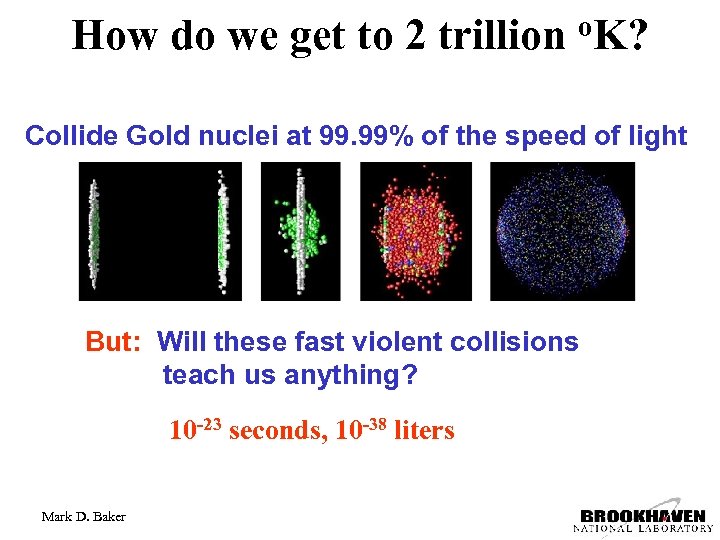 How do we get to 2 trillion o. K? Collide Gold nuclei at 99. 99% of the speed of light But: Will these fast violent collisions teach us anything? 10 -23 seconds, 10 -38 liters Mark D. Baker
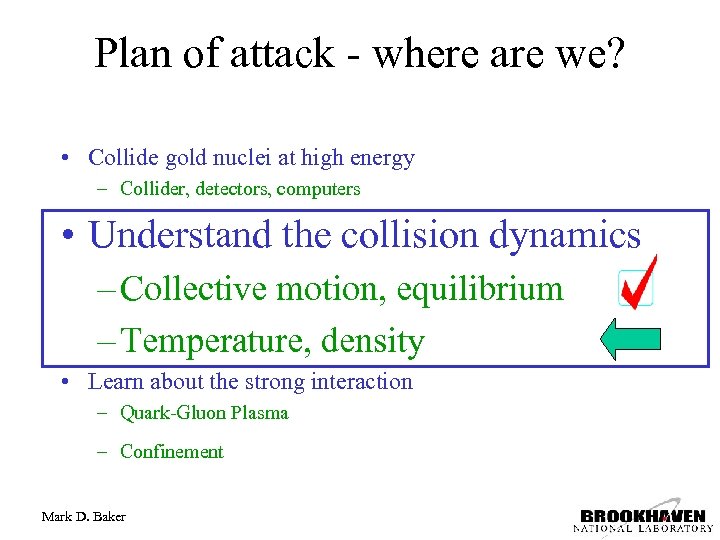
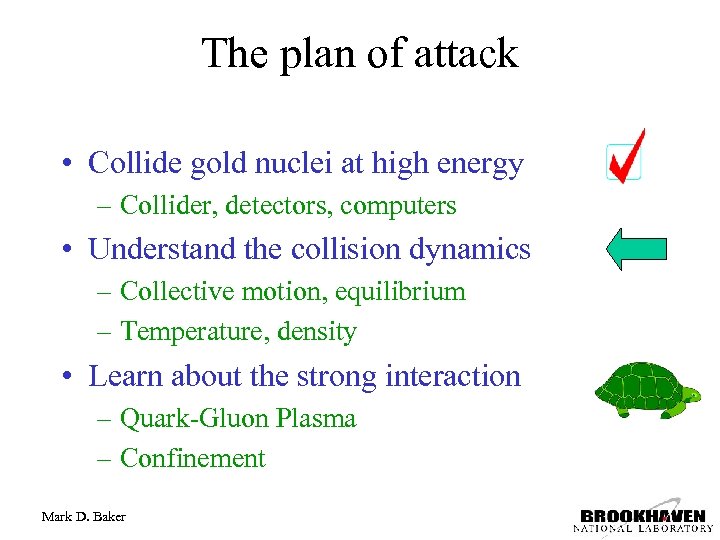 The plan of attack • Collide gold nuclei at high energy – Collider, detectors, computers • Understand the collision dynamics – Collective motion, equilibrium – Temperature, density • Learn about the strong interaction – Quark-Gluon Plasma – Confinement Mark D. Baker
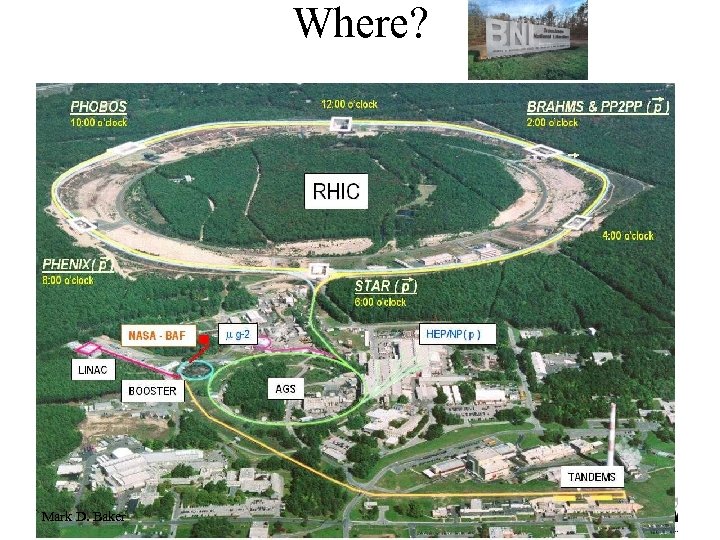 Where? Mark D. Baker
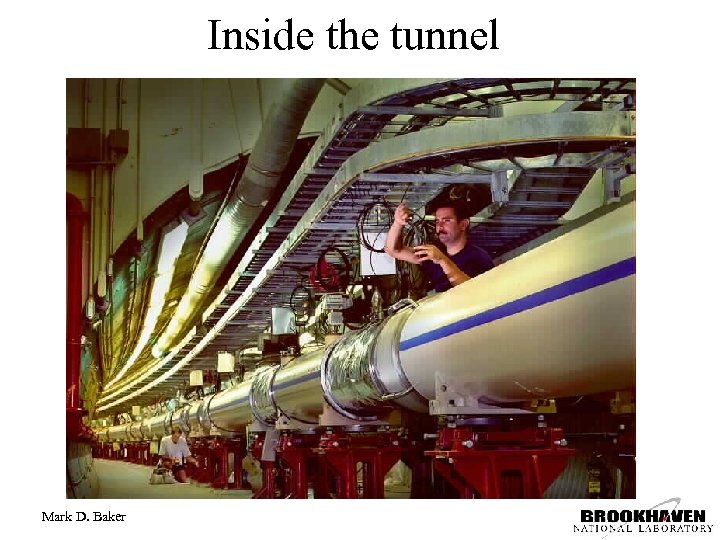 Inside the tunnel Mark D. Baker
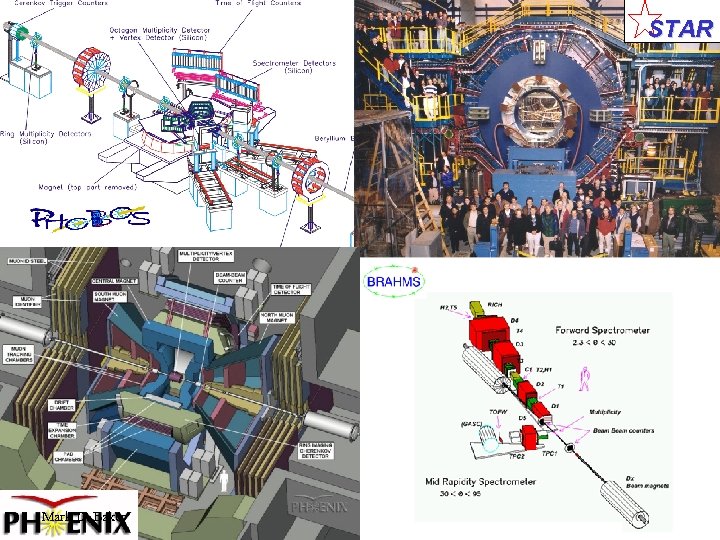 STAR Mark D. Baker
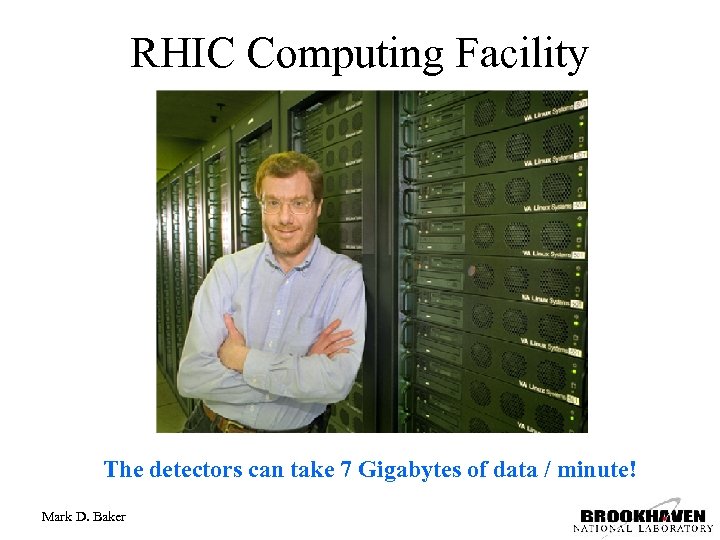 RHIC Computing Facility The detectors can take 7 Gigabytes of data / minute! Mark D. Baker
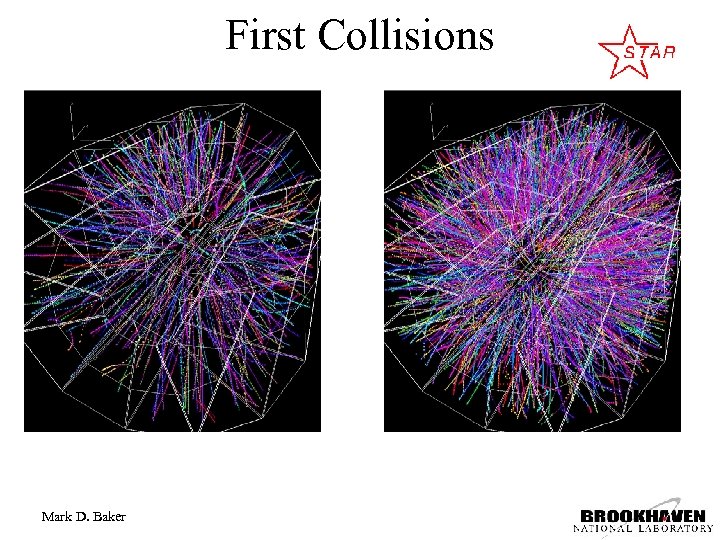 First Collisions Mark D. Baker
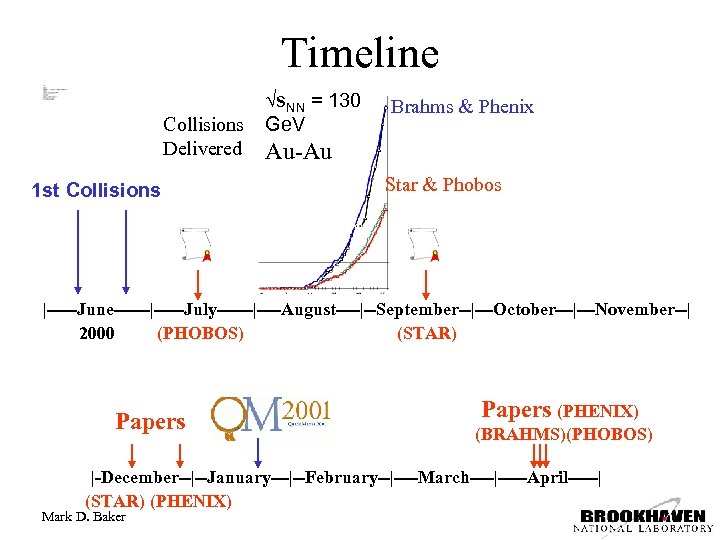 Timeline Collisions Delivered 1 st Collisions s. NN = 130 Ge. V Brahms & Phenix Au-Au Star & Phobos |-----June------|-----July------|----August----|--September--|---October---|---November--| 2000 (PHOBOS) (STAR) Papers (PHENIX) (BRAHMS)(PHOBOS) |-December--|--January---|--February--|----March----|-----April-----| (STAR) (PHENIX) Mark D. Baker
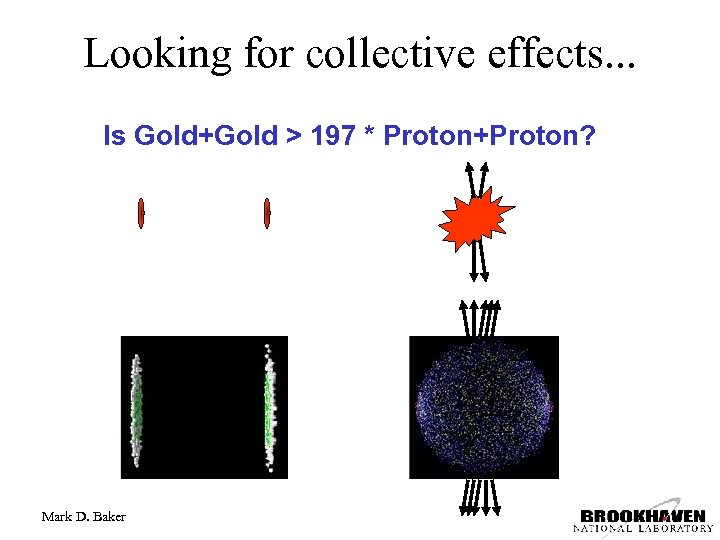 Looking for collective effects. . . Is Gold+Gold > 197 * Proton+Proton? Mark D. Baker
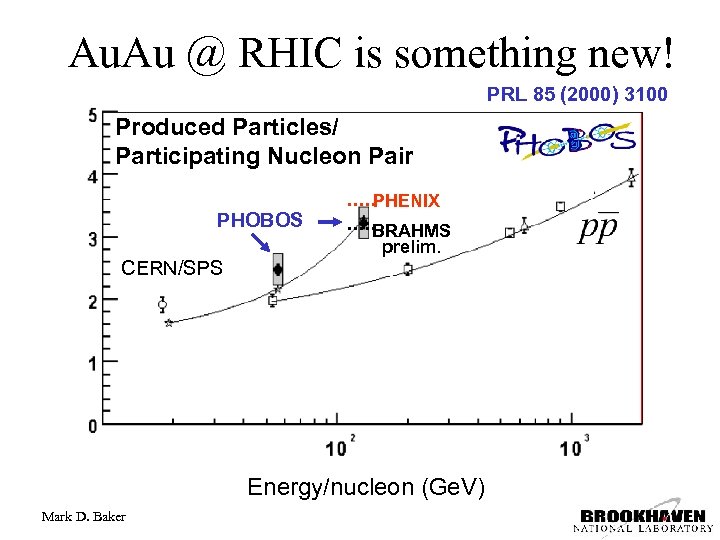 Au. Au @ RHIC is something new! PRL 85 (2000) 3100 Produced Particles/ Participating Nucleon Pair PHOBOS PHENIX BRAHMS prelim. CERN/SPS Energy/nucleon (Ge. V) Mark D. Baker
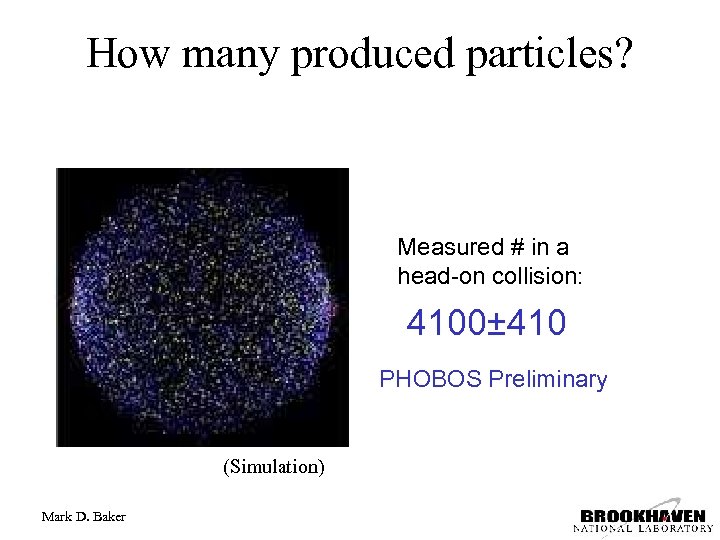 How many produced particles? Measured # in a head-on collision: 4100± 410 PHOBOS Preliminary (Simulation) Mark D. Baker
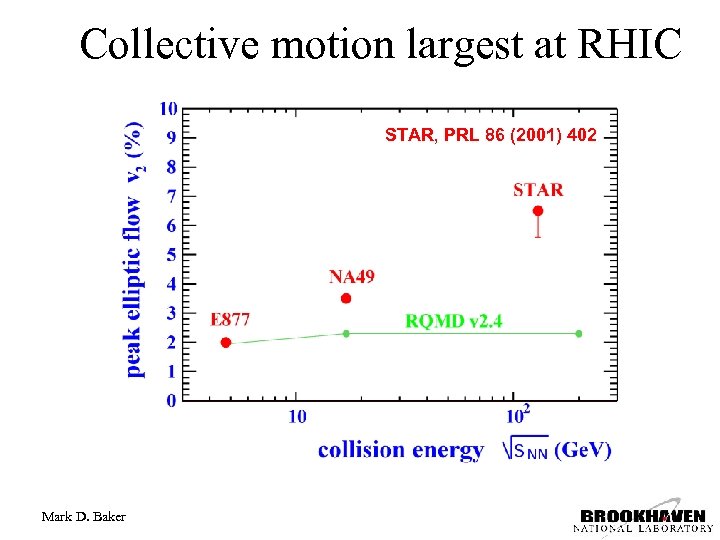
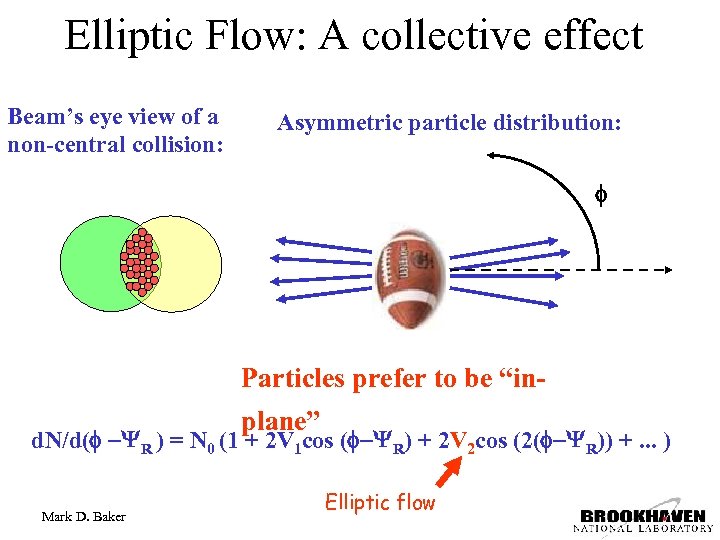 Elliptic Flow: A collective effect Beam’s eye view of a non-central collision: Asymmetric particle distribution: f Particles prefer to be “inplane” d. N/d(f -YR ) = N 0 (1 + 2 V 1 cos (f-YR) + 2 V 2 cos (2(f-YR)) +. . . ) Mark D. Baker Elliptic flow
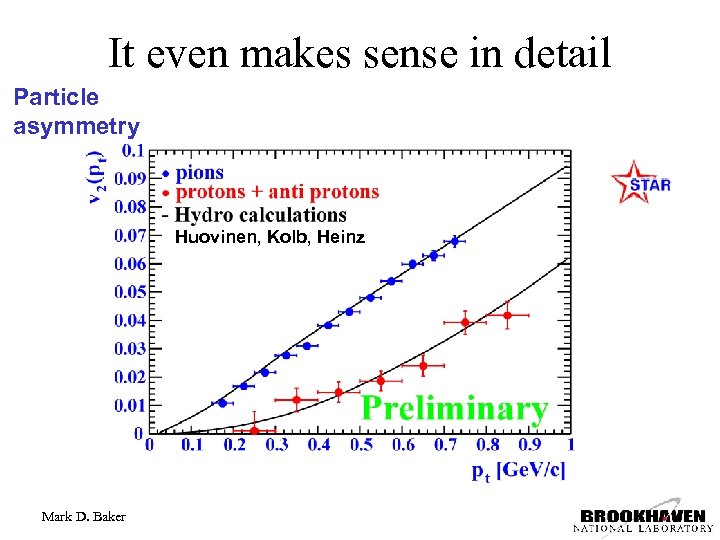
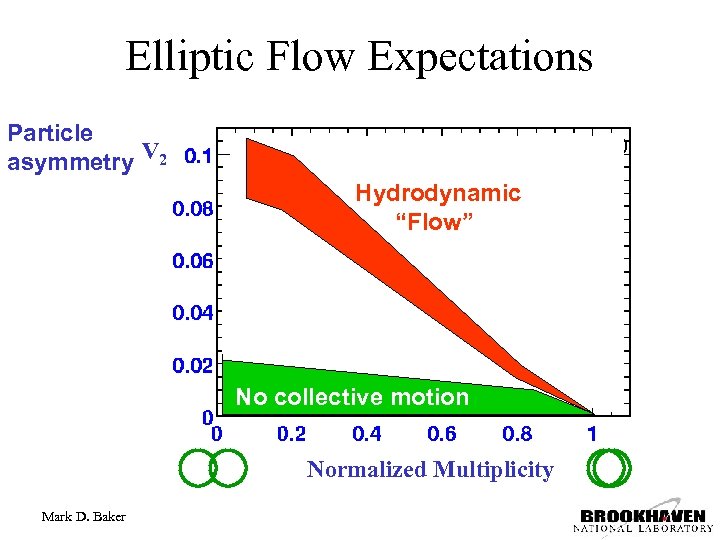 Elliptic Flow Expectations Particle asymmetry V 2 midrapidity : | | < 1. 0 Hydrodynamic model Hydrodynamic Preliminary “Flow” No collective motion Normalized Multiplicity Mark D. Baker
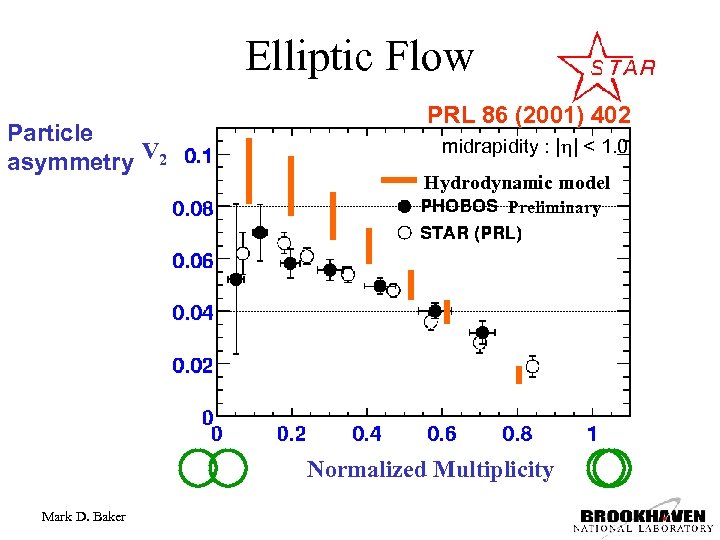 Elliptic Flow Particle asymmetry V 2 PRL 86 (2001) 402 midrapidity : | | < 1. 0 Hydrodynamic model Preliminary Normalized Multiplicity Mark D. Baker
 Collective motion largest at RHIC STAR, PRL 86 (2001) 402 Mark D. Baker
 It even makes sense in detail Particle asymmetry Huovinen, Kolb, Heinz Mark D. Baker
 Plan of attack - where are we? • Collide gold nuclei at high energy – Collider, detectors, computers • Understand the collision dynamics – Collective motion, equilibrium – Temperature, density • Learn about the strong interaction – Quark-Gluon Plasma – Confinement Mark D. Baker
 We see the conditions at freezeout (a lower limit to the maximum Temperature) Hottest period Freezeout Expansion cooling Mark D. Baker
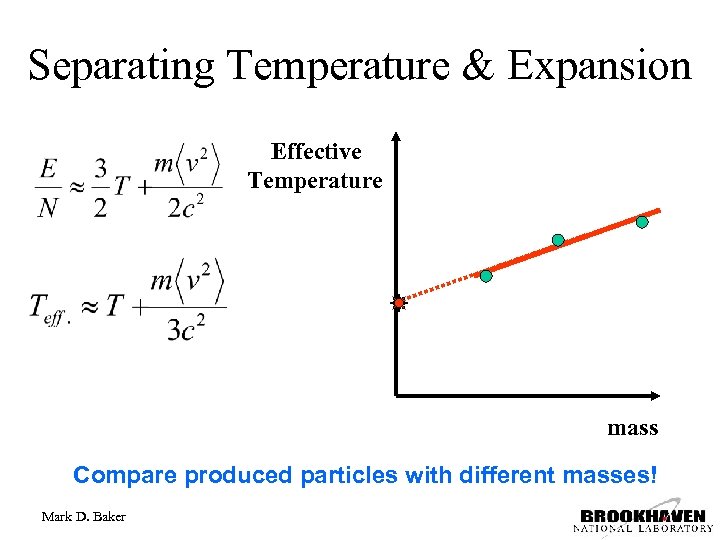 Separating Temperature & Expansion Effective Temperature mass Compare produced particles with different masses! Mark D. Baker
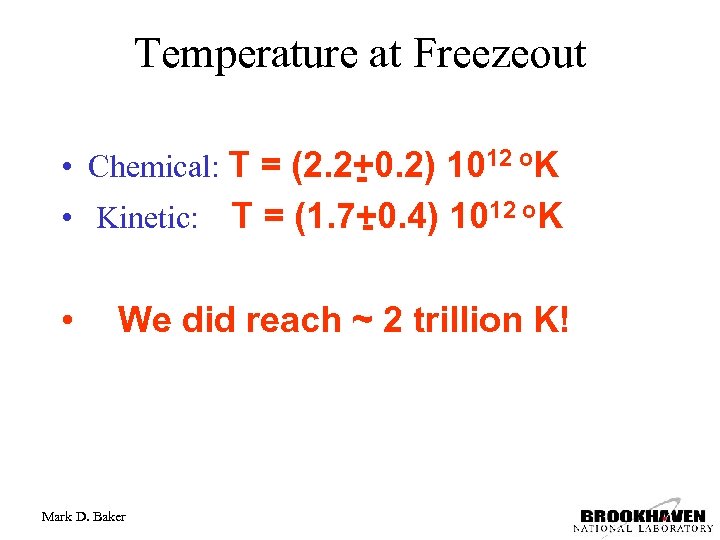
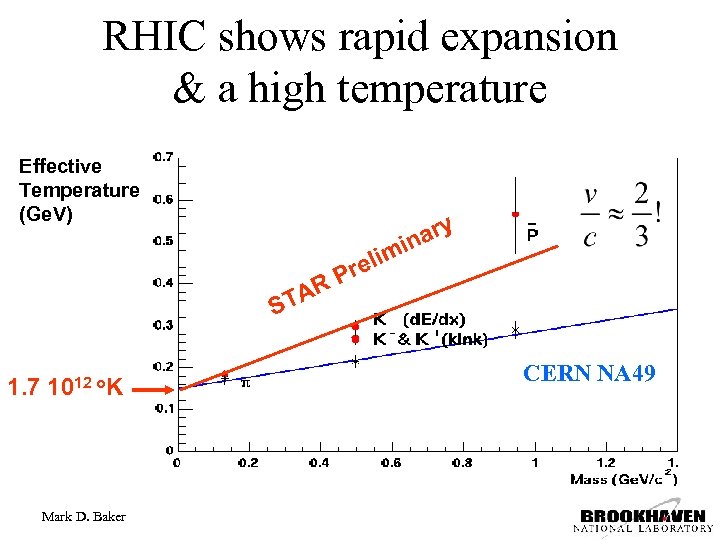 RHIC shows rapid expansion & a high temperature Effective Temperature (Ge. V) ary in AR T elim Pr S 1. 7 1012 o. K Mark D. Baker CERN NA 49
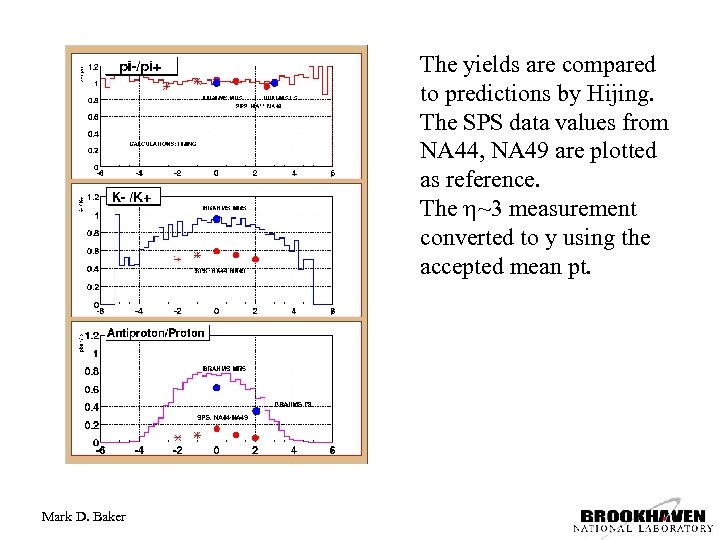
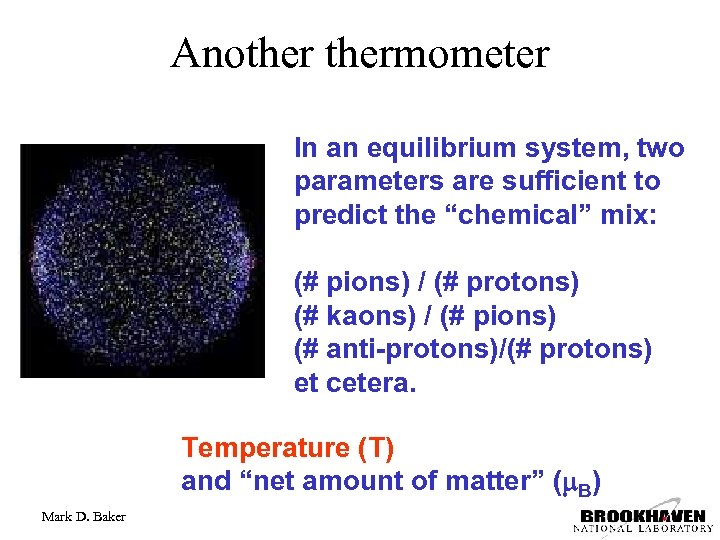 Anothermometer In an equilibrium system, two parameters are sufficient to predict the “chemical” mix: (# pions) / (# protons) (# kaons) / (# pions) (# anti-protons)/(# protons) et cetera. Temperature (T) and “net amount of matter” (m. B) Mark D. Baker
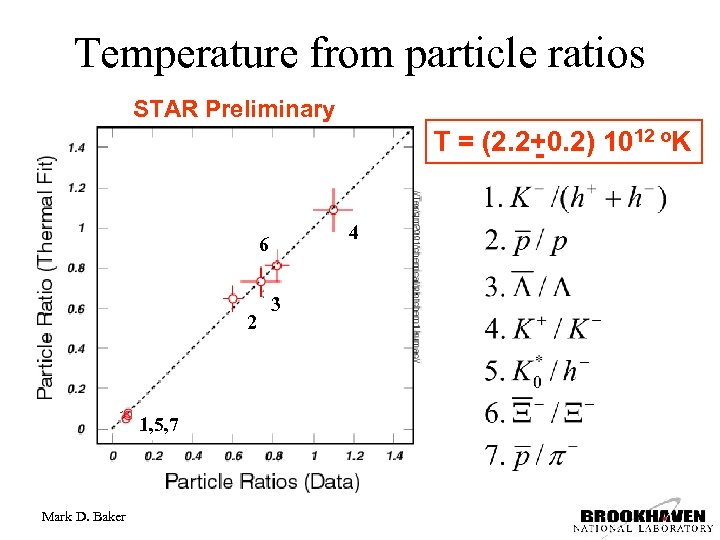 Temperature from particle ratios STAR Preliminary T = (2. 2+0. 2) 1012 o. K 4 6 2 1, 5, 7 Mark D. Baker 3
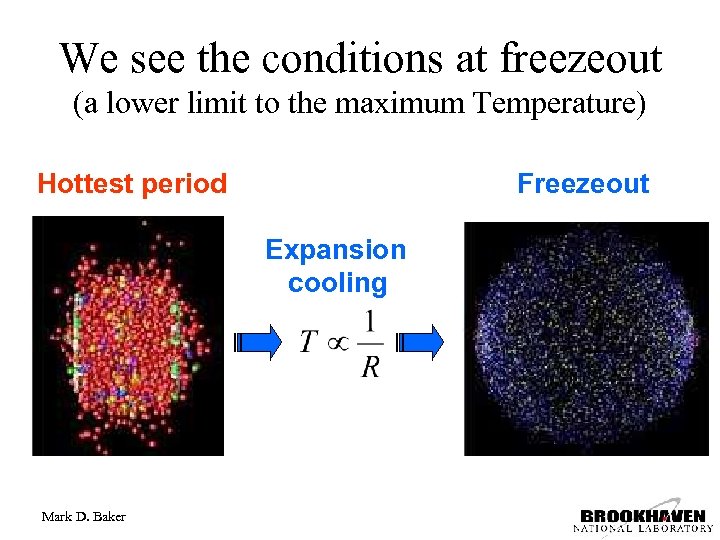
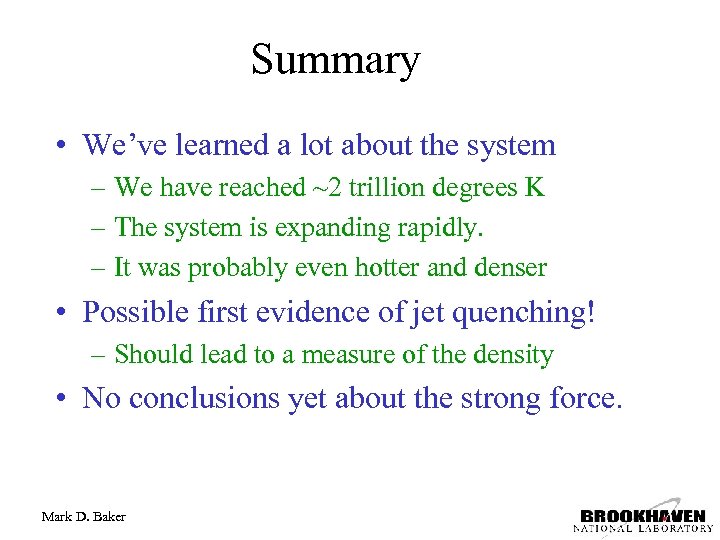
 Temperature at Freezeout • Chemical: T = (2. 2+0. 2) 1012 o. K - • Kinetic: T = (1. 7+0. 4) 1012 o. K - • We did reach ~ 2 trillion K! Mark D. Baker
 The yields are compared to predictions by Hijing. The SPS data values from NA 44, NA 49 are plotted as reference. The ~3 measurement converted to y using the accepted mean pt. Mark D. Baker
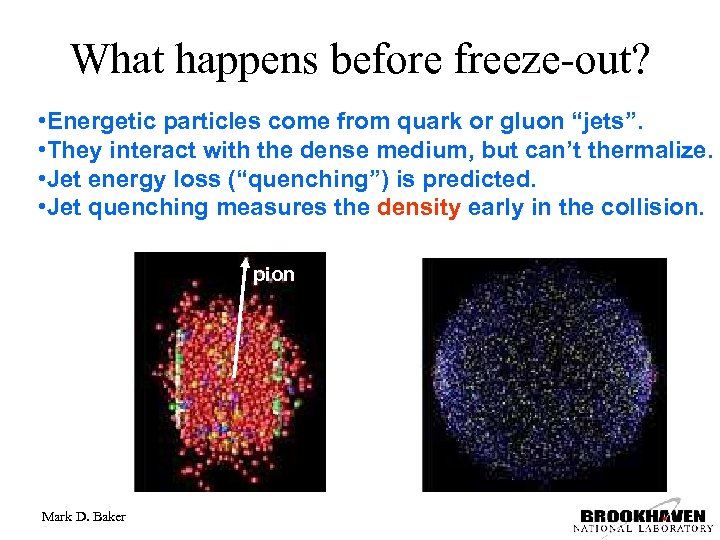 What happens before freeze-out? • Energetic particles come from quark or gluon “jets”. • They interact with the dense medium, but can’t thermalize. • Jet energy loss (“quenching”) is predicted. • Jet quenching measures the density early in the collision. pion Mark D. Baker
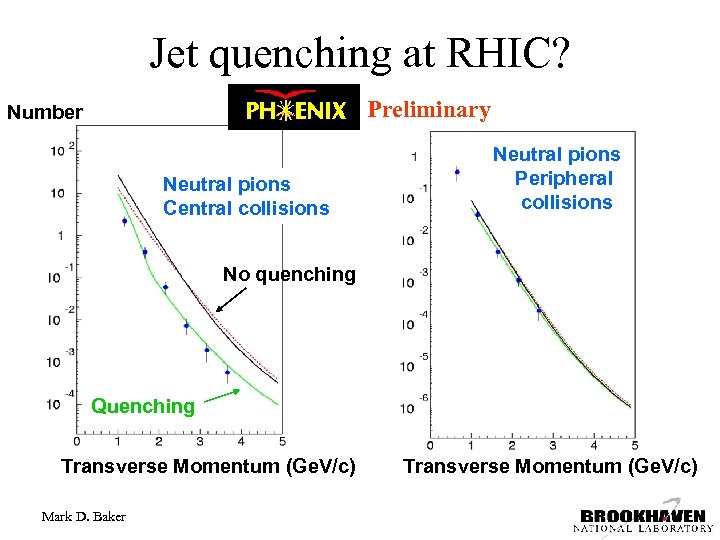 Jet quenching at RHIC? Preliminary Number Neutral pions Central collisions Neutral pions Peripheral collisions No quenching Quenching Transverse Momentum (Ge. V/c) Mark D. Baker Transverse Momentum (Ge. V/c)
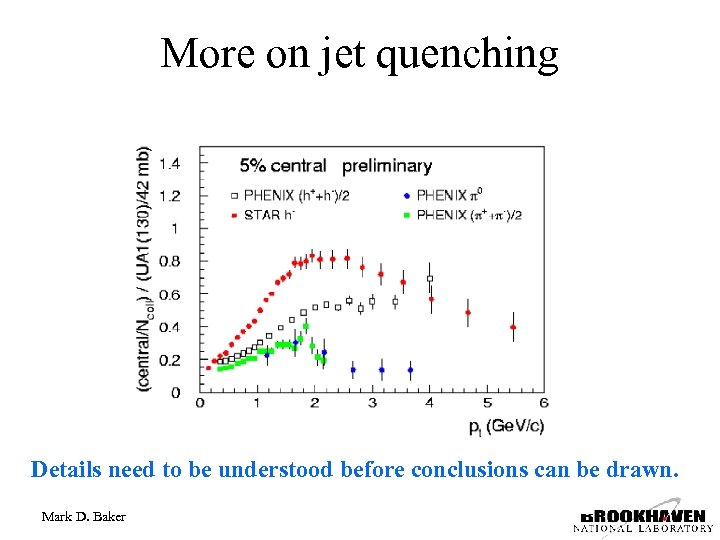 More on jet quenching Details need to be understood before conclusions can be drawn. Mark D. Baker
 Summary • We’ve learned a lot about the system – We have reached ~2 trillion degrees K – The system is expanding rapidly. – It was probably even hotter and denser • Possible first evidence of jet quenching! – Should lead to a measure of the density • No conclusions yet about the strong force. Mark D. Baker
 Outlook It’s going to get even better! • More analysis • More data (x 100 next run) – Allows new early time probes • More variety of data – Energy and species scan • Detector Upgrades Stay tuned for news about the strong force! Mark D. Baker