 Скачать презентацию What happens when property finance goes wrong before
156699c59d477dd6e430181d0ab7d2db.ppt
- Количество слайдов: 27



What happens when property finance goes wrong (before and after lending)? Monday 14 September 2009 Jonathan Lawrence, Partner, K&L Gates LLP
What are the deal breakers before lending? § § § § § Valuation amount Lack of equity / mezzanine debt Loss of tenant Bank loses appetite generally or specifically Due diligence on B or sponsor Site / planning / environmental / title problems Credit committee process Strength of parent company guarantee Anti-money laundering checks 4
What happens when a loan can’t be serviced? § Amendment and waiver (especially of interest rate, covenants and payment schedules) § Offering cash deposits, more security and guarantees § Finding new tenants / upgrading the property § Handing back the keys § Court proceedings § Insolvency / receivership 5
Security § § § Legal mortgage Fixed charge Assignment of rental income Floating charge Guarantees Negative pledge 6
Legal mortgage § Over specified real estate § Transfer of legal ownership from mortgagor (B) to mortgagee (L) § Mortgagor has right to return of property and payment of any balance after satisfaction of mortgage (right of redemption) 7
Fixed charge § § § § § All other freehold and leasehold property All buildings, fixture, plant and machinery on the property All future interests in land Benefit of all agreements relating to land Right and interest in proceeds of sale of charged property Amount standing to credit of all bank accounts Book debts and other receivables Goodwill and uncalled capital Right to recover VAT on any supplies relating to charged property 8
Assignment by way of security § Rental income § Right to payment under all present and future insurance policies over any charged property § Rights against any tenants of property § Benefit of any hedging documentation § Rights under any development and acquisition documentation § Benefit of all contracts relating to property 9
Other security § Floating charge § Over all other assets of B not covered by the other security § Crystallisation § Share charge over shares in B § L has opportunity to take control of B § Choice to sell B rather than the property § Negative pledge 10
Practicalities § Security documentation must be correctly registered (“perfected”) § English company: Companies House § Non-English company: all companies - Slavenburg register (pre 1 October 2009) / only if registered place of business in UK (1 October 2009 and thereafter) § Land Registry § Otherwise void against liquidator, administrator, creditor of the company § Governing law – location of assets? 11
Guarantees § Especially relevant when dealing with SPV B with no trading history where real estate is sole asset § L should ensure the guarantor enters guarantee as a primary obligor and therefore has to immediately comply with any demand made on the guarantee without L having to first make demand of B § Guarantor likely to seek grace period 12
Why is the security package so important? § Security Trustee has certain control over all assets of B § Ideally only security over property itself is needed to recover the principal amount of the loan § Remaining security satisfies L’s underwriting in case the LTV covenant is breached 13
Pre-insolvency: Protection for the Lender § Most importantly through security § Fixed charge § Floating charge § Security Trustee § Effect? Enforcement and realisation § 100% flawless? § No… 14
Deficiencies with taking security § § Floating charges and the “prescribed part” Statutory order of priority of proceeds Moratorium (with certain insolvency proceedings) Deficiencies in realisation 15
Who can challenge a bank’s security? § § The borrower The guarantor or other security provider The liquidator or administrator The shareholders (where directors exceed their powers) 16
What challenges to security are available? § § § § Lack of commercial benefit Preference Transaction at an undervalue Avoidance of floating charges Unfair contract terms Undue influence Variations to secured sums 17
Enforcement § B unable to repay loan § B has breached its covenants § Enforcing security and insolvency procedures 18
What is insolvency? § When a corporate entity “is unable to pay its debts” (Section 123 Insolvency Act 1986) § Tests § Failure to pay a statutory demand § Execution on a judgement is unsatisfied § Unable to pay its debts as they fall due (“cash flow” test) § Value of assets less than liabilities (“balance sheet” test) § Threshold amount: £ 750 19
Relevance to Lenders? § Likelihood of repayment of loans if B insolvent? § Loan agreement contains safeguards: chiefly through events of default and acceleration § How does acceleration help L? 20
Insolvency Procedures § Administrative receivership and fixed asset receivers (e. g. LPA receiver) § Liquidation § Administration § Compromise arrangements 21
Background to the Enterprise Act 2002 § § Came into force on 15 September 2003 Promotion of “rescue culture” Abolition of Crown preference Creation of the prescribed part 22
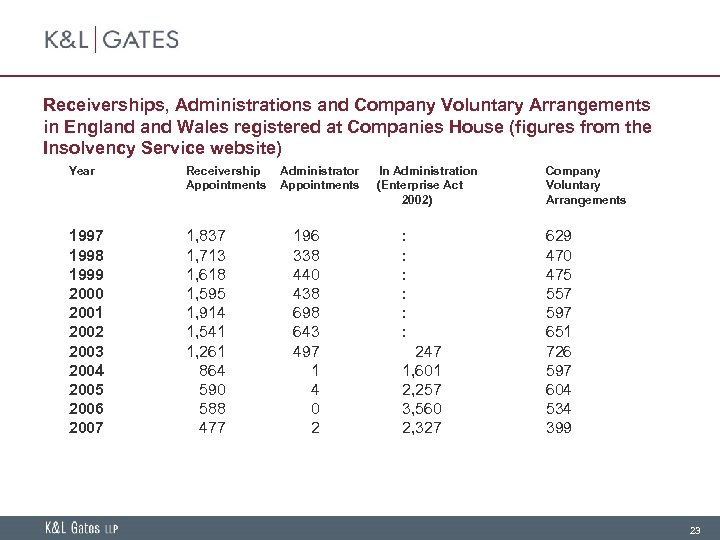
Receiverships, Administrations and Company Voluntary Arrangements in England Wales registered at Companies House (figures from the Insolvency Service website) Year Receivership Appointments 1997 1998 1999 2000 2001 2002 2003 2004 2005 2006 2007 1, 837 1, 713 1, 618 1, 595 1, 914 1, 541 1, 261 864 590 588 477 Administrator Appointments 196 338 440 438 698 643 497 1 4 0 2 In Administration (Enterprise Act 2002) : : : 247 1, 601 2, 257 3, 560 2, 327 Company Voluntary Arrangements 629 470 475 557 597 651 726 597 604 534 399 23
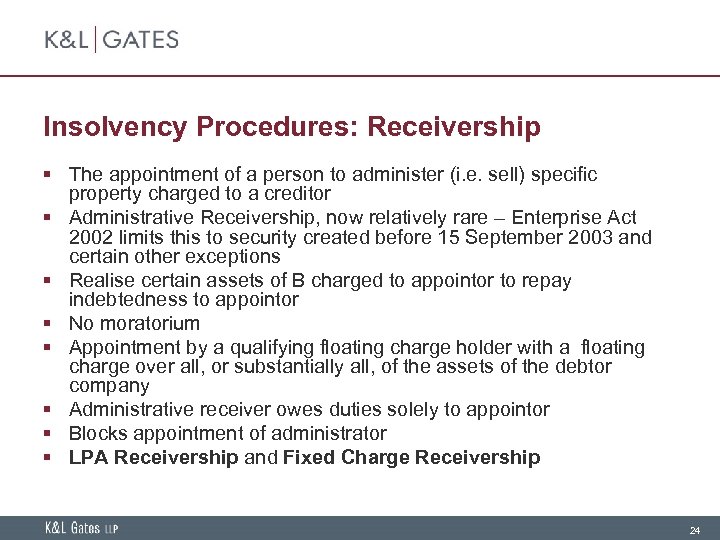
Insolvency Procedures: Receivership § The appointment of a person to administer (i. e. sell) specific property charged to a creditor § Administrative Receivership, now relatively rare – Enterprise Act 2002 limits this to security created before 15 September 2003 and certain other exceptions § Realise certain assets of B charged to appointor to repay indebtedness to appointor § No moratorium § Appointment by a qualifying floating charge holder with a floating charge over all, or substantially all, of the assets of the debtor company § Administrative receiver owes duties solely to appointor § Blocks appointment of administrator § LPA Receivership and Fixed Charge Receivership 24
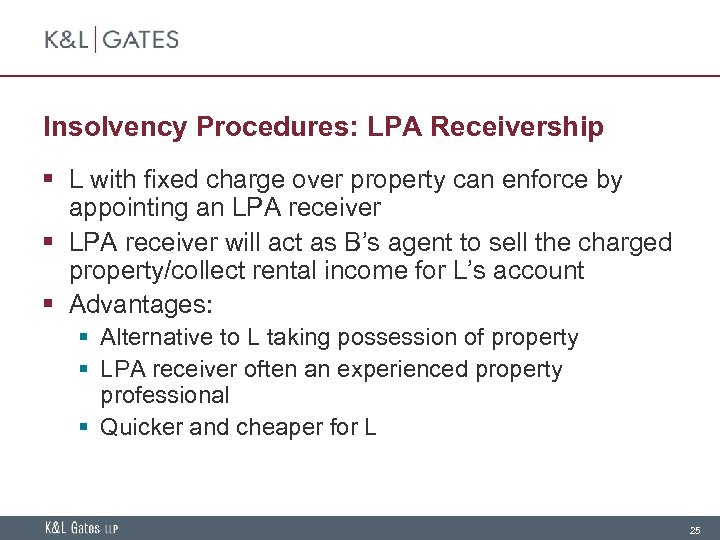
Insolvency Procedures: LPA Receivership § L with fixed charge over property can enforce by appointing an LPA receiver § LPA receiver will act as B’s agent to sell the charged property/collect rental income for L’s account § Advantages: § Alternative to L taking possession of property § LPA receiver often an experienced property professional § Quicker and cheaper for L 25
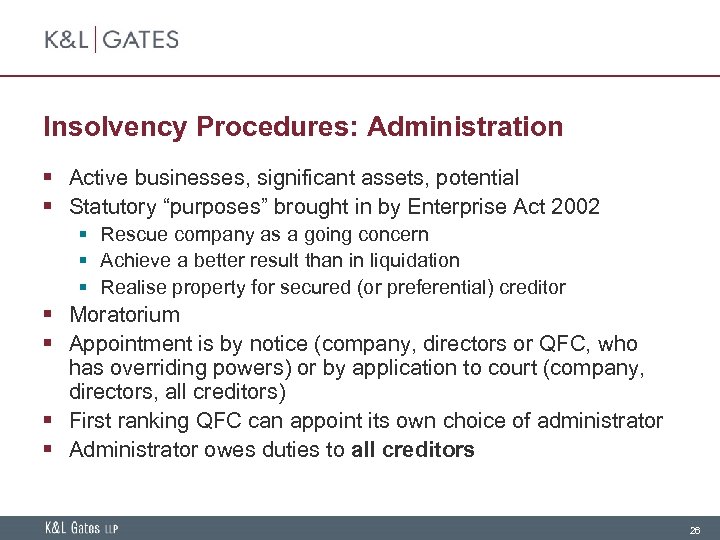
Insolvency Procedures: Administration § Active businesses, significant assets, potential § Statutory “purposes” brought in by Enterprise Act 2002 § Rescue company as a going concern § Achieve a better result than in liquidation § Realise property for secured (or preferential) creditor § Moratorium § Appointment is by notice (company, directors or QFC, who has overriding powers) or by application to court (company, directors, all creditors) § First ranking QFC can appoint its own choice of administrator § Administrator owes duties to all creditors 26
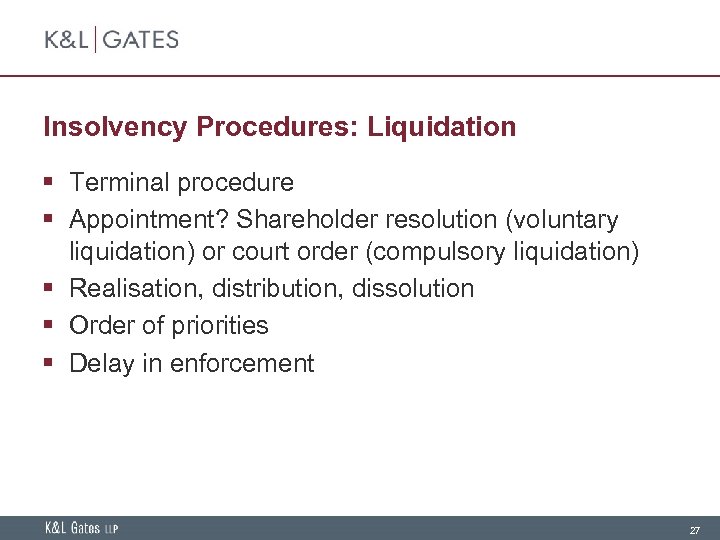
Insolvency Procedures: Liquidation § Terminal procedure § Appointment? Shareholder resolution (voluntary liquidation) or court order (compulsory liquidation) § Realisation, distribution, dissolution § Order of priorities § Delay in enforcement 27
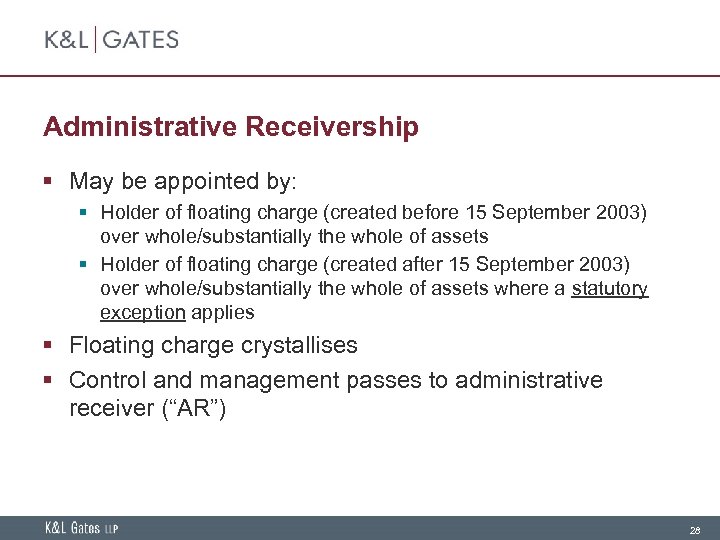
Administrative Receivership § May be appointed by: § Holder of floating charge (created before 15 September 2003) over whole/substantially the whole of assets § Holder of floating charge (created after 15 September 2003) over whole/substantially the whole of assets where a statutory exception applies § Floating charge crystallises § Control and management passes to administrative receiver (“AR”) 28
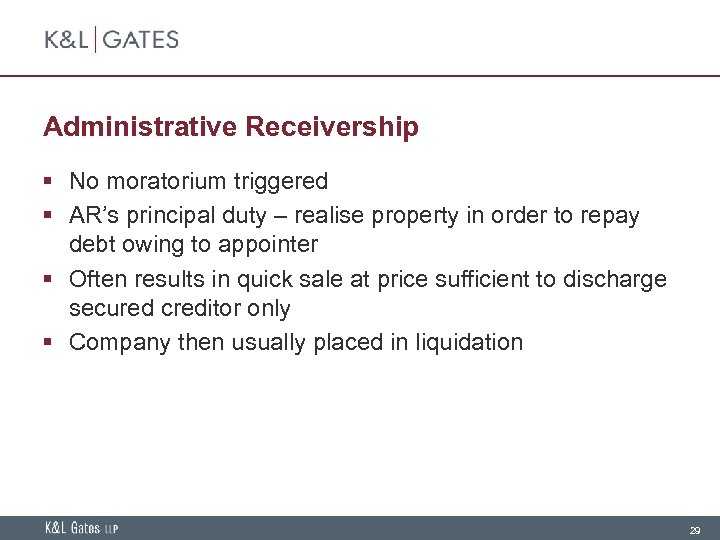
Administrative Receivership § No moratorium triggered § AR’s principal duty – realise property in order to repay debt owing to appointer § Often results in quick sale at price sufficient to discharge secured creditor only § Company then usually placed in liquidation 29
Скачать презентацию What happens when property finance goes wrong before
156699c59d477dd6e430181d0ab7d2db.ppt