 Скачать презентацию What functional brain imaging reveals about the neuroarchitecture
b57ad0e39bc734e8f0fa3db9bce727a8.ppt
- Количество слайдов: 1



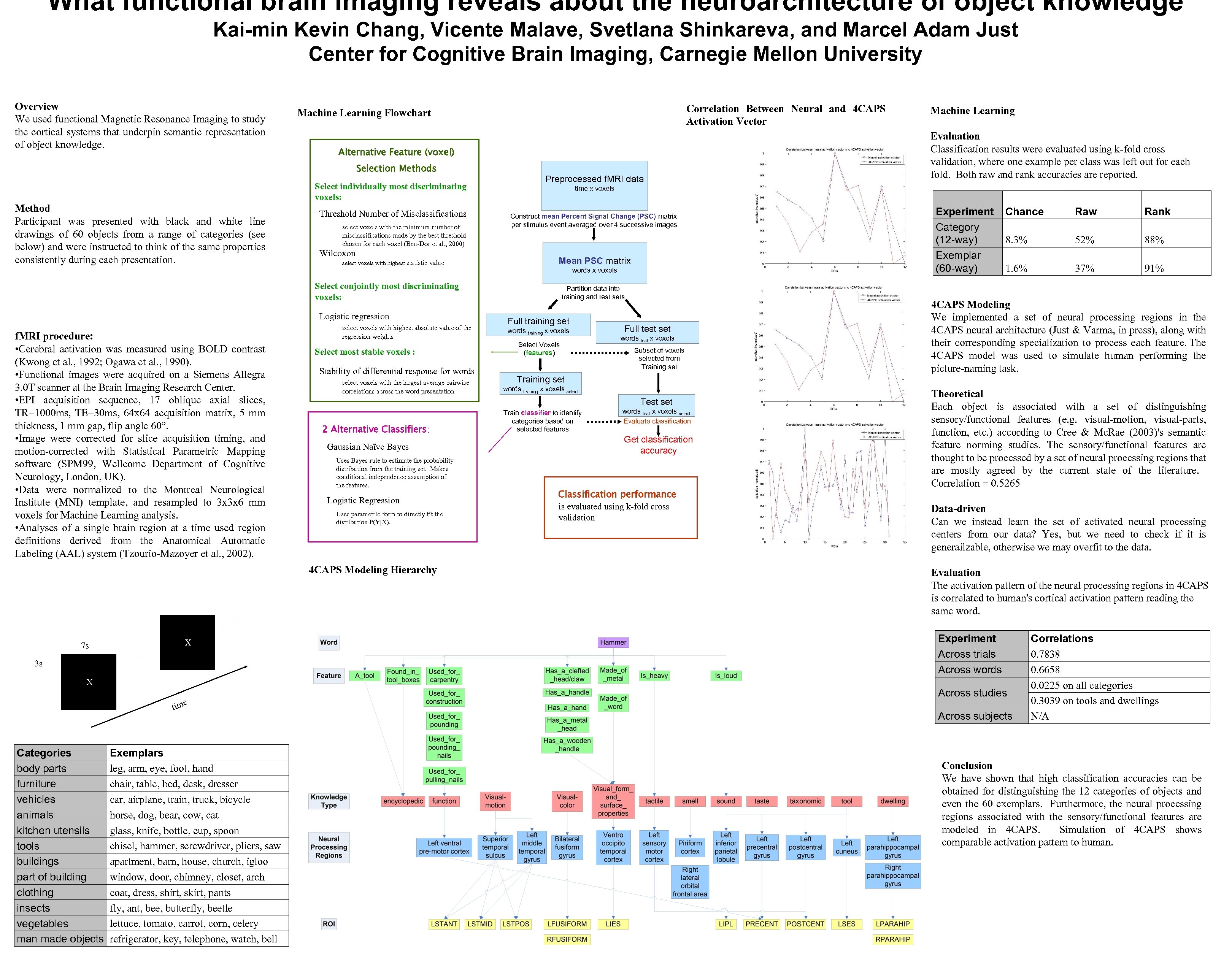
What functional brain imaging reveals about the neuroarchitecture of object knowledge Kai-min Kevin Chang, Vicente Malave, Svetlana Shinkareva, and Marcel Adam Just Center for Cognitive Brain Imaging, Carnegie Mellon University Overview We used functional Magnetic Resonance Imaging to study the cortical systems that underpin semantic representation of object knowledge. Alternative Feature (voxel) Selection Methods Select individually most discriminating voxels: Method Participant was presented with black and white line drawings of 60 objects from a range of categories (see below) and were instructed to think of the same properties consistently during each presentation. Correlation Between Neural and 4 CAPS Activation Vector Machine Learning Flowchart Threshold Number of Misclassifications select voxels with the minimum number of misclassifications made by the best threshold chosen for each voxel (Ben-Dor et al. , 2000) Wilcoxon select voxels with highest statistic value Preprocessed f. MRI data f. MRI procedure: • Cerebral activation was measured using BOLD contrast (Kwong et al. , 1992; Ogawa et al. , 1990). • Functional images were acquired on a Siemens Allegra 3. 0 T scanner at the Brain Imaging Research Center. • EPI acquisition sequence, 17 oblique axial slices, TR=1000 ms, TE=30 ms, 64 x 64 acquisition matrix, 5 mm thickness, 1 mm gap, flip angle 60°. • Image were corrected for slice acquisition timing, and motion-corrected with Statistical Parametric Mapping software (SPM 99, Wellcome Department of Cognitive Neurology, London, UK). • Data were normalized to the Montreal Neurological Institute (MNI) template, and resampled to 3 x 3 x 6 mm voxels for Machine Learning analysis. • Analyses of a single brain region at a time used region definitions derived from the Anatomical Automatic Labeling (AAL) system (Tzourio-Mazoyer et al. , 2002). select voxels with highest absolute value of the regression weights Select most stable voxels : Stability of differential response for words select voxels with the largest average pairwise correlations across the word presentation Construct mean Percent Signal Change (PSC) matrix per stimulus event averaged over 4 successive images Mean PSC matrix words x voxels Gaussian Naïve Bayes Uses Bayes rule to estimate the probability distribution from the training set. Makes conditional independence assumption of the features. Logistic Regression Uses parametric form to directly fit the distribution P(Y|X). 4 CAPS Modeling Hierarchy X 7 s celery 3 s X ant e tim refrigerator Categories body parts furniture vehicles animals kitchen utensils tools buildings part of building clothing insects vegetables man made objects Exemplars leg, arm, eye, foot, hand chair, table, bed, desk, dresser car, airplane, train, truck, bicycle horse, dog, bear, cow, cat glass, knife, bottle, cup, spoon chisel, hammer, screwdriver, pliers, saw apartment, barn, house, church, igloo window, door, chimney, closet, arch coat, dress, shirt, skirt, pants fly, ant, bee, butterfly, beetle lettuce, tomato, carrot, corn, celery refrigerator, key, telephone, watch, bell Partition data into training and test sets Full training set words training x voxels Select Voxels (features) Full test set words test x voxels Subset of voxels selected from Training set Experiment Category (12 -way) Exemplar (60 -way) Chance Raw Rank 8. 3% 52% 88% 1. 6% 37% 91% 4 CAPS Modeling We implemented a set of neural processing regions in the 4 CAPS neural architecture (Just & Varma, in press), along with their corresponding specialization to process each feature. The 4 CAPS model was used to simulate human performing the picture-naming task. Training set words training x voxels select Test set 2 Alternative Classifiers: Evaluation Classification results were evaluated using k-fold cross validation, where one example per class was left out for each fold. Both raw and rank accuracies are reported. time x voxels Select conjointly most discriminating voxels: Logistic regression Machine Learning Train classifier to identify categories based on selected features words test x voxels select Evaluate classification Get classification accuracy Classification performance is evaluated using k-fold cross validation Theoretical Each object is associated with a set of distinguishing sensory/functional features (e. g. visual-motion, visual-parts, function, etc. ) according to Cree & Mc. Rae (2003)'s semantic feature norming studies. The sensory/functional features are thought to be processed by a set of neural processing regions that are mostly agreed by the current state of the literature. Correlation = 0. 5265 Data-driven Can we instead learn the set of activated neural processing centers from our data? Yes, but we need to check if it is generailzable, otherwise we may overfit to the data. Evaluation The activation pattern of the neural processing regions in 4 CAPS is correlated to human's cortical activation pattern reading the same word. Experiment Across trials Across words Across studies Across subjects Correlations 0. 7838 0. 6658 0. 0225 on all categories 0. 3039 on tools and dwellings N/A Conclusion We have shown that high classification accuracies can be obtained for distinguishing the 12 categories of objects and even the 60 exemplars. Furthermore, the neural processing regions associated with the sensory/functional features are modeled in 4 CAPS. Simulation of 4 CAPS shows comparable activation pattern to human.
Скачать презентацию What functional brain imaging reveals about the neuroarchitecture
b57ad0e39bc734e8f0fa3db9bce727a8.ppt