


 Скачать презентацию What factors affect the passage of state legislation
b1f6fcb24d29bc4d92ddfae22720728e.ppt
- Количество слайдов: 54
 What factors affect the passage of state legislation to prevent childhood obesity? Ellen Jones, Ph. D Elizabeth Dodson, MPH
 Collaborators § Saint Louis Univ. School of Public Health • • Chris Fleming (Mathematica Policy Research, Inc. ) Tegan Boehmer (CDC) Debra Haire-Joshu Doug Luke Ross Brownson Ellen Jones Amy Eyler Leah Wentworth
 Background § Childhood obesity epidemic § Environmental and policy interventions § Individual states have much of the authority over public health policy
 Art and Science 4
 Why policy interventions? changing the physical and sociopolitical environments § opportunities, support, and cues § may directly affect behaviors • Influence of price of tobacco on consumption § or may alter social norms • Physically active people in public spaces § Often more permanent than many public health programs focused on individual-level behavioral change • Important complement to individual-level programs
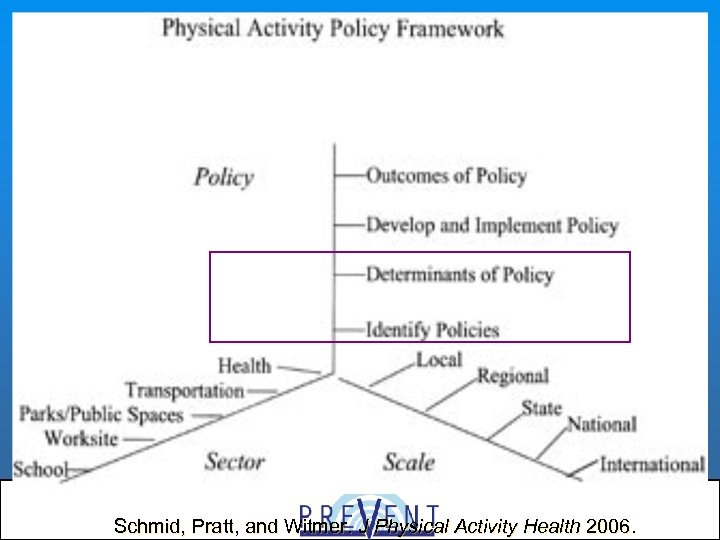 Schmid, Pratt, and Witmer. J Physical Activity Health 2006.
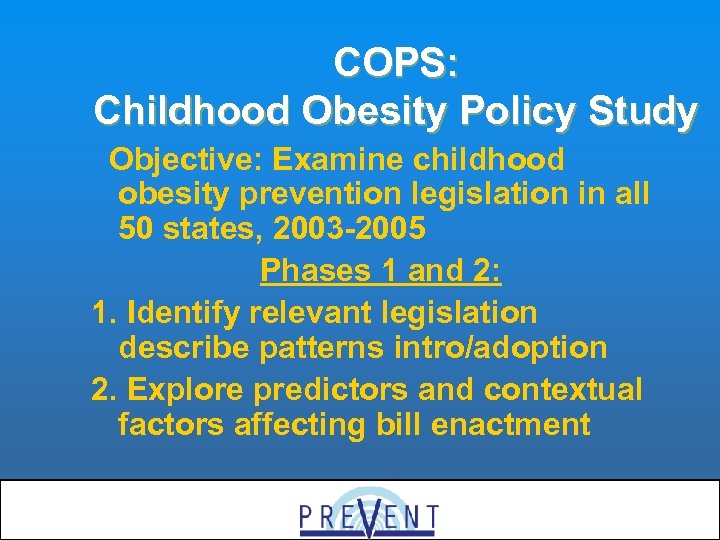 COPS: Childhood Obesity Policy Study Objective: Examine childhood obesity prevention legislation in all 50 states, 2003 -2005 Phases 1 and 2: 1. Identify relevant legislation describe patterns intro/adoption 2. Explore predictors and contextual factors affecting bill enactment
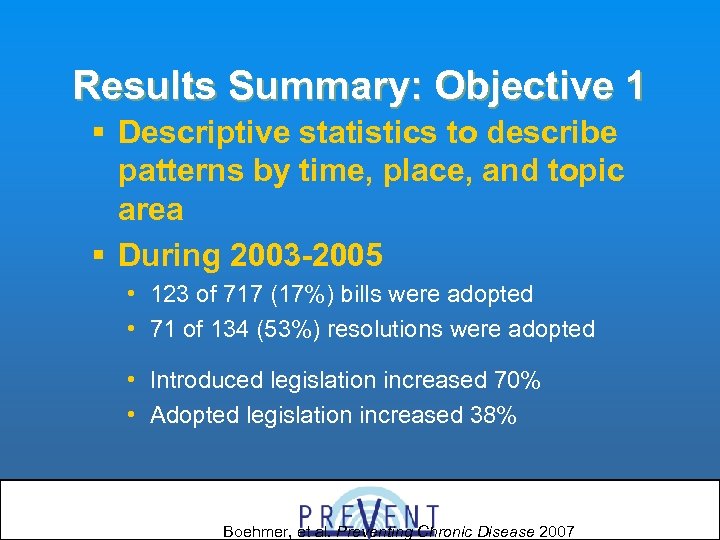 Results Summary: Objective 1 § Descriptive statistics to describe patterns by time, place, and topic area § During 2003 -2005 • 123 of 717 (17%) bills were adopted • 71 of 134 (53%) resolutions were adopted • Introduced legislation increased 70% • Adopted legislation increased 38% Boehmer, et al. Preventing Chronic Disease 2007
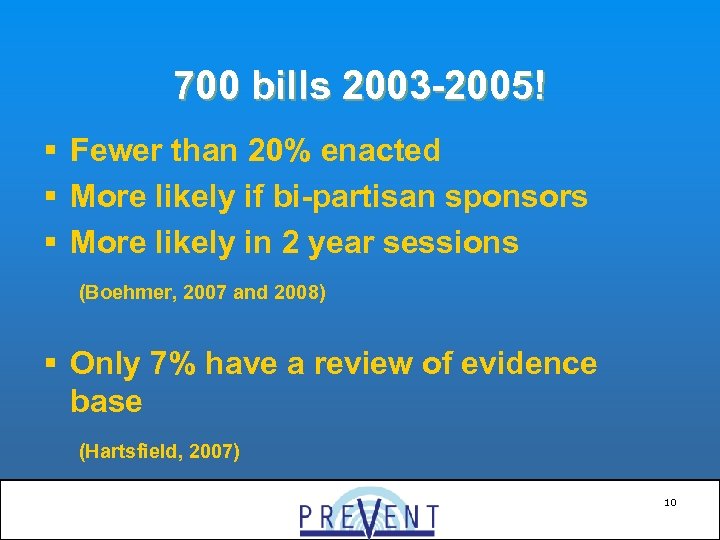 700 bills 2003 -2005! § Fewer than 20% enacted § More likely if bi-partisan sponsors § More likely in 2 year sessions (Boehmer, 2007 and 2008) § Only 7% have a review of evidence base (Hartsfield, 2007) 10
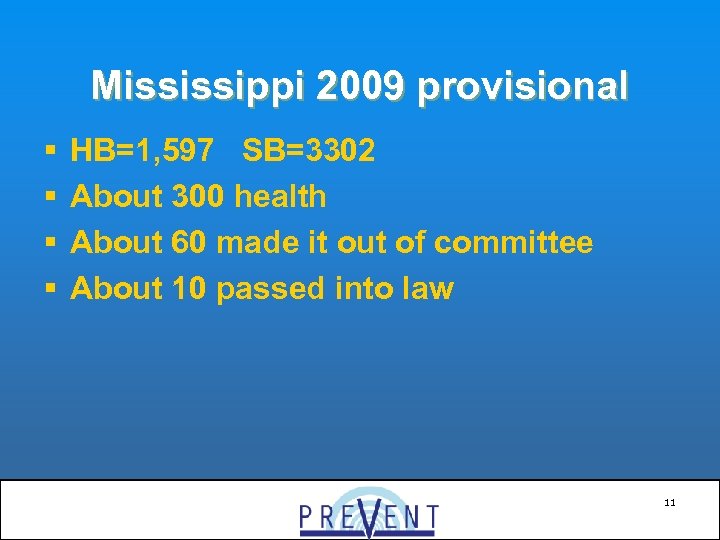 Mississippi 2009 provisional § § HB=1, 597 SB=3302 About 300 health About 60 made it out of committee About 10 passed into law 11
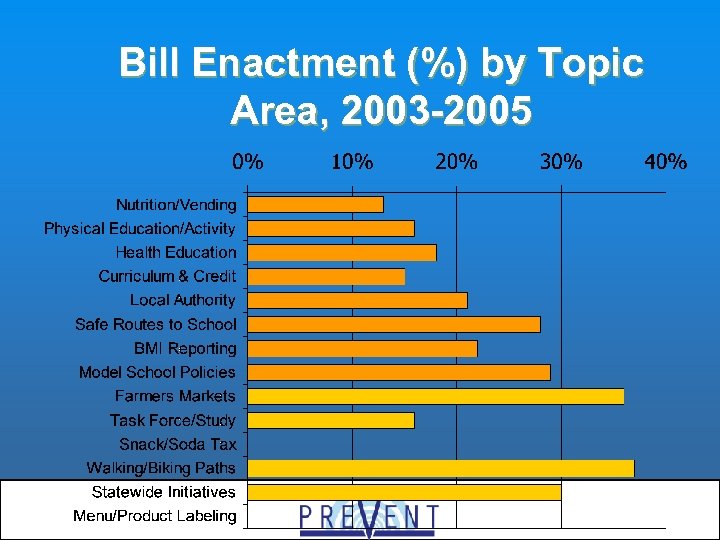 Bill Enactment (%) by Topic Area, 2003 -2005
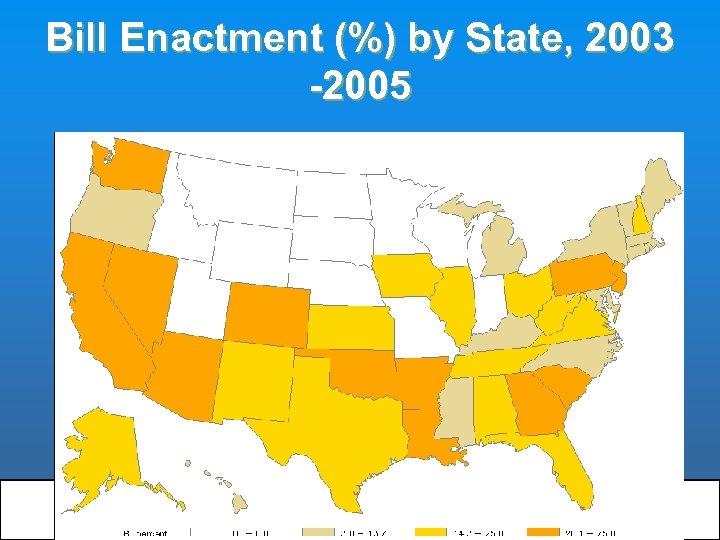 Bill Enactment (%) by State, 2003 -2005
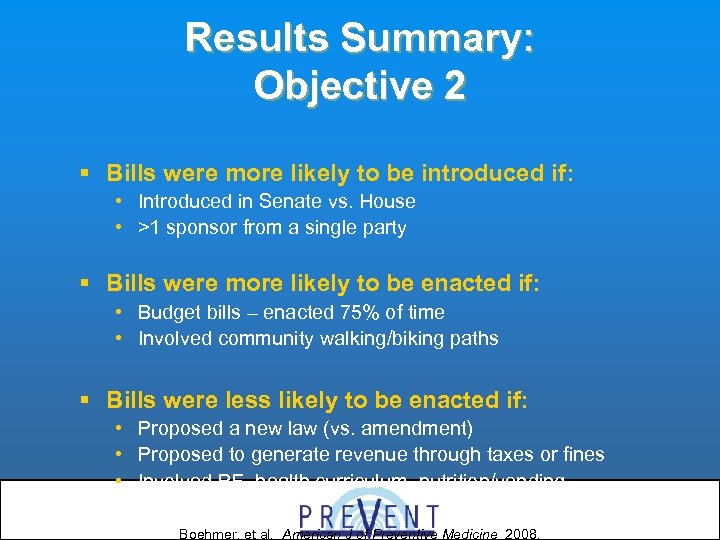 Results Summary: Objective 2 § Bills were more likely to be introduced if: • Introduced in Senate vs. House • >1 sponsor from a single party § Bills were more likely to be enacted if: • Budget bills – enacted 75% of time • Involved community walking/biking paths § Bills were less likely to be enacted if: • Proposed a new law (vs. amendment) • Proposed to generate revenue through taxes or fines • Involved PE, health curriculum, nutrition/vending regulations Boehmer, et al. American J of Preventive Medicine 2008.
 Phase 3: Purpose Objectives: • Identify factors of state legislative environment important for successful childhood obesity prevention legislation • Describe significant barriers to passing & adopting childhood obesity prevention legislation
 Phase 3: Methods § Key informant interviews with state legislators and staffers § Interview questions § Sample selection § Telephone interviews conducted: Dec 05 – April 06 § Qualitative data analysis
 Results: Sample § N=16: 11 legislators, 5 staffers § Political party: 80% Democratic § Backgrounds: law & ed (20% health) § Time in state legislature: range=4 -21 years; mean=11. 8 years § Legislative responsibilities
 Interview Question #1 In your view, what factors support or facilitate the introduction and adoption of childhood obesity prevention legislation?
![Results: Facilitators National Media Exposure “[Which bills pass] depends on what makes it into](https://present5.com/presentation/b1f6fcb24d29bc4d92ddfae22720728e/image-19.jpg "Results: Facilitators National Media Exposure “[Which bills pass] depends on what makes it into") Results: Facilitators National Media Exposure “[Which bills pass] depends on what makes it into the media. ”
Results: Facilitators National Media Exposure “[Which bills pass] depends on what makes it into the media. ”
 Results: Facilitators Introduction by senior legislators & those with personal interest § “You need … committed legislators. Legislators who are going to say, ‘I’m going to put myself on the line and push. . . ’” § “We said that we need to do something about the obesity issue instead of just inform the public…We just did basic fundamental thinking of, what can we do to help? And then: what can we do that will pass? ”
 Other Facilitators § Gaining support of key players § Working in supportive political climate § Attempting incremental changes
 Interview Question #2 In your view, what factors oppose or inhibit the introduction and adoption of childhood obesity prevention legislation?
 Results: Barriers Lobbyists § “We cannot underestimate the power of the food lobby, the soda lobby, the restaurant association…” § “You can’t blindside the lobbyists…I had this one…bill, we had as many lobbyists in the room as legislators…Lobbyists are there. They get paid and they can watch things a lot more carefully than public interest groups, which are not as well-funded. ”
 Results: Barriers Misconceptions - outcomes for schools “Representatives who voted no [on school junk food bill] indicated that their schools had encouraged them to vote no. Some of them implied that soft drink companies had put pressure on them as well. But most of them, even the ones who said they got pressure from the soda companies, all of them mentioned pressures from their school districts they represented, saying that their school districts feared they would lose money. ”
 Interview Question #3 Legislation sometimes passes in increments over a period of time, eventually leading to a comprehensive set of bills vs. the initial adoption of comprehensive bills. Do you think that childhood obesity prevention legislation is more likely to progress through (1) a series of several incremental bills or (2) a few comprehensive bills?
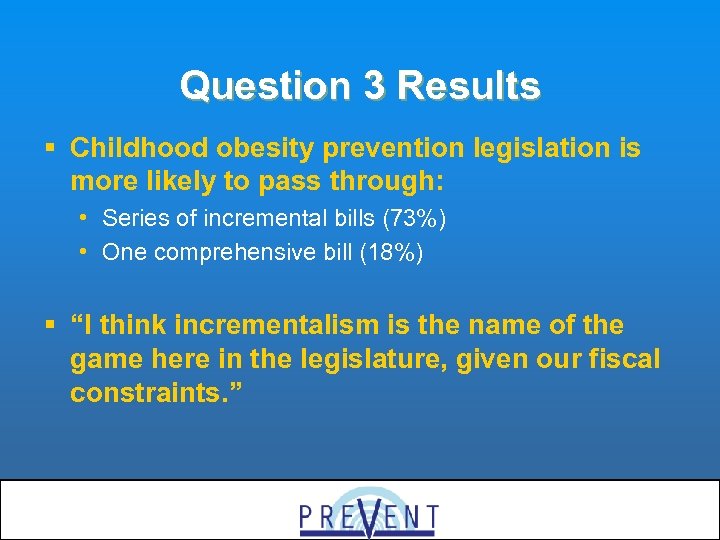 Question 3 Results § Childhood obesity prevention legislation is more likely to pass through: • Series of incremental bills (73%) • One comprehensive bill (18%) § “I think incrementalism is the name of the game here in the legislature, given our fiscal constraints. ”
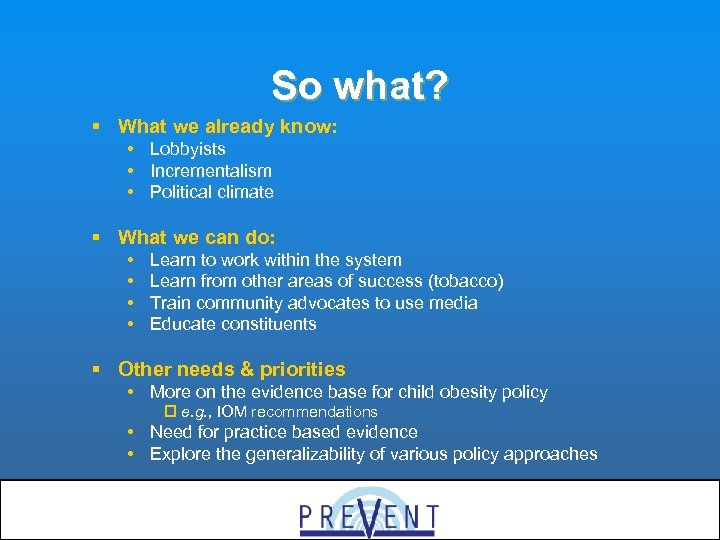 So what? § What we already know: • Lobbyists • Incrementalism • Political climate § What we can do: • • Learn to work within the system Learn from other areas of success (tobacco) Train community advocates to use media Educate constituents § Other needs & priorities • More on the evidence base for child obesity policy p e. g. , IOM recommendations • Need for practice based evidence • Explore the generalizability of various policy approaches
 Recommendations § Build & advocate incrementally § “If you can get things into the media, it’s very helpful to legislators. ” § “…to pass legislation like this, you really want to make sure that the people who are going to be implementing it and the people who are affected by it are involved in your legislative planning. ”
 Why do States Differ in the Level of Childhood Obesity Legislation? Ellen Jones, Ph. D
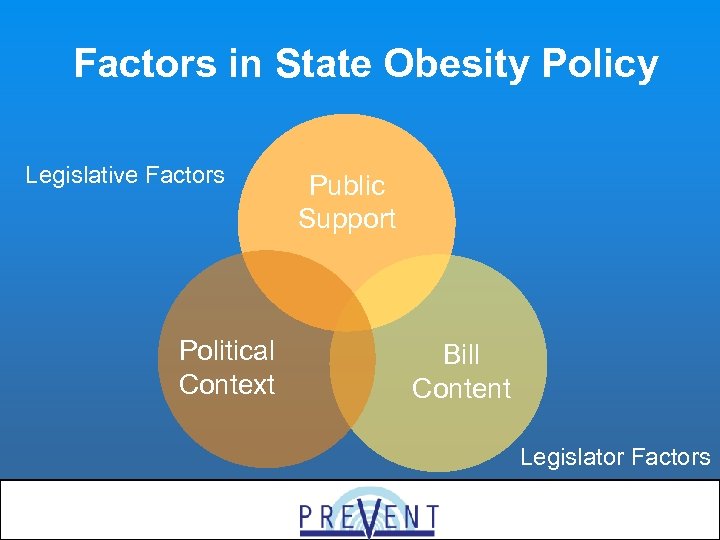
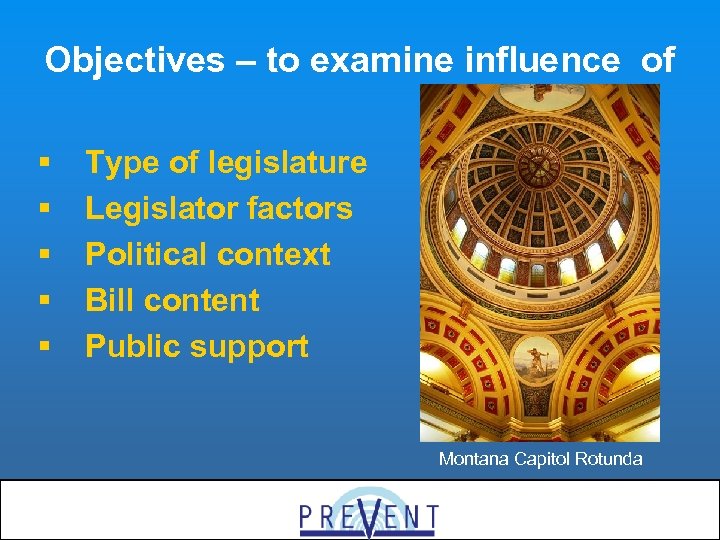 Objectives – to examine influence of § § § Type of legislature Legislator factors Political context Bill content Public support Montana Capitol Rotunda
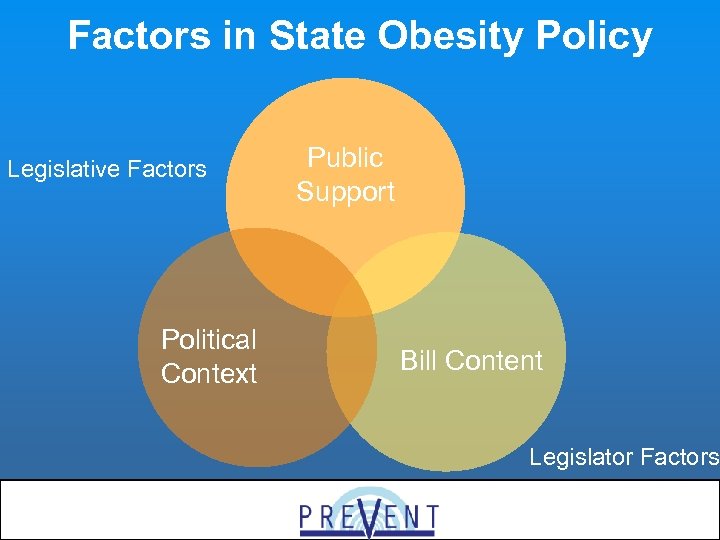 Factors in State Obesity Policy Legislative Factors Political Context Public Support Bill Content Legislator Factors
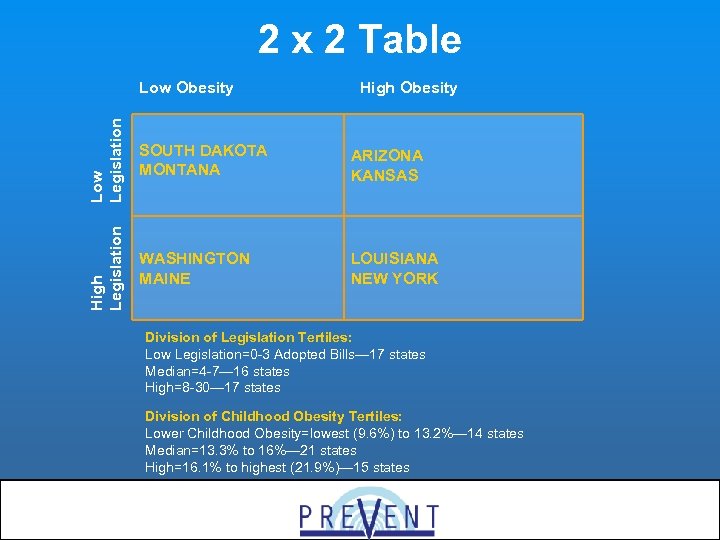 2 x 2 Table Low High Legislation Low Obesity High Obesity SOUTH DAKOTA MONTANA ARIZONA KANSAS WASHINGTON MAINE LOUISIANA NEW YORK Division of Legislation Tertiles: Low Legislation=0 -3 Adopted Bills— 17 states Median=4 -7— 16 states High=8 -30— 17 states Division of Childhood Obesity Tertiles: Lower Childhood Obesity=lowest (9. 6%) to 13. 2%— 14 states Median=13. 3% to 16%— 21 states High=16. 1% to highest (21. 9%)— 15 states
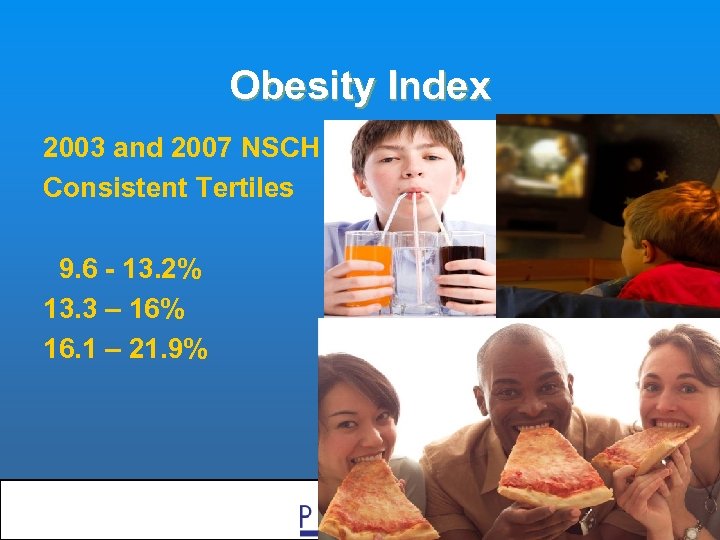 Obesity Index 2003 and 2007 NSCH Consistent Tertiles 9. 6 - 13. 2% 13. 3 – 16% 16. 1 – 21. 9% 35
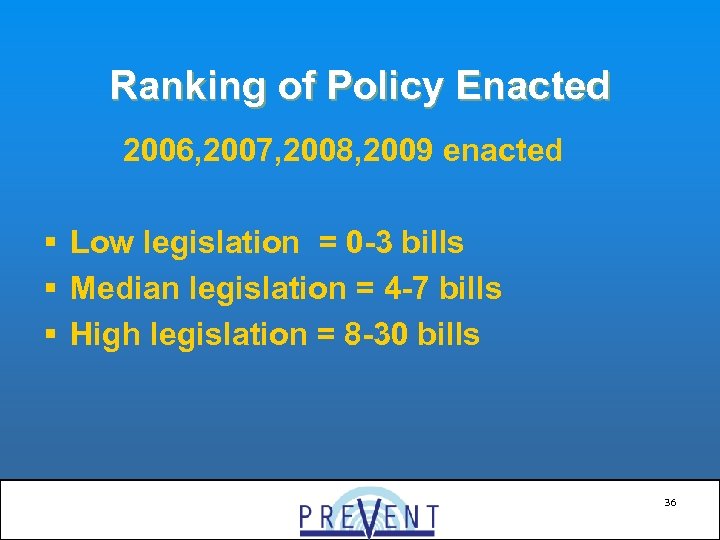 Ranking of Policy Enacted 2006, 2007, 2008, 2009 enacted § Low legislation = 0 -3 bills § Median legislation = 4 -7 bills § High legislation = 8 -30 bills 36
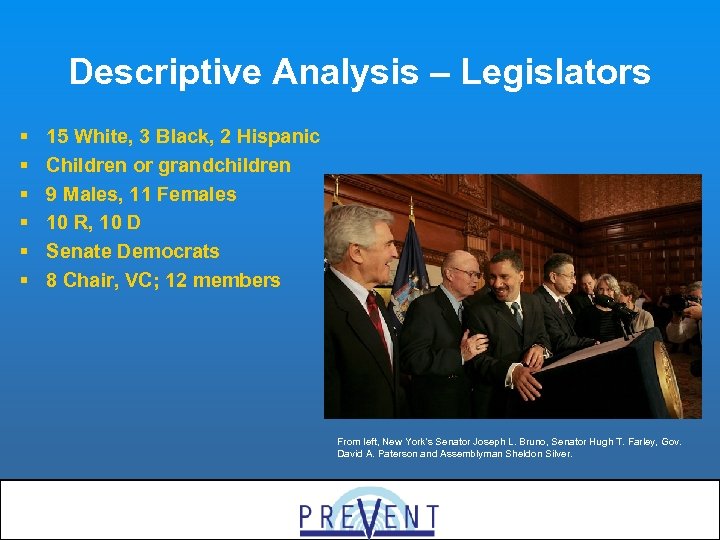 Descriptive Analysis – Legislators § § § 15 White, 3 Black, 2 Hispanic Children or grandchildren 9 Males, 11 Females 10 R, 10 D Senate Democrats 8 Chair, VC; 12 members From left, New York’s Senator Joseph L. Bruno, Senator Hugh T. Farley, Gov. David A. Paterson and Assemblyman Sheldon Silver.
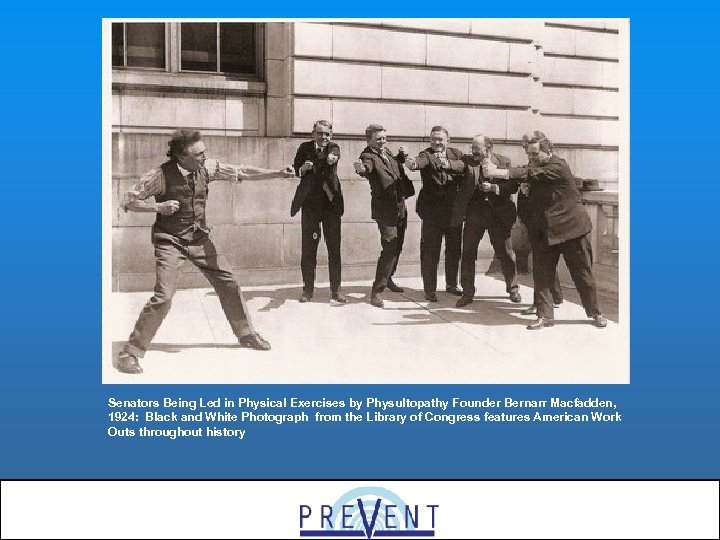 Senators Being Led in Physical Exercises by Physultopathy Founder Bernarr Macfadden, 1924: Black and White Photograph from the Library of Congress features American Work Outs throughout history
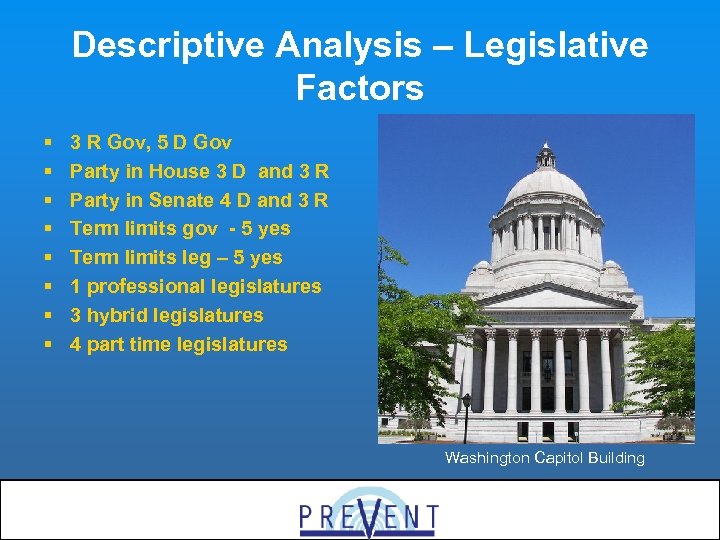 Descriptive Analysis – Legislative Factors § § § § 3 R Gov, 5 D Gov Party in House 3 D and 3 R Party in Senate 4 D and 3 R Term limits gov - 5 yes Term limits leg – 5 yes 1 professional legislatures 3 hybrid legislatures 4 part time legislatures Washington Capitol Building
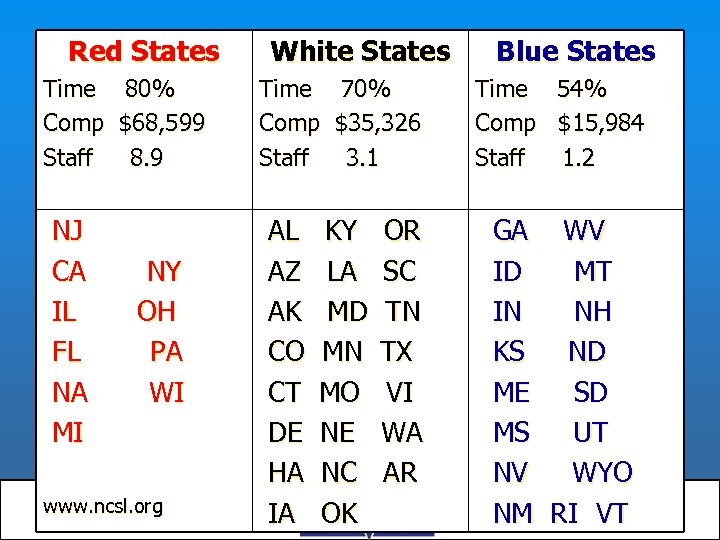 Red States Time 80% Comp $68, 599 Staff 8. 9 NJ CA IL FL NA MI NY OH PA WI www. ncsl. org White States Time 70% Comp $35, 326 Staff 3. 1 AL AZ AK CO CT DE HA IA KY LA MD MN MO NE NC OK OR SC TN TX VI WA AR Blue States Time 54% Comp $15, 984 Staff 1. 2 GA WV ID MT IN NH KS ND ME SD MS UT NV WYO NM RI VT 40
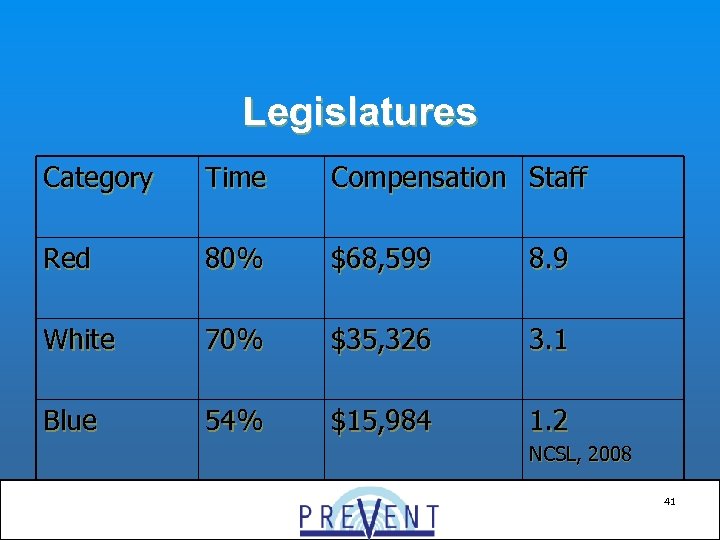 Legislatures Category Time Compensation Staff Red 80% $68, 599 8. 9 White 70% $35, 326 3. 1 Blue 54% $15, 984 1. 2 NCSL, 2008 41
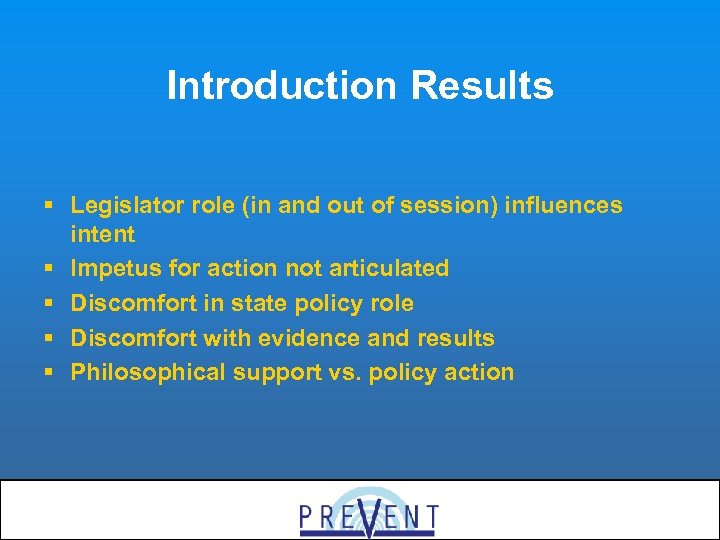 Introduction Results § Legislator role (in and out of session) influences intent § Impetus for action not articulated § Discomfort in state policy role § Discomfort with evidence and results § Philosophical support vs. policy action
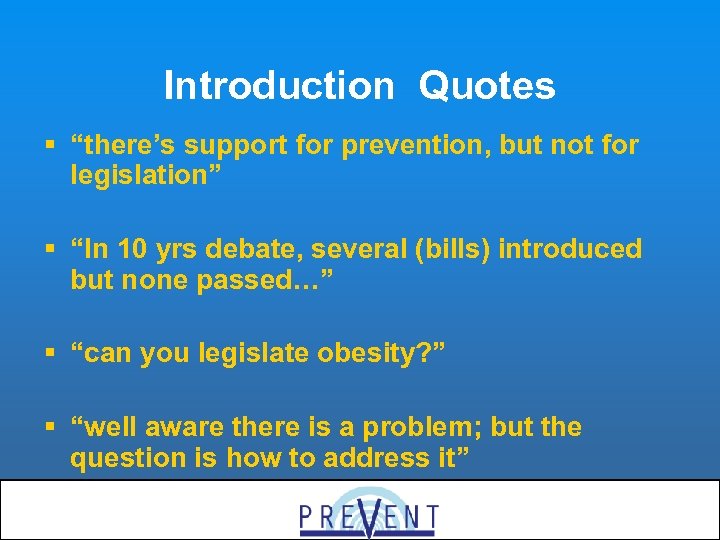 Introduction Quotes § “there’s support for prevention, but not for legislation” § “In 10 yrs debate, several (bills) introduced but none passed…” § “can you legislate obesity? ” § “well aware there is a problem; but the question is how to address it”
 Bill Content Results § § § Unclear cost or new cost is barrier Need for immediate results No consensus around role of legislature Different definitions Different expectations of evidence/science
 Bill Content Quote § “not a whole lot of it is science…. I think a lot of it is anecdotal…” § “the science is hard because policies are so new” § …any proposed policies with start up money will be hard pressed” § “cost is a make or break issue”
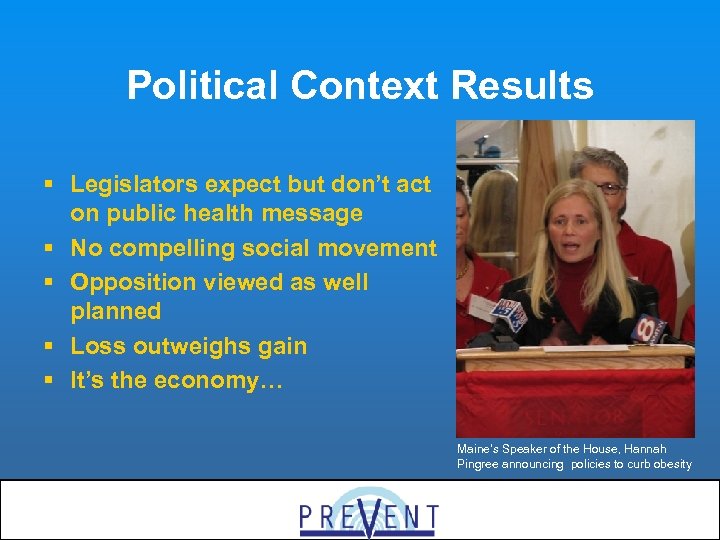 Political Context Results § Legislators expect but don’t act on public health message § No compelling social movement § Opposition viewed as well planned § Loss outweighs gain § It’s the economy… Maine’s Speaker of the House, Hannah Pingree announcing policies to curb obesity
 Political Context Quotes § “several people introduced bills but no one is consistently pushing and prodding”… § “no one comes to mind” § “are you kidding me? Cost is a very critical issue – a deciding factor” § “overwhelming budget deficit makes funding obesity policy difficult”
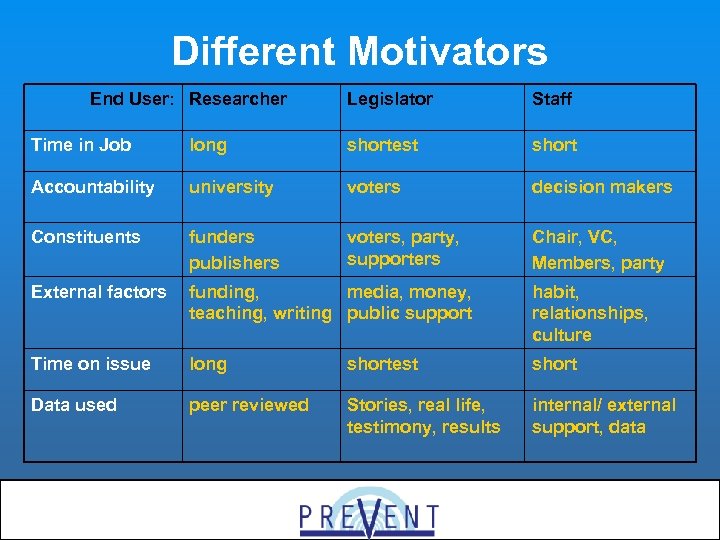 Different Motivators End User: Researcher Legislator Staff Time in Job long shortest short Accountability university voters decision makers Constituents funders publishers voters, party, supporters Chair, VC, Members, party External factors funding, media, money, teaching, writing public support habit, relationships, culture Time on issue long shortest short Data used peer reviewed Stories, real life, testimony, results internal/ external support, data
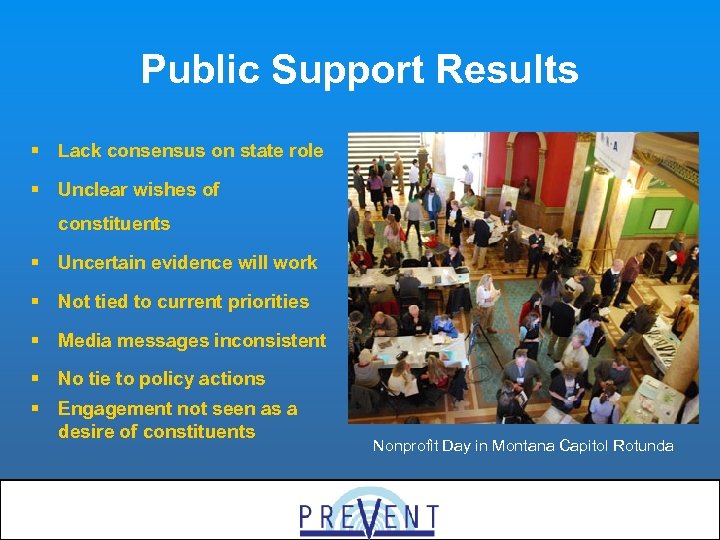 Public Support Results § Lack consensus on state role § Unclear wishes of constituents § Uncertain evidence will work § Not tied to current priorities § Media messages inconsistent § No tie to policy actions § Engagement not seen as a desire of constituents Nonprofit Day in Montana Capitol Rotunda
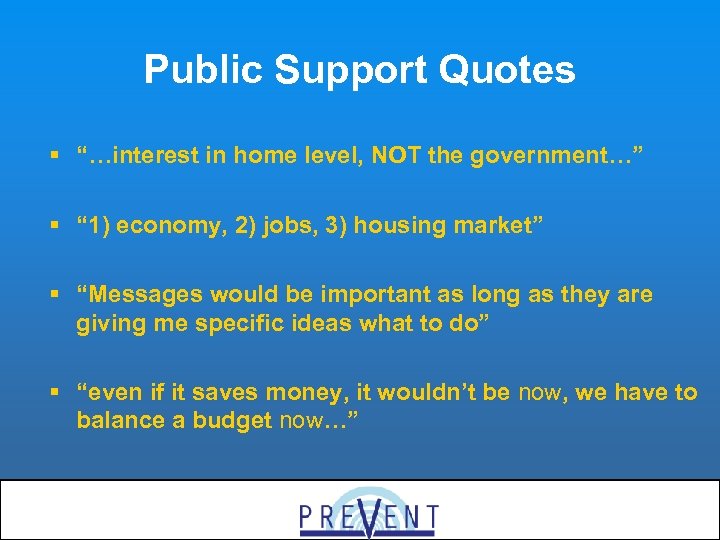 Public Support Quotes § “…interest in home level, NOT the government…” § “ 1) economy, 2) jobs, 3) housing market” § “Messages would be important as long as they are giving me specific ideas what to do” § “even if it saves money, it wouldn’t be now, we have to balance a budget now…”
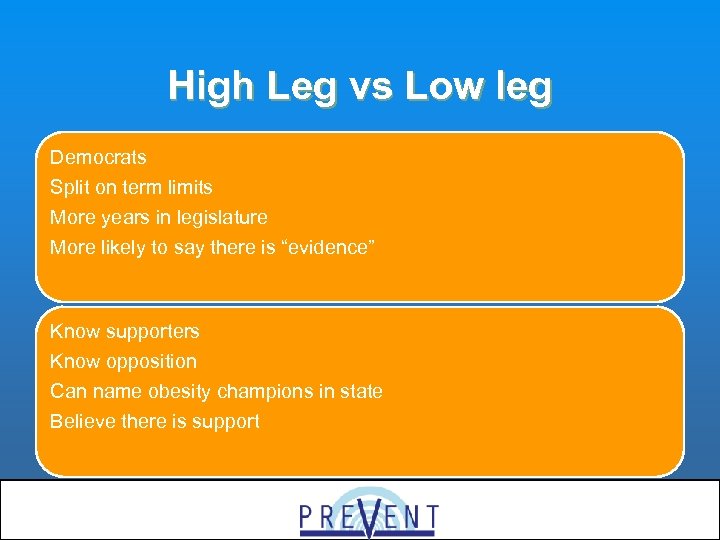 High Leg vs Low leg Democrats Split on term limits More years in legislature More likely to say there is “evidence” Know supporters Know opposition Can name obesity champions in state Believe there is support
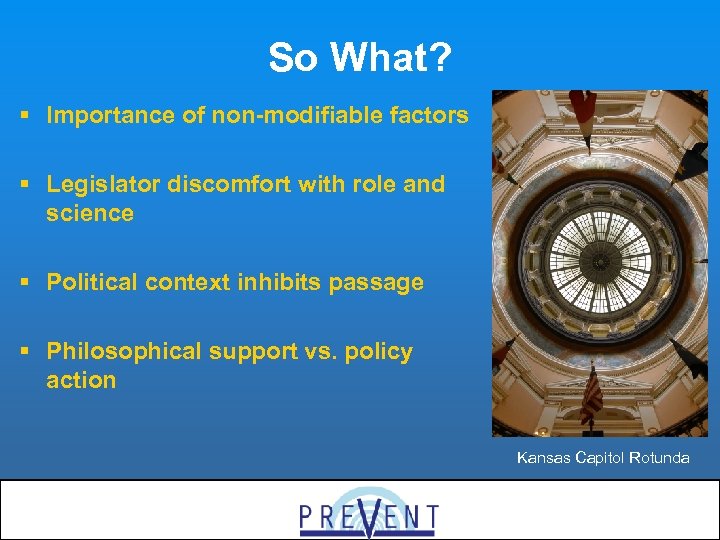 So What? § Importance of non-modifiable factors § Legislator discomfort with role and science § Political context inhibits passage § Philosophical support vs. policy action Kansas Capitol Rotunda
 Factors in State Obesity Policy Legislative Factors Political Context Public Support Bill Content Legislator Factors
 Art and Science § Next Study: § Advocates in • • • LA WA CO NY CA ME 54