 Скачать презентацию WHAT EVERY NAV ADMIN SHOULD KNOW ABOUT PROJECT
5945f9f6cc8e41c399652fffa2007094.ppt
- Количество слайдов: 61



WHAT EVERY NAV ADMIN SHOULD KNOW ABOUT PROJECT MANAGEMENT Dennis Mahon, GOGO Inc. #NAVUGFocus 1
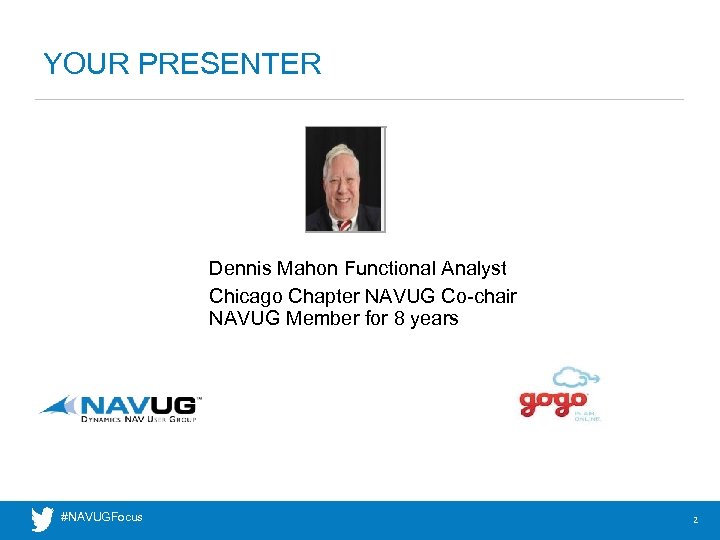
YOUR PRESENTER headshot Dennis Mahon Functional Analyst Chicago Chapter NAVUG Co-chair NAVUG Member for 8 years #NAVUGFocus 2
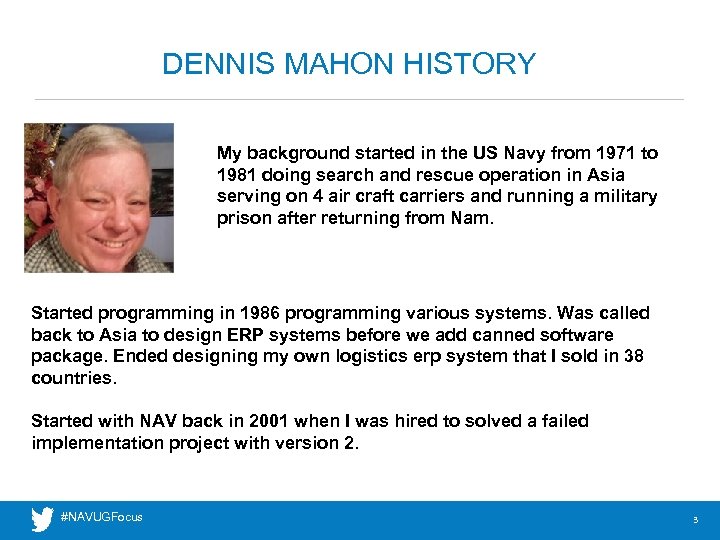
DENNIS MAHON HISTORY My background started in the US Navy from 1971 to 1981 doing search and rescue operation in Asia serving on 4 air craft carriers and running a military prison after returning from Nam. Started programming in 1986 programming various systems. Was called back to Asia to design ERP systems before we add canned software package. Ended designing my own logistics erp system that I sold in 38 countries. Started with NAV back in 2001 when I was hired to solved a failed implementation project with version 2. #NAVUGFocus 3
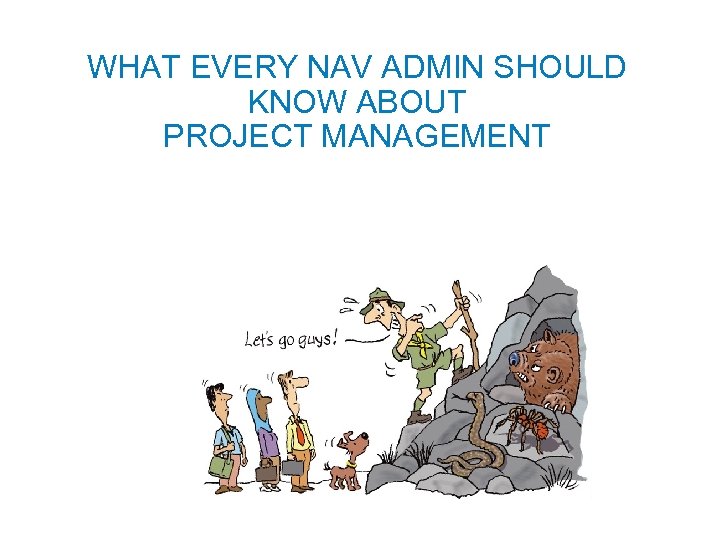
WHAT EVERY NAV ADMIN SHOULD KNOW ABOUT PROJECT MANAGEMENT
PRESENTATION OUTLINE v What is a Project? v Project Management History v Why do we need Project Management? v What every NAV admin should know v What is PM methodology? v Microsoft Sure Step Methodology v Sample project Documents v Q&A #NAVUGFocus 5
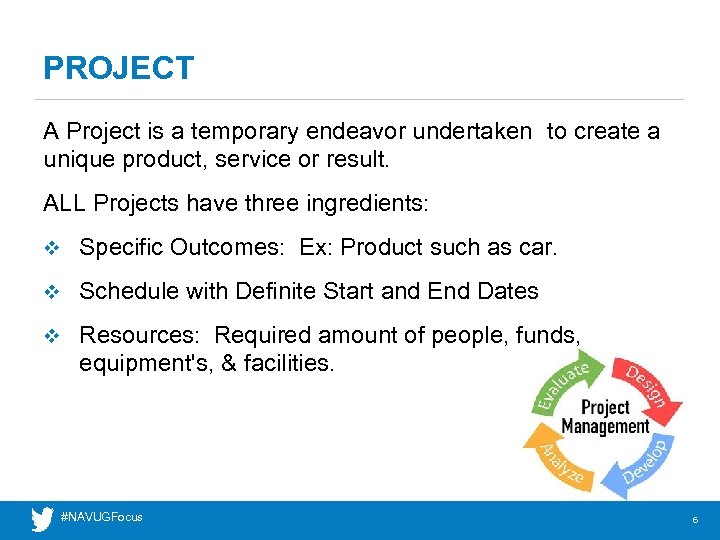
PROJECT A Project is a temporary endeavor undertaken to create a unique product, service or result. ALL Projects have three ingredients: v Specific Outcomes: Ex: Product such as car. v Schedule with Definite Start and End Dates v Resources: Required amount of people, funds, equipment's, & facilities. #NAVUGFocus 6
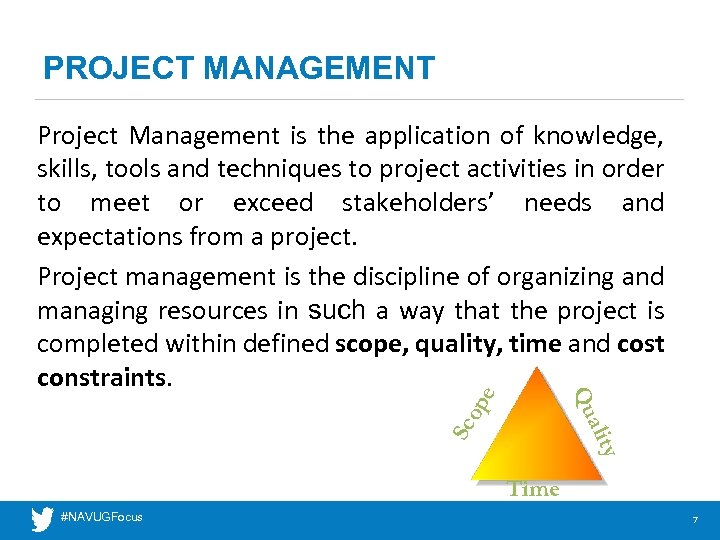
PROJECT MANAGEMENT Sc alit op Qu e Project Management is the application of knowledge, skills, tools and techniques to project activities in order to meet or exceed stakeholders’ needs and expectations from a project. Project management is the discipline of organizing and managing resources in such a way that the project is completed within defined scope, quality, time and cost constraints. y Time #NAVUGFocus 7
WHY DO PROJECTS FAIL? v Rigid Organization Process ( Ex : Business users not ready for process/ system changes) v Unmanaged Project Execution (Ex : Requirements/ Scope keep changing) v Lack of Traceability (Ex: Not knowing who requested the code modification) v Non Documented Activities and Poor Deliverables ( Poor documentation of requirements) Ex: v Lack of Formal Acceptance from Business on our understanding ( Ex; No sign off on requirements document) #NAVUGFocus 8
HISTORY OF PROJECT MANAGEMENT Do you think Project management was involved in the 2570 BC Great pyramid of Giza, which was completed. Records remain of how the work was managed. There were managers of each of the four faces of the pyramid, responsible for their completion. #NAVUGFocus 9
PROJECT HISTORY 1910 The Gantt Chart was developed by Henry Laurence Gantt. 1950 s The Critical Path Method (CPM) invented a step-by-step project management technique for process planning that defines critical and non-critical tasks with the goal of preventing time-frame problems and process bottlenecks. The CPM is ideally suited to projects consisting of numerous activities that interact in a complex manner. #NAVUGFocus 10
PROJECT HISTORY 1950 s The US DOD used modern project management techniques in their Polaris Project. 1958 The Program Evaluation and Review Technique (PERT) method invented 1965 International Project Management Association (IPMA) established as International Management Systems Association (IMSA) #NAVUGFocus 11
PROJECT HISTORY 1969 Project Management Institute (PMI) launched to promote project management profession. 1986 Scrum was named as a project management style in the article The New Product Development Game #NAVUGFocus 12
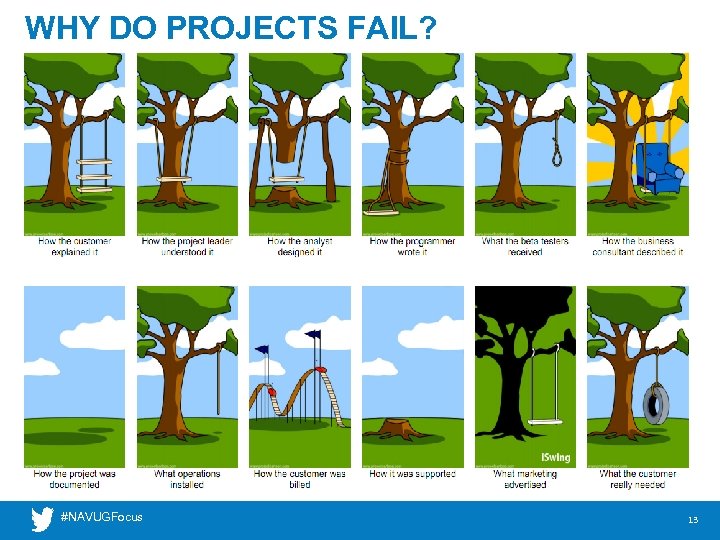
WHY DO PROJECTS FAIL? #NAVUGFocus 13
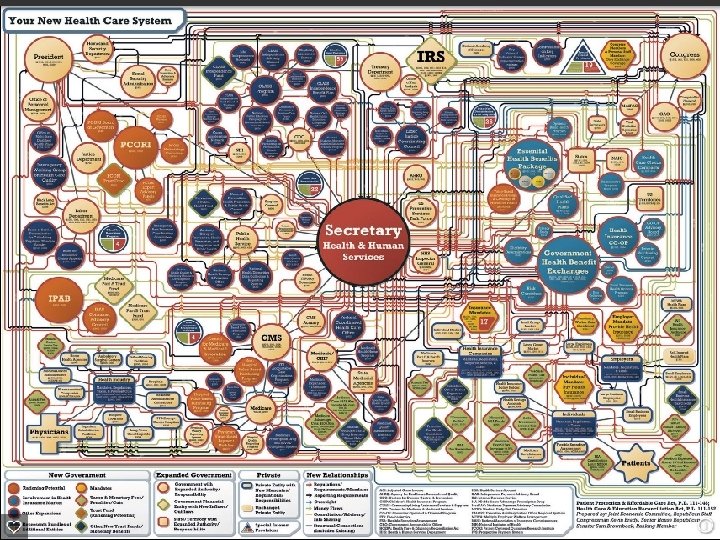
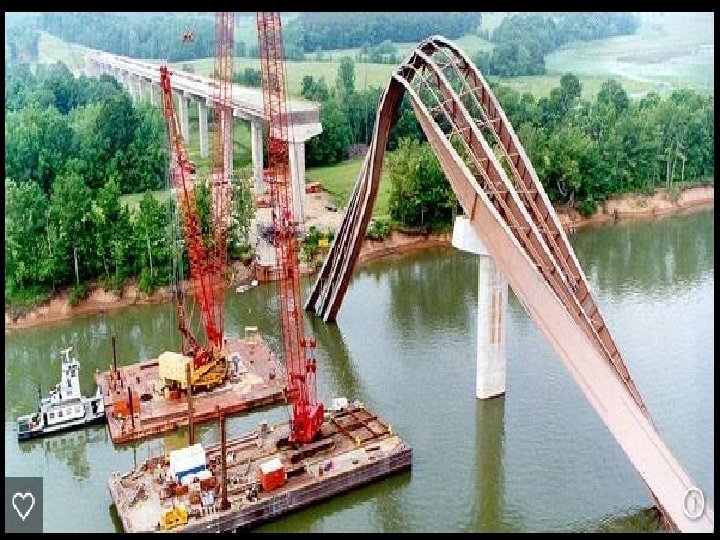
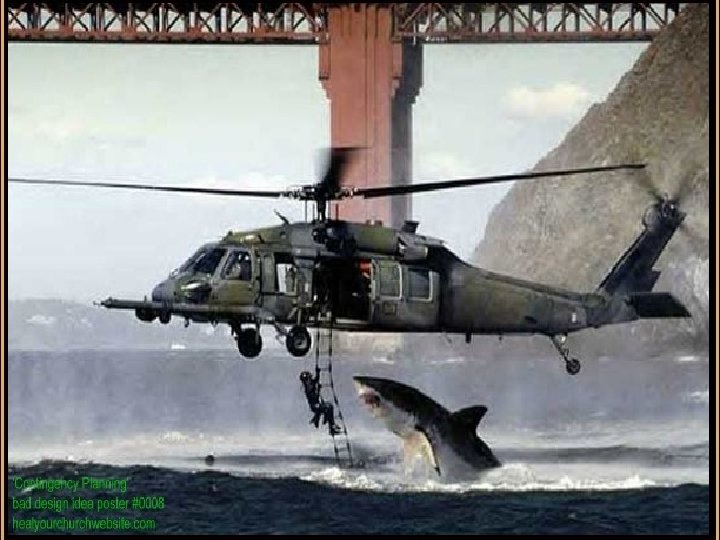
EXAMPLES OF PROJECT FAILURES What is a project without a project manager? #NAVUGFocus 14
#NAVUGFocus 15
#NAVUGFocus 16

COLUMBIA SHUTTLE DISINTEGRATED #NAVUGFocus 17
#NAVUGFocus 18
PROJECT MANAGEMENT RESPONSIBILITIES Typical Activities of Project manager: v Ability to define schedule v Assign project activities v Record project issues v Monitor progress and report changes in activity completion v Issue resolution v Maintain and control changes to designs, & plans #NAVUGFocus 19
COMMUNICATE WITH EVERY LEVEL v The ability to communicate comfortably with people at all levels of the organization about the project. v Communication is almost always named as one of the toptier skills by project managers and team members. v Each person will need to be engaged differently. One may need details while another prefers a brief overview. #NAVUGFocus 20 20
LEARN HOW TO SPEAK PUBLICLY v A project manager can be skilled at putting the project together, but may fail in presenting information to stakeholders v Project managers need effective presentation skills— both formal and informal v Good presenters typically are not born. You may need to invest in presentation training, practice, and get feedback. v There are some personality trends, but the simple truth is that good presenters have had lots of practice. #NAVUGFocus 21 21
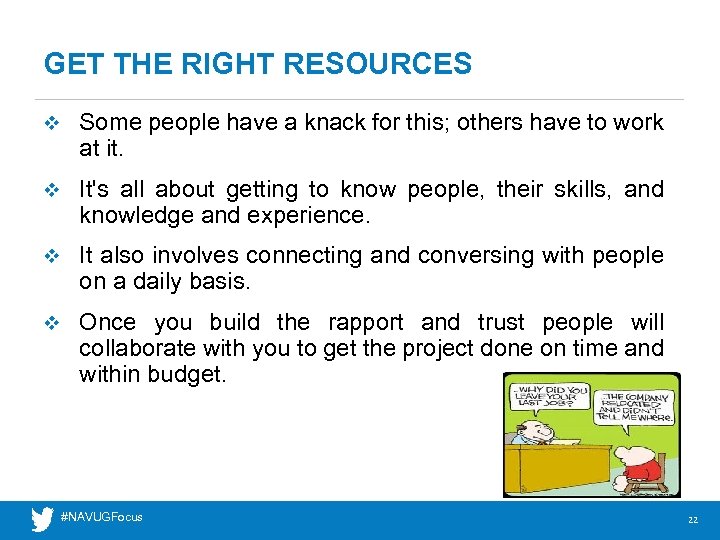
GET THE RIGHT RESOURCES v Some people have a knack for this; others have to work at it. v It's all about getting to know people, their skills, and knowledge and experience. v It also involves connecting and conversing with people on a daily basis. v Once you build the rapport and trust people will collaborate with you to get the project done on time and within budget. #NAVUGFocus 22
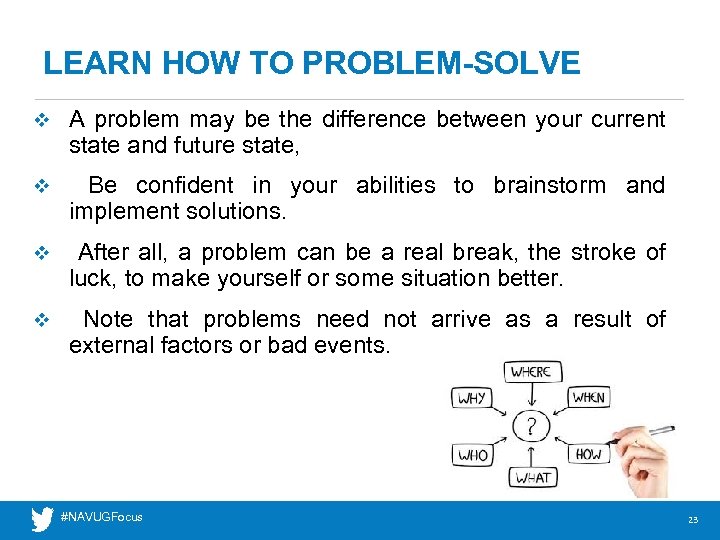
LEARN HOW TO PROBLEM-SOLVE v A problem may be the difference between your current state and future state, v Be confident in your abilities to brainstorm and implement solutions. v After all, a problem can be a real break, the stroke of luck, to make yourself or some situation better. v Note that problems need not arrive as a result of external factors or bad events. #NAVUGFocus 23
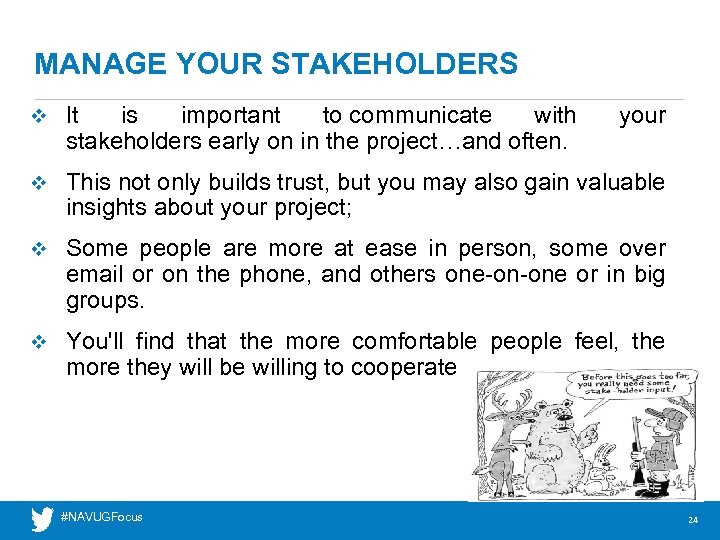
MANAGE YOUR STAKEHOLDERS v It is important to communicate with stakeholders early on in the project…and often. v This not only builds trust, but you may also gain valuable insights about your project; v Some people are more at ease in person, some over email or on the phone, and others one-on-one or in big groups. v You'll find that the more comfortable people feel, the more they will be willing to cooperate #NAVUGFocus your 24
LEARN THE NECESSARY CRITICAL SKILLS v Having a narrow technical focus is not enough to be a successful project manager, v You also need to posses other critical skills such as negotiation and decision-making. v Skills such as these are imperative, when you cross organizational boundaries to obtain support or get decisions. #NAVUGFocus 25
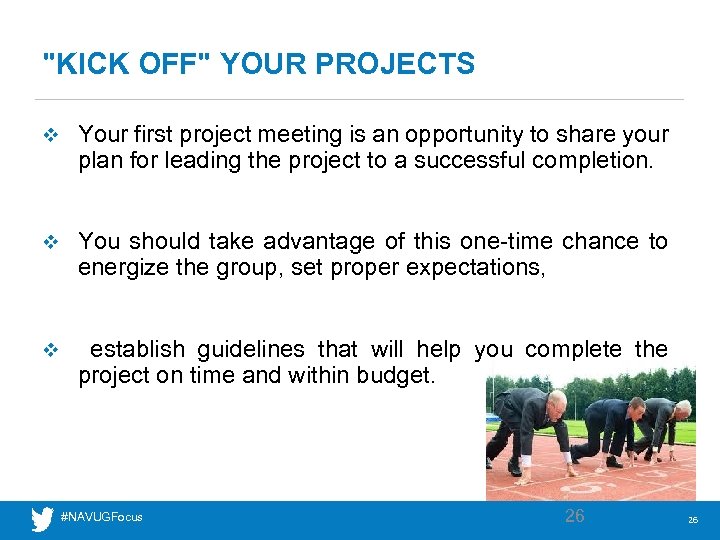
"KICK OFF" YOUR PROJECTS v Your first project meeting is an opportunity to share your plan for leading the project to a successful completion. v You should take advantage of this one-time chance to energize the group, set proper expectations, v establish guidelines that will help you complete the project on time and within budget. #NAVUGFocus 26 26
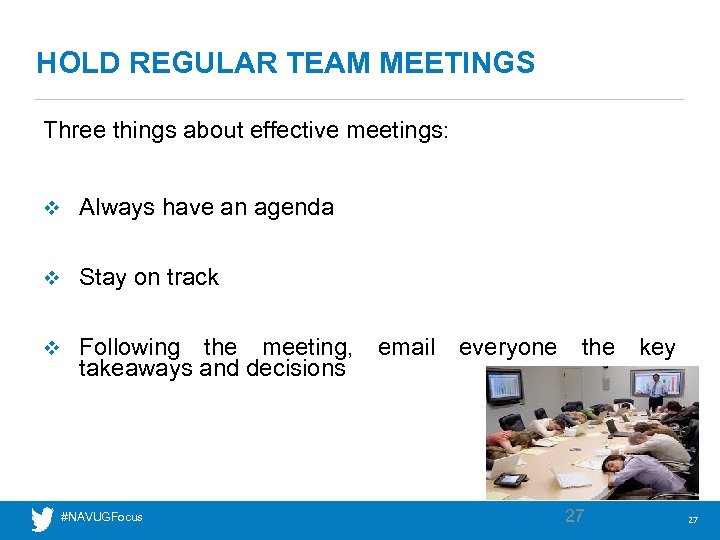
HOLD REGULAR TEAM MEETINGS Three things about effective meetings: v Always have an agenda v Stay on track v Following the meeting, email everyone the key takeaways and decisions #NAVUGFocus 27 27
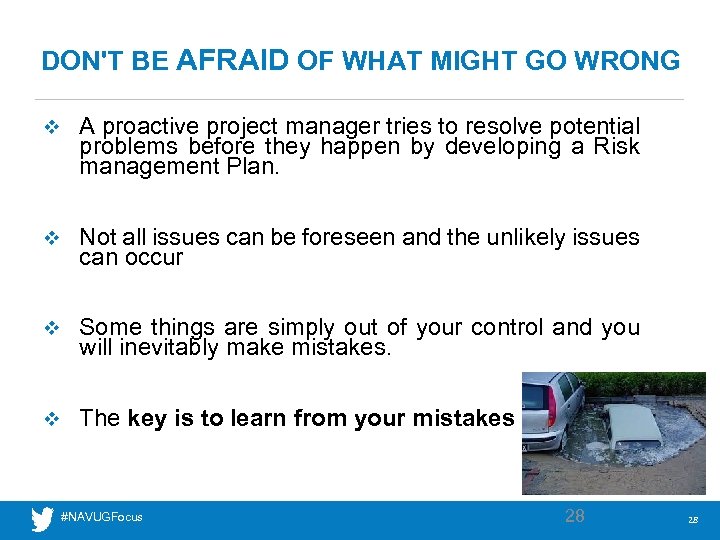
DON'T BE AFRAID OF WHAT MIGHT GO WRONG v A proactive project manager tries to resolve potential problems before they happen by developing a Risk management Plan. v Not all issues can be foreseen and the unlikely issues can occur v Some things are simply out of your control and you will inevitably make mistakes. v The key is to learn from your mistakes #NAVUGFocus 28 28
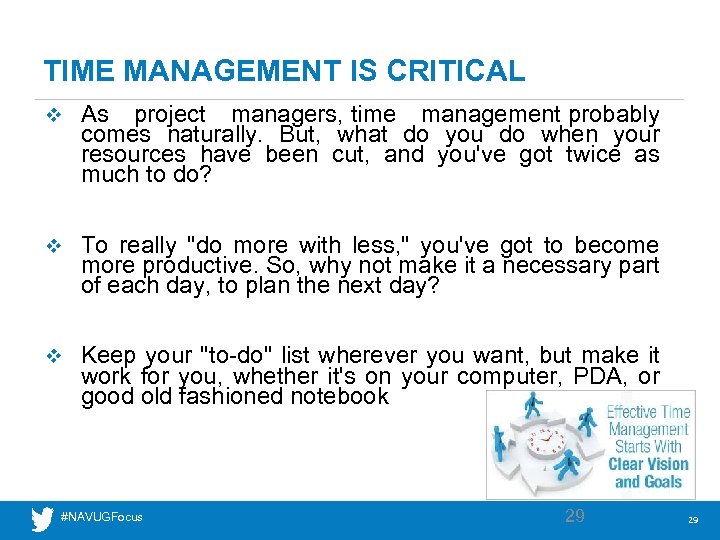
TIME MANAGEMENT IS CRITICAL v As project managers, time management probably comes naturally. But, what do you do when your resources have been cut, and you've got twice as much to do? v To really "do more with less, " you've got to become more productive. So, why not make it a necessary part of each day, to plan the next day? v Keep your "to-do" list wherever you want, but make it work for you, whether it's on your computer, PDA, or good old fashioned notebook #NAVUGFocus 29 29
CAPTURE BEST PRACTICES v A great way to ensure best practices are captured is to commit your thoughts to paper and share it with others. v Find a way to keep track of best practices for each project that works for you, v This is a powerful way to ensure your hard work doesn’t go unnoticed, while creating a permanent record for the future. #NAVUGFocus 30 30
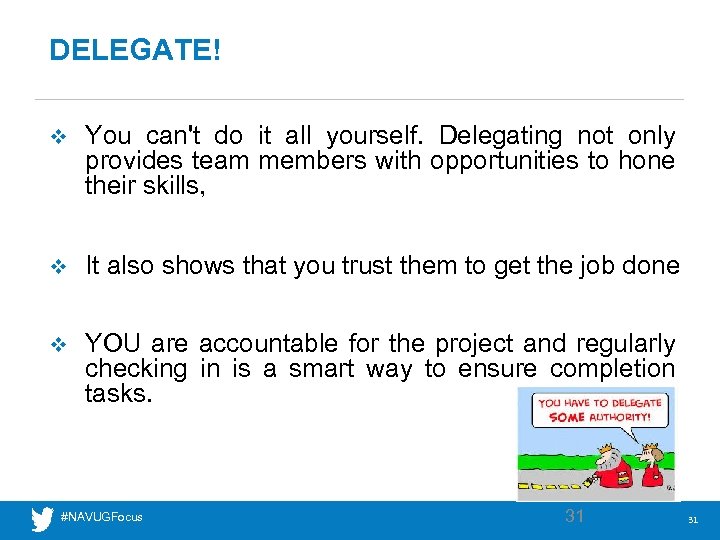
DELEGATE! v You can't do it all yourself. Delegating not only provides team members with opportunities to hone their skills, v It also shows that you trust them to get the job done v YOU are accountable for the project and regularly checking in is a smart way to ensure completion tasks. #NAVUGFocus 31 31
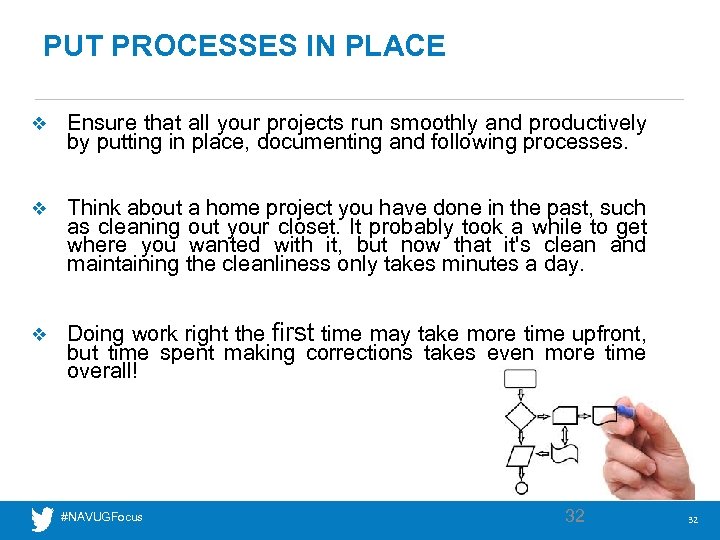
PUT PROCESSES IN PLACE v Ensure that all your projects run smoothly and productively by putting in place, documenting and following processes. v Think about a home project you have done in the past, such as cleaning out your closet. It probably took a while to get where you wanted with it, but now that it's clean and maintaining the cleanliness only takes minutes a day. v Doing work right the first time may take more time upfront, but time spent making corrections takes even more time overall! #NAVUGFocus 32 32
BE A STRONG DECISION MAKER v Decision-making is an integral part of project management. Yes, it is important to get the right people involved and get their opinions; What is wrong with opinions? Everyone has one. v Consensus is a process of analyzing, evaluating, and synthesizing many diverse factors for making decisions on a project team. It is a method by which an entire project team can come to agreement. Input and ideas of all team members are considered to arrive at a final decision that is acceptable to all. v #NAVUGFocus 33
CONSENSUS PROJECT MANAGEMENT The consensus decision making approach means that every member of the project team has to buy into the decision. The project leader transfers control to the project team. The project leader is no longer responsible for the decision and its consequences. #NAVUGFocus 34
CONSENSUS PROJECT MANAGEMENT Consensus will often require compromise – win/lose or lose/win. Not every team member can get everything they want out of the final decision. However, because every team member has equal input, the decisions reached are often ones that everyone can support. #NAVUGFocus 35
CONSENSUS PROJECT MANAGEMENT Through the consensus decision making process, teams work to achieve better solutions, promote trust, and improve team spirit. Team members work through differences to reach a mutually satisfactory position (“mutuality”). Ideas are not lost. Every member’s input is valued as part of the final solution. #NAVUGFocus 36
THE CONSENSUS DECISION MAKING MODEL WORKS BEST WITH PROJECT ISSUES: v That rouse a lot of emotion v That concern team members’ ethics, politics, culture, or values v Where the investment and stakes are high. v Coming to consensus requires: v Time and effort to get everyone organized and on board v The ability to tolerate ambiguity v Accepting and working with dissent, disagreement, or controversy v Remaining outcome focused. v An effective way to reach consensus is to use the E-A-S -Y approach: #NAVUGFocus 37
Consensus method • Time and effort to get everyone organized and on board • The ability to tolerate ambiguity • Accepting and working with dissent, disagreement, or controversy • Remaining outcome focused. • An effective way to reach consensus is to use the E-A-S-Y approach: 38
EASY METHOD Elicit comments or explanations (oral and written) from all team members Ask open-ended questions (what, where, when, which, who, how, why) about the topic State the obvious – summarize. . . write it down Your opinion as the project leader is important, but is not likely to be as important as the collective wisdom of the project team. #NAVUGFocus 39
FORMALLY CLOSEOUT THE PROJECT v There are important lessons to be learned through the project closeout phase. v Projects can be mined for best practices and lessons need to be documented for any possible improvements in future. v The project team has spent a great deal of time and effort, which leads us to our last words of wisdom. . . #NAVUGFocus 40
CELEBRATE! v People need time to celebrate and relish in the successes of the project. v Working on projects is often hard work requiring many hours of dedication. This is why it is important to recognize team contributions v This may be done with the team at a celebration ceremony #NAVUGFocus 41 41
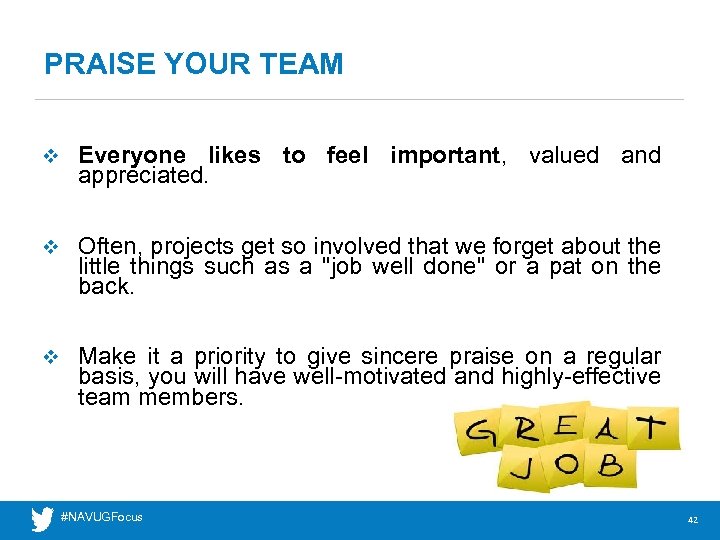
PRAISE YOUR TEAM v Everyone likes to feel important, valued and appreciated. v Often, projects get so involved that we forget about the little things such as a "job well done" or a pat on the back. v Make it a priority to give sincere praise on a regular basis, you will have well-motivated and highly-effective team members. #NAVUGFocus 42
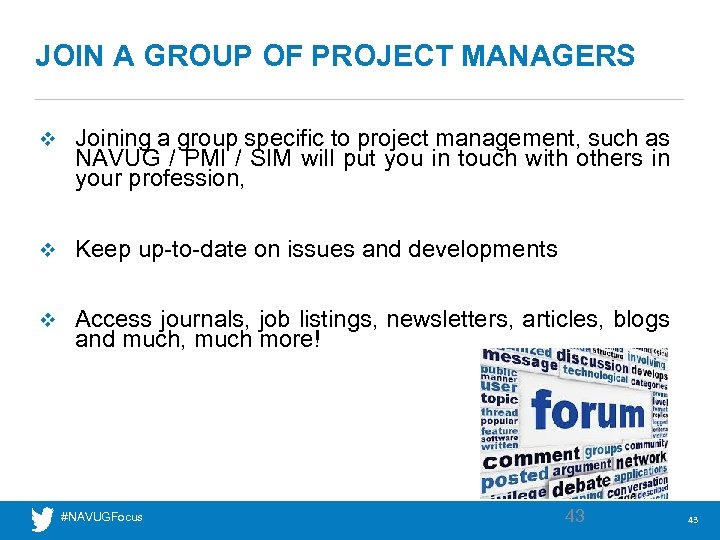
JOIN A GROUP OF PROJECT MANAGERS v Joining a group specific to project management, such as NAVUG / PMI / SIM will put you in touch with others in your profession, v Keep up-to-date on issues and developments v Access journals, job listings, newsletters, articles, blogs and much, much more! #NAVUGFocus 43 43
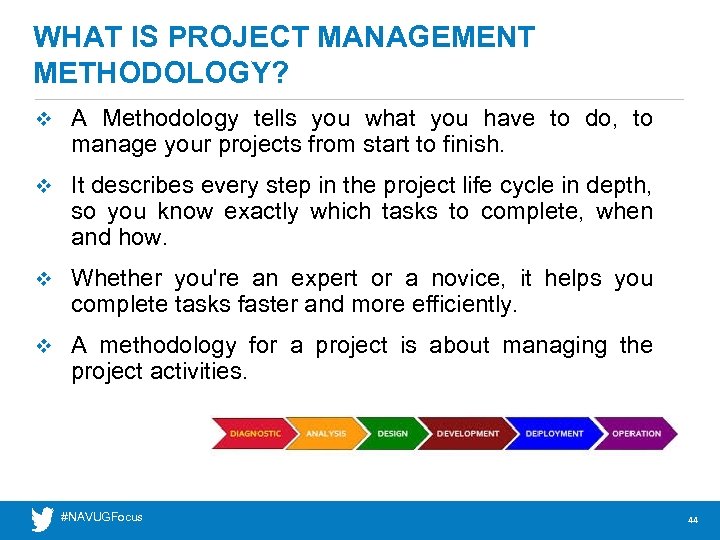
WHAT IS PROJECT MANAGEMENT METHODOLOGY? v A Methodology tells you what you have to do, to manage your projects from start to finish. v It describes every step in the project life cycle in depth, so you know exactly which tasks to complete, when and how. v Whether you're an expert or a novice, it helps you complete tasks faster and more efficiently. v A methodology for a project is about managing the project activities. #NAVUGFocus 44
WHY DO YOU NEED ONE? v You need a Project Management Methodology to steer your projects in the right direction v You also need it to help you manage your projects in a structured, repeatable fashion. v That way, you can apply the same approach ( Best Practices) to every project you undertake. #NAVUGFocus 45
WHAT IS SURE STEP BY MICROSOFT v The key to success is how the solution is implemented and how the implementations are managed. v Keeping this as the background, Microsoft has developed Sure Step for the Microsoft Dynamics products ( NAV, GP, AX, CRM). v Bringing Sure Step helps you in getting maximum benefits and satisfactory project completion. #NAVUGFocus 46
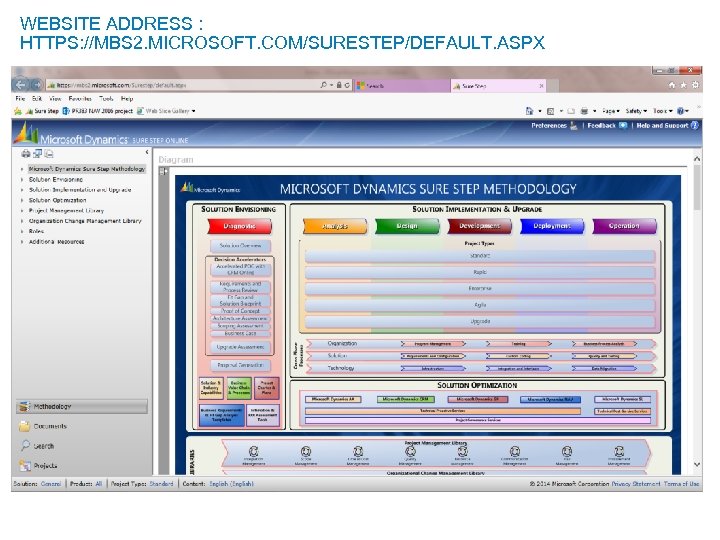
WEBSITE ADDRESS : HTTPS: //MBS 2. MICROSOFT. COM/SURESTEP/DEFAULT. ASPX
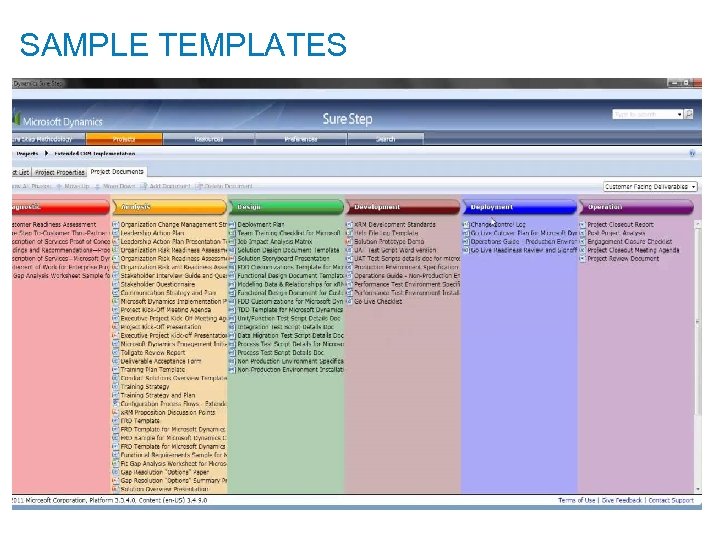
SAMPLE TEMPLATES
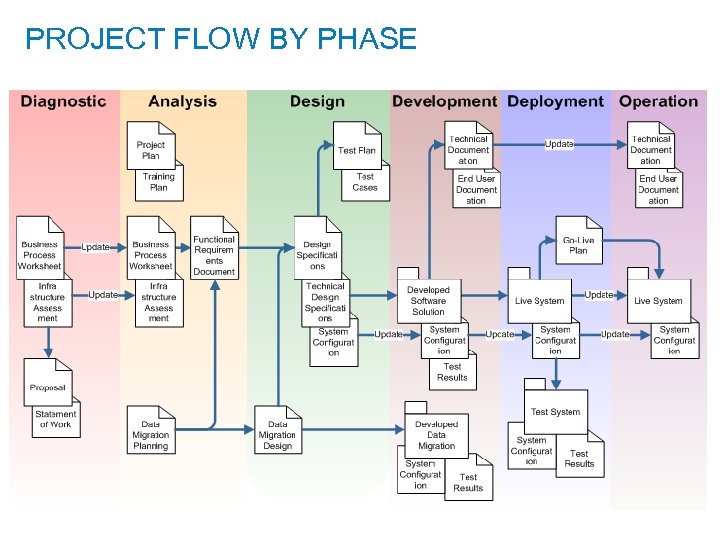
PROJECT FLOW BY PHASE
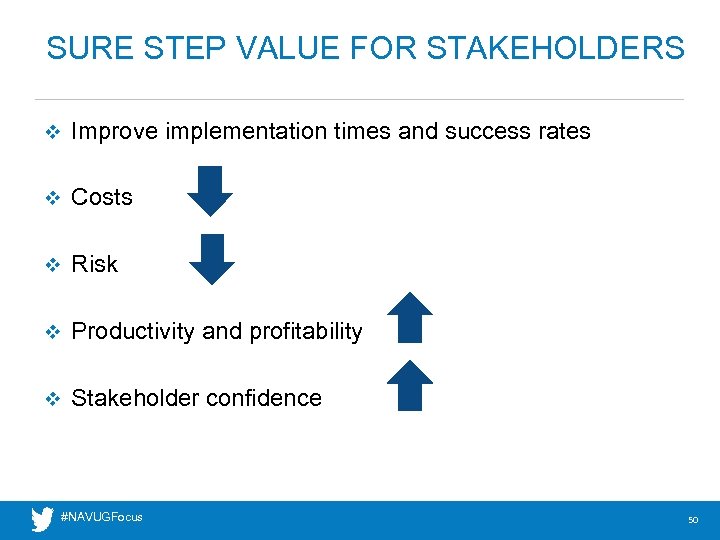
SURE STEP VALUE FOR STAKEHOLDERS v Improve implementation times and success rates v Costs v Risk v Productivity and profitability v Stakeholder confidence #NAVUGFocus 50
SURE STEP VALUE FOR STAKEHOLDER v More visibility into the implementation process v Increased collaboration with Stakeholder Project Teams v More predictability during the implementation process v Better project documentation, estimates and timelines v Faster return on IT investment v Business User satisfaction #NAVUGFocus 51
SAMPLE PROJECT DOCUMENTS v NAV Intercompany is the project I worked at GOGO recently. v My role was a Project Manager and System Analyst v Goal was to Establish Standard NAV Intercompany Processes for GOGO along with twelve Partner companies #NAVUGFocus 52
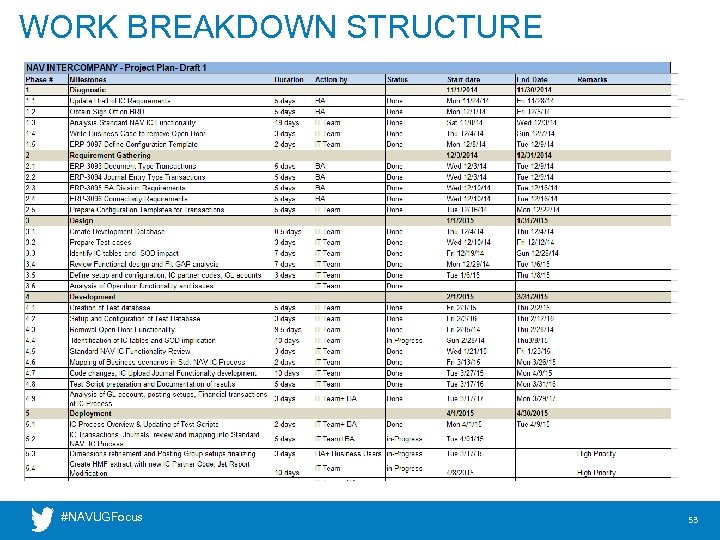
WORK BREAKDOWN STRUCTURE #NAVUGFocus 53
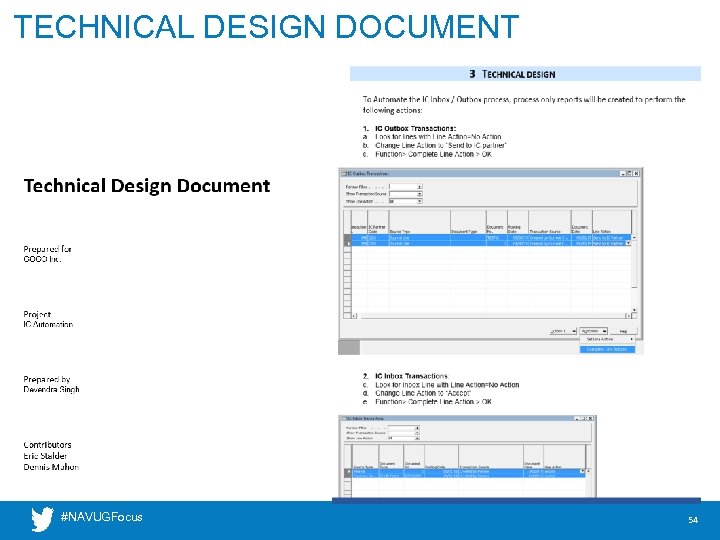
TECHNICAL DESIGN DOCUMENT #NAVUGFocus 54
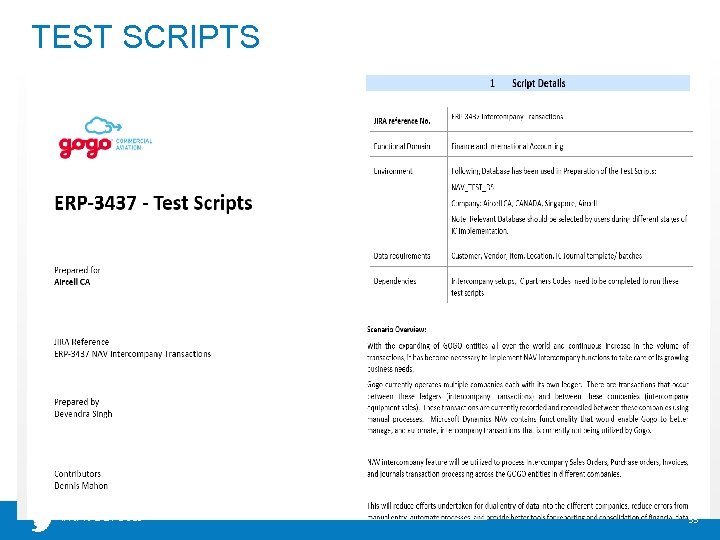
TEST SCRIPTS #NAVUGFocus 55
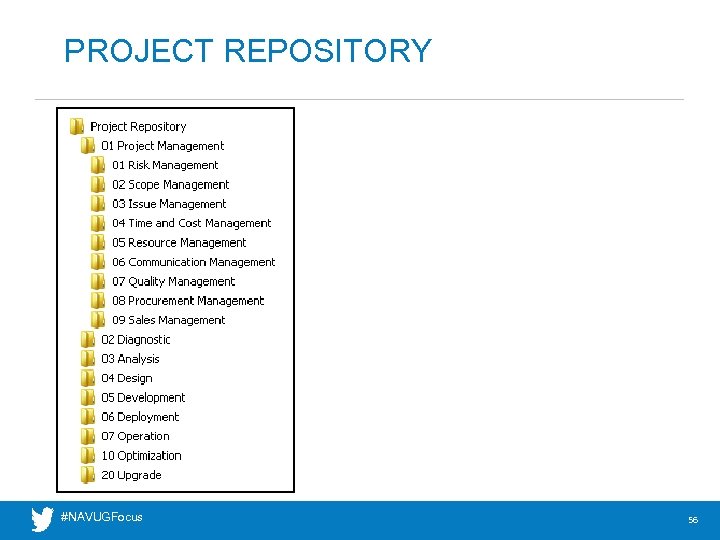
PROJECT REPOSITORY #NAVUGFocus 56
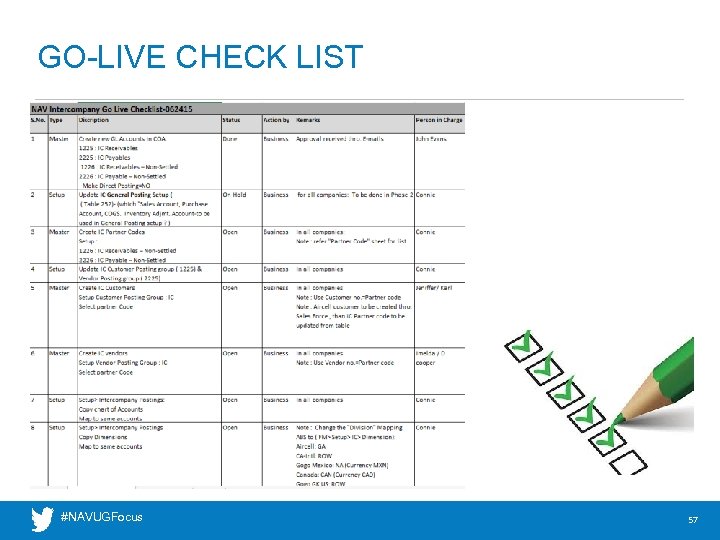
GO-LIVE CHECK LIST #NAVUGFocus 57
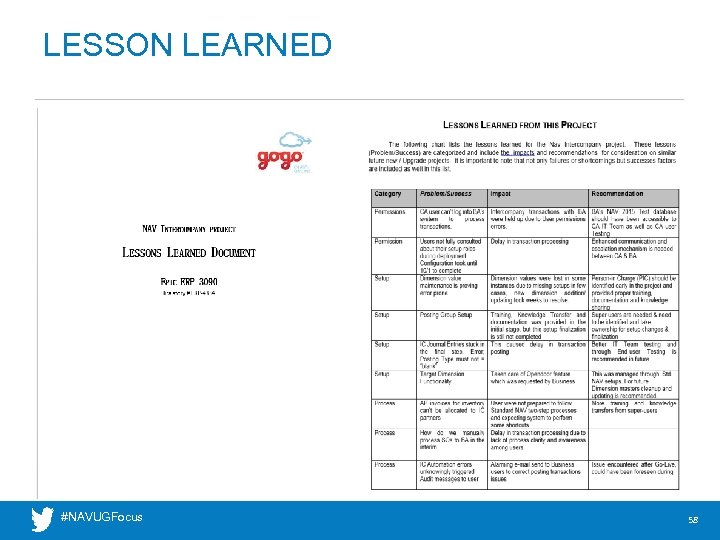
LESSON LEARNED #NAVUGFocus 58
Q & A… THANK YOU #NAVUGFocus 59
CONTACT INFORMATION Email: dmahon@gogoair. com Linkedin: https: //www. linkedin. com/in/dennis-mahon-511 b 458 Chicago NAVUG Chapter Co-Chair #NAVUGFocus 609 -204 -2511 60
#NAVUGFocus 61
Скачать презентацию WHAT EVERY NAV ADMIN SHOULD KNOW ABOUT PROJECT
5945f9f6cc8e41c399652fffa2007094.ppt