


 Скачать презентацию What Electrical Computer Engineering Can Do for
72c9e1ebd5e60d8b9c38617f3f03d994.ppt
- Количество слайдов: 106
 What Electrical & Computer Engineering Can Do for You? Science & Engineering Saturday Seminar 23 January, 2010 Marinos N. Vouvakis vouvakis@ecs. umass. edu Special Thanks to: Baird Soules, Kris Hollot, Maciej Ciesielski, Wayne Burleson, Pat Kelly, Sandip Kundu, Russ Tessier Electrical and Computer Engineering
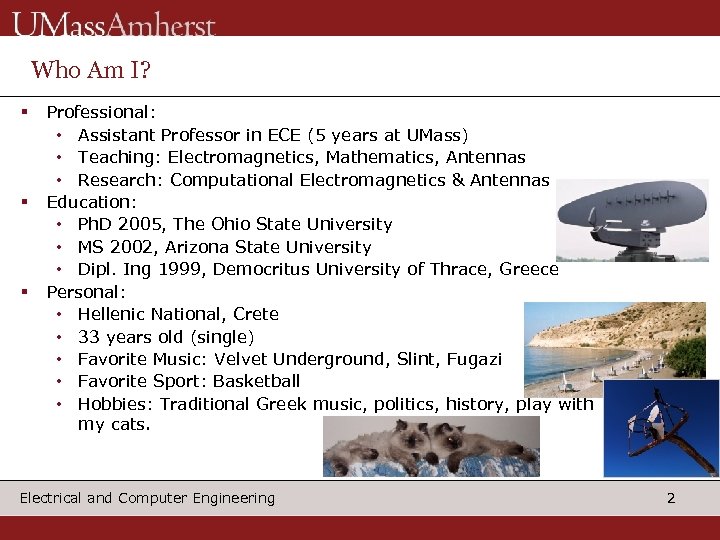 Who Am I? § § § Professional: • Assistant Professor in ECE (5 years at UMass) • Teaching: Electromagnetics, Mathematics, Antennas • Research: Computational Electromagnetics & Antennas Education: • Ph. D 2005, The Ohio State University • MS 2002, Arizona State University • Dipl. Ing 1999, Democritus University of Thrace, Greece Personal: • Hellenic National, Crete • 33 years old (single) • Favorite Music: Velvet Underground, Slint, Fugazi • Favorite Sport: Basketball • Hobbies: Traditional Greek music, politics, history, play with my cats. Electrical and Computer Engineering 2
 Seminar Objectives § Why am I doing this? § Science vs. Engineering? § What is Electrical & Computer Engineering? • What are major ECE sub-areas? • What are the trends? § A Closer look at some basic concepts ECE: • Analog CKTs (sensing & signals) • Digital (entering the Digital world) • Wireless (the communications revolution) § Demos • Sensing & Transducers (Chris) • Sampling & Bits (Baird, Marinos) Electrical and Computer Engineering 3
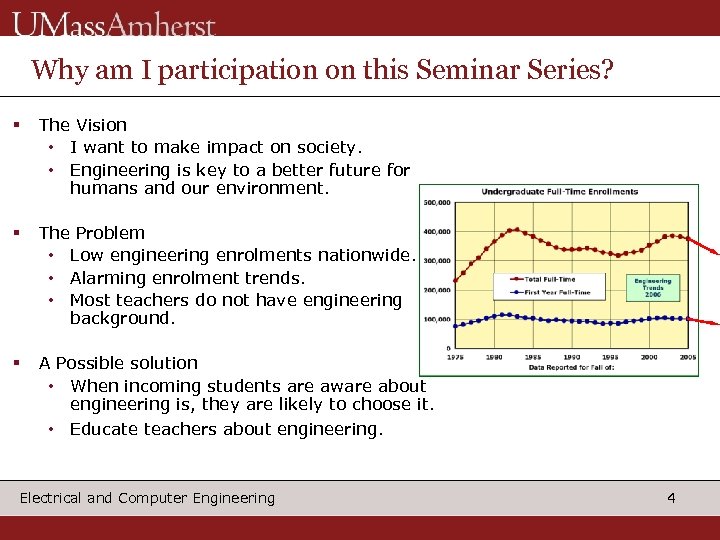 Why am I participation on this Seminar Series? § The Vision • I want to make impact on society. • Engineering is key to a better future for humans and our environment. § The Problem • Low engineering enrolments nationwide. • Alarming enrolment trends. • Most teachers do not have engineering background. § A Possible solution • When incoming students are aware about engineering is, they are likely to choose it. • Educate teachers about engineering. Electrical and Computer Engineering 4
 Science and Engineering Electrical and Computer Engineering 5
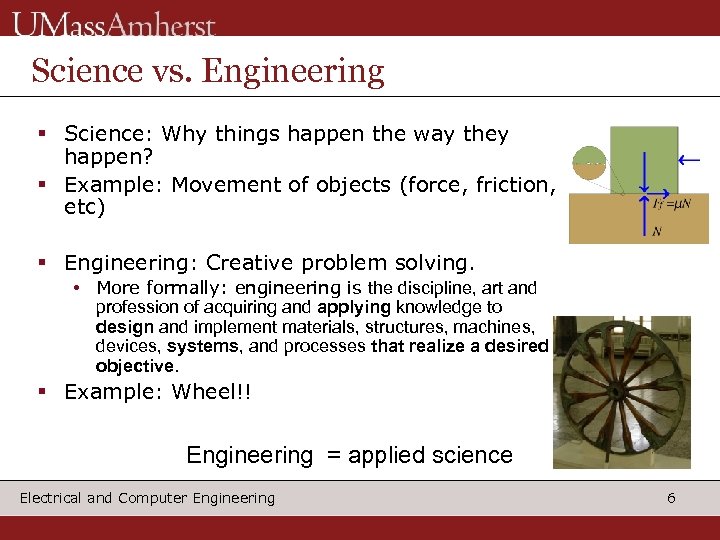 Science vs. Engineering § Science: Why things happen the way they happen? § Example: Movement of objects (force, friction, etc) § Engineering: Creative problem solving. • More formally: engineering is the discipline, art and profession of acquiring and applying knowledge to design and implement materials, structures, machines, devices, systems, and processes that realize a desired objective. § Example: Wheel!! Engineering = applied science Electrical and Computer Engineering 6
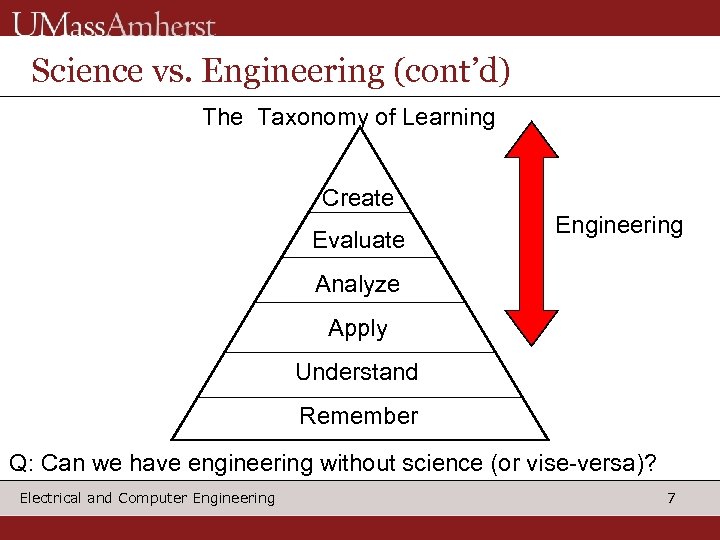 Science vs. Engineering (cont’d) The Taxonomy of Learning Create Evaluate Engineering Analyze Apply Understand Remember Q: Can we have engineering without science (or vise-versa)? Electrical and Computer Engineering 7
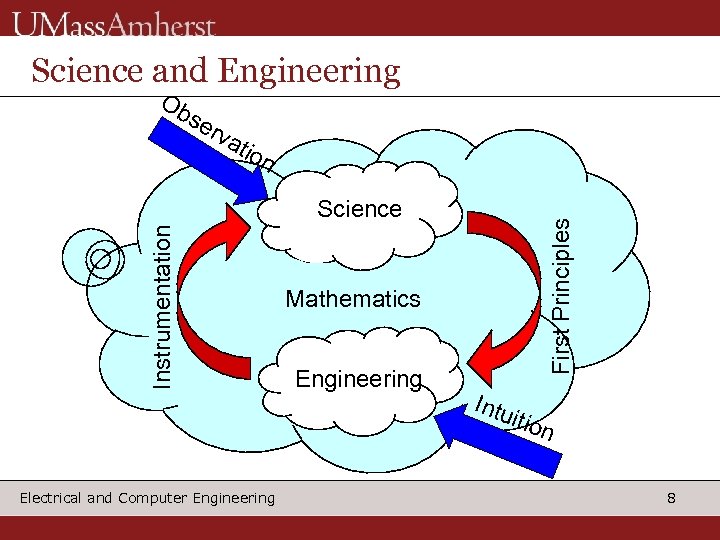 Science and Engineering Ob se rva tio n First Principles Instrumentation Science Mathematics Engineering Intu ition Electrical and Computer Engineering 8
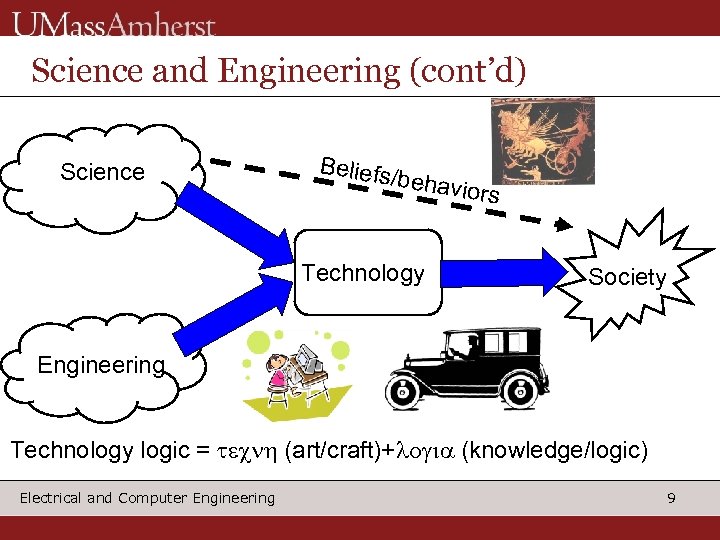 Science and Engineering (cont’d) Science Beliefs /behav Technology iors Society Engineering Technology logic = (art/craft)+ (knowledge/logic) Electrical and Computer Engineering 9
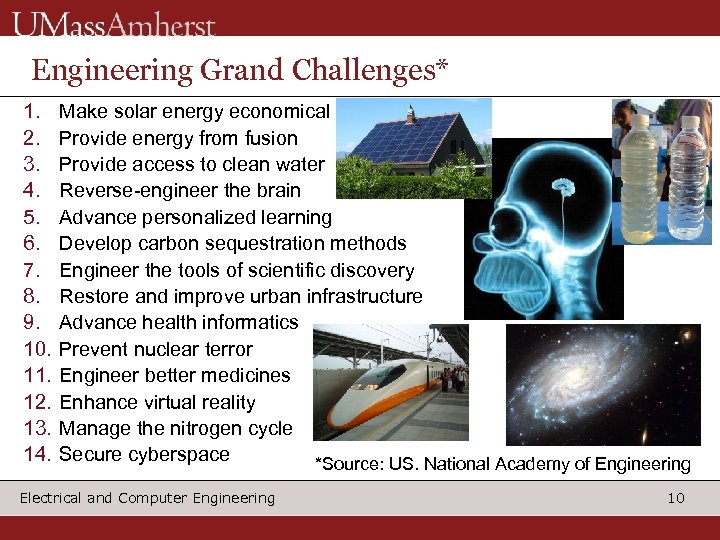 Engineering Grand Challenges* 1. 2. 3. 4. 5. 6. 7. 8. 9. 10. 11. 12. 13. 14. Make solar energy economical
Provide energy from fusion Provide access to clean water Reverse-engineer the brain Advance personalized learning Develop carbon sequestration methods Engineer the tools of scientific discovery Restore and improve urban infrastructure Advance health informatics
Prevent nuclear terror Engineer better medicines Enhance virtual reality Manage the nitrogen cycle Secure cyberspace *Source: US. National Academy of Engineering Electrical and Computer Engineering 10
Engineering Grand Challenges* 1. 2. 3. 4. 5. 6. 7. 8. 9. 10. 11. 12. 13. 14. Make solar energy economical
Provide energy from fusion Provide access to clean water Reverse-engineer the brain Advance personalized learning Develop carbon sequestration methods Engineer the tools of scientific discovery Restore and improve urban infrastructure Advance health informatics
Prevent nuclear terror Engineer better medicines Enhance virtual reality Manage the nitrogen cycle Secure cyberspace *Source: US. National Academy of Engineering Electrical and Computer Engineering 10
 Electrical & Computer Engineering Electrical and Computer Engineering 11
 What do Electrical and Computer Engineers do? Electrical and Computer Engineering 12
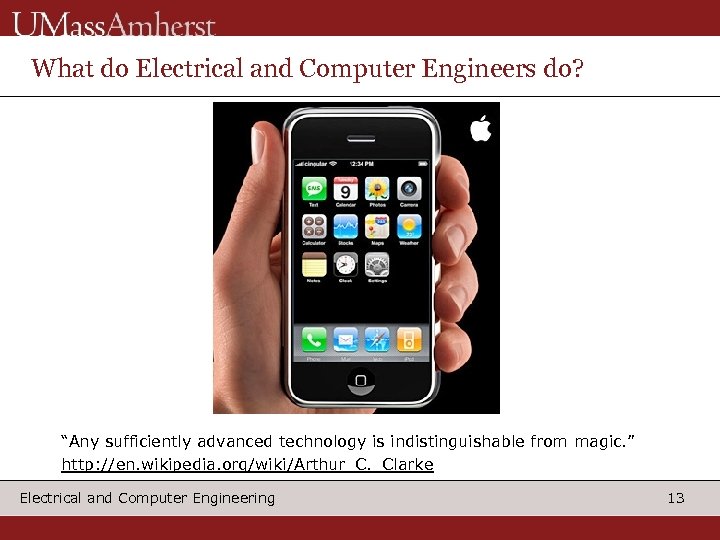 What do Electrical and Computer Engineers do? “Any sufficiently advanced technology is indistinguishable from magic. ” http: //en. wikipedia. org/wiki/Arthur_C. _Clarke Electrical and Computer Engineering 13
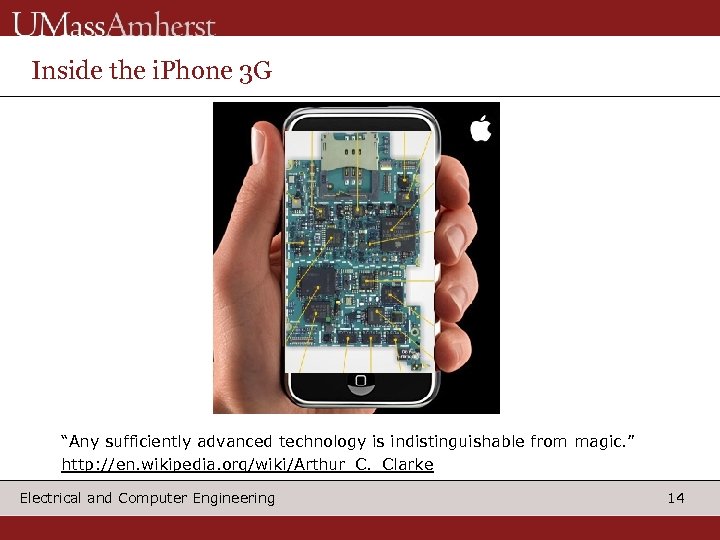 Inside the i. Phone 3 G “Any sufficiently advanced technology is indistinguishable from magic. ” http: //en. wikipedia. org/wiki/Arthur_C. _Clarke Electrical and Computer Engineering 14
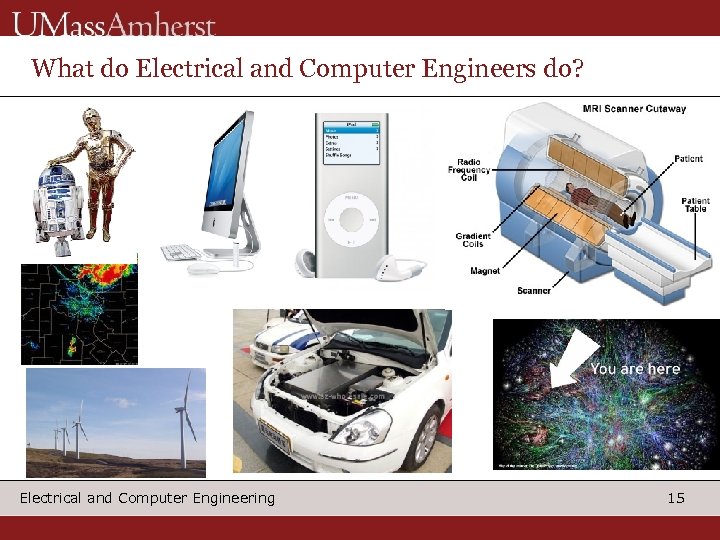 What do Electrical and Computer Engineers do? Electrical and Computer Engineering 15
 Electrical and Computer Engineering § “Electrical engineering is an engineering discipline that deals with the study and/or application of electricity, electronics and electro-magnetism. ” § “Computer engineering is a discipline that combines elements of both electrical engineering and computer science. Computer engineers are involved in many aspects of computing, from the design of individual microprocessors, personal computers, and supercomputers, to circuit design. ” § Easier to understand by exploring example systems Electrical and Computer Engineering 16
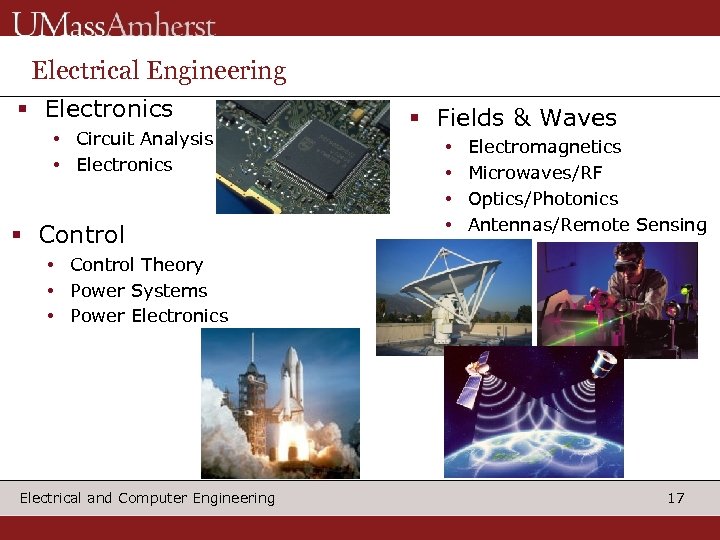 Electrical Engineering § Electronics • Circuit Analysis • Electronics § Control § Fields & Waves • • Electromagnetics Microwaves/RF Optics/Photonics Antennas/Remote Sensing • Control Theory • Power Systems • Power Electronics Electrical and Computer Engineering 17
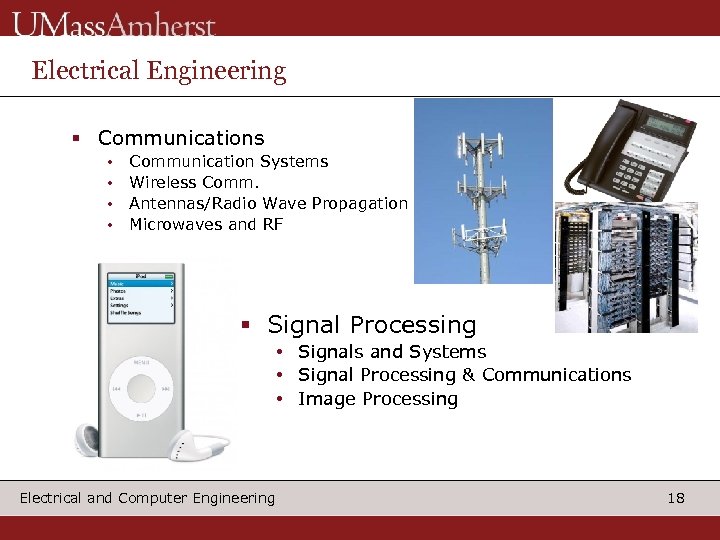 Electrical Engineering § Communications • • Communication Systems Wireless Comm. Antennas/Radio Wave Propagation Microwaves and RF § Signal Processing • Signals and Systems • Signal Processing & Communications • Image Processing Electrical and Computer Engineering 18
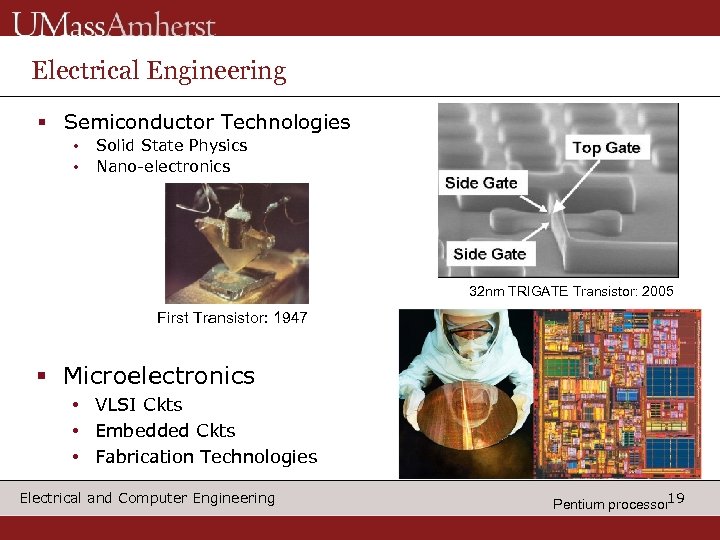 Electrical Engineering § Semiconductor Technologies • • Solid State Physics Nano-electronics 32 nm TRIGATE Transistor: 2005 First Transistor: 1947 § Microelectronics • VLSI Ckts • Embedded Ckts • Fabrication Technologies Electrical and Computer Engineering Pentium processor 19
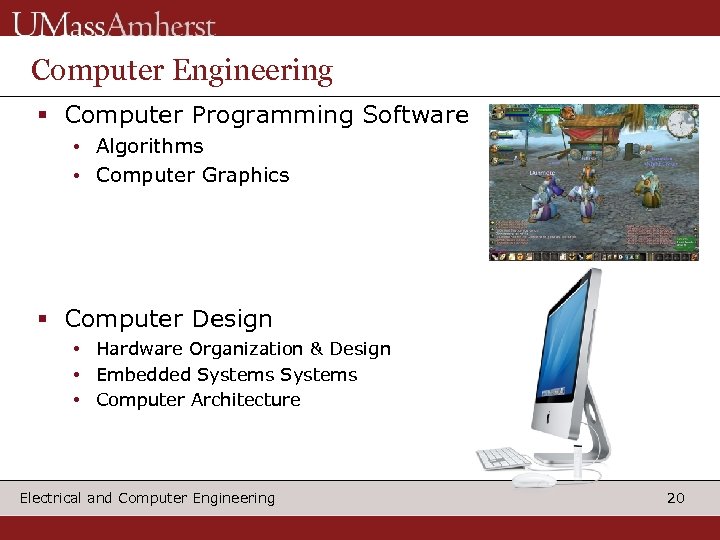 Computer Engineering § Computer Programming Software • Algorithms • Computer Graphics § Computer Design • Hardware Organization & Design • Embedded Systems • Computer Architecture Electrical and Computer Engineering 20
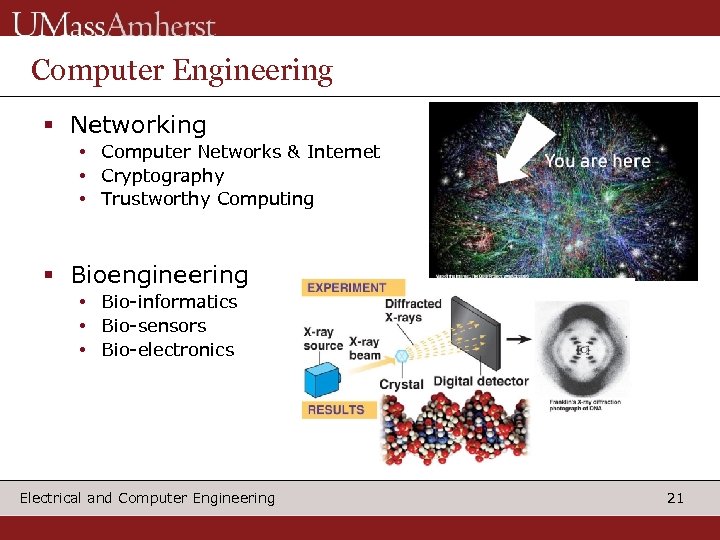 Computer Engineering § Networking • Computer Networks & Internet • Cryptography • Trustworthy Computing § Bioengineering • Bio-informatics • Bio-sensors • Bio-electronics Electrical and Computer Engineering 21
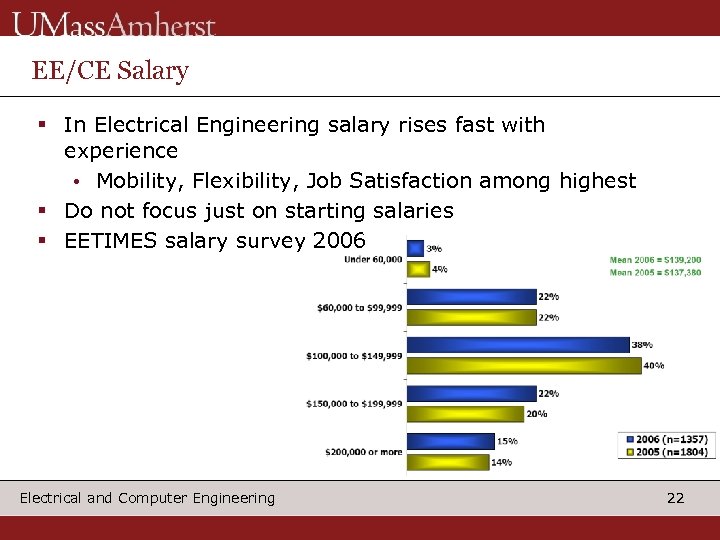 EE/CE Salary § In Electrical Engineering salary rises fast with experience • Mobility, Flexibility, Job Satisfaction among highest § Do not focus just on starting salaries § EETIMES salary survey 2006 Electrical and Computer Engineering 22
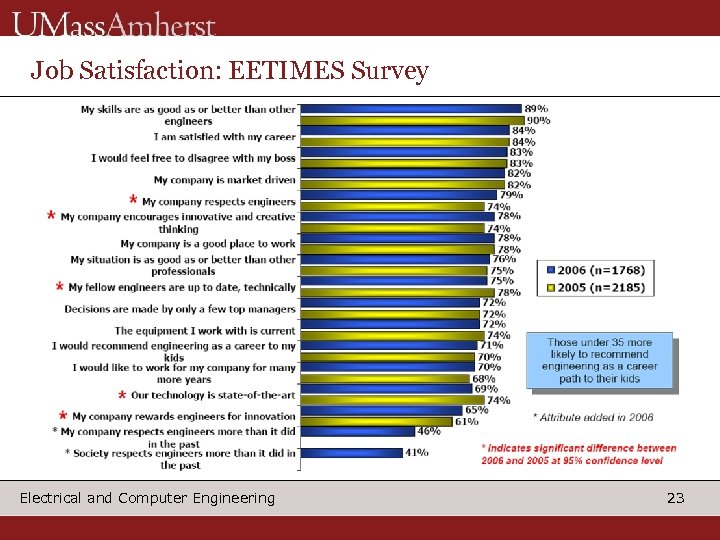 Job Satisfaction: EETIMES Survey Electrical and Computer Engineering 23
 Future ECE Job Prospects* § § § Computer hardware engineers are expected to have employment growth of 4 percent over the projections decade, for all occupations. Although the use of information technology continues to expand rapidly, the manufacture of computer hardware is expected to be adversely affected by intense foreign competition. As computer and semiconductor manufacturers contract out more of their engineering needs to both domestic and foreign design firms, much of the growth in employment of hardware engineers is expected to take place in the computer systems design and related services industry. Electrical engineers are expected to have employment growth of 2 percent over the projections decade. Although strong demand for electrical devices including electric power generators, wireless phone transmitters, high-density batteries, and navigation systems should spur job growth, international competition and the use of engineering services performed in other countries will limit employment growth. Electrical engineers working in firms providing engineering expertise and design services to manufacturers should have better job prospects. Electronics engineers, are expected to experience little to no employment change over the projections decade. Although rising demand for electronic goods including communications equipment, defense-related equipment, medical electronics, and consumer products should continue to increase demand for electronics engineers, foreign competition in electronic products development and the use of engineering services performed in other countries will limit employment growth. Growth is expected to be fastest in service-providing industries particularly in firms that provide engineering and design services. *Bureau of Labor & Statistics Electrical and Computer Engineering 24
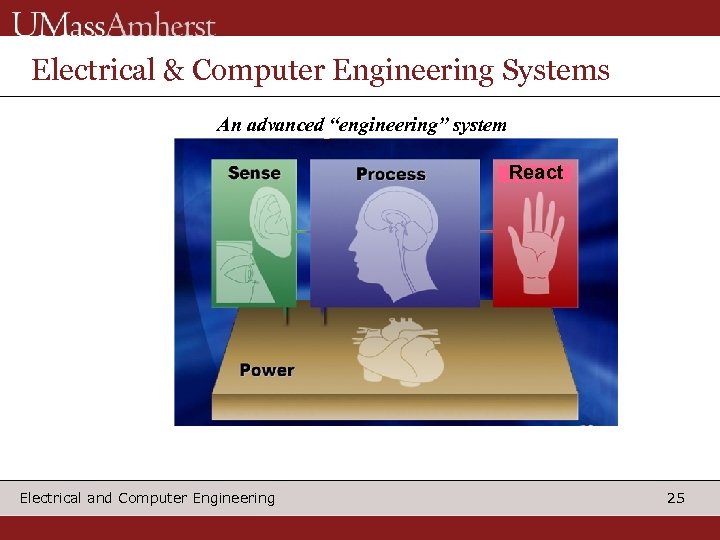 Electrical & Computer Engineering Systems An advanced “engineering” system React Electrical and Computer Engineering 25
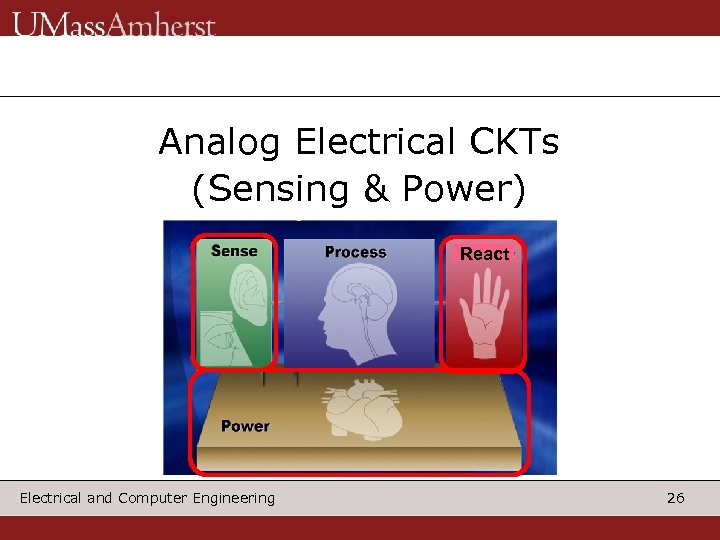 Analog Electrical CKTs (Sensing & Power) React Electrical and Computer Engineering 26
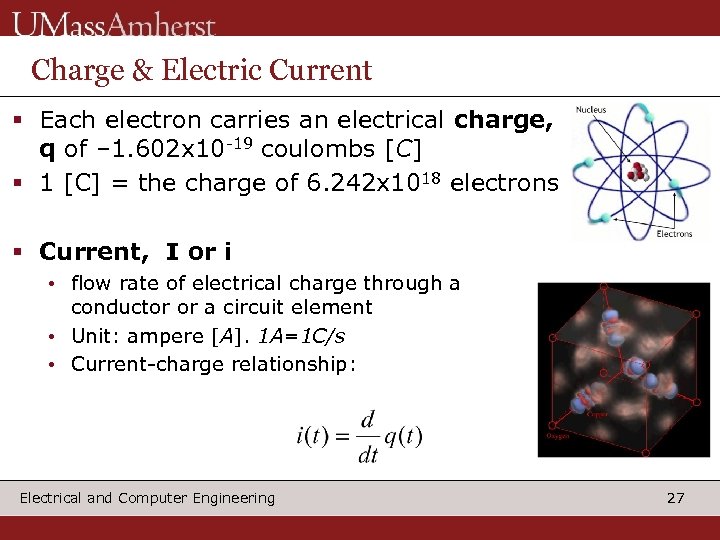 Charge & Electric Current § Each electron carries an electrical charge, q of – 1. 602 x 10 -19 coulombs [C] § 1 [C] = the charge of 6. 242 x 1018 electrons § Current, I or i • flow rate of electrical charge through a conductor or a circuit element • Unit: ampere [A]. 1 A=1 C/s • Current-charge relationship: Electrical and Computer Engineering 27
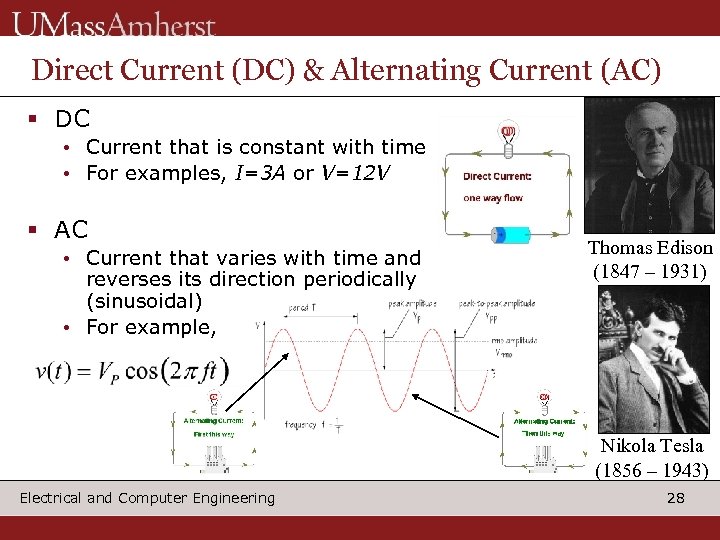 Direct Current (DC) & Alternating Current (AC) § DC • Current that is constant with time • For examples, I=3 A or V=12 V § AC • Current that varies with time and reverses its direction periodically (sinusoidal) • For example, Thomas Edison (1847 – 1931) Nikola Tesla (1856 – 1943) Electrical and Computer Engineering 28
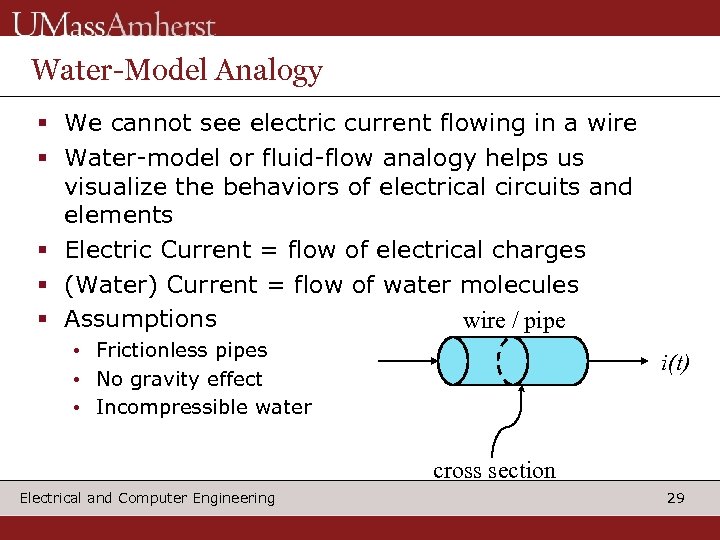 Water-Model Analogy § We cannot see electric current flowing in a wire § Water-model or fluid-flow analogy helps us visualize the behaviors of electrical circuits and elements § Electric Current = flow of electrical charges § (Water) Current = flow of water molecules § Assumptions wire / pipe • Frictionless pipes • No gravity effect • Incompressible water i(t) cross section Electrical and Computer Engineering 29
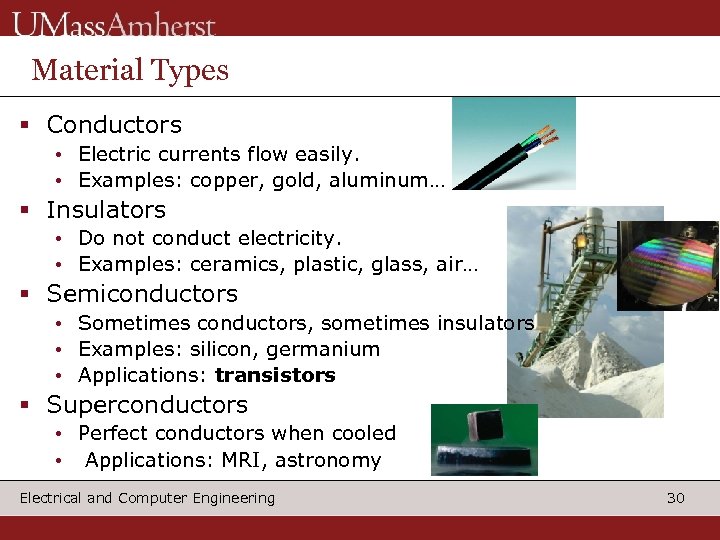 Material Types § Conductors • Electric currents flow easily. • Examples: copper, gold, aluminum… § Insulators • Do not conduct electricity. • Examples: ceramics, plastic, glass, air… § Semiconductors • Sometimes conductors, sometimes insulators • Examples: silicon, germanium • Applications: transistors § Superconductors • Perfect conductors when cooled • Applications: MRI, astronomy Electrical and Computer Engineering 30
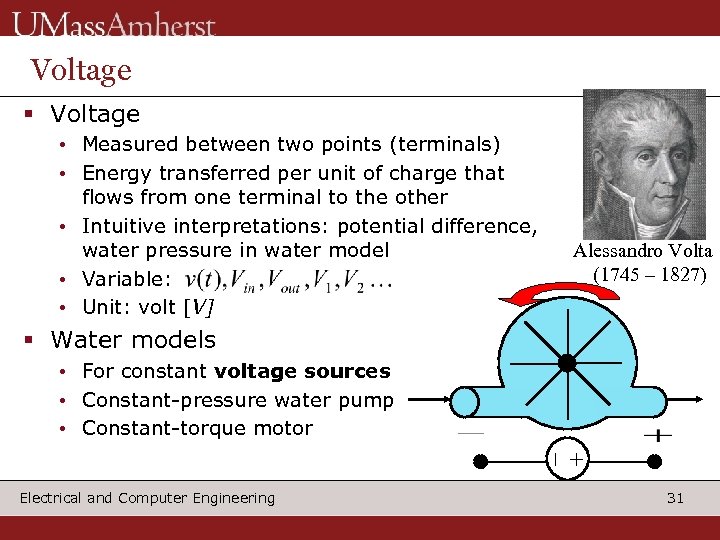 Voltage § Voltage • Measured between two points (terminals) • Energy transferred per unit of charge that flows from one terminal to the other • Intuitive interpretations: potential difference, water pressure in water model • Variable: • Unit: volt [V] Alessandro Volta (1745 – 1827) § Water models • For constant voltage sources • Constant-pressure water pump • Constant-torque motor Electrical and Computer Engineering 31
 Rules of Current Flow - Kirchhoff’s Current Law § Kirchhoff’s current law (KCL) • Conservation of electrical currents • The sum of all the currents into a node is zero • The sum of the currents entering a node equals the sum of the currents leaving a node Gustav Kirchhoff (1824 – 1887) Electrical and Computer Engineering 32
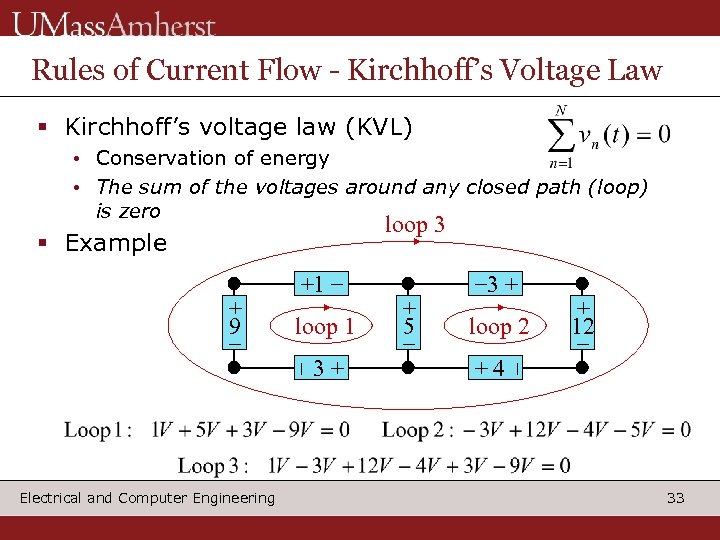 Rules of Current Flow - Kirchhoff’s Voltage Law § Kirchhoff’s voltage law (KVL) • Conservation of energy • The sum of the voltages around any closed path (loop) is zero loop 3 loop 1 _ + 9 _ +1 _ Electrical and Computer Engineering 3+ + 5 _ _3 + loop 2 + 12 _ +4 _ § Example 33
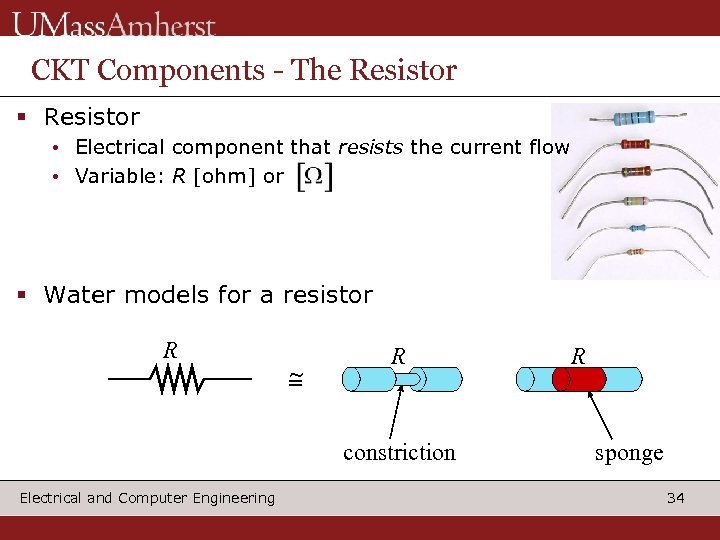 CKT Components - The Resistor § Resistor • Electrical component that resists the current flow • Variable: R [ohm] or § Water models for a resistor R ~ = R constriction Electrical and Computer Engineering R sponge 34
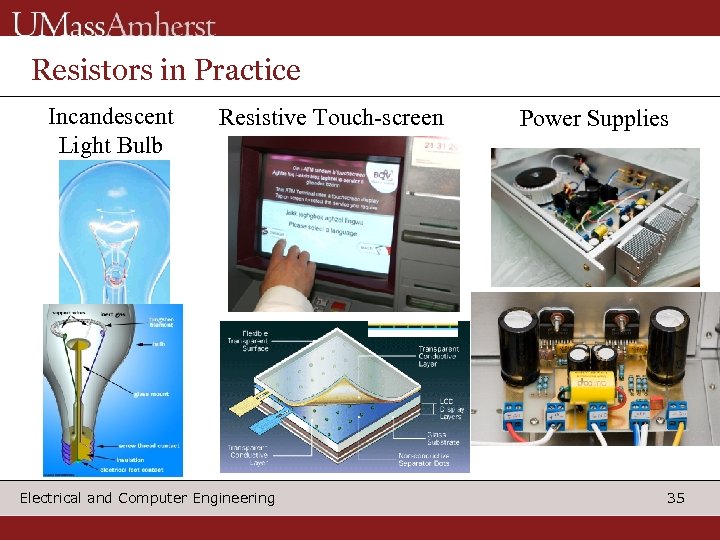 Resistors in Practice Incandescent Light Bulb Resistive Touch-screen Electrical and Computer Engineering Power Supplies 35
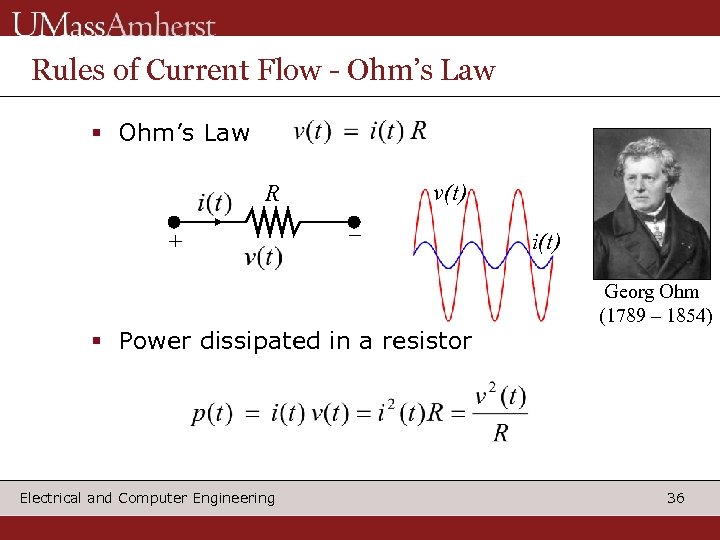 Rules of Current Flow - Ohm’s Law § Ohm’s Law v(t) R + _ § Power dissipated in a resistor Electrical and Computer Engineering i(t) Georg Ohm (1789 – 1854) 36
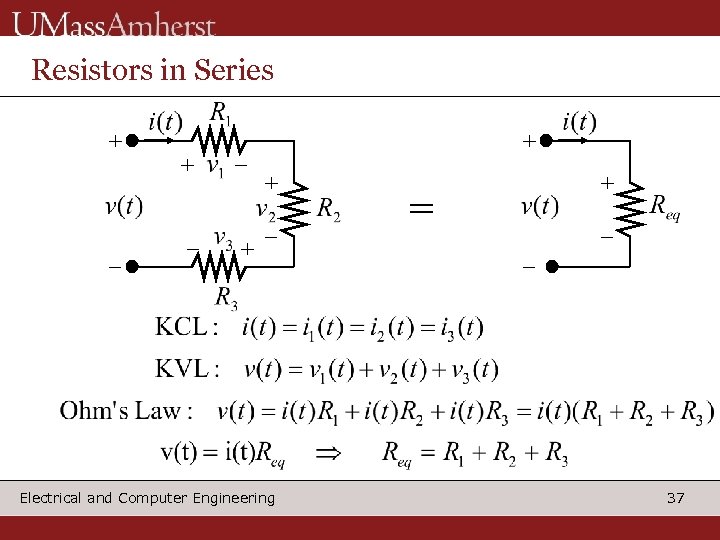 Resistors in Series + _ + _ + + _ Electrical and Computer Engineering + = _ _ 37
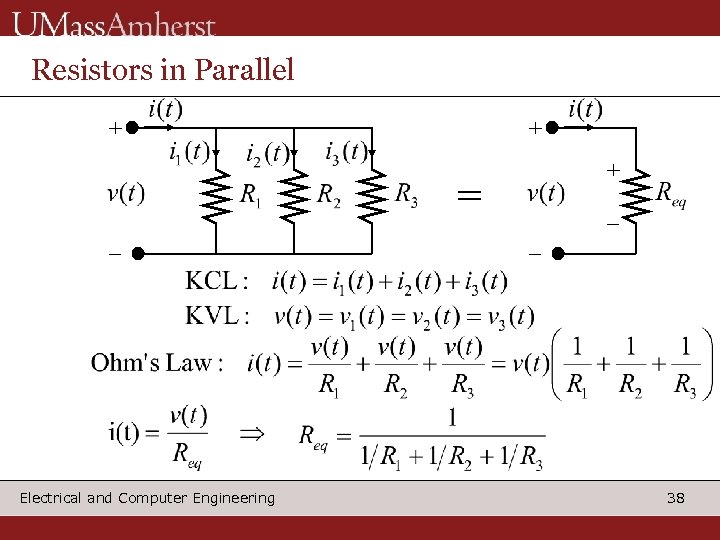 Resistors in Parallel + + + = _ Electrical and Computer Engineering _ _ 38
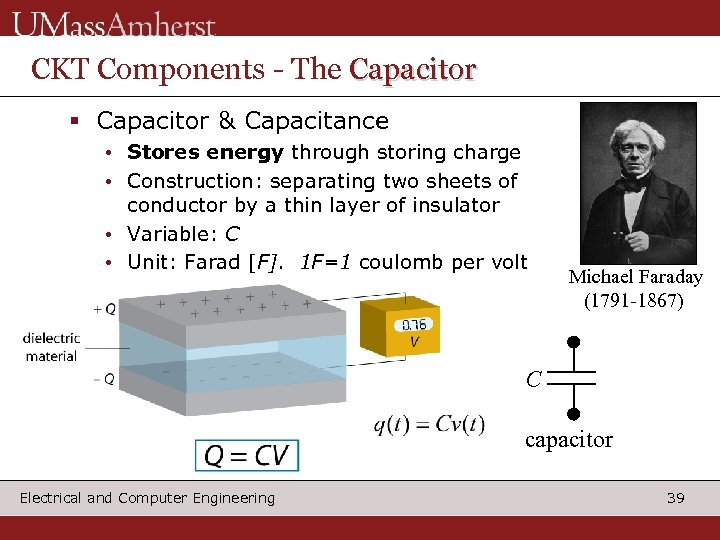 CKT Components - The Capacitor § Capacitor & Capacitance • Stores energy through storing charge • Construction: separating two sheets of conductor by a thin layer of insulator • Variable: C • Unit: Farad [F]. 1 F=1 coulomb per volt Michael Faraday (1791 -1867) C capacitor Electrical and Computer Engineering 39
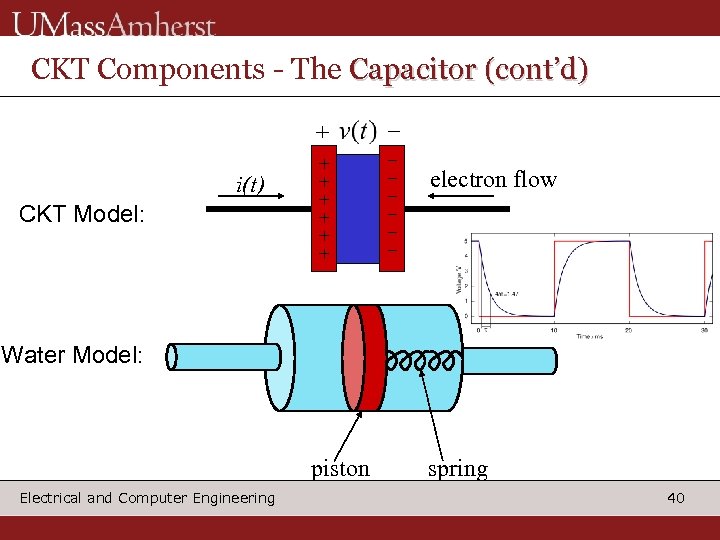 CKT Components - The Capacitor (cont’d) + i(t) CKT Model: + + + _ _ _ _ electron flow Water Model: piston Electrical and Computer Engineering spring 40
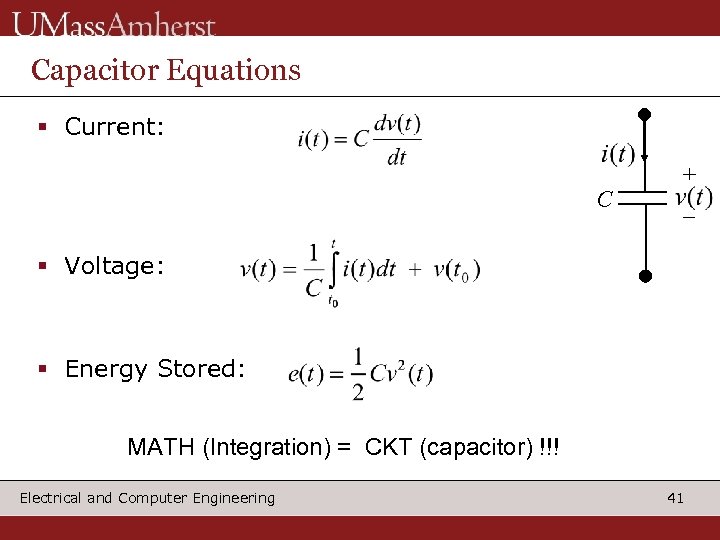 Capacitor Equations § Current: C + _ § Voltage: § Energy Stored: MATH (Integration) = CKT (capacitor) !!! Electrical and Computer Engineering 41
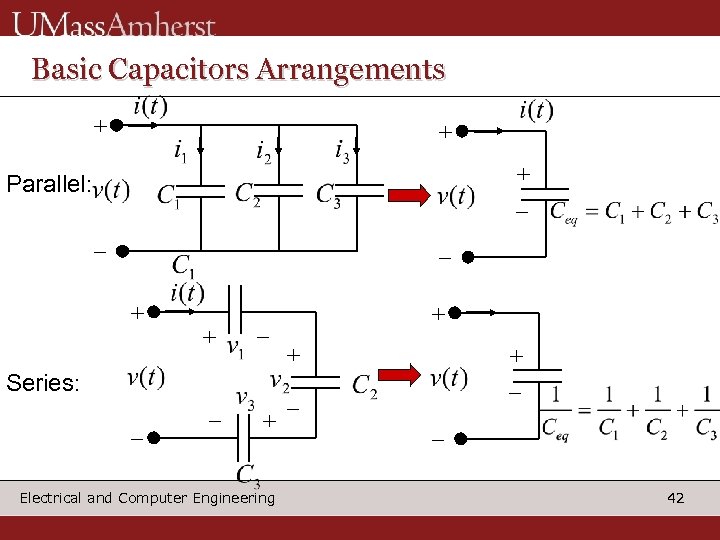 Basic Capacitors Arrangements + + + _ Parallel: _ _ + Series: _ + _ + + Electrical and Computer Engineering + _ _ _ 42
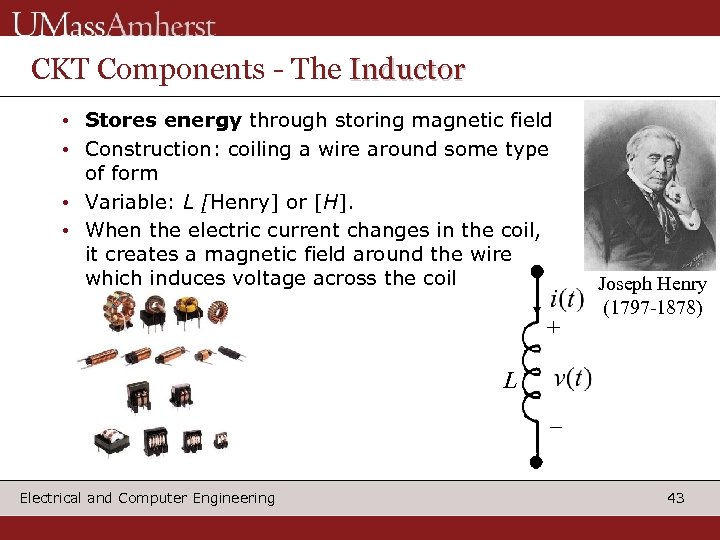 CKT Components - The Inductor • Stores energy through storing magnetic field • Construction: coiling a wire around some type of form • Variable: L [Henry] or [H]. • When the electric current changes in the coil, it creates a magnetic field around the wire which induces voltage across the coil + Joseph Henry (1797 -1878) L _ Electrical and Computer Engineering 43
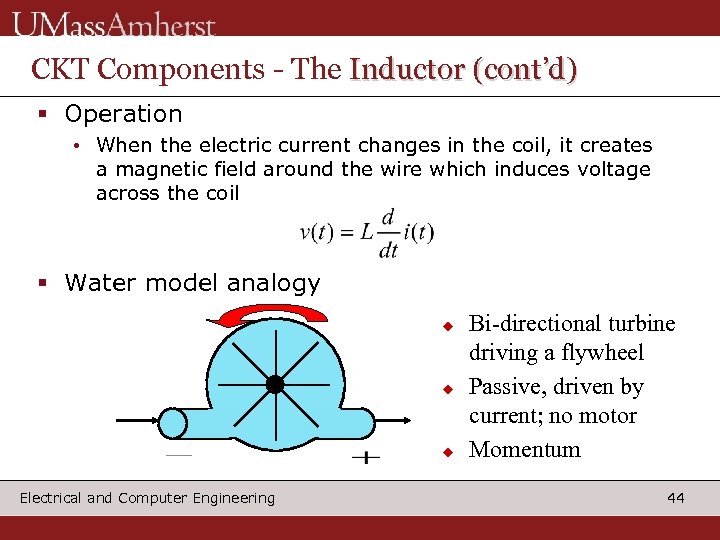 CKT Components - The Inductor (cont’d) § Operation • When the electric current changes in the coil, it creates a magnetic field around the wire which induces voltage across the coil § Water model analogy u u u Electrical and Computer Engineering Bi-directional turbine driving a flywheel Passive, driven by current; no motor Momentum 44
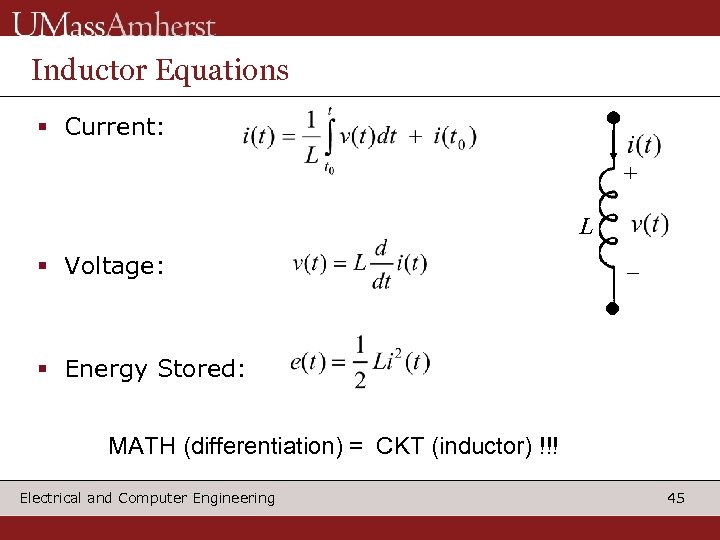 Inductor Equations § Current: + L § Voltage: _ § Energy Stored: MATH (differentiation) = CKT (inductor) !!! Electrical and Computer Engineering 45
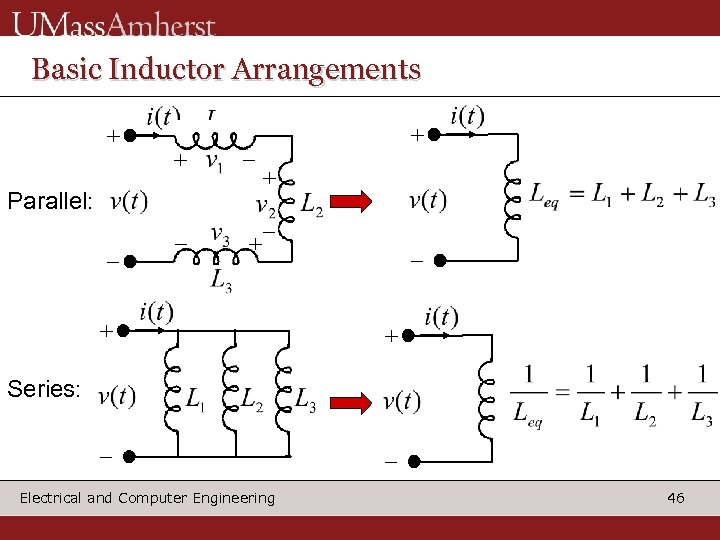 Basic Inductor Arrangements + + + Parallel: _ _ + + _ _ Series: Electrical and Computer Engineering 46
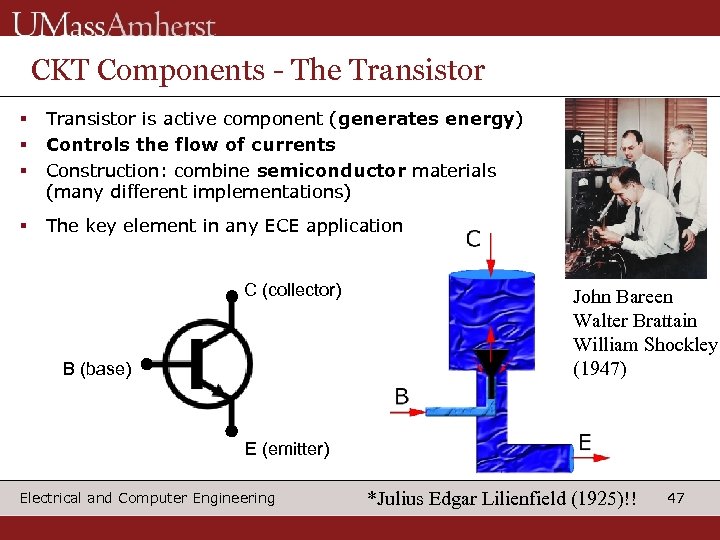 CKT Components - The Transistor § § § Transistor is active component (generates energy) Controls the flow of currents Construction: combine semiconductor materials (many different implementations) § The key element in any ECE application C (collector) B (base) John Bareen Walter Brattain William Shockley (1947) E (emitter) Electrical and Computer Engineering *Julius Edgar Lilienfield (1925)!! 47
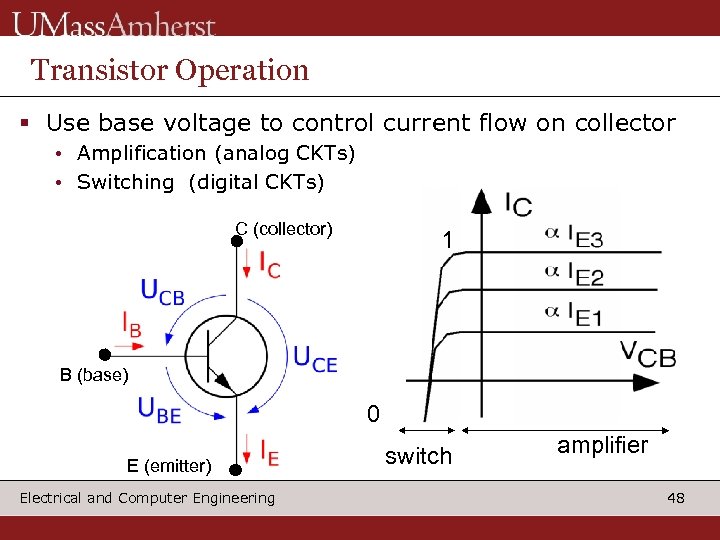 Transistor Operation § Use base voltage to control current flow on collector • Amplification (analog CKTs) • Switching (digital CKTs) C (collector) 1 B (base) 0 E (emitter) Electrical and Computer Engineering switch amplifier 48
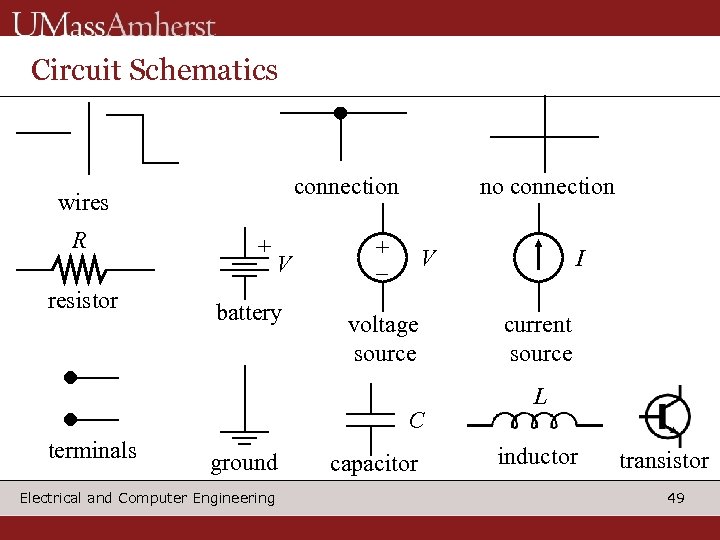 Circuit Schematics connection wires R resistor + V battery no connection + _ V voltage source C terminals ground Electrical and Computer Engineering capacitor I current source L inductor transistor 49
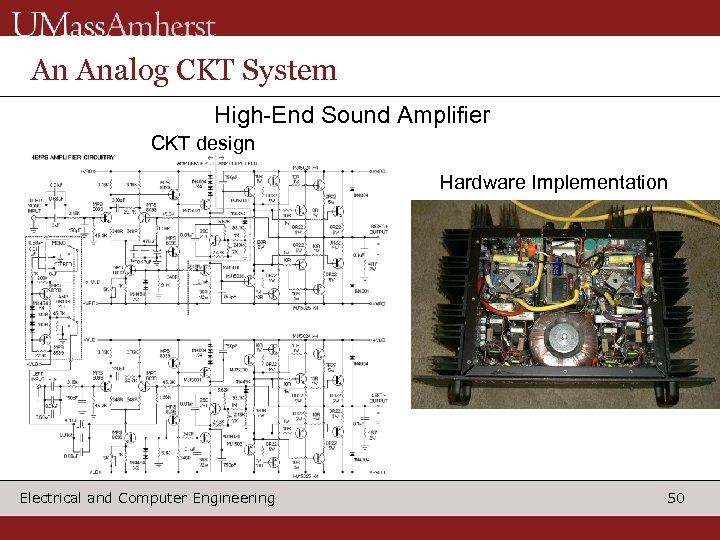 An Analog CKT System High-End Sound Amplifier CKT design Hardware Implementation Electrical and Computer Engineering 50
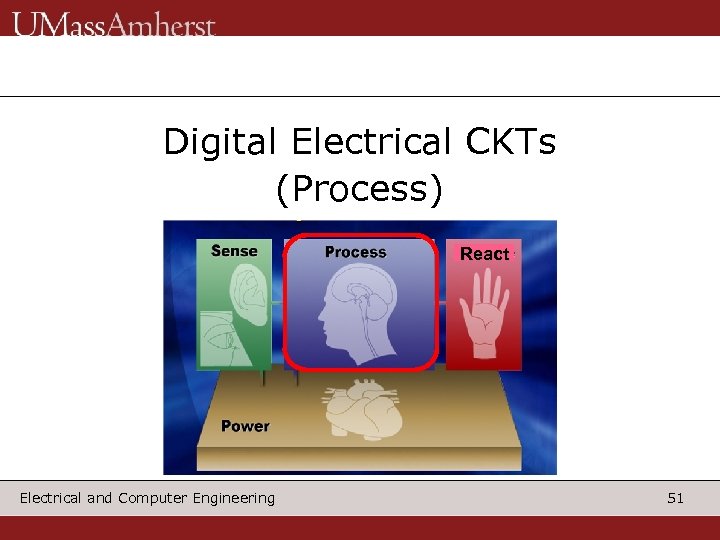 Digital Electrical CKTs (Process) React Electrical and Computer Engineering 51
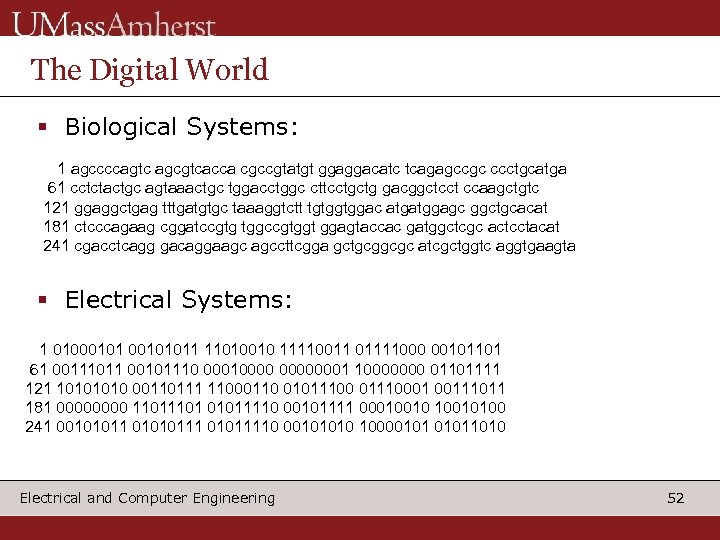 The Digital World § Biological Systems: 1 agccccagtc agcgtcacca cgccgtatgt ggaggacatc tcagagccgc ccctgcatga 61 cctctactgc agtaaactgc tggacctggc cttcctgctg gacggctcct ccaagctgtc 121 ggaggctgag tttgatgtgc taaaggtctt tgtggtggac atgatggagc ggctgcacat 181 ctcccagaag cggatccgtg tggccgtggt ggagtaccac gatggctcgc actcctacat 241 cgacctcagg gacaggaagc agccttcgga gctgcggcgc atcgctggtc aggtgaagta § Electrical Systems: 1 01000101011 11010010 11110011 01111000 00101101 61 00111011 00101110 000100000001 10000000 01101111 121 1010 00110111 11000110 0101110001 00111011 181 0000 1101 01011110 00101111 00010010100 241 001010111 01011110 00101010 100001011010 Electrical and Computer Engineering 52
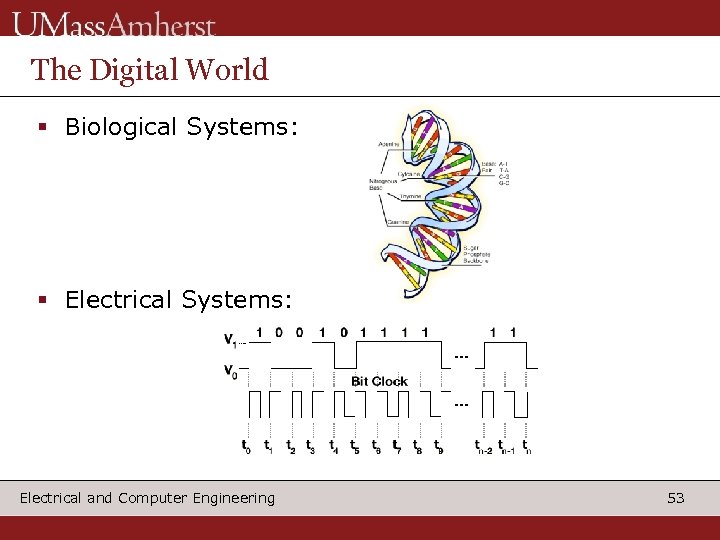 The Digital World § Biological Systems: § Electrical Systems: Electrical and Computer Engineering 53
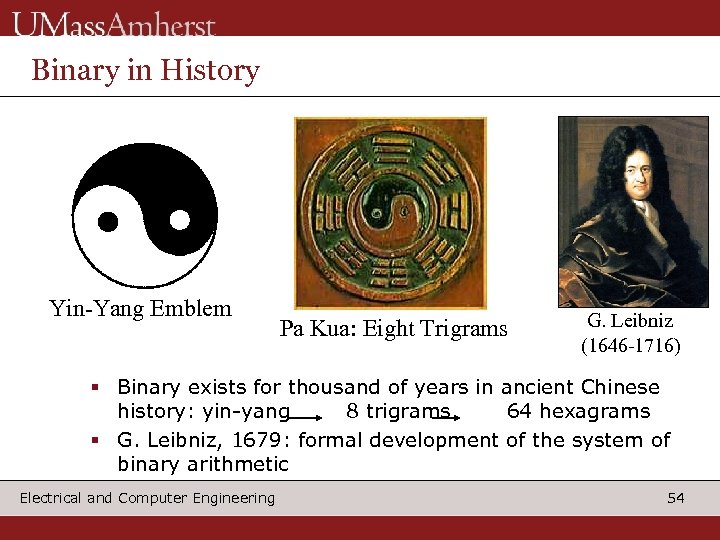 Binary in History Yin-Yang Emblem Pa Kua: Eight Trigrams G. Leibniz (1646 -1716) § Binary exists for thousand of years in ancient Chinese history: yin-yang 8 trigrams 64 hexagrams § G. Leibniz, 1679: formal development of the system of binary arithmetic Electrical and Computer Engineering 54
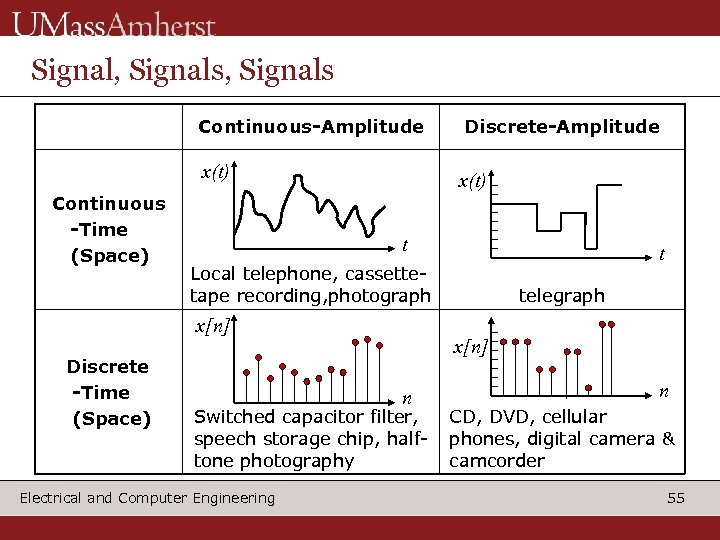 Signal, Signals Continuous-Amplitude x(t) Continuous -Time (Space) x(t) t t Local telephone, cassettetape recording, photograph x[n] Discrete -Time (Space) Discrete-Amplitude x[n] n Switched capacitor filter, speech storage chip, halftone photography Electrical and Computer Engineering telegraph n CD, DVD, cellular phones, digital camera & camcorder 55
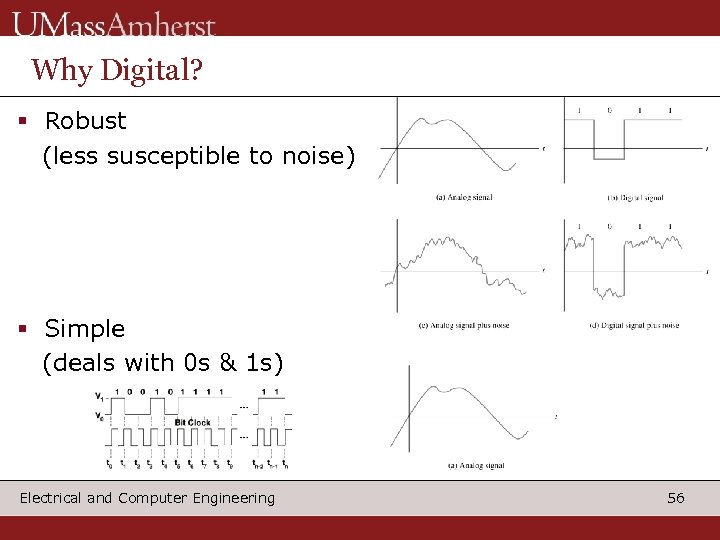 Why Digital? § Robust (less susceptible to noise) § Simple (deals with 0 s & 1 s) Electrical and Computer Engineering 56
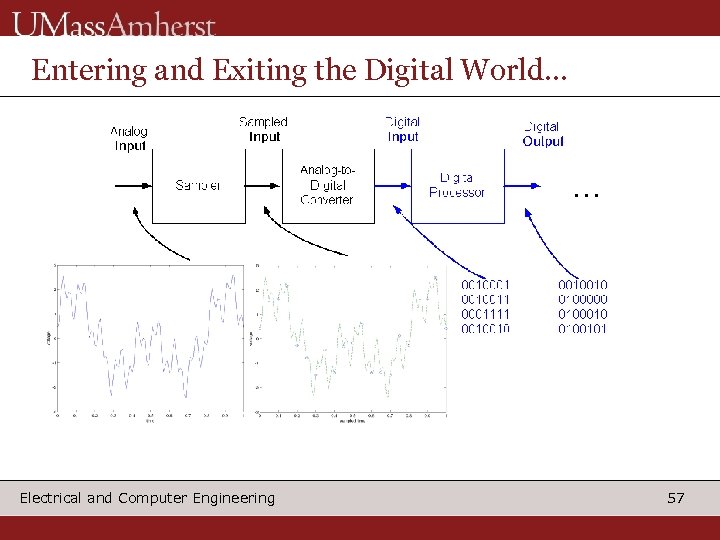 Entering and Exiting the Digital World… Electrical and Computer Engineering 57
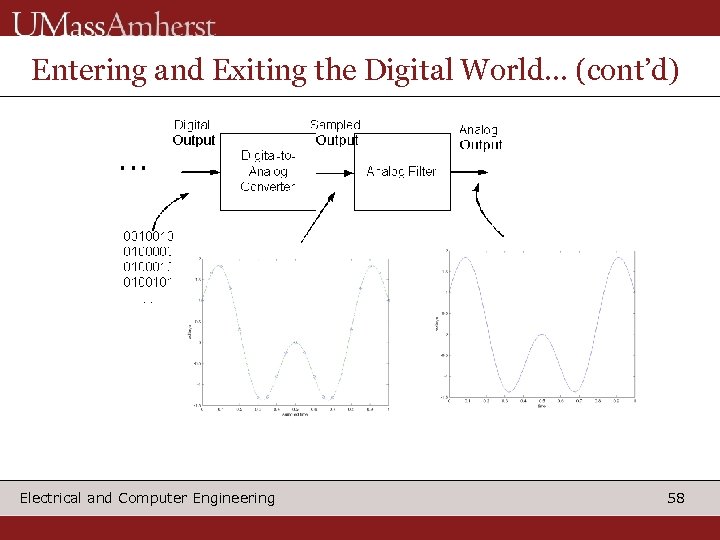 Entering and Exiting the Digital World… (cont’d) Electrical and Computer Engineering 58
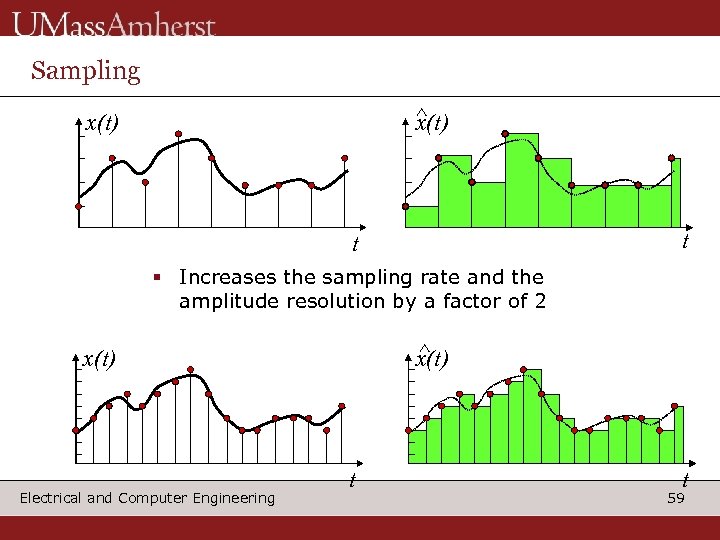 Sampling ^ x(t) t t § Increases the sampling rate and the amplitude resolution by a factor of 2 ^ x(t) Electrical and Computer Engineering t t 59
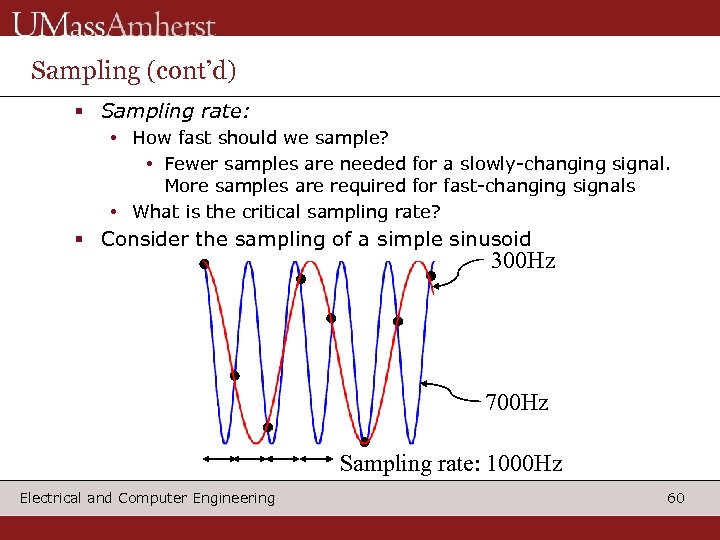 Sampling (cont’d) § Sampling rate: • How fast should we sample? • Fewer samples are needed for a slowly-changing signal. More samples are required for fast-changing signals • What is the critical sampling rate? § Consider the sampling of a simple sinusoid 300 Hz 700 Hz Sampling rate: 1000 Hz Electrical and Computer Engineering 60
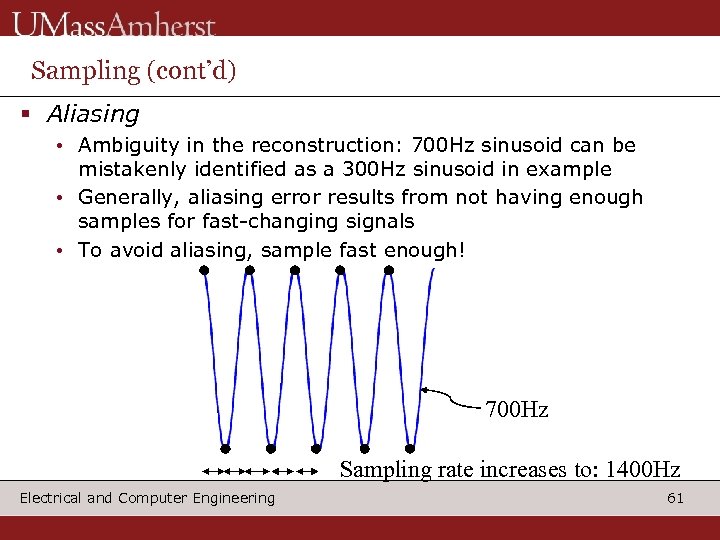 Sampling (cont’d) § Aliasing • Ambiguity in the reconstruction: 700 Hz sinusoid can be mistakenly identified as a 300 Hz sinusoid in example • Generally, aliasing error results from not having enough samples for fast-changing signals • To avoid aliasing, sample fast enough! 700 Hz Sampling rate increases to: 1400 Hz Electrical and Computer Engineering 61
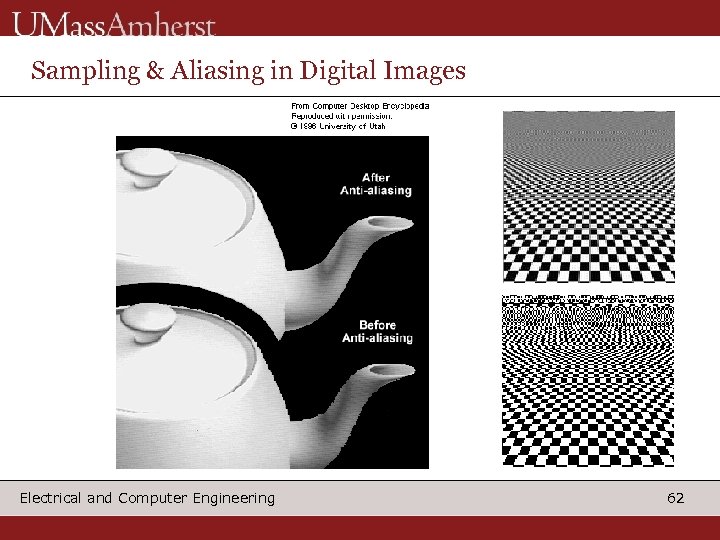 Sampling & Aliasing in Digital Images Electrical and Computer Engineering 62
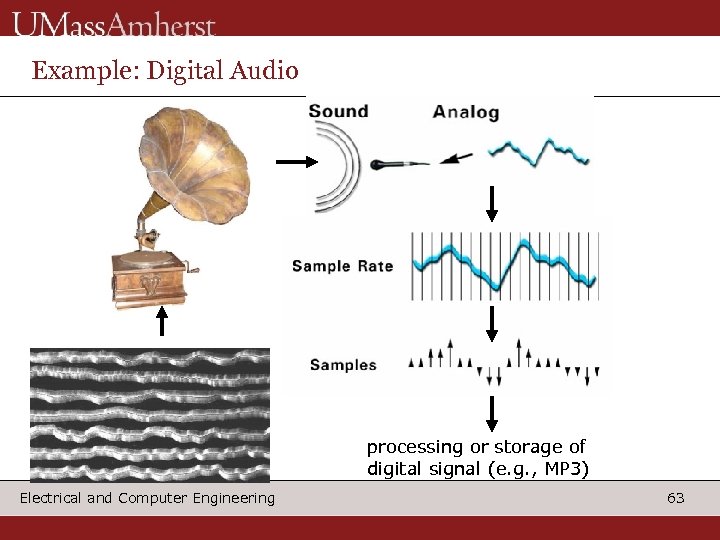 Example: Digital Audio processing or storage of digital signal (e. g. , MP 3) Electrical and Computer Engineering 63
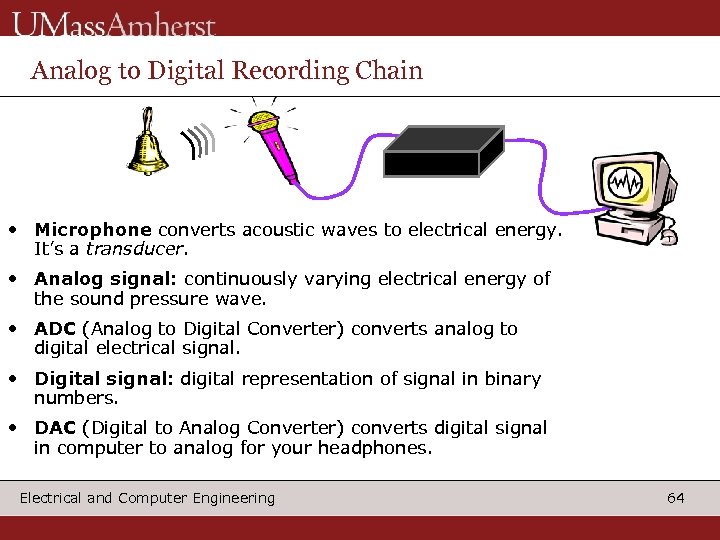 Analog to Digital Recording Chain ADC • Microphone converts acoustic waves to electrical energy. It’s a transducer. • Analog signal: continuously varying electrical energy of the sound pressure wave. • ADC (Analog to Digital Converter) converts analog to digital electrical signal. • Digital signal: digital representation of signal in binary numbers. • DAC (Digital to Analog Converter) converts digital signal in computer to analog for your headphones. Electrical and Computer Engineering 64
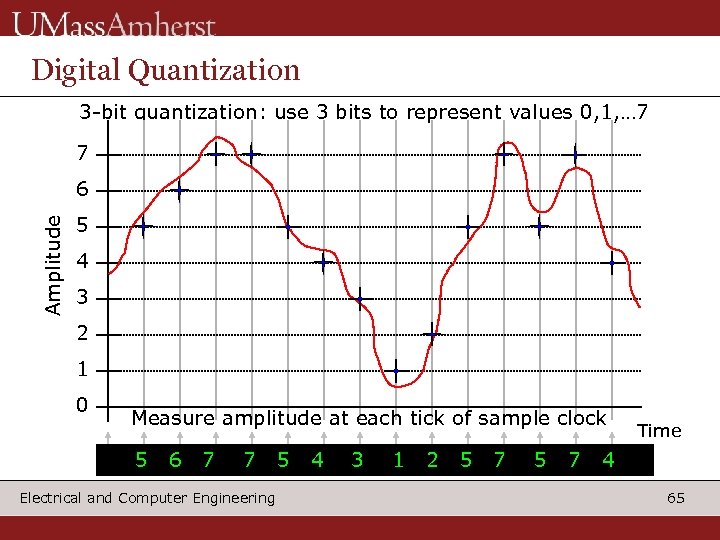 Digital Quantization 3 -bit quantization: use 3 bits to represent values 0, 1, … 7 7 Amplitude 6 5 4 3 2 1 0 Measure amplitude at each tick of sample clock 5 6 7 7 Electrical and Computer Engineering 5 4 3 1 2 5 7 Time 4 65
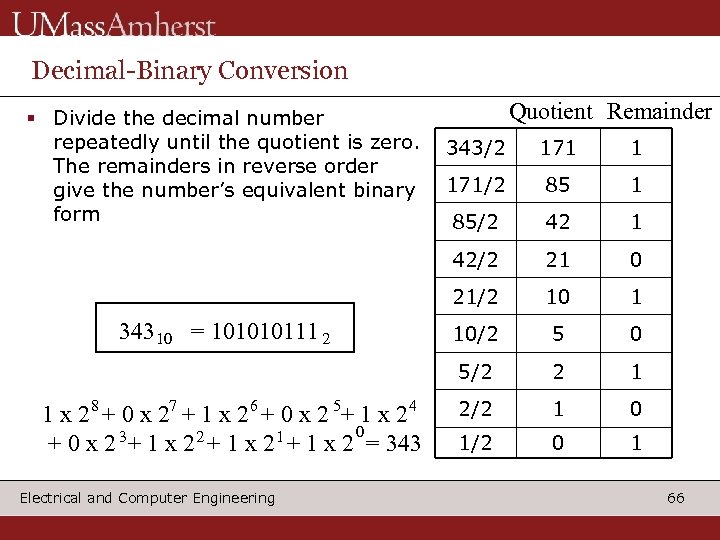 Decimal-Binary Conversion § Divide the decimal number repeatedly until the quotient is zero. The remainders in reverse order give the number’s equivalent binary form Quotient Remainder 171/2 85 1 85/2 42 1 21 0 10 1 10/2 5 0 5/2 Electrical and Computer Engineering 1 21/2 1 x 2 8 + 0 x 27 + 1 x 2 6 + 0 x 2 5+ 1 x 2 4 0 + 0 x 2 3+ 1 x 2 2 + 1 x 2 1 + 1 x 2 = 343 171 42/2 343 10 = 101010111 2 343/2 2 1 2/2 1 0 1/2 0 1 66
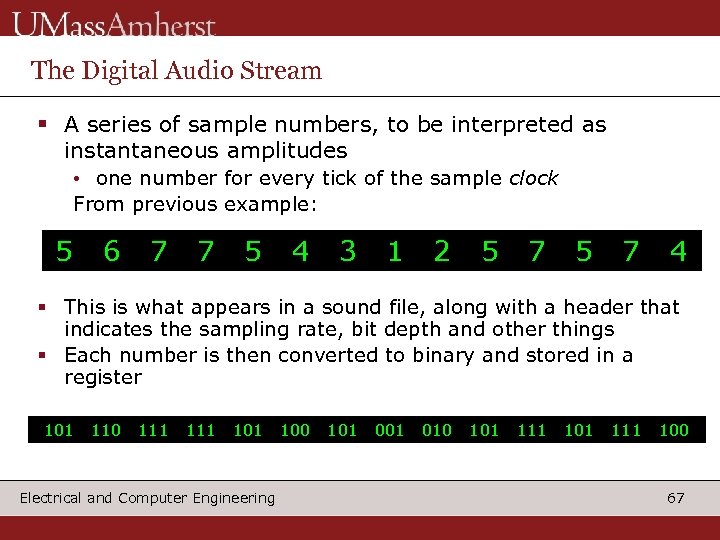 The Digital Audio Stream § A series of sample numbers, to be interpreted as instantaneous amplitudes • one number for every tick of the sample clock From previous example: 5 6 7 7 5 4 3 1 2 5 7 4 § This is what appears in a sound file, along with a header that indicates the sampling rate, bit depth and other things § Each number is then converted to binary and stored in a register 101 110 111 101 Electrical and Computer Engineering 100 101 010 101 111 100 67
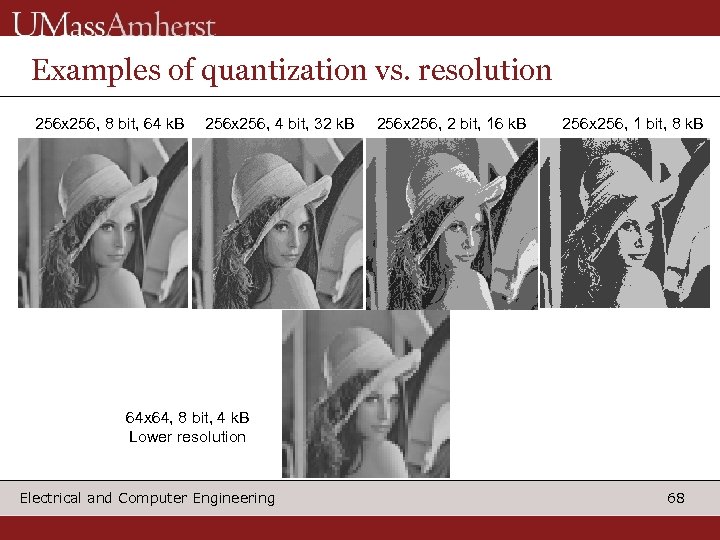 Examples of quantization vs. resolution 256 x 256, 8 bit, 64 k. B 256 x 256, 4 bit, 32 k. B 256 x 256, 2 bit, 16 k. B 256 x 256, 1 bit, 8 k. B 64 x 64, 8 bit, 4 k. B Lower resolution Electrical and Computer Engineering 68
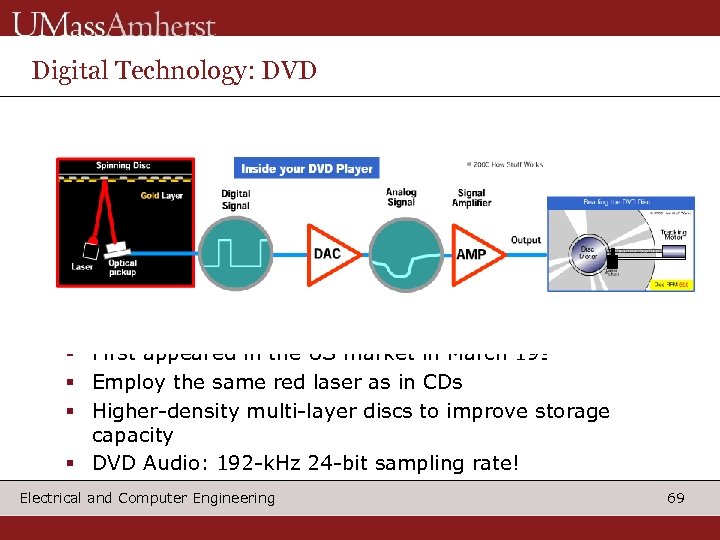 Digital Technology: DVD Digital Versatile Disc or Digital Video Disc First appeared in the US market in March 1997 Employ the same red laser as in CDs Higher-density multi-layer discs to improve storage capacity § DVD Audio: 192 -k. Hz 24 -bit sampling rate! § § Electrical and Computer Engineering 69
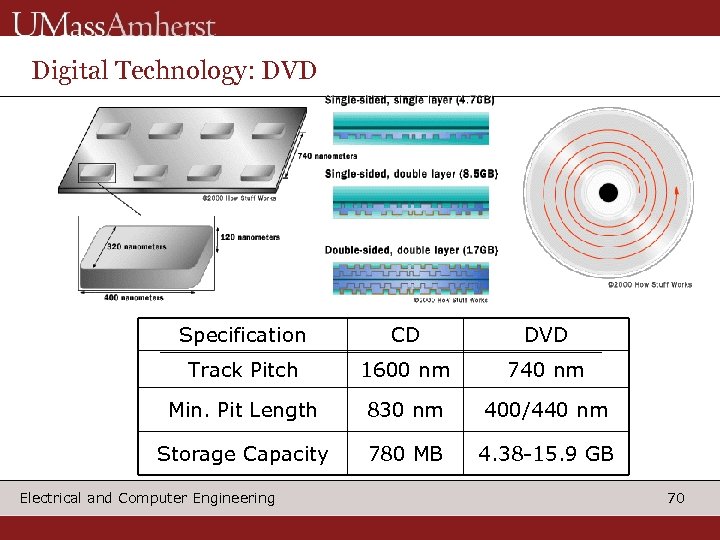 Digital Technology: DVD Specification CD DVD Track Pitch 1600 nm 740 nm Min. Pit Length 830 nm 400/440 nm Storage Capacity 780 MB 4. 38 -15. 9 GB Electrical and Computer Engineering 70
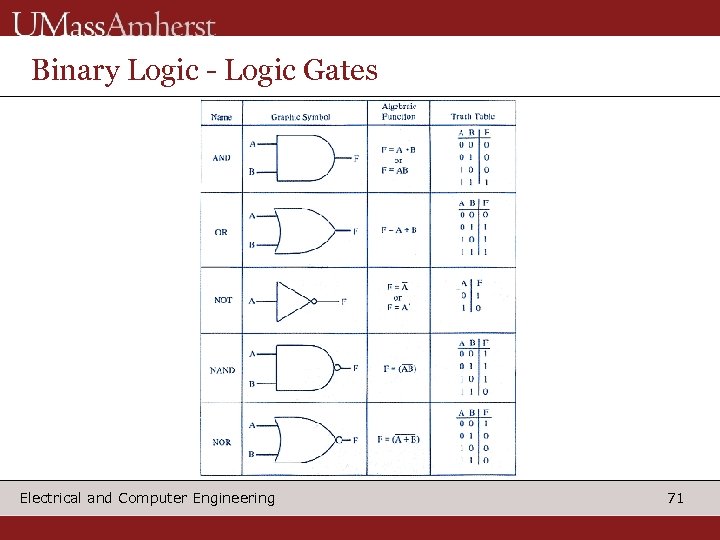 Binary Logic - Logic Gates Electrical and Computer Engineering 71
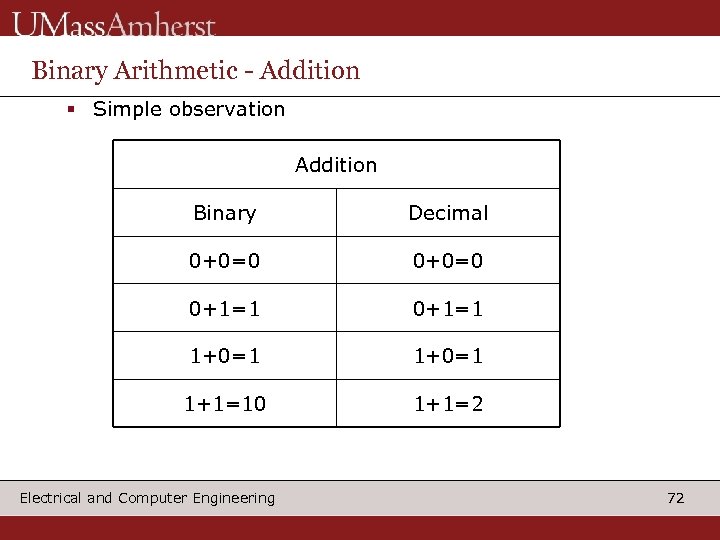 Binary Arithmetic - Addition § Simple observation Addition Binary Decimal 0+0=0 0+1=1 1+0=1 1+1=10 1+1=2 Electrical and Computer Engineering 72
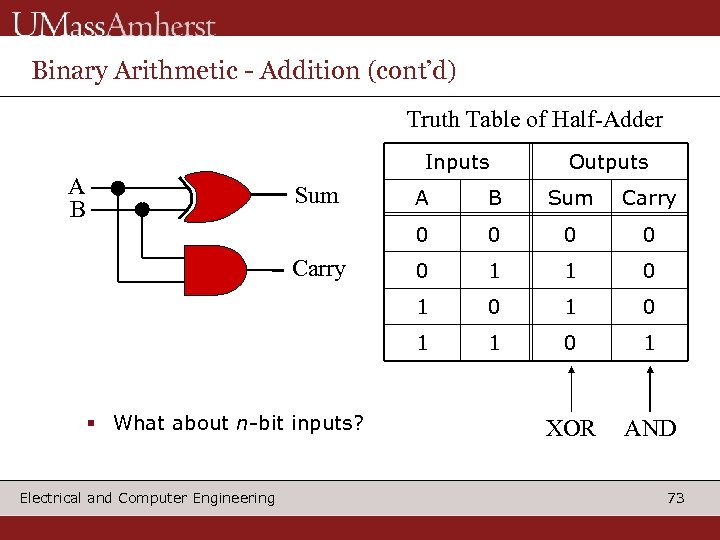 Binary Arithmetic - Addition (cont’d) Truth Table of Half-Adder Inputs A B Sum Outputs Carry 0 0 1 1 0 0 1 Electrical and Computer Engineering Sum 1 § What about n-bit inputs? B 0 Carry A 1 0 1 XOR AND 73
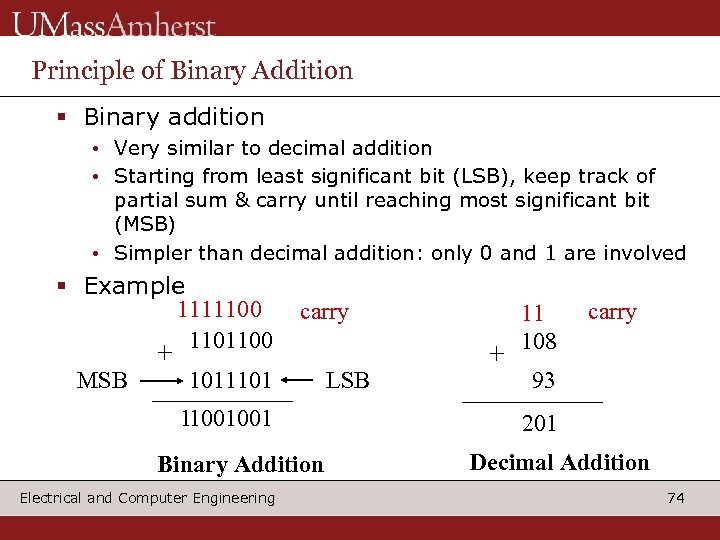 Principle of Binary Addition § Binary addition • Very similar to decimal addition • Starting from least significant bit (LSB), keep track of partial sum & carry until reaching most significant bit (MSB) • Simpler than decimal addition: only 0 and 1 are involved § Example 111110 0 1101100 MSB + carry 1011101 11001001 Binary Addition Electrical and Computer Engineering LSB + 11 108 carry 93 201 Decimal Addition 74
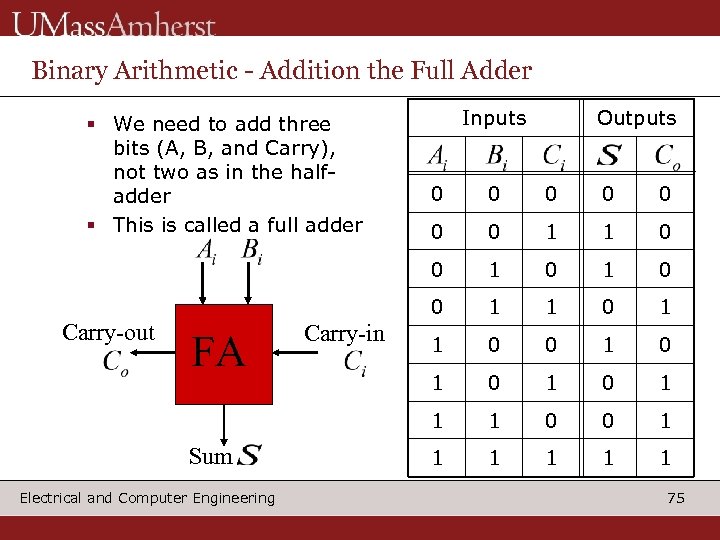 Binary Arithmetic - Addition the Full Adder § We need to add three bits (A, B, and Carry), not two as in the halfadder § This is called a full adder Inputs Outputs Sum Electrical and Computer Engineering 0 0 1 1 0 1 0 1 1 0 0 1 0 1 1 FA 0 0 Carry-in 0 0 Carry-out 0 1 0 0 1 1 1 75
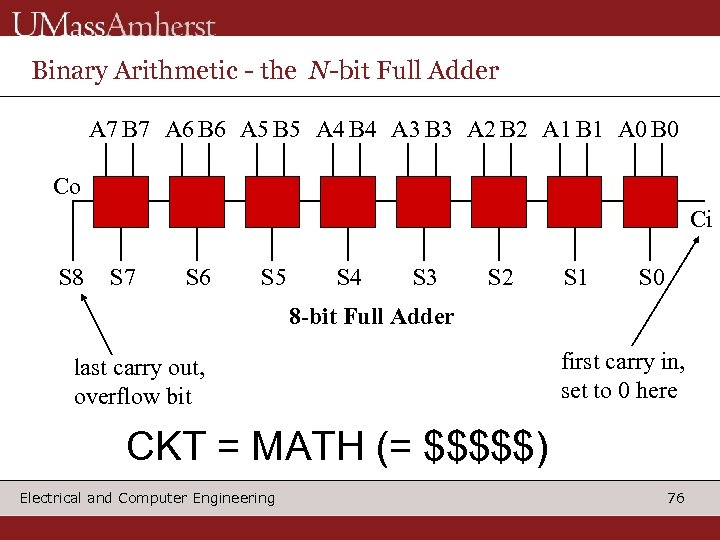 Binary Arithmetic - the N-bit Full Adder A 7 B 7 A 6 B 6 A 5 B 5 A 4 B 4 A 3 B 3 A 2 B 2 A 1 B 1 A 0 B 0 Co Ci S 8 S 7 S 6 S 5 S 4 S 3 S 2 S 1 S 0 8 -bit Full Adder last carry out, overflow bit first carry in, set to 0 here CKT = MATH (= $$$$$) Electrical and Computer Engineering 76
 The Systems Approach (divide and conquer) Electrical and Computer Engineering 77
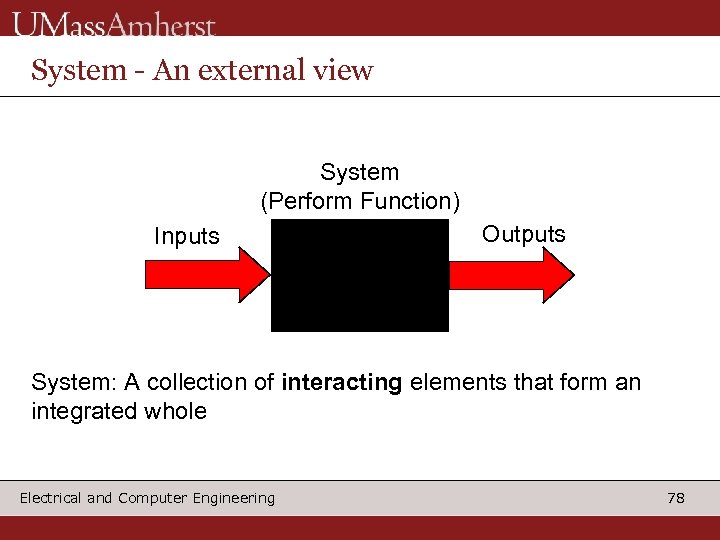 System - An external view System (Perform Function) Inputs Outputs System: A collection of interacting elements that form an integrated whole Electrical and Computer Engineering 78
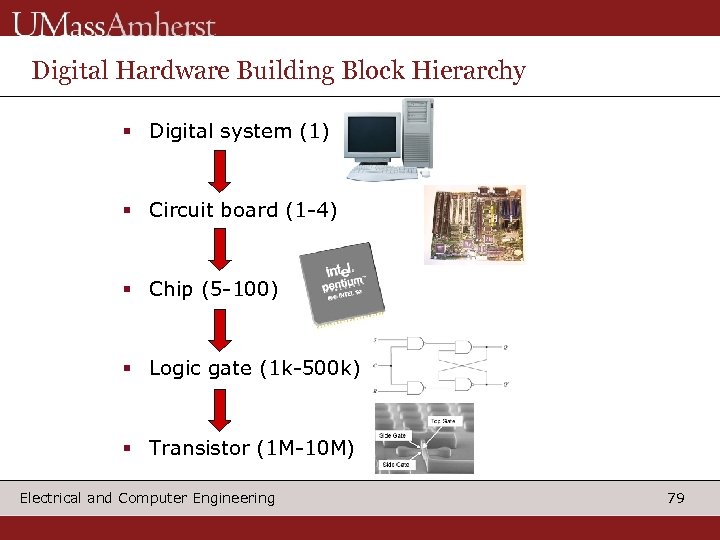 Digital Hardware Building Block Hierarchy § Digital system (1) § Circuit board (1 -4) § Chip (5 -100) § Logic gate (1 k-500 k) § Transistor (1 M-10 M) Electrical and Computer Engineering 79
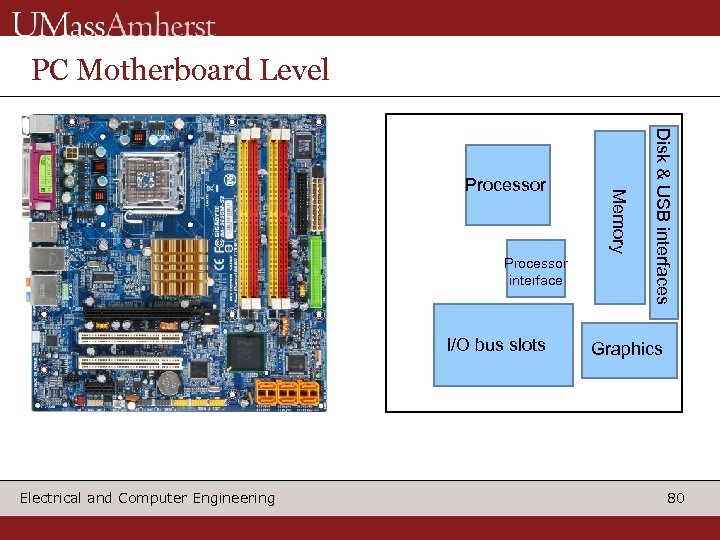 PC Motherboard Level I/O bus slots Electrical and Computer Engineering Disk & USB interfaces Processor interface Memory Processor Graphics 80
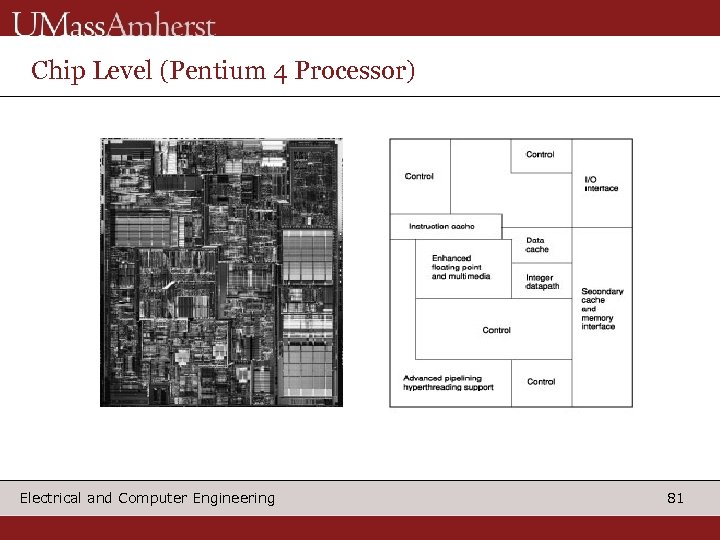 Chip Level (Pentium 4 Processor) Electrical and Computer Engineering 81
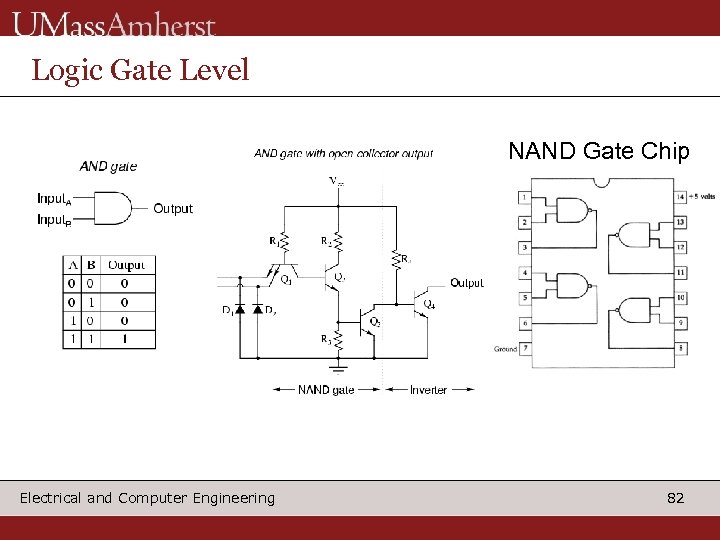 Logic Gate Level NAND Gate Chip Electrical and Computer Engineering 82
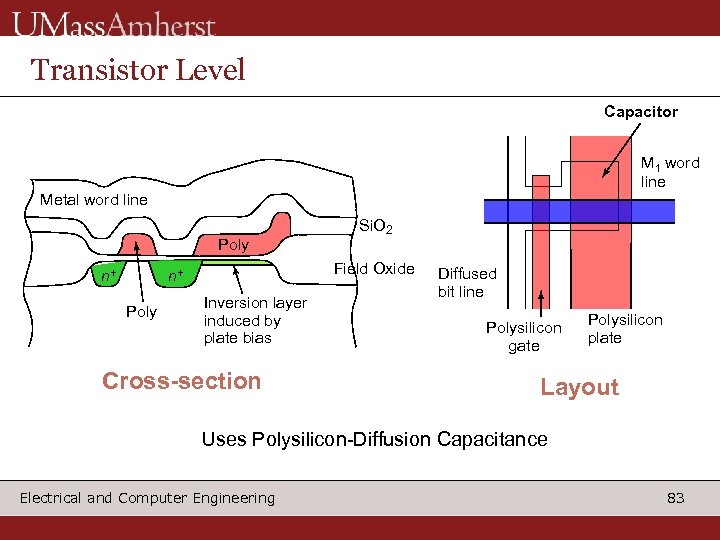 Transistor Level Capacitor M 1 word line Metal word line Poly n+ Field Oxide n+ Poly Si. O 2 Inversion layer induced by plate bias Cross-section Diffused bit line Polysilicon gate Polysilicon plate Layout Uses Polysilicon-Diffusion Capacitance Electrical and Computer Engineering 83
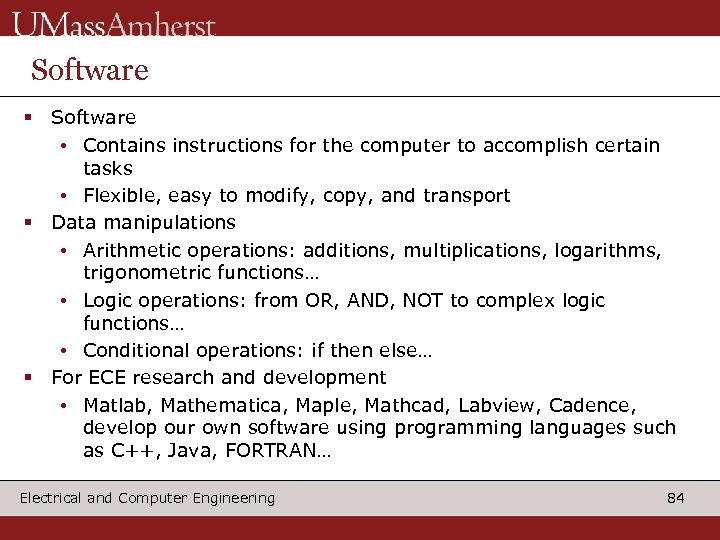 Software § Software • Contains instructions for the computer to accomplish certain tasks • Flexible, easy to modify, copy, and transport § Data manipulations • Arithmetic operations: additions, multiplications, logarithms, trigonometric functions… • Logic operations: from OR, AND, NOT to complex logic functions… • Conditional operations: if then else… § For ECE research and development • Matlab, Mathematica, Maple, Mathcad, Labview, Cadence, develop our own software using programming languages such as C++, Java, FORTRAN… Electrical and Computer Engineering 84
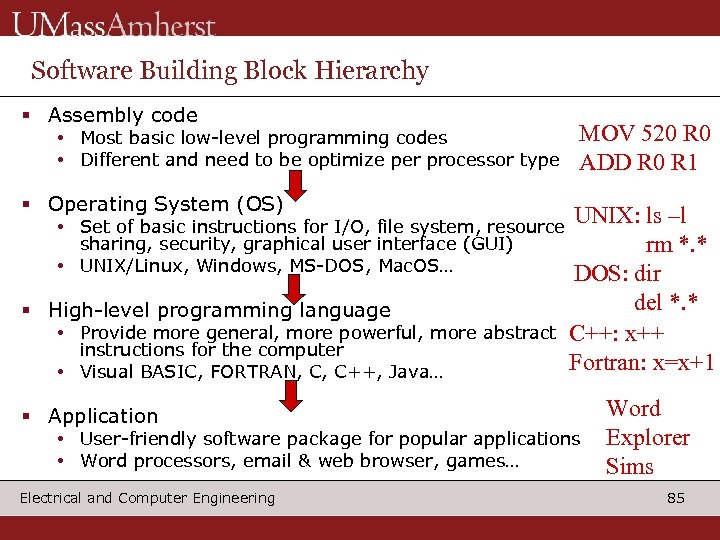 Software Building Block Hierarchy § Assembly code • Most basic low-level programming codes • Different and need to be optimize per processor type § Operating System (OS) • Set of basic instructions for I/O, file system, resource sharing, security, graphical user interface (GUI) • UNIX/Linux, Windows, MS-DOS, Mac. OS… § High-level programming language • Provide more general, more powerful, more abstract instructions for the computer • Visual BASIC, FORTRAN, C, C++, Java… § Application MOV 520 R 0 ADD R 0 R 1 UNIX: ls –l rm *. * DOS: dir del *. * C++: x++ Fortran: x=x+1 • User-friendly software package for popular applications • Word processors, email & web browser, games… Electrical and Computer Engineering Word Explorer Sims 85
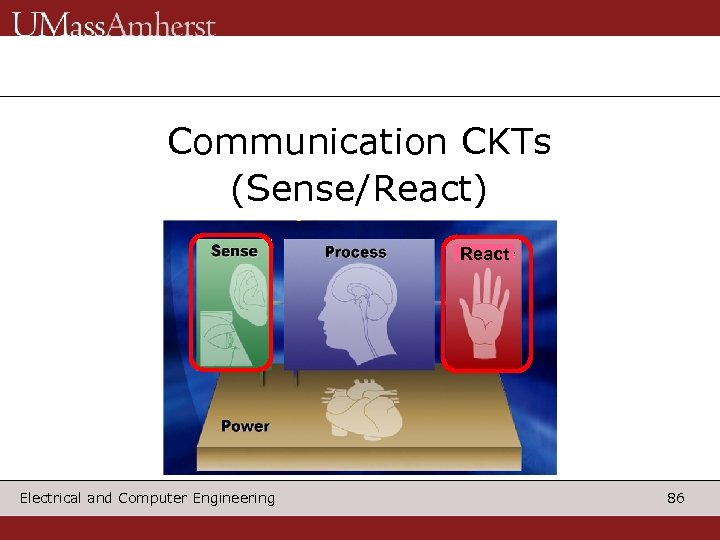 Communication CKTs (Sense/React) React Electrical and Computer Engineering 86
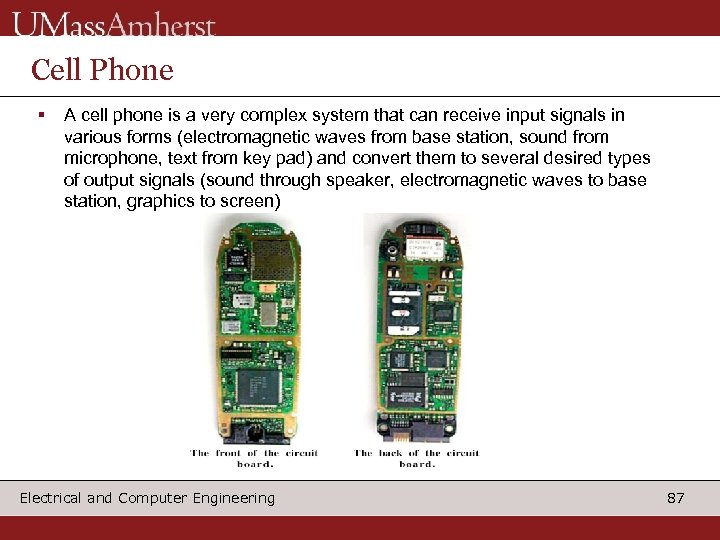 Cell Phone § A cell phone is a very complex system that can receive input signals in various forms (electromagnetic waves from base station, sound from microphone, text from key pad) and convert them to several desired types of output signals (sound through speaker, electromagnetic waves to base station, graphics to screen) Electrical and Computer Engineering 87
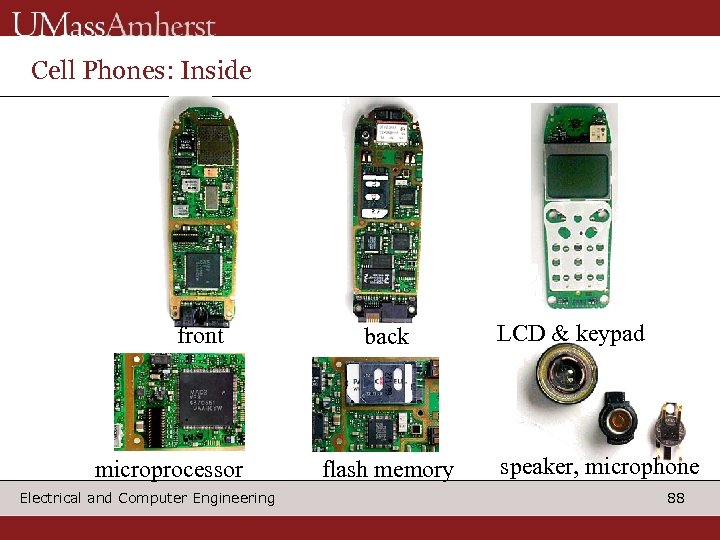 Cell Phones: Inside front microprocessor Electrical and Computer Engineering back flash memory LCD & keypad speaker, microphone 88
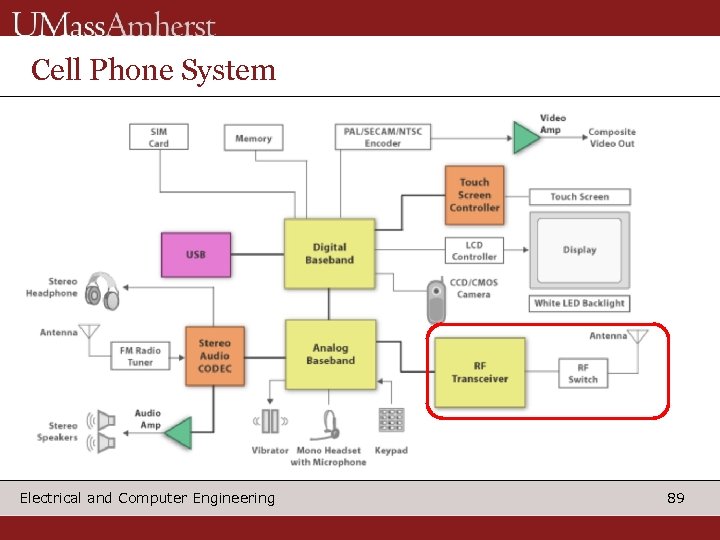 Cell Phone System Electrical and Computer Engineering 89
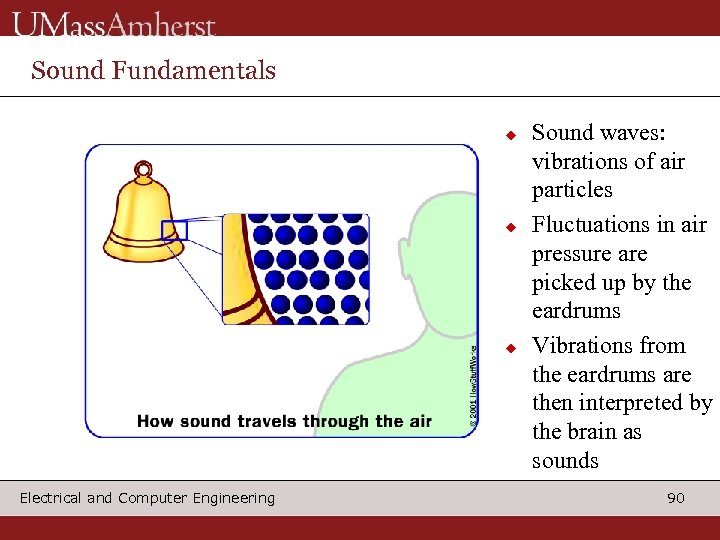 Sound Fundamentals u u u Electrical and Computer Engineering Sound waves: vibrations of air particles Fluctuations in air pressure are picked up by the eardrums Vibrations from the eardrums are then interpreted by the brain as sounds 90
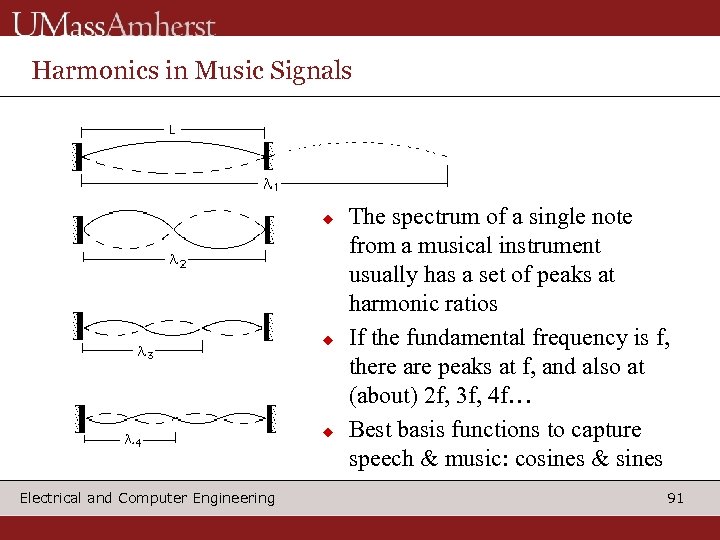 Harmonics in Music Signals u u u Electrical and Computer Engineering The spectrum of a single note from a musical instrument usually has a set of peaks at harmonic ratios If the fundamental frequency is f, there are peaks at f, and also at (about) 2 f, 3 f, 4 f… Best basis functions to capture speech & music: cosines & sines 91
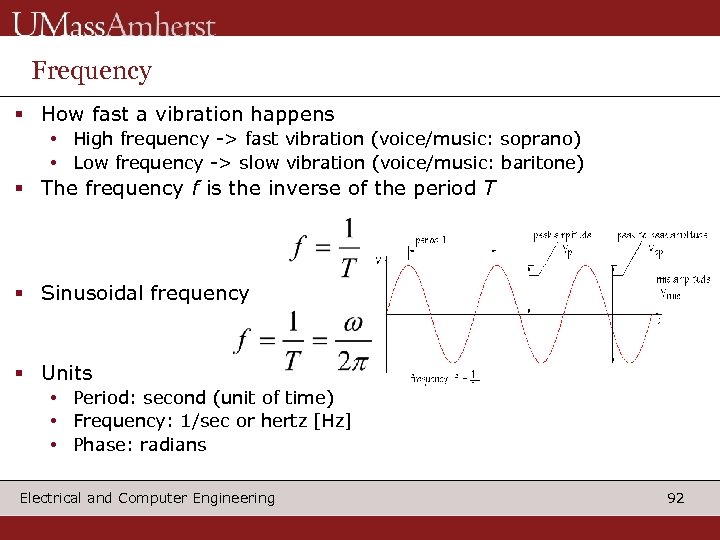 Frequency § How fast a vibration happens • High frequency -> fast vibration (voice/music: soprano) • Low frequency -> slow vibration (voice/music: baritone) § The frequency f is the inverse of the period T § Sinusoidal frequency § Units • Period: second (unit of time) • Frequency: 1/sec or hertz [Hz] • Phase: radians Electrical and Computer Engineering 92
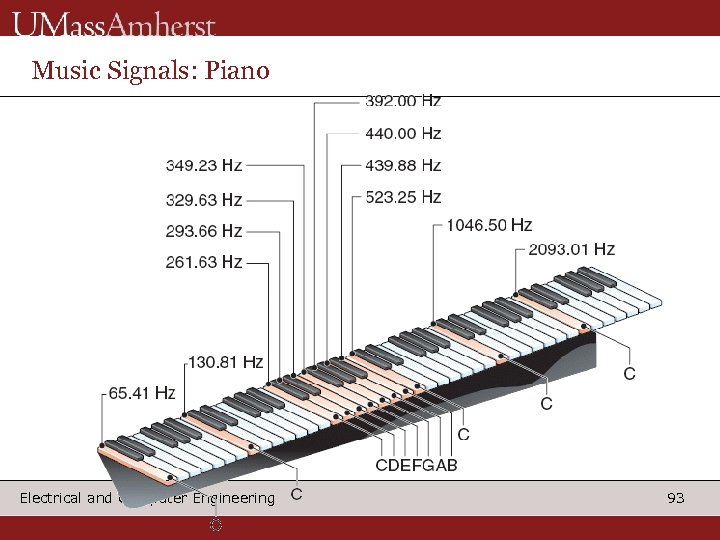 Music Signals: Piano Electrical and Computer Engineering 93
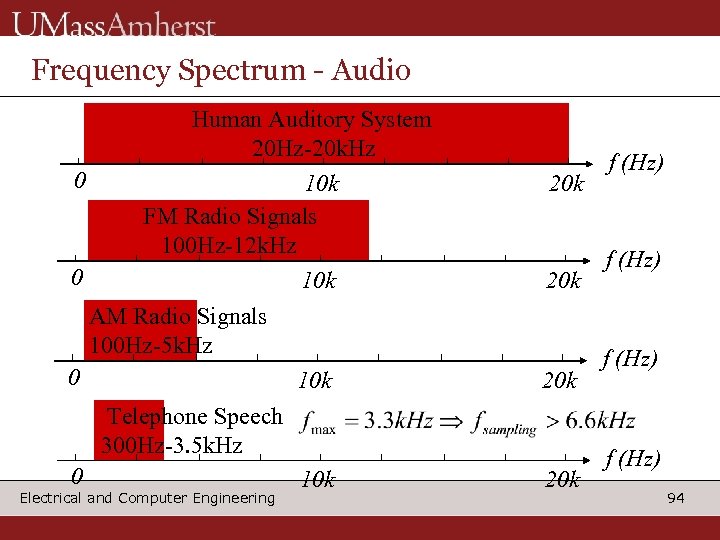 Frequency Spectrum - Audio 0 0 Human Auditory System 20 Hz-20 k. Hz 10 k FM Radio Signals 100 Hz-12 k. Hz 10 k 20 k AM Radio Signals 100 Hz-5 k. Hz 0 10 k 20 k Telephone Speech 300 Hz-3. 5 k. Hz 0 Electrical and Computer Engineering 10 k 20 k f (Hz) 94
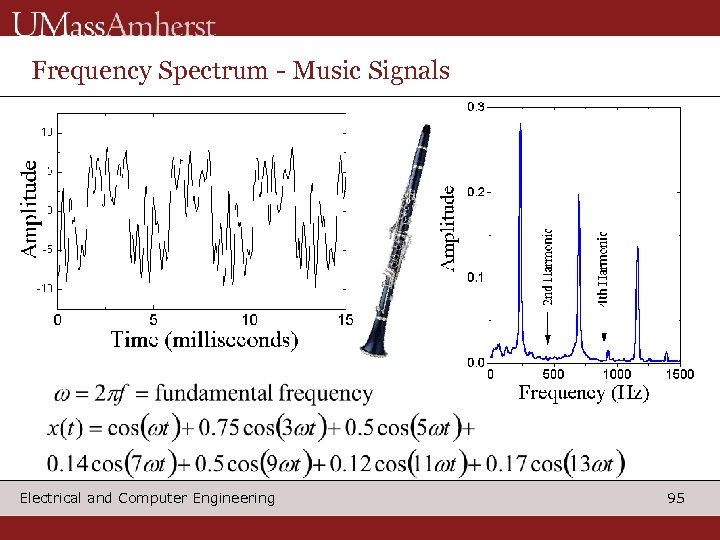 Frequency Spectrum - Music Signals Electrical and Computer Engineering 95
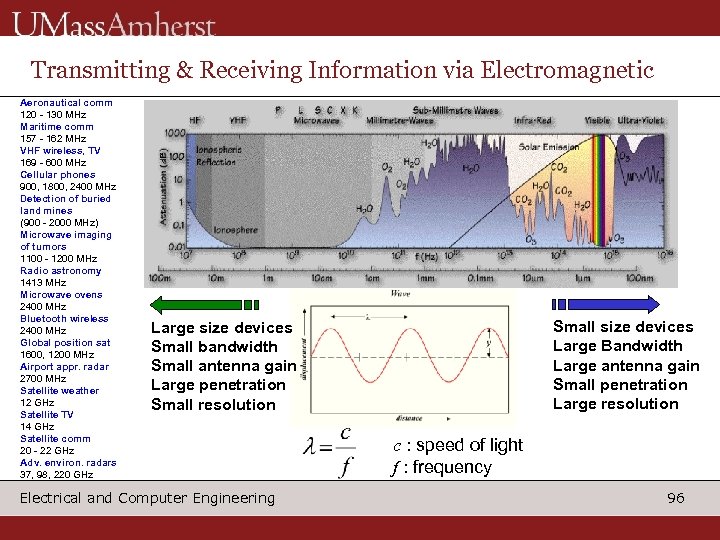 Transmitting & Receiving Information via Electromagnetic Aeronautical comm 120 - 130 MHz Maritime comm 157 - 162 MHz VHF wireless, TV 169 - 600 MHz Cellular phones 900, 1800, 2400 MHz Detection of buried land mines (900 - 2000 MHz) Microwave imaging of tumors 1100 - 1200 MHz Radio astronomy 1413 MHz Microwave ovens 2400 MHz Bluetooth wireless 2400 MHz Global position sat 1600, 1200 MHz Airport appr. radar 2700 MHz Satellite weather 12 GHz Satellite TV 14 GHz Satellite comm 20 - 22 GHz Adv. environ. radars 37, 98, 220 GHz Small size devices Large Bandwidth Large antenna gain Small penetration Large resolution Large size devices Small bandwidth Small antenna gain Large penetration Small resolution Electrical and Computer Engineering c : speed of light f : frequency 96
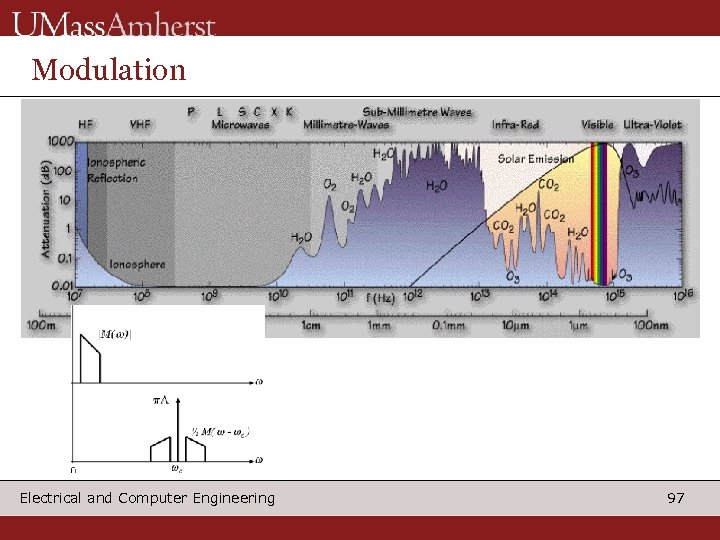 Modulation Electrical and Computer Engineering 97
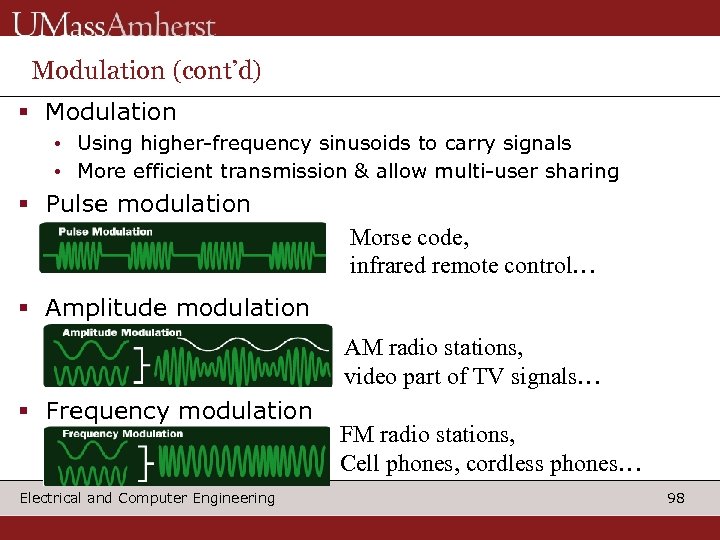 Modulation (cont’d) § Modulation • Using higher-frequency sinusoids to carry signals • More efficient transmission & allow multi-user sharing § Pulse modulation Morse code, infrared remote control… § Amplitude modulation AM radio stations, video part of TV signals… § Frequency modulation Electrical and Computer Engineering FM radio stations, Cell phones, cordless phones… 98
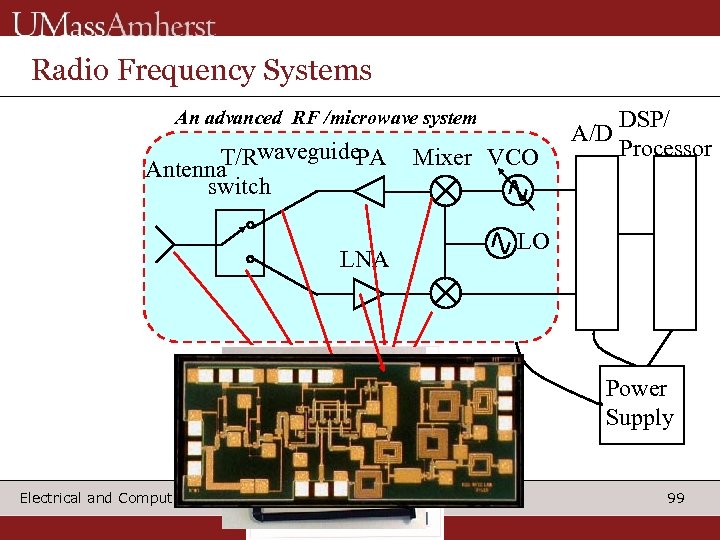 Radio Frequency Systems An advanced RF /microwave system T/Rwaveguide. PA Antenna switch LNA Mixer VCO DSP/ A/D Processor LO Power Supply Electrical and Computer Engineering 99
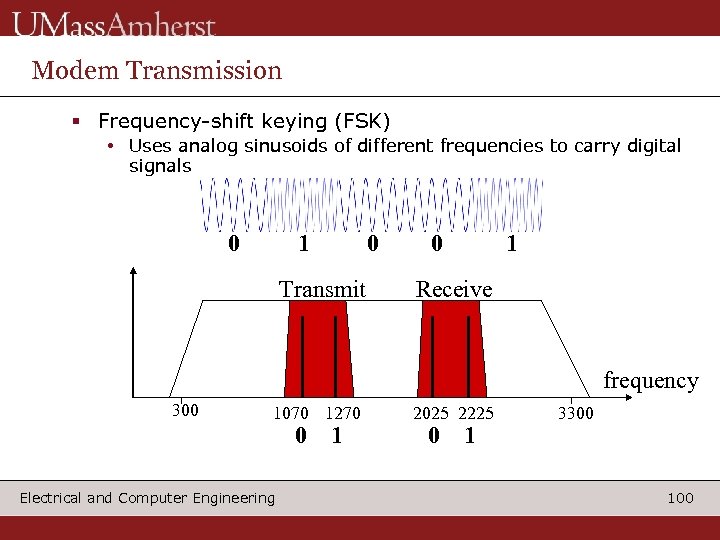 Modem Transmission § Frequency-shift keying (FSK) • Uses analog sinusoids of different frequencies to carry digital signals 0 1 0 Transmit 0 1 Receive frequency 300 1070 1270 0 Electrical and Computer Engineering 1 2025 2225 0 1 3300 100
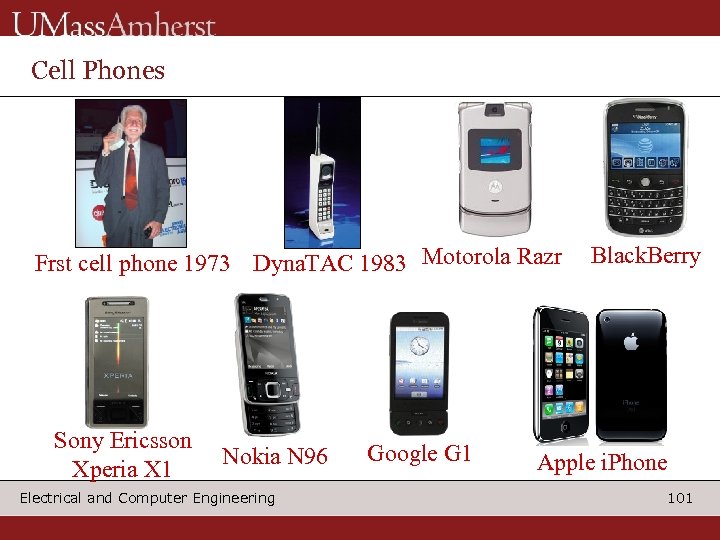 Cell Phones Frst cell phone 1973 Dyna. TAC 1983 Motorola Razr Sony Ericsson Xperia X 1 Nokia N 96 Electrical and Computer Engineering Google G 1 Black. Berry Apple i. Phone 101
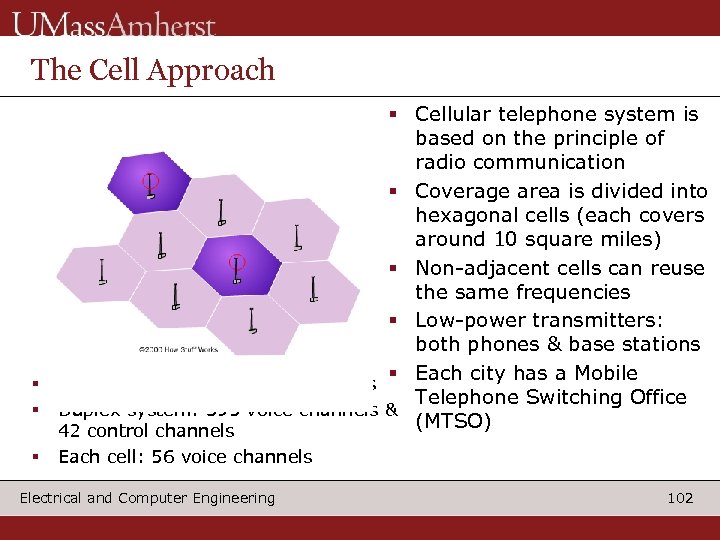 The Cell Approach § Cellular telephone system is based on the principle of radio communication § Coverage area is divided into hexagonal cells (each covers around 10 square miles) § Non-adjacent cells can reuse the same frequencies § Low-power transmitters: both phones & base stations § Each city has a Mobile § Each carrier: 832 radio frequencies Telephone Switching Office § Duplex system: 395 voice channels & (MTSO) 42 control channels § Each cell: 56 voice channels Electrical and Computer Engineering 102
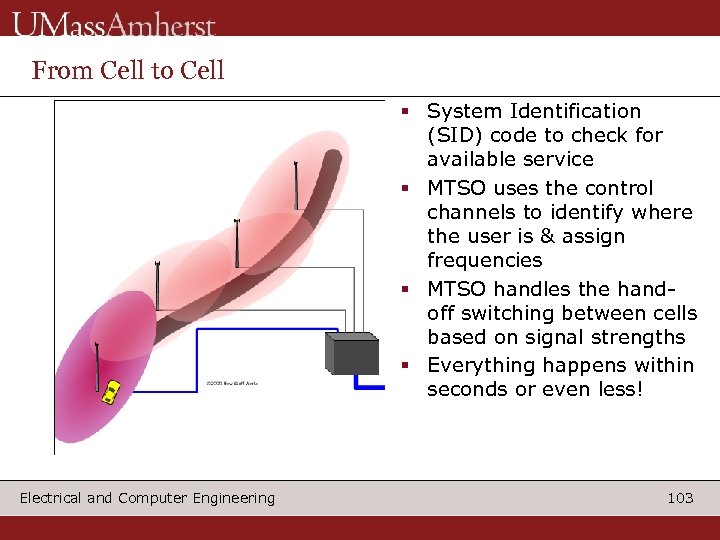 From Cell to Cell § System Identification (SID) code to check for available service § MTSO uses the control channels to identify where the user is & assign frequencies § MTSO handles the handoff switching between cells based on signal strengths § Everything happens within seconds or even less! Electrical and Computer Engineering 103
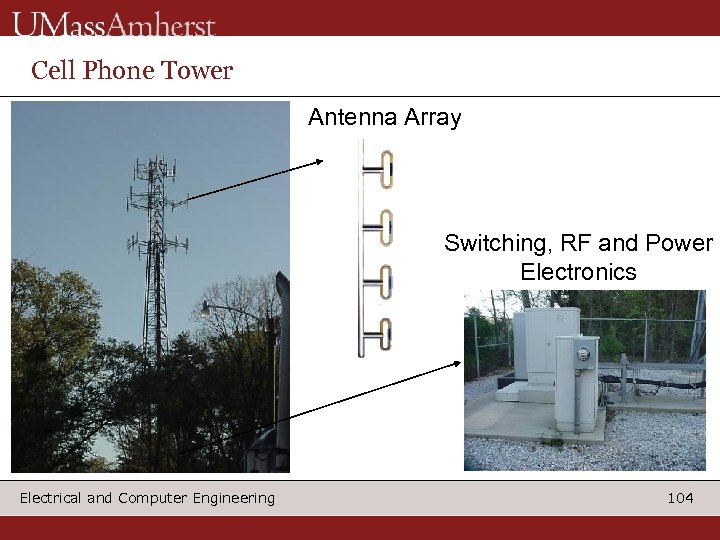 Cell Phone Tower Antenna Array Switching, RF and Power Electronics Electrical and Computer Engineering 104
 What Next? 1. Connect & collaborate with UMass Amherst ECE faculty 1. Teacher development grants 2. Summer research experience for teachers 2. Recommend exceptional high-school juniors/seniors summer research at UMass. 3. Invite UMass Profs to High-school student seminars. 4. M 5 Open house for students and Teachers. 5. Spread the word to students & colleagues. 6. Participate on upcoming ECE SESS(more in-depth). Marinos N. Vouvakis vouvakis@ecs. umass. edu Electrical and Computer Engineering 105
 Disclaimer Some materials (drawings, figures, text) presented in these slides was obtained from the following web resources: 1. 2. 3. 4. 5. 6. 7. 8. http: //images. google. com/imghp? hl=en&tab=wi http: //www. ecs. umass. edu/ece/engin 112/ http: //thanglong. ece. jhu. edu/Course/137/Lectures/ http: //www. ecs. umass. edu/public/ece_docs/ECE_303_ syllabus_S 09. pdf http: //www. nae. edu/ http: //www. bls. gov/ocos 027. htm#outlook http: //www. engtrends. com/IEE/0806 D. php http: //www. eetimes. com/news/latest/show. Article. jhtml ? article. ID=206903802 Electrical and Computer Engineering 106