


 Скачать презентацию What Drives the WTA-WTP Disparity in Real Estate
bf79612950e73fb0a62c1f633cc01744.ppt
- Количество слайдов: 1
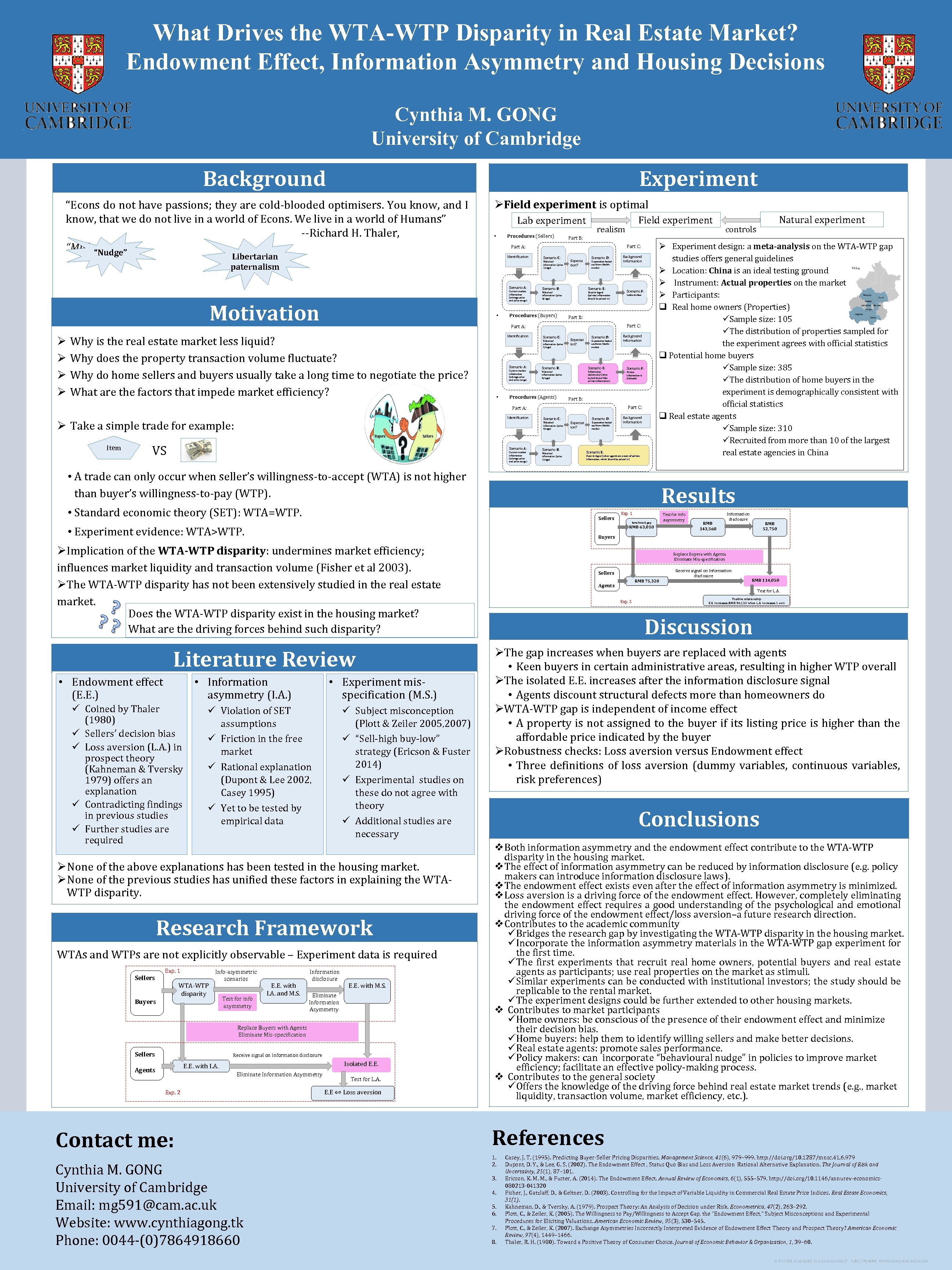 What Drives the WTA-WTP Disparity in Real Estate Market? Endowment Effect, Information Asymmetry and Housing Decisions Cynthia M. GONG University of Cambridge Background Experiment “Econs do not have passions; they are cold-blooded optimisers. You know, and I know, that we do not live in a world of Econs. We live in a world of Humans” --Richard H. Thaler, “Misbehaving” “Nudge” ØField experiment is optimal Lab experiment Procedures (Sellers) • Identification Scenario A: Ø Ø Scenario C: Current market information (average price and price range) • Expecta tion? Scenario D: Expectation-based up/down/stable market Scenario B: Scenario E: Historical information (price 4 y ago) Receive signal (private information should be priced in) Procedures (Buyers) Why is the real estate market less liquid? Why does the property transaction volume fluctuate? Why do home sellers and buyers usually take a long time to negotiate the price? What are the factors that impede market efficiency? Historical information (price 2 y ago) Scenario A: Current market information (average price and price range) • Expectat ion? Scenario D: Expectation-based up/down/stable market Scenario B: Scenario E: Historical information (price 4 y ago) Information asymmetry (when buyers know little private information) Procedures (Agents) Ø Take a simple trade for example: Item Scenario A: Current market information (average price and price range) Loss aversion Background information Scenario F: Private information is disclosed Part C: Scenario C: Historical information (price 4 y ago) VS Scenario F: Part B: Part A: Identification Background information Part C: Scenario C: Scenario B: Historical information (price 2 y ago) Expectat ion? Scenario D: Expectation-based up/down/stable market Background information Scenario E: Receive signal (when agents are aware of private information, which should be priced in) • A trade can only occur when seller’s willingness-to-accept (WTA) is not higher than buyer’s willingness-to-pay (WTP). Results • Standard economic theory (SET): WTA=WTP. Sellers • Experiment evidence: WTA>WTP. Literature Review • Information asymmetry (I. A. ) • Experiment misspecification (M. S. ) ü Violation of SET assumptions ü Friction in the free market ü Rational explanation (Dupont & Lee 2002, Casey 1995) ü Yet to be tested by empirical data ü Subject misconception (Plott & Zeiler 2005, 2007) ü “Sell-high buy-low” strategy (Ericson & Fuster 2014) ü Experimental studies on these do not agree with theory ü Additional studies are necessary Ø None of the above explanations has been tested in the housing market. Ø None of the previous studies has unified these factors in explaining the WTAWTP disparity. Research Framework WTAs and WTPs are not explicitly observable – Experiment data is required Sellers Exp. 1 WTA-WTP disparity Info-asymmetric scenarios Buyers Test for info asymmetry E. E. with I. A. and M. S. Information disclosure E. E. with M. S. Eliminate Information Asymmetry Replace Buyers with Agents Eliminate Mis-specification Sellers Receive signal on Information disclosure Isolated E. E. with I. A. Agents Eliminate Information Asymmetry Exp. 2 Contact me: Cynthia M. GONG University of Cambridge Email: mg 591@cam. ac. uk Website: www. cynthiagong. tk Phone: 0044 -(0)7864918660 Benchmark gap Test for info asymmetry RMB 143, 560 Information disclosure RMB 52, 750 Buyers Replace Buyers with Agents Eliminate Mis-specification Sellers Test for L. A. E. E ⇔ Loss aversion RMB 75, 320 Agents ? ? ? ü Coined by Thaler (1980) ü Sellers’ decision bias ü Loss aversion (L. A. ) in prospect theory (Kahneman & Tversky 1979) offers an explanation ü Contradicting findings in previous studies ü Further studies are required Exp. 1 RMB 63, 010 ØImplication of the WTA-WTP disparity: undermines market efficiency; influences market liquidity and transaction volume (Fisher et al 2003). ØThe WTA-WTP disparity has not been extensively studied in the real estate market. Does the WTA-WTP disparity exist in the housing market? What are the driving forces behind such disparity? • Endowment effect (E. E. ) controls Ø Experiment design: a meta-analysis on the WTA-WTP gap studies offers general guidelines Ø Location: China is an ideal testing ground Ø Instrument: Actual properties on the market Ø Participants: q Real home owners (Properties) üSample size: 105 üThe distribution of properties sampled for the experiment agrees with official statistics q Potential home buyers üSample size: 385 üThe distribution of home buyers in the experiment is demographically consistent with official statistics q Real estate agents üSample size: 310 üRecruited from more than 10 of the largest real estate agencies in China Part B: Part A: Identification Natural experiment Part B: Part C: Historical information (price 2 y ago) Motivation realism Part A: Libertarian paternalism Field experiment Receive signal on Information disclosure RMB 114, 050 Test for L. A. Exp. 2 Positive relationship E. E. increases RMB 86, 120 when L. A. increases 1 unit Discussion ØThe gap increases when buyers are replaced with agents • Keen buyers in certain administrative areas, resulting in higher WTP overall ØThe isolated E. E. increases after the information disclosure signal • Agents discount structural defects more than homeowners do ØWTA-WTP gap is independent of income effect • A property is not assigned to the buyer if its listing price is higher than the affordable price indicated by the buyer ØRobustness checks: Loss aversion versus Endowment effect • Three definitions of loss aversion (dummy variables, continuous variables, risk preferences) Conclusions v Both information asymmetry and the endowment effect contribute to the WTA-WTP disparity in the housing market. v The effect of information asymmetry can be reduced by information disclosure (e. g. policy makers can introduce information disclosure laws). v The endowment effect exists even after the effect of information asymmetry is minimized. v Loss aversion is a driving force of the endowment effect. However, completely eliminating the endowment effect requires a good understanding of the psychological and emotional driving force of the endowment effect/loss aversion–a future research direction. v Contributes to the academic community üBridges the research gap by investigating the WTA-WTP disparity in the housing market. üIncorporate the information asymmetry materials in the WTA-WTP gap experiment for the first time. üThe first experiments that recruit real home owners, potential buyers and real estate agents as participants; use real properties on the market as stimuli. üSimilar experiments can be conducted with institutional investors; the study should be replicable to the rental market. üThe experiment designs could be further extended to other housing markets. v Contributes to market participants üHome owners: be conscious of the presence of their endowment effect and minimize their decision bias. üHome buyers: help them to identify willing sellers and make better decisions. üReal estate agents: promote sales performance. üPolicy makers: can incorporate “behavioural nudge” in policies to improve market efficiency; facilitate an effective policy-making process. v Contributes to the general society üOffers the knowledge of the driving force behind real estate market trends (e. g. , market liquidity, transaction volume, market efficiency, etc. ). References 1. 2. 3. 4. 5. 6. 7. 8. Casey, J. T. (1995). Predicting Buyer-Seller Pricing Disparities. Management Science, 41(6), 979– 999. http: //doi. org/10. 1287/mnsc. 41. 6. 979 Dupont, D. Y. , & Lee, G. S. (2002). The Endowment Effect , Status Quo Bias and Loss Aversion Rational Alternative Explanation. The Journal of Risk and Uncertainty, 25(1), 87– 101. Ericson, K. M. M. , & Fuster, A. (2014). The Endowment Effect. Annual Review of Economics, 6(1), 555– 579. http: //doi. org/10. 1146/annurev-economics 080213 -041320 Fisher, J. , Gatzlaff, D. , & Geltner, D. (2003). Controlling for the Impact of Variable Liquidity in Commercial Real Estate Price Indices. Real Estate Economics, 31(1). Kahneman, D. , & Tversky, A. (1979). Prospect Theory: An Analysis of Decision under Risk. Econometrica, 47(2), 263– 292. Plott, C. , & Zeiler, K. (2005). The Willingness to Pay/Willingness to Accept Gap, the “Endowment Effect, ” Subject Misconceptions and Experimental Procedures for Eliciting Valuations. American Economic Review, 95(3), 530– 545. Plott, C. , & Zeiler, K. (2007). Exchange Asymmetries Incorrectly Interpreted Evidence of Endowment Effect Theory and Prospect Theory? American Economic Review, 97(4), 1449– 1466. Thaler, R. H. (1980). Toward a Positive Theory of Consumer Choice. Journal of Economic Behavior & Organization, 1, 39– 60.