


 Скачать презентацию What does your child have in common with
1a8e6eefc455ffbb6fe97613b5031d64.ppt
- Количество слайдов: 18
 What does your child have in common with these people? Jeff Bezos, founder of Amazon ¡ Sergey Brin and Larry Page, founder of Google ¡ Anne Frank, writer ¡ Jimmy Wales, founder of Wikipedia ¡ Will Wright, designer of the Sims ¡ Katherine Graham, late owner-editor of The Washington Post ¡ Joshua Bell, celebrated American violinist and IU graduate ¡ George Clooney, Academy Award-winning actor ¡ Helen Hunt, Academy Award-winning actress ¡ Sean Combs, Grammy-winning rapper ¡ Julia Child, the late television chef and cookbook author ¡ Jacqueline Bouvier Kennedy Onassis –former First Lady of the U. S. ¡ Prince William and Prince Harry, English royal family ¡ Cher Bono, singer-actress ¡ Yo Yo Ma, cellist ¡
 Maria Montessori… who was she? Born August 31, 1870 in Italy ¡ First woman doctor in Italy ¡ Studied children of the ghettos of Italy ¡ Designed materials that were child friendly and sized to teach them. ¡ Children want to learn and will when the environment is right. ¡
 Planes of Development ¡ Dr. Montessori’s observations led her to divide the children’s educational and psychological growth and development from childhood to adulthood into four planes of development; 0 -6 years, 6 -12 year, 12 -18 years, and 18 -24 years. Below is an overview of Two of Montessori’s Four Planes of Development.
 The First Plane Age 0 -6 years: The First Plane of Development (Our Early Childhood Classrooms) ¡ sensitive period for development of language ¡ sensitive period for physical order ¡ prefers to work alone
 The Second Plane Age 6 -12 years: The Second Plane of Development (Our Lower and Upper Elementary Classrooms ) ¡ sensitive period for social order and relationships ¡ sensitive to moral justice and fairness ¡ imagination and reasoning skills develop ¡ prefers to work in groups
 Social Aspects Six to Eight Year Old Children
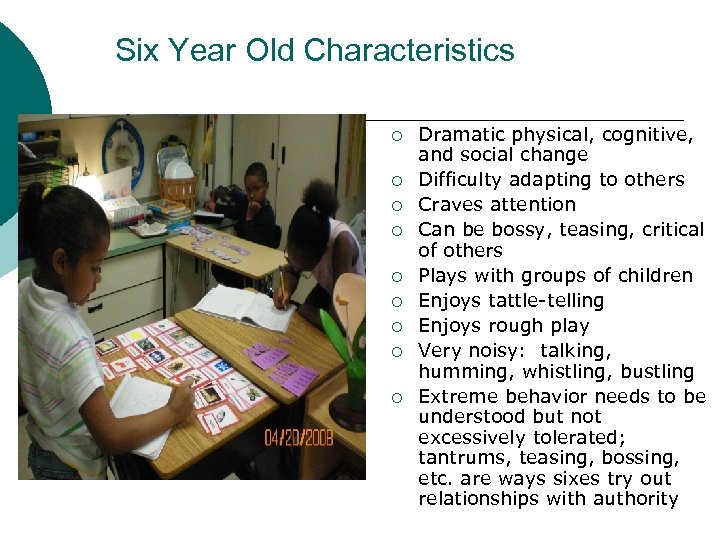 Six Year Old Characteristics ¡ ¡ ¡ ¡ ¡ Dramatic physical, cognitive, and social change Difficulty adapting to others Craves attention Can be bossy, teasing, critical of others Plays with groups of children Enjoys tattle-telling Enjoys rough play Very noisy: talking, humming, whistling, bustling Extreme behavior needs to be understood but not excessively tolerated; tantrums, teasing, bossing, etc. are ways sixes try out relationships with authority
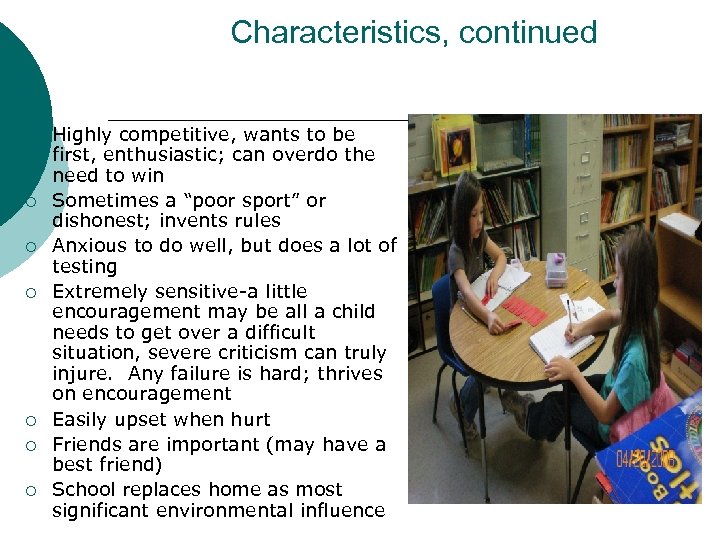 Characteristics, continued ¡ ¡ ¡ ¡ Highly competitive, wants to be first, enthusiastic; can overdo the need to win Sometimes a “poor sport” or dishonest; invents rules Anxious to do well, but does a lot of testing Extremely sensitive-a little encouragement may be all a child needs to get over a difficult situation, severe criticism can truly injure. Any failure is hard; thrives on encouragement Easily upset when hurt Friends are important (may have a best friend) School replaces home as most significant environmental influence
 Special Interests Loves to begin new tasks ¡ Likes to display the products of his work ¡ Interested in the larger community ¡ Interested in other cultures ¡ Interested in animals and nature ¡ Collects odds and ends ¡ Likes dramatic play ¡
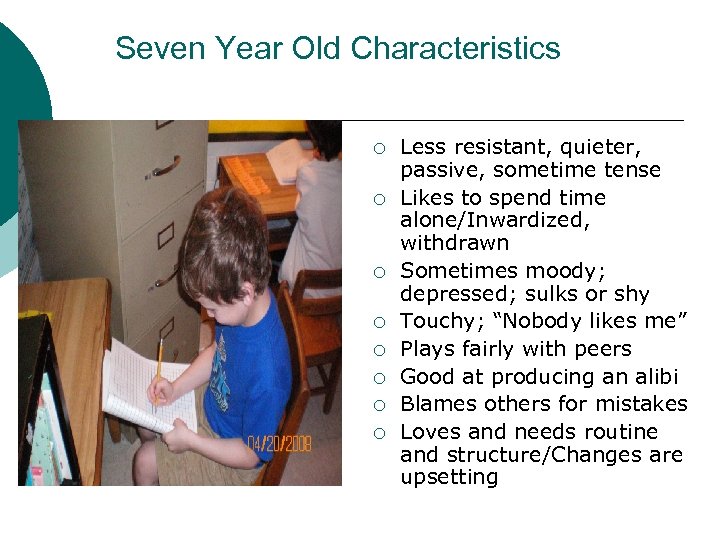 Seven Year Old Characteristics ¡ ¡ ¡ ¡ Less resistant, quieter, passive, sometime tense Likes to spend time alone/Inwardized, withdrawn Sometimes moody; depressed; sulks or shy Touchy; “Nobody likes me” Plays fairly with peers Good at producing an alibi Blames others for mistakes Loves and needs routine and structure/Changes are upsetting
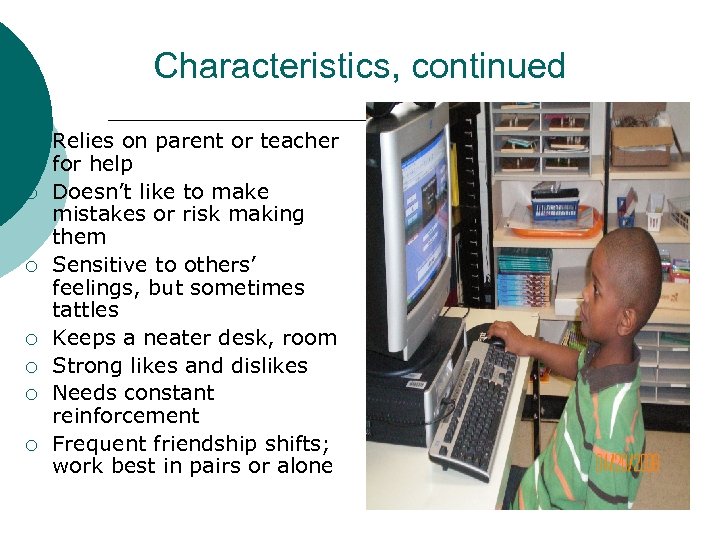 Characteristics, continued ¡ ¡ ¡ ¡ Relies on parent or teacher for help Doesn’t like to make mistakes or risk making them Sensitive to others’ feelings, but sometimes tattles Keeps a neater desk, room Strong likes and dislikes Needs constant reinforcement Frequent friendship shifts; work best in pairs or alone
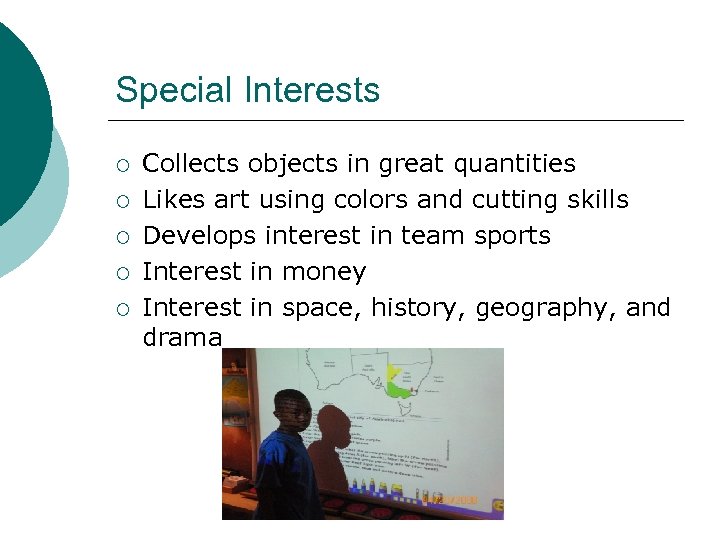 Special Interests ¡ ¡ ¡ Collects objects in great quantities Likes art using colors and cutting skills Develops interest in team sports Interest in money Interest in space, history, geography, and drama
 Eight Year Old Characteristics ¡ ¡ ¡ ¡ Very demanding of mother and teacher Develops a close relationship with a special friend (usually the same sex) Feelings are easily hurt Enjoys group play Sex segregation in play; prefers same gender activities Does not like to play alone; likes to work cooperatively Willing to accept consequences for actions
 Characteristics, continued ¡ ¡ ¡ ¡ Humorous Often “bites off more than chew”/overestimates abilities Resilient; bounces back quickly from mistakes Trouble with limits and boundaries Often has more friendship groups than at 7 Fairness issues, growing sense of moral responsibility beyond self Responds to studies of other cultures, stories that concern fairness, justice
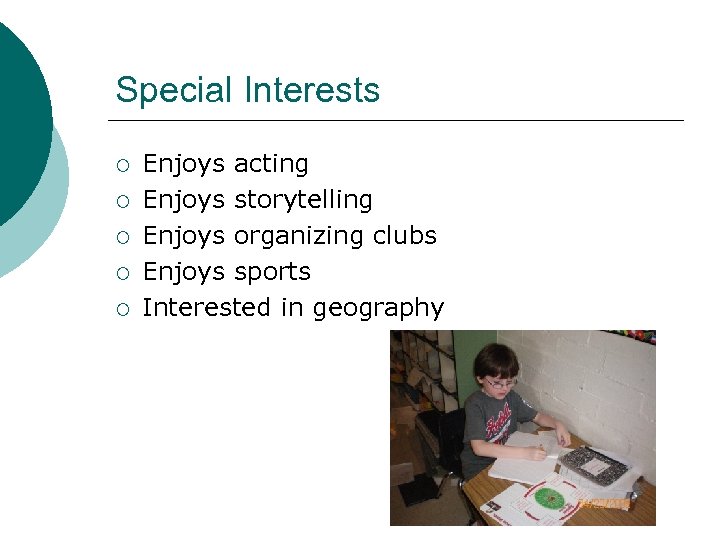 Special Interests ¡ ¡ ¡ Enjoys acting Enjoys storytelling Enjoys organizing clubs Enjoys sports Interested in geography
 IMPORTANT TO REMEMBER Teachers and parents need to remember that the process is more important than the product.
 Ways to Help at Home ¡ ¡ ¡ Understand extreme behavior, but do not tolerate inappropriate behavior. Talk less! Say what you mean, and mean what you say! Have family game night often. Expect rules of the games to be followed. Invite a friend over to play and for a planned activity, such as baking cookies, craft, board games, etc. Expect child to put own toys, clothes, etc. away. Designate specific places for these things. Expect child to have certain family responsibilities and obligations, such as responsible for cleaning own room, etc. Make certain chores within home his/her responsibility. Children should be shown how to complete chores and held accountable to complete them. Expected chores examples are: Dusting, vacuuming, help with laundry, setting the table, helping to prepare meals, clean up after meals, care of pets, care of plants, helping with garden/yard work, etc. Turn off the TV, video games, etc. and play outside with your child. Take your child and one of his/her friends to a park to play and a picnic that they helped to prepare. Practice/role play conversations with friends and adults. Talk with your child often!
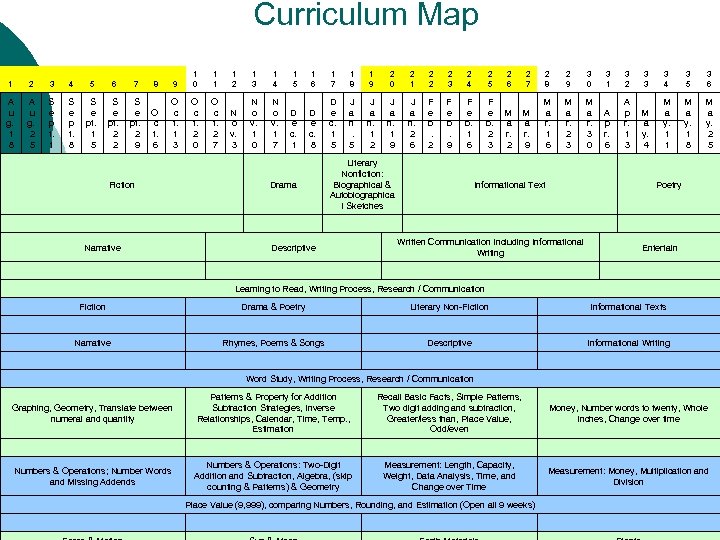 Curriculum Map 1 2 3 4 5 6 7 A u g. 1 8 A u g. 2 5 S e p t. 1 S e p t. 8 S e pt. 1 5 S e pt. 2 2 8 S e O pt. c 2 t. 9 6 9 1 0 1 1 1 2 1 3 1 4 1 5 1 6 1 7 1 8 1 9 2 0 2 1 2 2 2 3 2 4 2 5 O c t. 1 3 O c t. 2 0 O c t. 2 7 N o v. 3 N o v. 1 0 N o v. 1 7 D e c. 1 D e c. 8 D e c. 1 5 J a n. 1 2 J a n. 1 9 J a n. 2 6 F e b. 2 F e b. 9 F e b. 1 6 F e M M b. a a 2 r. 3 2 9 Fiction Drama Literary Nonfiction: Biographical & Autobiographica l Sketches 2 6 2 7 2 8 2 9 3 0 3 1 3 2 3 3 3 4 3 5 3 6 M a r. 1 6 M a r. 2 3 M a r. 3 0 A p r. 6 A p r. 1 3 M a y. 4 M a y. 1 1 M a y. 1 8 M a y. 2 5 Informational Text Poetry Narrative Descriptive Written Communication Including Informational Writing Entertain Learning to Read, Writing Process, Research / Communication Fiction Drama & Poetry Literary Non-Fiction Informational Texts Narrative Rhymes, Poems & Songs Descriptive Informational Writing Word Study, Writing Process, Research / Communication Graphing, Geometry, Translate between numeral and quantity Patterns & Property for Addition Subtraction Strategies, Inverse Relationships, Calendar, Time, Temp. , Estimation Recall Basic Facts, Simple Patterns, Two digit adding and subtraction, Greater/less than, Place Value, Odd/even Money, Number words to twenty, Whole Inches, Change over time Numbers & Operations; Number Words and Missing Addends Numbers & Operations: Two-Digit Addition and Subtraction, Algebra, (skip counting & Patterns) & Geometry Measurement: Length, Capacity, Weight, Data Analysis, Time, and Change over Time Measurement: Money, Multiplication and Division Place Value (9, 999), comparing Numbers, Rounding, and Estimation (Open all 9 weeks)