


 Скачать презентацию What does leadership mean to trainees Darzi Fellows
33cb1e15159b9c531ebfda99f449f3cc.ppt
- Количество слайдов: 24
 What does leadership mean to trainees? Darzi Fellows' perspective and experience. Judy King and Catriona Shaw Nov 2010
 The NHS Next Stage Review Final Report – ‘High Quality Care For All’ • "[It] requires a new obligation to step up, work with other leaders, both clinical and managerial, and change the system where it would benefit patients. “ Lord Darzi
 Darzi Fellowship: Background Response to the Next Stage Review London Deanery and NHS London Yearlong fellowship programme Clinical trainees from different disciplines and services • Develop the skills required to manage people and relationships in order to achieve organisational goals • •
 Darzi fellowship: components 1. ) A change management project: Working closely with the Medical Director or nominated deputy to support the development of services changes, in keeping with the principles of Lord Darzi’s ‘Next Stage Review’. 2. ) A quality improvement / safety improvement / clinical governance project: Devising, leading and delivering a local quality improvement, safety improvement or clinical governance initiative within their Trust. 3. ) Supporting capacity building within the Trust for training and generic skills: Working with various departments within the Trust to develop the capacity for training in one or more essential organisational skills.
 Leadership training- what was the added value for me? • Renewed sense of purpose; individual, team, organisational level • Improved leadership, team-working skills • Networks and relationships for the present and future • New skill set in change management, quality improvement • Improved optimism despite challenges facing profession, organisation • Empowerment to contribute towards making a difference
 But not everyone can do a Darzi Fellowship: • 'Training for quality improvement and safety includes training clinicians not only to be very good at looking after individual patients but also ensuring that they acquire the organisational skills to enable them to look after the system of care on behalf of their patients. ' Dr Fiona Moss • Good medical practice/professionalism?
 Leadership for all? Opportunities and challenges. . • Economic climate • Not the realm of bespoke programmes and conferences, but essential tools and priorities for all clinicians • Competing time restraints/training priorities • Fragmented working patterns, fragmented teams • Change in emphasis from task orientated competencies? Emotional intelligence • ? how to integrate leadership culture • Capture and utilise passion, commitment, innovation of new generation of trainees • Education /training for “i”-generation
 The challenge. . . • How do we make leadership skills development accessible and effective for all trainees? • How do we make it a priority, so that these elements feel as relevant and integral to training as clinical skills?
 How to implement the MLCF – a Darzi Fellows’ solution Judy King ST 3 Medical Oncology
 The challenge • How to teach leadership and management to junior doctors • How to make it interesting/relevant • Competing priorities: exams, job applications
 Leadership and Management for All: Le. MA Background: • Most leadership and management courses to date aimed at senior Sp. Rs • Introducing these topics earlier may be of benefit Aim: • Provide an introduction to leadership and management which is relevant to FY/core trainees • Free resource – available via Synapse (London Deanery) • Integrated into generic teaching program • Certificate (recognized at ARCP)
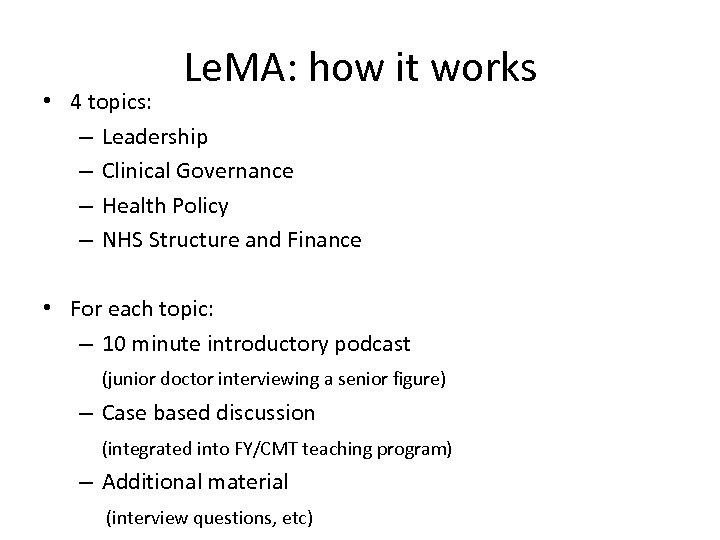 Le. MA: how it works • 4 topics: – Leadership – Clinical Governance – Health Policy – NHS Structure and Finance • For each topic: – 10 minute introductory podcast (junior doctor interviewing a senior figure) – Case based discussion (integrated into FY/CMT teaching program) – Additional material (interview questions, etc)
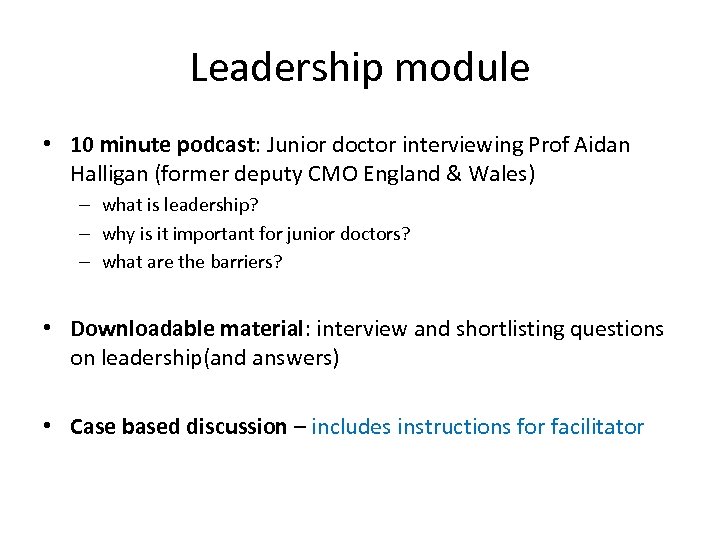 Leadership module • 10 minute podcast: Junior doctor interviewing Prof Aidan Halligan (former deputy CMO England & Wales) – what is leadership? – why is it important for junior doctors? – what are the barriers? • Downloadable material: interview and shortlisting questions on leadership(and answers) • Case based discussion – includes instructions for facilitator
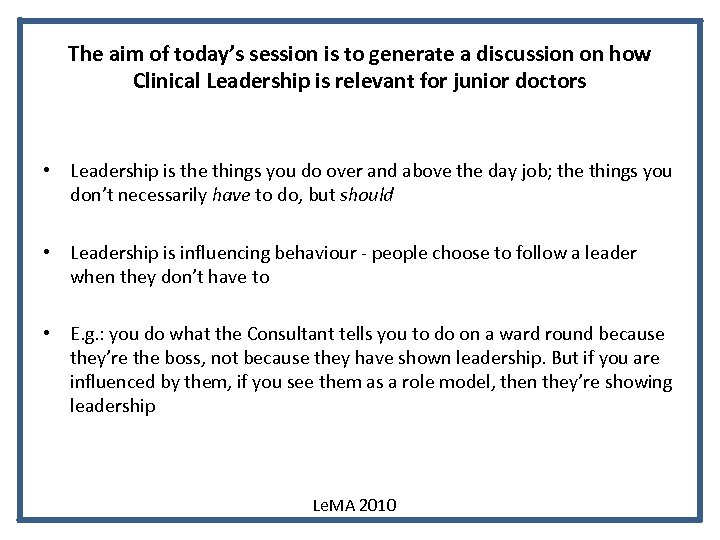 The aim of today’s session is to generate a discussion on how Clinical Leadership is relevant for junior doctors • Leadership is the things you do over and above the day job; the things you don’t necessarily have to do, but should • Leadership is influencing behaviour - people choose to follow a leader when they don’t have to • E. g. : you do what the Consultant tells you to do on a ward round because they’re the boss, not because they have shown leadership. But if you are influenced by them, if you see them as a role model, then they’re showing leadership Le. MA 2010
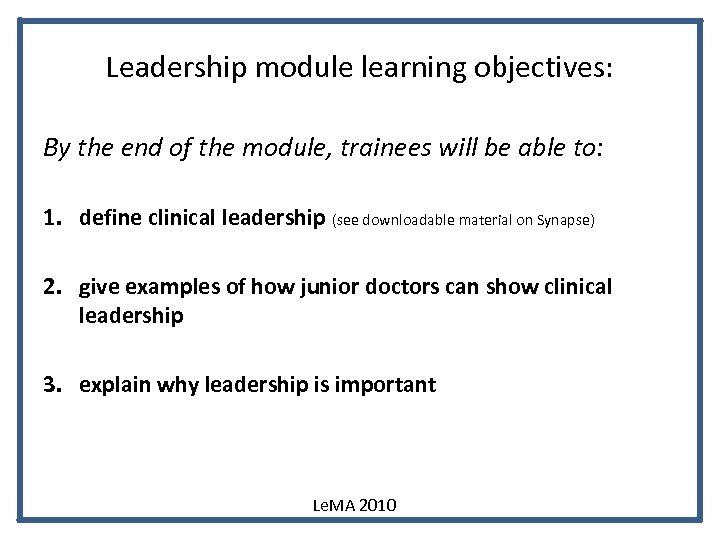 Leadership module learning objectives: By the end of the module, trainees will be able to: 1. define clinical leadership (see downloadable material on Synapse) 2. give examples of how junior doctors can show clinical leadership 3. explain why leadership is important Le. MA 2010
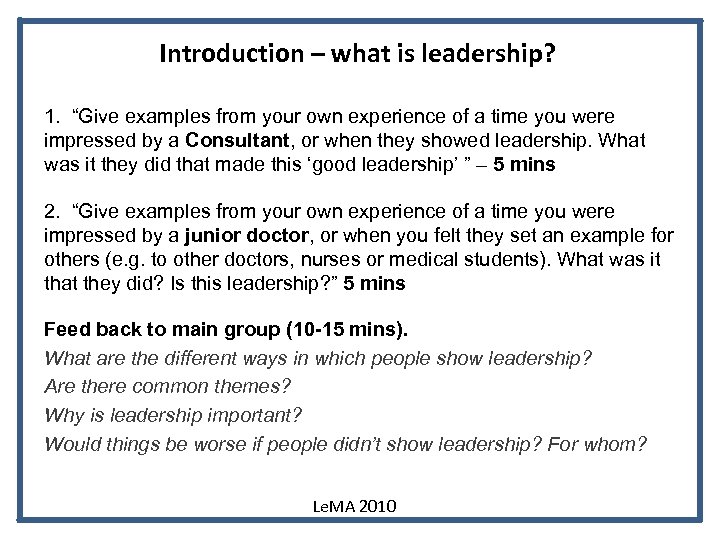 Introduction – what is leadership? 1. “Give examples from your own experience of a time you were impressed by a Consultant, or when they showed leadership. What was it they did that made this ‘good leadership’ ” – 5 mins 2. “Give examples from your own experience of a time you were impressed by a junior doctor, or when you felt they set an example for others (e. g. to other doctors, nurses or medical students). What was it that they did? Is this leadership? ” 5 mins Feed back to main group (10 -15 mins). What are the different ways in which people show leadership? Are there common themes? Why is leadership important? Would things be worse if people didn’t show leadership? For whom? Le. MA 2010
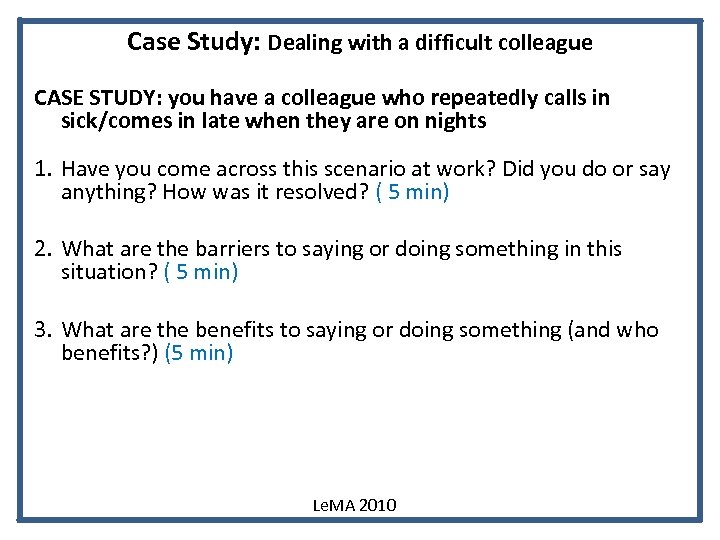 Case Study: Dealing with a difficult colleague CASE STUDY: you have a colleague who repeatedly calls in sick/comes in late when they are on nights 1. Have you come across this scenario at work? Did you do or say anything? How was it resolved? ( 5 min) 2. What are the barriers to saying or doing something in this situation? ( 5 min) 3. What are the benefits to saying or doing something (and who benefits? ) (5 min) Le. MA 2010
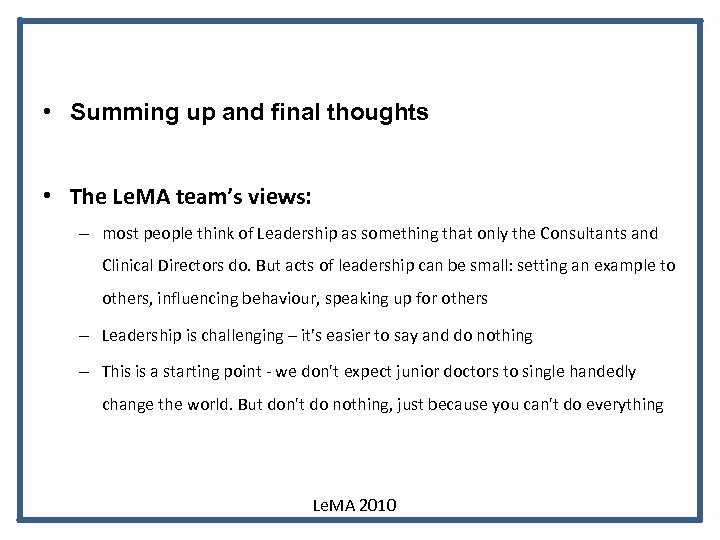 • Summing up and final thoughts • The Le. MA team’s views: – most people think of Leadership as something that only the Consultants and Clinical Directors do. But acts of leadership can be small: setting an example to others, influencing behaviour, speaking up for others – Leadership is challenging – it’s easier to say and do nothing – This is a starting point - we don't expect junior doctors to single handedly change the world. But don't do nothing, just because you can't do everything Le. MA 2010
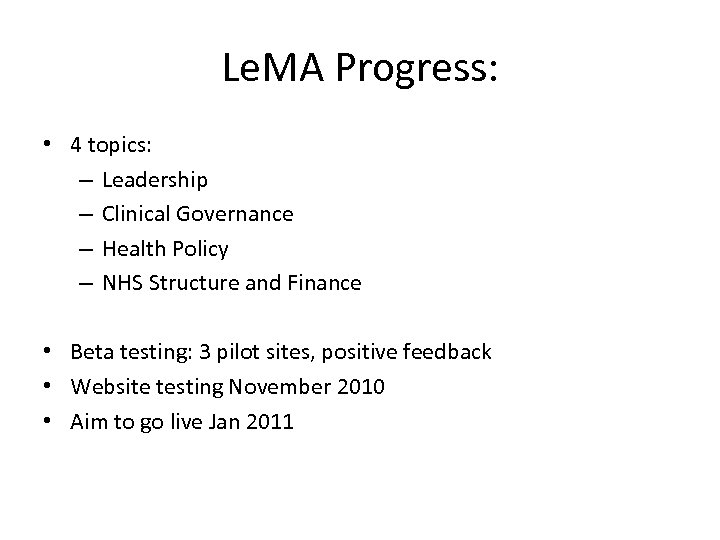 Le. MA Progress: • 4 topics: – Leadership – Clinical Governance – Health Policy – NHS Structure and Finance • Beta testing: 3 pilot sites, positive feedback • Website testing November 2010 • Aim to go live Jan 2011
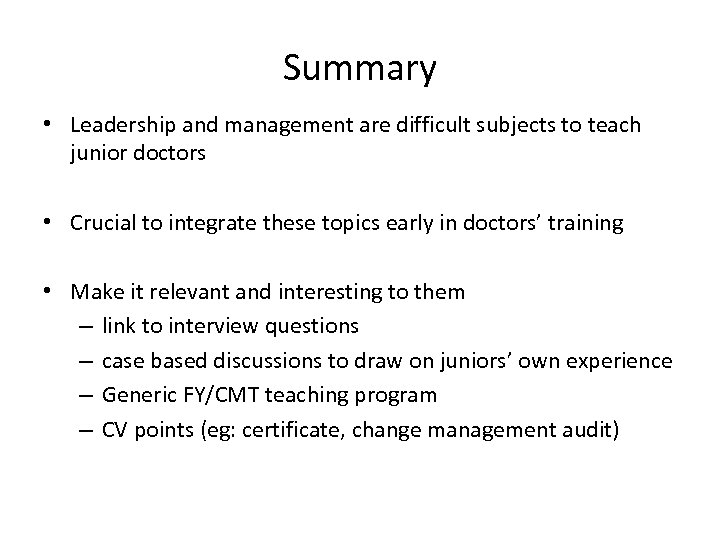 Summary • Leadership and management are difficult subjects to teach junior doctors • Crucial to integrate these topics early in doctors’ training • Make it relevant and interesting to them – link to interview questions – case based discussions to draw on juniors’ own experience – Generic FY/CMT teaching program – CV points (eg: certificate, change management audit)
 Thank you Acknowledgements • The Le. MA team – – – – Kirsten Brown Helen Burgess Tim Chapman Sunny Kaul Chris Meadows Carlo Prina Chris Thorn • Martin Fischer & Diane Plampling • London Deanery/Synapse team • Adrian Hopper & Peter Jaye judyking@doctors. org. uk catriona. shaw@nhs. net

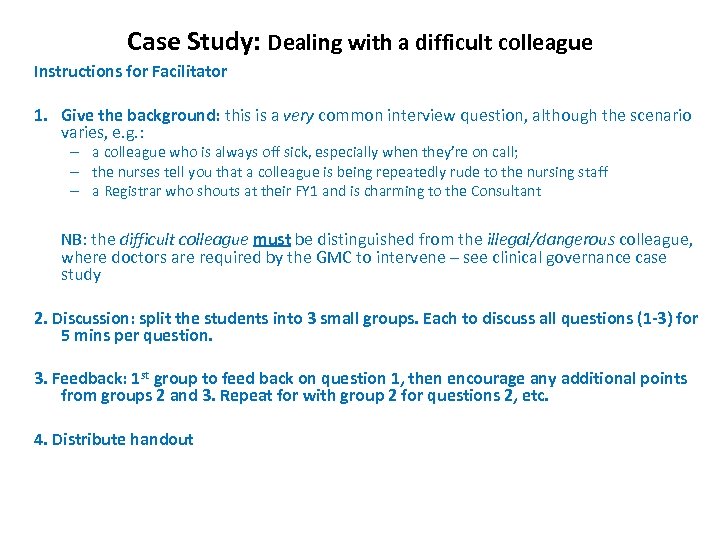 Case Study: Dealing with a difficult colleague Instructions for Facilitator 1. Give the background: this is a very common interview question, although the scenario varies, e. g. : – a colleague who is always off sick, especially when they’re on call; – the nurses tell you that a colleague is being repeatedly rude to the nursing staff – a Registrar who shouts at their FY 1 and is charming to the Consultant NB: the difficult colleague must be distinguished from the illegal/dangerous colleague, where doctors are required by the GMC to intervene – see clinical governance case study 2. Discussion: split the students into 3 small groups. Each to discuss all questions (1 -3) for 5 mins per question. 3. Feedback: 1 st group to feed back on question 1, then encourage any additional points from groups 2 and 3. Repeat for with group 2 for questions 2, etc. 4. Distribute handout
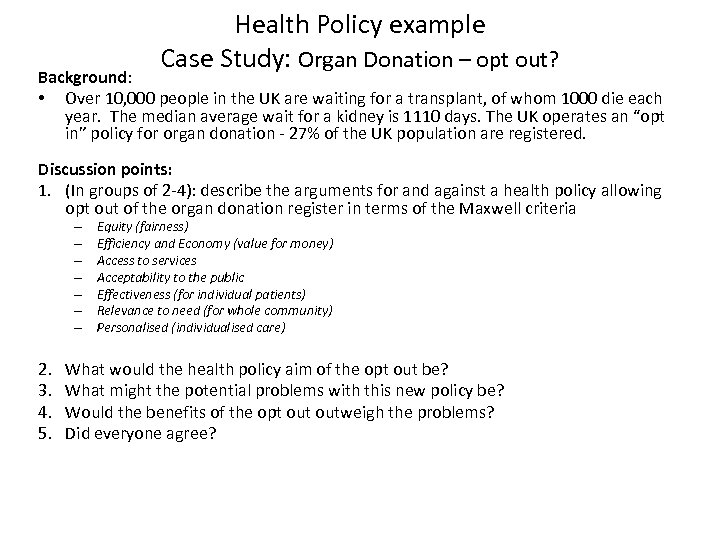 Health Policy example Case Study: Organ Donation – opt out? Background: • Over 10, 000 people in the UK are waiting for a transplant, of whom 1000 die each year. The median average wait for a kidney is 1110 days. The UK operates an “opt in” policy for organ donation - 27% of the UK population are registered. Discussion points: 1. (In groups of 2 -4): describe the arguments for and against a health policy allowing opt out of the organ donation register in terms of the Maxwell criteria – – – – 2. 3. 4. 5. Equity (fairness) Efficiency and Economy (value for money) Access to services Acceptability to the public Effectiveness (for individual patients) Relevance to need (for whole community) Personalised (individualised care) What would the health policy aim of the opt out be? What might the potential problems with this new policy be? Would the benefits of the opt outweigh the problems? Did everyone agree?