


 Скачать презентацию What does Health Care Reform Mean to YOU
ab9cc49d94db5e28120a4c1f2d6bc0b8.ppt
- Количество слайдов: 50
 What does Health Care Reform Mean to YOU? Associate Dean for Outreach and Multicultural Affairs Professor of Medicine and Pathology Medical Director, Arizona Telemedicine Program Arizona Cancer Center - University of Arizona Governor, Arizona Chapter, American College of Physicians
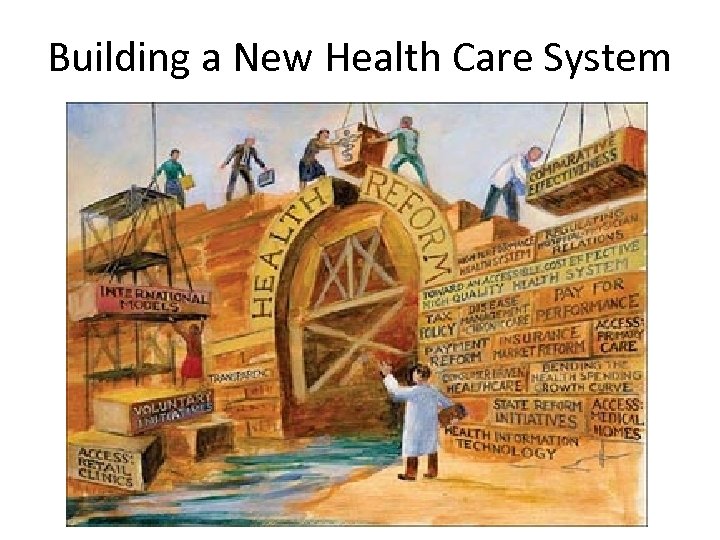 Building a New Health Care System
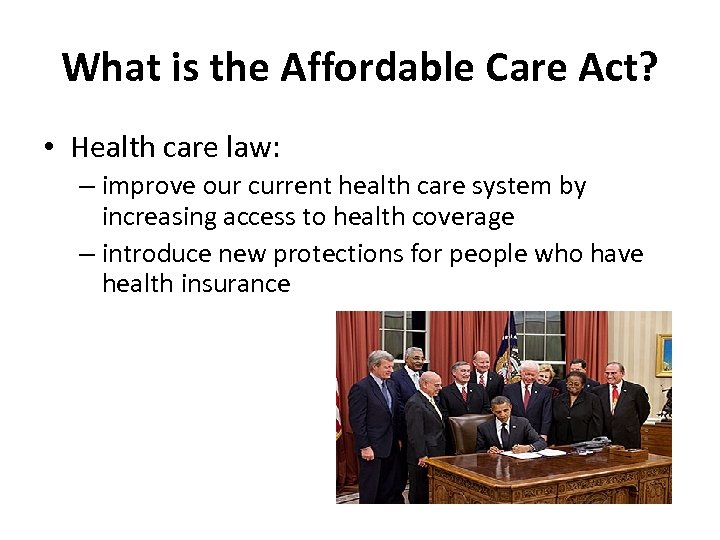 What is the Affordable Care Act? • Health care law: – improve our current health care system by increasing access to health coverage – introduce new protections for people who have health insurance
 Examples of Changes • If you have health insurance, you’re at risk of the insurance companies cancelling your coverage if you get sick. – Law requires insurance plans to cover your out-of-pocket costs for many proven preventive and screening services, such as colonoscopies and mammograms, to catch problems at their earliest, most treatable stages. • If your job does not offer health insurance or you have been denied coverage because of a pre-existing condition, – Law covers people with pre-existing conditions. Will increase access to coverage by 2014. • If you are a small business may be difficult to pay for health insurance for employees. – Law supports small business to cover employees
 Goals • Important to understand what the law means for you. • Check out what changes have already taken place • Learn more about what is happening in AZ

 The New Health Care Law: How it might affect you • The new health care law brings a number of changes; so it’s important to know if, how and when these changes will affect you. • You and your family can be better informed by knowing what’s in the law and when changes take effect. • Think of this as a start. Because everyone’s situation is different, check with other trusted sources to get all the details you want.
 Some Parts of the Law • Go into effect – Now – Later • Are for people – Under 65 – Over 65 • Are for small businesses

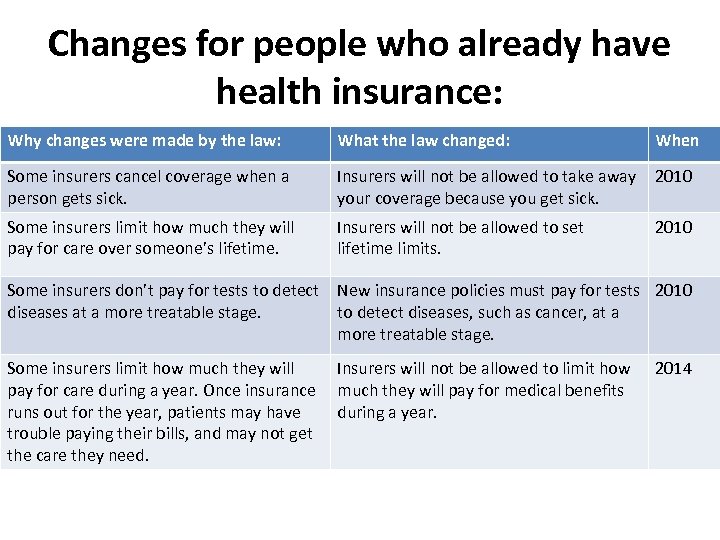 Changes for people who already have health insurance: Why changes were made by the law: What the law changed: When Some insurers cancel coverage when a person gets sick. Insurers will not be allowed to take away 2010 your coverage because you get sick. Some insurers limit how much they will pay for care over someone’s lifetime. Insurers will not be allowed to set lifetime limits. 2010 Some insurers don’t pay for tests to detect New insurance policies must pay for tests 2010 diseases at a more treatable stage. to detect diseases, such as cancer, at a more treatable stage. Some insurers limit how much they will Insurers will not be allowed to limit how pay for care during a year. Once insurance much they will pay for medical benefits runs out for the year, patients may have during a year. trouble paying their bills, and may not get the care they need. 2014
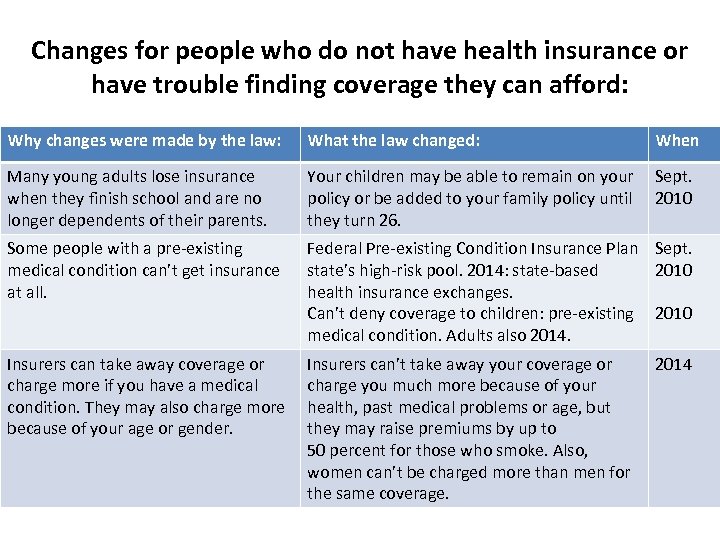 Changes for people who do not have health insurance or have trouble finding coverage they can afford: Why changes were made by the law: What the law changed: When Many young adults lose insurance when they finish school and are no longer dependents of their parents. Your children may be able to remain on your Sept. policy or be added to your family policy until 2010 they turn 26. Some people with a pre-existing medical condition can’t get insurance at all. Federal Pre-existing Condition Insurance Plan Sept. state’s high-risk pool. 2014: state-based 2010 health insurance exchanges. Can’t deny coverage to children: pre-existing 2010 medical condition. Adults also 2014. Insurers can take away coverage or charge more if you have a medical condition. They may also charge more because of your age or gender. Insurers can’t take away your coverage or charge you much more because of your health, past medical problems or age, but they may raise premiums by up to 50 percent for those who smoke. Also, women can’t be charged more than men for the same coverage. 2014
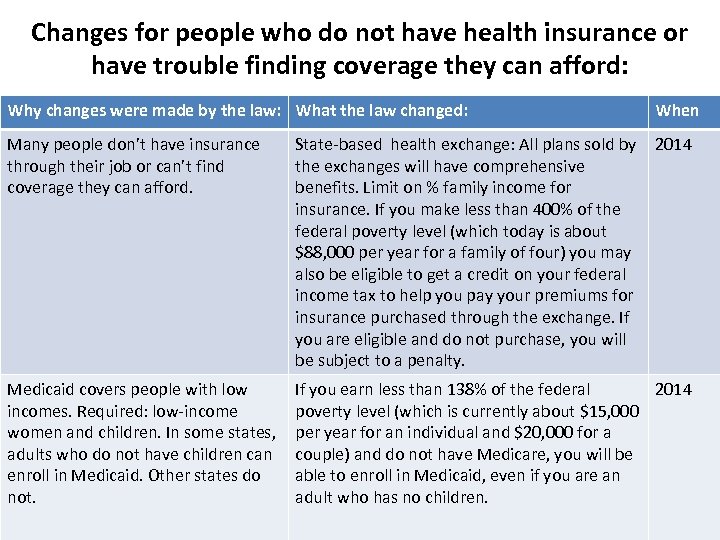 Changes for people who do not have health insurance or have trouble finding coverage they can afford: Why changes were made by the law: What the law changed: When Many people don’t have insurance through their job or can’t find coverage they can afford. State-based health exchange: All plans sold by 2014 the exchanges will have comprehensive benefits. Limit on % family income for insurance. If you make less than 400% of the federal poverty level (which today is about $88, 000 per year for a family of four) you may also be eligible to get a credit on your federal income tax to help you pay your premiums for insurance purchased through the exchange. If you are eligible and do not purchase, you will be subject to a penalty. Medicaid covers people with low incomes. Required: low-income women and children. In some states, adults who do not have children can enroll in Medicaid. Other states do not. If you earn less than 138% of the federal 2014 poverty level (which is currently about $15, 000 per year for an individual and $20, 000 for a couple) and do not have Medicare, you will be able to enroll in Medicaid, even if you are an adult who has no children.
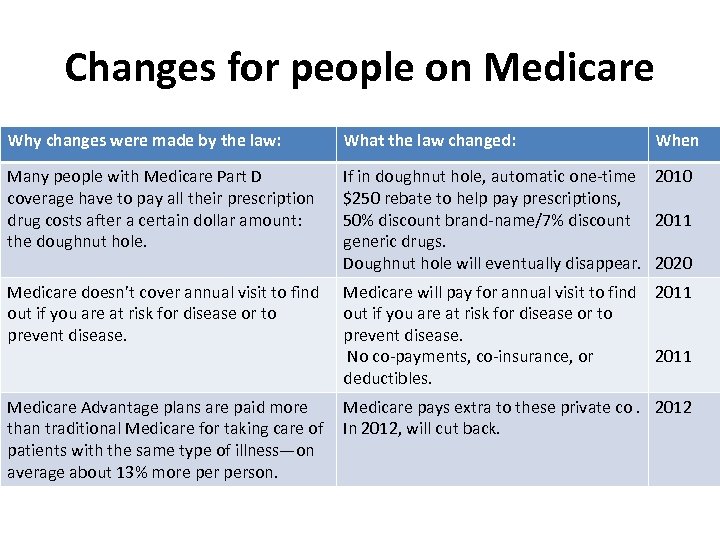 Changes for people on Medicare Why changes were made by the law: What the law changed: When Many people with Medicare Part D coverage have to pay all their prescription drug costs after a certain dollar amount: the doughnut hole. If in doughnut hole, automatic one-time 2010 $250 rebate to help pay prescriptions, 50% discount brand-name/7% discount 2011 generic drugs. Doughnut hole will eventually disappear. 2020 Medicare doesn’t cover annual visit to find out if you are at risk for disease or to prevent disease. Medicare will pay for annual visit to find 2011 out if you are at risk for disease or to prevent disease. No co-payments, co-insurance, or 2011 deductibles. Medicare Advantage plans are paid more Medicare pays extra to these private co. 2012 than traditional Medicare for taking care of In 2012, will cut back. patients with the same type of illness—on average about 13% more person.
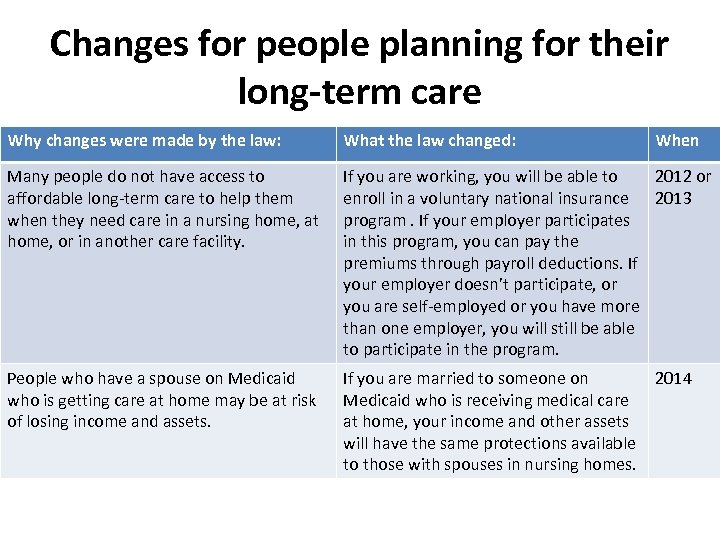 Changes for people planning for their long-term care Why changes were made by the law: What the law changed: When Many people do not have access to affordable long-term care to help them when they need care in a nursing home, at home, or in another care facility. If you are working, you will be able to 2012 or enroll in a voluntary national insurance 2013 program. If your employer participates in this program, you can pay the premiums through payroll deductions. If your employer doesn’t participate, or you are self-employed or you have more than one employer, you will still be able to participate in the program. People who have a spouse on Medicaid who is getting care at home may be at risk of losing income and assets. If you are married to someone on 2014 Medicaid who is receiving medical care at home, your income and other assets will have the same protections available to those with spouses in nursing homes.
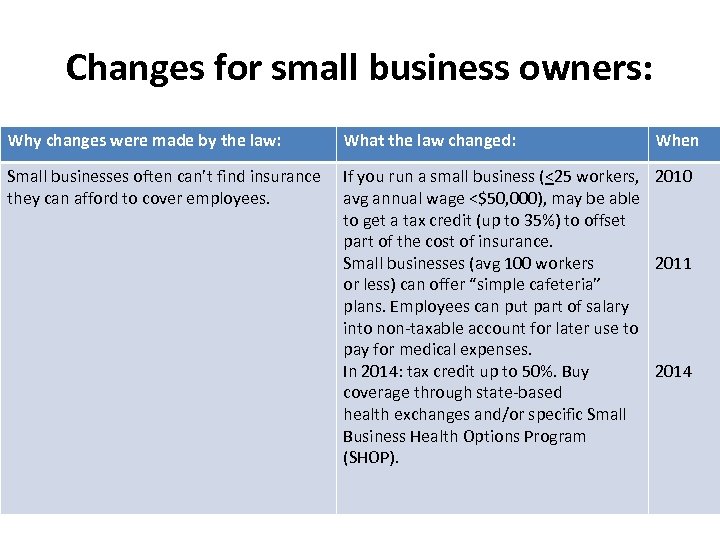 Changes for small business owners: Why changes were made by the law: What the law changed: When Small businesses often can’t find insurance they can afford to cover employees. If you run a small business (<25 workers, 2010 avg annual wage <$50, 000), may be able to get a tax credit (up to 35%) to offset part of the cost of insurance. Small businesses (avg 100 workers 2011 or less) can offer “simple cafeteria” plans. Employees can put part of salary into non-taxable account for later use to pay for medical expenses. In 2014: tax credit up to 50%. Buy 2014 coverage through state-based health exchanges and/or specific Small Business Health Options Program (SHOP).

 Did You Know? • Consumers Maybe Be Unaware Of Their Right To a Review Of Health Plan Decisions Starting this year, consumers will have new rights in their ability to appeal decisions made. . . • Approximately $40 million in Affordable Care Act funds for statewide chronic disease prevention programs In support of the Affordable Care Act’s initiative to prevent the most prevalent chronic diseases, . . . • At Least 600, 000 Young Adults Join Parents’ Health Plans Under New Law Hundreds of thousands of young adults have enrolled in their parents’ coverage plans as the. . . • New Labels Will Soon Help Consumers Choose Health Plans Look out for “coverage fact labels, ” a requirement of the ACA, . . .
 Insurer Requirements for Spending Your Health Care Dollar • Insurance companies are required to spend 85 cents of every health care dollar collected from large employers’ plans on health care services instead of administrative expenses and salaries. For small plans and plans sold to individuals, the requirement is 80 cents for every dollar. If insurance companies do not meet this requirement, they are required to give rebates to consumers. • Starting January 1, 2011
 Provides Medicare Bonus Payments to Health Care Professionals • The law provides a 10 percent Medicare bonus payment for office visits to primary care physicians. It also provides a 10 percent bonus payment for office visits to general surgeons practicing in areas that are short on health professionals. This helps ensure that there are enough primary care professionals to take care of patients. And that general surgeons are available in rural and low-income communities. • Starting January 1, 2011 through December 31, 2015
 Center for Medicare and Medicaid Innovation • The law creates a new Center for Medicare and Medicaid Innovation. The new center aims to improve quality of care and help lower costs by studying new ways of providing care. • Starting January 1, 2011
 Premiums for Higher-Income Medicare Part B Beneficiaries • The law freezes the income cap for incomerelated Medicare Part B premiums at 2010 levels ($85, 000 per year for individuals and $170, 000 per year for couples) until 2019. • Starting January 1, 2011
 Medicaid Health Homes • The law gives states the option to let certain Medicaid enrollees choose a “health home” – a system of care that is centered around the patient and coordinates care to help meet the needs of people with chronic conditions. States that choose to offer the health home option will receive funds for two years to help cover the cost of providing home-related health services. • Starting January 1, 2011
 Chronic Disease Prevention in Medicaid • The law gives states grants to create programs that provide people in Medicaid with rewards for participating in certain lifestyle programs to help keep them healthy and prevent chronic diseases like diabetes and high blood pressure. • Starting January 1, 2011
 Improving Care for People in Medicare After They Leave the Hospital • The Community Care Transitions Program helps people in Medicare avoid returning to the hospital by connecting them with services like health coaches. • Starting January 1, 2011
 Changes to Flexible Spending Accounts (FSAs) • Flexible Spending Accounts and Health Reimbursement Accounts will no longer reimburse the cost of over-the-counter drugs not prescribed by a doctor. The law also ends tax-free reimbursements through a Health Savings Account or Archer Medical Savings Account. • Starting January 1, 2011
 Teaching Health Centers • The law funds programs to train primary care physicians in community-based clinics, called Teaching Health Centers. • Starting fiscal year 2011 (October 2010 – September 2011)
 New Nutritional Labeling • The law requires that nutritional content be posted publicly for standard menu items at chain restaurants and food sold in vending machines.
 Grants for Small Employer Wellness Programs • The law provides grants to small employers that establish wellness programs in the workplace. • Starting fiscal year 2011 (October 2010 – September 2011)
 Grants to Evaluate Ways to Reduce Malpractice Costs • The law authorizes $50 million for 5 -year state grants to develop, implement and evaluate alternatives to current medical malpractice lawsuits and to improve patient safety. • Starting fiscal year 2011 (October 2010 – September 2011)
 Grants for American Health Benefit Exchanges • The law provides grants to states to start planning for the creation of state-based marketplaces called exchanges – where uninsured individuals and small businesses can shop for and buy health plans for themselves and their employees. • Starting March 23, 2011
 Medicare Independent Payment Advisory Board • The law creates an Independent Payment Advisory Board that will make recommendations aimed at extending the Medicare Trust Fund and reducing the growth rate of Medicare spending if it exceeds projected growth rates. The Board’s recommendation is due on January 15, 2014. • Starting October 1, 2011
 Community First Choice Option Through Medicaid • The law creates a new Community First Choice Option to allow states to offer home and community-based health services to disabled individuals on Medicaid as an alternative to institutional care in nursing homes. • Starting October 1, 2011

 Arizona • The health care law aims to make health coverage more affordable and accessible for individuals and families. • In Arizona, some changes have already taken place. • Others will be phased in from now through 2014.
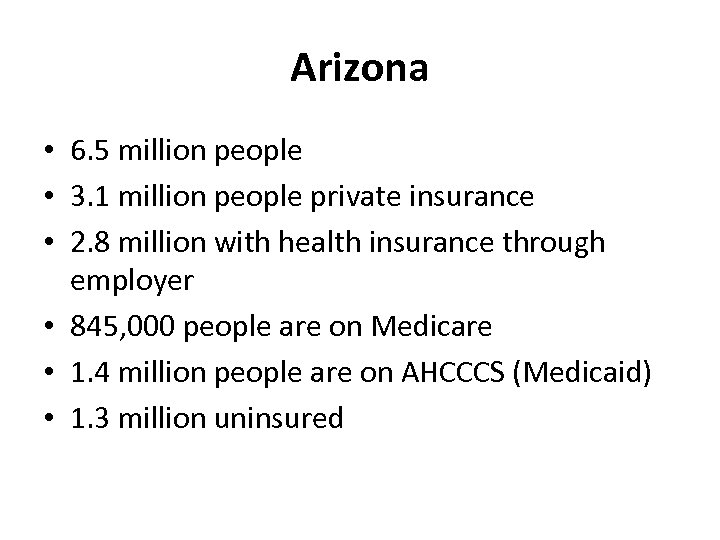 Arizona • 6. 5 million people • 3. 1 million people private insurance • 2. 8 million with health insurance through employer • 845, 000 people are on Medicare • 1. 4 million people are on AHCCCS (Medicaid) • 1. 3 million uninsured
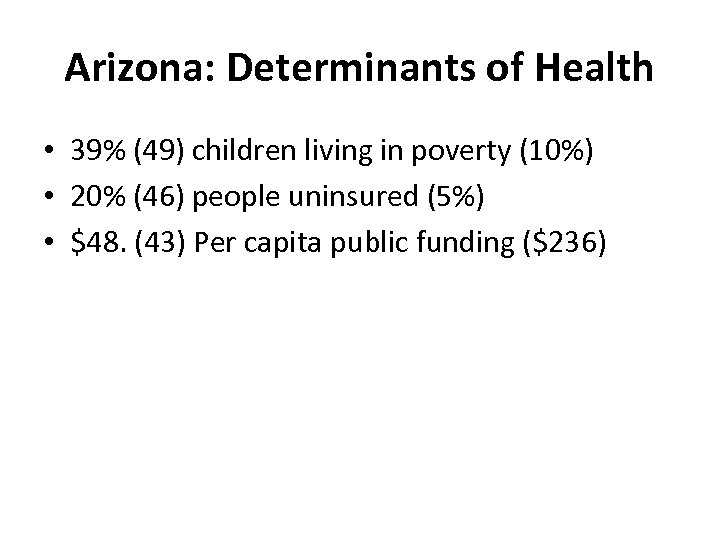 Arizona: Determinants of Health • 39% (49) children living in poverty (10%) • 20% (46) people uninsured (5%) • $48. (43) Per capita public funding ($236)
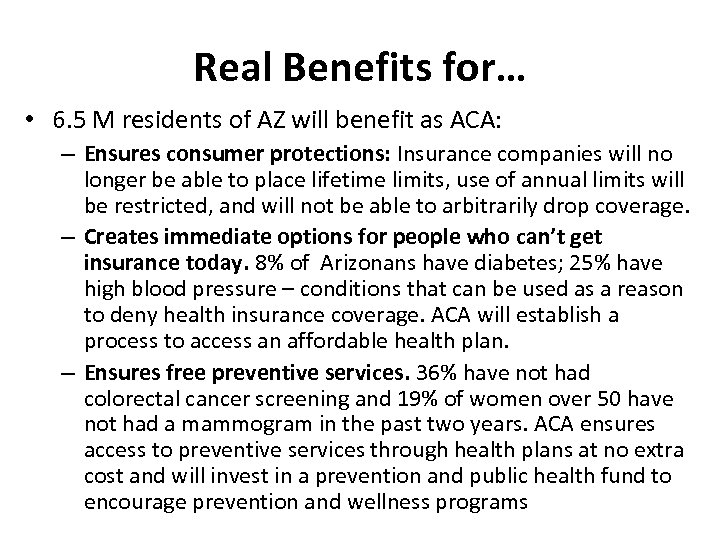 Real Benefits for… • 6. 5 M residents of AZ will benefit as ACA: – Ensures consumer protections: Insurance companies will no longer be able to place lifetime limits, use of annual limits will be restricted, and will not be able to arbitrarily drop coverage. – Creates immediate options for people who can’t get insurance today. 8% of Arizonans have diabetes; 25% have high blood pressure – conditions that can be used as a reason to deny health insurance coverage. ACA will establish a process to access an affordable health plan. – Ensures free preventive services. 36% have not had colorectal cancer screening and 19% of women over 50 have not had a mammogram in the past two years. ACA ensures access to preventive services through health plans at no extra cost and will invest in a prevention and public health fund to encourage prevention and wellness programs
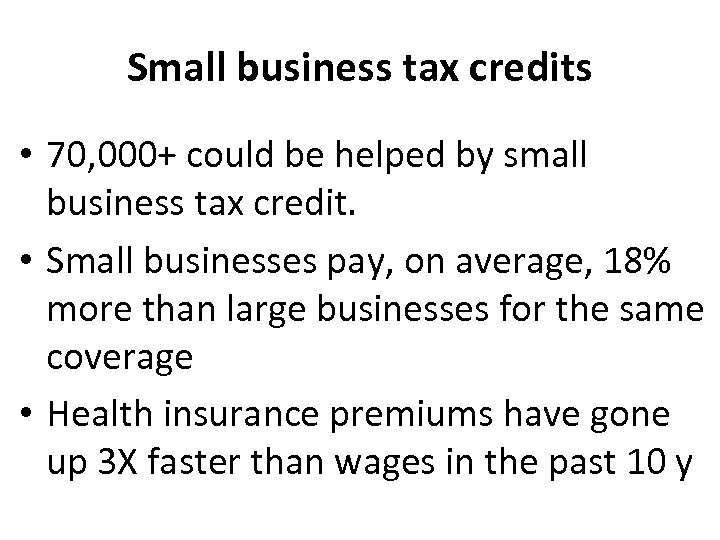 Small business tax credits • 70, 000+ could be helped by small business tax credit. • Small businesses pay, on average, 18% more than large businesses for the same coverage • Health insurance premiums have gone up 3 X faster than wages in the past 10 y
 Closing the Medicare Part D donut hole • 2009: ~72, 800 Medicare beneficiaries hit the donut hole, or gap in Medicare Part D drug coverage, and received no extra help pay for their prescription drugs. • Medicare beneficiaries in Arizona who hit the gap in 2010 were mailed a one-time $250 rebate check. • The new law completely closes the donut hole by 2020.
 Health coverage for early retirees • ~103, 000 people from Arizona retired before they were eligible for Medicare – have health coverage through their former employers. • number of firms that provide health coverage to their retirees has decreased. • June 1, 2010: a $5 billion temporary early retiree reinsurance program – help stabilize early retiree coverage – help ensure that firms continue to provide health coverage to their early retirees – companies, unions, and state and local governments are eligible for these benefits
 New Consumer Protections - Insurance Market September 23, 2010 – Insurance companies will not be able to exclude children from coverage because of a pre-existing condition – Health insurers offering new plans will have to develop an appeals process to make it easy for enrollees to dispute the denial of a medical claim. – Patients’ choice of doctors will be protected by allowing plan members in new plans to pick any participating primary care provider, prohibiting insurers from requiring prior authorization before a woman sees an ob-gyn, and ensuring access to emergency care.
 ACA: Benefit for Arizona • Affordable insurance for uninsured with pre-existing conditions. • $129 million federal dollars are available to AZ starting July 1 to provide coverage for uninsured residents with preexisting medical conditions through a new transitional highrisk pool program, funded entirely by the Federal govt. • The program is a bridge to 2014 when Americans will have access to affordable coverage options in the new health insurance exchanges and insurance companies will be prohibited from denying coverage to Americans with preexisting conditions. • If states choose not to run the program, the Federal government will administer the program for those residents.
 ACA: Benefit for Arizona • Strengthening community health centers. – Beginning October 1, 2010, increased funding for Community Health Centers – will help nearly double the number of patients seen by the centers over the next five years. – funding could not only help the 129 Community Health Centers in Arizona but also support the construction of new centers.
 ACA: Benefit for Arizona • More doctors where people need them. – Beginning October 1, 2010, the Act will provide funding for the National Health Service Corps ($1. 5 billion over five years) for scholarships and loan repayments for doctors, nurses and other health care providers who work in areas with a shortage of health professionals. – This will help the 16% of Arizona’s population who live in an underserved area. • New Medicaid options for states. For the first time, Arizona has the option of Federal Medicaid funding for coverage for all low-income populations, irrespective of age, disability, or family status.
 Coverage Options • Children’s Health Insurance Program and Medicaid A family of four in Arizona earning up to $44, 700 a year may be eligible for health coverage through Kids. Care or Arizona Medicaid. • Pre-Existing Condition Insurance Plan Have you been denied coverage because of a pre-existing condition? You may qualify for a Pre-Existing Condition Insurance Plan. • Private Insurance Compare and buy private insurance plans in your state. • Medicare People under age 65 with certain disabilities and those 65 or older. • Medicaid If you have a limited income, including individuals without children earning up to $11, 979 a year may be eligible
 What if AZ repeals ACA? • 30, 900 young adults would lose their insurance coverage through their parents’ health plans • 3 million+ with private insurance coverage would – be vulnerable to lifetime limits – not benefit from insurer requirement to spend at least 80 -85% of premium dollars on health care rather than CEO salaries, bonuses, and corporate profits • 281, 000 Arizonans would be at risk for health insurance loss when they need it most -- if they are in an accident or become sick • New insurance plans would not be required – to cover recommended preventive services, like mammograms and flu shots, without cost sharing – to guarantee enrollees the right to choose an available primary care provider in the network or see an OB-GYN without a referral. • 853, 000 seniors on Medicare – would be forced to pay a co-pay to receive preventive services, like mammograms and colonoscopies. – would have to pay extra for annual health check-ups
 What if AZ repeals ACA? • 51, 988 on Medicare Would See Significantly Higher Prescription Drug Costs: In Arizona, 51, 988 Medicare beneficiaries received a one-time, taxfree $250 rebate to help pay for prescription drugs when in the “donut hole” in 2010 and are eligible for 50% discounts on covered brand name prescription drugs. • Arizona Would Not Receive – Resources to review proposed health insurance premium increases and hold insurance companies accountable for unjustified premiums increases. – Funds to Plan for a Health Insurance Exchange: a new, competitive private health insurance marketplace that provides lower costs, one-stop insurance shopping, and greater benefits and protections. – Funds to Support a Consumer Assistance Program to help protect you from negative insurance industry practices. – Funds from the Early Retiree Reinsurance Program: Businesses, schools and other educational institutions, unions, State and local governments, and nonprofits would not be receiving much-needed financial relief to help early retirees and their families continue to have quality, affordable health coverage.

 More Information about the new health care law: • http: //www. irs. gov/pub/newsroom/count_per_state_for_special_post _card_notice. pdf • Office of the Actuary. Centers for Medicare and Medicaid Services. Number represents only non-LIS seniors. • Kaiser Family Foundation. 2009 Employer Health Benefits Survey. • U. S. Census Bureau, Current Population Survey. Annual Social and Economic Supplements, March 2009; and 45 CFR Parts 144, 146, and 147. • www. acponline. org/aboutyourcoverage • www. aarp. org/getthefacts • www. healthcare. gov • http: //www. healthcareandyou. org/ • http: //www. hhs. gov/ociio/regulations/pra_omnibus_final. pdf • http: //www. healthreform. gov/reports/statehealthreform/arizona. html • http: //tucsoncitizen. com/medicare/2010/05/22/health-care-reformwho-will-benefit-in-arizona/
 Questions