


 Скачать презентацию What do YOU want to do Negotiating for
25e343c3952e29b98c5796142303a7d2.ppt
- Количество слайдов: 46
 What do YOU want to do: Negotiating for the ideal job Stacy Rudnicki, MD University of Arkansas for Medical Sciences Little Rock, Arkansas
 Negotiating Tips • Plan ahead, knowledge is power – Group, HMO, Department • Know your worth – Salary information • Professional organizations – How long has the position been offered – Do you have a skill in demand – Interview for several positions
 Negotiating Tips, cont. • Set priorities – What do you need – What do you want – What can you get • Is the item worth the fight – Choose your battles wisely
 Negotiating Tips, cont. • Is your demand legitimate – Be realistic • Define your limits, but keep them private • Don’t be afraid to ask – But remember some things may not be negotiable
 It’s Not Easy to Talk About Money • In a salaried position, the salary you accept now will play a role in your future salary • Promote yourself so that your employer sees your worth – Easier to do this when you are well qualified for the position you’re seeking – Elaborate on your strengths • Money won’t make you happy. . . But it sure makes life easier
 It’s Not Easy to Talk About Money • Early on, talk about salary ranges – Don’t lowball – An absolute amount may be seen as confrontational • Try to keep the salary specifics for the end of the interview • If the salary is under what you want but the job is perfect focus negotiations on – Future salary / Bonuses – Other forms of compensation
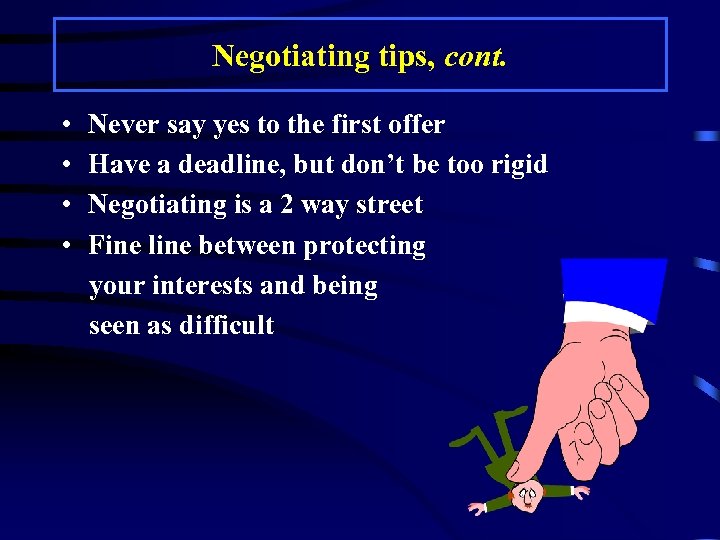 Negotiating tips, cont. • • Never say yes to the first offer Have a deadline, but don’t be too rigid Negotiating is a 2 way street Fine line between protecting your interests and being seen as difficult
 And Don’t Forget. . . • Your first negotiations with this future partner/group/chairman/university won’t be your last – Was it fair? – Was it more of a struggle than it needed to be? It’s unlikely to change the next time around!
 Gone are the days of a handshake to settle the deal!
 Contract: an agreement between parties, especially one enforceable by law
 Employment Contract • Details of the contract will differ depending upon the employer • Start negotiating before you have a contract in writing • “Standard” contracts can be changed
 Contract Terminology Preamble Recitals Definitions Obligations Termination Signatures Exhibits
 The Physician Contract • Compensation and benefits • Partnership provisions • Professional obligations • Termination • Restrictive covenant
 Compensation and Benefits
 Salary • Fixed – “Safe” – Usually for a year • Base salary with an incentive based on productivity – Is the bonus based on billings or collections • Solely productivity based – Lag between time billed and time collected • Academics – Typically base with incentive
 Factors That Influence Salary Offer • Location • Fellowship training • Type of fellowship training • Board certification • Reputation of the group/department
 Productivity • Billings • Overhead – Ranges from 35 - 65% – Will vary in the same group over time – If you have to share overhead, contract should state what your share is • Collections – Payer mix / population you serve – Negotiated contracts – Efficiency of billing service
 Adjusted vs. Unadjusted Collection Rates • Patient visit: You charge $100, have a contract with that insurance company that you will receive $65 for the visit and it is paid • Unadjusted collection is 65% • Adjusted collection is 100%
 Example of a Salary Offer • Your base salary is $100, 000 – After you have billed $300, 000, you will receive 25 % of what is billed – After $300, 000 is collected, you will receive 25% of what is collected
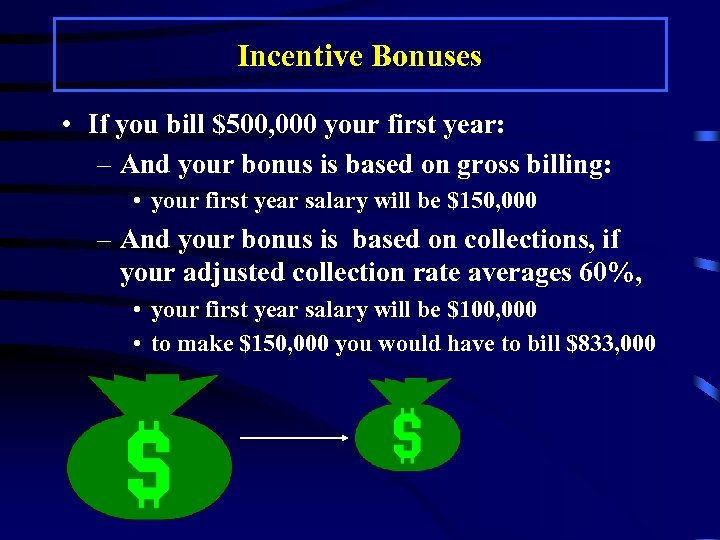 Incentive Bonuses • If you bill $500, 000 your first year: – And your bonus is based on gross billing: • your first year salary will be $150, 000 – And your bonus is based on collections, if your adjusted collection rate averages 60%, • your first year salary will be $100, 000 • to make $150, 000 you would have to bill $833, 000
 Other Ways Bonuses May Be Determined • • Number of patients seen Patient satisfaction New referrals Academics – Publications/ Presentations – Grants – Teaching awards – Productivity
 More on Bonuses • A productivity based bonus is most fair to both you and your employer
 Other Income • Fees for reviewing medical records for a lawyer • Fees for being an expert witness • Honorarium for speaking engagements • Pharmaceutical sponsored investigational drug studies
 More on Academic Salaries • Differences with private practice typically less when first starting, then increase dramatically in the next few years, then at the middle/end of one’s career, approach each other • Academic salaries are in part tied into how the institution is doing – Keep this in mind when interviewing • Ask about recent pay raises for faculty • COLA • Merit • Range (%)
 Insurance • Malpractice insurance • Do you need tail coverage? – claims made – occurrence - University insurance • Health insurance • Disability insurance • Life insurance
 Retirement Plans • Plans differ substantially, and include profit sharing plans – How much does your employee contribute? – Do they have a matching program? – How long does it take to be 100% vested? – How much control do you have over the plan? • Most academic institutions use TIAA/CREF
 Other Benefits • • Signing bonus Moving allowance Vacation time Days off Sick leave Personal leave CME time Cafeteria plan
 Other Benefits, cont. • “The group/department will pay X amount for …” – Academy dues – State license fees – DEA fees – Journal • Board fees Pre-tax dollars
 Promotion and Tenure
 P&T • Instructor or assistant professor? • What track will you be appointed to? – Nontenure – Tenure • Make sure it’s right for you • Changing your track • Tenure clock
 Partnership Requirements
 The Cost of a Partnership • In general, managed care has decreased the value of a medical group • The worth of a practice is hard to pin down, and is always changing • Your buy in amount should be less than what it would cost you to start a practice on your own
 Specifications on Partnership • Minimum length of time and effort • Amount of the buy in – How is it determined? • Valuation of group’s assets • Real estate – How do they want it? • Sweat equity • Set sum – Lump sum or installments
 Restrictive Covenant
 Restrictive Covenant • If you leave the group, it forbids you to practice – within a certain geographic area – for a certain length of time • Are they legal? – States vary – Legality may depend upon • How reasonable they are • What the need is for health care in the area • Academic centers are starting to have them
 Restrictive Covenant • Buy out clause • Clause that admits it is illegal, but that you will abide buy it • To fight it if you should leave will take time and money • Nonsolicitation clause
 Professional Obligations
 Your Will Need to be Able to Obtain: • • • Unrestricted state medical license DEA number Privileges at hospitals Malpractice insurance Right to participate in health care plans
 Your Responsibilities • Clinical responsibilities – Clinic – Hospital – Call coverage • Attend staff meetings • Obtain board certification in a set number of years
 Academic Responsibilities • Protected time – Is it commensurate with your track? – Is it similar to your peers? • Teaching responsibilities - residents and medical students • Other responsibilities – Residency director – Student clerkship director – Resident clinic – Ward/consult attending
 Obligations of the Practice or Department • Office space • Equipment • Staffing – Receptionist, transcriptionist, medical assistant, nurse • Billing services
 Other Areas to Negotiate • • • Promotion and advertising when you join Beeper, paging service Mobile phone and service Personal office furniture Computer, printer, internet service, access to Medline
 Termination • Termination without cause – Time limit - 90 days – Give notice - 60 -120 days – Ramifications • Termination with cause – Should be specific • Failure to cure – May include a time to correct problem • What happens if the group is bought • What happens if you don’t get tenure?
 • Watch out for a practice that: – Drags its feet providing items in writing – Has a spouse involved in the management • Think twice about the department that: – Has an acting chairman – Has a poor promotion rate • Reconsider a job that: – Won’t provide an incentive bonus – Has a revolving door
 Now that you’ve been there a while. . . • Do have enough support staff? – Nurse • Have you landed a grant or pharmaceutical study? – If it offers salary support, then your obligations to the department should change accordingly • Meet with your chairman yearly to discuss your academic progress • Working hard is important, but it isn’t enough - make sure you’re noticed!
 Final Comments • • The contract should be as specific as possible Don’t be afraid to walk away from a bad deal Start early You can negotiate with 2 (or more) groups/departments at the same time • Use a lawyer who specializes in contract law and or health care law in the state you’ll practice in