 Скачать презентацию What do we know about the identity of
79359dd5258ada489384dbafcc824081.ppt
- Количество слайдов: 28




What do we know about the identity of CR sources ? Boaz Katz, Kfir Blum Eli Waxman Weizmann Institute, ISRAEL
![The cosmic-ray spectrum & Composition log [d. J/d. E] E-2. 7 Galactic Protons E-3](https://present5.com/presentation/79359dd5258ada489384dbafcc824081/image-2.jpg "The cosmic-ray spectrum & Composition log [d. J/d. E] E-2. 7 Galactic Protons E-3")
The cosmic-ray spectrum & Composition log [d. J/d. E] E-2. 7 Galactic Protons E-3 Source: Supernovae(? ) X-Galactic (? ) Heavy Nuclei Source? Light Nuclei? Lighter Source? 1 106 1010 Cosmic-ray E [Ge. V] [Blandford & Eichler, Phys. Rep. 87; Axford, Ap. JS 94; Nagano & Watson, Rev. Mod. Phys. 00]
Intra-cluster CRs • Observed in radio, HXR • Will not be discussed here • See D. Kushnir’s talk: [ar. Xiv: 0903. 2271, 0903. 2275, 0905. 1950] * Likely origin- Accretion shocks * Predictions for Fermi, Te. V (HESS, MAGIC)
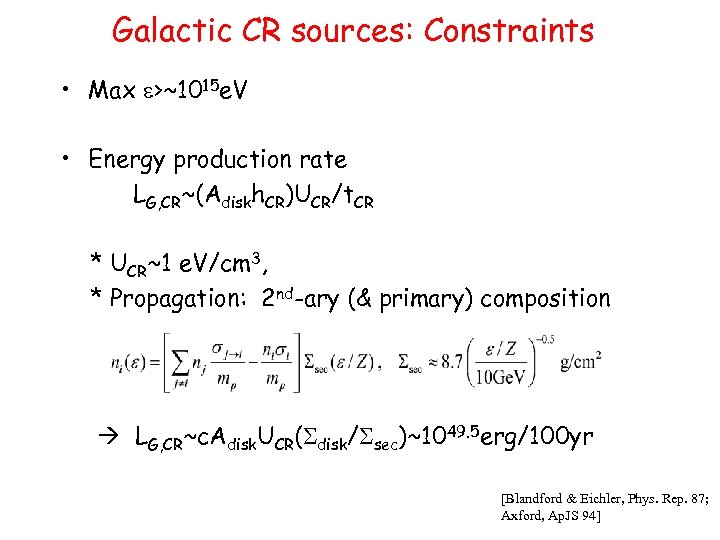
Galactic CR sources: Constraints • Max e>~1015 e. V • Energy production rate LG, CR~(Adiskh. CR)UCR/t. CR * UCR~1 e. V/cm 3, * Propagation: 2 nd-ary (& primary) composition LG, CR~c. Adisk. UCR(Sdisk/Ssec)~1049. 5 erg/100 yr [Blandford & Eichler, Phys. Rep. 87; Axford, Ap. JS 94]
Galactic CR sources: SNe? • Motivation for SNe as sources: * LG, CR~10 -1. 5 LG, SN * Max e~1015 e. V * e- acceleration to 1015 e. V from X emission [e. g. Koyama et al. 95] • Te. V photons from SNRs (RXJ 1713. 7 -3946, RXJ 0852. 0 -4622) [e. g. Aharonian et al. 04 --07] * Claim: must be due to pp pion production Confirms CR ion production
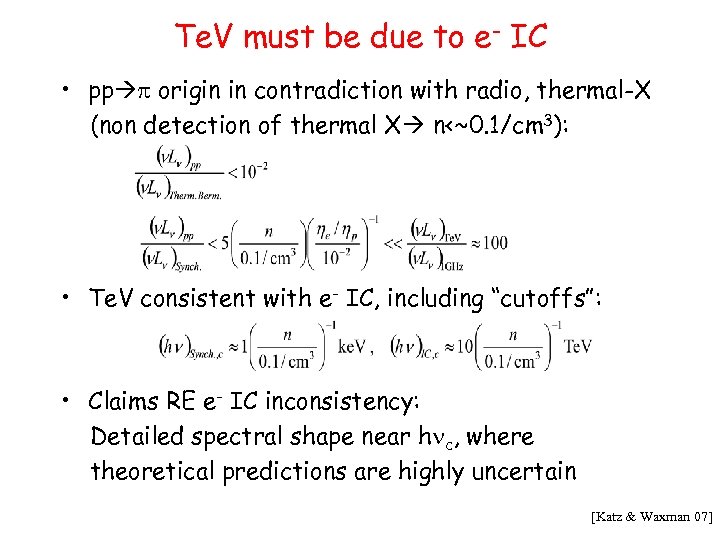
Te. V must be due to e- IC • pp p origin in contradiction with radio, thermal-X (non detection of thermal X n<~0. 1/cm 3): • Te. V consistent with e- IC, including “cutoffs”: • Claims RE e- IC inconsistency: Detailed spectral shape near hnc, where theoretical predictions are highly uncertain [Katz & Waxman 07]
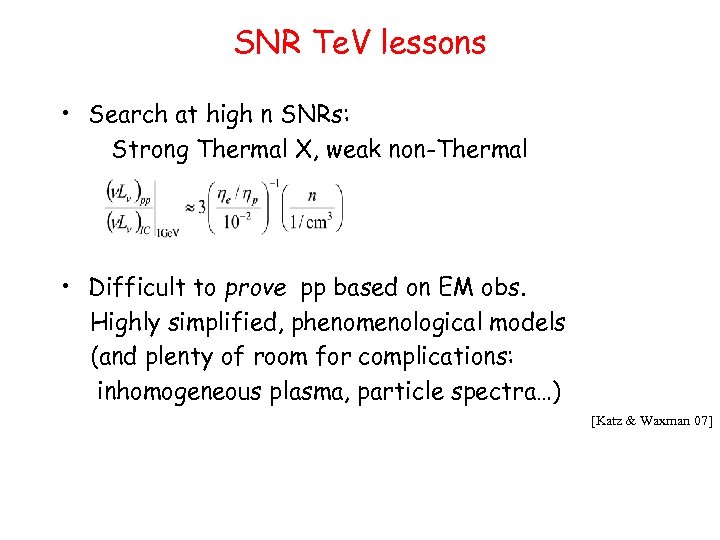
SNR Te. V lessons • Search at high n SNRs: Strong Thermal X, weak non-Thermal • Difficult to prove pp based on EM obs. Highly simplified, phenomenological models (and plenty of room for complications: inhomogeneous plasma, particle spectra…) [Katz & Waxman 07]
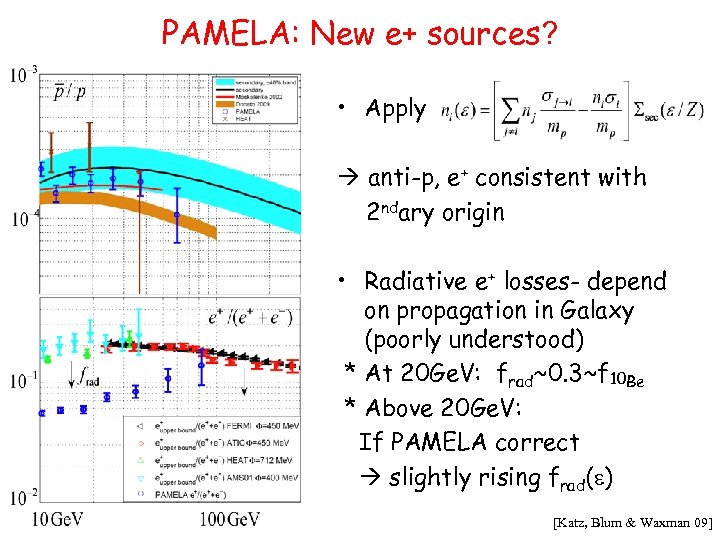
PAMELA: New e+ sources? • Apply anti-p, e+ consistent with 2 ndary origin • Radiative e+ losses- depend on propagation in Galaxy (poorly understood) * At 20 Ge. V: frad~0. 3~f 10 Be * Above 20 Ge. V: If PAMELA correct slightly rising frad(e) [Katz, Blum & Waxman 09]
What do we know about >1019 e. V CRs? • • Max e: LB>1012 (G 2/b) (e/Z 1020 e. V)2 Lsun (see Dermer’s talk) Composition [Waxman 95, 04]
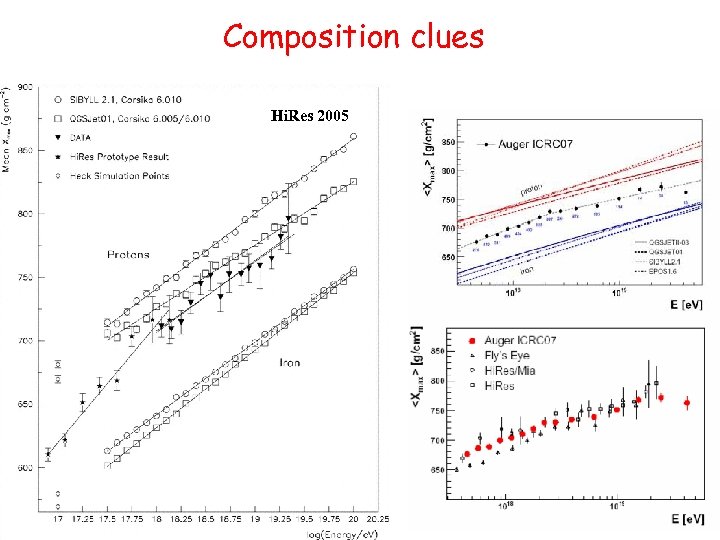
Composition clues Hi. Res 2005
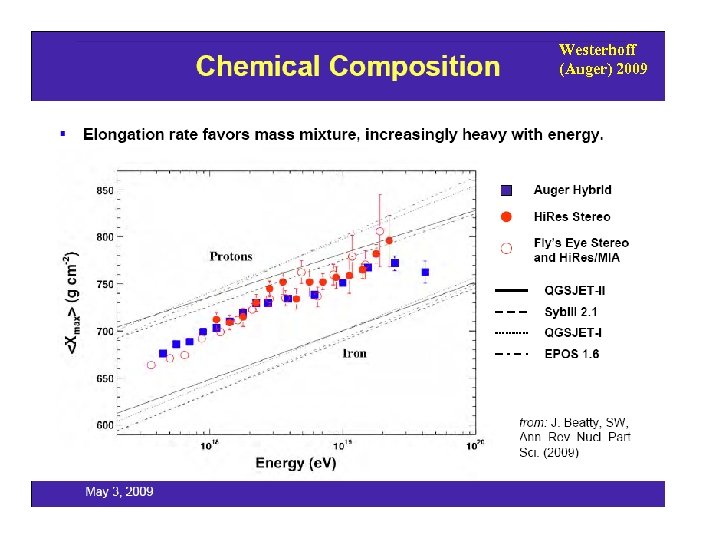
Westerhoff (Auger) 2009
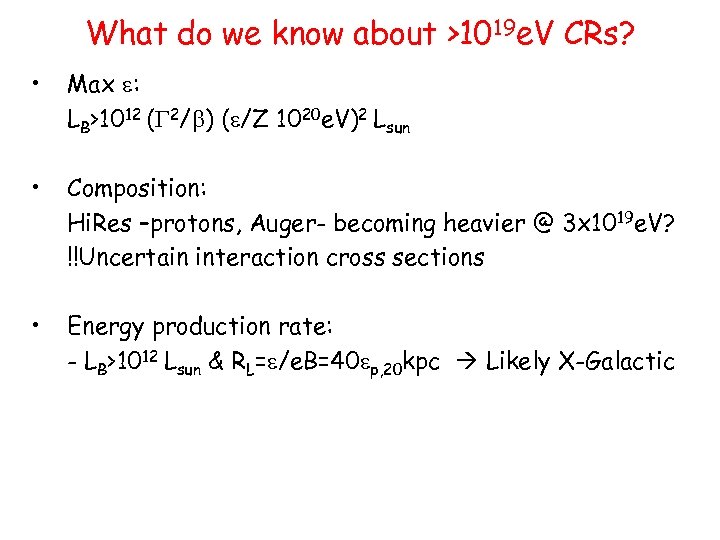
What do we know about >1019 e. V CRs? • Max e: LB>1012 (G 2/b) (e/Z 1020 e. V)2 Lsun • Composition: Hi. Res –protons, Auger- becoming heavier @ 3 x 10¹⁹ e. V? !!Uncertain interaction cross sections • Energy production rate: - LB>1012 Lsun & RL=e/e. B=40 ep, 20 kpc Likely X-Galactic
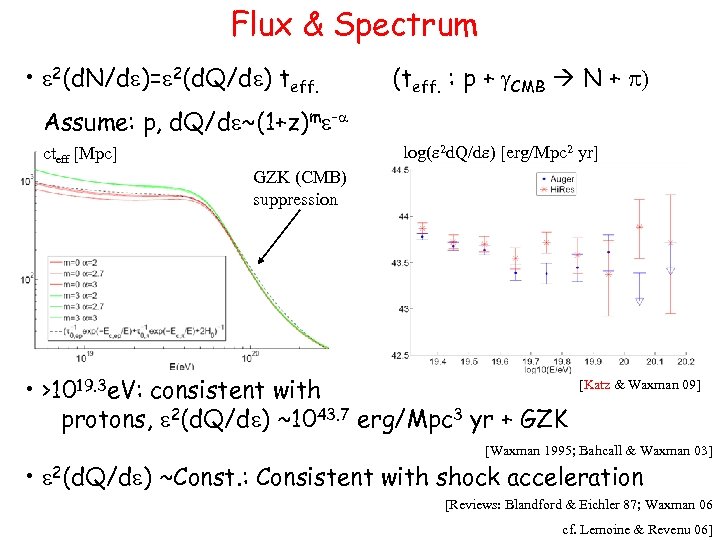
Flux & Spectrum • e 2(d. N/de)=e 2(d. Q/de) teff. (teff. : p + g. CMB N + p) Assume: p, d. Q/de~(1+z)me-a log(e 2 d. Q/de) [erg/Mpc 2 yr] cteff [Mpc] GZK (CMB) suppression • >1019. 3 e. V: consistent with protons, e 2(d. Q/de) ~1043. 7 erg/Mpc 3 yr + GZK [Katz & Waxman 09] [Waxman 1995; Bahcall & Waxman 03] • e 2(d. Q/de) ~Const. : Consistent with shock acceleration [Reviews: Blandford & Eichler 87; Waxman 06 cf. Lemoine & Revenu 06]
![G-XG Transition at 1018 e. V? Fine tuning Inconsistent spectrum [Katz & Waxman 09]](https://present5.com/presentation/79359dd5258ada489384dbafcc824081/image-14.jpg "G-XG Transition at 1018 e. V? Fine tuning Inconsistent spectrum [Katz & Waxman 09]")
G-XG Transition at 1018 e. V? Fine tuning Inconsistent spectrum [Katz & Waxman 09]
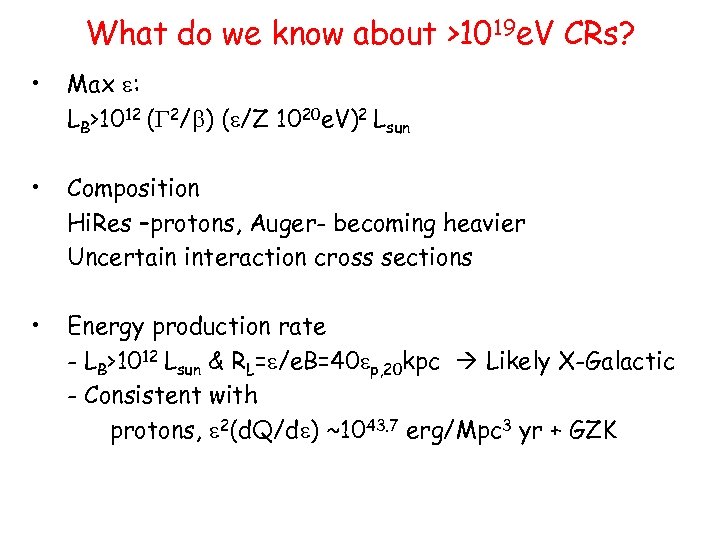
What do we know about >1019 e. V CRs? • Max e: LB>1012 (G 2/b) (e/Z 1020 e. V)2 Lsun • Composition Hi. Res –protons, Auger- becoming heavier Uncertain interaction cross sections • Energy production rate - LB>1012 Lsun & RL=e/e. B=40 ep, 20 kpc Likely X-Galactic - Consistent with protons, e 2(d. Q/de) ~1043. 7 erg/Mpc 3 yr + GZK
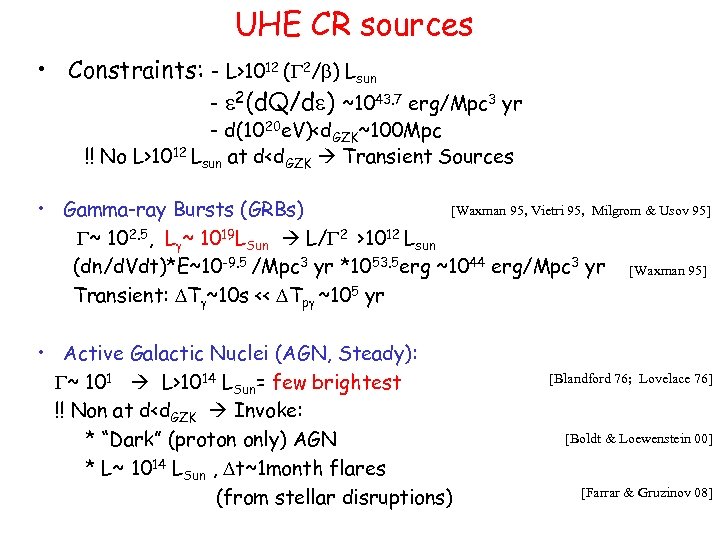
UHE CR sources • Constraints: - L>1012 (G 2/b) Lsun - e 2(d. Q/de) ~1043. 7 erg/Mpc 3 yr - d(1020 e. V)<d. GZK~100 Mpc !! No L>1012 Lsun at d<d. GZK Transient Sources [Waxman 95, Vietri 95, Milgrom & Usov 95] • Gamma-ray Bursts (GRBs) G~ 102. 5, Lg~ 1019 LSun L/G 2 >1012 Lsun (dn/d. Vdt)*E~10 -9. 5 /Mpc 3 yr *1053. 5 erg ~1044 erg/Mpc 3 yr [Waxman 95] Transient: DTg~10 s << DTpg ~105 yr • Active Galactic Nuclei (AGN, Steady): G~ 101 L>1014 LSun= few brightest !! Non at d<d. GZK Invoke: * “Dark” (proton only) AGN * L~ 1014 LSun , Dt~1 month flares (from stellar disruptions) [Blandford 76; Lovelace 76] [Boldt & Loewenstein 00] [Farrar & Gruzinov 08]
![Anisotropy Biased (rsource~rgal for rgal>rgal ) [Kashti & Waxman 08] • Cross-correlation signal: Inconsistent](https://present5.com/presentation/79359dd5258ada489384dbafcc824081/image-17.jpg "Anisotropy Biased (rsource~rgal for rgal>rgal ) [Kashti & Waxman 08] • Cross-correlation signal: Inconsistent")
Anisotropy Biased (rsource~rgal for rgal>rgal ) [Kashti & Waxman 08] • Cross-correlation signal: Inconsistent with isotropy @ 98% CL (~1. 5 s) Consistent with LSS • If anisotropy signal real & no anisotropy at 60 Ee. V/(Z~10) primaries must be protons See M. Lemoine’s talk [ar. Xiv: 0907. 1354]
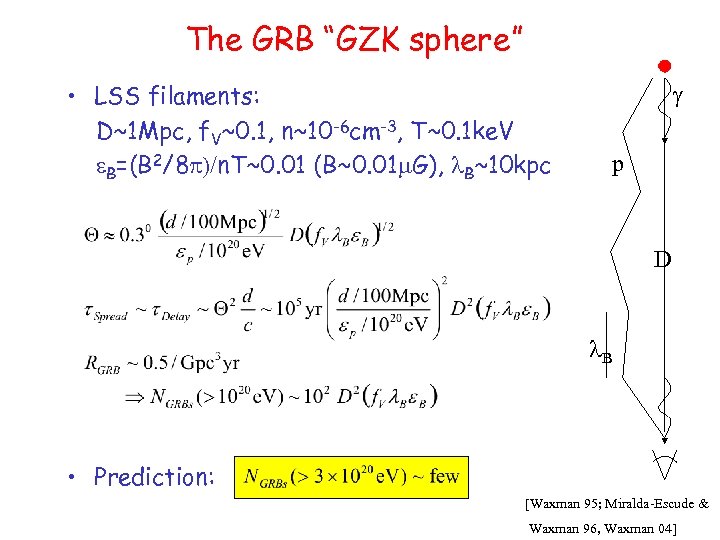
The GRB “GZK sphere” • LSS filaments: D~1 Mpc, f. V~0. 1, n~10 -6 cm-3, T~0. 1 ke. V e. B=(B 2/8 p)/n. T~0. 01 (B~0. 01 m. G), l. B~10 kpc g p D l. B • Prediction: [Waxman 95; Miralda-Escude & Waxman 96, Waxman 04]
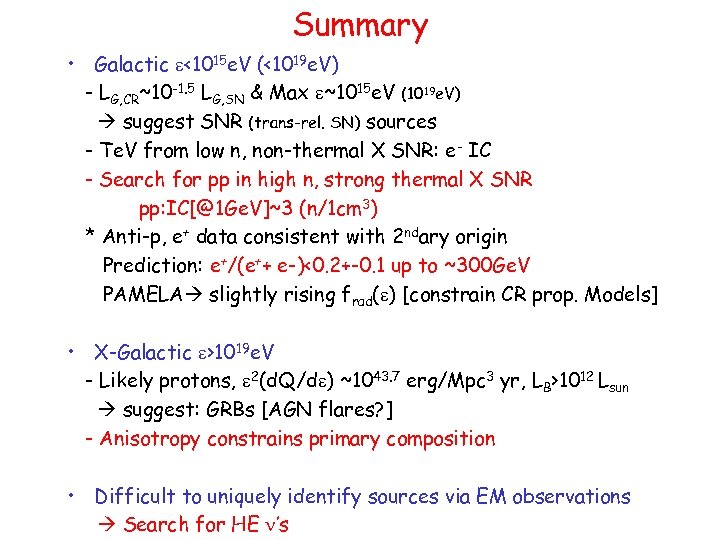
Summary • Galactic e<1015 e. V (<1019 e. V) - LG, CR~10 -1. 5 LG, SN & Max e~1015 e. V (1019 e. V) suggest SNR (trans-rel. SN) sources - Te. V from low n, non-thermal X SNR: e- IC - Search for pp in high n, strong thermal X SNR pp: IC[@1 Ge. V]~3 (n/1 cm 3) * Anti-p, e+ data consistent with 2 ndary origin Prediction: e+/(e++ e-)<0. 2+-0. 1 up to ~300 Ge. V PAMELA slightly rising frad(e) [constrain CR prop. Models] • X-Galactic e>1019 e. V - Likely protons, e 2(d. Q/de) ~1043. 7 erg/Mpc 3 yr, LB>1012 Lsun suggest: GRBs [AGN flares? ] - Anisotropy constrains primary composition • Difficult to uniquely identify sources via EM observations Search for HE n’s

Back up slides
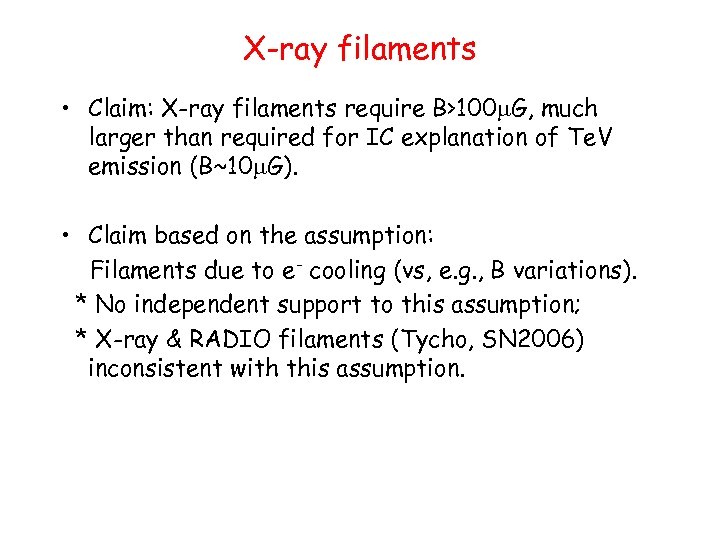
X-ray filaments • Claim: X-ray filaments require B>100 m. G, much larger than required for IC explanation of Te. V emission (B~10 m. G). • Claim based on the assumption: Filaments due to e- cooling (vs, e. g. , B variations). * No independent support to this assumption; * X-ray & RADIO filaments (Tycho, SN 2006) inconsistent with this assumption.
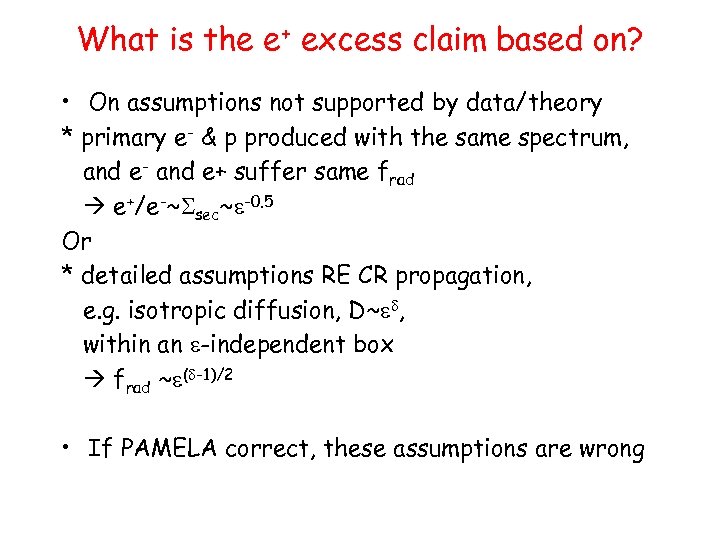
What is the e+ excess claim based on? • On assumptions not supported by data/theory * primary e- & p produced with the same spectrum, and e- and e+ suffer same frad e+/e-~Ssec~e-0. 5 Or * detailed assumptions RE CR propagation, e. g. isotropic diffusion, D~ed, within an e-independent box frad ~e(d-1)/2 • If PAMELA correct, these assumptions are wrong
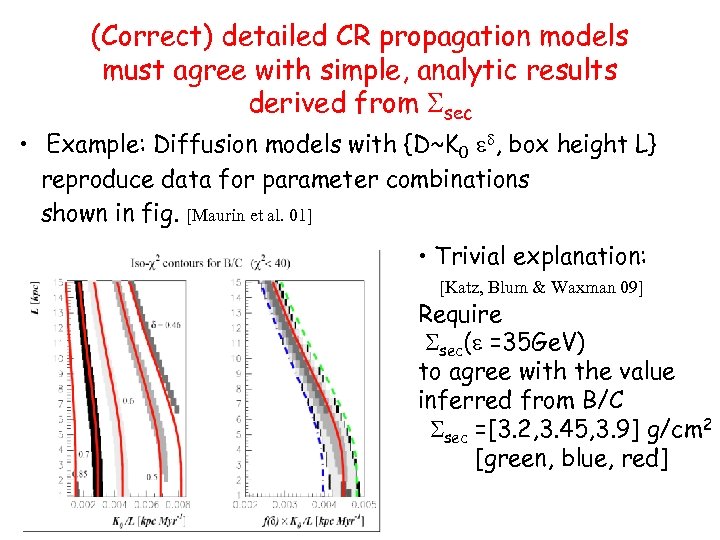
(Correct) detailed CR propagation models must agree with simple, analytic results derived from Ssec • Example: Diffusion models with {D~K 0 ed, box height L} reproduce data for parameter combinations shown in fig. [Maurin et al. 01] • Trivial explanation: [Katz, Blum & Waxman 09] Require Ssec(e =35 Ge. V) to agree with the value inferred from B/C Ssec =[3. 2, 3. 45, 3. 9] g/cm 2 [green, blue, red]
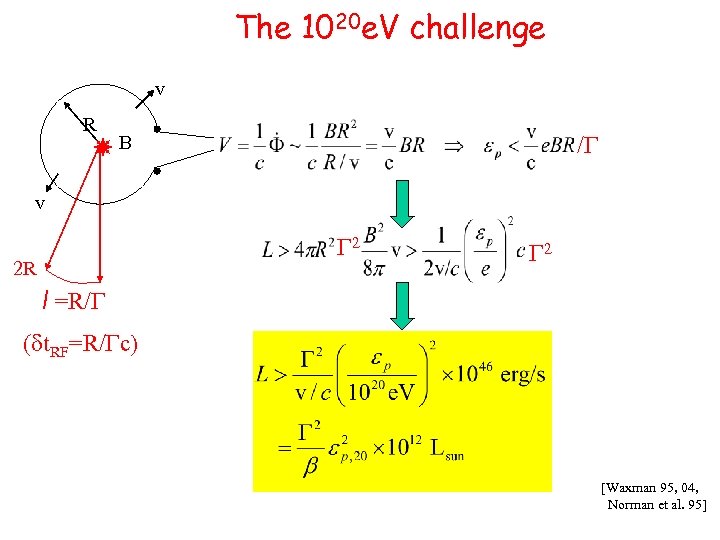
The 1020 e. V challenge v R /G B v G 2 2 R G 2 l =R/G (dt. RF=R/Gc) [Waxman 95, 04, Norman et al. 95]
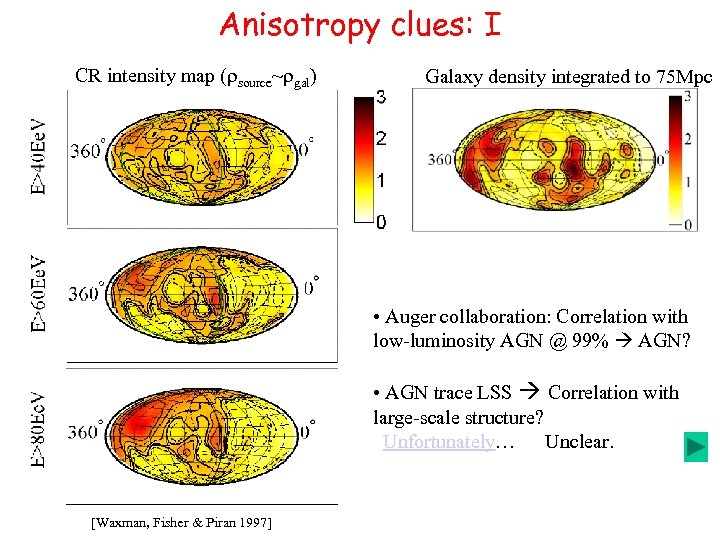
Anisotropy clues: I CR intensity map (rsource~rgal) Galaxy density integrated to 75 Mpc • Auger collaboration: Correlation with low-luminosity AGN @ 99% AGN? • AGN trace LSS Correlation with large-scale structure? Unfortunately… Unclear. [Waxman, Fisher & Piran 1997]
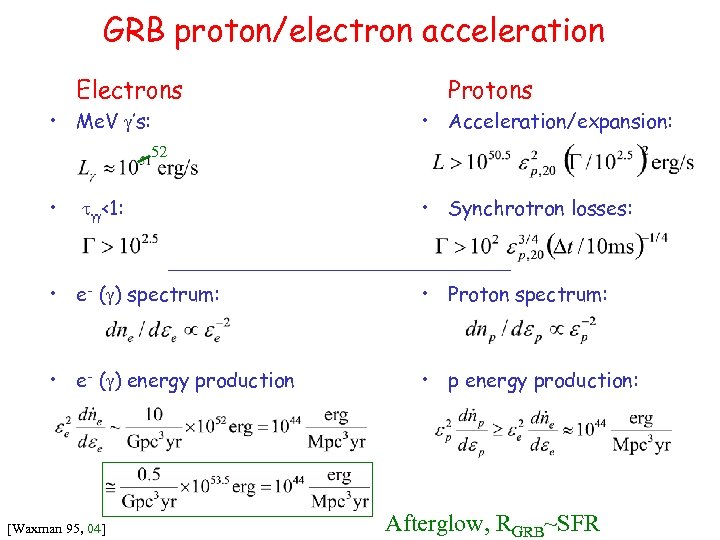
GRB proton/electron acceleration Electrons • Me. V g’s: Protons • Acceleration/expansion: 52 • tgg<1: • Synchrotron losses: • e- (g) spectrum: • Proton spectrum: • e- (g) energy production • p energy production: [Waxman 95, 04] Afterglow, RGRB~SFR
![GRB Model Predictions [Miralda-Escude & Waxman 96]](https://present5.com/presentation/79359dd5258ada489384dbafcc824081/image-28.jpg "GRB Model Predictions [Miralda-Escude & Waxman 96]")
GRB Model Predictions [Miralda-Escude & Waxman 96]
Скачать презентацию What do we know about the identity of
79359dd5258ada489384dbafcc824081.ppt