


 Скачать презентацию What do Injured Workers Think of Their Medical
5481ad72c84c058198190c2116dc5ab0.ppt
- Количество слайдов: 19
 What do Injured Workers Think of Their Medical Care? Kathy Dervin, M. P. H. DWC Managed Care Program May 1, 2003
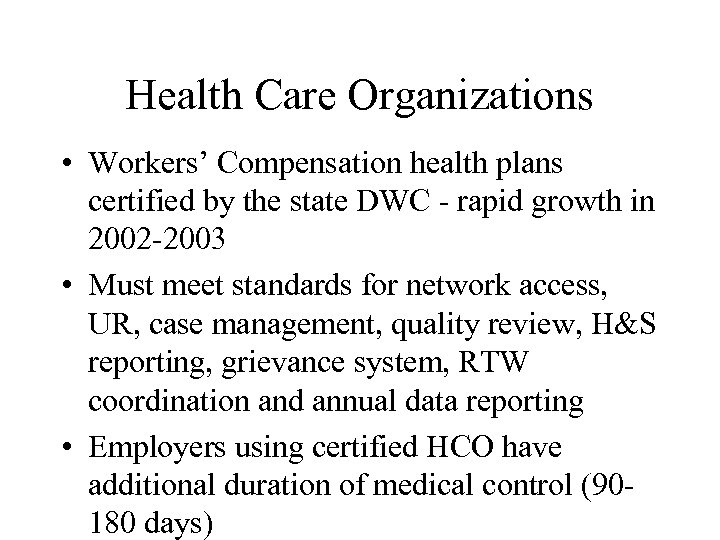 Health Care Organizations • Workers’ Compensation health plans certified by the state DWC - rapid growth in 2002 -2003 • Must meet standards for network access, UR, case management, quality review, H&S reporting, grievance system, RTW coordination and annual data reporting • Employers using certified HCO have additional duration of medical control (90180 days)
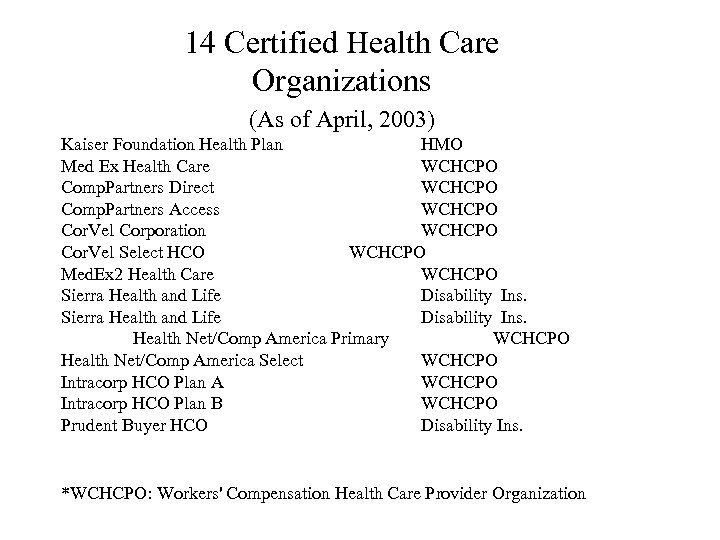 14 Certified Health Care Organizations (As of April, 2003) Kaiser Foundation Health Plan HMO Med Ex Health Care WCHCPO Comp. Partners Direct WCHCPO Comp. Partners Access WCHCPO Cor. Vel Corporation WCHCPO Cor. Vel Select HCO WCHCPO Med. Ex 2 Health Care WCHCPO Sierra Health and Life Disability Ins. Health Net/Comp America Primary WCHCPO Health Net/Comp America Select WCHCPO Intracorp HCO Plan A WCHCPO Intracorp HCO Plan B WCHCPO Prudent Buyer HCO Disability Ins. *WCHCPO: Workers' Compensation Health Care Provider Organization
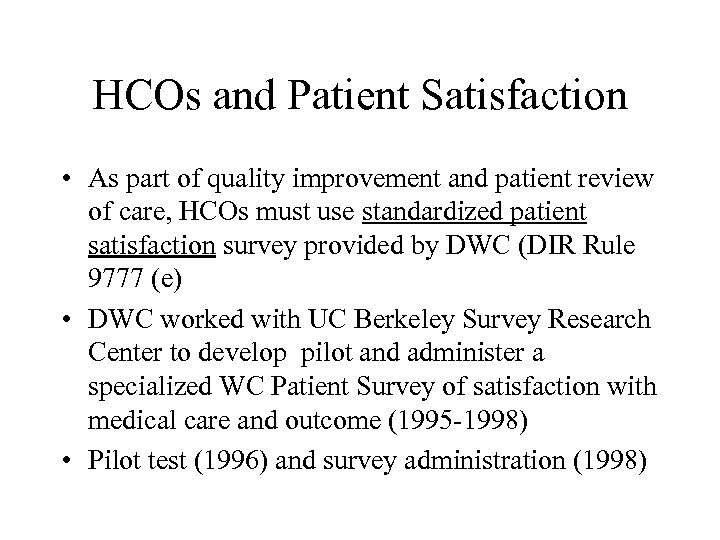 HCOs and Patient Satisfaction • As part of quality improvement and patient review of care, HCOs must use standardized patient satisfaction survey provided by DWC (DIR Rule 9777 (e) • DWC worked with UC Berkeley Survey Research Center to develop pilot and administer a specialized WC Patient Survey of satisfaction with medical care and outcome (1995 -1998) • Pilot test (1996) and survey administration (1998)
 What Do Injured Workers Think of their Medical Care and Outcome Following Work Injury? • Administered both mail survey (96 pilot test) and telephone survey (98) • Telephone survey of 813 injured workers drawn from a sample of : – 24 hour pilot program – Pacific Business Group on Health members – HCOs – Non-HCO managed care plans
 Survey Areas • • • Anchoring in work-injury episode of care Access to care, type of providers seen Satisfaction with doctor-patient interaction Overall satisfaction with care Doctor’s occ medicine orientation Self report of pain and functional outcomes (including satisfaction with RTW process) • Respondent characteristics and open ended question
 Survey Results • Response rate = 61% • Representative of injured worker population • Reported injuries predominantly sprains and strains of back/upper extremities • Overall satisfaction rate – very satisfied/somewhat satisfied = 76. 5% – very dissatisfied/somewhat dissatisfied = 27%
 Survey Results (cont’d) • Key issues by subgroup and process of care – Latino, Spanish speaking workers much less satisfied with communication and doctorpatient interaction – Substantial, ongoing problems with impact of the work injury due to pain, 6 -8 months post injury, reported by large number of respondents – Respondents with upper extremity nerve disorders report poor post-injury function
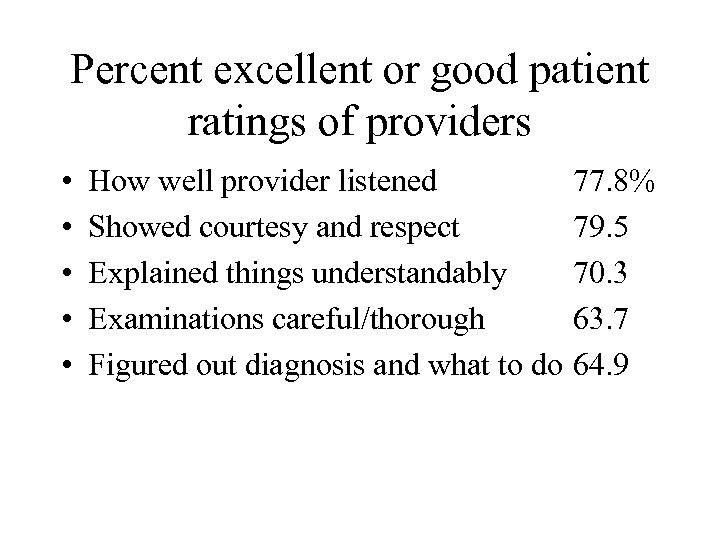 Percent excellent or good patient ratings of providers • • • How well provider listened Showed courtesy and respect Explained things understandably Examinations careful/thorough Figured out diagnosis and what to do 77. 8% 79. 5 70. 3 63. 7 64. 9
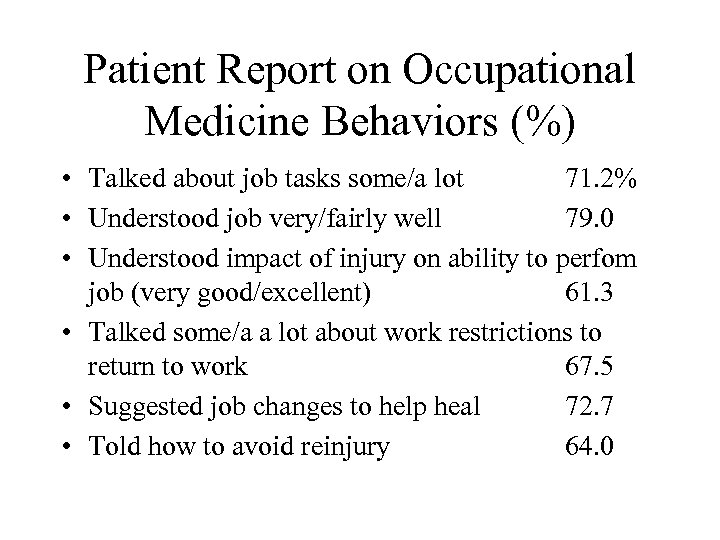 Patient Report on Occupational Medicine Behaviors (%) • Talked about job tasks some/a lot 71. 2% • Understood job very/fairly well 79. 0 • Understood impact of injury on ability to perfom job (very good/excellent) 61. 3 • Talked some/a a lot about work restrictions to return to work 67. 5 • Suggested job changes to help heal 72. 7 • Told how to avoid reinjury 64. 0
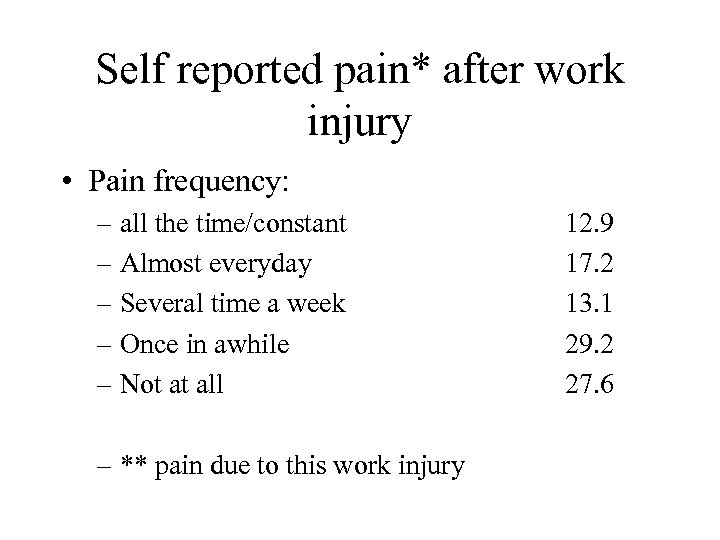 Self reported pain* after work injury • Pain frequency: – all the time/constant – Almost everyday – Several time a week – Once in awhile – Not at all – ** pain due to this work injury 12. 9 17. 2 13. 1 29. 2 27. 6
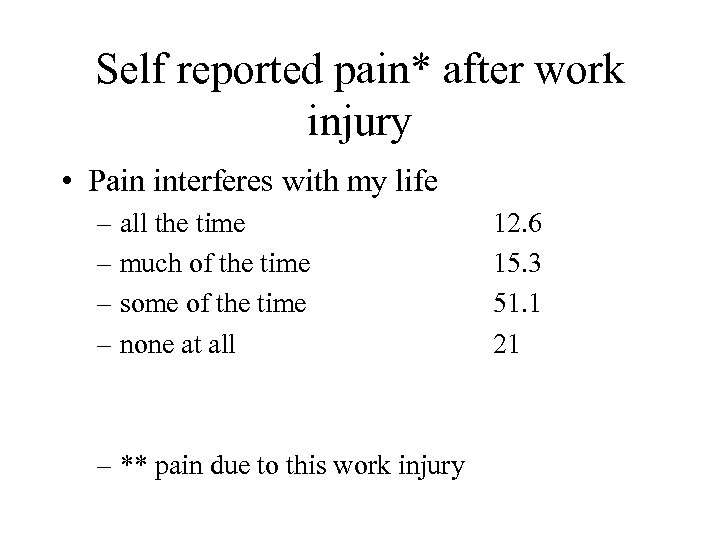 Self reported pain* after work injury • Pain interferes with my life – all the time – much of the time – some of the time – none at all – ** pain due to this work injury 12. 6 15. 3 51. 1 21
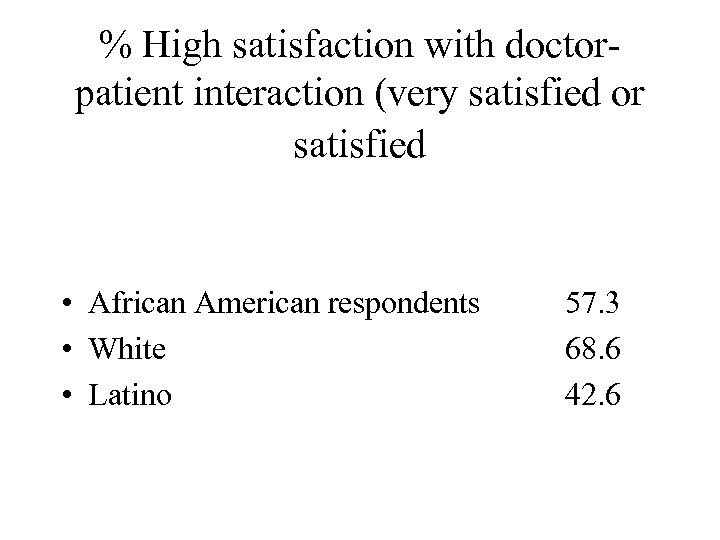 % High satisfaction with doctorpatient interaction (very satisfied or satisfied • African American respondents • White • Latino 57. 3 68. 6 42. 6
 Using Patient Satisfaction Results to Target Quality Improvement • HCOs must meet specific quality of care standards set by DWC • HCOs have stable population of patients for 90180 days of care (compared to 30 days) • HCO care is delivered in-network by providers under contract with HCO • HCOs must have nurses case managers, customer service, 800#s and grievance process which all help to solve problems as they arise
 Using Patient Satisfaction Results • Results provide feedback to organized system of care like an HCO • Identify areas of low satisfaction – provider level (communication, patient understanding, access, knowledge of occ med) – system level (case manager, administration) – outcomes (RTW, pain, daily functions) – employer interaction (esp on RTW process)
 Challenges in Collecting Patient Satisfaction Data • How do we fund ongoing survey administration and analysis ? – Mail survey (lower cost, lower response rate, literacy issues, language issues) – Telephone survey (higher cost, higher response rates) – Who should pay ? state? HCOs? Purchasers? – Get buy-in from purchasers to value and use results
 More Challenges – Methodological issues: sample selection, timing or survey, adjusting for different mix of patients, injuries industry, employer size. – HCO system is one example, but what about outside a stable managed care network where control and care is quite variable? – Reporting results to employees, unions, purchasers in a way they will use.
 AB 749 Provisions on Quality • DWC to look at: – performance measures for workers’ comp medical care – quality indicators – patient satisfaction – case management to promote RTW
 Where do we go from here? • Need to see patient satisfaction as part of broader quality of care improvement effort • Need stakeholders to embrace satisfaction survey as important measure of patient view of care/outcome • What survey should we use? DWC survey ---> development of national survey by URAC, at least for managed care plans • Survey needs to be available minimally for English and Spanish speaking workers