


 Скачать презентацию What are the laws of physics Resisting reification
b149890e0572dd3a60e0c4989abfe01c.ppt
- Количество слайдов: 40
 What are the laws of physics? Resisting reification Carlton M. Caves C. M. Caves, C. A. Fuchs, and R. Schack, “Subjective probability and quantum certainty, ” Studies in History and Philosophy of Modern Physics 38, 255 -274 (2007). C. G. Timpson, “Quantum Bayesianism: A Study, ” Studies in History and Philosophy of Modern Physics 39, 579 -609 (2008). Department of Physics and Astronomy University of New Mexico caves@info. phys. unm. edu http: //info. phys. unm. edu/~caves The laws are out there. Probabilities aren’t.
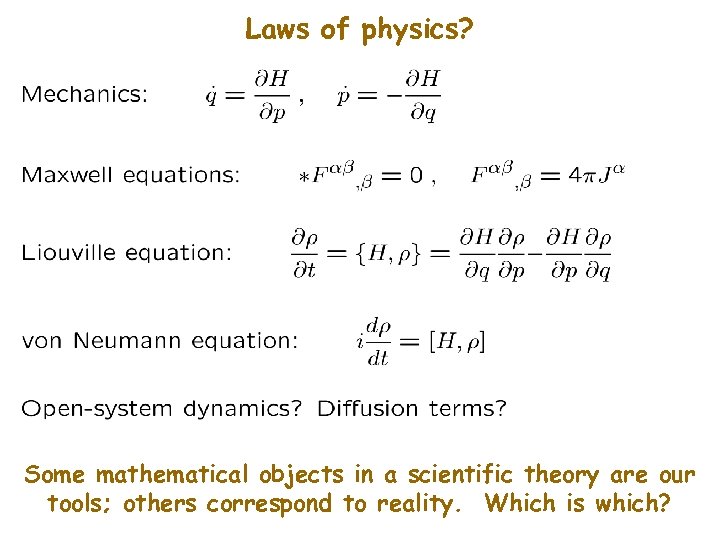 Laws of physics? Some mathematical objects in a scientific theory are our tools; others correspond to reality. Which is which?
 Subjective Bayesian probabilities Oljeto Wash Southern Utah
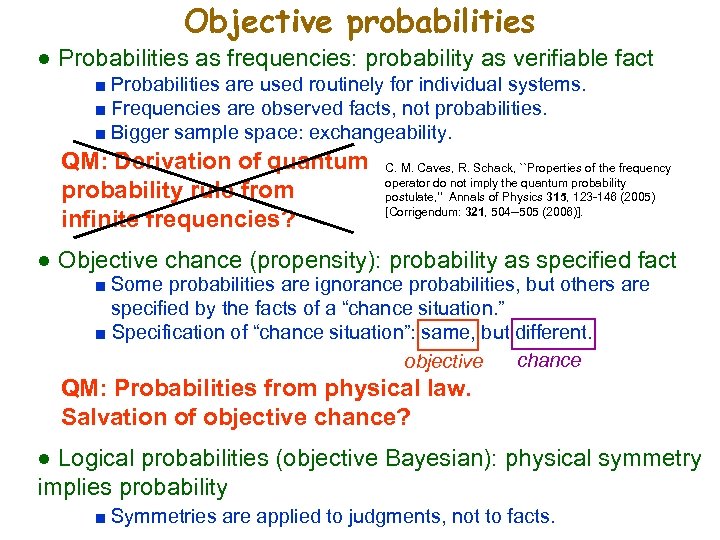 Objective probabilities ● Probabilities as frequencies: probability as verifiable fact ■ Probabilities are used routinely for individual systems. ■ Frequencies are observed facts, not probabilities. ■ Bigger sample space: exchangeability. QM: Derivation of quantum probability rule from infinite frequencies? C. M. Caves, R. Schack, ``Properties of the frequency operator do not imply the quantum probability postulate, '' Annals of Physics 315, 123 -146 (2005) [Corrigendum: 321, 504 --505 (2006)]. ● Objective chance (propensity): probability as specified fact ■ Some probabilities are ignorance probabilities, but others are specified by the facts of a “chance situation. ” ■ Specification of “chance situation”: same, but different. chance objective QM: Probabilities from physical law. Salvation of objective chance? ● Logical probabilities (objective Bayesian): physical symmetry implies probability ■ Symmetries are applied to judgments, not to facts.
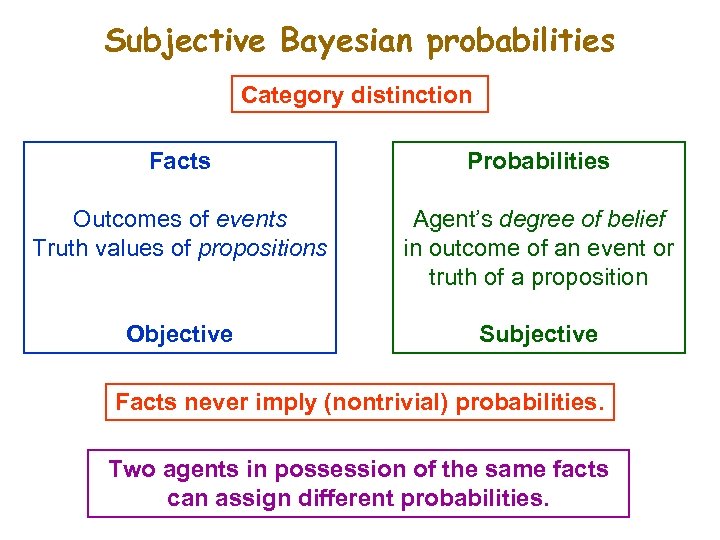 Subjective Bayesian probabilities Category distinction Facts Probabilities Outcomes of events Truth values of propositions Agent’s degree of belief in outcome of an event or truth of a proposition Objective Subjective Facts never imply (nontrivial) probabilities. Two agents in possession of the same facts can assign different probabilities.
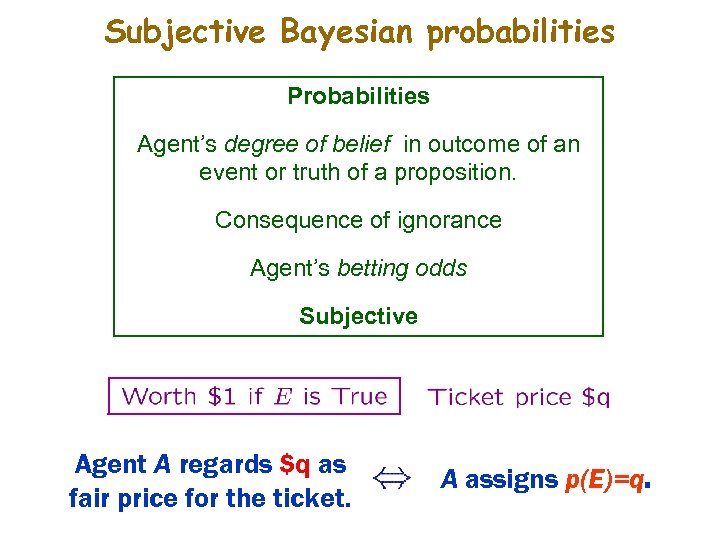 Subjective Bayesian probabilities Probabilities Agent’s degree of belief in outcome of an event or truth of a proposition. Consequence of ignorance Agent’s betting odds Subjective Agent A regards $q as fair price for the ticket. A assigns p(E)=q.
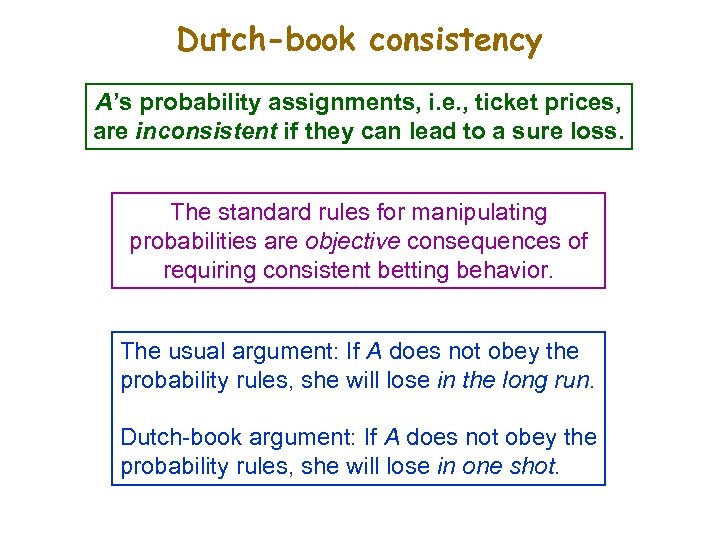 Dutch-book consistency A’s probability assignments, i. e. , ticket prices, are inconsistent if they can lead to a sure loss. The standard rules for manipulating probabilities are objective consequences of requiring consistent betting behavior. The usual argument: If A does not obey the probability rules, she will lose in the long run. Dutch-book argument: If A does not obey the probability rules, she will lose in one shot.
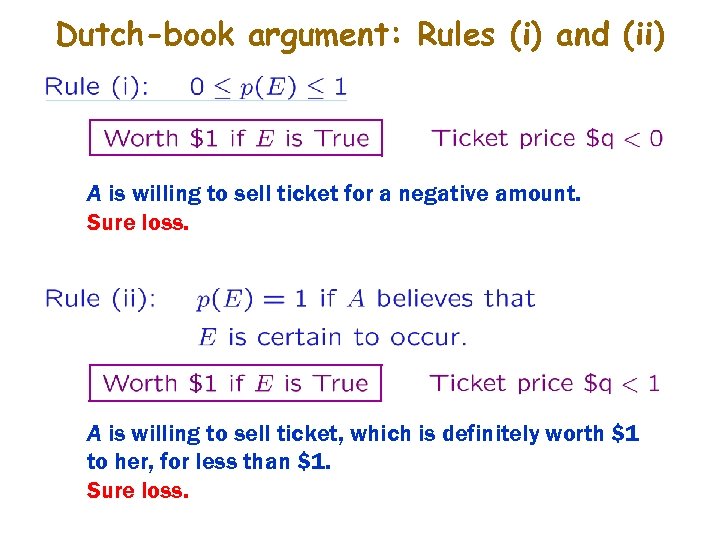 Dutch-book argument: Rules (i) and (ii) A is willing to sell ticket for a negative amount. Sure loss. A is willing to sell ticket, which is definitely worth $1 to her, for less than $1. Sure loss.
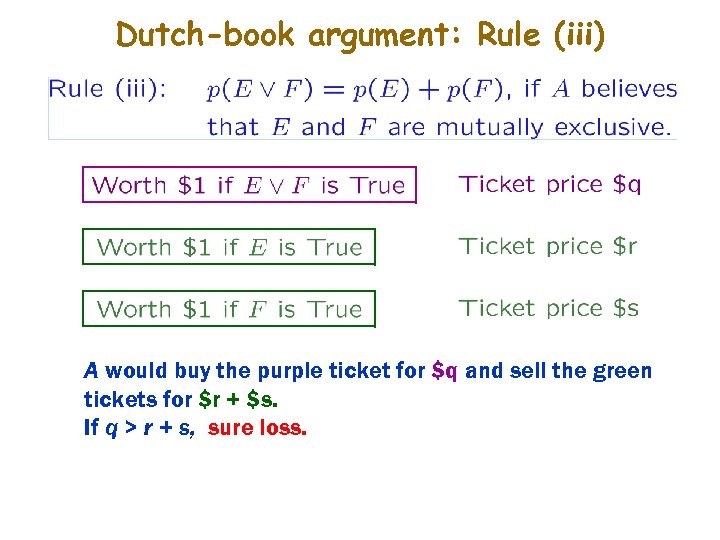 Dutch-book argument: Rule (iii) A would buy the purple ticket for $q and sell the green tickets for $r + $s. If q > r + s, sure loss.
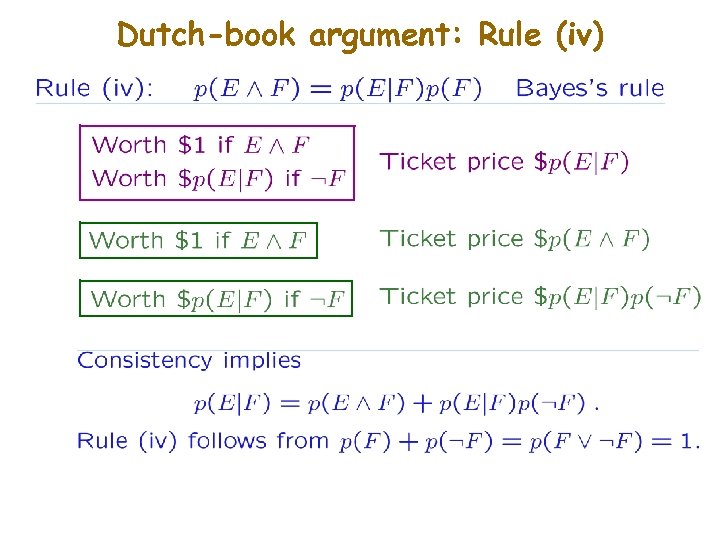 Dutch-book argument: Rule (iv)
 Subjective Bayesian probabilities The standard rules of probability theory are objective consequences of requiring consistent betting behavior.
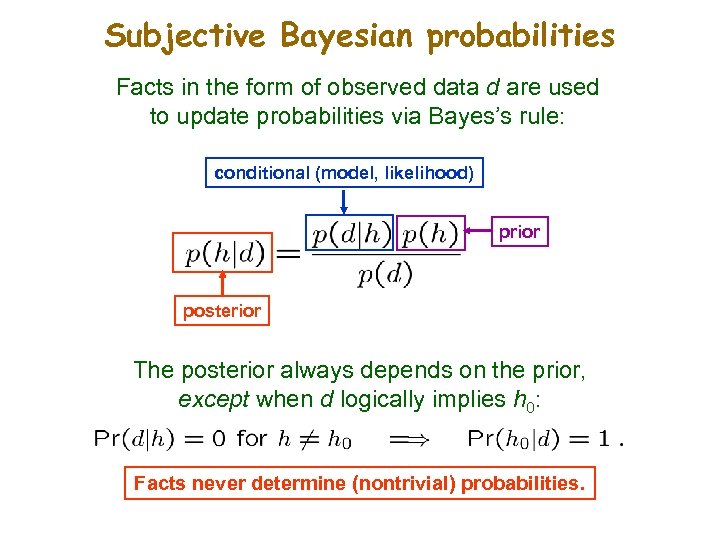 Subjective Bayesian probabilities Facts in the form of observed data d are used to update probabilities via Bayes’s rule: conditional (model, likelihood) prior posterior The posterior always depends on the prior, except when d logically implies h 0: Facts never determine (nontrivial) probabilities.
 Are quantum probabilities subjective? Bungle Range Western Australia
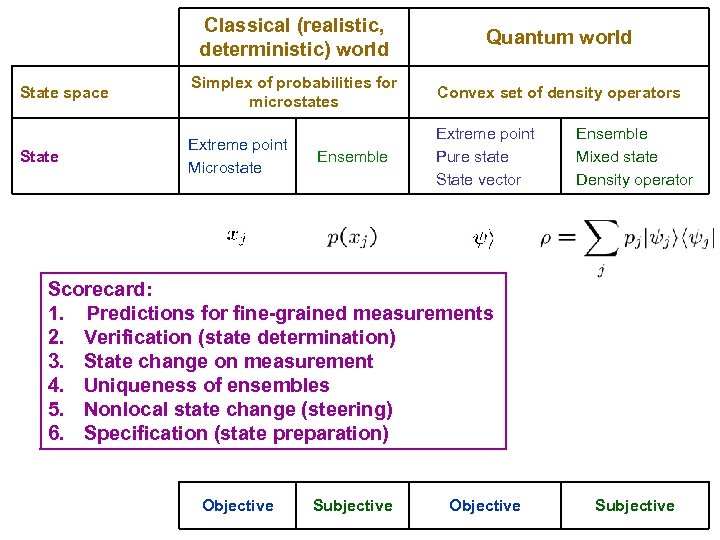 Classical (realistic, deterministic) world Quantum world State space Simplex of probabilities for microstates Convex set of density operators State Extreme point Microstate Extreme point Pure state State vector Ensemble Mixed state Density operator Scorecard: 1. Predictions for fine-grained measurements 2. Verification (state determination) 3. State change on measurement 4. Uniqueness of ensembles 5. Nonlocal state change (steering) 6. Specification (state preparation) Objective Subjective
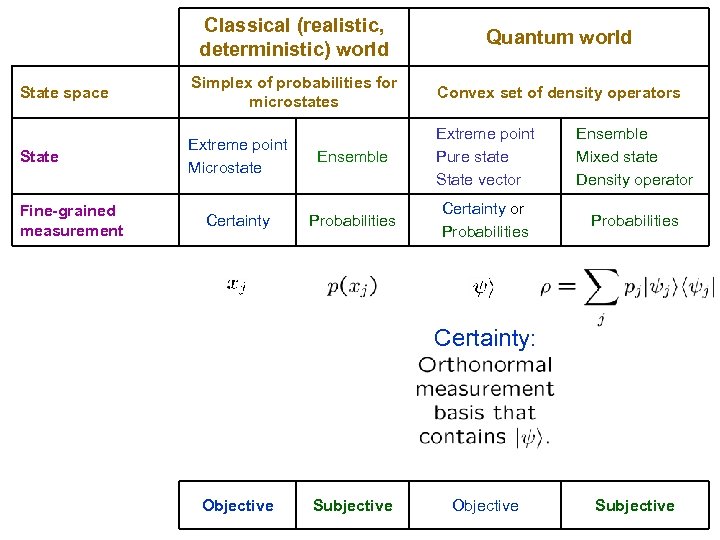 Classical (realistic, deterministic) world Quantum world State space Simplex of probabilities for microstates Convex set of density operators State Extreme point Microstate Ensemble Extreme point Pure state State vector Ensemble Mixed state Density operator Certainty Probabilities Certainty or Probabilities Fine-grained measurement Certainty: Objective Subjective
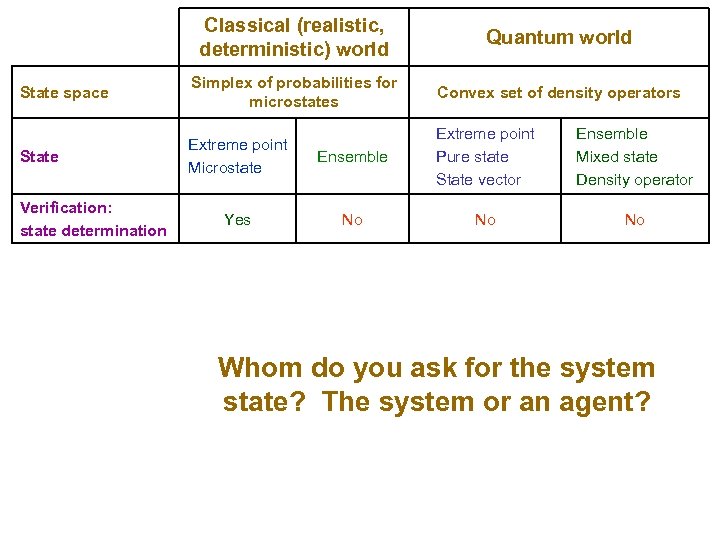 Classical (realistic, deterministic) world Quantum world State space Simplex of probabilities for microstates Convex set of density operators State Extreme point Microstate Ensemble Extreme point Pure state State vector Ensemble Mixed state Density operator Yes No No No Verification: state determination Whom do you ask for the system state? The system or an agent?
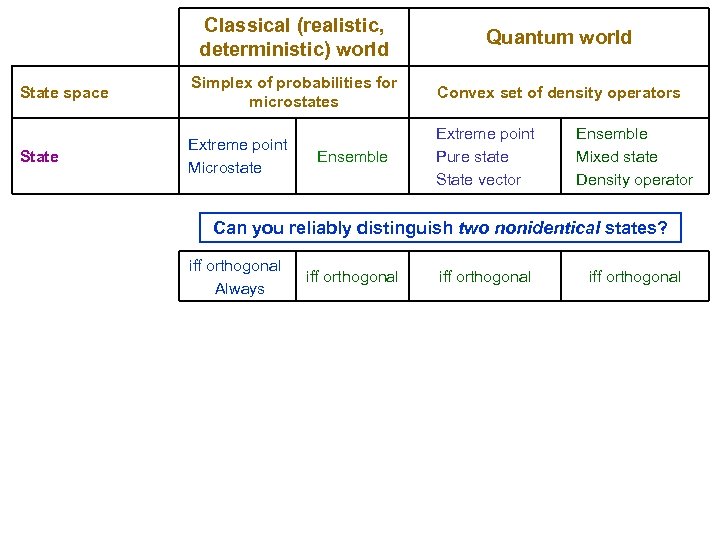 Classical (realistic, deterministic) world Quantum world State space Simplex of probabilities for microstates Convex set of density operators State Extreme point Microstate Extreme point Pure state State vector Ensemble Mixed state Density operator Can you reliably distinguish two nonidentical states? iff orthogonal Always iff orthogonal
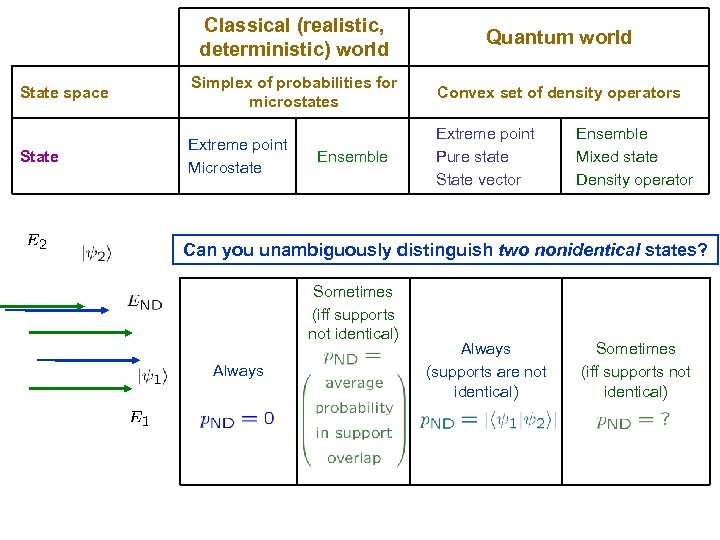 Classical (realistic, deterministic) world Quantum world State space Simplex of probabilities for microstates Convex set of density operators State Extreme point Microstate Extreme point Pure state State vector Ensemble Mixed state Density operator Can you unambiguously distinguish two nonidentical states? Sometimes (iff supports not identical) Always (supports are not identical) Sometimes (iff supports not identical)
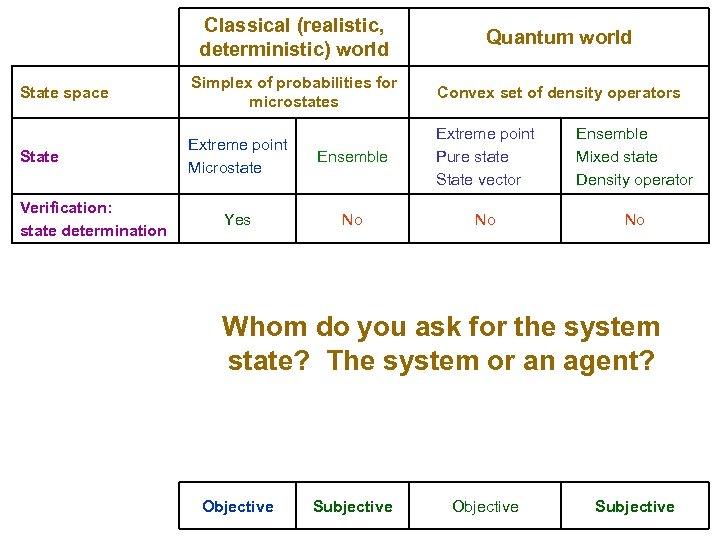 Classical (realistic, deterministic) world Quantum world State space Simplex of probabilities for microstates Convex set of density operators State Extreme point Microstate Ensemble Extreme point Pure state State vector Ensemble Mixed state Density operator Yes No No No Verification: state determination Whom do you ask for the system state? The system or an agent? Objective Subjective
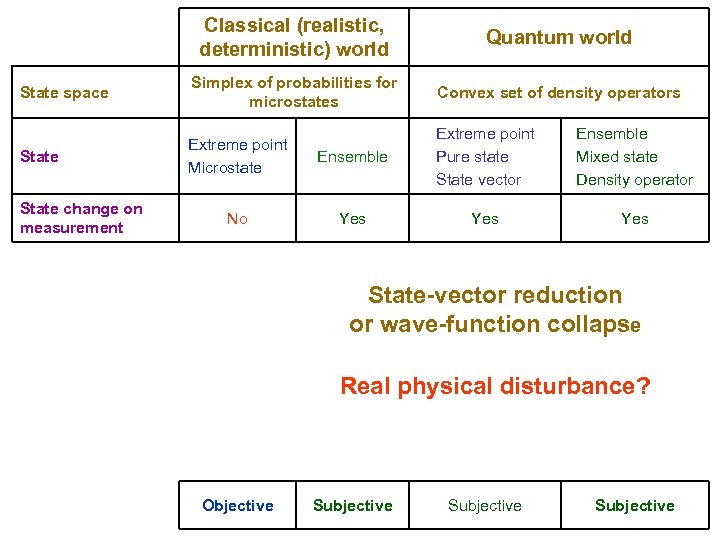 Classical (realistic, deterministic) world Quantum world State space Simplex of probabilities for microstates Convex set of density operators State Extreme point Microstate Ensemble Extreme point Pure state State vector Ensemble Mixed state Density operator No Yes Yes State change on measurement State-vector reduction or wave-function collapse Real physical disturbance? Objective Subjective
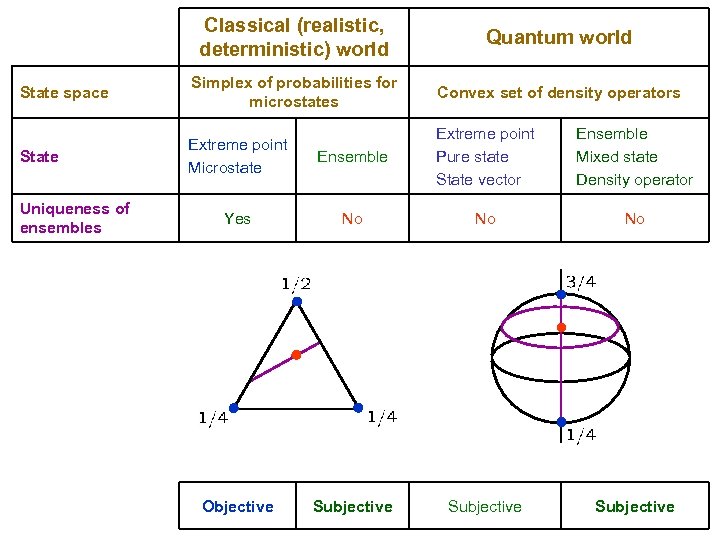 Classical (realistic, deterministic) world Quantum world State space Simplex of probabilities for microstates Convex set of density operators State Extreme point Microstate Ensemble Extreme point Pure state State vector Ensemble Mixed state Density operator Yes No No No Objective Subjective Uniqueness of ensembles
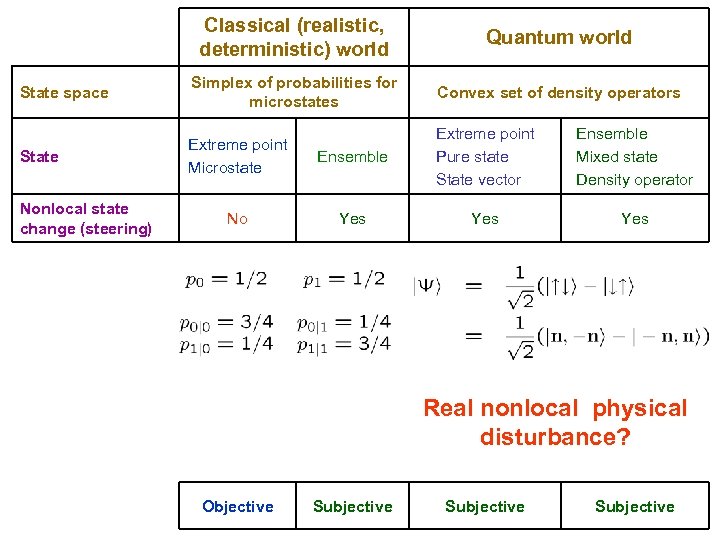 Classical (realistic, deterministic) world Quantum world State space Simplex of probabilities for microstates Convex set of density operators State Extreme point Microstate Ensemble Extreme point Pure state State vector Ensemble Mixed state Density operator No Yes Yes Nonlocal state change (steering) Real nonlocal physical disturbance? Objective Subjective
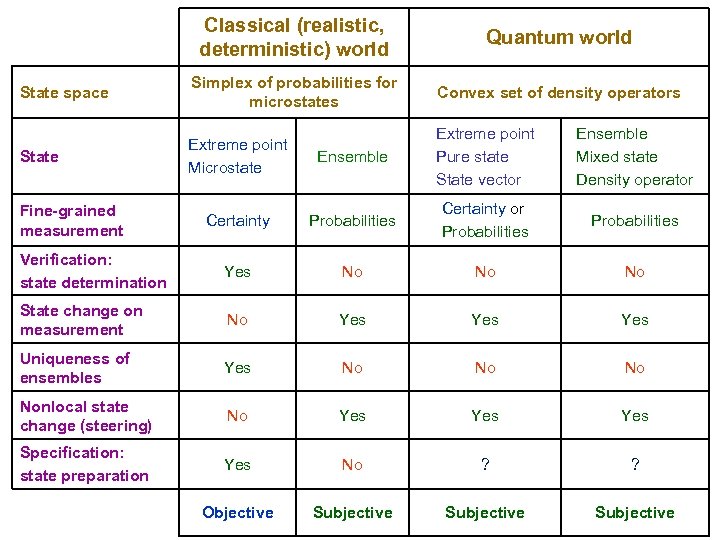 Classical (realistic, deterministic) world Quantum world State space Simplex of probabilities for microstates Convex set of density operators State Extreme point Microstate Ensemble Extreme point Pure state State vector Ensemble Mixed state Density operator Certainty Probabilities Certainty or Probabilities Verification: state determination Yes No No No State change on measurement No Yes Yes Uniqueness of ensembles Yes No Nonlocal state change (steering) No Yes Yes Specification: state preparation Yes No ? ? Objective Subjective Fine-grained measurement
 Copenhagen vs. Bayes Truchas from East Pecos Baldy Sangre de Cristo Range Northern New Mexico
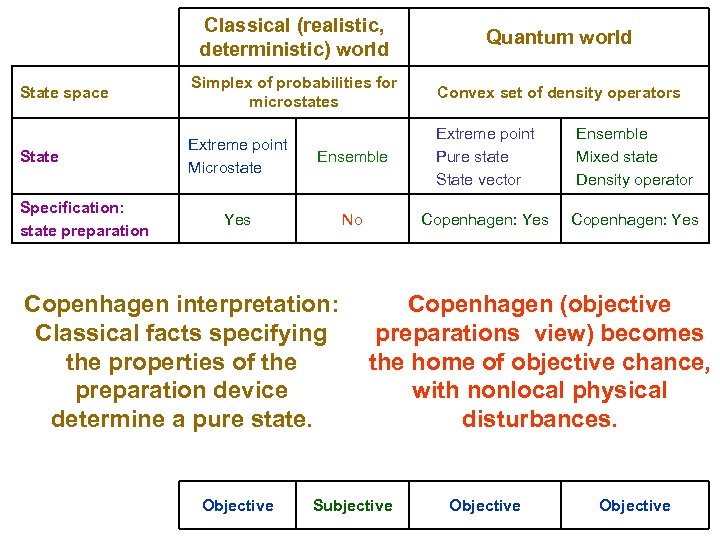 Classical (realistic, deterministic) world Quantum world State space Simplex of probabilities for microstates Convex set of density operators State Extreme point Microstate Ensemble Extreme point Pure state State vector Ensemble Mixed state Density operator Yes No Copenhagen: Yes Specification: state preparation Copenhagen interpretation: Classical facts specifying the properties of the preparation device determine a pure state. Objective Copenhagen (objective preparations view) becomes the home of objective chance, with nonlocal physical disturbances. Subjective Objective
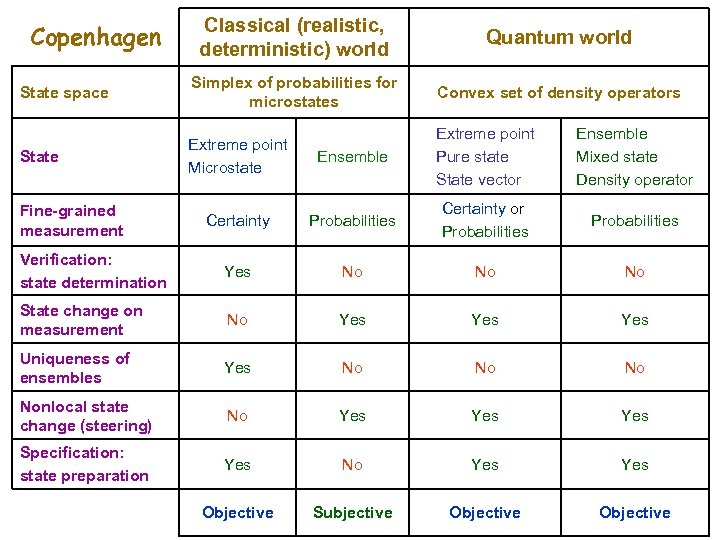 Classical (realistic, deterministic) world Quantum world State space Simplex of probabilities for microstates Convex set of density operators State Extreme point Microstate Ensemble Extreme point Pure state State vector Ensemble Mixed state Density operator Certainty Probabilities Certainty or Probabilities Verification: state determination Yes No No No State change on measurement No Yes Yes Uniqueness of ensembles Yes No Nonlocal state change (steering) No Yes Yes Specification: state preparation Yes No Yes Objective Subjective Objective Copenhagen Fine-grained measurement
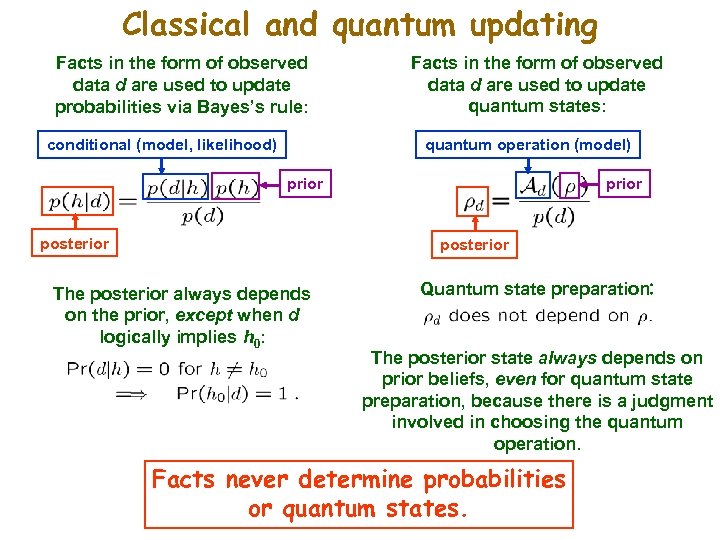 Classical and quantum updating Facts in the form of observed data d are used to update probabilities via Bayes’s rule: Facts in the form of observed data d are used to update quantum states: quantum operation (model) conditional (model, likelihood) prior posterior The posterior always depends on the prior, except when d logically implies h 0: Quantum state preparation: The posterior state always depends on prior beliefs, even for quantum state preparation, because there is a judgment involved in choosing the quantum operation. Facts never determine probabilities or quantum states.
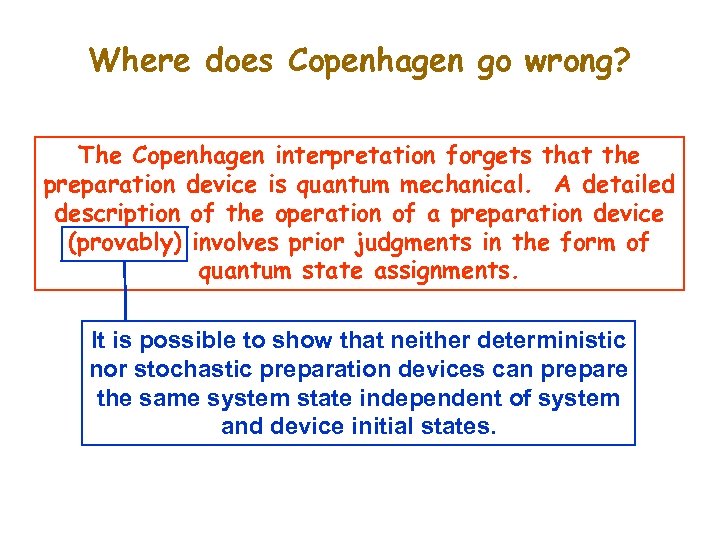 Where does Copenhagen go wrong? The Copenhagen interpretation forgets that the preparation device is quantum mechanical. A detailed description of the operation of a preparation device (provably) involves prior judgments in the form of quantum state assignments. It is possible to show that neither deterministic nor stochastic preparation devices can prepare the same system state independent of system and device initial states.
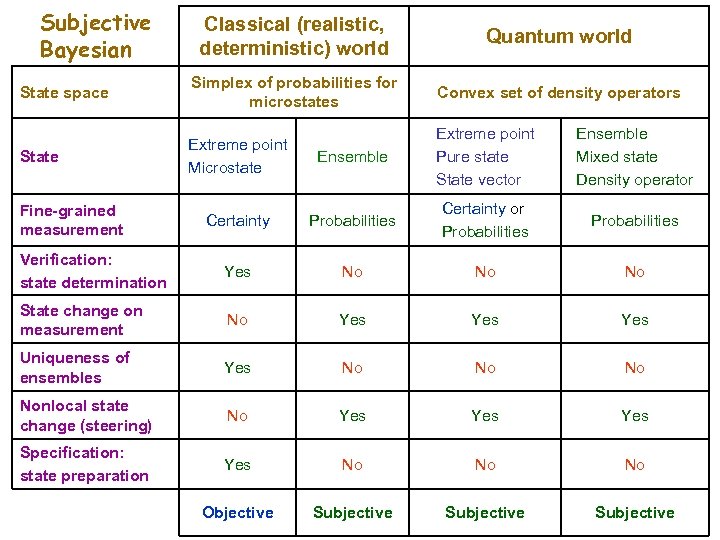 Subjective Bayesian Classical (realistic, deterministic) world Quantum world State space Simplex of probabilities for microstates Convex set of density operators State Extreme point Microstate Ensemble Extreme point Pure state State vector Ensemble Mixed state Density operator Certainty Probabilities Certainty or Probabilities Verification: state determination Yes No No No State change on measurement No Yes Yes Uniqueness of ensembles Yes No Nonlocal state change (steering) No Yes Yes Specification: state preparation Yes No No No Objective Subjective Fine-grained measurement
 Bayesian quantum probabilities Echidna Gorge Bungle Range Western Australia
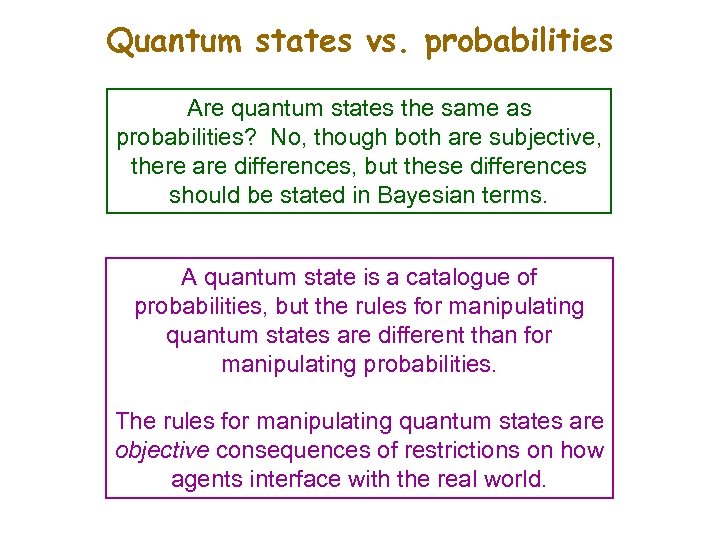 Quantum states vs. probabilities Are quantum states the same as probabilities? No, though both are subjective, there are differences, but these differences should be stated in Bayesian terms. A quantum state is a catalogue of probabilities, but the rules for manipulating quantum states are different than for manipulating probabilities. The rules for manipulating quantum states are objective consequences of restrictions on how agents interface with the real world.
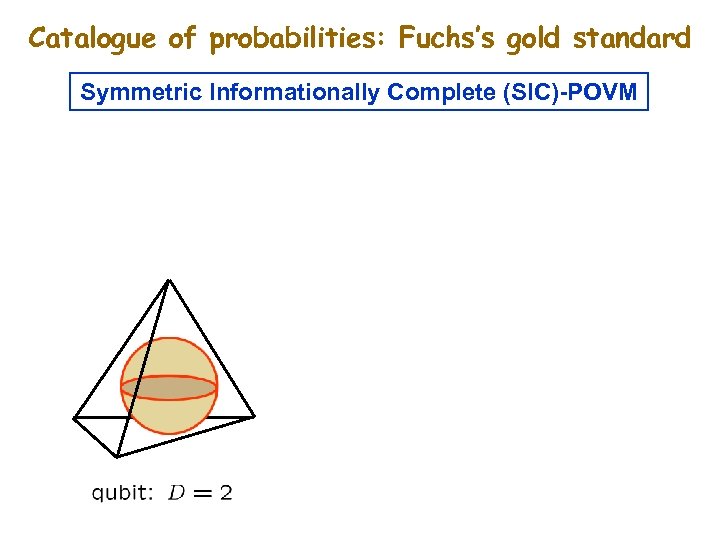 Catalogue of probabilities: Fuchs’s gold standard Symmetric Informationally Complete (SIC)-POVM
 Quantum coin tossing Cable Beach Western Australia
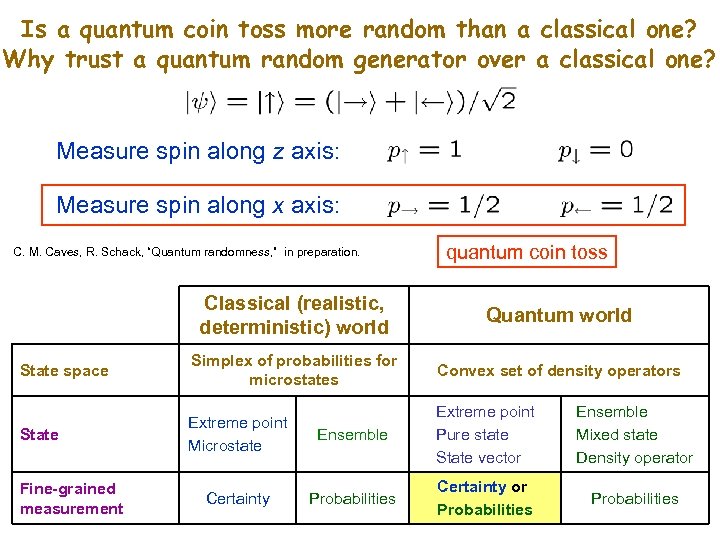 Is a quantum coin toss more random than a classical one? Why trust a quantum random generator over a classical one? Measure spin along z axis: Measure spin along x axis: C. M. Caves, R. Schack, “Quantum randomness, ” in preparation. quantum coin toss Classical (realistic, deterministic) world Quantum world State space Simplex of probabilities for microstates Convex set of density operators State Extreme point Microstate Ensemble Extreme point Pure state State vector Ensemble Mixed state Density operator Certainty Probabilities Certainty or Probabilities Fine-grained measurement
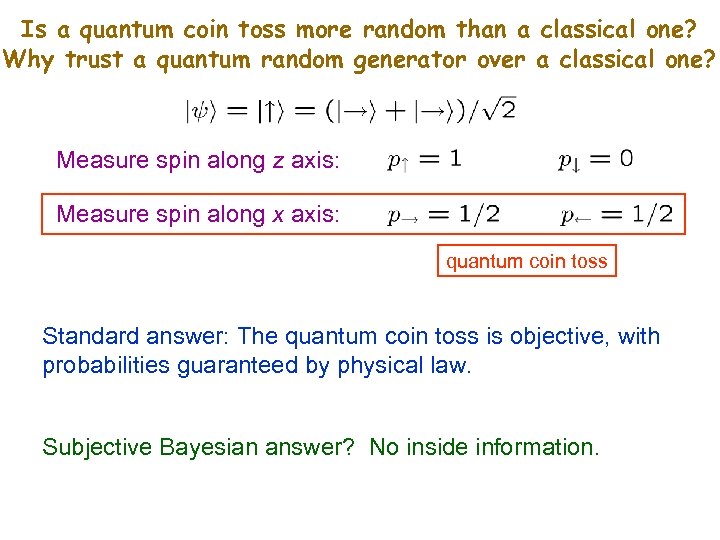 Is a quantum coin toss more random than a classical one? Why trust a quantum random generator over a classical one? Measure spin along z axis: Measure spin along x axis: quantum coin toss Standard answer: The quantum coin toss is objective, with probabilities guaranteed by physical law. Subjective Bayesian answer? No inside information.
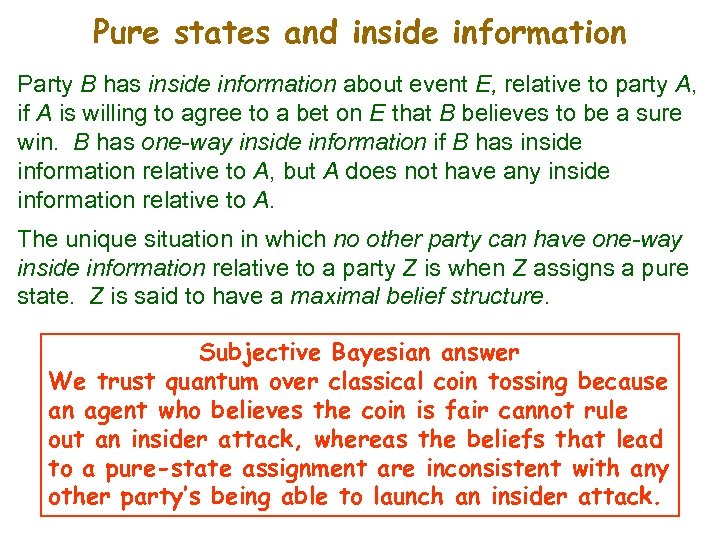 Pure states and inside information Party B has inside information about event E, relative to party A, if A is willing to agree to a bet on E that B believes to be a sure win. B has one-way inside information if B has inside information relative to A, but A does not have any inside information relative to A. The unique situation in which no other party can have one-way inside information relative to a party Z is when Z assigns a pure state. Z is said to have a maximal belief structure. Subjective Bayesian answer We trust quantum over classical coin tossing because an agent who believes the coin is fair cannot rule out an insider attack, whereas the beliefs that lead to a pure-state assignment are inconsistent with any other party’s being able to launch an insider attack.
 A stab at ontology Cape Hauy Tasman Peninsula
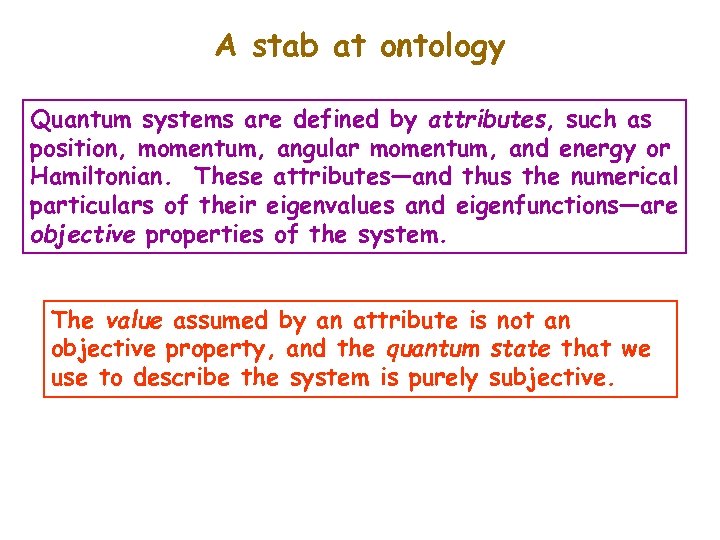 A stab at ontology Quantum systems are defined by attributes, such as position, momentum, angular momentum, and energy or Hamiltonian. These attributes—and thus the numerical particulars of their eigenvalues and eigenfunctions—are objective properties of the system. The value assumed by an attribute is not an objective property, and the quantum state that we use to describe the system is purely subjective.
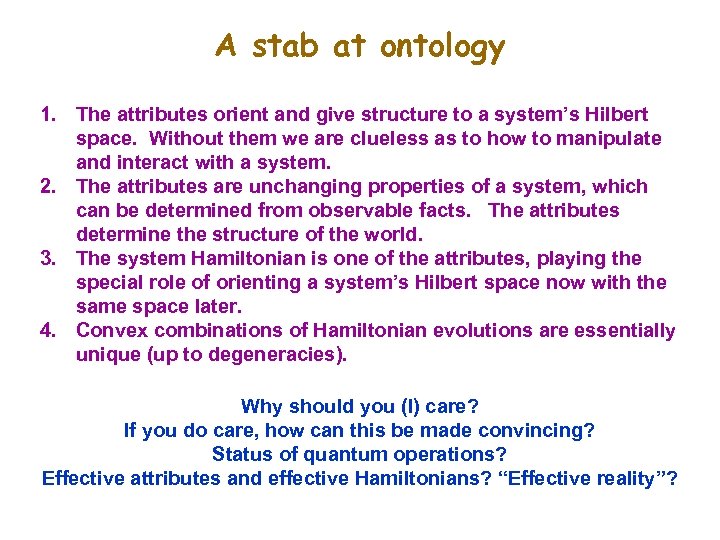 A stab at ontology 1. The attributes orient and give structure to a system’s Hilbert space. Without them we are clueless as to how to manipulate and interact with a system. 2. The attributes are unchanging properties of a system, which can be determined from observable facts. The attributes determine the structure of the world. 3. The system Hamiltonian is one of the attributes, playing the special role of orienting a system’s Hilbert space now with the same space later. 4. Convex combinations of Hamiltonian evolutions are essentially unique (up to degeneracies). Why should you (I) care? If you do care, how can this be made convincing? Status of quantum operations? Effective attributes and effective Hamiltonians? “Effective reality”?
 Kookaburras in New Mexico