
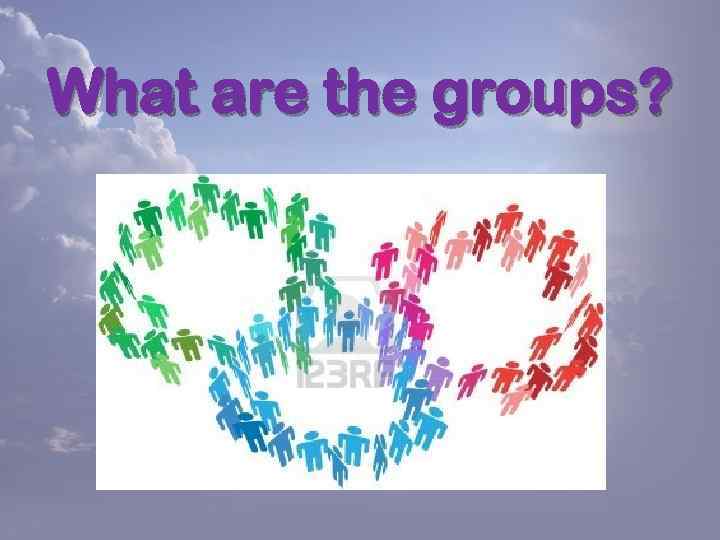
 What are the groups?
 Introduction • Though individuality is positive and natural, we all need other people in our lives, and we form alliances with others every day. One of the most basic ways to arrange human beings is into groups. Large or small, groups serve many functions. They give an individual a sense of identity, as well as meet individual needs such as the need for emotional intimacy. In some groups, we have close personal ties to the other members. Other groups are so large and impersonal that we might never get to meet the other members. Some groups work to accomplish a task, and others meet just because the members feel a personal connection to one another.
 Groups, Aggregates, and Categories Sociological study relies on the ability to classify the people being studied in order to arrive at correct conclusions. Classifications include groups, aggregates, and categories.
 Groups • A group consists of two or more people who are distinct in the following three ways: • Interact over time. • Have a sense of identity or belonging. • Have norms that nonmembers don’t have.
 Example • A class of students is a group. Classes by definition consist of more than two people, meet at least a few times a week for an entire semester, and identify themselves on the basis of what classes they are taking. Students in a class must follow that professor’s class and test schedule, as well as rules for behavior and contribution in class.
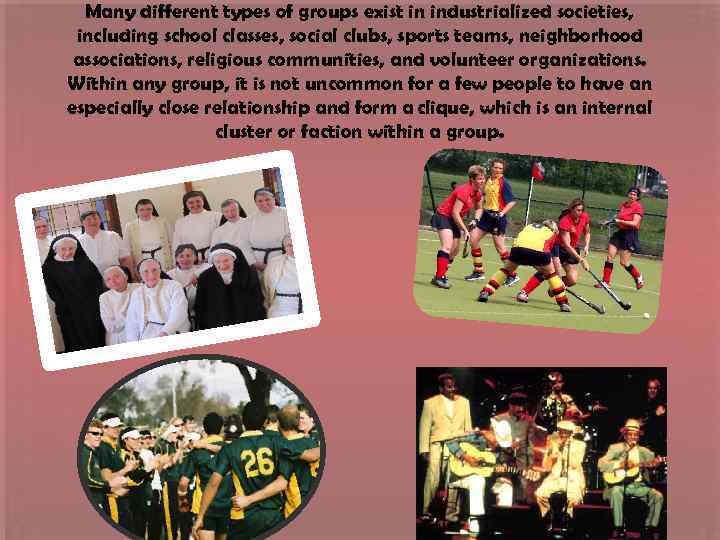 Many different types of groups exist in industrialized societies, including school classes, social clubs, sports teams, neighborhood associations, religious communities, and volunteer organizations. Within any group, it is not uncommon for a few people to have an especially close relationship and form a clique, which is an internal cluster or faction within a group.
 Aggregate • The word group is sometimes confused with the word aggregate. An aggregate is a collection of people who happen to be at the same place at the same time but who have no other connection to one another.
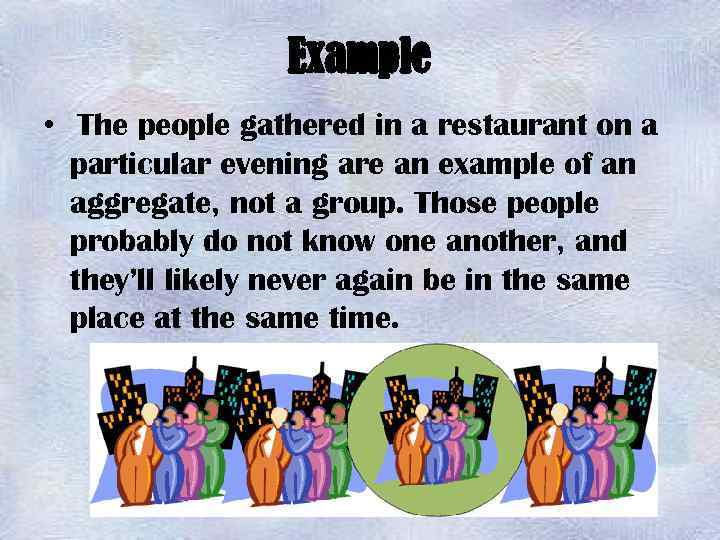 Example • The people gathered in a restaurant on a particular evening are an example of an aggregate, not a group. Those people probably do not know one another, and they’ll likely never again be in the same place at the same time.
 Category • A category is a collection of people who share a particular characteristic. They do not necessarily interact with one another and have nothing else in common. • Example: Categories of people might include people who have green eyes, people who were born in Nevada, and women who have given birth to twins.

 Humans have a natural tendency to form groups, and a single person can be a part of several groups at a time. GROUP CLASSIFICATIONS
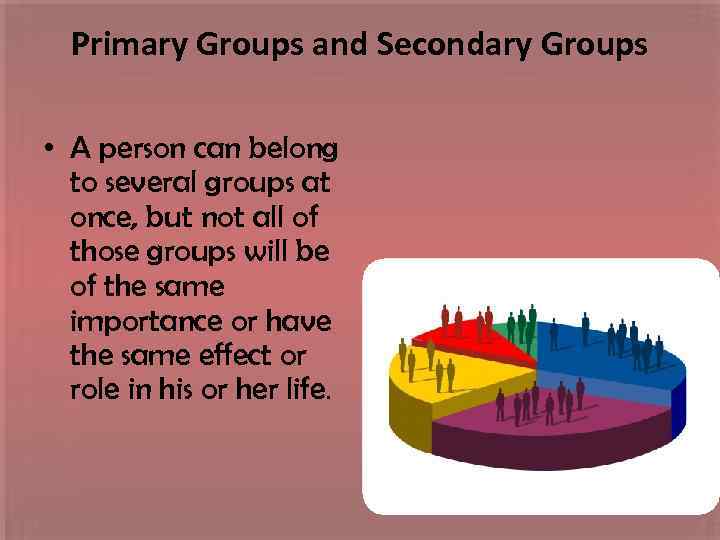 Primary Groups and Secondary Groups • A person can belong to several groups at once, but not all of those groups will be of the same importance or have the same effect or role in his or her life.
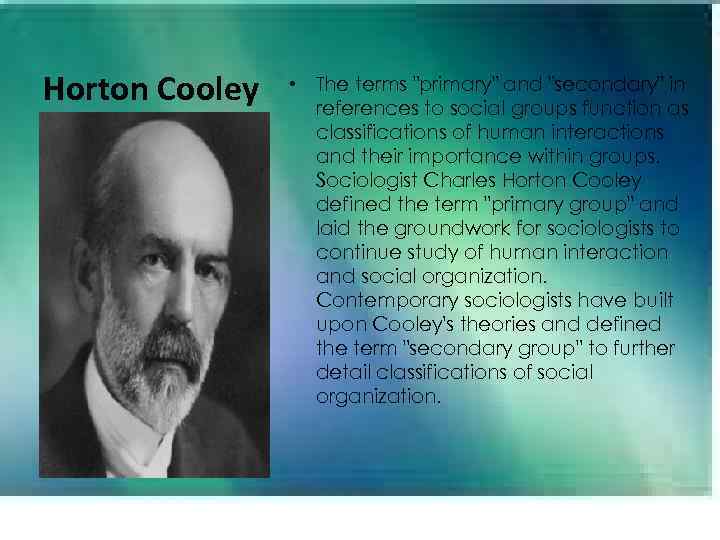 Horton Cooley • The terms "primary" and "secondary" in references to social groups function as classifications of human interactions and their importance within groups. Sociologist Charles Horton Cooley defined the term "primary group" and laid the groundwork for sociologists to continue study of human interaction and social organization. Contemporary sociologists have built upon Cooley's theories and defined the term "secondary group" to further detail classifications of social organization.
 primary Groups • Cooley defined primary groups as close relationships that directly aid in a child's development, such as the family unit, children's play groups, and the neighborhood in which the child lives. Cooley states that a member of a primary group will usually commit selfless acts and sacrifices for the comfort of other members in their group, or for the benefit of the group as a whole. Such actions would be exclusive to primary groups; that individual may perform such acts for those outside the primary group, but expect compensation.
 Secondary Groups • Secondary groups are defined by impersonal, emotionless and impermanent interactions. Interactions are often based upon tasks or reciprocity, such as the temporary relationship between salesperson and customer. Numerous employees within a large corporation, or a university with thousands of students can be considered as a secondary group, as these interactions would be impermanent, have a specific function, and interactions will often be anonymous. Cooley never used this term himself to describe these interactions; the term "secondary group" is used by other sociologists and stemmed from his classification of the relationships between members of primary groups.
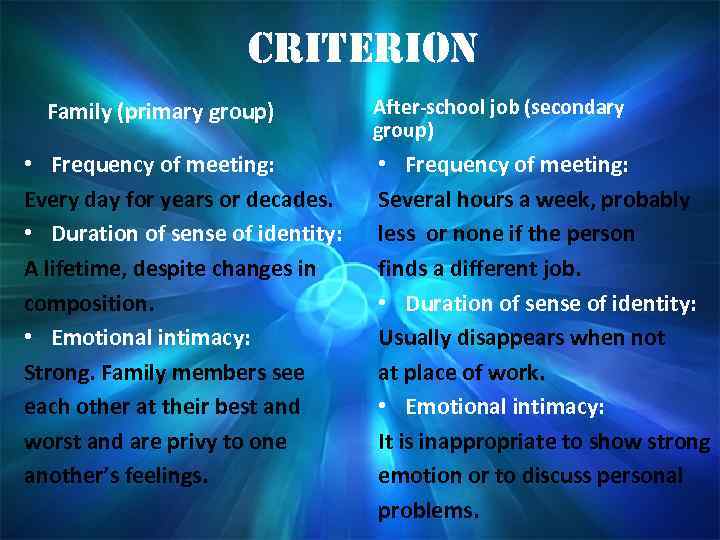 Criterion Family (primary group) • Frequency of meeting: Every day for years or decades. • Duration of sense of identity: A lifetime, despite changes in composition. • Emotional intimacy: Strong. Family members see each other at their best and worst and are privy to one another’s feelings. After-school job (secondary group) • Frequency of meeting: Several hours a week, probably less or none if the person finds a different job. • Duration of sense of identity: Usually disappears when not at place of work. • Emotional intimacy: It is inappropriate to show strong emotion or to discuss personal problems.
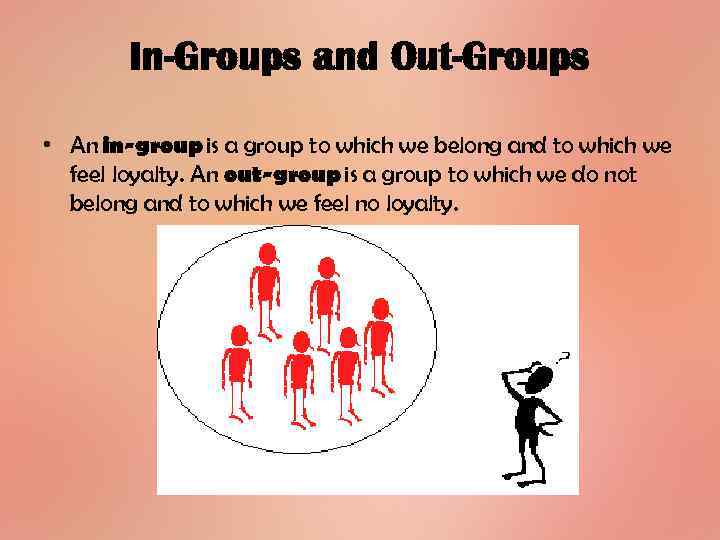 In-Groups and Out-Groups • An in-group is a group to which we belong and to which we feel loyalty. An out-group is a group to which we do not belong and to which we feel no loyalty.
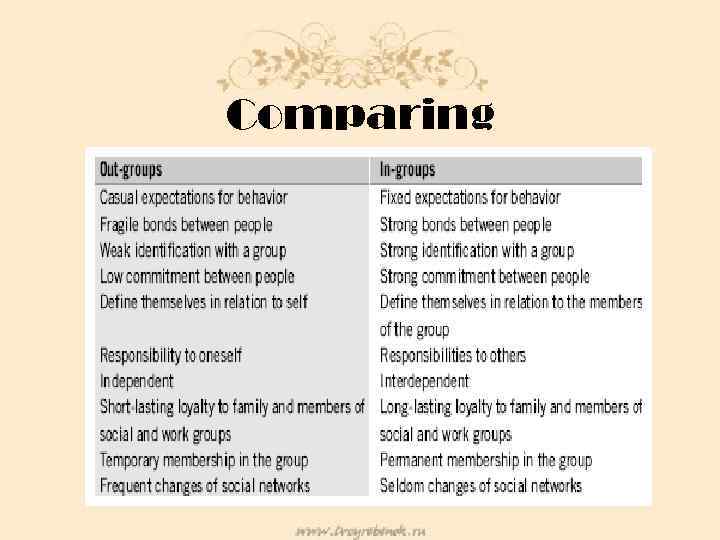 Comparing