


 Скачать презентацию What are etymological and etymographical units made of
919c51d79603623dc009c08acf938db7.ppt
- Количество слайдов: 27
 What are etymological (and etymographical) units made of: vocables or lexemes? Éva Buchi (ATILF/CNRS & Université de Lorraine) Hungarian Academy of Sciences, Research Institute for Linguistics Budapest, January 27 2015 www. atilf. fr/perso/buchi
 Analyse et Traitement Informatique de la Langue Française Metalexicological and metalexicographical topic Theoretical in its essence, but poses practical problems to practitioners of historical lexicology and lexicography ATILF lab (Nancy, France) Dictionnaire Étymologique Roman (DÉRom) European Master in Lexicography 2
 Analyse et Traitement Informatique de la Langue Française Etymological dictionary ‘DICTIONARY in which are traced back to words their earliest appropriate forms and meanings’ (Hartmann & James, Dictionary of lexicography, 1998) Lacks technical rigour ambiguous Threefold terminology established within theoretical framework of Meaning-text theory (Mel’čuk 2012: 1: 21 -44) 3
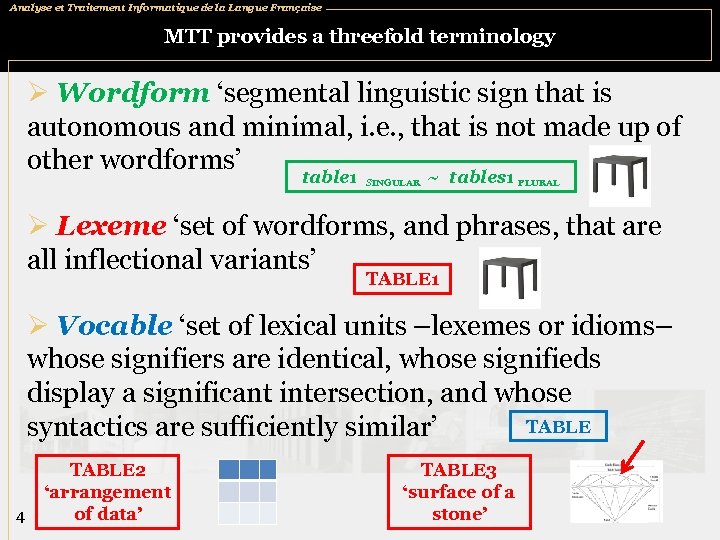 Analyse et Traitement Informatique de la Langue Française MTT provides a threefold terminology Ø Wordform ‘segmental linguistic sign that is autonomous and minimal, i. e. , that is not made up of other wordforms’ table 1 ~ tables 1 SINGULAR PLURAL Ø Lexeme ‘set of wordforms, and phrases, that are all inflectional variants’ TABLE 1 Ø Vocable ‘set of lexical units –lexemes or idioms– whose signifiers are identical, whose signifieds display a significant intersection, and whose TABLE syntactics are sufficiently similar’ 4 TABLE 2 ‘arrangement of data’ TABLE 3 ‘surface of a stone’
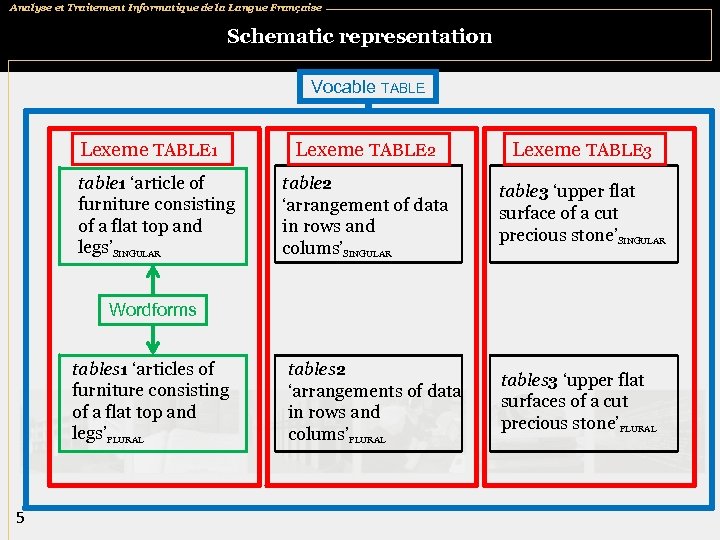 Analyse et Traitement Informatique de la Langue Française Schematic representation Vocable TABLE Lexeme TABLE 1 table 1 ‘article of furniture consisting of a flat top and legs’SINGULAR Lexeme TABLE 2 Lexeme TABLE 3 table 2 ‘arrangement of data in rows and colums’SINGULAR table 3 ‘upper flat surface of a cut precious stone’SINGULAR Wordforms tables 1 ‘articles of furniture consisting of a flat top and legs’PLURAL 5 tables 2 ‘arrangements of data in rows and colums’PLURAL tables 3 ‘upper flat surfaces of a cut precious stone’PLURAL
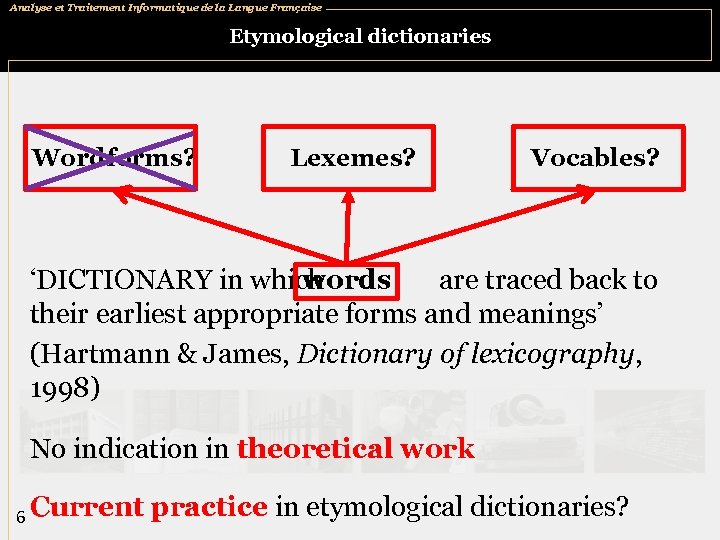 Analyse et Traitement Informatique de la Langue Française Etymological dictionaries Wordforms? Lexemes? Vocables? ‘DICTIONARY in which are traced back to words their earliest appropriate forms and meanings’ (Hartmann & James, Dictionary of lexicography, 1998) No indication in theoretical work 6 Current practice in etymological dictionaries?
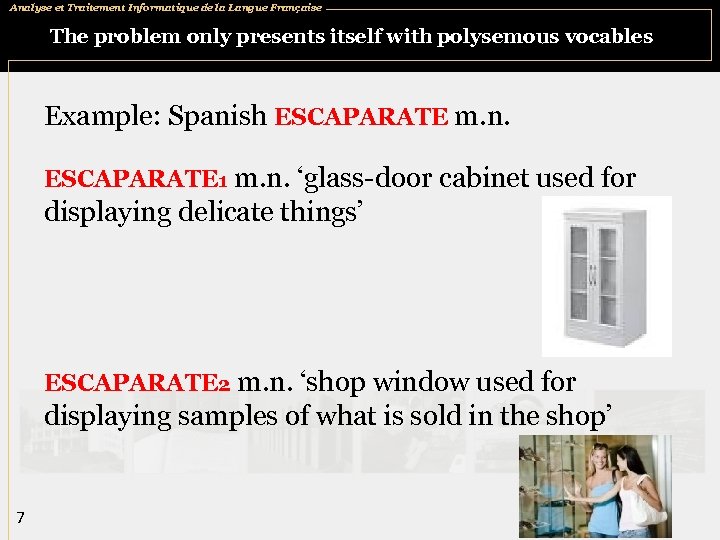 Analyse et Traitement Informatique de la Langue Française The problem only presents itself with polysemous vocables Example: Spanish ESCAPARATE m. n. ESCAPARATE 1 m. n. ‘glass-door cabinet used for displaying delicate things’ ESCAPARATE 2 m. n. ‘shop window used for displaying samples of what is sold in the shop’ 7
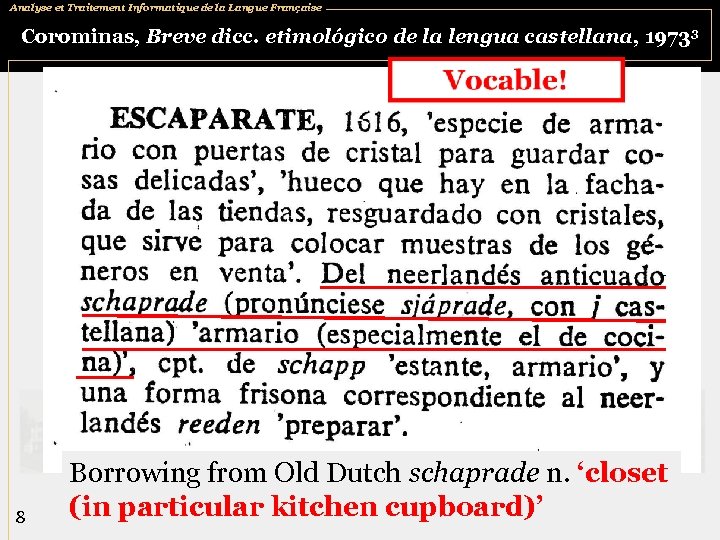 Analyse et Traitement Informatique de la Langue Française Corominas, Breve dicc. etimológico de la lengua castellana, 19733 8 Borrowing from Old Dutch schaprade n. ‘closet (in particular kitchen cupboard)’
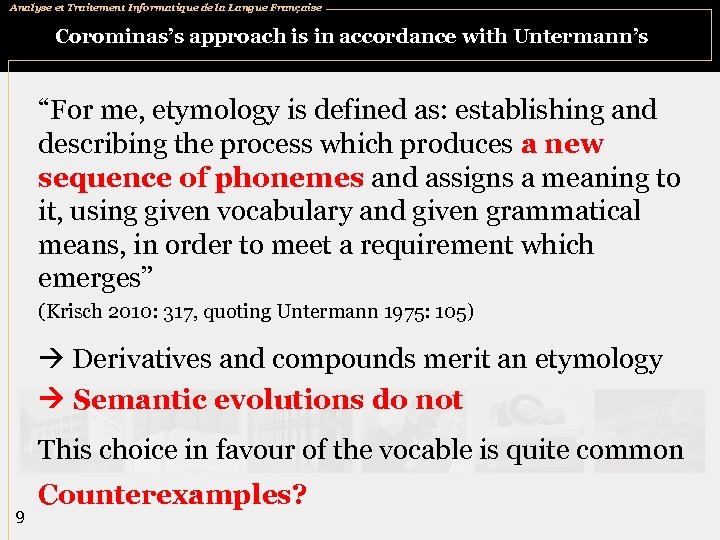 Analyse et Traitement Informatique de la Langue Française Corominas’s approach is in accordance with Untermann’s “For me, etymology is defined as: establishing and describing the process which produces a new sequence of phonemes and assigns a meaning to it, using given vocabulary and given grammatical means, in order to meet a requirement which emerges” (Krisch 2010: 317, quoting Untermann 1975: 105) Derivatives and compounds merit an etymology Semantic evolutions do not This choice in favour of the vocable is quite common 9 Counterexamples?
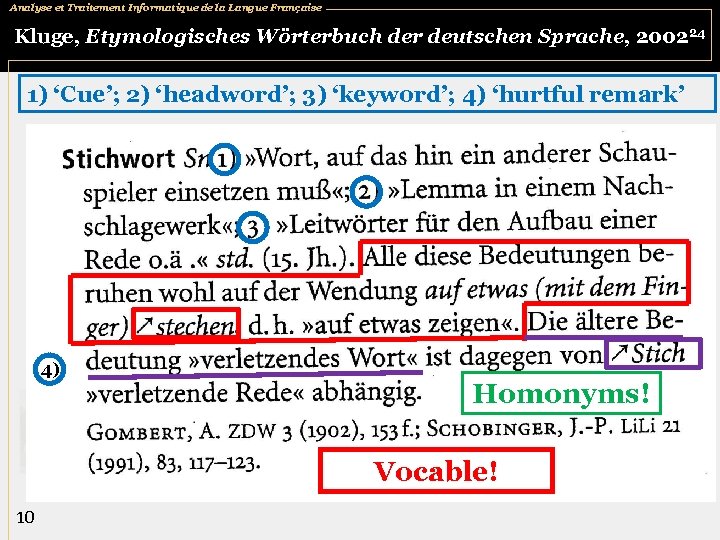 Analyse et Traitement Informatique de la Langue Française Kluge, Etymologisches Wörterbuch der deutschen Sprache, 200224 1) ‘Cue’; 2) ‘headword’; 3) ‘keyword’; 4) ‘hurtful remark’ 4) Homonyms! Vocable! 10
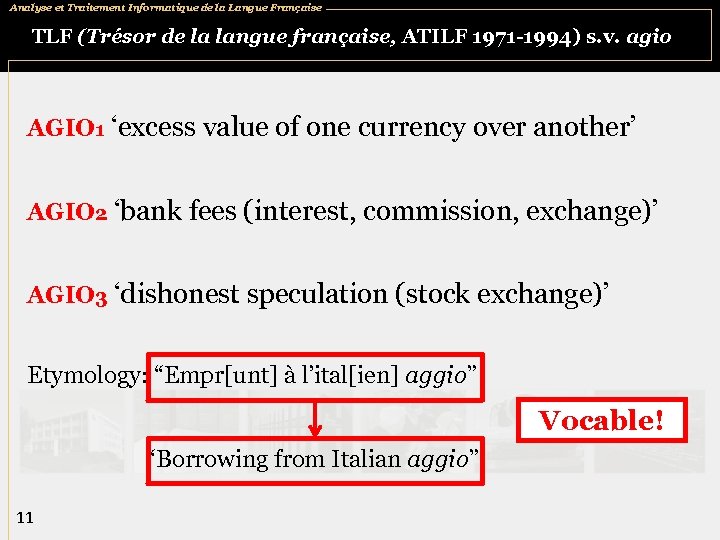 Analyse et Traitement Informatique de la Langue Française TLF (Trésor de la langue française, ATILF 1971 -1994) s. v. agio AGIO 1 ‘excess value of one currency over another’ AGIO 2 ‘bank fees (interest, commission, exchange)’ AGIO 3 ‘dishonest speculation (stock exchange)’ Etymology: “Empr[unt] à l’ital[ien] aggio” Vocable! “Borrowing from Italian aggio” 11
 Analyse et Traitement Informatique de la Langue Française Etymology of AGIO revised in the context of TLF-Étym = Steinfeld, Nadine (dir. ) (2005–): Trésor de la Langue Française Étymologique (TLF-Étym). Nancy: ATILF: http: //www. atilf. fr/tlf-etym Selective revision of the etymologies contained in the TLFi (Trésor de la Langue Française informatisé) Entry agio compiled by Franz Rainer, professor at Vienna University of Economics and Business 12
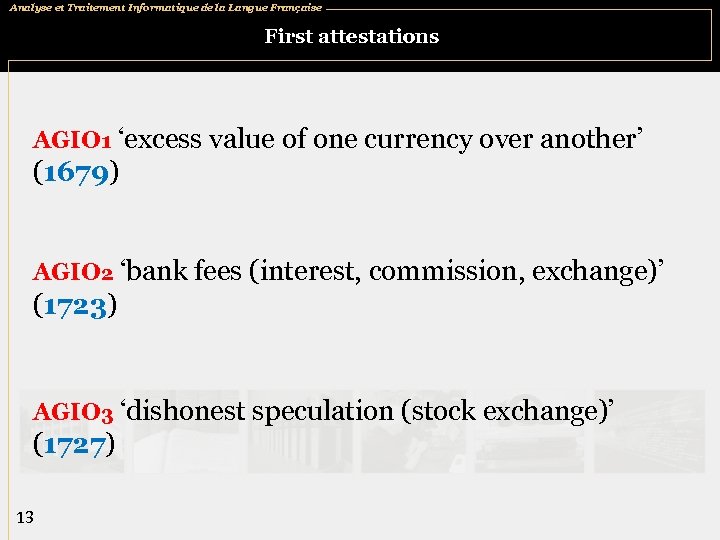 Analyse et Traitement Informatique de la Langue Française First attestations AGIO 1 ‘excess value of one currency over another’ (1679) AGIO 2 ‘bank fees (interest, commission, exchange)’ (1723) AGIO 3 ‘dishonest speculation (stock exchange)’ (1727) 13
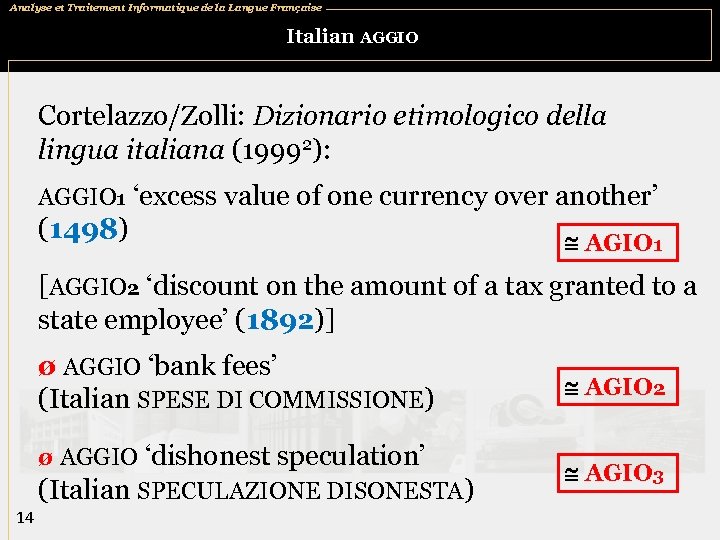 Analyse et Traitement Informatique de la Langue Française Italian AGGIO Cortelazzo/Zolli: Dizionario etimologico della lingua italiana (19992): AGGIO 1 ‘excess value of one currency over another’ (1498) AGIO 1 [AGGIO 2 ‘discount on the amount of a tax granted to a state employee’ (1892)] ø AGGIO ‘bank fees’ (Italian SPESE DI COMMISSIONE) ø AGGIO ‘dishonest speculation’ (Italian SPECULAZIONE DISONESTA) 14 AGIO 2 AGIO 3
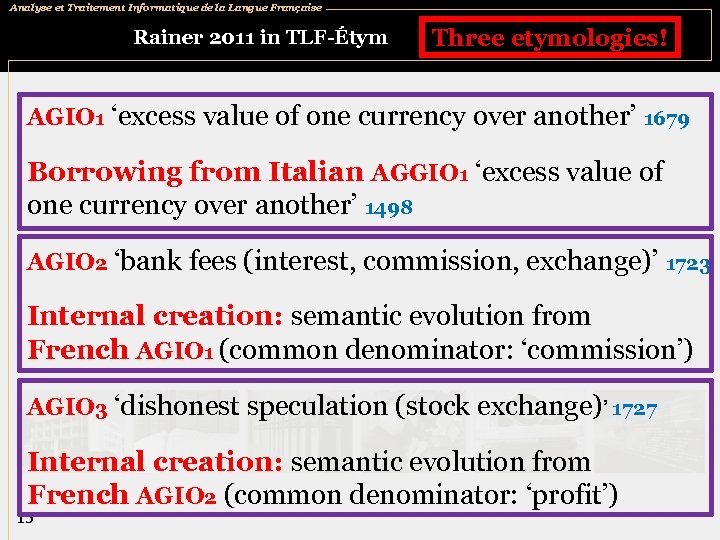 Analyse et Traitement Informatique de la Langue Française Rainer 2011 in TLF-Étym Three etymologies! AGIO 1 ‘excess value of one currency over another’ 1679 Borrowing from Italian AGGIO 1 ‘excess value of one currency over another’ 1498 AGIO 2 ‘bank fees (interest, commission, exchange)’ 1723 Internal creation: semantic evolution from French AGIO 1 (common denominator: ‘commission’) AGIO 3 ‘dishonest speculation (stock exchange)’ 1727 Internal creation: semantic evolution from French AGIO 2 (common denominator: ‘profit’) 15
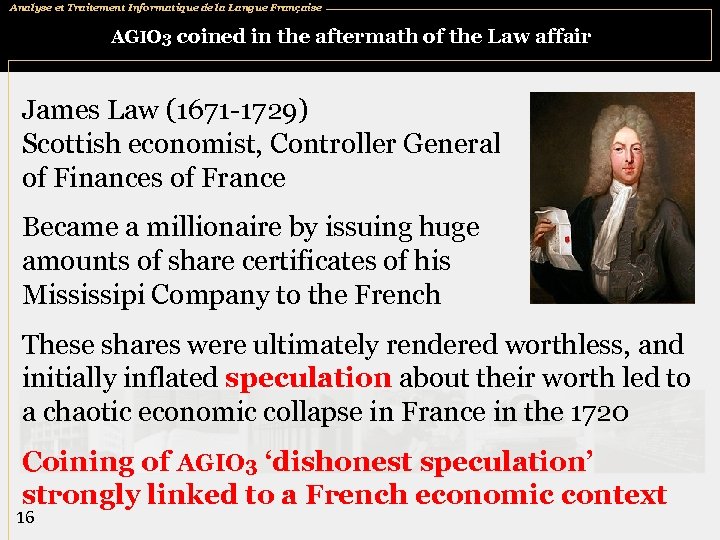 Analyse et Traitement Informatique de la Langue Française AGIO 3 coined in the aftermath of the Law affair James Law (1671 -1729) Scottish economist, Controller General of Finances of France Became a millionaire by issuing huge amounts of share certificates of his Mississipi Company to the French These shares were ultimately rendered worthless, and initially inflated speculation about their worth led to a chaotic economic collapse in France in the 1720 Coining of AGIO 3 ‘dishonest speculation’ strongly linked to a French economic context 16
 Analyse et Traitement Informatique de la Langue Française What are etymological units made of: vocables or lexemes? Dictionaries are made up of vocables like Spanish ESCAPARATE, German STICHWORT 1 and STICHWORT 2, and French AGIO But Spanish ESCAPARATE 2 ‘shop window’ cannot be considered a Dutch borrowing, and French AGIO 3 ‘dishonest speculation’ cannot be considered an Italian borrowing These lexemes deserve to be individually etymologized (as internal creations) 17
 Analyse et Traitement Informatique de la Langue Française For this reason I advocate a contrario that individual lexemes, not whole vocables, are best hypostatized as etymological (and etymographical) units This seems quite obvious: etymologies which put the different lexemes of a vocable to the centre of their attention are better etymologies Then why did the discipline of etymology have to wait for 2015 for this finding to be put forward? 18
 Analyse et Traitement Informatique de la Langue Française The answer lies in the terminology we use Ultimately, in our conceptualization of the units which constitue the lexicon of a language If ESCAPARATE 2 ‘shop window’ = “meaning” of the “word” ESCAPARATE, there is no need for etymologizing it Only “words” = linguistic signs = sets of signifiers, signifieds, and syntactic properties may and should be etymologized If ESCAPARATE 2 ‘shop window’ = lexeme = set of signifier, signified, and syntactic properties 19 Then the stage is set for the lexeme becoming the etymological (and etymographical) unit
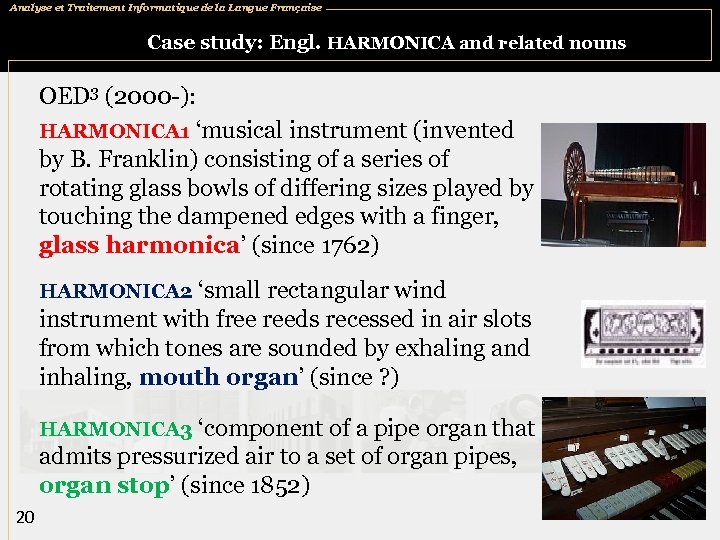 Analyse et Traitement Informatique de la Langue Française Case study: Engl. HARMONICA and related nouns OED 3 (2000 -): HARMONICA 1 ‘musical instrument (invented by B. Franklin) consisting of a series of rotating glass bowls of differing sizes played by touching the dampened edges with a finger, glass harmonica’ (since 1762) HARMONICA 2 ‘small rectangular wind instrument with free reeds recessed in air slots from which tones are sounded by exhaling and inhaling, mouth organ’ (since ? ) HARMONICA 3 ‘component of a pipe organ that admits pressurized air to a set of organ pipes, organ stop’ (since 1852) 20
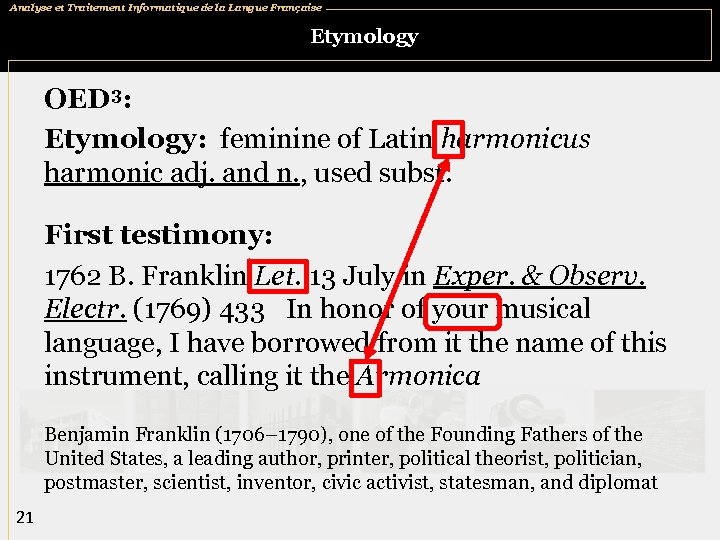 Analyse et Traitement Informatique de la Langue Française Etymology OED 3: Etymology: feminine of Latin harmonicus harmonic adj. and n. , used subst. First testimony: 1762 B. Franklin Let. 13 July in Exper. & Observ. Electr. (1769) 433 In honor of your musical language, I have borrowed from it the name of this instrument, calling it the Armonica Benjamin Franklin (1706– 1790), one of the Founding Fathers of the United States, a leading author, printer, political theorist, politician, postmaster, scientist, inventor, civic activist, statesman, and diplomat 21
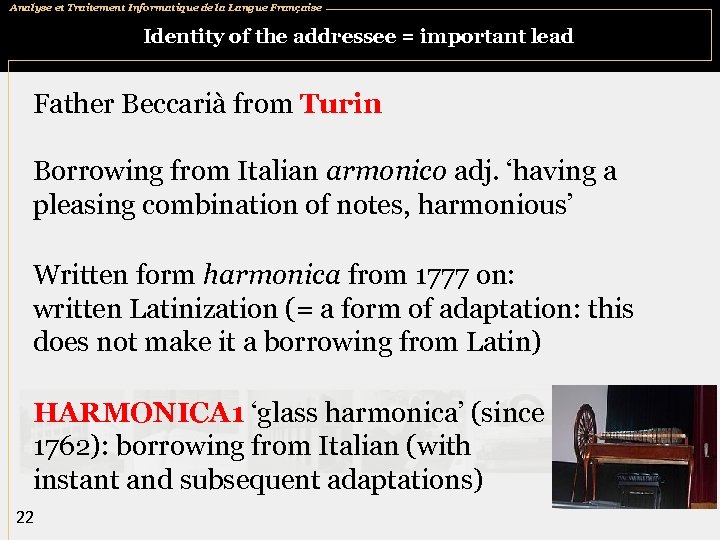 Analyse et Traitement Informatique de la Langue Française Identity of the addressee = important lead Father Beccarià from Turin Borrowing from Italian armonico adj. ‘having a pleasing combination of notes, harmonious’ Written form harmonica from 1777 on: written Latinization (= a form of adaptation: this does not make it a borrowing from Latin) HARMONICA 1 ‘glass harmonica’ (since 1762): borrowing from Italian (with instant and subsequent adaptations) 22
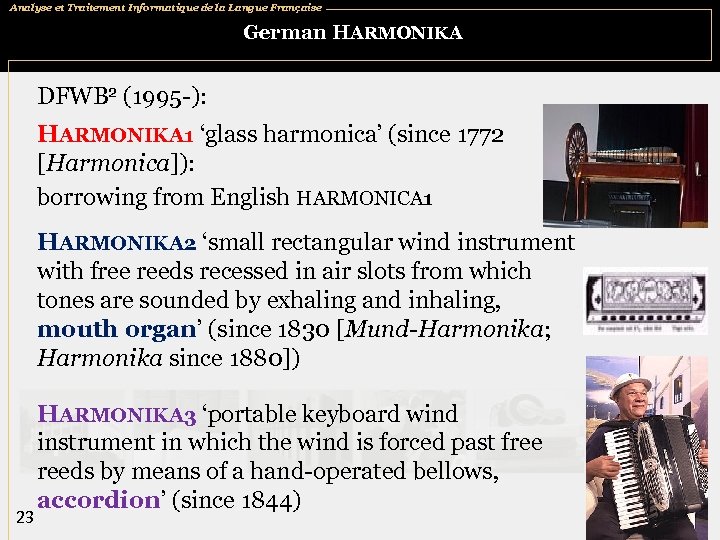 Analyse et Traitement Informatique de la Langue Française German HARMONIKA DFWB 2 (1995 -): HARMONIKA 1 ‘glass harmonica’ (since 1772 [Harmonica]): borrowing from English HARMONICA 1 HARMONIKA 2 ‘small rectangular wind instrument with free reeds recessed in air slots from which tones are sounded by exhaling and inhaling, mouth organ’ (since 1830 [Mund-Harmonika; Harmonika since 1880]) 23 HARMONIKA 3 ‘portable keyboard wind instrument in which the wind is forced past free reeds by means of a hand-operated bellows, accordion’ (since 1844)
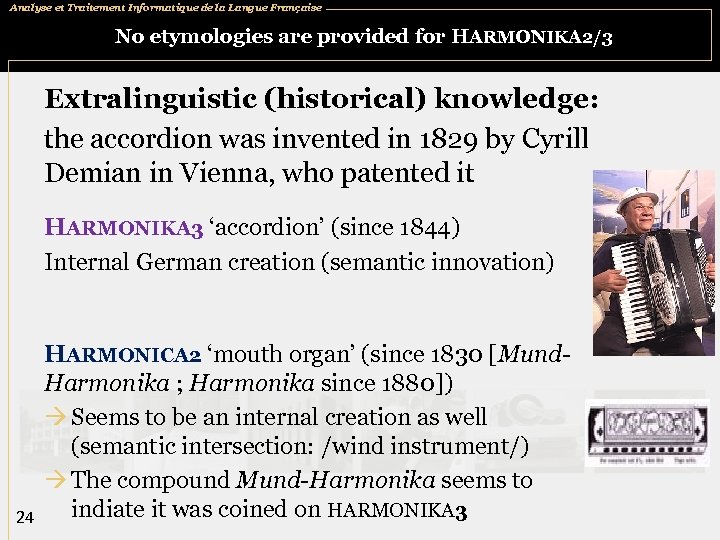 Analyse et Traitement Informatique de la Langue Française No etymologies are provided for HARMONIKA 2/3 Extralinguistic (historical) knowledge: the accordion was invented in 1829 by Cyrill Demian in Vienna, who patented it HARMONIKA 3 ‘accordion’ (since 1844) Internal German creation (semantic innovation) 24 HARMONICA 2 ‘mouth organ’ (since 1830 [Mund. Harmonika ; Harmonika since 1880]) Seems to be an internal creation as well (semantic intersection: /wind instrument/) The compound Mund-Harmonika seems to indiate it was coined on HARMONIKA 3
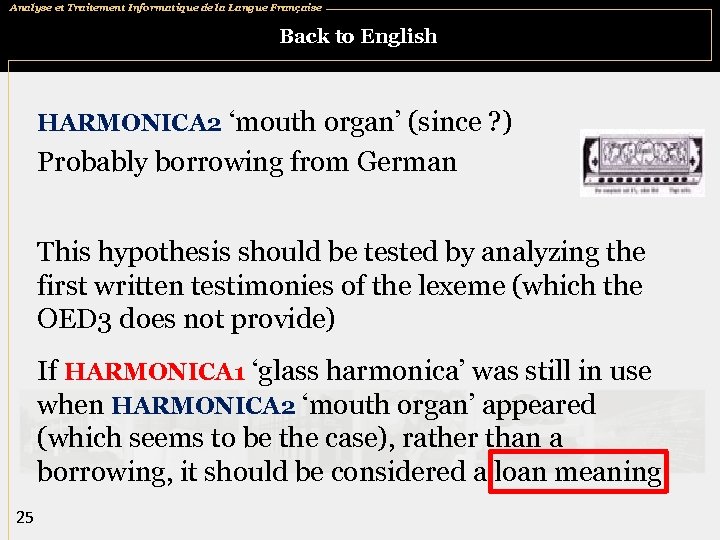 Analyse et Traitement Informatique de la Langue Française Back to English HARMONICA 2 ‘mouth organ’ (since ? ) Probably borrowing from German This hypothesis should be tested by analyzing the first written testimonies of the lexeme (which the OED 3 does not provide) If HARMONICA 1 ‘glass harmonica’ was still in use when HARMONICA 2 ‘mouth organ’ appeared (which seems to be the case), rather than a borrowing, it should be considered a loan meaning 25
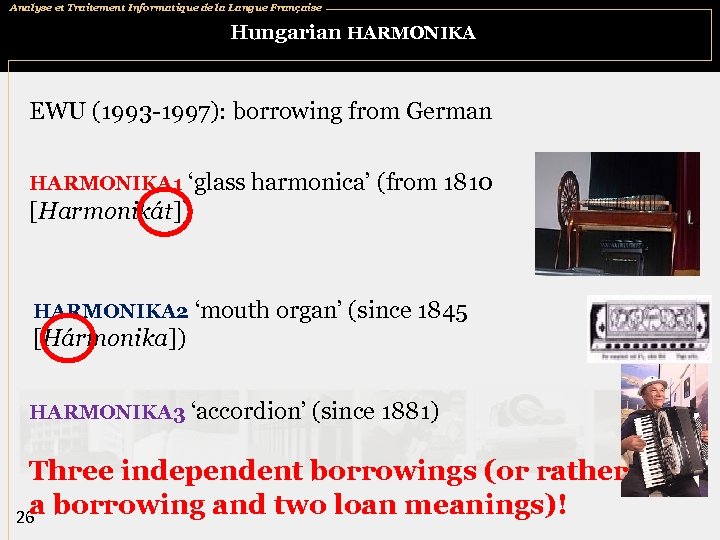 Analyse et Traitement Informatique de la Langue Française Hungarian HARMONIKA EWU (1993 -1997): borrowing from German HARMONIKA 1 ‘glass harmonica’ (from 1810 [Harmonikát]) HARMONIKA 2 ‘mouth organ’ (since 1845 [Hármonika]) HARMONIKA 3 ‘accordion’ (since 1881) Three independent borrowings (or rather a borrowing and two loan meanings)! 26
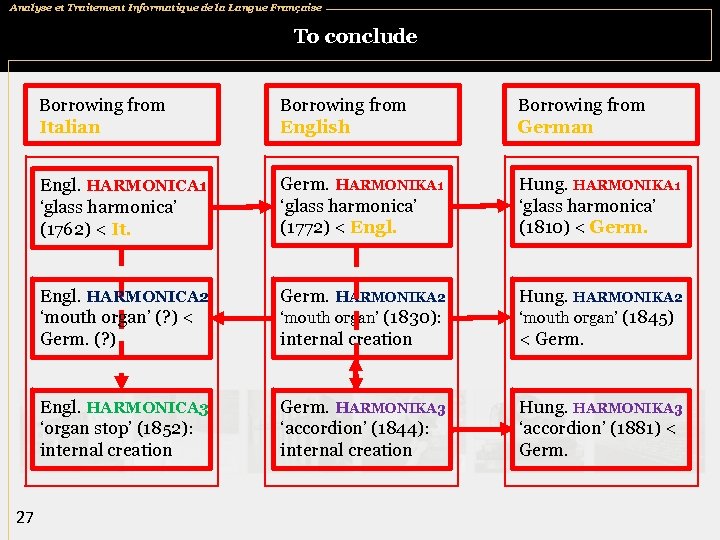 Analyse et Traitement Informatique de la Langue Française To conclude Borrowing from Italian Borrowing from German Engl. HARMONICA 1 ‘glass harmonica’ (1762) < It. Germ. HARMONIKA 1 ‘glass harmonica’ (1772) < Engl. Hung. HARMONIKA 1 ‘glass harmonica’ (1810) < Germ. Engl. HARMONICA 2 ‘mouth organ’ (? ) < Germ. (? ) Germ. HARMONIKA 2 ‘mouth organ’ (1830): internal creation Hung. HARMONIKA 2 ‘mouth organ’ (1845) < Germ. Engl. HARMONICA 3 ‘organ stop’ (1852): internal creation 27 Borrowing from English Germ. HARMONIKA 3 ‘accordion’ (1844): internal creation Hung. HARMONIKA 3 ‘accordion’ (1881) < Germ.