


 Скачать презентацию What Are Cognitive Disorders Cognitive disorders occur
Cognitive disorders.pptx
- Количество слайдов: 8
 What Are Cognitive Disorders?
 Cognitive disorders occur when a person experiences a loss or interruption of normal thought processes. There are three general types of cognitive disorders: dementia, delirium, and amnesia. Let's look closer at each one.
 Delirium Charlotte is in the hospital because she fell and had to have hip replacement surgery. Her granddaughter Mimi comes to visit her often, and soon Mimi notices a strange pattern. When she visits Charlotte in the morning, she seems OK. She talks and acts normally, though sometimes she gazes off into space and seems to get lost in her own thoughts. But overall, Charlotte seems fine in the mornings. But when Mimi comes to visit in the afternoons or evenings, something is different. Charlotte seems confused and sometimes doesn't know what day it is or where she is. Her attention wanders, and she doesn't always seem to be aware that Mimi is there. The doctors who check in on Charlotte usually do their rounds in the morning, so they don't ever see her at her worst. But Mimi is concerned. She heard in her psychology class at school that some people suffer from delirium, a cognitive disorder that involves confusion and disorientation, among other symptoms. Could Charlotte have delirium?
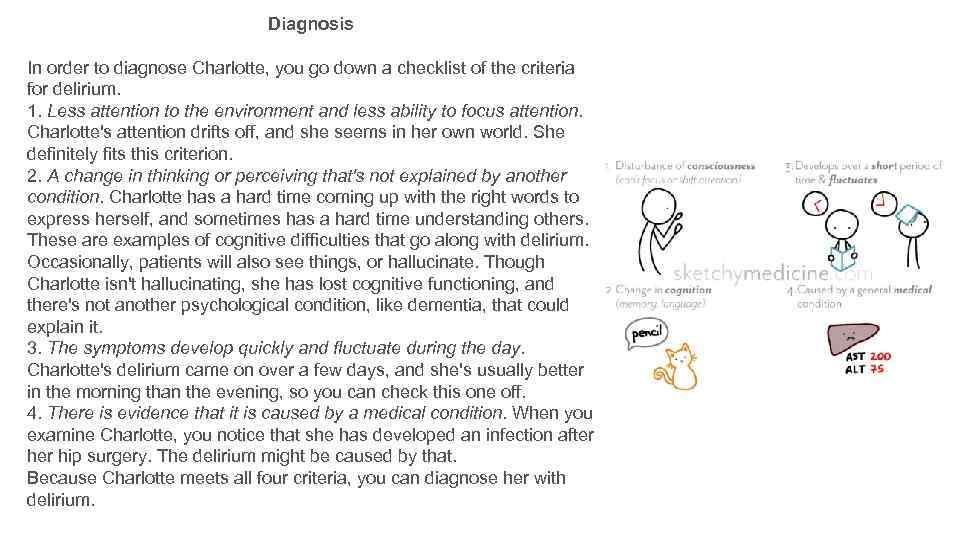 Diagnosis In order to diagnose Charlotte, you go down a checklist of the criteria for delirium. 1. Less attention to the environment and less ability to focus attention. Charlotte's attention drifts off, and she seems in her own world. She definitely fits this criterion. 2. A change in thinking or perceiving that's not explained by another condition. Charlotte has a hard time coming up with the right words to express herself, and sometimes has a hard time understanding others. These are examples of cognitive difficulties that go along with delirium. Occasionally, patients will also see things, or hallucinate. Though Charlotte isn't hallucinating, she has lost cognitive functioning, and there's not another psychological condition, like dementia, that could explain it. 3. The symptoms develop quickly and fluctuate during the day. Charlotte's delirium came on over a few days, and she's usually better in the morning than the evening, so you can check this one off. 4. There is evidence that it is caused by a medical condition. When you examine Charlotte, you notice that she has developed an infection after hip surgery. The delirium might be caused by that. Because Charlotte meets all four criteria, you can diagnose her with delirium.
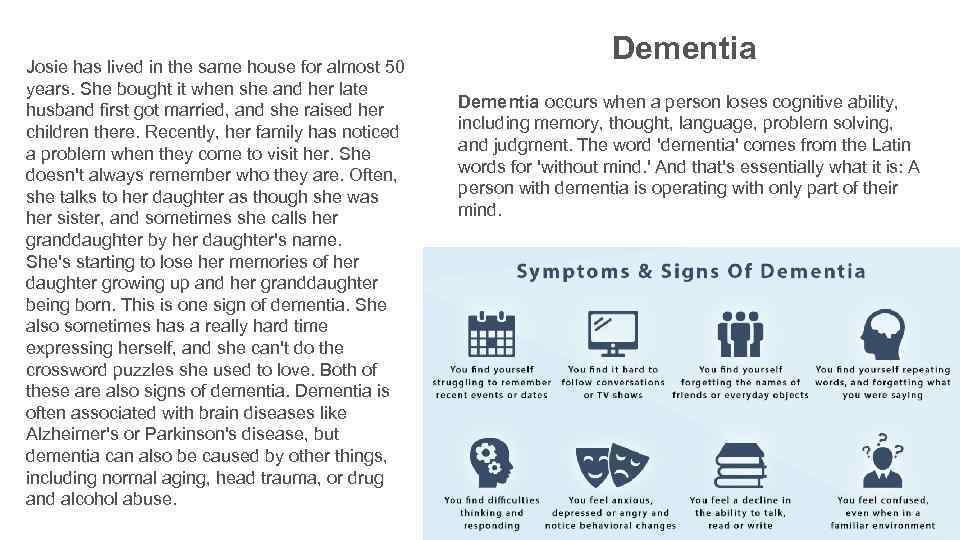 Josie has lived in the same house for almost 50 years. She bought it when she and her late husband first got married, and she raised her children there. Recently, her family has noticed a problem when they come to visit her. She doesn't always remember who they are. Often, she talks to her daughter as though she was her sister, and sometimes she calls her granddaughter by her daughter's name. She's starting to lose her memories of her daughter growing up and her granddaughter being born. This is one sign of dementia. She also sometimes has a really hard time expressing herself, and she can't do the crossword puzzles she used to love. Both of these are also signs of dementia. Dementia is often associated with brain diseases like Alzheimer's or Parkinson's disease, but dementia can also be caused by other things, including normal aging, head trauma, or drug and alcohol abuse. Dementia occurs when a person loses cognitive ability, including memory, thought, language, problem solving, and judgment. The word 'dementia' comes from the Latin words for 'without mind. ' And that's essentially what it is: A person with dementia is operating with only part of their mind.
 Delirium or Dementia? Delirium is sometimes confused with dementia, another cognitive disorder that involves losing the ability to think clearly and losing memories. Because delirium and dementia are so similar, someone with delirium can be diagnosed with dementia and vice versa. But there a few key differences. 1. Onset of the condition. Delirium usually develops quickly, within a few days, while dementia develops slowly over months or years. 2. Attention. Someone with delirium often has problems engaging or disengaging their attention. As a result, they often come across as 'out of it. ' In contrast, patients in the early stages of dementia are usually alert. 3. Fluctuation. While dementia patients are usually the same no matter when you talk to them, delirium patients' symptoms fluctuate during the day. Sundowning, or worsening of symptoms as night sets in, is common for delirium patients.
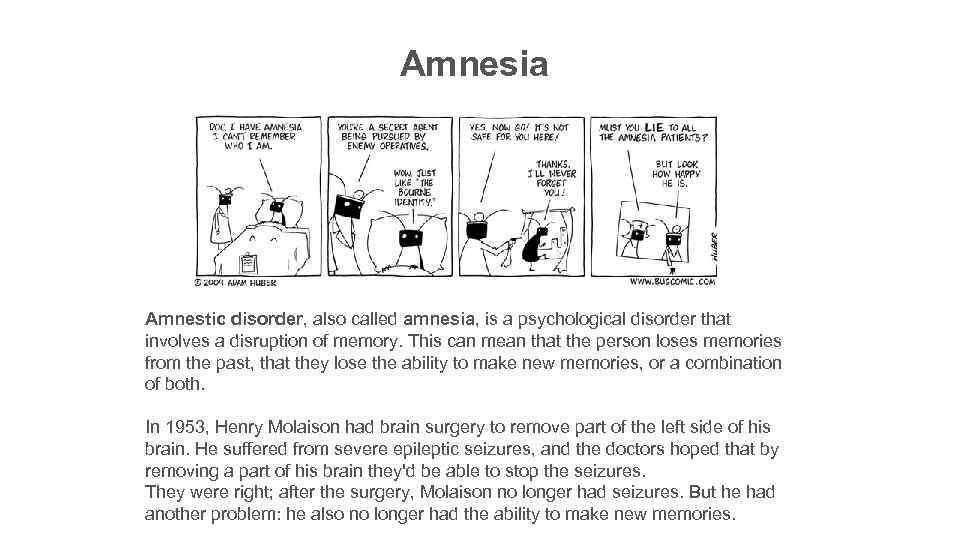 Amnesia Amnestic disorder, also called amnesia, is a psychological disorder that involves a disruption of memory. This can mean that the person loses memories from the past, that they lose the ability to make new memories, or a combination of both. In 1953, Henry Molaison had brain surgery to remove part of the left side of his brain. He suffered from severe epileptic seizures, and the doctors hoped that by removing a part of his brain they'd be able to stop the seizures. They were right; after the surgery, Molaison no longer had seizures. But he had another problem: he also no longer had the ability to make new memories.
 Types of Amnesia There are many types of amnestic disorders. The most commonly studied ones are retrograde and anterograde amnesia. Remember Henry Molaison? After he had surgery to remove part of his brain, many of his childhood memories were still intact. He could remember where he went to school, the time that he fell off his bike, and other important moments from his past. But every day for the rest of his life, he woke up believing that he had just had the surgery. Even over 50 years after his surgery, he didn't remember his life past the day of the surgery! Molaison suffered from severe anterograde amnesia. This type of amnestic disorder involves an inability to form new memories. Patients like H. M. can learn how to do new things, but they don't remember learning them. For example, if H. M. was taught a new computer game one day, the next day he would say that he had never played the game before. But when he played it, he would do much better than he had the first time he played it, and much better than other first-time players. He had learned how to play the game but didn't remember learning it. Imagine for a moment that H. M. 's surgery had a different outcome. He woke up from the surgery and had no problem making new memories. The day after the surgery, he woke up and remembered the day before, when he'd had the surgery. But imagine that H. M. could not remember anything at all from before the surgery. All of his childhood memories, his parents, his favorite restaurant, his least favorite vegetable: all of these memories gone. That is retrograde amnesia, an amnestic disorder that involves losing memories that have already been formed. In reality, H. M. did suffer from some retrograde amnesia, but it was not as severe as his anterograde amnesia. He could remember some things, but lost a few large chunks of time before the surgery.