 Скачать презентацию What about the fifth skill Badria Al Brashdi
81c67e84f593cbc35df0110d87a184c7.ppt
- Количество слайдов: 22



What about the fifth skill? Badria Al Brashdi Louise Greenwood Kate Tindle
Grammar is often seen as… ‘…a static product that consists of forms that are rule-governed, sentence-level, absolute, and constitute a closed system. ’ Larsen-Freeman, 2003
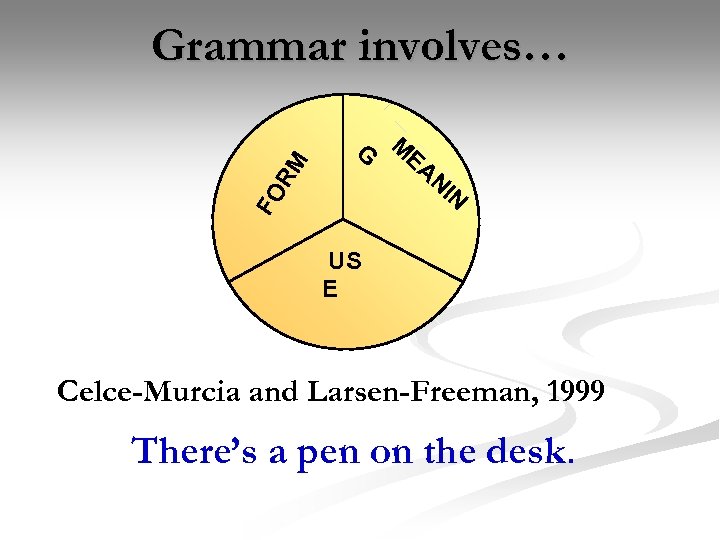
FO RM Grammar involves… G ME AN IN US E Celce-Murcia and Larsen-Freeman, 1999 There’s a pen on the desk.
‘…students (need) to learn how to use grammar structures accurately , meaningfully appropriately and. ’ Celce-Murcia and Larsen-Freeman, 1999
Is it teachable? ‘There is ample evidence to demonstrate that teaching grammar works. ’ Ellis, 2006
‘…students will not necessarily learn what we teach them when we teach (it). ’ Willis, J. , 1996
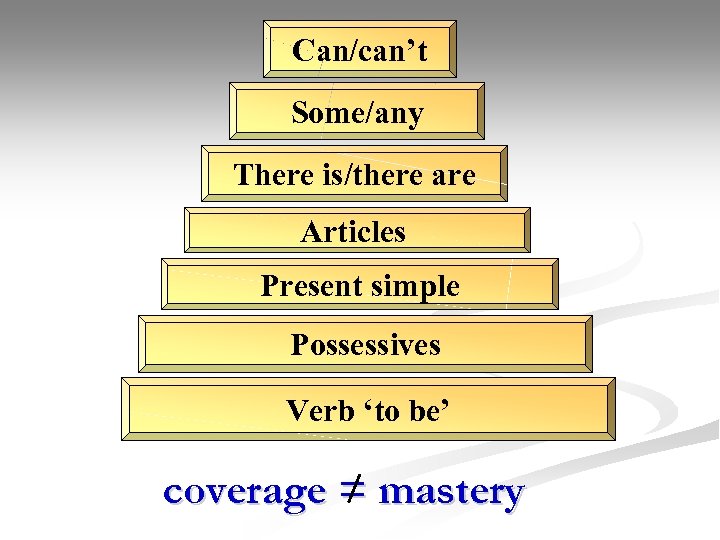
Can/can’t Some/any There is/there are Articles Present simple Possessives Verb ‘to be’ coverage = mastery
‘Grammar can be productively regarded as a fifth skill, not only as an area of knowledge. ’ Larsen-Freeman, 2003 ‘It’s a process for which we need a verb – something like grammaring. ’ Thornbury, 2001
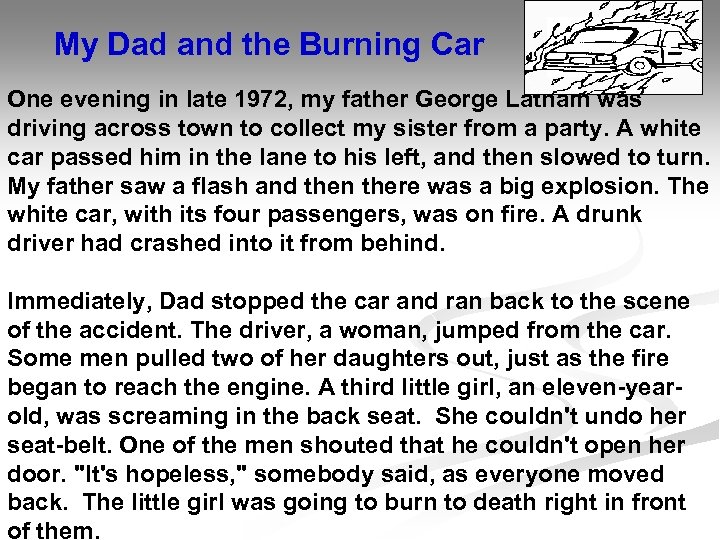
My Dad and the Burning Car One evening in late 1972, my father George Latham was driving across town to collect my sister from a party. A white car passed him in the lane to his left, and then slowed to turn. My father saw a flash and then there was a big explosion. The white car, with its four passengers, was on fire. A drunk driver had crashed into it from behind. Immediately, Dad stopped the car and ran back to the scene of the accident. The driver, a woman, jumped from the car. Some men pulled two of her daughters out, just as the fire began to reach the engine. A third little girl, an eleven-yearold, was screaming in the back seat. She couldn't undo her seat-belt. One of the men shouted that he couldn't open her door. "It's hopeless, " somebody said, as everyone moved back. The little girl was going to burn to death right in front of them.
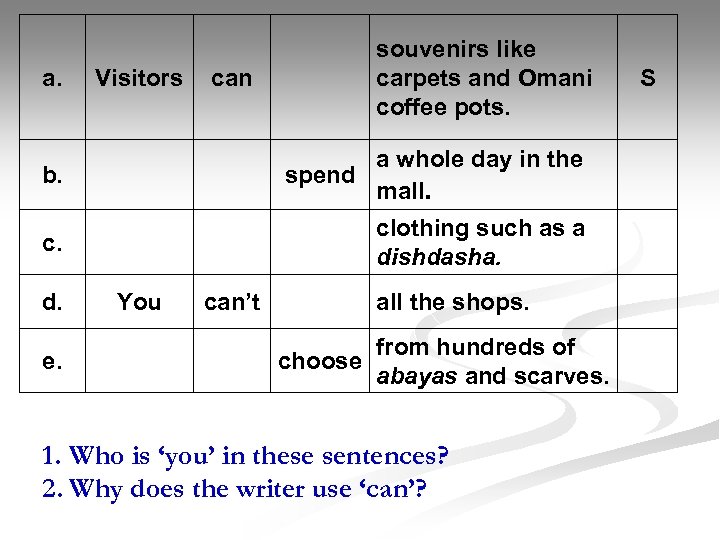
a. Visitors can souvenirs like carpets and Omani coffee pots. b. a whole day in the spend mall. clothing such as a dishdasha. d. e. You can’t all the shops. from hundreds of choose abayas and scarves. 1. Who is ‘you’ in these sentences? 2. Why does the writer use ‘can’? S
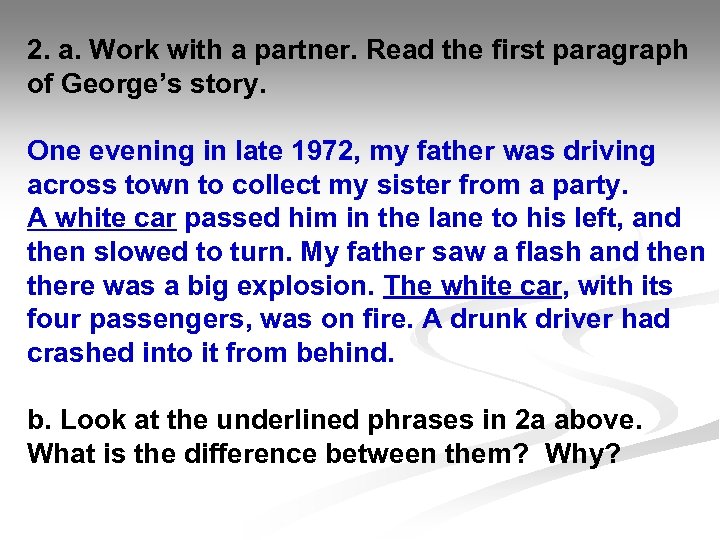
2. a. Work with a partner. Read the first paragraph of George’s story. One evening in late 1972, my father was driving across town to collect my sister from a party. A white car passed him in the lane to his left, and then slowed to turn. My father saw a flash and then there was a big explosion. The white car, with its four passengers, was on fire. A drunk driver had crashed into it from behind. b. Look at the underlined phrases in 2 a above. What is the difference between them? Why?
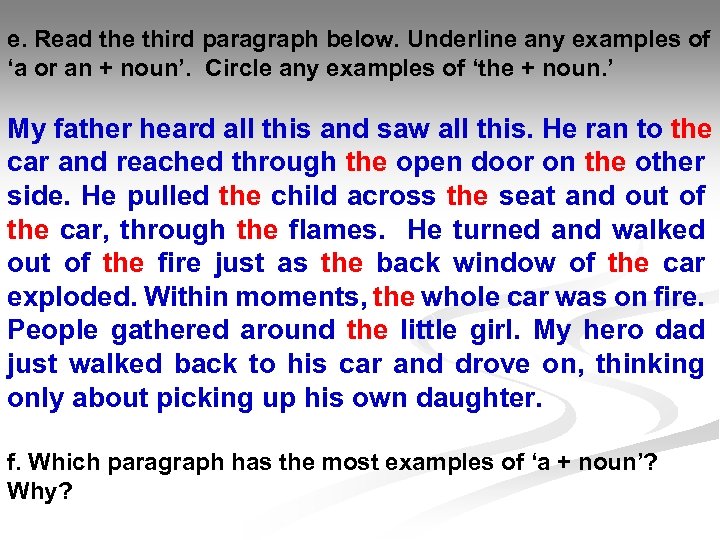
e. Read the third paragraph below. Underline any examples of ‘a or an + noun’. Circle any examples of ‘the + noun. ’ My father heard all this and saw all this. He ran to the car and reached through the open door on the other side. He pulled the child across the seat and out of the car, through the flames. He turned and walked out of the fire just as the back window of the car exploded. Within moments, the whole car was on fire. People gathered around the little girl. My hero dad just walked back to his car and drove on, thinking only about picking up his own daughter. f. Which paragraph has the most examples of ‘a + noun’? Why?
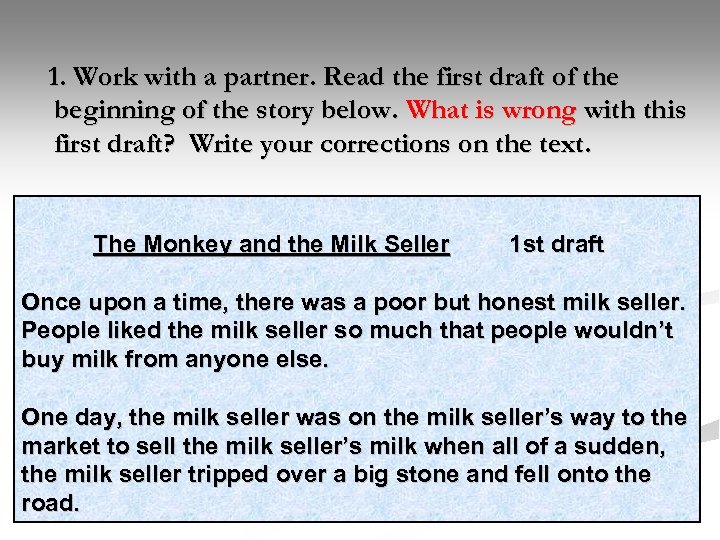
1. Work with a partner. Read the first draft of the beginning of the story below. What is wrong with this first draft? Write your corrections on the text. The Monkey and the Milk Seller 1 st draft Once upon a time, there was a poor but honest milk seller. People liked the milk seller so much that people wouldn’t buy milk from anyone else. One day, the milk seller was on the milk seller’s way to the market to sell the milk seller’s milk when all of a sudden, the milk seller tripped over a big stone and fell onto the road.
4. Improve your writing Look back at the story you wrote for the competition and check it: n Did you use pronouns (he, she, him, and etc. ) possessives (her, correctly? his) Make changes to your first draft if necessary.
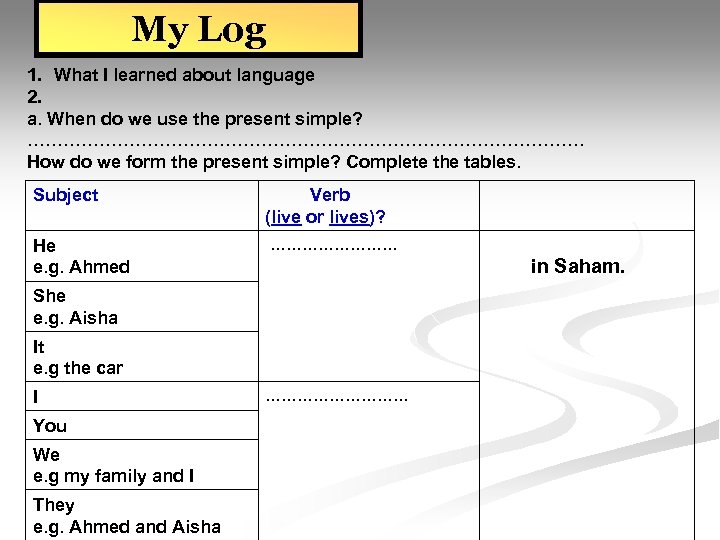
My Log 1. What I learned about language 2. a. When do we use the present simple? ………………………………………… How do we form the present simple? Complete the tables. Subject Verb (live or lives)? He e. g. Ahmed ………… in Saham. She e. g. Aisha It e. g the car I You We e. g my family and I They e. g. Ahmed and Aisha ……………
To practise or not to practise… ‘… some structures may require (in-depth practice) before they can be fully acquired. ’ Ellis, 2006
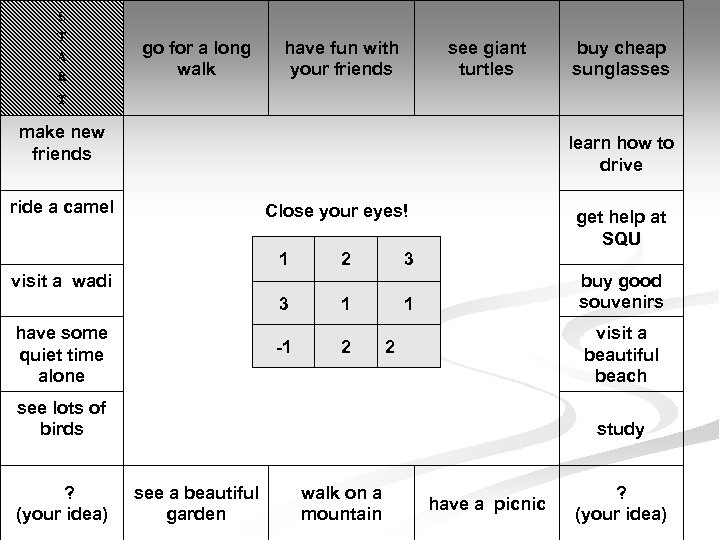
S T A R go for a long walk have fun with your friends see giant turtles buy cheap sunglasses T make new friends learn how to drive ride a camel Close your eyes! 1 2 get help at SQU 3 visit a wadi 3 have some quiet time alone -1 1 2 buy good souvenirs 1 visit a beautiful beach 2 see lots of birds ? (your idea) study see a beautiful garden walk on a mountain have a picnic ? (your idea)
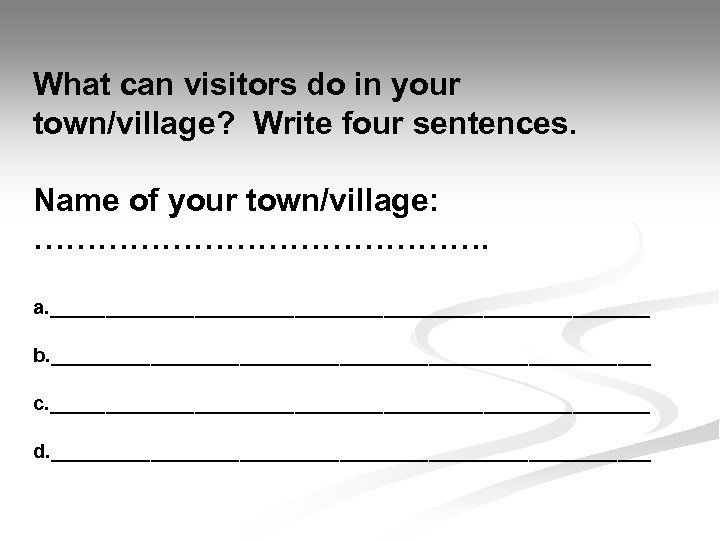
What can visitors do in your town/village? Write four sentences. Name of your town/village: …………………. a. ___________________________ b. ___________________________ c. ___________________________ d. ___________________________
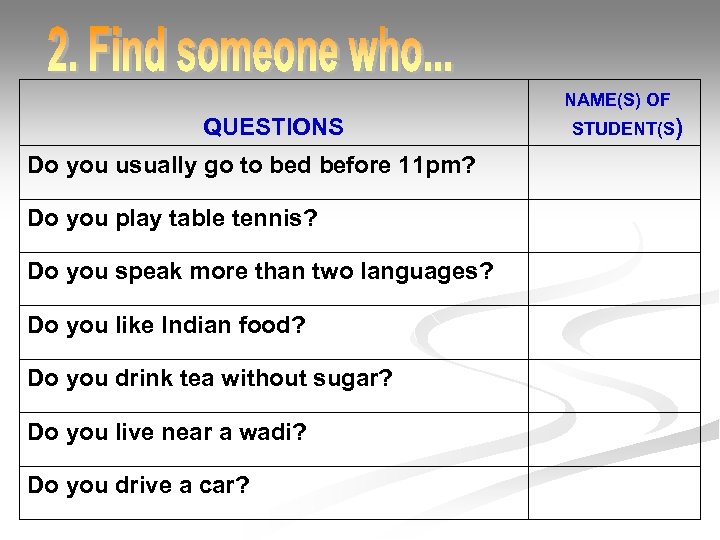
NAME(S) OF QUESTIONS Do you usually go to bed before 11 pm? Do you play table tennis? Do you speak more than two languages? Do you like Indian food? Do you drink tea without sugar? Do you live near a wadi? Do you drive a car? STUDENT(S)
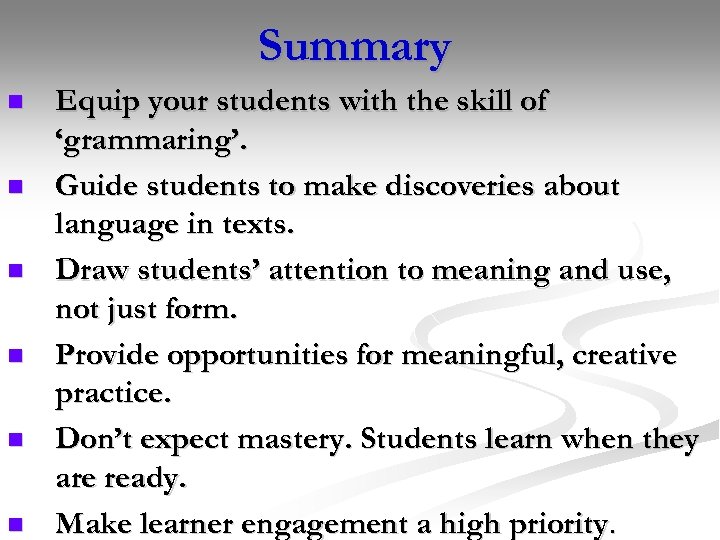
Summary n n n Equip your students with the skill of ‘grammaring’. Guide students to make discoveries about language in texts. Draw students’ attention to meaning and use, not just form. Provide opportunities for meaningful, creative practice. Don’t expect mastery. Students learn when they are ready. Make learner engagement a high priority.
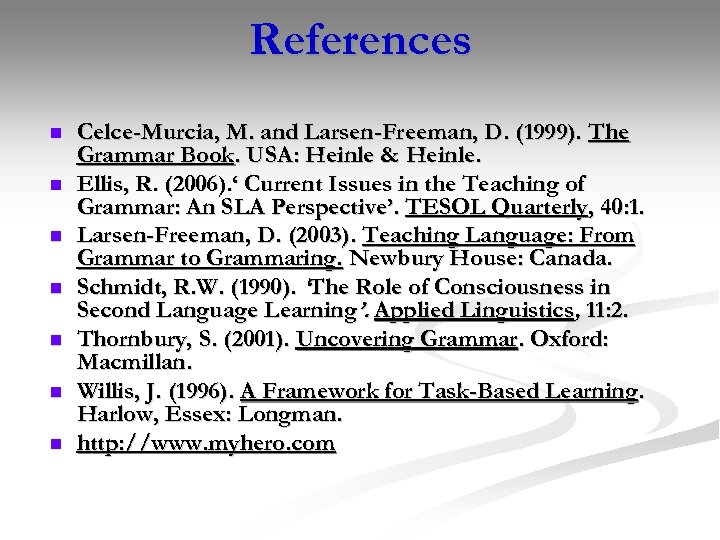
References n n n n Celce-Murcia, M. and Larsen-Freeman, D. (1999). The Grammar Book. USA: Heinle & Heinle. Ellis, R. (2006). ‘ Current Issues in the Teaching of Grammar: An SLA Perspective’. TESOL Quarterly, 40: 1. Larsen-Freeman, D. (2003). Teaching Language: From Grammar to Grammaring. Newbury House: Canada. Schmidt, R. W. (1990). ‘The Role of Consciousness in Second Language Learning’. Applied Linguistics, 11: 2. Thornbury, S. (2001). Uncovering Grammar. Oxford: Macmillan. Willis, J. (1996). A Framework for Task-Based Learning. Harlow, Essex: Longman. http: //www. myhero. com
Скачать презентацию What about the fifth skill Badria Al Brashdi
81c67e84f593cbc35df0110d87a184c7.ppt