


 Скачать презентацию WG 2 RD 51 in Crete Introductionary
1ddd7b272c100cc085fb1fd69e352693.ppt
- Количество слайдов: 59
 WG 2 @RD 51 in Crete
 Introductionary remarks: WG 2 “specialty”: physics of MPGDs and common standards A ancient philosopher definition: “…if it smells- it is chemistry …if it moves- it is biology. . if it does not work –it is physics”… …so the task of the WG 2 is to make it working
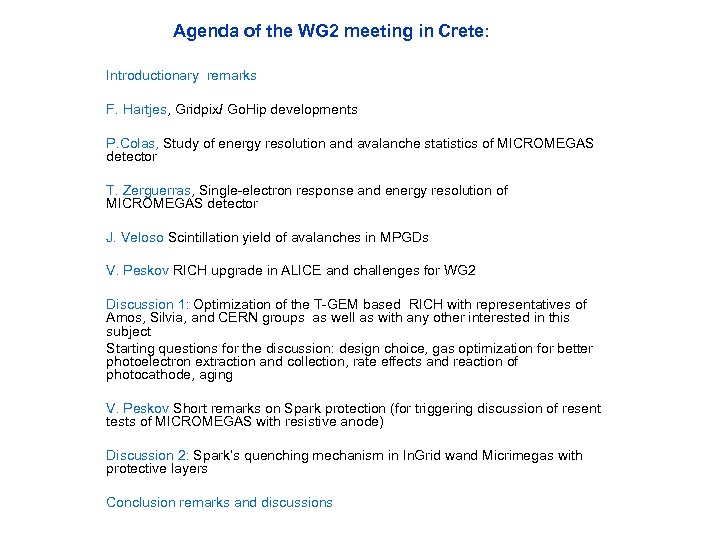 Agenda of the WG 2 meeting in Crete: Introductionary remarks F. Hartjes, Gridpix/ Go. Hip developments P. Colas, Study of energy resolution and avalanche statistics of MICROMEGAS detector T. Zerguerras, Single-electron response and energy resolution of MICROMEGAS detector J. Veloso Scintillation yield of avalanches in MPGDs V. Peskov RICH upgrade in ALICE and challenges for WG 2 Discussion 1: Optimization of the T-GEM based RICH with representatives of Amos, Silvia, and CERN groups as well as with any other interested in this subject Starting questions for the discussion: design choice, gas optimization for better photoelectron extraction and collection, rate effects and reaction of photocathode, aging V. Peskov Short remarks on Spark protection (for triggering discussion of resent tests of MICROMEGAS with resistive anode) Discussion 2: Spark’s quenching mechanism in In. Grid wand Micrimegas with protective layers Conclusion remarks and discussions
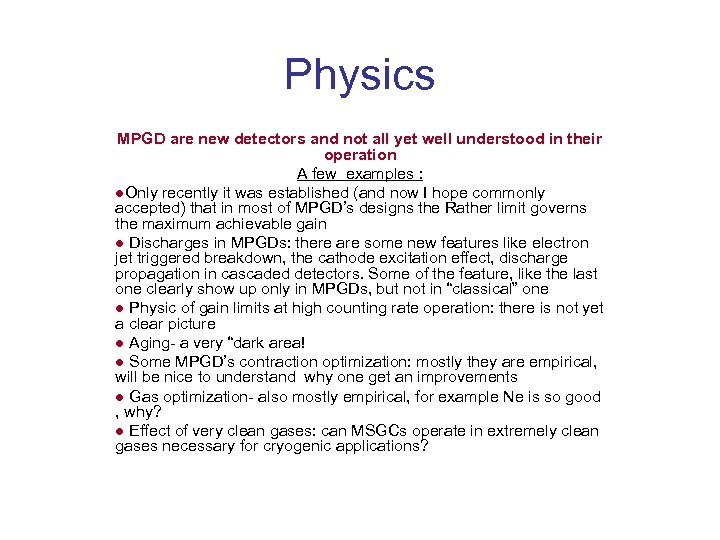 Physics MPGD are new detectors and not all yet well understood in their operation A few examples : ●Only recently it was established (and now I hope commonly accepted) that in most of MPGD’s designs the Rather limit governs the maximum achievable gain ● Discharges in MPGDs: there are some new features like electron jet triggered breakdown, the cathode excitation effect, discharge propagation in cascaded detectors. Some of the feature, like the last one clearly show up only in MPGDs, but not in “classical” one ● Physic of gain limits at high counting rate operation: there is not yet a clear picture ● Aging- a very “dark area! ● Some MPGD’s contraction optimization: mostly they are empirical, will be nice to understand why one get an improvements ● Gas optimization- also mostly empirical, for example Ne is so good , why? ● Effect of very clean gases: can MSGCs operate in extremely clean gases necessary for cryogenic applications?
 Where common standards are important? A few examples: ● Aging study: to compare results obtained in different laboratories on need set identical conditions: gas cleanest and composition, gas gain, counting rate ● QE there are several methods to measure it: via comparison to a calibrate detector, comparison to TMAE It is important then how the QE was measured, at what gain
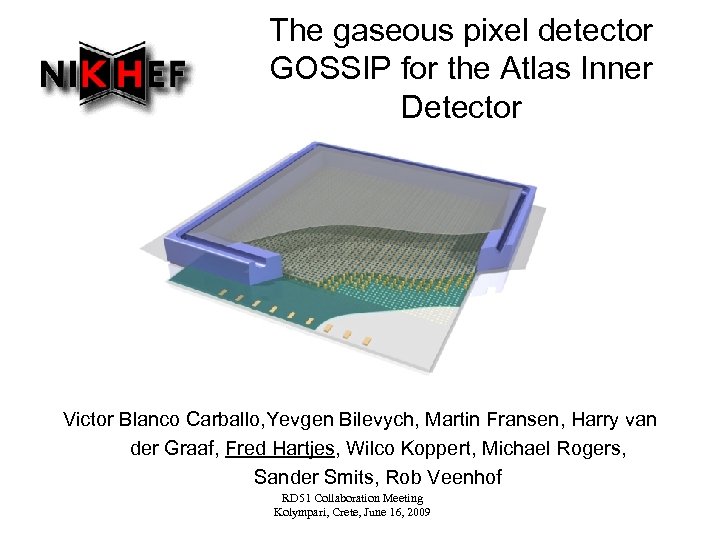 The gaseous pixel detector GOSSIP for the Atlas Inner Detector Victor Blanco Carballo, Yevgen Bilevych, Martin Fransen, Harry van der Graaf, Fred Hartjes, Wilco Koppert, Michael Rogers, Sander Smits, Rob Veenhof RD 51 Collaboration Meeting Kolympari, Crete, June 16, 2009
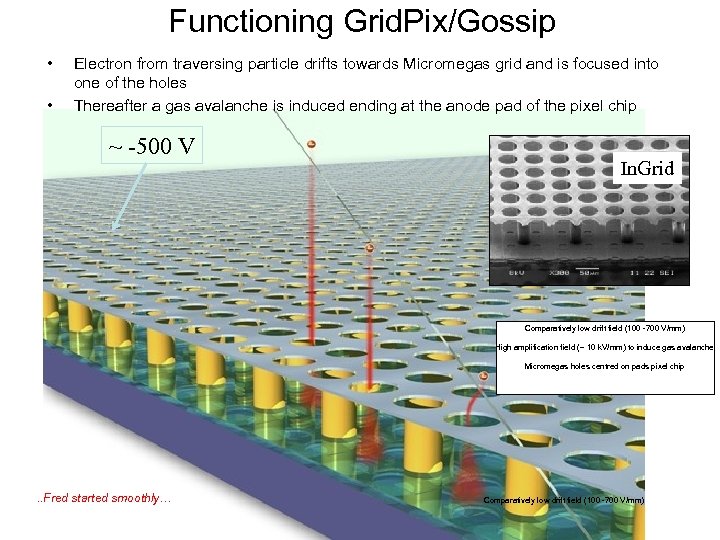 Functioning Grid. Pix/Gossip • • Electron from traversing particle drifts towards Micromegas grid and is focused into one of the holes Thereafter a gas avalanche is induced ending at the anode pad of the pixel chip ~ -500 V In. Grid Comparatively low drift field (100 -700 V/mm) High amplification field (~ 10 k. V/mm) to induce gas avalanche Micromegas holes centred on pads pixel chip . . Fred started smoothly… Comparatively low drift field (100 -700 V/mm)
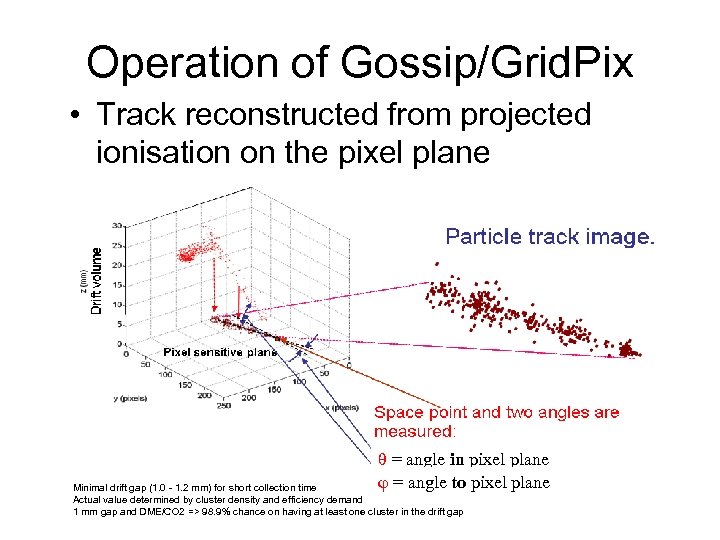 Operation of Gossip/Grid. Pix • Track reconstructed from projected ionisation on the pixel plane θ = angle in pixel plane φ = angle to pixel plane Minimal drift gap (1. 0 - 1. 2 mm) for short collection time Actual value determined by cluster density and efficiency demand 1 mm gap and DME/CO 2 => 98. 9% chance on having at least one cluster in the drift gap
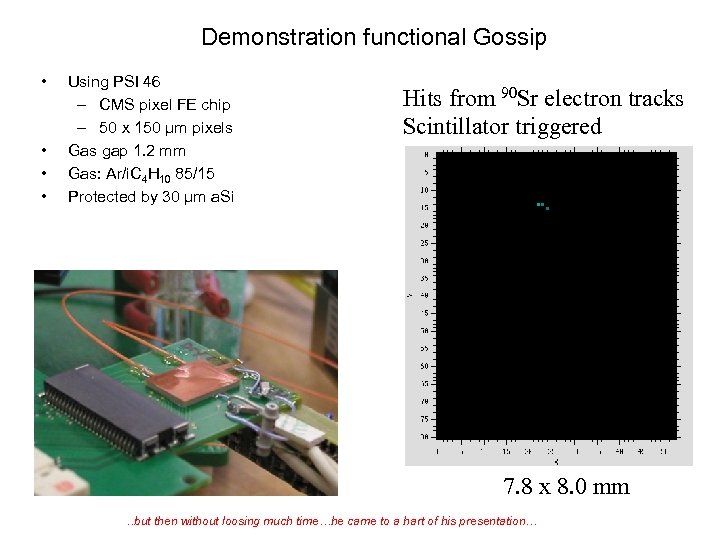 Demonstration functional Gossip • • Using PSI 46 – CMS pixel FE chip – 50 x 150 µm pixels Gas gap 1. 2 mm Gas: Ar/i. C 4 H 10 85/15 Protected by 30 µm a. Si Hits from 90 Sr electron tracks Scintillator triggered 7. 8 x 8. 0 mm. . but then without loosing much time…he came to a hart of his presentation…
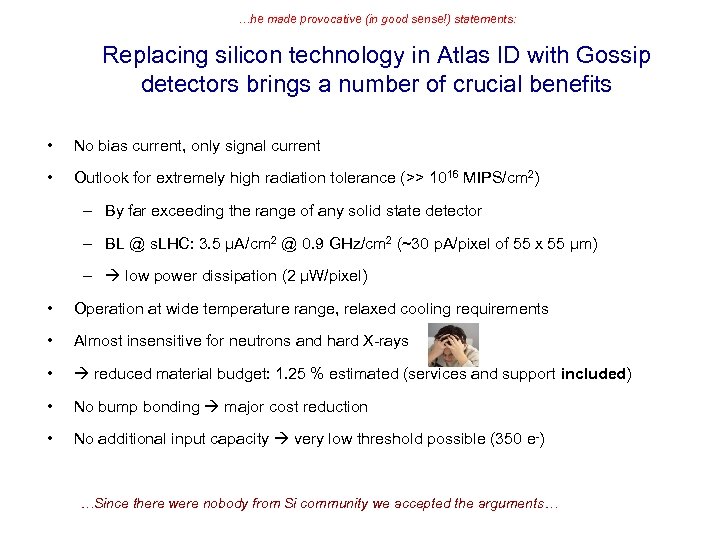 …he made provocative (in good sense!) statements: Replacing silicon technology in Atlas ID with Gossip detectors brings a number of crucial benefits • No bias current, only signal current • Outlook for extremely high radiation tolerance (>> 1016 MIPS/cm 2) – By far exceeding the range of any solid state detector – BL @ s. LHC: 3. 5 µA/cm 2 @ 0. 9 GHz/cm 2 (~30 p. A/pixel of 55 x 55 µm) – low power dissipation (2 µW/pixel) • Operation at wide temperature range, relaxed cooling requirements • Almost insensitive for neutrons and hard X-rays • reduced material budget: 1. 25 % estimated (services and support included) • No bump bonding major cost reduction • No additional input capacity very low threshold possible (350 e-) …Since there were nobody from Si community we accepted the arguments…
 Personally I think that there is no science and breakthroughs without “pushers”…so I like this talk and the main idea
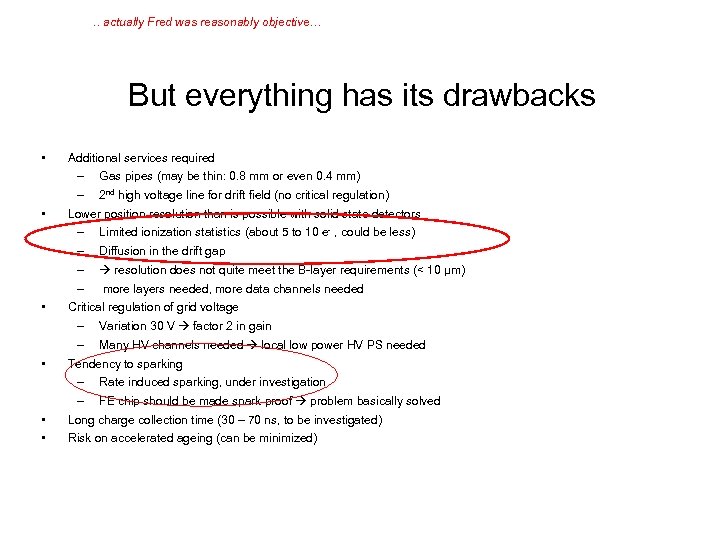 . . actually Fred was reasonably objective… But everything has its drawbacks • • • Additional services required – Gas pipes (may be thin: 0. 8 mm or even 0. 4 mm) – 2 nd high voltage line for drift field (no critical regulation) Lower position resolution than is possible with solid state detectors – Limited ionization statistics (about 5 to 10 e- , could be less) – Diffusion in the drift gap – resolution does not quite meet the B-layer requirements (< 10 µm) – more layers needed, more data channels needed Critical regulation of grid voltage – Variation 30 V factor 2 in gain – Many HV channels needed local low power HV PS needed Tendency to sparking – Rate induced sparking, under investigation – FE chip should be made spark proof problem basically solved Long charge collection time (30 – 70 ns, to be investigated) Risk on accelerated ageing (can be minimized)
 Then Fred moved to the subject close to the WG 2 “specialty: ” radiation tolerance/aging spark protection rate effect
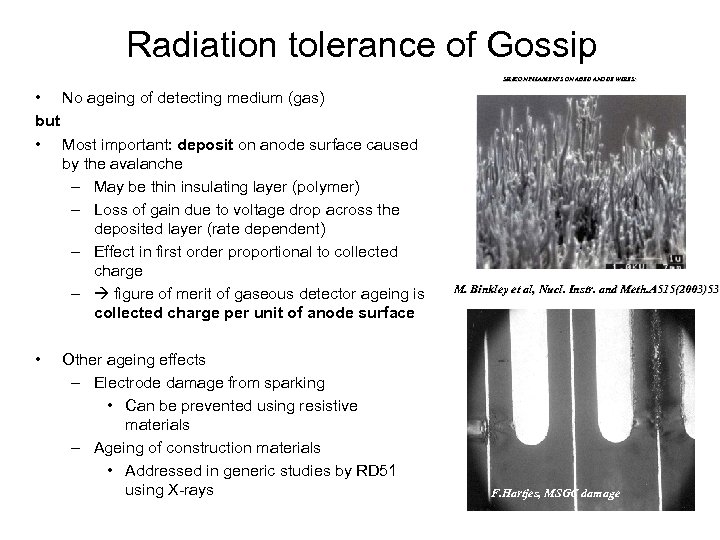 Radiation tolerance of Gossip SILICON FILAMENTS ON AGED ANODE WIRES: • No ageing of detecting medium (gas) but • Most important: deposit on anode surface caused by the avalanche – May be thin insulating layer (polymer) – Loss of gain due to voltage drop across the deposited layer (rate dependent) – Effect in first order proportional to collected charge – figure of merit of gaseous detector ageing is collected charge per unit of anode surface • Other ageing effects – Electrode damage from sparking • Can be prevented using resistive materials – Ageing of construction materials • Addressed in generic studies by RD 51 using X-rays M. Binkley et al, Nucl. Instr. and Meth. A 515(2003)53 Nucl. F. Hartjes, MSGC damage
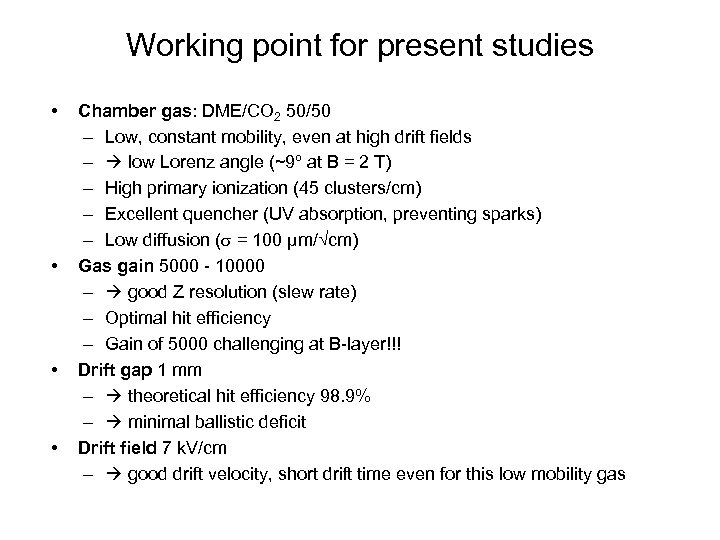 Working point for present studies • • Chamber gas: DME/CO 2 50/50 – Low, constant mobility, even at high drift fields – low Lorenz angle (~9º at B = 2 T) – High primary ionization (45 clusters/cm) – Excellent quencher (UV absorption, preventing sparks) – Low diffusion (s = 100 µm/√cm) Gas gain 5000 - 10000 – good Z resolution (slew rate) – Optimal hit efficiency – Gain of 5000 challenging at B-layer!!! Drift gap 1 mm – theoretical hit efficiency 98. 9% – minimal ballistic deficit Drift field 7 k. V/cm – good drift velocity, short drift time even for this low mobility gas
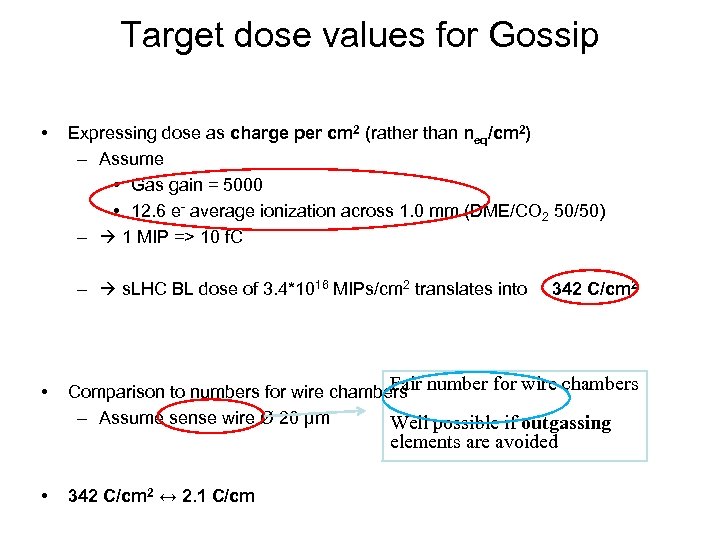 Target dose values for Gossip • Expressing dose as charge per cm 2 (rather than neq/cm 2) – Assume • Gas gain = 5000 • 12. 6 e- average ionization across 1. 0 mm (DME/CO 2 50/50) – 1 MIP => 10 f. C – s. LHC BL dose of 3. 4*1016 MIPs/cm 2 translates into • 342 C/cm 2 Fair Comparison to numbers for wire chambers number for wire chambers – Assume sense wire Ø 20 µm Well possible if outgassing elements are avoided • 342 C/cm 2 ↔ 2. 1 C/cm
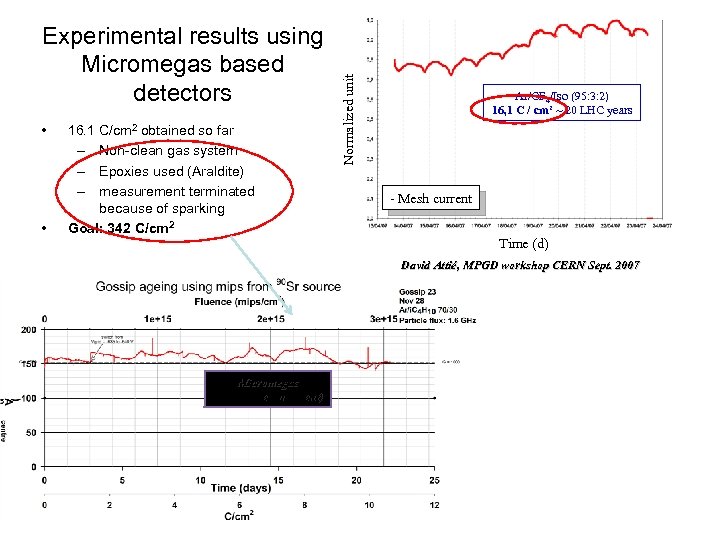 • • 16. 1 C/cm 2 obtained so far – Non-clean gas system – Epoxies used (Araldite) – measurement terminated because of sparking Goal: 342 C/cm 2 Normalized unit Experimental results using Micromegas based detectors Ar/CF 4/Iso (95: 3: 2) 16, 1 C / cm² ~ 20 LHC years - Mesh current Time (d) David Attié, MPGD workshop CERN Sept. 2007 Attié, Micromegas (Nikhef measurement)
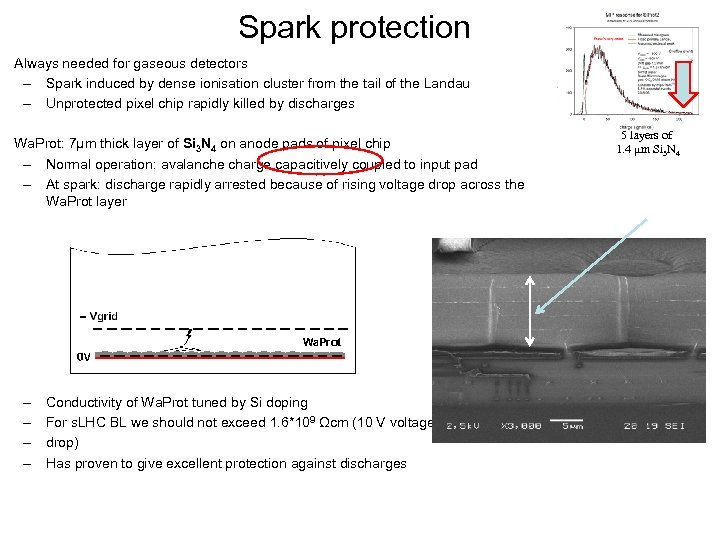 Spark protection Always needed for gaseous detectors – Spark induced by dense ionisation cluster from the tail of the Landau – Unprotected pixel chip rapidly killed by discharges Wa. Prot: 7µm thick layer of Si 3 N 4 on anode pads of pixel chip – Normal operation: avalanche charge capacitively coupled to input pad – At spark: discharge rapidly arrested because of rising voltage drop across the Wa. Prot layer Wa. Prot – – Conductivity of Wa. Prot tuned by Si doping For s. LHC BL we should not exceed 1. 6*109 Ωcm (10 V voltage drop) Has proven to give excellent protection against discharges 5 layers of 1. 4 µm Si 3 N 4
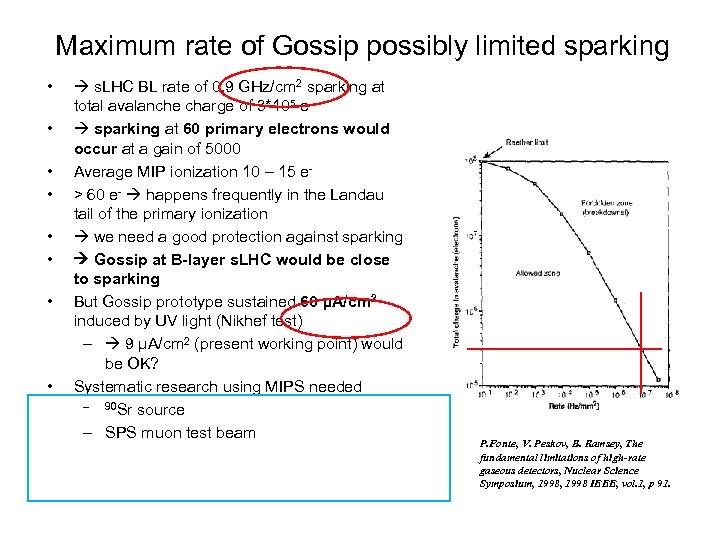 Maximum rate of Gossip possibly limited sparking • • s. LHC BL rate of 0. 9 GHz/cm 2 sparking at total avalanche charge of 3*105 e sparking at 60 primary electrons would occur at a gain of 5000 Average MIP ionization 10 – 15 e> 60 e- happens frequently in the Landau tail of the primary ionization we need a good protection against sparking Gossip at B-layer s. LHC would be close to sparking But Gossip prototype sustained 60 µA/cm 2 induced by UV light (Nikhef test) – 9 µA/cm 2 (present working point) would be OK? Systematic research using MIPS needed – 90 Sr source – SPS muon test beam P. Fonte, V. Peskov, B. Ramsey, The fundamental limitations of high-rate gaseous detectors, Nuclear Science Symposium, 1998 IEEE, vol. 1, p 91.
 Summary • Applying the Gossip technology in the pixel layers brings great benefits – Very relaxed cooling requirements – High radiation tolerance • 3. 4*1016 MIPS/cm 2 possible – Low costs (no bumpbonding) – Low material budget (1. 25%) • But we don’t get it for free – We might have to face ageing phenomena, but they are probably solvable • Many ageing tests to be done, more time consuming than for solid state detectors – New technology without running experience – Less good position resolution • Limited statistics in primary ionization – Additional services (HV, gas) – Possibly more dead area • => more layers required
 Single-electron response and energy resolution of a Micromegas detector T. Zerguerras*, B. Genolini, V. Lepeltier†, J. Peyré, J. Pouthas, P. Rosier * E-mail: zerguer@ipno. in 2 p 3. fr Web site: http: //ipnweb. in 2 p 3. fr/~detect/
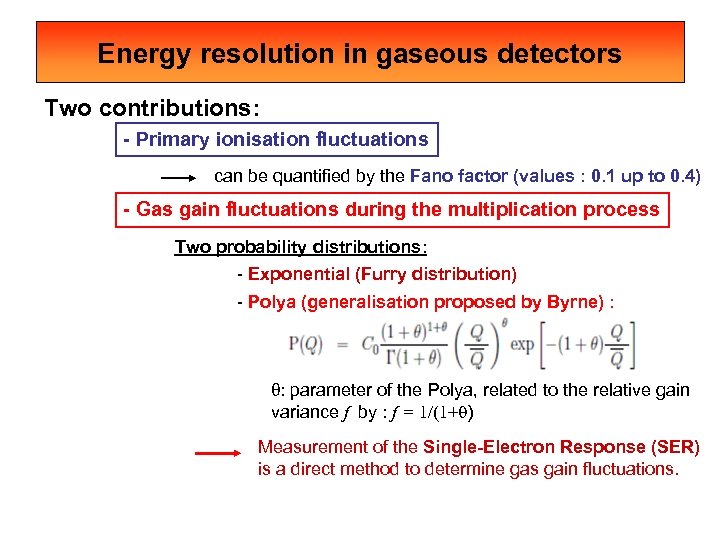 Energy resolution in gaseous detectors Two contributions: - Primary ionisation fluctuations can be quantified by the Fano factor (values : 0. 1 up to 0. 4) - Gas gain fluctuations during the multiplication process Two probability distributions: - Exponential (Furry distribution) - Polya (generalisation proposed by Byrne) : q: parameter of the Polya, related to the relative gain variance f by : f = 1/(1+q) Measurement of the Single-Electron Response (SER) is a direct method to determine gas gain fluctuations.
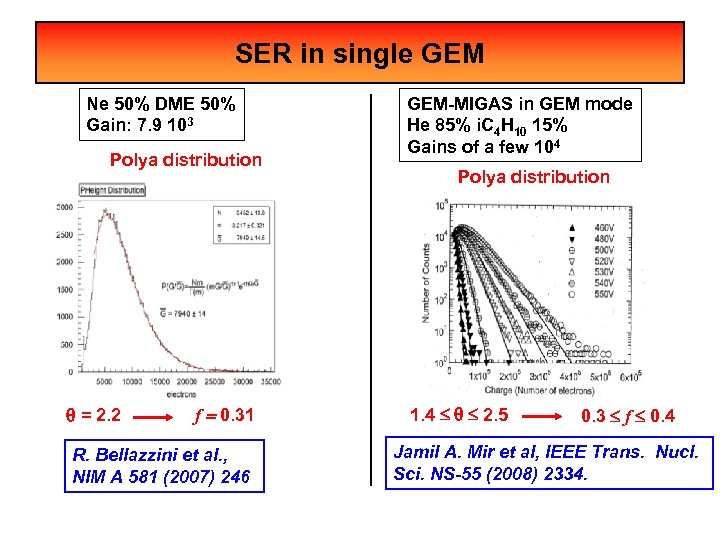 SER in single GEM Ne 50% DME 50% Gain: 7. 9 103 Polya distribution q = 2. 2 f = 0. 31 R. Bellazzini et al. , NIM A 581 (2007) 246 GEM-MIGAS in GEM mode He 85% i. C 4 H 10 15% Gains of a few 104 Polya distribution 1. 4 £ q £ 2. 5 0. 3 £ f £ 0. 4 Jamil A. Mir et al, IEEE Trans. Nucl. Sci. NS-55 (2008) 2334.
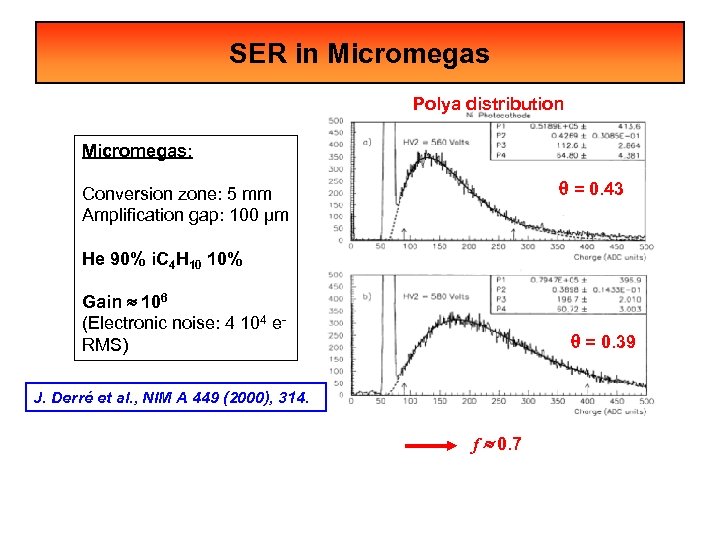 SER in Micromegas Polya distribution Micromegas: q = 0. 43 Conversion zone: 5 mm Amplification gap: 100 µm He 90% i. C 4 H 10 10% Gain » 106 (Electronic noise: 4 104 e. RMS) q = 0. 39 J. Derré et al. , NIM A 449 (2000), 314. f » 0. 7
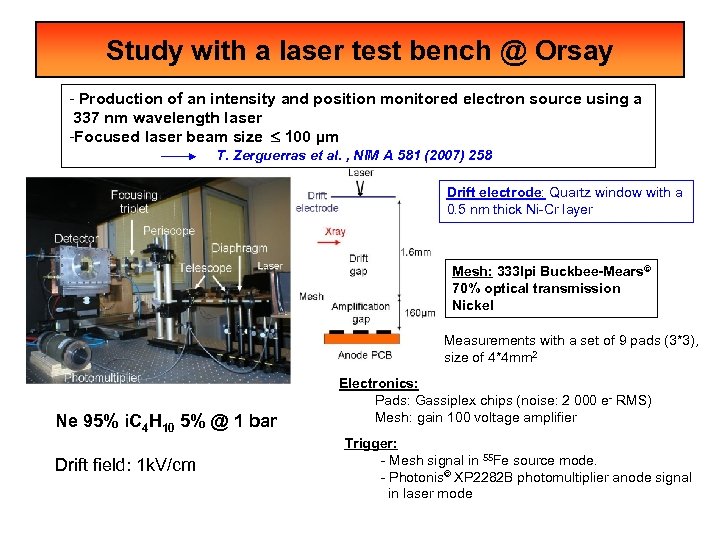 Study with a laser test bench @ Orsay - Production of an intensity and position monitored electron source using a 337 nm wavelength laser -Focused laser beam size £ 100 µm T. Zerguerras et al. , NIM A 581 (2007) 258 Drift electrode: Quartz window with a 0. 5 nm thick Ni-Cr layer Mesh: 333 lpi Buckbee-Mears© 70% optical transmission Nickel Measurements with a set of 9 pads (3*3), size of 4*4 mm 2 Ne 95% i. C 4 H 10 5% @ 1 bar Drift field: 1 k. V/cm Electronics: Pads: Gassiplex chips (noise: 2 000 e- RMS) Mesh: gain 100 voltage amplifier Trigger: - Mesh signal in 55 Fe source mode. - Photonis© XP 2282 B photomultiplier anode signal in laser mode
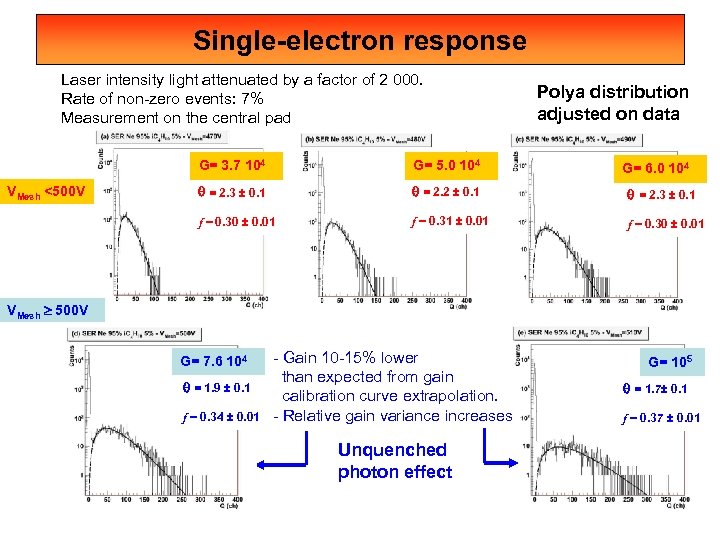 Single-electron response Laser intensity light attenuated by a factor of 2 000. Rate of non-zero events: 7% Measurement on the central pad Polya distribution adjusted on data G= 3. 7 104 q = 2. 3 ± 0. 1 q = 2. 2 ± 0. 1 q = 2. 3 ± 0. 1 f = 0. 30 ± 0. 01 VMesh <500 V G= 5. 0 104 f = 0. 31 ± 0. 01 f = 0. 30 ± 0. 01 G= 6. 0 104 VMesh ³ 500 V G= 7. 6 104 q = 1. 9 ± 0. 1 f = 0. 34 ± 0. 01 - Gain 10 -15% lower than expected from gain calibration curve extrapolation. - Relative gain variance increases. Unquenched photon effect G= 105 q = 1. 7± 0. 1 f = 0. 37 ± 0. 01
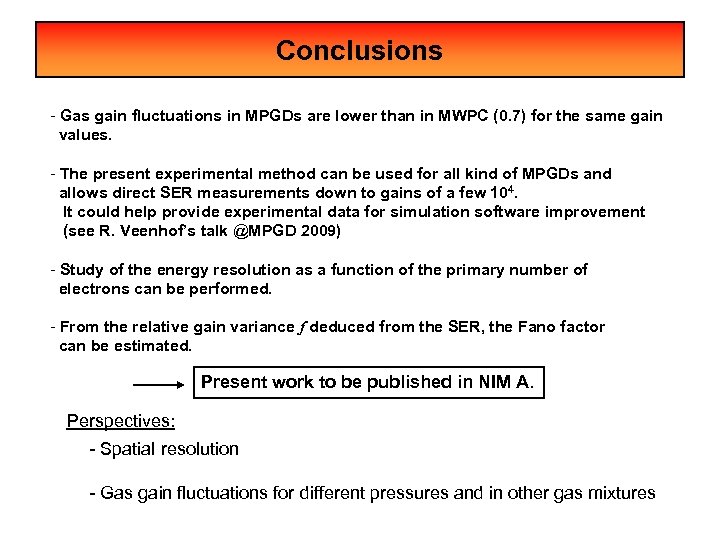 Conclusions - Gas gain fluctuations in MPGDs are lower than in MWPC (0. 7) for the same gain values. - The present experimental method can be used for all kind of MPGDs and allows direct SER measurements down to gains of a few 104. It could help provide experimental data for simulation software improvement (see R. Veenhof’s talk @MPGD 2009) - Study of the energy resolution as a function of the primary number of electrons can be performed. - From the relative gain variance f deduced from the SER, the Fano factor can be estimated. Present work to be published in NIM A. Perspectives: - Spatial resolution - Gas gain fluctuations for different pressures and in other gas mixtures
 Next talk was in the same stream…
 Study of avalanche fluctuations and energy resolution with an In. Grid-Time. Pix detector Paul Colas, CEA/Irfu Saclay Progress report, based on PC, IEEE Dresden 2008, Max Chefdeville’s thesis 2009, and more recent analysis Kolympari, Crete, June 16, 2009 P. Colas 29
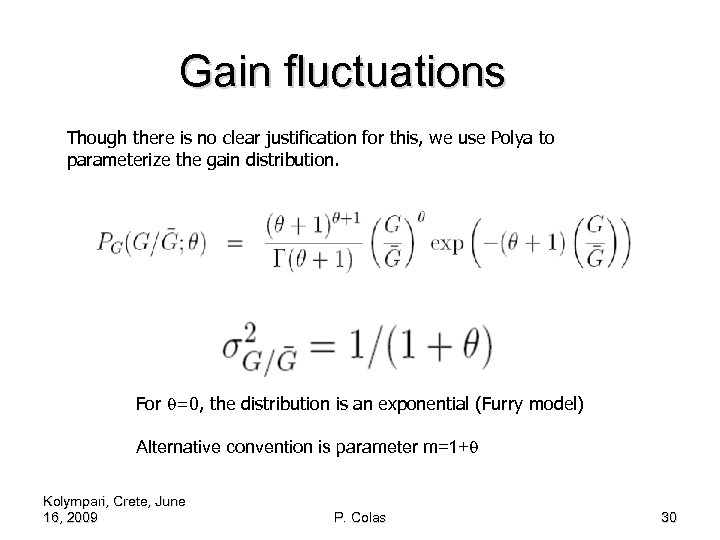 Gain fluctuations Though there is no clear justification for this, we use Polya to parameterize the gain distribution. For q=0, the distribution is an exponential (Furry model) Alternative convention is parameter m=1+q Kolympari, Crete, June 16, 2009 P. Colas 30
 New experimental handles Many measurements have been carried out (see T. Zerguerras’s talk). New detectors provide new handles: • Electron counting with In. Grid on Time. Pix provides a direct measurement of Fano fluctuations, giving access to the contribution of gain fluctuations to the width of the observed 55 Fe peak (itself measured by In. Grids or Microbulks). • Time-over-threshold on single pixels give the charge distribution of single electron avalanches • Study of electron counting vs gain gives a sensitivity to q Kolympari, Crete, June 16, 2009 P. Colas 31
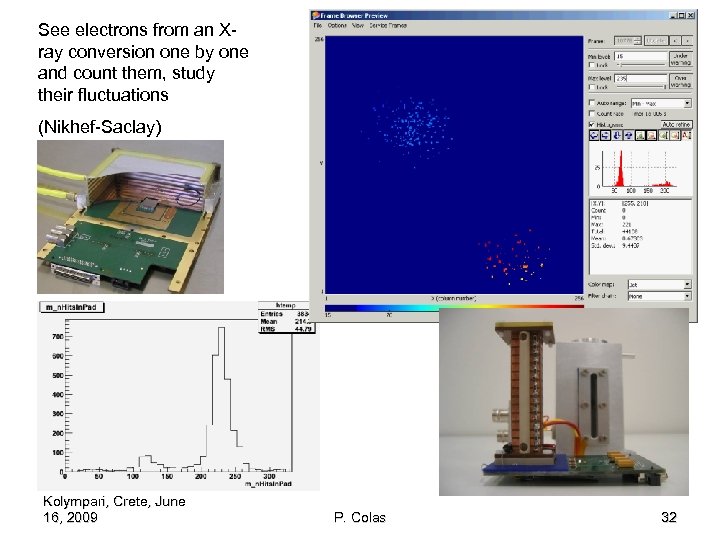 See electrons from an Xray conversion one by one and count them, study their fluctuations (Nikhef-Saclay) Kolympari, Crete, June 16, 2009 P. Colas 32
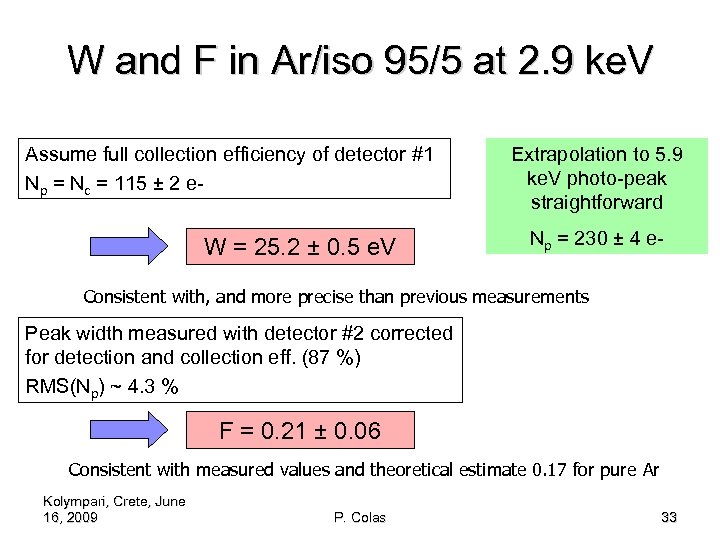 W and F in Ar/iso 95/5 at 2. 9 ke. V Assume full collection efficiency of detector #1 Np = Nc = 115 ± 2 e- W = 25. 2 ± 0. 5 e. V Extrapolation to 5. 9 ke. V photo-peak straightforward Np = 230 ± 4 e- Consistent with, and more precise than previous measurements Peak width measured with detector #2 corrected for detection and collection eff. (87 %) RMS(Np) ~ 4. 3 % F = 0. 21 ± 0. 06 Consistent with measured values and theoretical estimate 0. 17 for pure Ar Kolympari, Crete, June 16, 2009 P. Colas 33
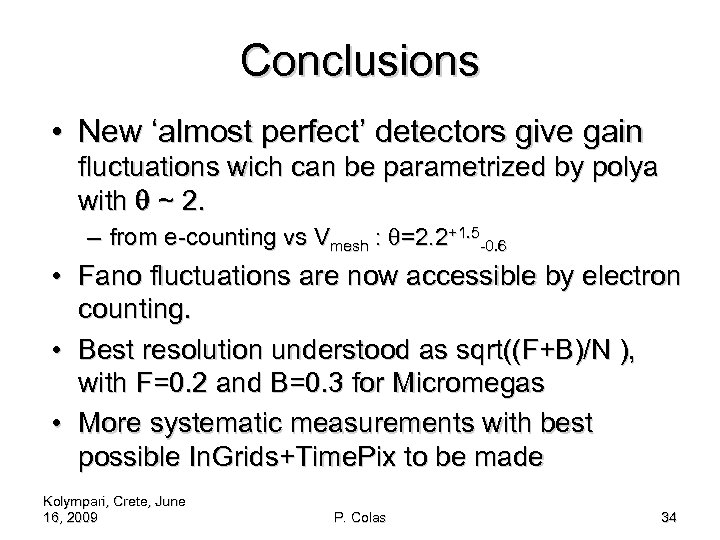 Conclusions • New ‘almost perfect’ detectors give gain fluctuations wich can be parametrized by polya with q ~ 2. – from e-counting vs Vmesh : q=2. 2+1. 5 -0. 6 • Fano fluctuations are now accessible by electron counting. • Best resolution understood as sqrt((F+B)/N ), with F=0. 2 and B=0. 3 for Micromegas • More systematic measurements with best possible In. Grids+Time. Pix to be made Kolympari, Crete, June 16, 2009 P. Colas 34
 . . so both these talks touched the fundamentals of avalanche statistics, there is tremendous progress in this direction and it was a very important contribution to the WG 2
 Electroluminescence Yield in Electron Avalanche Development for João Veloso MPDGs C. A. B. Oliveira Physics Department – University of Aveiro C. Monteiro, J. M. F. dos Santos Physics Department – University of Coimbra A. Breskin and R. Chechik Weizmann Institute of Science, Rehovot
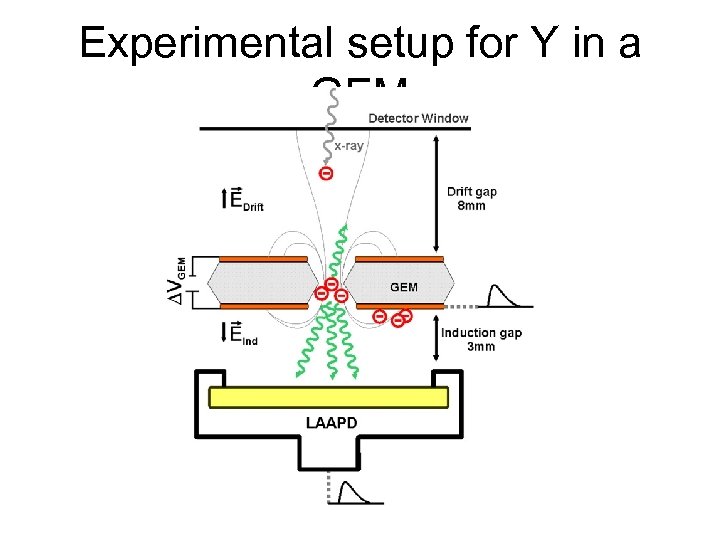 Experimental setup for Y in a GEM
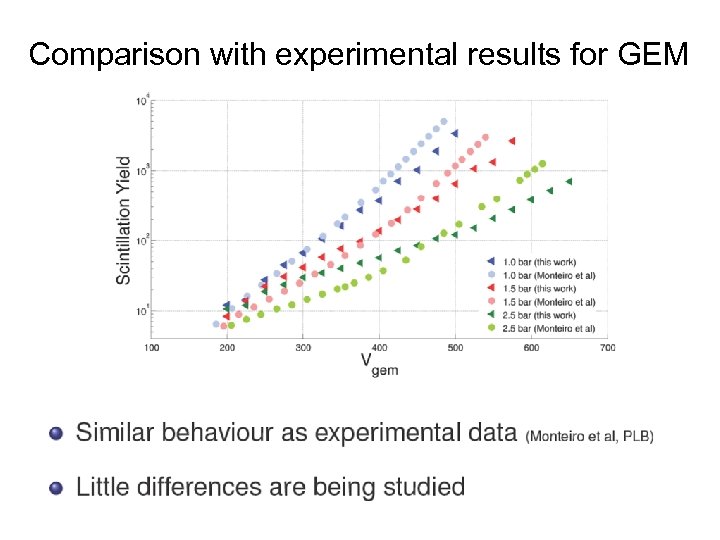 Comparison with experimental results for GEM
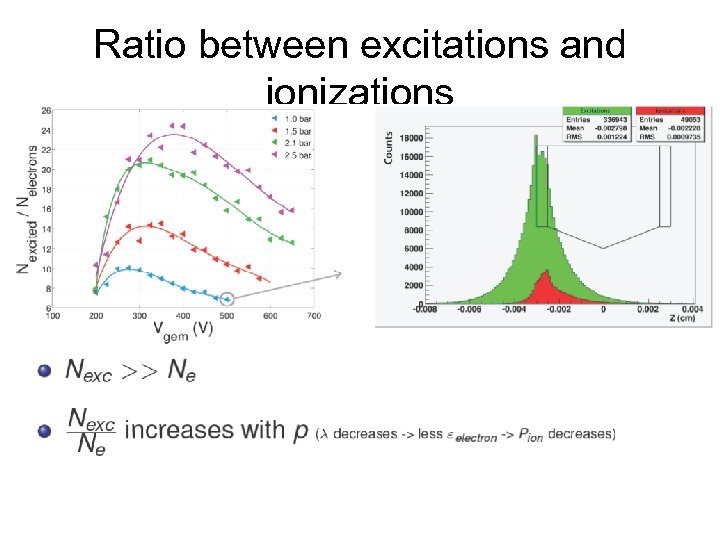 Ratio between excitations and ionizations
 All four talks are an excellent example what should e presented and discussed @WG 2
 ALICE RICH upgrade and challenges for WG 2
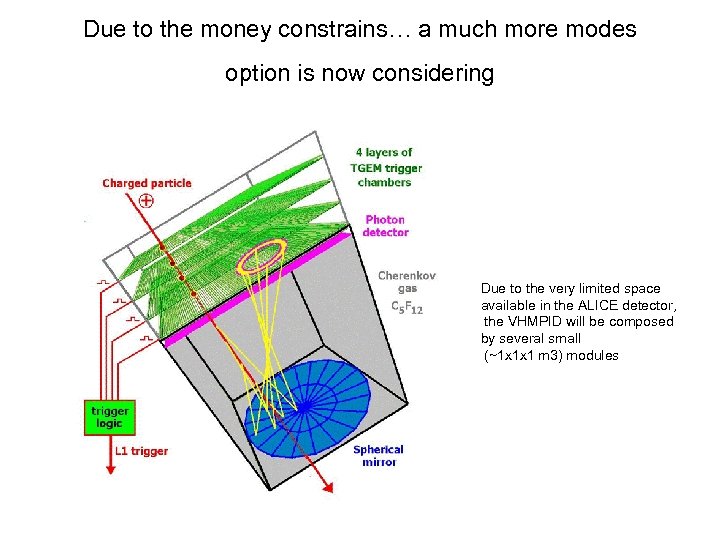 Due to the money constrains… a much more modes option is now considering Due to the very limited space available in the ALICE detector, the VHMPID will be composed by several small (~1 x 1 x 1 m 3) modules
 Challenges in the frame of WG 2
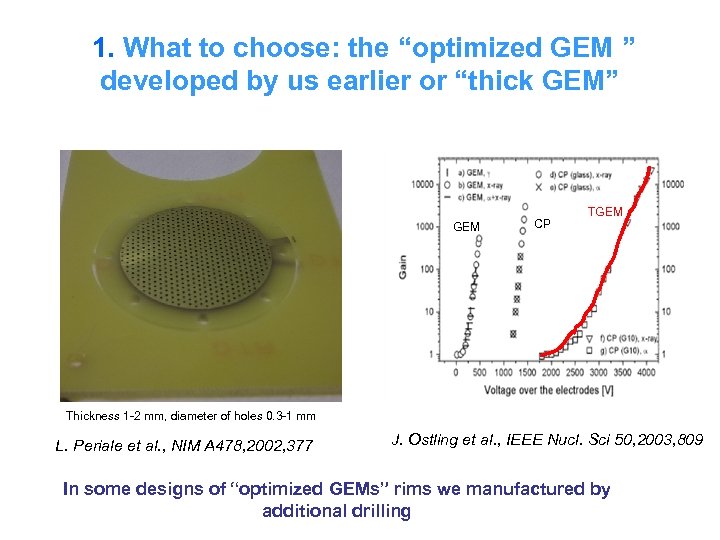 1. What to choose: the “optimized GEM ” developed by us earlier or “thick GEM” GEM CP TGEM Thickness 1 -2 mm, diameter of holes 0. 3 -1 mm L. Periale et al. , NIM A 478, 2002, 377 J. Ostling et al. , IEEE Nucl. Sci 50, 2003, 809 In some designs of “optimized GEMs” rims we manufactured by additional drilling
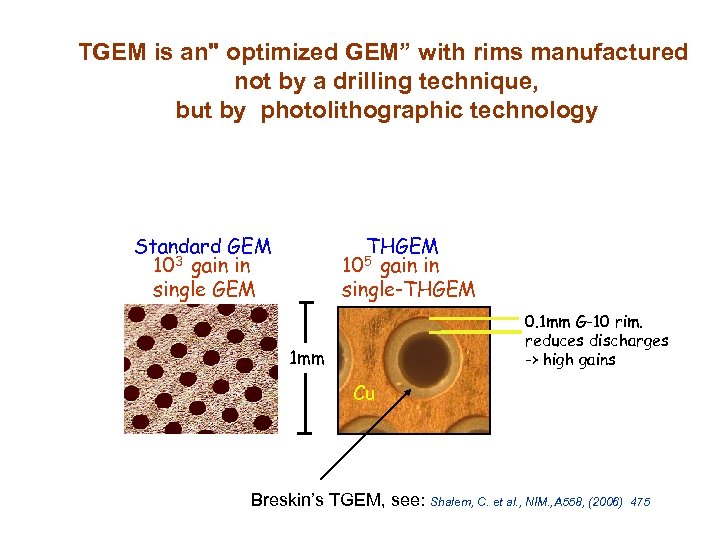 TGEM is an" optimized GEM” with rims manufactured not by a drilling technique, but by photolithographic technology Standard GEM 103 gain in single GEM THGEM gain in single-THGEM 105 0. 1 mm G-10 rim. reduces discharges -> high gains 1 mm Cu Breskin’s TGEM, see: Shalem, C. et al. , NIM. , A 558, (2006) 475
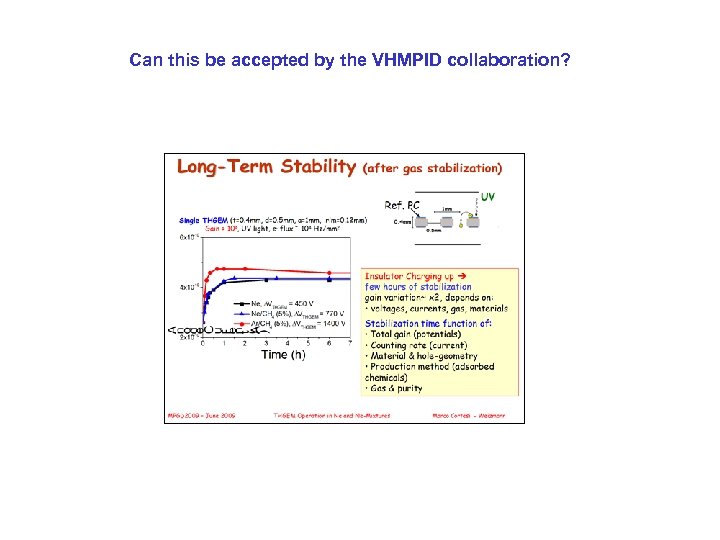 Can this be accepted by the VHMPID collaboration?
 2. Gas?
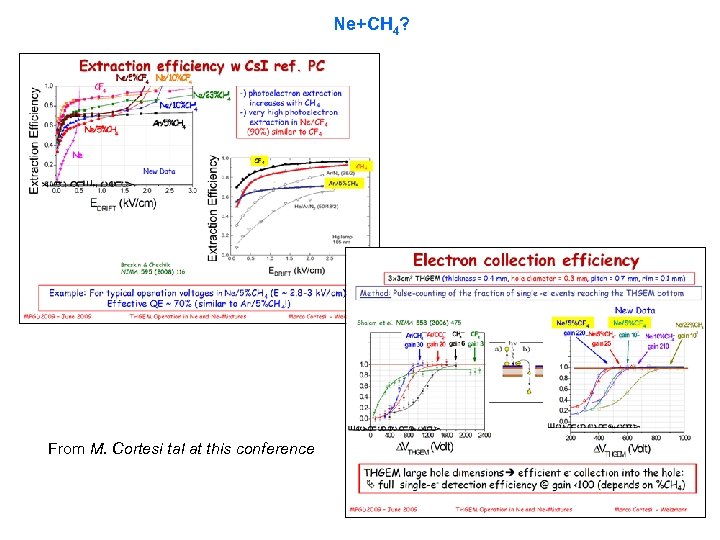 Ne+CH 4? From M. Cortesi tal at this conference
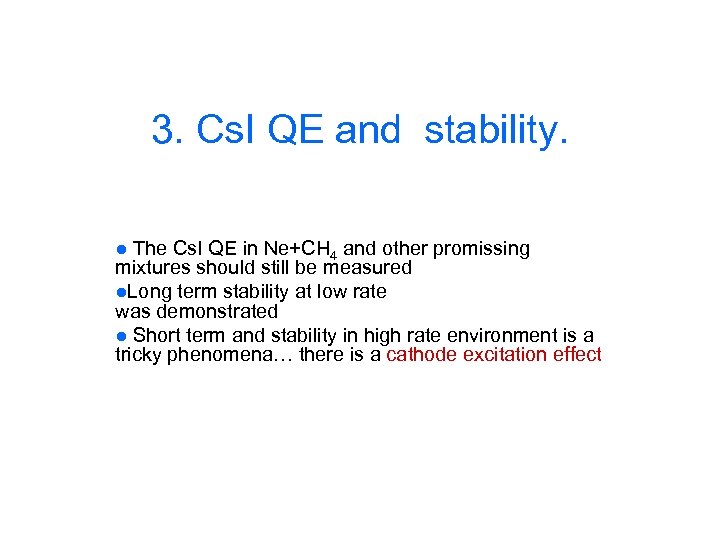 3. Cs. I QE and stability. ● The Cs. I QE in Ne+CH 4 and other promissing mixtures should still be measured ●Long term stability at low rate was demonstrated ● Short term and stability in high rate environment is a tricky phenomena… there is a cathode excitation effect
 Discussion 1 ●Silvia’s advice during the discussion: “stay away from any instability…” ● Silvia and Fulvio remarks concerning Ne+CH 4 mixture ● M. Cortesi advocated this mixture
 Remarks on spark protection
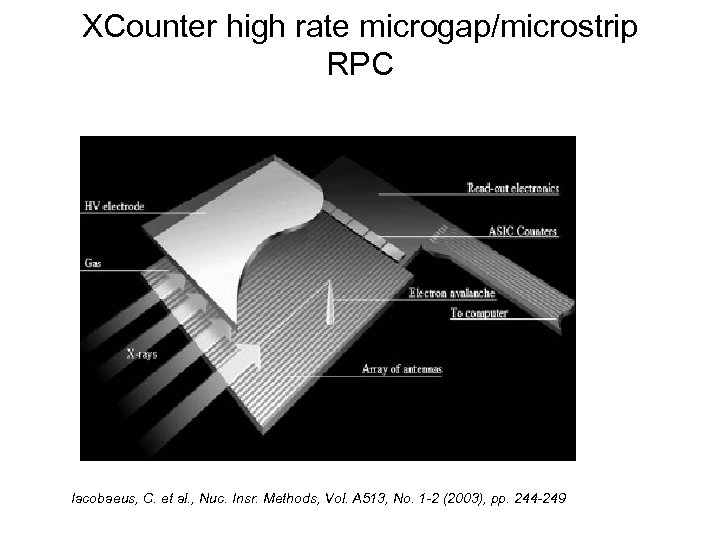
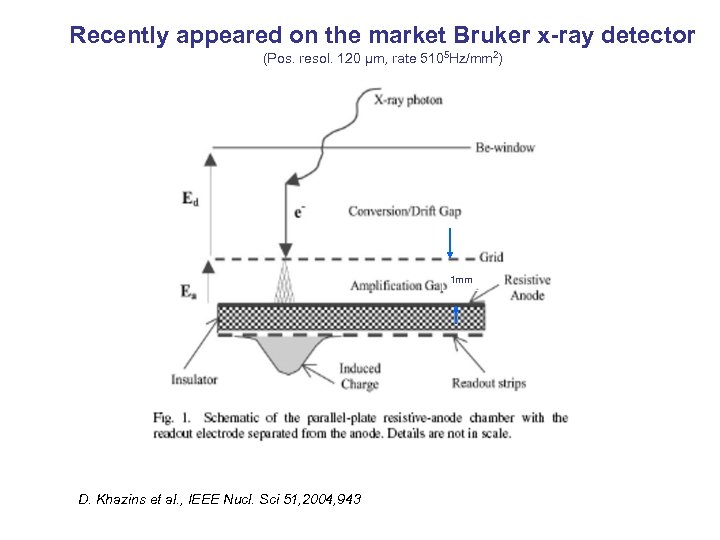
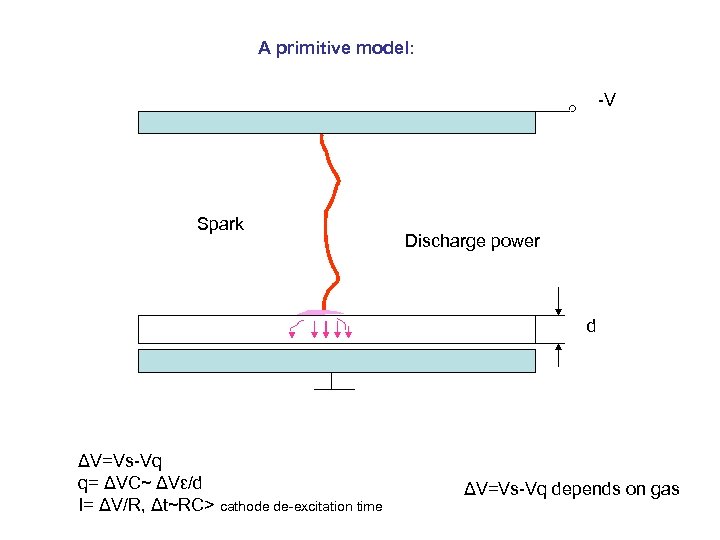 A primitive model: -V Spark Discharge power d ΔV=Vs-Vq q= ΔVC~ ΔVε/d I= ΔV/R, Δt~RC> cathode de-excitation time ΔV=Vs-Vq depends on gas
 XCounter high rate microgap/microstrip RPC Iacobaeus, C. et al. , Nuc. Insr. Methods, Vol. A 513, No. 1 -2 (2003), pp. 244 -249
 Recently appeared on the market Bruker x-ray detector (Pos. resol. 120 μm, rate 5105 Hz/mm 2) 1 mm D. Khazins et al. , IEEE Nucl. Sci 51, 2004, 943
 Discussion 2 ●Paul informed us about the plans to develop and test MICROMEGAS with protective resistive layers ● Fred share with us the experience of his group in the spark protection
 Final remarks ● How do you see the future of the WG 2? ● How should we organize ourself? ● Passive “coordination” or more? ●How often the WG 2 meetings should be? ● Should we try to organize exchange of visitors to attack the problem or to accomplish task (for example I often work in Israel, somebody can come and wok with me …or also go to Israel. . or in Leszek group and so on)?
 Lack of communications between current conveners themselves and between them and RD 51 was admitted So we should improve this!
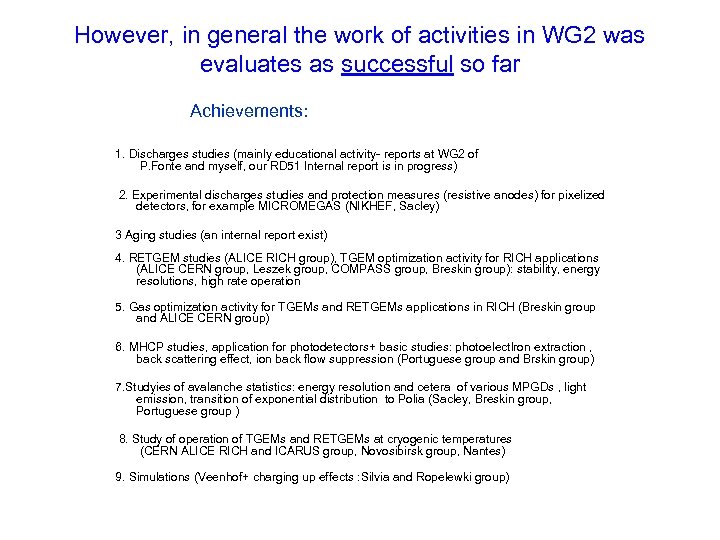 However, in general the work of activities in WG 2 was evaluates as successful so far Achievements: 1. Discharges studies (mainly educational activity- reports at WG 2 of P. Fonte and myself, our RD 51 Internal report is in progress) 2. Experimental discharges studies and protection measures (resistive anodes) for pixelized detectors, for example MICROMEGAS (NIKHEF, Sacley) 3 Aging studies (an internal report exist) 4. RETGEM studies (ALICE RICH group), TGEM optimization activity for RICH applications (ALICE CERN group, Leszek group, COMPASS group, Breskin group): stability, energy resolutions, high rate operation 5. Gas optimization activity for TGEMs and RETGEMs applications in RICH (Breskin group and ALICE CERN group) 6. MHCP studies, application for photodetectors+ basic studies: photoelectlron extraction , back scattering effect, ion back flow suppression (Portuguese group and Brskin group) 7. Studyies of avalanche statistics: energy resolution and cetera of various MPGDs , light emission, transition of exponential distribution to Polia (Sacley, Breskin group, Portuguese group ) 8. Study of operation of TGEMs and RETGEMs at cryogenic temperatures (CERN ALICE RICH and ICARUS group, Novosibirsk group, Nantes) 9. Simulations (Veenhof+ charging up effects : Silvia and Ropelewki group)
 So, as it should be, with difficulties, but we are moving forward!