 Скачать презентацию Western Occupational and Environmental Medical Association Webinar
23f32a93c08e50f2a44cf72a2a2e5407.ppt
- Количество слайдов: 34



Western Occupational and Environmental Medical Association Webinar – June 17, 2010 To Work or Not to Work: The Costs of Presenteeism and Absenteeism Speaker: Constantine Gean, MD, MS, MBA, FACOEM Regional Medical Director, Liberty Mutual Group PLEASE STAND BY WEBINAR WILL BEGIN AT 12: 00 pm (PDT) For Audio: Call: 866 -740 -1260 Access Code: 7644915# Faculty Disclosure: Constantine Gean, MD, MS, MBA, FACOEM has no conflict of interest to disclose.
To Work or Not To Work The Costs of Presenteeism and Absenteeism Constantine Gean, MD, MS, MBA, FACOEM Regional Medical Director, Liberty Mutual Group WOEMA Webinar - June 17, 2010
Learning Objectives • Understand absenteeism, presenteeism, and differences between the two • Describe why absenteeism and presenteeism are important concepts for occupational health practice • Obtain a general concept of the origins of presenteeism. • Appreciate absenteeism and presenteeism as they relate to the Workers Compensation and Group Health arenas. • Review the economic consequences of absenteeism and presenteeism. • Obtain an understanding of program approaches to monitoring and limiting costs from absenteeism and presenteeism.

The Big Picture The Solar System
“Ideas rather than materials or physical brawn have been by far the greatest contributors during the past half-century to our average annual increase of 3 -1/4 percent in real gross domestic product. ” -Alan Greenspan, March 11, 2004 (Before the Committee on Education and the Workforce, U. S. House of Representatives)
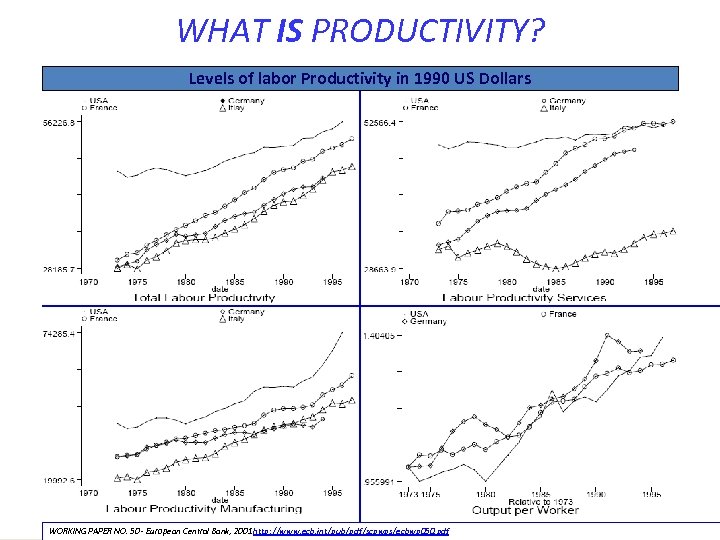
WHAT IS PRODUCTIVITY? Levels of labor Productivity in 1990 US Dollars WORKING PAPER NO. 50 - European Central Bank, 2001 http: //www. ecb. int/pub/pdf/scpwps/ecbwp 050. pdf
“Hang On! I just got another nibble!” The Perils of Fishing
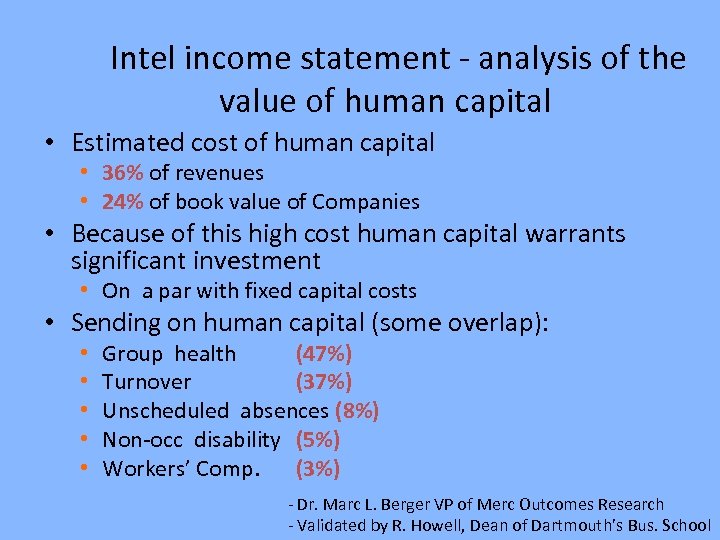
Intel income statement - analysis of the value of human capital • Estimated cost of human capital • 36% of revenues • 24% of book value of Companies • Because of this high cost human capital warrants significant investment • On a par with fixed capital costs • Sending on human capital (some overlap): • • • Group health (47%) Turnover (37%) Unscheduled absences (8%) Non-occ disability (5%) Workers’ Comp. (3%) - Dr. Marc L. Berger VP of Merc Outcomes Research - Validated by R. Howell, Dean of Dartmouth’s Bus. School
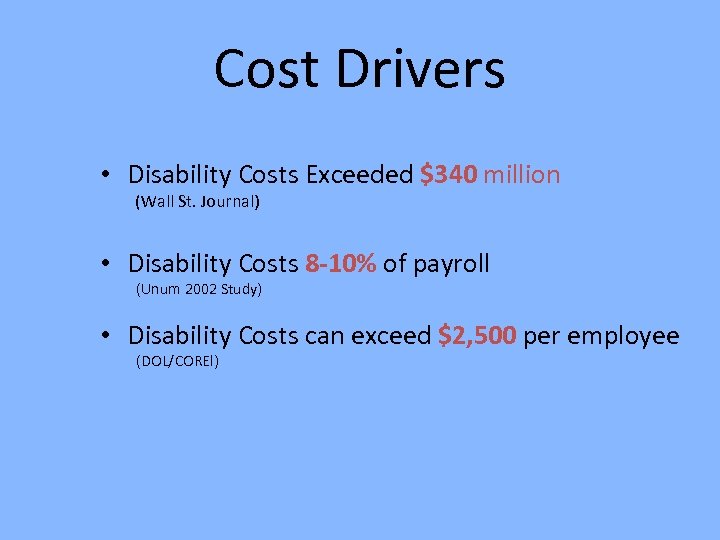
Cost Drivers • Disability Costs Exceeded $340 million (Wall St. Journal) • Disability Costs 8 -10% of payroll (Unum 2002 Study) • Disability Costs can exceed $2, 500 per employee (DOL/COREl)
PRESENTEEISM AND ABSENTEEISM What are they? How Measured? Examples?
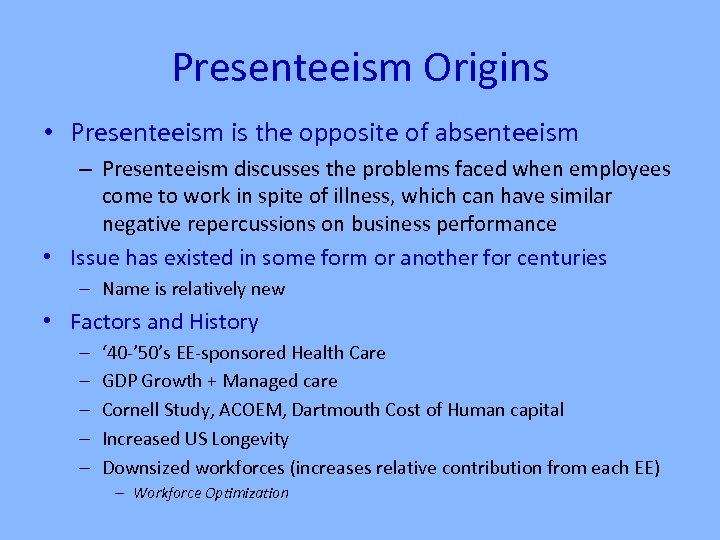
Presenteeism Origins • Presenteeism is the opposite of absenteeism – Presenteeism discusses the problems faced when employees come to work in spite of illness, which can have similar negative repercussions on business performance • Issue has existed in some form or another for centuries – Name is relatively new • Factors and History – – – ‘ 40 -’ 50’s EE-sponsored Health Care GDP Growth + Managed care Cornell Study, ACOEM, Dartmouth Cost of Human capital Increased US Longevity Downsized workforces (increases relative contribution from each EE) – Workforce Optimization
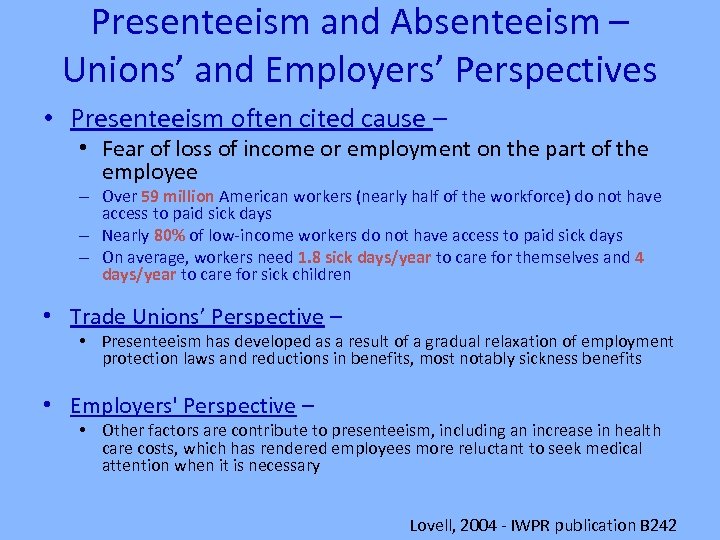
Presenteeism and Absenteeism – Unions’ and Employers’ Perspectives • Presenteeism often cited cause – • Fear of loss of income or employment on the part of the employee – Over 59 million American workers (nearly half of the workforce) do not have access to paid sick days – Nearly 80% of low-income workers do not have access to paid sick days – On average, workers need 1. 8 sick days/year to care for themselves and 4 days/year to care for sick children • Trade Unions’ Perspective – • Presenteeism has developed as a result of a gradual relaxation of employment protection laws and reductions in benefits, most notably sickness benefits • Employers' Perspective – • Other factors are contribute to presenteeism, including an increase in health care costs, which has rendered employees more reluctant to seek medical attention when it is necessary Lovell, 2004 - IWPR publication B 242
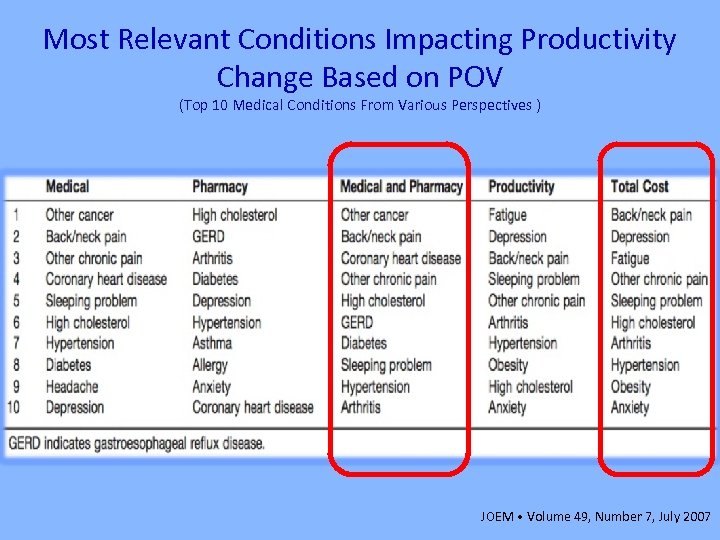
Most Relevant Conditions Impacting Productivity Change Based on POV (Top 10 Medical Conditions From Various Perspectives ) JOEM • Volume 49, Number 7, July 2007
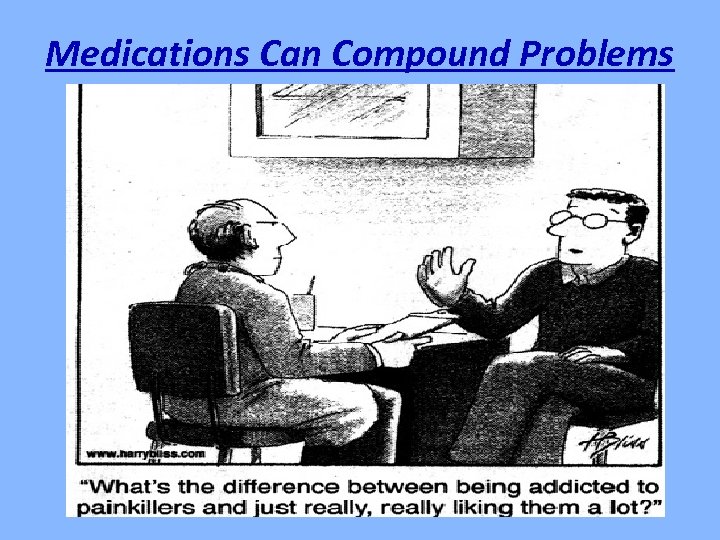
Medications Can Compound Problems
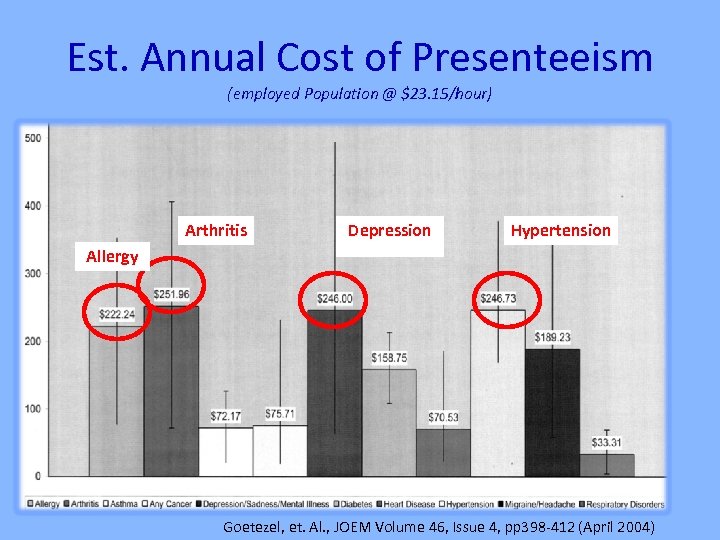
Est. Annual Cost of Presenteeism (employed Population @ $23. 15/hour) Arthritis Depression Hypertension Allergy Goetezel, et. Al. , JOEM Volume 46, Issue 4, pp 398 -412 (April 2004)
Absenteeism • DEFINITION: A habitual pattern of absence from a duty or obligation – Traditionally viewed as poor individual performance – Seen as a management problem – Framed in economic or quasi-economic terms – More recently seen as an indicator of psychological, medical, or social adjustment to work • Short Term Disability – Generally 50% of absences are < 2 weeks, and 50% are > 2 weeks
Commonly used Days Away from Work (DAFW) Approach CONCLUSION: Find low hanging fruit just by adding up DAFW.
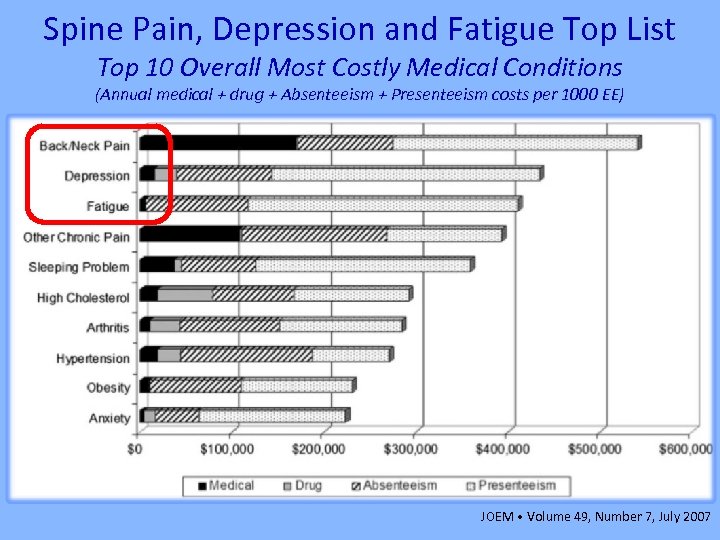
Spine Pain, Depression and Fatigue Top List Top 10 Overall Most Costly Medical Conditions (Annual medical + drug + Absenteeism + Presenteeism costs per 1000 EE) JOEM • Volume 49, Number 7, July 2007
PRESENTEEISM AND ABSENTEEISM What to do to limit? How Managed? Examples?
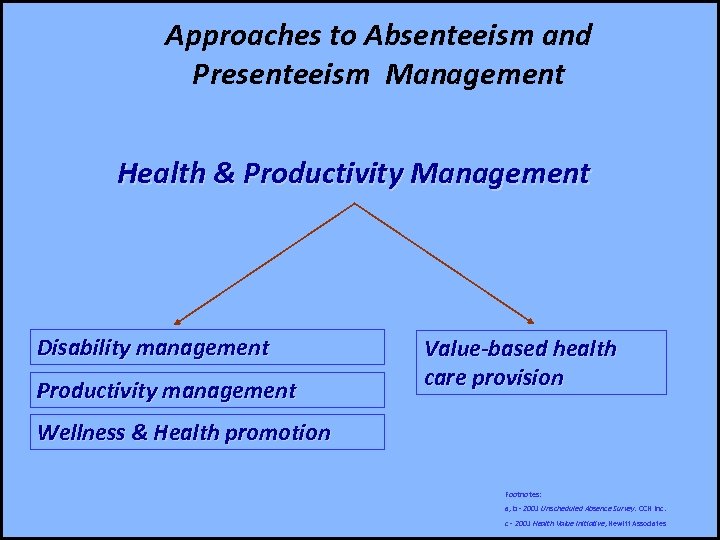
Approaches to Absenteeism and Presenteeism Management Health & Productivity Management Disability management Productivity management Value-based health care provision Wellness & Health promotion Footnotes: a, b - 2001 Unscheduled Absence Survey. CCH Inc. c - 2001 Health Value Initiative, Hewitt Associates
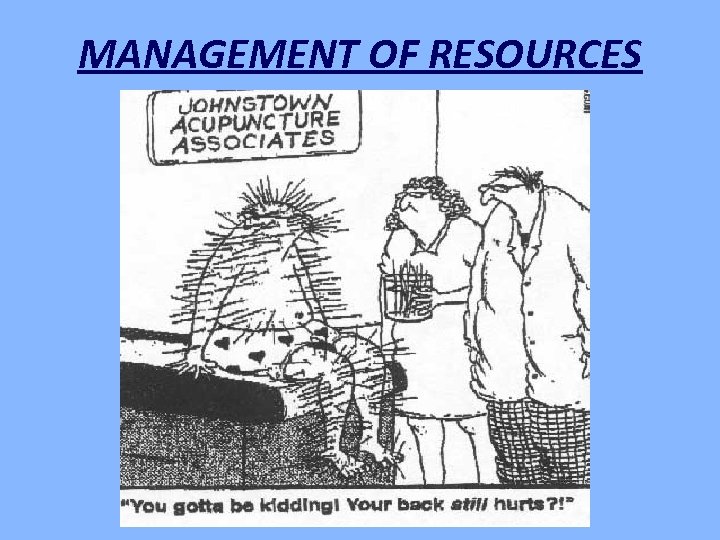
MANAGEMENT OF RESOURCES
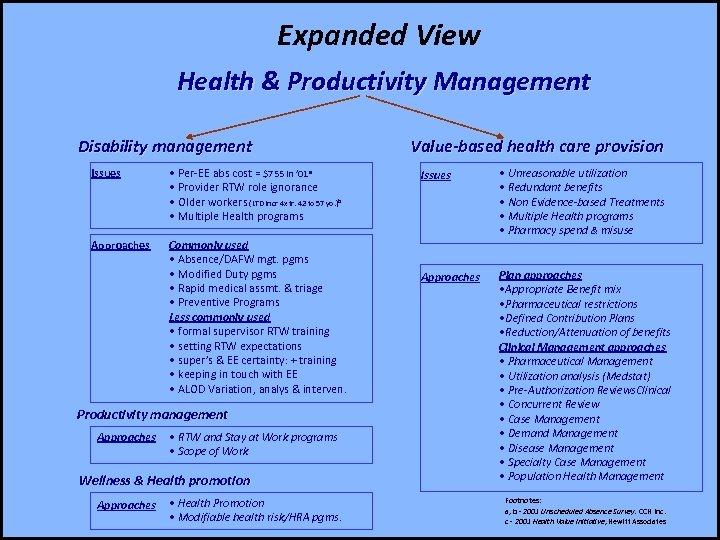
Expanded View Health & Productivity Management Disability management Issues • Per-EE abs cost = $755 in ’ 01 a • Provider RTW role ignorance • Older workers (LTD incr 4 x fr. 42 to 57 yo. )b • Multiple Health programs Approaches Commonly used • Absence/DAFW mgt. pgms • Modified Duty pgms • Rapid medical assmt. & triage • Preventive Programs Less commonly used • formal supervisor RTW training • setting RTW expectations • super’s & EE certainty: + training • keeping in touch with EE • ALOD Variation, analys & interven. Productivity management Approaches • RTW and Stay at Work programs • Scope of Work Wellness & Health promotion Approaches • Health Promotion • Modifiable health risk/HRA pgms. Value-based health care provision Issues • Unreasonable utilization • Redundant benefits • Non Evidence-based Treatments • Multiple Health programs • Pharmacy spend & misuse Approaches Plan approaches • Appropriate Benefit mix • Pharmaceutical restrictions • Defined Contribution Plans • Reduction/Attenuation of benefits Clinical Management approaches • Pharmaceutical Management • Utilization analysis (Medstat) • Pre-Authorization Reviews. Clinical • Concurrent Review • Case Management • Demand Management • Disease Management • Specialty Case Management • Population Health Management Footnotes: a, b - 2001 Unscheduled Absence Survey. CCH Inc. c - 2001 Health Value Initiative, Hewitt Associates
Backache and Depression Most Prevalent Conditions (Focus on the most common conditions)

OVERALL UTILIZATION TRENDS - Circulatory Case Types (ALOD = Average Length of Disability) Result: 12% ALOD decrease.

HIGH IMPACT UTILIZATION TRENDS - Psychiatric Case Types (ALOD = Average Length of Disability) 26
Manufacturer - Location Analysis - ALOD by Location and type (Medical vs MH*)- 4 Qtr Summary(Q 3’ 00 Q 2’ 01) Savings Potential: What’s up with San Jose and Orchard Park? *MH=Mental Health ICD-9’s
So What Does this Mean from the Clinician’s POV? “Oh, the Pain!”
Implications for the Practitioner (ID problems and be a good doctor) • Understand the continuum of Absenteeism and Presenteeism can help the care of the individual • Do aggressive treatment of common conditions (depression, respiratory illness, hypertension) • Understand/find possible company resources (EAP’s, wellness programs, special benefits, etc. ) • Encourage employers to use transitional work and focus on defining employee functional level
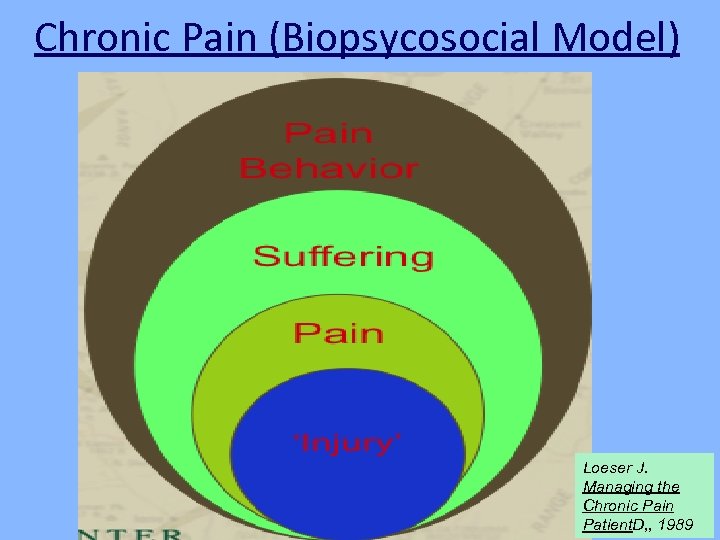
Chronic Pain (Biopsycosocial Model) Loeser J. Managing the Chronic Pain Patient. D, , 1989
Implications for the Practitioner Understand basic disability prevention/management • Understand the Biopsychosocial Model (e. g. , emotional reactions accompany temporary disability and should be managed to prevent it becoming permanent). • Understand that a diagnosis alone (without demonstrable functional impairment) may not justify work absence • ID and treat psychiatric issues and teach patients about the interaction of psychiatric and physical problems. • Understand Functional Recovery Programs and use them in cases of delayed recovery

? WRAP UP AND QUESTIONS
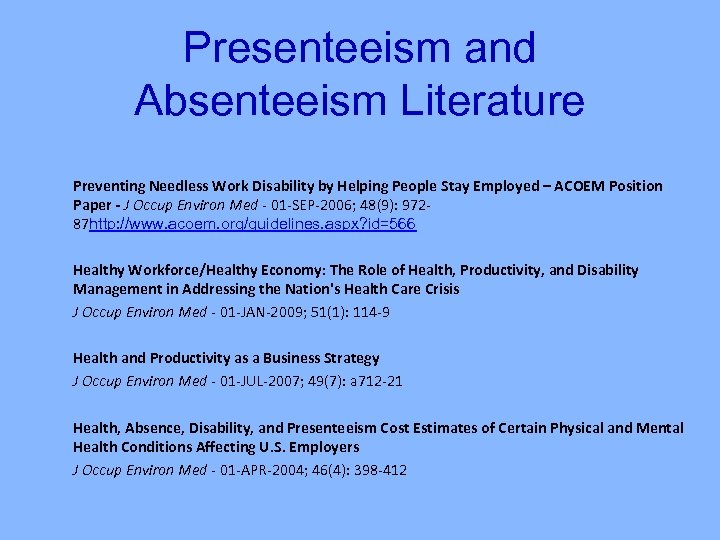
Presenteeism and Absenteeism Literature Preventing Needless Work Disability by Helping People Stay Employed – ACOEM Position Paper - J Occup Environ Med - 01 -SEP-2006; 48(9): 97287 http: //www. acoem. org/guidelines. aspx? id=566 Healthy Workforce/Healthy Economy: The Role of Health, Productivity, and Disability Management in Addressing the Nation's Health Care Crisis J Occup Environ Med - 01 -JAN-2009; 51(1): 114 -9 Health and Productivity as a Business Strategy J Occup Environ Med - 01 -JUL-2007; 49(7): a 712 -21 Health, Absence, Disability, and Presenteeism Cost Estimates of Certain Physical and Mental Health Conditions Affecting U. S. Employers J Occup Environ Med - 01 -APR-2004; 46(4): 398 -412
Thank you for participating in today’s webinar. At the conclusion of this call you will receive an email with a link to a post-webinar questionnaire. You will need to complete this questionnaire in order to receive CME for this webinar. This webinar presentation can be downloaded at www. woema. org
Скачать презентацию Western Occupational and Environmental Medical Association Webinar
23f32a93c08e50f2a44cf72a2a2e5407.ppt