


 Скачать презентацию West Nile Virus Epidemiology of the North American
a8b07aaae45e78009bab8be46c8f7ed0.ppt
- Количество слайдов: 26
 West Nile Virus Epidemiology of the North American outbreak Mira J. Leslie State Public Health Veterinarian Washington State Department of Health
 Learning Objective • West Nile virus is established in North America. The magnitude of the ongoing WNV outbreak is extraordinary and our knowledge is incomplete. • Definitions: § Arbovirus = arthropod-borne virus Epizootic = epidemic in animals Washington State Department of Health
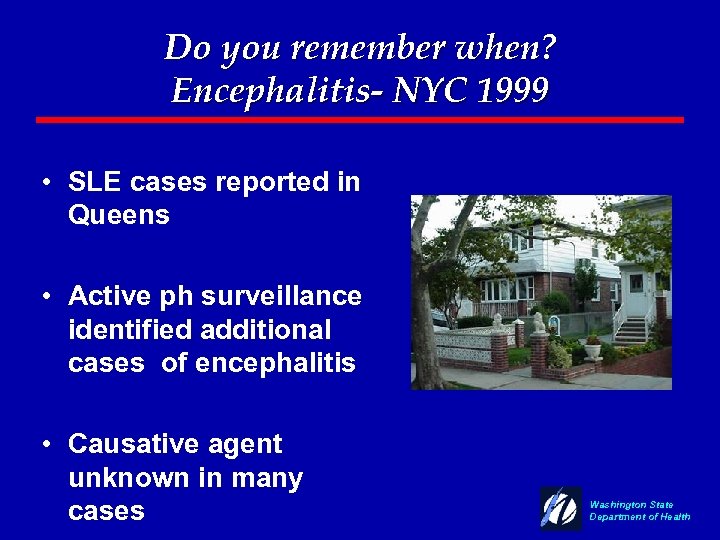 Do you remember when? Encephalitis- NYC 1999 • SLE cases reported in Queens • Active ph surveillance identified additional cases of encephalitis • Causative agent unknown in many cases Washington State Department of Health
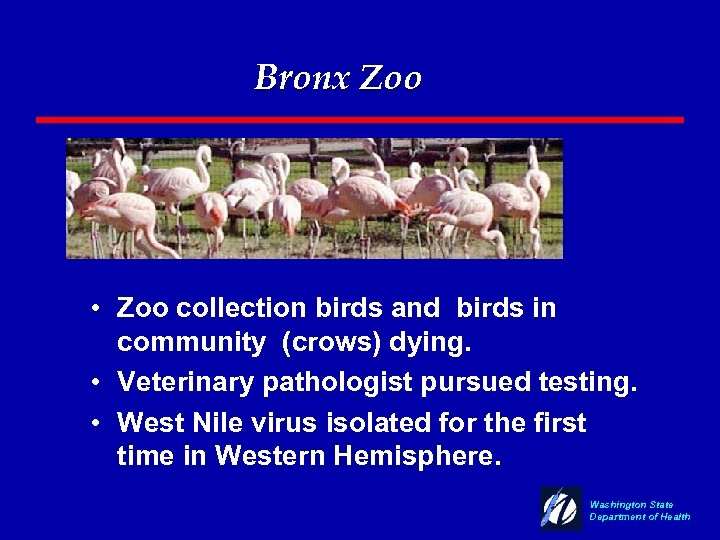 Bronx Zoo • Zoo collection birds and birds in community (crows) dying. • Veterinary pathologist pursued testing. • West Nile virus isolated for the first time in Western Hemisphere. Washington State Department of Health
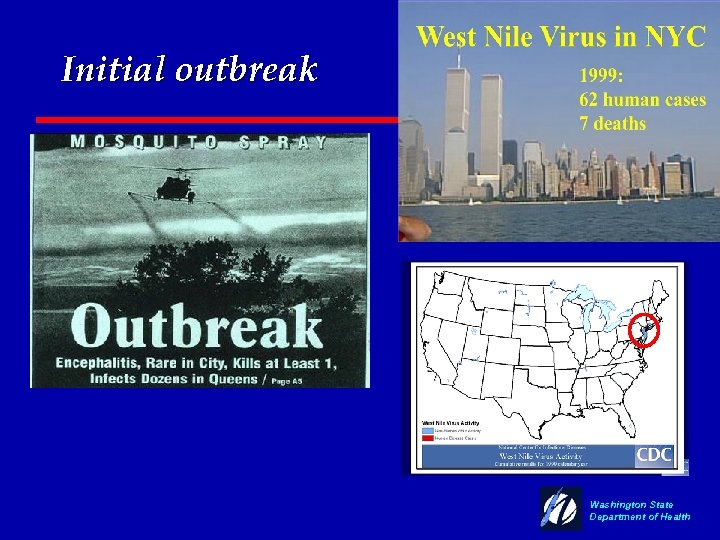 Initial outbreak Washington State Department of Health
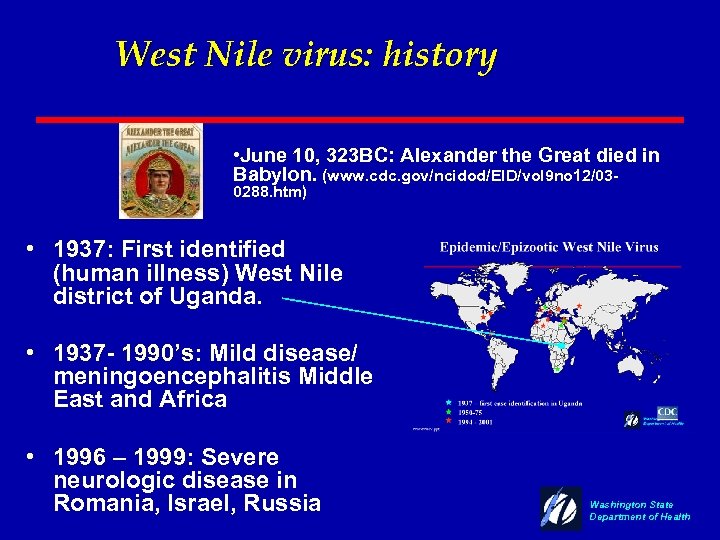 West Nile virus: history • June 10, 323 BC: Alexander the Great died in Babylon. (www. cdc. gov/ncidod/EID/vol 9 no 12/030288. htm) • 1937: First identified (human illness) West Nile district of Uganda. • 1937 - 1990’s: Mild disease/ meningoencephalitis Middle East and Africa • 1996 – 1999: Severe neurologic disease in Romania, Israel, Russia Washington State Department of Health
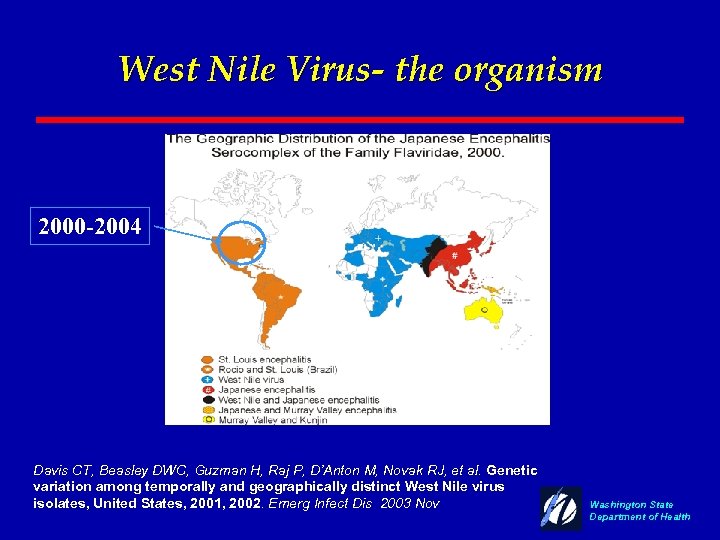 West Nile Virus- the organism 2000 -2004 Davis CT, Beasley DWC, Guzman H, Raj P, D’Anton M, Novak RJ, et al. Genetic variation among temporally and geographically distinct West Nile virus isolates, United States, 2001, 2002. Emerg Infect Dis 2003 Nov Washington State Department of Health
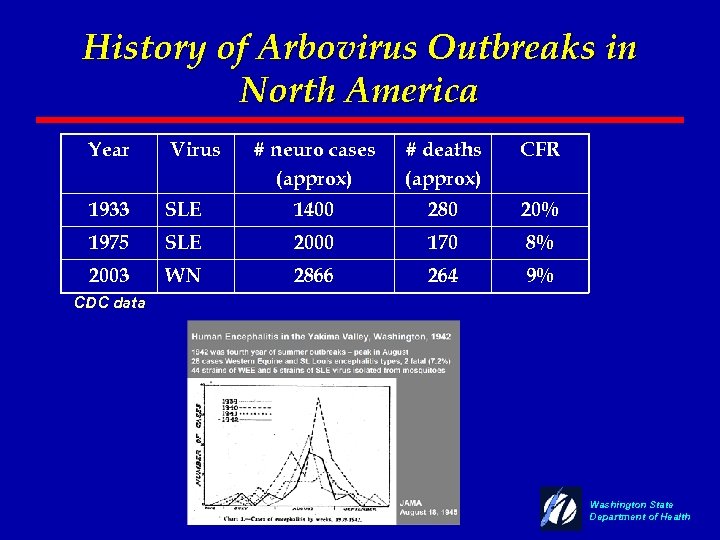 History of Arbovirus Outbreaks in North America Year Virus # neuro cases (approx) # deaths (approx) CFR 1933 SLE 1400 280 20% 1975 SLE 2000 170 8% 2003 WN 2866 264 9% CDC data Washington State Department of Health
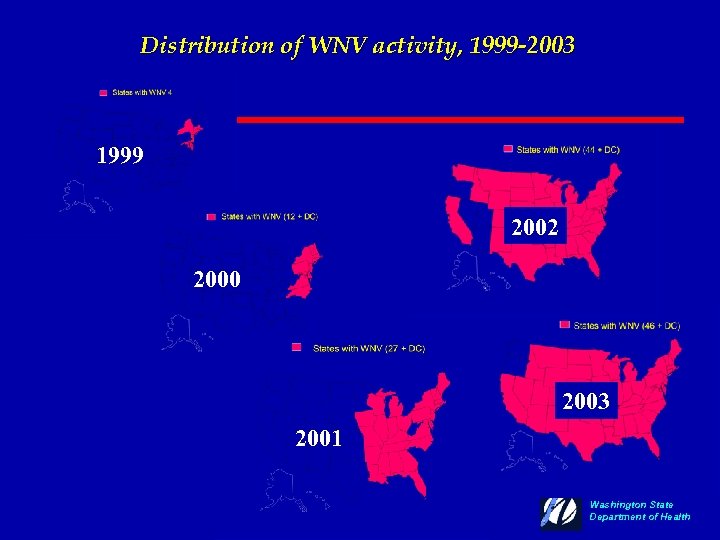 Distribution of WNV activity, 1999 -2003 1999 2002 2000 2003 2001 Washington State Department of Health
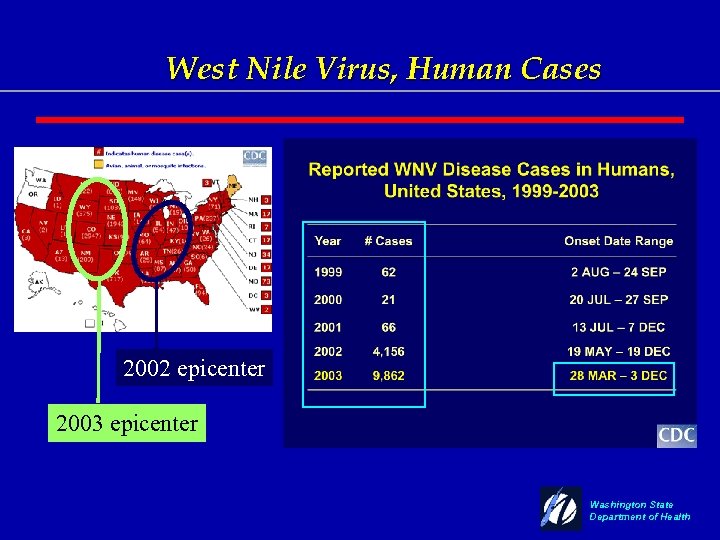 West Nile Virus, Human Cases 2002 epicenter 2003 epicenter Washington State Department of Health
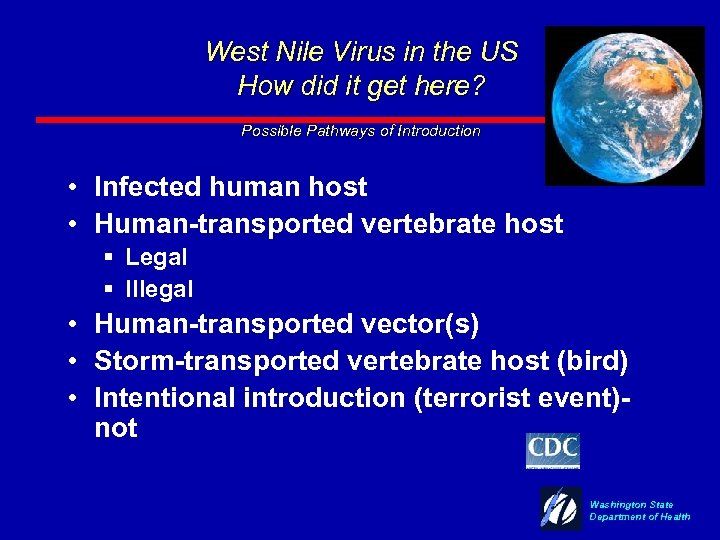 West Nile Virus in the US How did it get here? Possible Pathways of Introduction • Infected human host • Human-transported vertebrate host § Legal § Illegal • Human-transported vector(s) • Storm-transported vertebrate host (bird) • Intentional introduction (terrorist event)not Washington State Department of Health
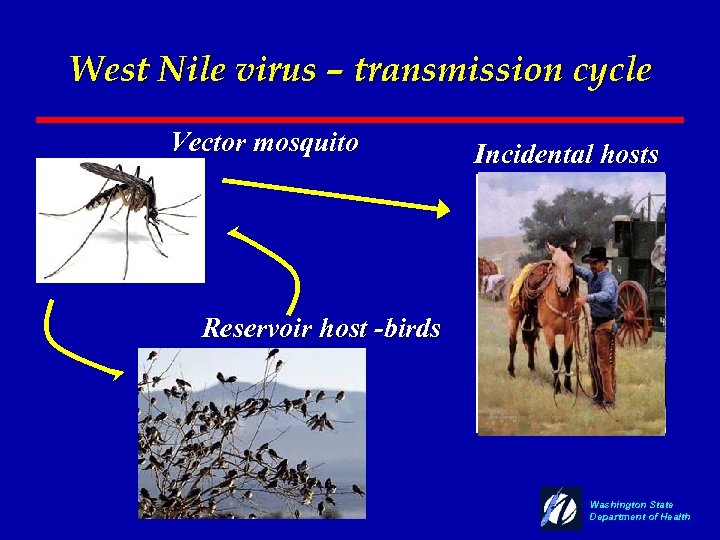 West Nile virus – transmission cycle Vector mosquito Incidental hosts Reservoir host -birds Washington State Department of Health
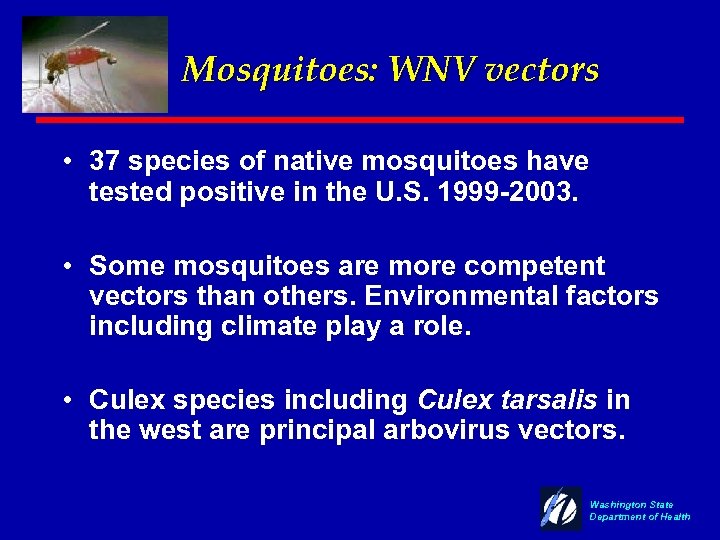 Mosquitoes: WNV vectors • 37 species of native mosquitoes have tested positive in the U. S. 1999 -2003. • Some mosquitoes are more competent vectors than others. Environmental factors including climate play a role. • Culex species including Culex tarsalis in the west are principal arbovirus vectors. Washington State Department of Health
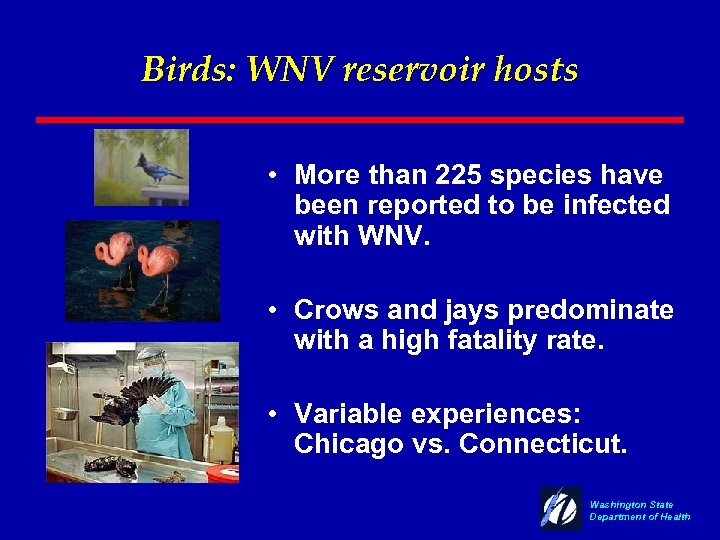 Birds: WNV reservoir hosts • More than 225 species have been reported to be infected with WNV. • Crows and jays predominate with a high fatality rate. • Variable experiences: Chicago vs. Connecticut. Washington State Department of Health
 Learning about avian reservoirs of WNV Most competent reservoirs: Blue jay, Common grackle, House finch, American crow, House sparrow Transmission routes: mosquitoes, ingestion, and bird-bird contact. Some birds have persistent infection in many organs including skin. Komar et al. Experimental Infection of North American birds with the New York 99 strain of West Nile Virus, Emerg Infect Dis, Vol 9, No. 3, March 2003 Washington State Department of Health
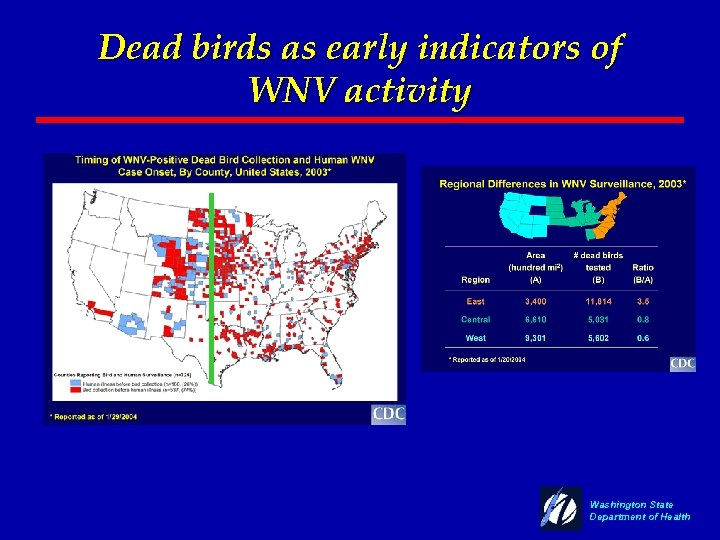 Dead birds as early indicators of WNV activity Washington State Department of Health
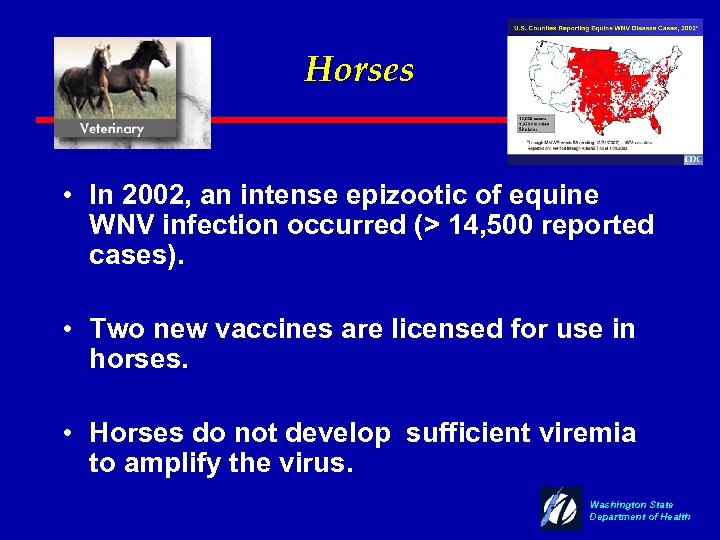 Horses • In 2002, an intense epizootic of equine WNV infection occurred (> 14, 500 reported cases). • Two new vaccines are licensed for use in horses. • Horses do not develop sufficient viremia to amplify the virus. Washington State Department of Health
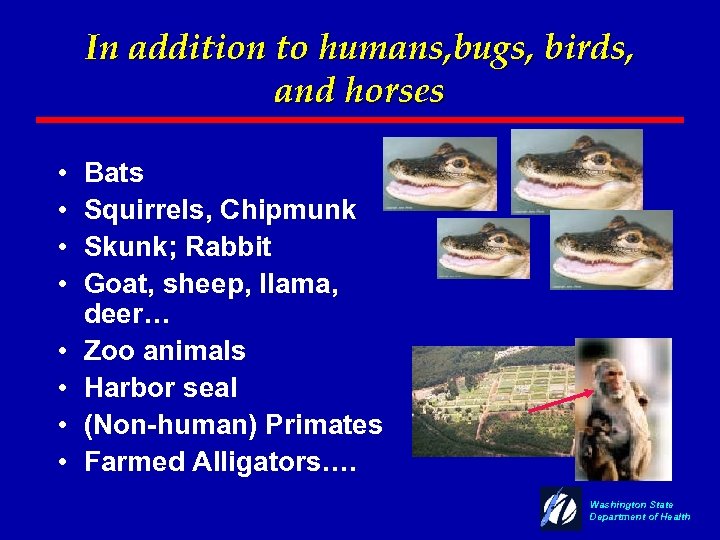 In addition to humans, bugs, birds, and horses • • Bats Squirrels, Chipmunk Skunk; Rabbit Goat, sheep, llama, deer… Zoo animals Harbor seal (Non-human) Primates Farmed Alligators…. Washington State Department of Health
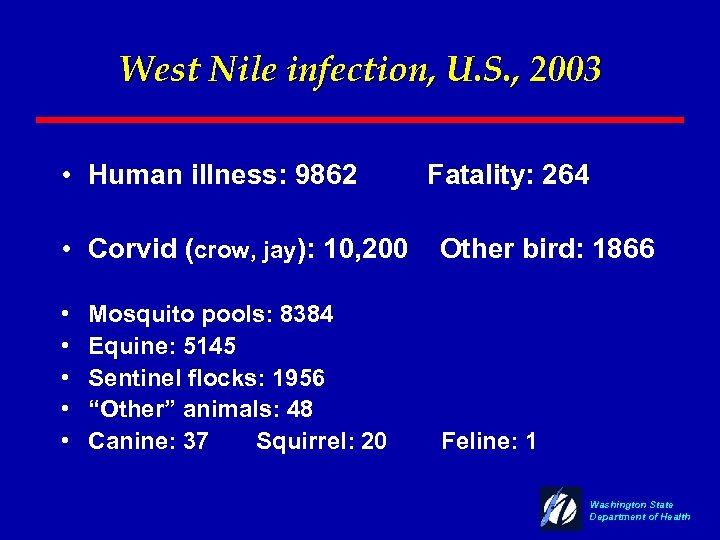 West Nile infection, U. S. , 2003 • Human illness: 9862 Fatality: 264 • Corvid (crow, jay): 10, 200 Other bird: 1866 • • • Feline: 1 Mosquito pools: 8384 Equine: 5145 Sentinel flocks: 1956 “Other” animals: 48 Canine: 37 Squirrel: 20 Washington State Department of Health
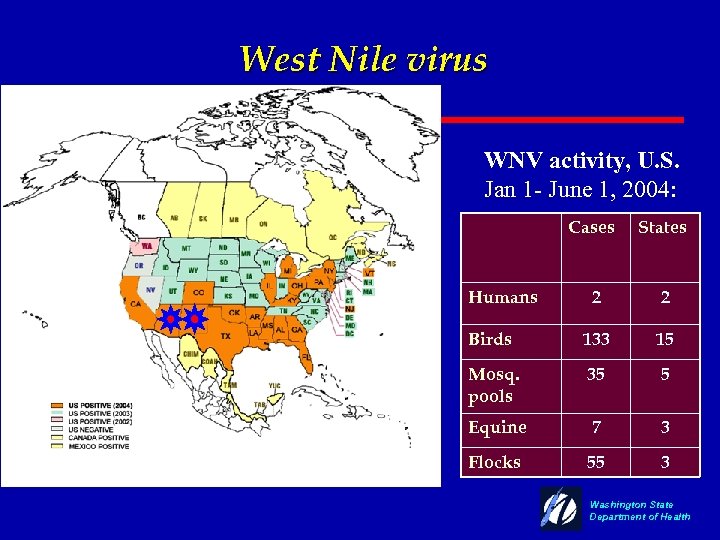 West Nile virus WNV activity, U. S. Jan 1 - June 1, 2004: Cases States 2 2 Birds 133 15 Mosq. pools 35 5 Equine 7 3 Flocks 55 3 Humans Washington State Department of Health
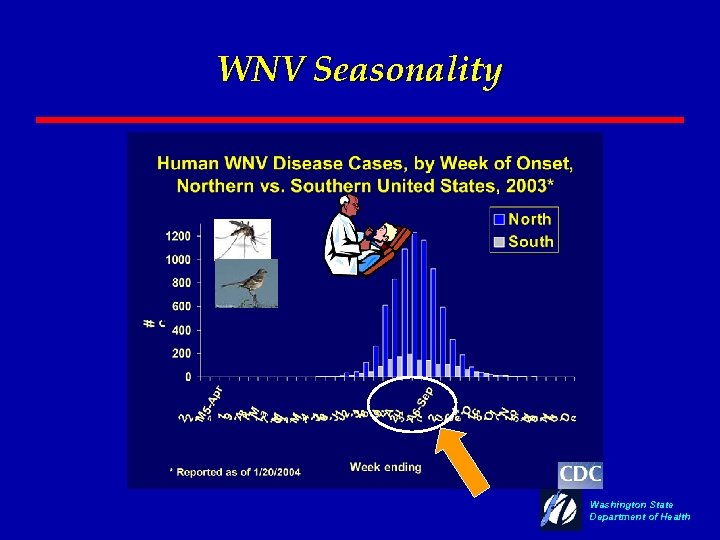 WNV Seasonality Washington State Department of Health
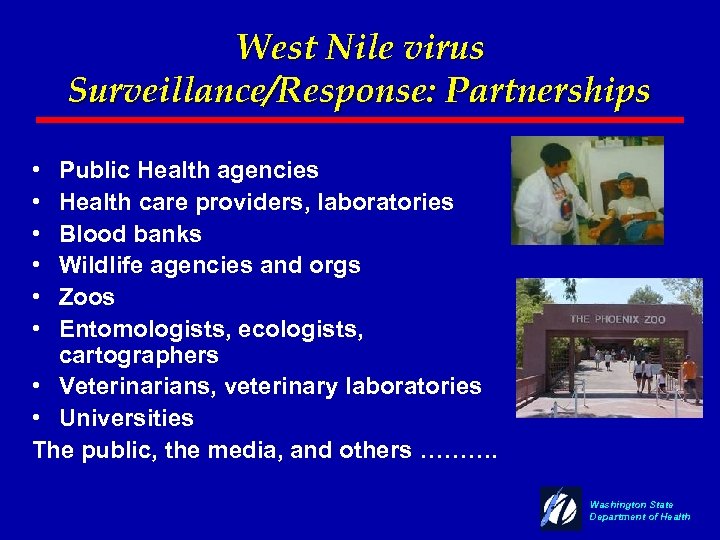 West Nile virus Surveillance/Response: Partnerships • • • Public Health agencies Health care providers, laboratories Blood banks Wildlife agencies and orgs Zoos Entomologists, ecologists, cartographers • Veterinarians, veterinary laboratories • Universities The public, the media, and others ………. Washington State Department of Health
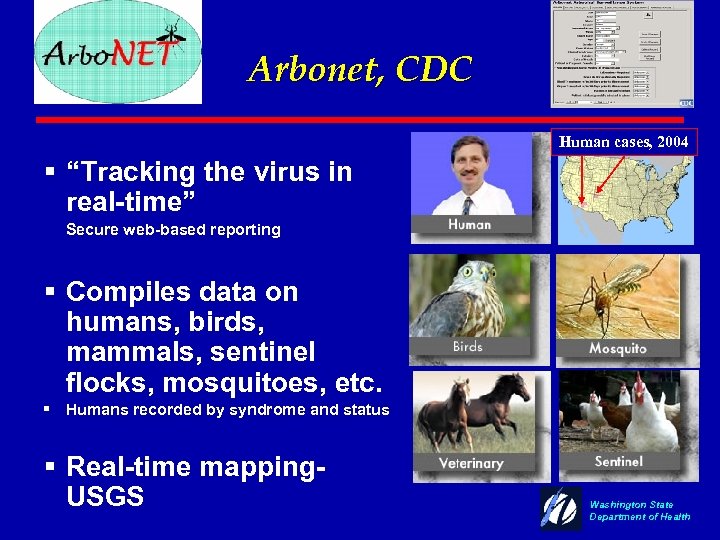 Arbonet, CDC Human cases, 2004 § “Tracking the virus in real-time” Secure web-based reporting § Compiles data on humans, birds, mammals, sentinel flocks, mosquitoes, etc. § Humans recorded by syndrome and status § Real-time mapping. USGS Washington State Department of Health
 Take home messages West Nile virus: • Established ecological niche in North America • WNV outbreaks are unpredictable and our understanding is rudimentary. • Management: flexibility, coordination, partnerships • Plan surge capacity. Washington State Department of Health
 Who is this “human”? QUESTIONS? Washington State Department of Health
 West Nile virus-important issues • Laboratory testing § Public health labs, commercial labs § Veterinary labs § Test development • Communications § Health Alert messaging § Prevention messaging v. Strategies and target audiences Washington State Department of Health