


 Скачать презентацию WELL COME Well come 1 UNIVERSITY OF
7b443792897de6b8a8c9c050c0afe031.ppt
- Количество слайдов: 28
 WELL COME Well come 1
 UNIVERSITY OF AGRICULTURAL SCIENCES, RAICHUR AND UNIVERSITY OF DELHI Investigations on the Present Pigeonpea Pest Complex and Their Management, with Emphasis on Radiation Technology as An Integral Component in IPM B. V. Patil Principal Investigator & DOE UAS, Raichur-584 102, Karnataka & R. K. Seth CO-PI & Professor of Zoology University of Delhi, Delhi-110 007
 Objectives 1. Studies on changed pest scenario and their Natural Enemies in traditional and non traditional pigeonpea growing areas 2. Ecological studies on emerging pests of pigeon pea 3. To study the use of nuclear (radiation) technology against M. vitrata and Callosobruchus spp 4. To study the Mapping of resistance to conventional and new chemistry against pigeon pea insect pests. 5. Studies on pigeon pea sterility mosaic disease and its management
 Objective-I Studies on changed pest scenario and their Natural Enemies in traditional and non traditional pigeonpea growing areas
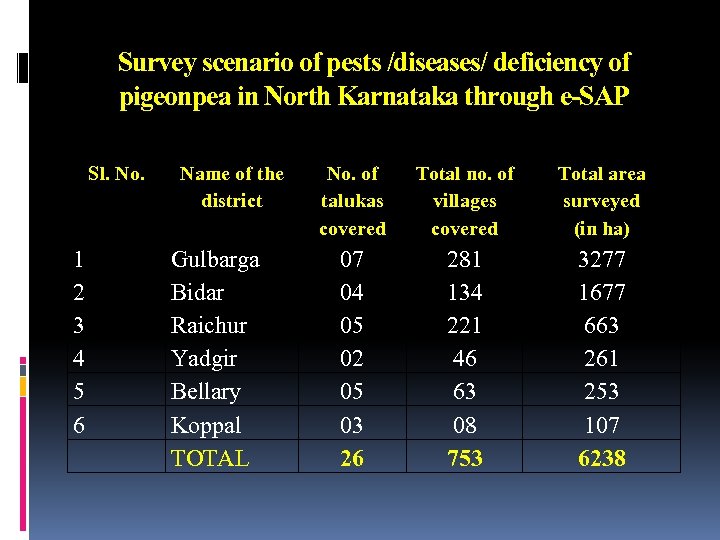 Survey scenario of pests /diseases/ deficiency of pigeonpea in North Karnataka through e-SAP Sl. No. 1 2 3 4 5 6 Name of the district Gulbarga Bidar Raichur Yadgir Bellary Koppal TOTAL No. of talukas covered Total no. of villages covered Total area surveyed (in ha) 07 04 05 02 05 03 26 281 134 221 46 63 08 753 3277 1677 663 261 253 107 6238
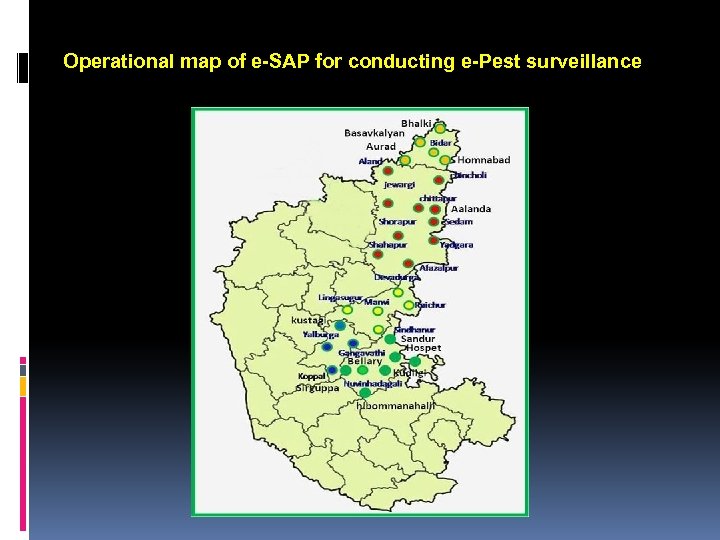 Operational map of e-SAP for conducting e-Pest surveillance
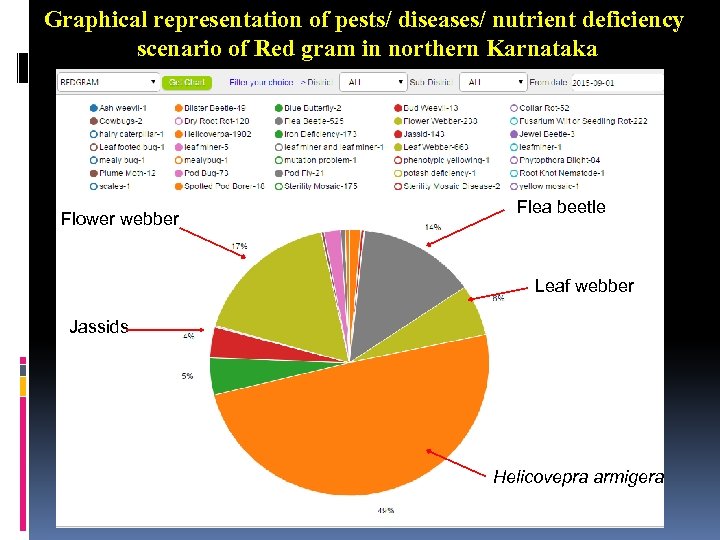 Graphical representation of pests/ diseases/ nutrient deficiency scenario of Red gram in northern Karnataka Flower webber Flea beetle Leaf webber Jassids Helicovepra armigera
 2. Ecological studies on emerging pests of pigeon pea
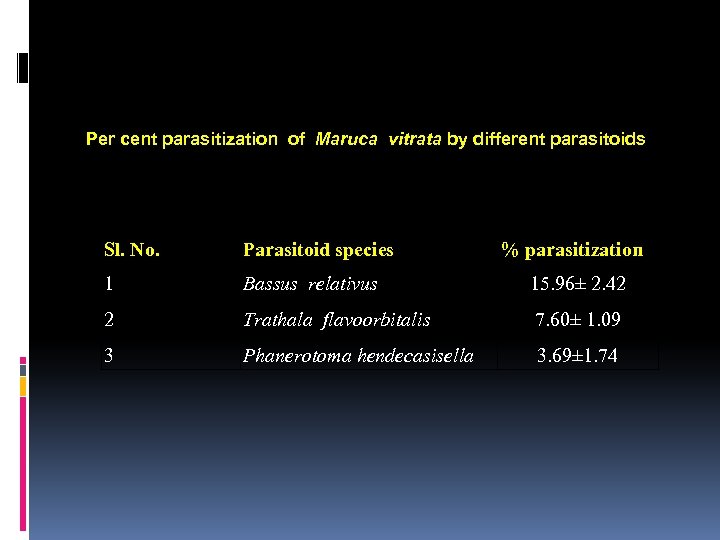 Per cent parasitization of Maruca vitrata by different parasitoids Sl. No. Parasitoid species % parasitization 1 Bassus relativus 15. 96± 2. 42 2 Trathala flavoorbitalis 7. 60± 1. 09 3 Phanerotoma hendecasisella 3. 69± 1. 74
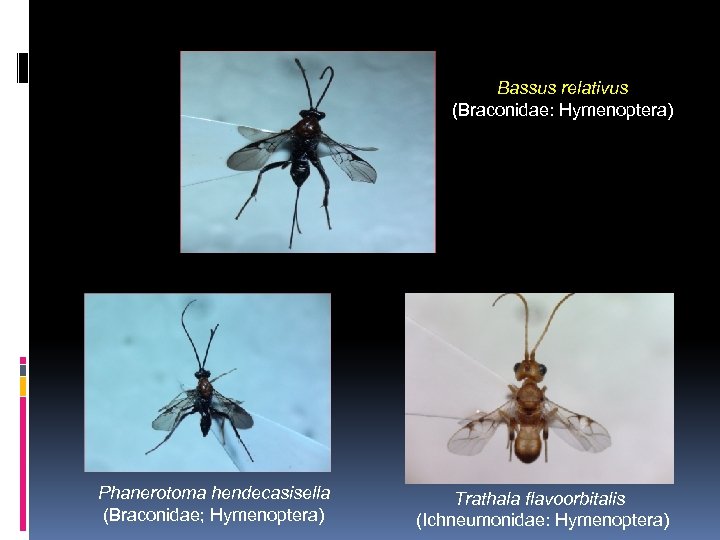 Bassus relativus (Braconidae: Hymenoptera) Phanerotoma hendecasisella (Braconidae; Hymenoptera) Trathala flavoorbitalis (Ichneumonidae: Hymenoptera)
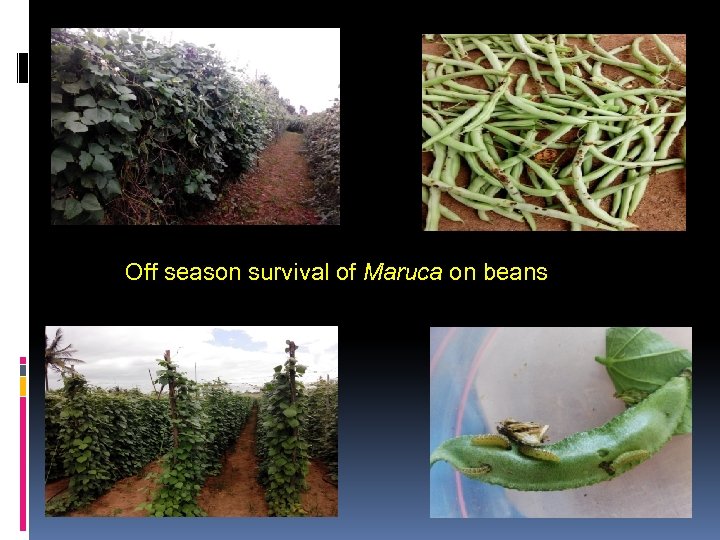 Off season survival of Maruca on beans
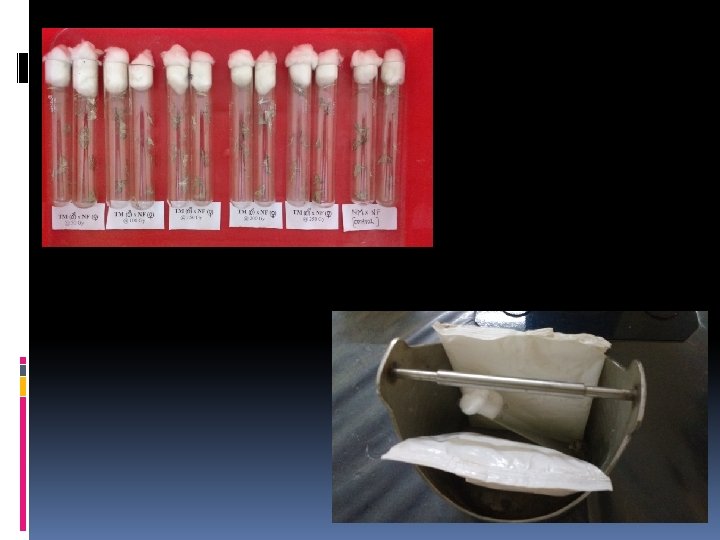
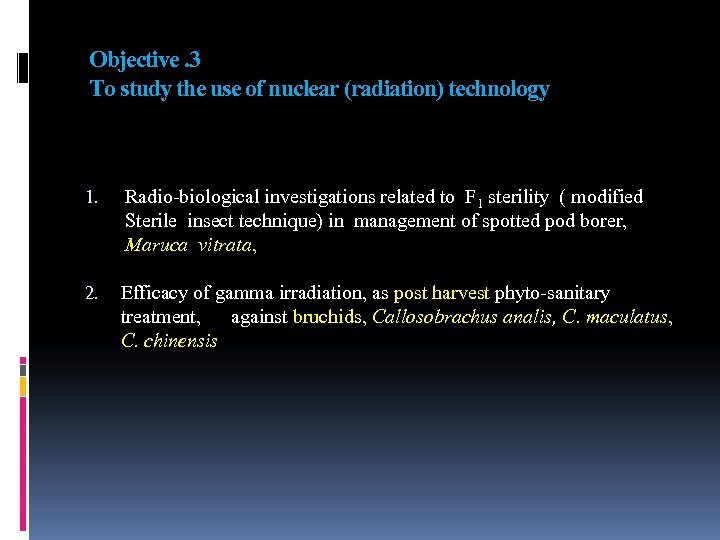 Objective. 3 To study the use of nuclear (radiation) technology 1. Radio-biological investigations related to F 1 sterility ( modified Sterile insect technique) in management of spotted pod borer, Maruca vitrata, 2. Efficacy of gamma irradiation, as post harvest phyto-sanitary treatment, against bruchids, Callosobrachus analis, C. maculatus, C. chinensis
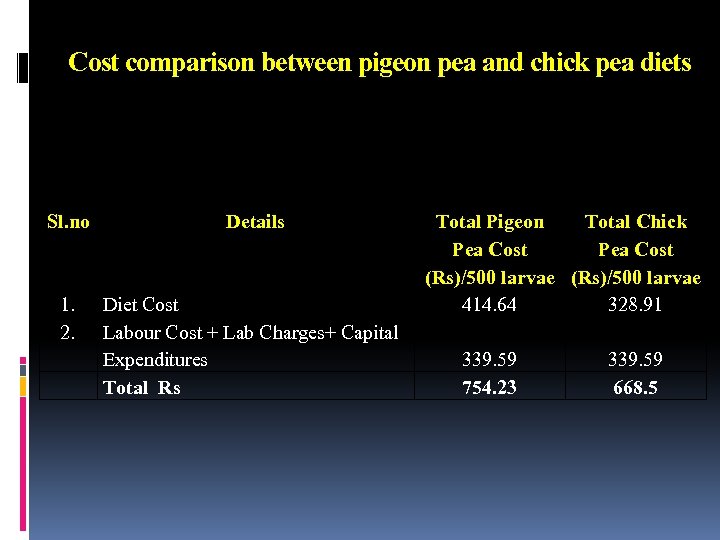 Cost comparison between pigeon pea and chick pea diets Sl. no 1. 2. Details Diet Cost Labour Cost + Lab Charges+ Capital Expenditures Total Rs Total Pigeon Total Chick Pea Cost (Rs)/500 larvae 414. 64 328. 91 339. 59 754. 23 339. 59 668. 5
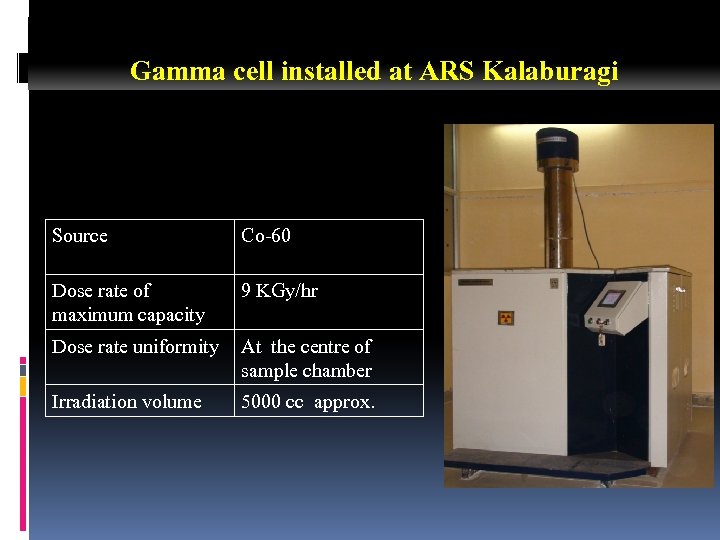 Gamma cell installed at ARS Kalaburagi Source Co-60 Dose rate of maximum capacity 9 KGy/hr Dose rate uniformity At the centre of sample chamber Irradiation volume 5000 cc approx.
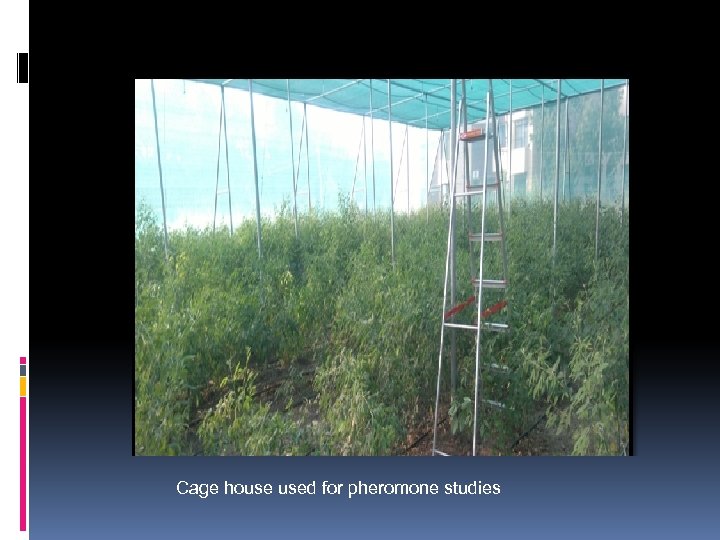 Cage house used for pheromone studies
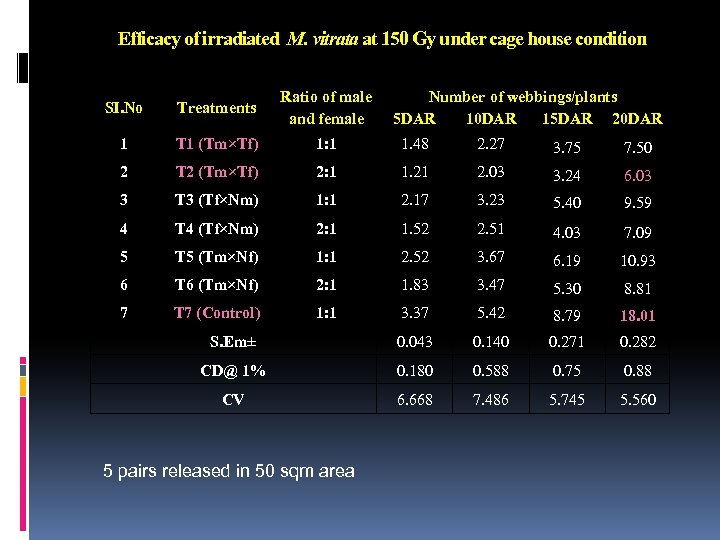 Efficacy of irradiated M. vitrata at 150 Gy under cage house condition SI. No Treatments Ratio of male and female 1 T 1 (Tm×Tf) 1: 1 1. 48 2. 27 3. 75 7. 50 2 T 2 (Tm×Tf) 2: 1 1. 21 2. 03 3. 24 6. 03 3 T 3 (Tf×Nm) 1: 1 2. 17 3. 23 5. 40 9. 59 4 T 4 (Tf×Nm) 2: 1 1. 52 2. 51 4. 03 7. 09 5 T 5 (Tm×Nf) 1: 1 2. 52 3. 67 6. 19 10. 93 6 T 6 (Tm×Nf) 2: 1 1. 83 3. 47 5. 30 8. 81 7 T 7 (Control) 1: 1 3. 37 5. 42 8. 79 18. 01 S. Em± 0. 043 0. 140 0. 271 0. 282 CD@ 1% 0. 180 0. 588 0. 75 0. 88 CV 6. 668 7. 486 5. 745 5. 560 5 pairs released in 50 sqm area Number of webbings/plants 5 DAR 10 DAR 15 DAR 20 DAR
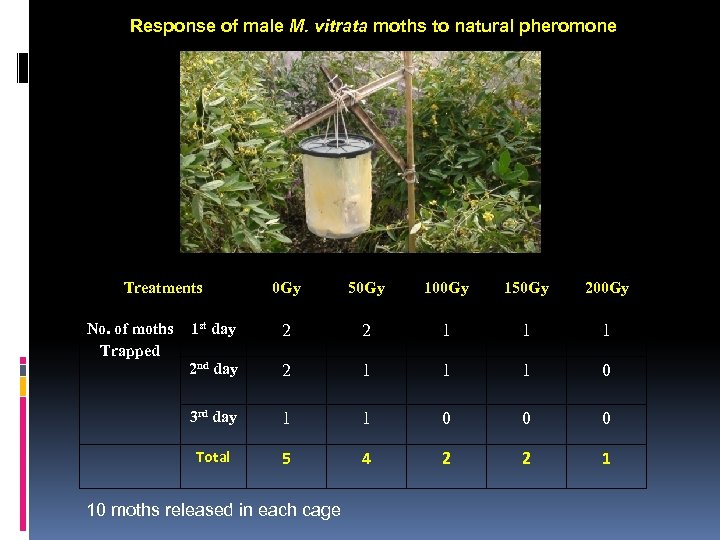 Response of male M. vitrata moths to natural pheromone Treatments 50 Gy 100 Gy 150 Gy 200 Gy 1 st day 2 2 1 1 1 2 nd day 2 1 1 1 0 3 rd day 1 1 0 0 0 Total No. of moths Trapped 0 Gy 5 4 2 2 1 10 moths released in each cage
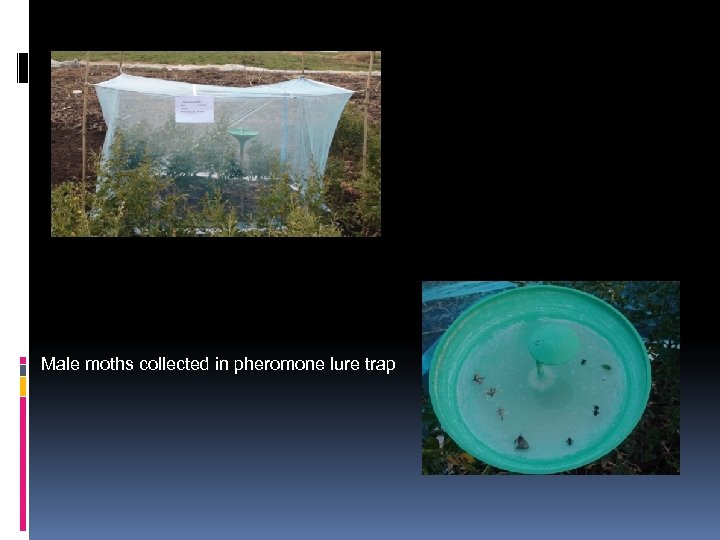 Male moths collected in pheromone lure trap
 Objective 4: To study the Mapping of resistance to conventional and new chemistry against pigeon pea insect pests
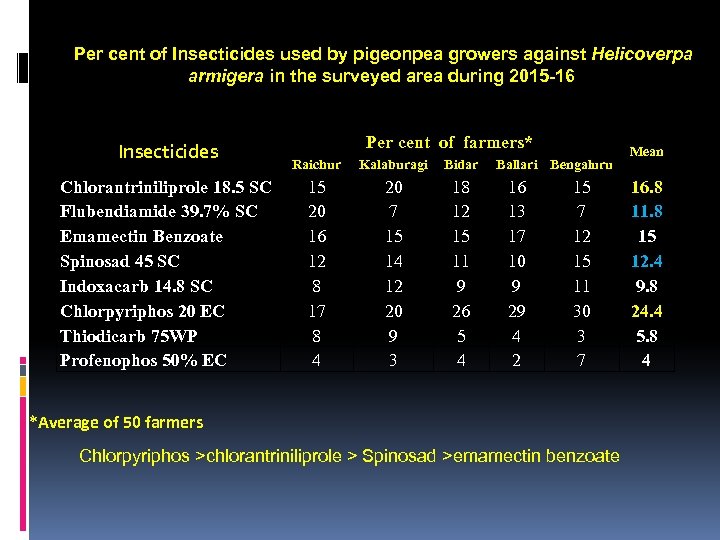 Per cent of Insecticides used by pigeonpea growers against Helicoverpa armigera in the surveyed area during 2015 -16 Insecticides Chlorantriniliprole 18. 5 SC Flubendiamide 39. 7% SC Emamectin Benzoate Spinosad 45 SC Indoxacarb 14. 8 SC Chlorpyriphos 20 EC Thiodicarb 75 WP Profenophos 50% EC Per cent of farmers* Raichur Kalaburagi Bidar 15 20 16 12 8 17 8 4 20 7 15 14 12 20 9 3 18 12 15 11 9 26 5 4 Ballari Bengaluru 16 13 17 10 9 29 4 2 15 7 12 15 11 30 3 7 *Average of 50 farmers Chlorpyriphos >chlorantriniliprole > Spinosad >emamectin benzoate Mean 16. 8 11. 8 15 12. 4 9. 8 24. 4 5. 8 4
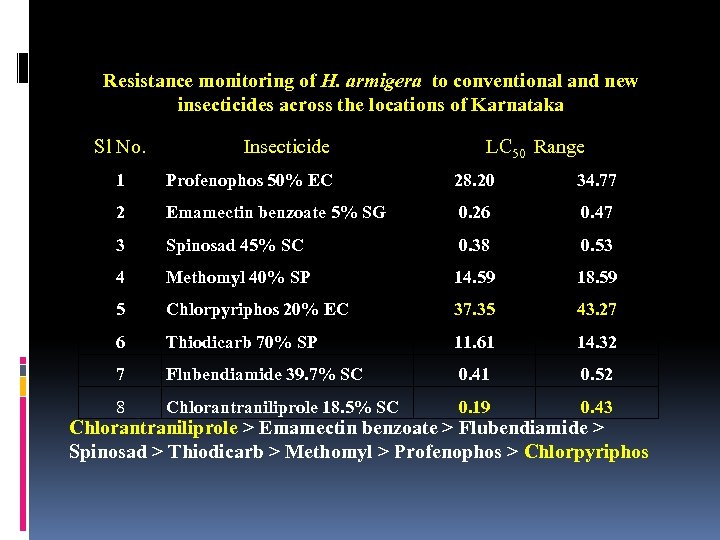 Resistance monitoring of H. armigera to conventional and new insecticides across the locations of Karnataka Sl No. Insecticide LC 50 Range 1 Profenophos 50% EC 28. 20 34. 77 2 Emamectin benzoate 5% SG 0. 26 0. 47 3 Spinosad 45% SC 0. 38 0. 53 4 Methomyl 40% SP 14. 59 18. 59 5 Chlorpyriphos 20% EC 37. 35 43. 27 6 Thiodicarb 70% SP 11. 61 14. 32 7 Flubendiamide 39. 7% SC 0. 41 0. 52 8 Chlorantraniliprole 18. 5% SC 0. 19 0. 43 Chlorantraniliprole > Emamectin benzoate > Flubendiamide > Spinosad > Thiodicarb > Methomyl > Profenophos > Chlorpyriphos
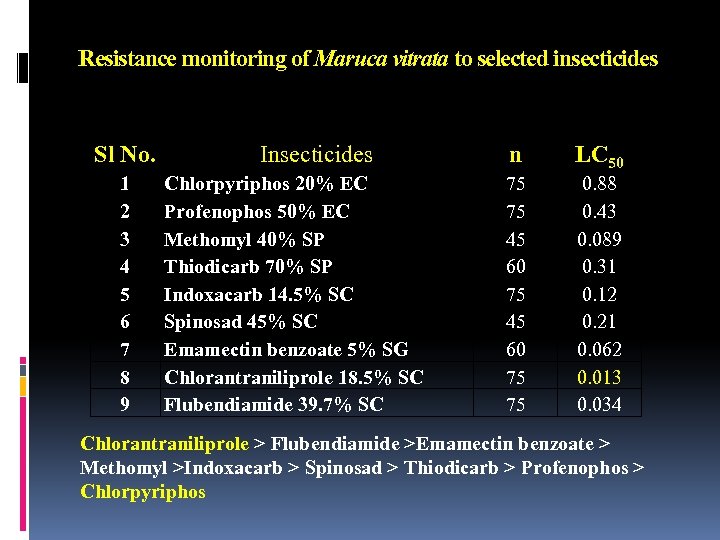 Resistance monitoring of Maruca vitrata to selected insecticides Sl No. 1 2 3 4 5 6 7 8 9 Insecticides Chlorpyriphos 20% EC Profenophos 50% EC Methomyl 40% SP Thiodicarb 70% SP Indoxacarb 14. 5% SC Spinosad 45% SC Emamectin benzoate 5% SG Chlorantraniliprole 18. 5% SC Flubendiamide 39. 7% SC n LC 50 75 75 45 60 75 75 0. 88 0. 43 0. 089 0. 31 0. 12 0. 21 0. 062 0. 013 0. 034 Chlorantraniliprole > Flubendiamide >Emamectin benzoate > Methomyl >Indoxacarb > Spinosad > Thiodicarb > Profenophos > Chlorpyriphos
 Studies on pigeon pea sterility mosaic disease and its management
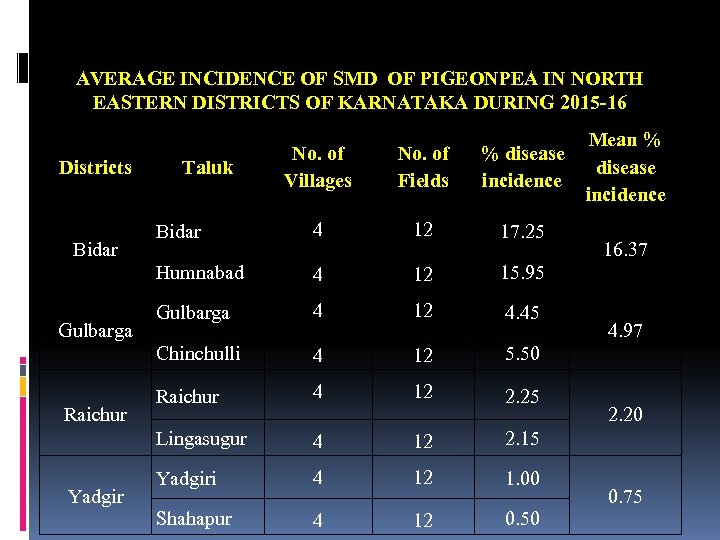 AVERAGE INCIDENCE OF SMD OF PIGEONPEA IN NORTH EASTERN DISTRICTS OF KARNATAKA DURING 2015 -16 Raichur Yadgir Bidar 4 12 17. 25 4 12 Gulbarga 4 12 4. 45 4 12 5. 50 Raichur 4 12 2. 25 4 12 2. 15 Yadgiri 4 12 1. 00 Shahapur 4 12 0. 50 Mean % disease incidence 15. 95 Lingasugur Gulbarga % disease incidence Chinchulli Bidar No. of Fields Humnabad Districts No. of Villages Taluk 16. 37 4. 97 2. 20 0. 75
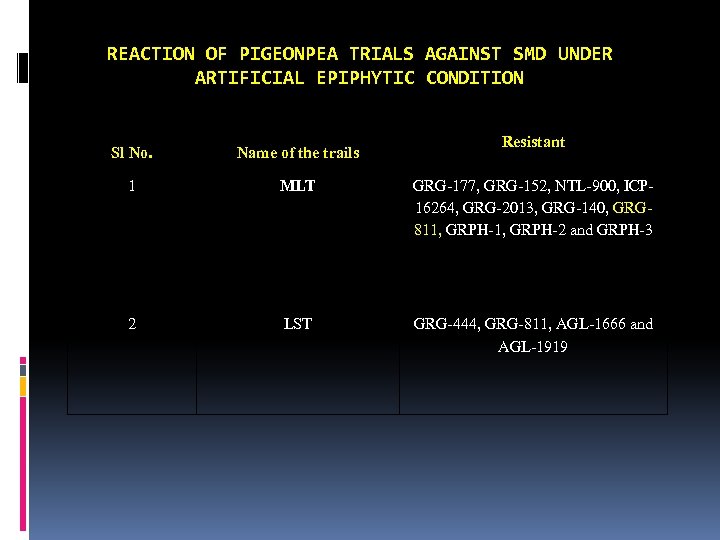 REACTION OF PIGEONPEA TRIALS AGAINST SMD UNDER ARTIFICIAL EPIPHYTIC CONDITION Resistant Sl No. Name of the trails 1 MLT GRG-177, GRG-152, NTL-900, ICP 16264, GRG-2013, GRG-140, GRG 811, GRPH-2 and GRPH-3 2 LST GRG-444, GRG-811, AGL-1666 and AGL-1919
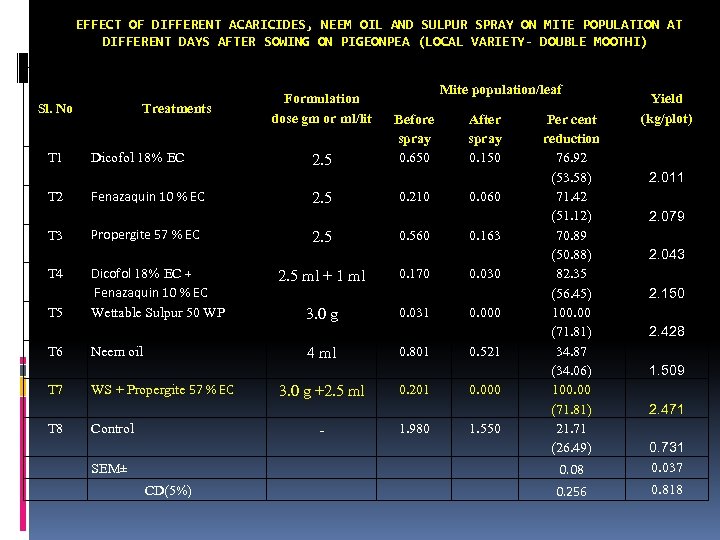 EFFECT OF DIFFERENT ACARICIDES, NEEM OIL AND SULPUR SPRAY ON MITE POPULATION AT DIFFERENT DAYS AFTER SOWING ON PIGEONPEA (LOCAL VARIETY- DOUBLE MOOTHI) Sl. No T 1 T 2 T 3 T 4 T 5 T 6 T 7 T 8 Treatments Dicofol 18% EC Fenazaquin 10 % EC Propergite 57 % EC Dicofol 18% EC + Fenazaquin 10 % EC Wettable Sulpur 50 WP Neem oil WS + Propergite 57 % EC Control SEM± CD(5%) Formulation dose gm or ml/lit 2. 5 ml + 1 ml 3. 0 g 4 ml 3. 0 g +2. 5 ml - Mite population/leaf Before spray 0. 650 0. 210 0. 560 0. 170 0. 031 0. 801 0. 201 1. 980 After spray 0. 150 0. 060 0. 163 0. 030 0. 000 0. 521 0. 000 1. 550 Per cent reduction 76. 92 (53. 58) 71. 42 (51. 12) 70. 89 (50. 88) 82. 35 (56. 45) 100. 00 (71. 81) 34. 87 (34. 06) 100. 00 (71. 81) 21. 71 (26. 49) Yield (kg/plot) 2. 011 2. 079 2. 043 2. 150 2. 428 1. 509 2. 471 0. 08 0. 731 0. 037 0. 256 0. 818
 THANK YOU