


 Скачать презентацию Welfare Economics Consumer and Producer Surplus Consumer
3f3e4dc9cebc6725e261e12bce6470d6.ppt
- Количество слайдов: 10
 Welfare Economics Consumer and Producer Surplus
 Consumer Surplus • How much are you willing to pay for a pair of jeans? • As an individual consumer, you have no say in determining the market price; you take the market price as given. • If the market price is at or below what you are willing to pay for a good, you buy it. • If the market price is below what you are willing to pay for a pair of (your favorite) jeans, your purchase will result in consumer surplus: the difference between the price that you were willing to pay and the (market) price you actually paid.
 Consumer Surplus • Individual consumer surplus = net gain from the purchase of a good= the difference between the maximum price a consumer is willing to pay for a good and the actual price paid • Total consumer surplus is the sum of all consumer surpluses gained by all buyers of a good in the market
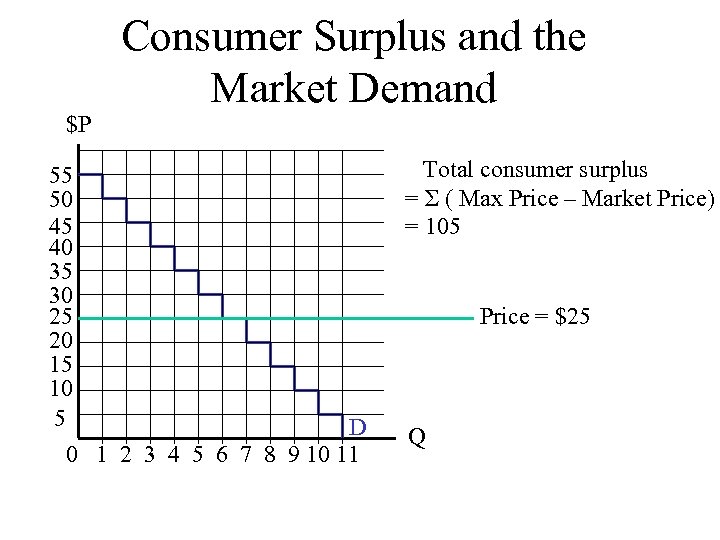 $P Consumer Surplus and the Market Demand 55 50 45 40 35 30 25 20 15 10 5 D 0 1 2 3 4 5 6 7 8 9 10 11 Total consumer surplus = Σ ( Max Price – Market Price) = 105 Price = $25 Q
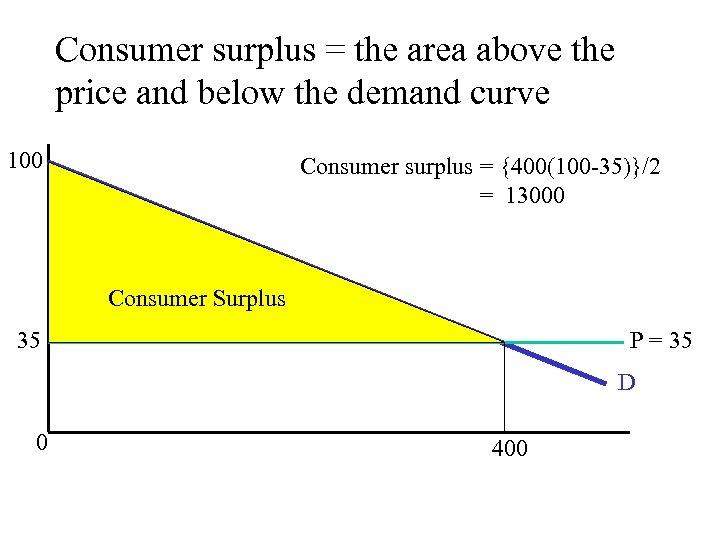 Consumer surplus = the area above the price and below the demand curve 100 Consumer surplus = {400(100 -35)}/2 = 13000 Consumer Surplus 35 P = 35 D 0 400
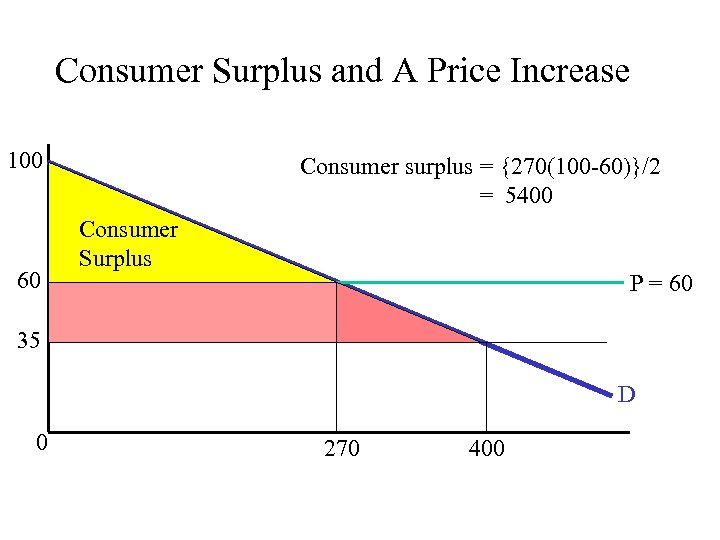 Consumer Surplus and A Price Increase 100 60 Consumer surplus = {270(100 -60)}/2 = 5400 Consumer Surplus P = 60 35 D 0 270 400
 Producer Surplus • The seller’s cost: the lowest price a seller is willing to accept for a good: (marginal cost of production) • Producer surplus: the difference between the (market) price a seller actually receives and his/her (seller’s) cost • A seller would not sell below his/her cost • If the market price is below a seller’s cost the seller will leave the market
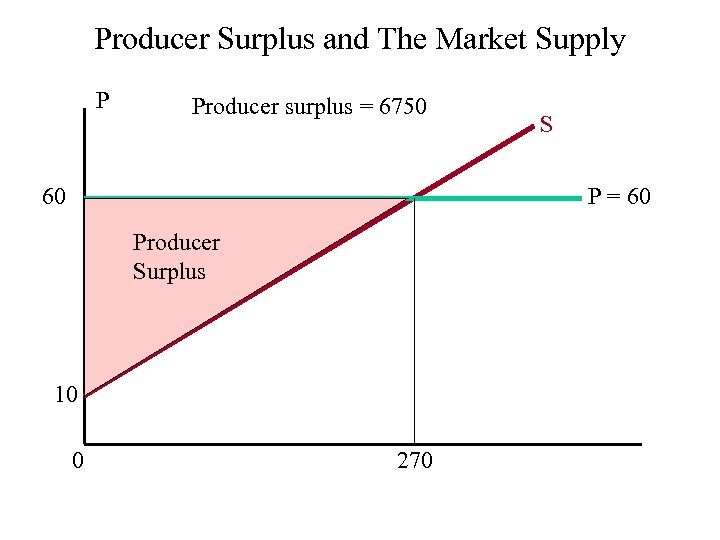 Producer Surplus and The Market Supply P Producer surplus = 6750 60 S P = 60 Producer Surplus 10 0 270
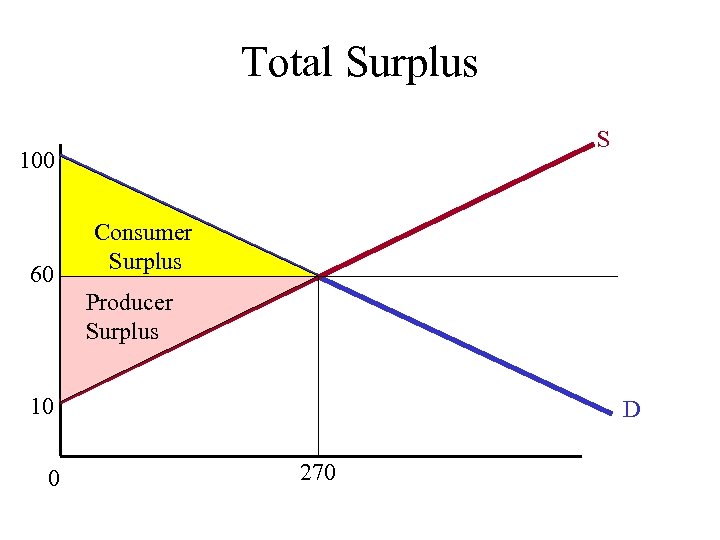 Total Surplus S 100 60 Consumer Surplus Producer Surplus 10 0 D 270
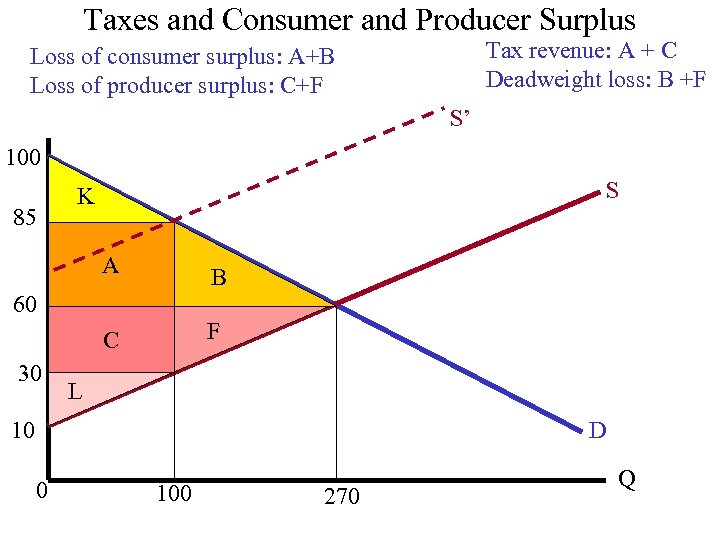 Taxes and Consumer and Producer Surplus Tax revenue: A + C Deadweight loss: B +F Loss of consumer surplus: A+B Loss of producer surplus: C+F S’ 100 85 S K A B C F 60 30 L 10 D 0 100 270 Q