 Скачать презентацию Welcomes the Civil Air Patrol Naval Research Laboratory
131ef145327ff11485bc08030364cace.ppt
- Количество слайдов: 61



Welcomes the Civil Air Patrol Naval Research Laboratory Air Force Research Laboratory U. S. Coast Guard
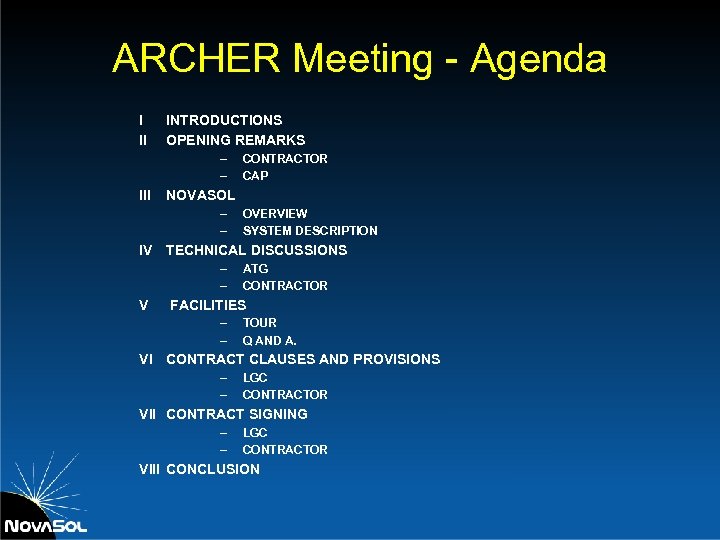
ARCHER Meeting - Agenda I II INTRODUCTIONS OPENING REMARKS – – III CONTRACTOR CAP NOVASOL – – OVERVIEW SYSTEM DESCRIPTION IV TECHNICAL DISCUSSIONS – – V ATG CONTRACTOR FACILITIES – – TOUR Q AND A. VI CONTRACT CLAUSES AND PROVISIONS – – LGC CONTRACTOR VII CONTRACT SIGNING – – LGC CONTRACTOR VIII CONCLUSION
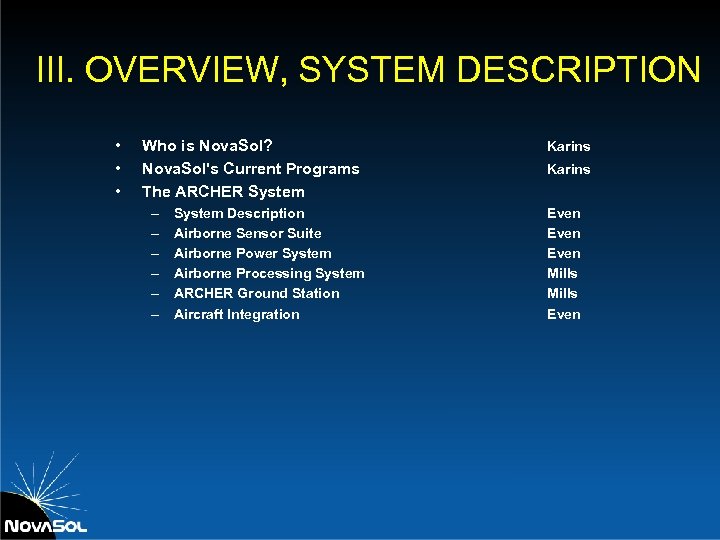
III. OVERVIEW, SYSTEM DESCRIPTION • • • Who is Nova. Sol? Nova. Sol's Current Programs The ARCHER System – – – System Description Airborne Sensor Suite Airborne Power System Airborne Processing System ARCHER Ground Station Aircraft Integration Karins Even Mills Even

Who is Nova. Sol? Dr. Jim Karins, President & CEO
The ARCHER System Description Airborne Sensor Suite Airborne Power System Detlev Even, Deputy Director Sensor Systems
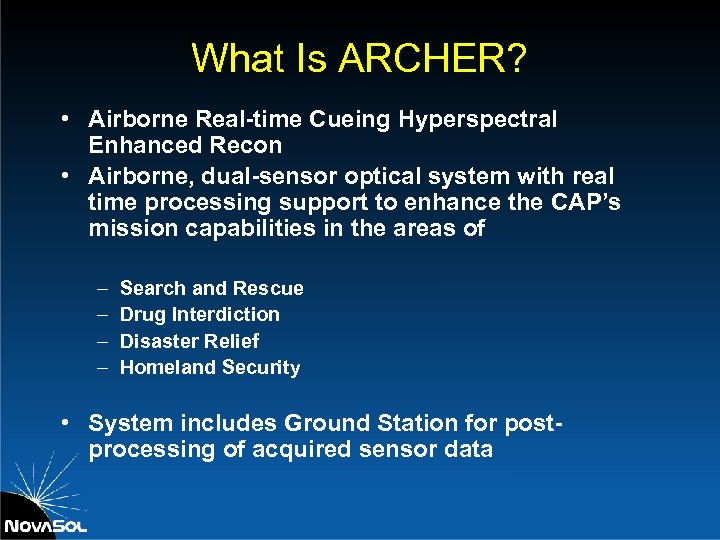
What Is ARCHER? • Airborne Real-time Cueing Hyperspectral Enhanced Recon • Airborne, dual-sensor optical system with real time processing support to enhance the CAP’s mission capabilities in the areas of – – Search and Rescue Drug Interdiction Disaster Relief Homeland Security • System includes Ground Station for postprocessing of acquired sensor data
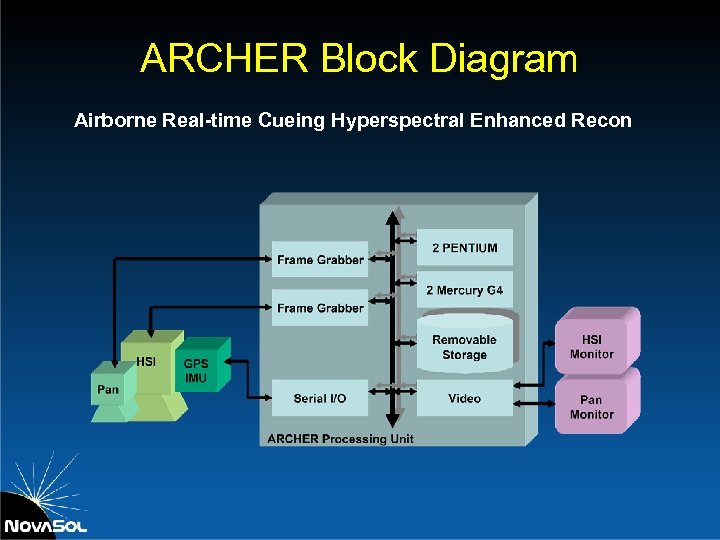
ARCHER Block Diagram Airborne Real-time Cueing Hyperspectral Enhanced Recon
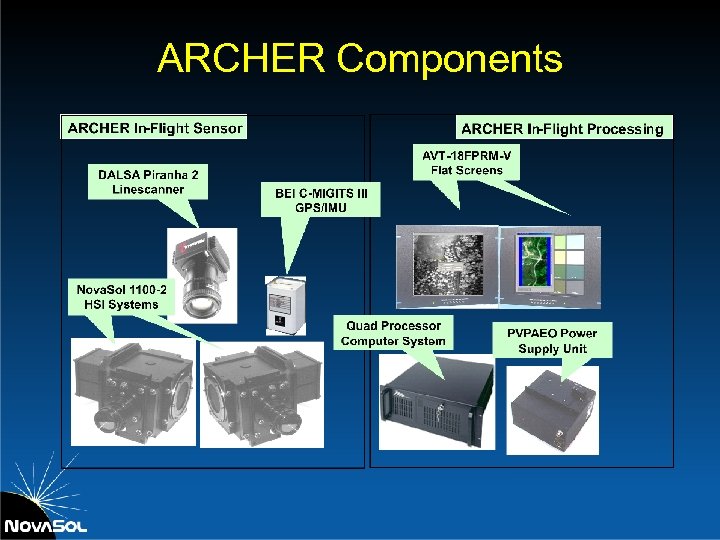
ARCHER Components
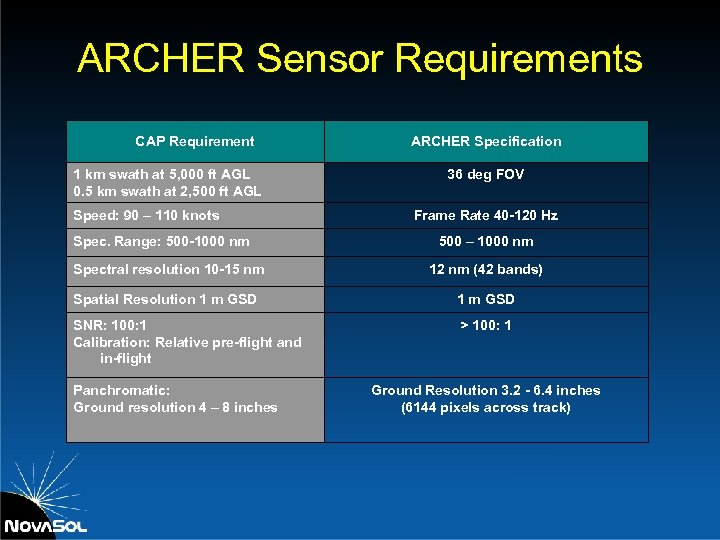
ARCHER Sensor Requirements CAP Requirement 1 km swath at 5, 000 ft AGL 0. 5 km swath at 2, 500 ft AGL Speed: 90 – 110 knots Spec. Range: 500 -1000 nm ARCHER Specification 36 deg FOV Frame Rate 40 -120 Hz 500 – 1000 nm Spectral resolution 10 -15 nm 12 nm (42 bands) Spatial Resolution 1 m GSD SNR: 100: 1 Calibration: Relative pre-flight and in-flight > 100: 1 Panchromatic: Ground resolution 4 – 8 inches Ground Resolution 3. 2 - 6. 4 inches (6144 pixels across track)
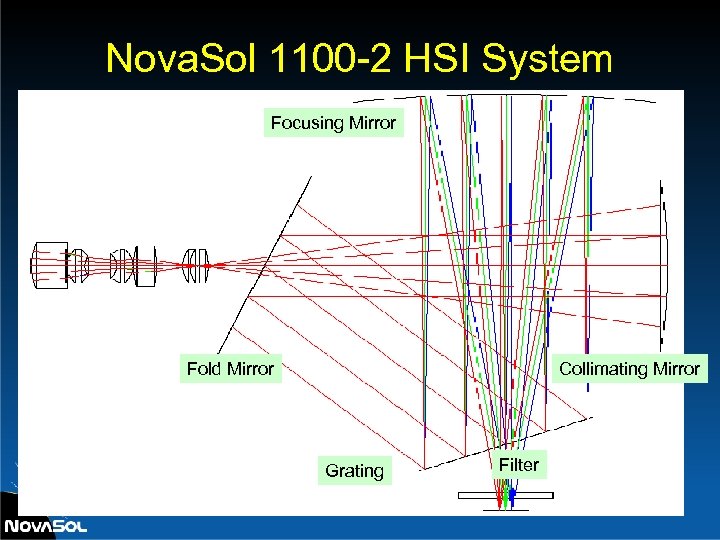
Nova. Sol 1100 -2 HSI System Focusing Mirror Fold Mirror Collimating Mirror Grating Filter
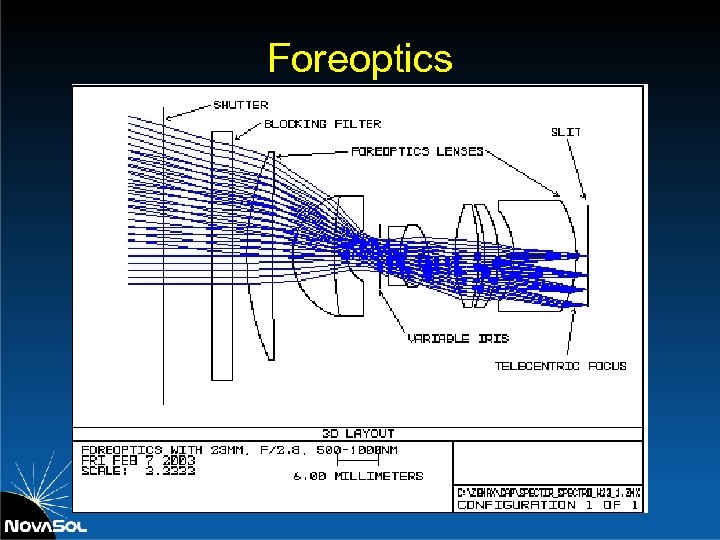
Foreoptics
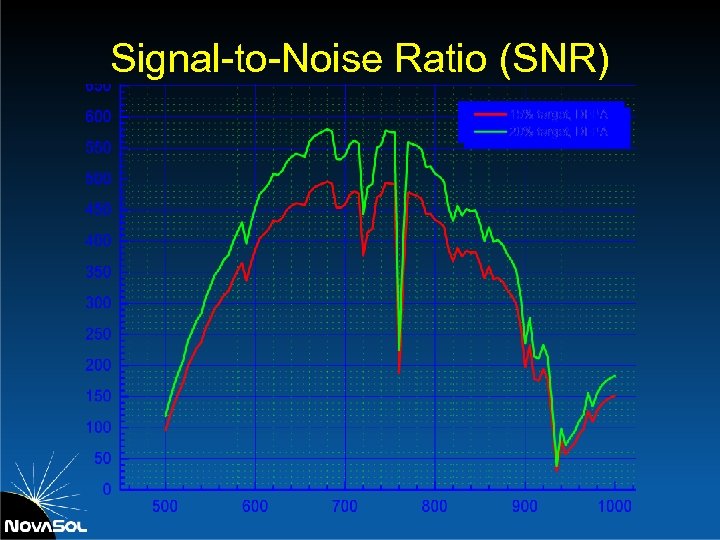
Signal-to-Noise Ratio (SNR)
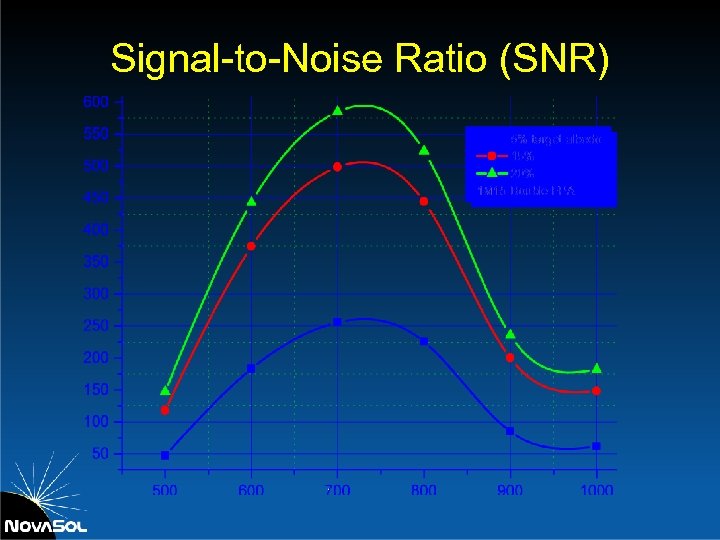
Signal-to-Noise Ratio (SNR)
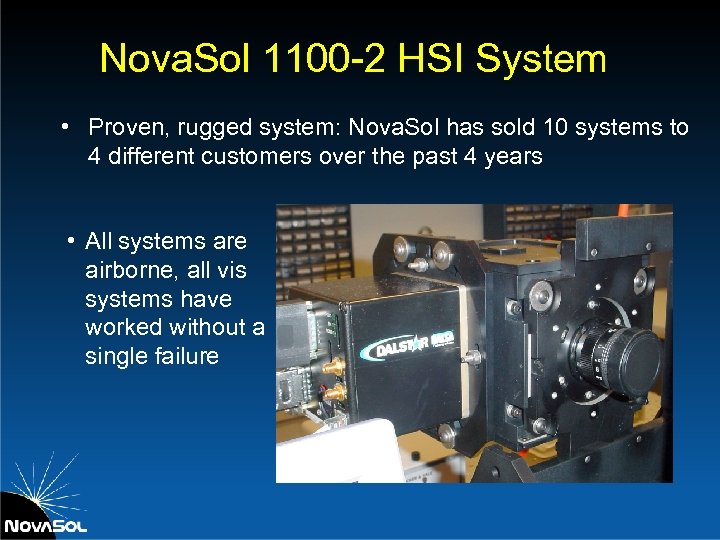
Nova. Sol 1100 -2 HSI System • Proven, rugged system: Nova. Sol has sold 10 systems to 4 different customers over the past 4 years • All systems are airborne, all vis systems have worked without a single failure
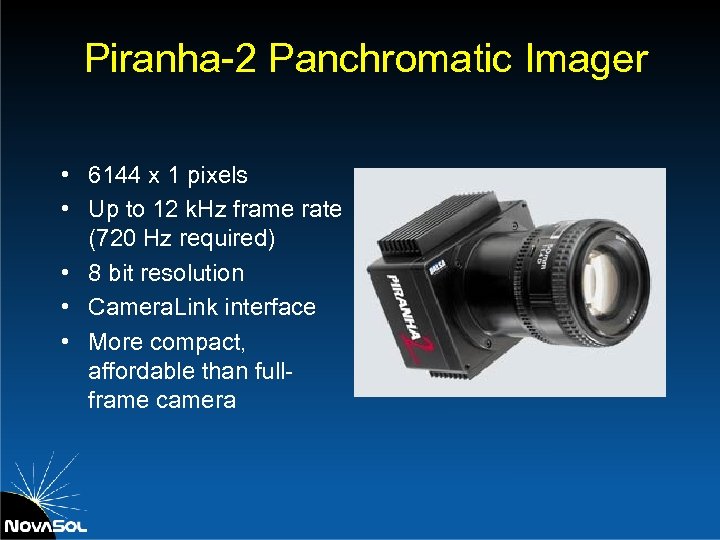
Piranha-2 Panchromatic Imager • 6144 x 1 pixels • Up to 12 k. Hz frame rate (720 Hz required) • 8 bit resolution • Camera. Link interface • More compact, affordable than fullframe camera
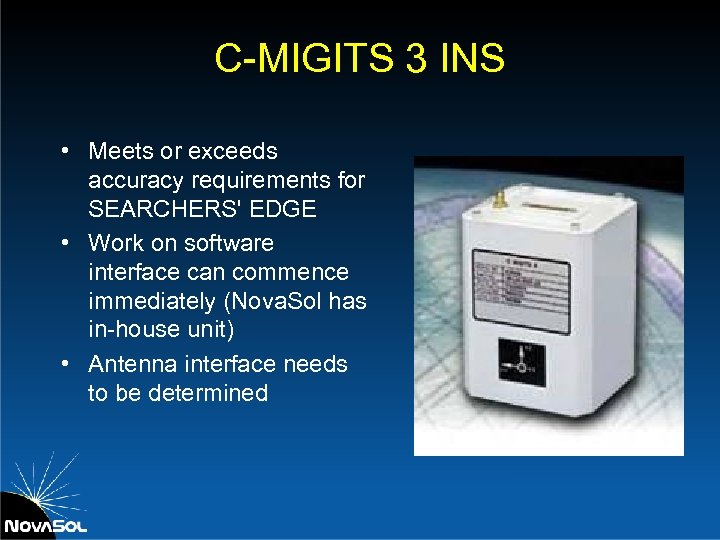
C-MIGITS 3 INS • Meets or exceeds accuracy requirements for SEARCHERS' EDGE • Work on software interface can commence immediately (Nova. Sol has in-house unit) • Antenna interface needs to be determined
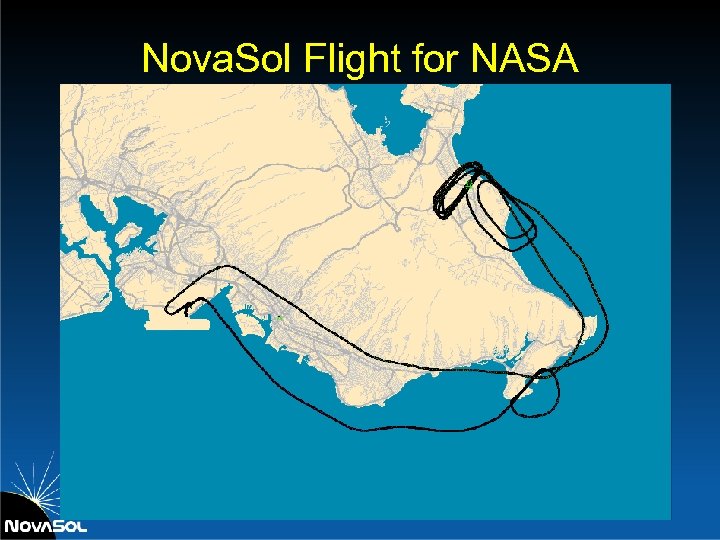
Nova. Sol Flight for NASA
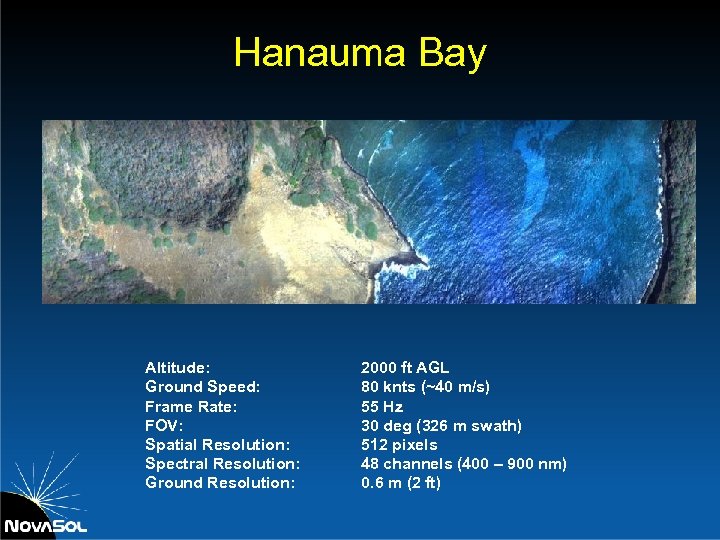
Hanauma Bay Altitude: Ground Speed: Frame Rate: FOV: Spatial Resolution: Spectral Resolution: Ground Resolution: 2000 ft AGL 80 knts (~40 m/s) 55 Hz 30 deg (326 m swath) 512 pixels 48 channels (400 – 900 nm) 0. 6 m (2 ft)
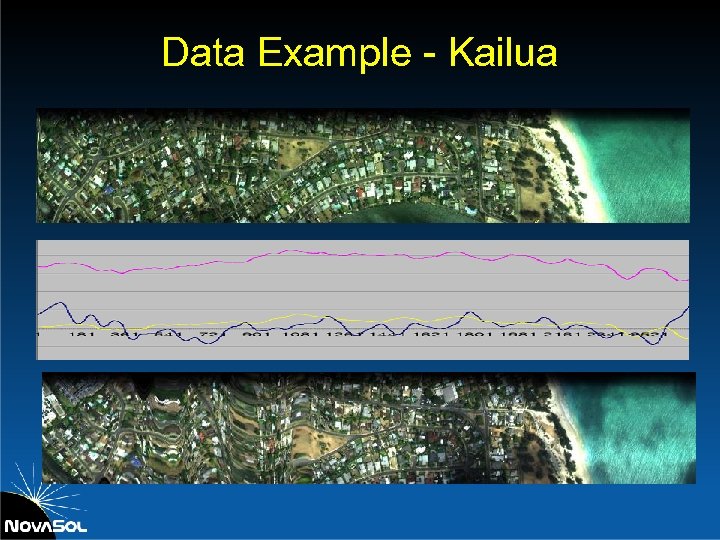
Data Example - Kailua

Power Supply • Custom power supply will guarantee efficient power conversion • PVPAEO has built airborne power supplies for NASA, others • Custom supply will minimize weight, volume of airborne system
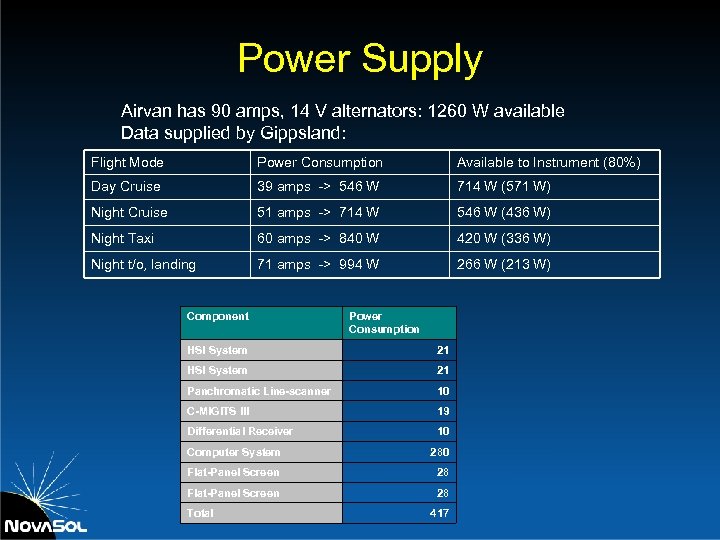
Power Supply Airvan has 90 amps, 14 V alternators: 1260 W available Data supplied by Gippsland: Flight Mode Power Consumption Available to Instrument (80%) Day Cruise 39 amps -> 546 W 714 W (571 W) Night Cruise 51 amps -> 714 W 546 W (436 W) Night Taxi 60 amps -> 840 W 420 W (336 W) Night t/o, landing 71 amps -> 994 W 266 W (213 W) Component Power Consumption HSI System 21 Panchromatic Line-scanner 10 C-MIGITS III 19 Differential Receiver 10 Computer System 280 Flat-Panel Screen 28 Total 417
The ARCHER System Airborne Processing System Hardware Software Concepts of Operation ARCHER Ground Station Stuart Mills, Senior System Engineer
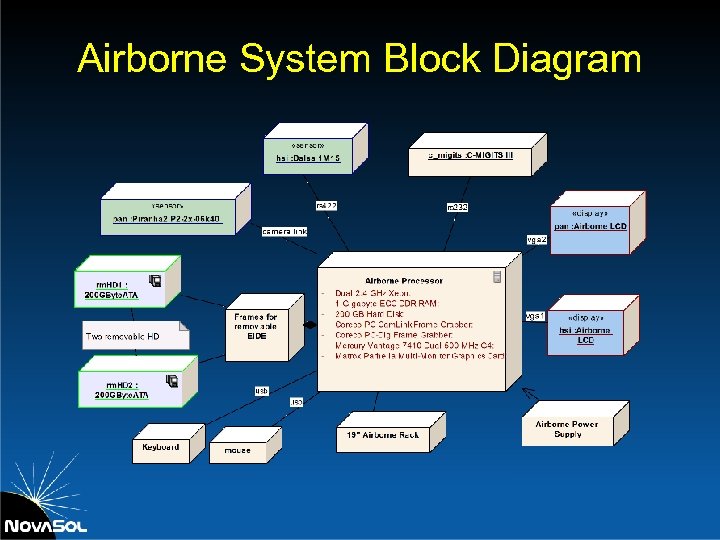
Airborne System Block Diagram
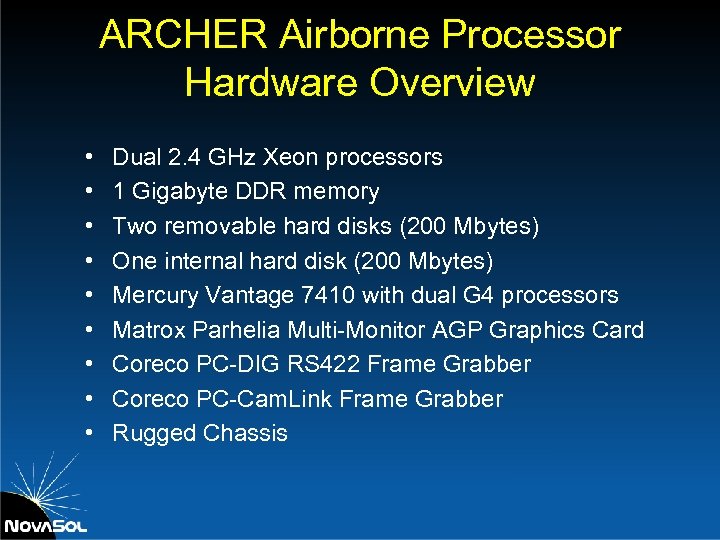
ARCHER Airborne Processor Hardware Overview • • • Dual 2. 4 GHz Xeon processors 1 Gigabyte DDR memory Two removable hard disks (200 Mbytes) One internal hard disk (200 Mbytes) Mercury Vantage 7410 with dual G 4 processors Matrox Parhelia Multi-Monitor AGP Graphics Card Coreco PC-DIG RS 422 Frame Grabber Coreco PC-Cam. Link Frame Grabber Rugged Chassis
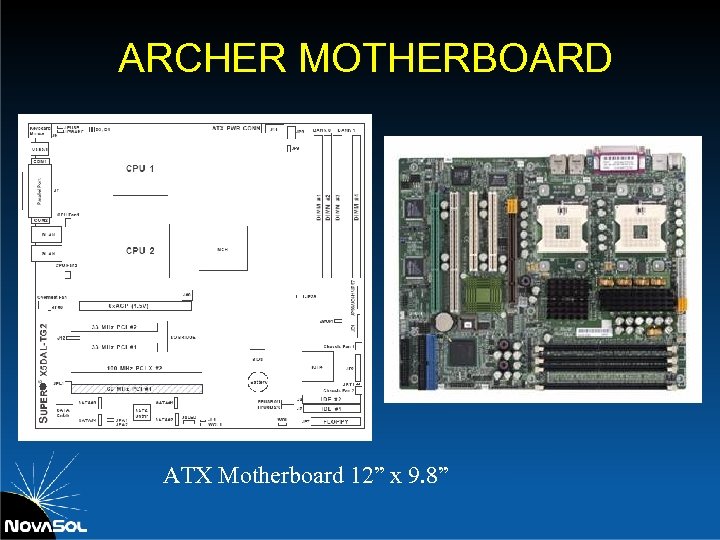
ARCHER MOTHERBOARD ATX Motherboard 12” x 9. 8”
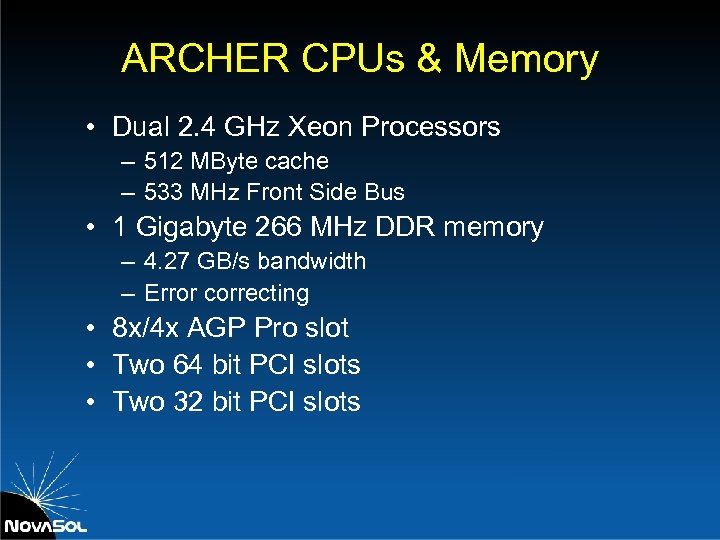
ARCHER CPUs & Memory • Dual 2. 4 GHz Xeon Processors – 512 MByte cache – 533 MHz Front Side Bus • 1 Gigabyte 266 MHz DDR memory – 4. 27 GB/s bandwidth – Error correcting • 8 x/4 x AGP Pro slot • Two 64 bit PCI slots • Two 32 bit PCI slots
ARCHER PCI & Storage Interfaces • 4 Serial ATA ports • Dual EIDE ports Ultra DMA 100 MB/s – Supports 4 IDE devices • Dual Gigabit Ethernet integrated on motherboard • Two serial ports • Two USB 2. 0 ports • PS/2 Keyboard and mouse ports
Motherboard System Health • Monitors CPU core voltages & system power supply • Monitors CPU, Chassis temperature • Monitors CPU & Chassis fans • CPU slow-down on temperature overheat • Self-Monitoring Analysis and Reporting Technology (SMART) • can help predict impending drive failures
Matrox Parhelia Graphics Card • Optimized for 2 D graphics display • 512 -bit GPU • 256 -bit DDR memory interface – 20 GB/s memory bandwidth • 128 MB DDR memory • Triple-RGB, Dual-DVI, TV output
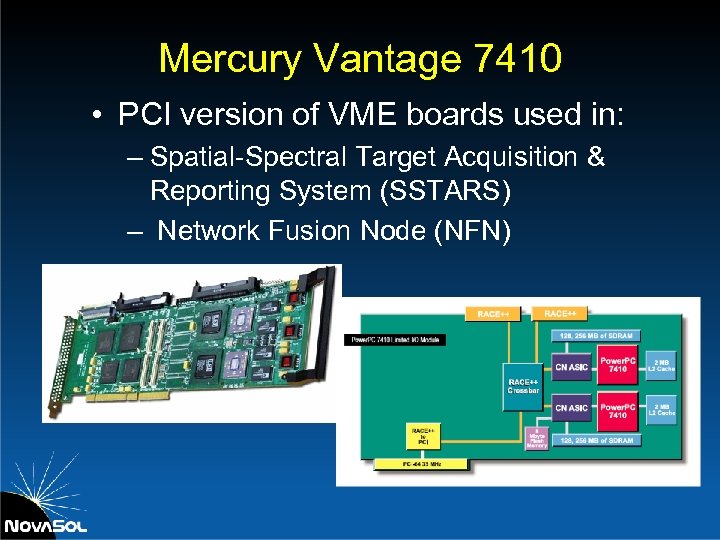
Mercury Vantage 7410 • PCI version of VME boards used in: – Spatial-Spectral Target Acquisition & Reporting System (SSTARS) – Network Fusion Node (NFN)
Vantage 7410 Compute Node • Two Compute Nodes each with: – G 4 Processor@ 500 MHz • 2 Mbytes L 2 cache • Altivec unit supports peak rates of 4 GFLOPS/sec – 256 Mbytes SDRAM • 1 Gbyte/sec bandwidth • Error Checking & Correcting – DMA with pre-fetch & FIFO buffering • Processors focus on processing, not moving data – PCI 64 Interface • 256 Mbytes/sec
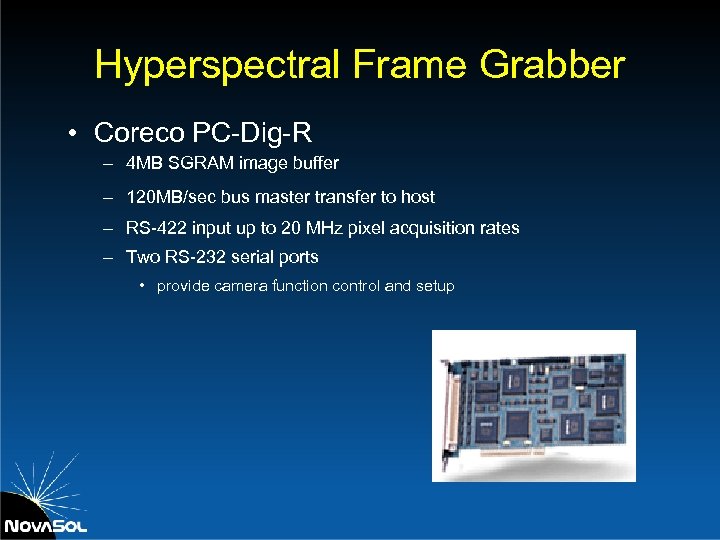
Hyperspectral Frame Grabber • Coreco PC-Dig-R – 4 MB SGRAM image buffer – 120 MB/sec bus master transfer to host – RS-422 input up to 20 MHz pixel acquisition rates – Two RS-232 serial ports • provide camera function control and setup
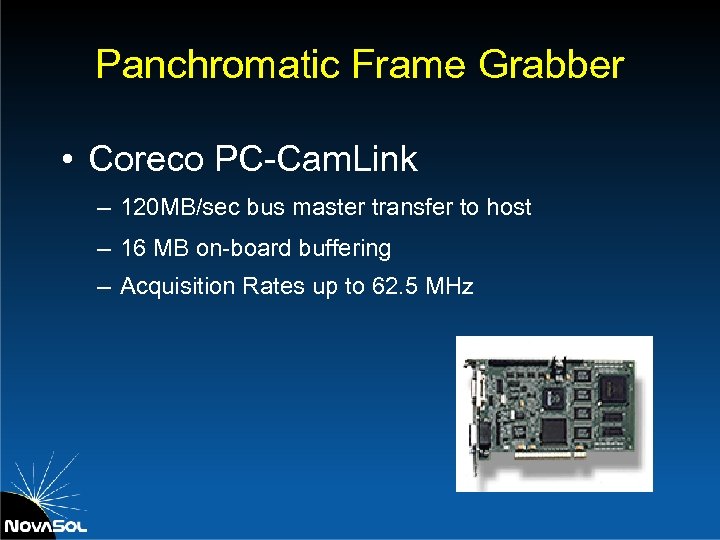
Panchromatic Frame Grabber • Coreco PC-Cam. Link – 120 MB/sec bus master transfer to host – 16 MB on-board buffering – Acquisition Rates up to 62. 5 MHz
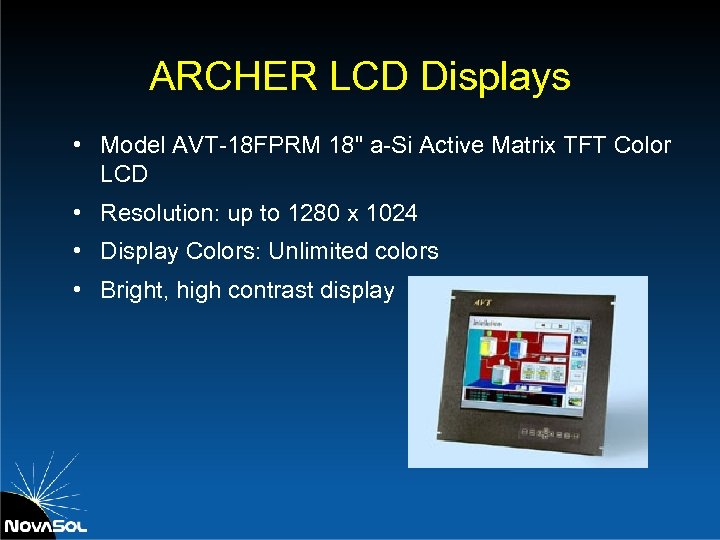
ARCHER LCD Displays • Model AVT-18 FPRM 18" a-Si Active Matrix TFT Color LCD • Resolution: up to 1280 x 1024 • Display Colors: Unlimited colors • Bright, high contrast display
ARCHER Hard Disks • • 200 Gbyte HD drive Ultra ATA/133 Data Transfer Speed Average seek time: < 9. 5 ms Average latency: 4. 2 ms Rotational speed: 7200 RPM 8 MB Cache Buffer Shock – Operating 2 ms (G): 60 – Non-operating 2 ms (G): 300
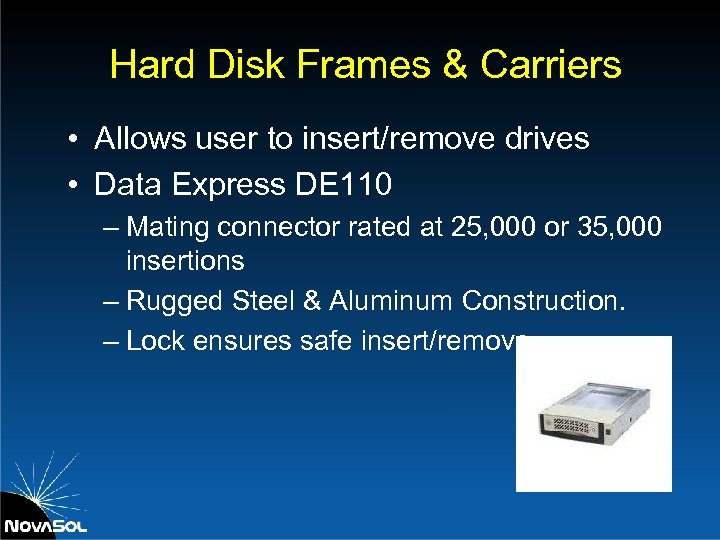
Hard Disk Frames & Carriers • Allows user to insert/remove drives • Data Express DE 110 – Mating connector rated at 25, 000 or 35, 000 insertions – Rugged Steel & Aluminum Construction. – Lock ensures safe insert/remove
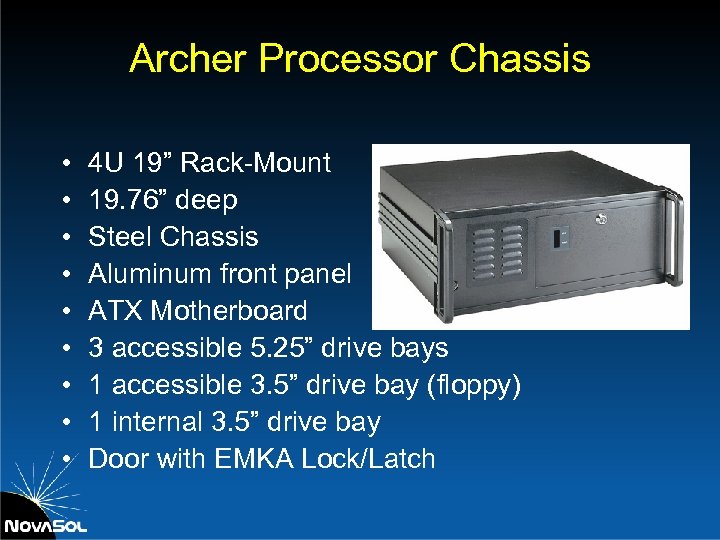
Archer Processor Chassis • • • 4 U 19” Rack-Mount 19. 76” deep Steel Chassis Aluminum front panel ATX Motherboard 3 accessible 5. 25” drive bays 1 accessible 3. 5” drive bay (floppy) 1 internal 3. 5” drive bay Door with EMKA Lock/Latch
Processor Reliability Enhancements • Shock/vibration mounts to racks • Hold down bar for I/O cards – Vibration damping • Support bars for CPU heat sinks • Supports & vibration damping for motherboard • Stabilant 22 for edge card connections – Provides the reliability of a soldered joint without bonding the contacting surfaces together
ARCHER Operating Systems • Windows XP – Used for GUIs, Storage & Data Capture • Real time threads for – Acquiring imagery – Acquiring navigation data • High priority threads for data storage – Dual processors ensures meeting real-time goals • Mercury MC/OS – Used for Hyperspectral Detection processing • Sub. Space Reed – Xiaoli (SSRX) Anomaly detection • Spectral Matched Filter detection – MC/OS designed specifically for real-time signal processing
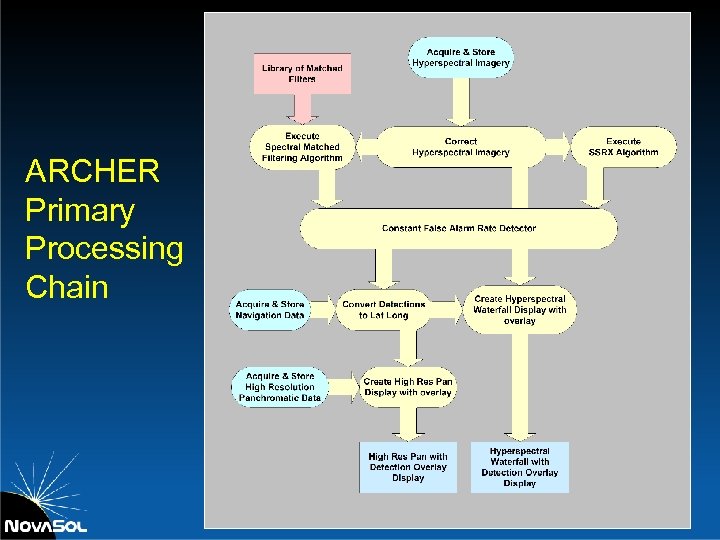
ARCHER Primary Processing Chain
ARCHER HSI Display • Hyperspectral Waterfall Display – 512 pixels x ~900 lines RGB • Full spatial resolution • Operator selects which bands are used to generate RGB – Automatically scrolls during flight – Operator can scroll back up to one minute in time – Detections are overlaid as they occur
ARCHER Panchromatic Display • Panchromatic Waterfall Display – 1024 pixels x ~900 lines monochromatic • 1/6 th actual spatial resolution – Automatically scrolls during flight – Operator can scroll back up to one minute in time – Detections are overlaid as they occur • Pop up window contains lat, long, el & detection source – Operator can click on panchromatic pixel to get full resolution pop-up • Display interesting regions that are not detected • 256 x 256 nominal
ARCHER Chips Display • Panchromatic Chip Display – Detection Chips • Displayed in pan detection chips window – Nominal size is 256 x 256 pixels – Operator can scroll through detection chips • Selecting detection chip loads filter into matched filter algorithm – Matched Filter Chips • Displayed in pan matched filters chips window – Decimated Detection Chip: 128 x 128 nominal – Maximum of 20 matched filters
ARCHER System Displays • ARCHER Command & Status Window – User Inputs • Initialize, Start, Stop, Shutdown • Select Profile – Displays • Current flight data – Lat, long, elevation, ground speed • ARCHER Processor Status & Errors – Disk storage status – Disk errors, processing errors, camera interface errors • Text print out of detections as they occur – Lat, Long, El, detection source
Ground Station Hardware • Same as Airborne Processor except – No Mercury Vantage 7410 – No frame grabbers – External Disk Enclosure • Approach provides back-up capabilities for PC hardware • Provides non-realtime execution of Airborne Processor algorithms
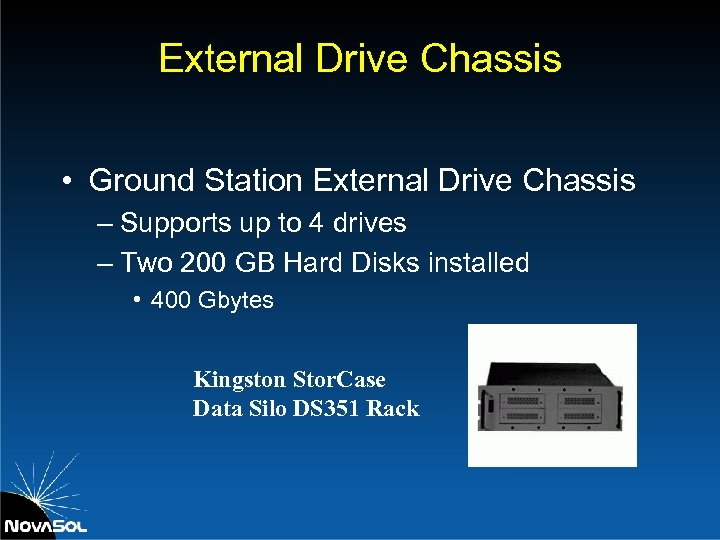
External Drive Chassis • Ground Station External Drive Chassis – Supports up to 4 drives – Two 200 GB Hard Disks installed • 400 Gbytes Kingston Stor. Case Data Silo DS 351 Rack
Playback Software • Allows the operator to play back the data collected during a flight – Scenes are loaded from disk – Based on the NRTP developed for NRL – Same algorithms used on the Airborne Processor – Allows the operator to adjust parameters • Determine optimal settings for specific missions
Data Conversion • The Ground Station will have utilities to convert the collected imagery into standard formats – NITF (National Imagery Transfer Format, the standard Do. D format), – STANAG 7023 (a standard NATO format) – HDF (Hierarchal Data Format, used in scientific processing) – ENVI/IDL compatible formats.
Geo-Rectification Utility – Uses the 100 Hz navigation data and digital terrain models to create spatially accurate representations of the ground imaged by the sensor. • Corrects for variations in the aircraft attitude that result in the sensor imaging off-nadir. – Roll, Pitch, and Yaw • Corrects for terrain variation (elevation) • Corrects for variations in altitude.
ARCHER Concept of Operation • Pre-Flight operations – Install two 200 Gigabyte disks for current flight – Select a profile • Collection of system parameters – – Enter mission name Initialize system Calibrate sensors Enable airborne processing
Concept of Operation (cont. ) • Flight operations – View Hyperspectral and Panchromatic displays • Hyperspectral displayed full res • Decimated Pan displayed – View detections and associated full resolution pan chips – Select detections for matched filtering • Maximum of 20 simultaneous matched filters – Select regions in the pan image to display as full resolution pop-ups
Concept of Operation (cont. ) • Post-Flight – Remove the two 200 Gigabyte disks – Install into the Ground Station for post-flight analysis. – Playback the flight – Investigate impact of parameter changes – Save new parameters as a new profile – Copy the data to Ground Station storage
The ARCHER System Aircraft Installation Organizational Chart Training and Support Detlev Even, Deputy Director Sensor Systems
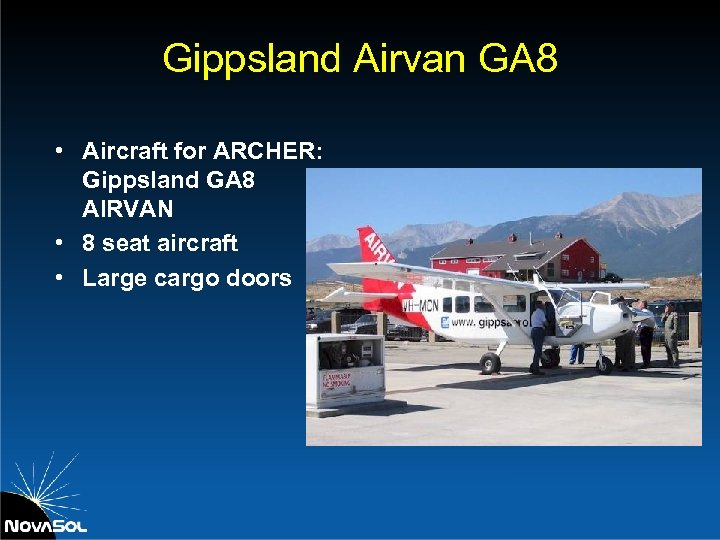
Gippsland Airvan GA 8 • Aircraft for ARCHER: Gippsland GA 8 AIRVAN • 8 seat aircraft • Large cargo doors
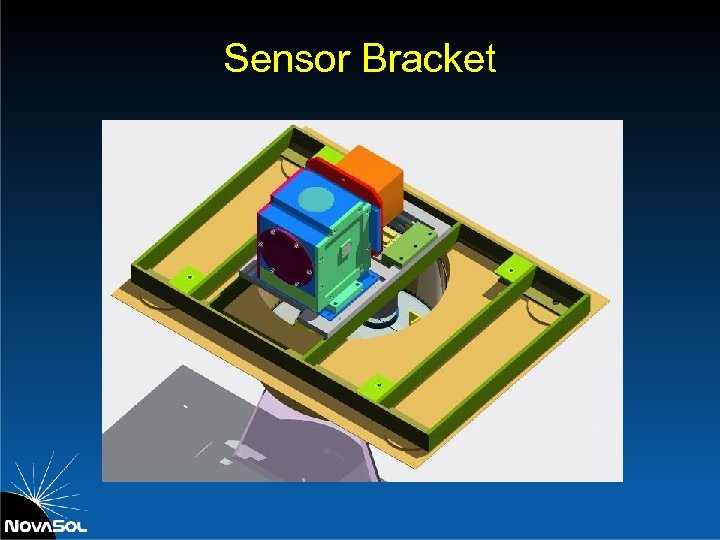
Sensor Bracket
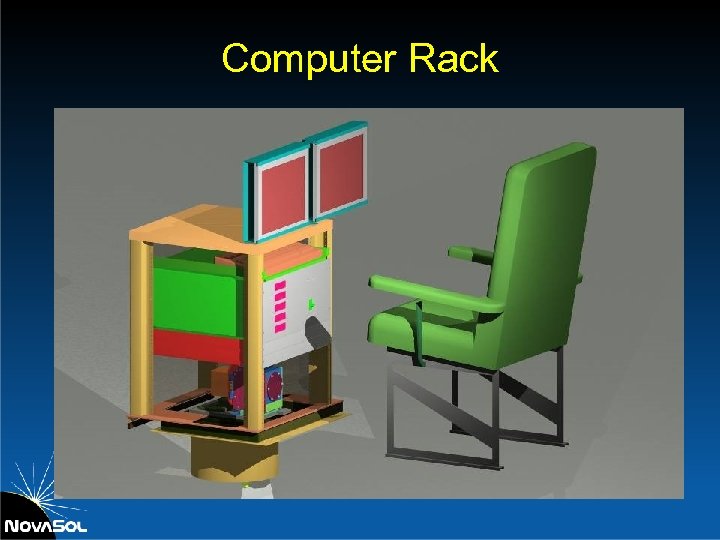
Computer Rack
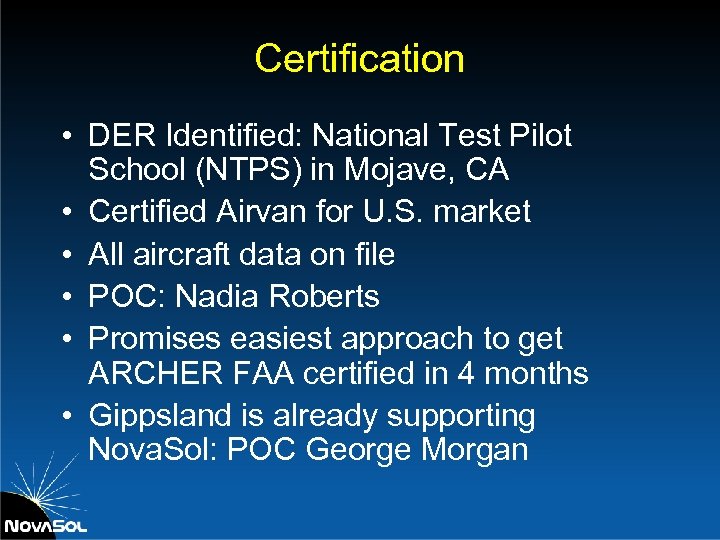
Certification • DER Identified: National Test Pilot School (NTPS) in Mojave, CA • Certified Airvan for U. S. market • All aircraft data on file • POC: Nadia Roberts • Promises easiest approach to get ARCHER FAA certified in 4 months • Gippsland is already supporting Nova. Sol: POC George Morgan
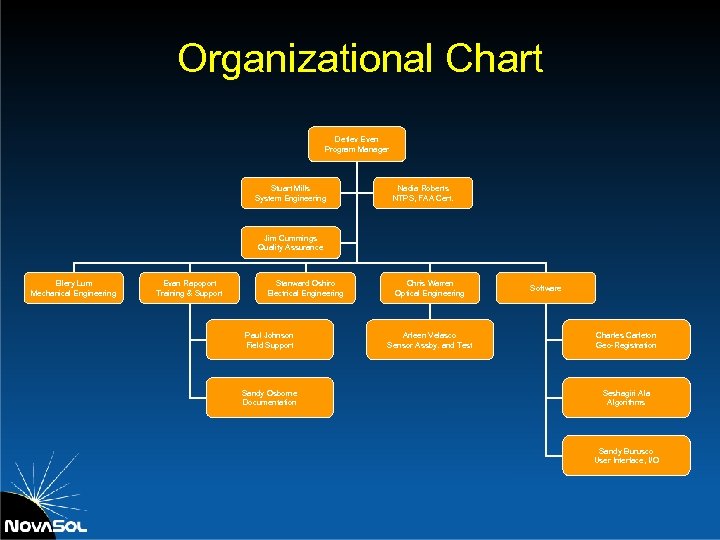
Organizational Chart Detlev Even Program Manager Stuart Mills System Engineering Nadia Roberts NTPS, FAA Cert. Jim Cummings Quality Assurance Ellery Lum Mechanical Engineering Evan Rapoport Training & Support Stanward Oshiro Electrical Engineering Paul Johnson Field Support Sandy Osborne Documentation Chris Warren Optical Engineering Arleen Velasco Sensor Assby. and Test Software Charles Carleton Geo-Registration Seshagiri Ala Algorithms Sandy Burusco User Interface, I/O
Training and Support • Each system will be delivered with full documentation, training • Web site will be developed for 24/7 tech support • All questions will receive a reply within 24 hours
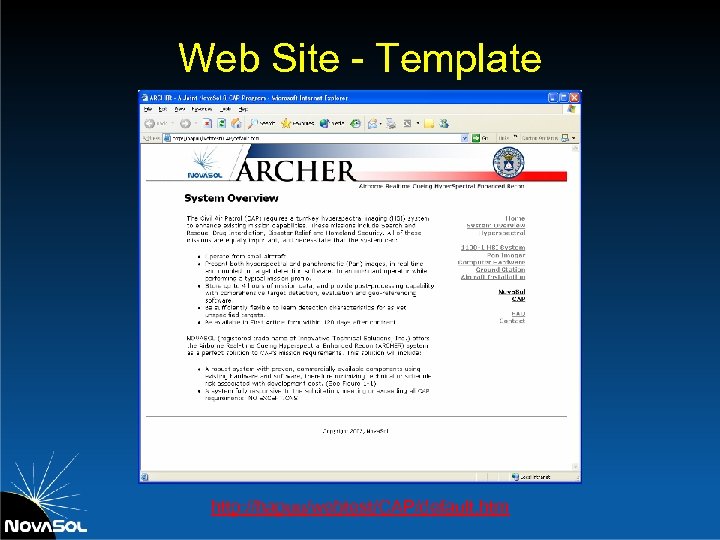
Web Site - Template http: //hapuu/webtest/CAP/default. htm

IV Technical Discussion
Скачать презентацию Welcomes the Civil Air Patrol Naval Research Laboratory
131ef145327ff11485bc08030364cace.ppt