


 Скачать презентацию Welcome to Year 6 Meet and Greet Session
d52b0062f73b73774795c8a4bf0d0c54.ppt
- Количество слайдов: 62
 Welcome to Year 6 Meet and Greet Session Autumn Term 2016 - 2017 Monday 19 th September 2016
 Aims of this evening § To give you an overview of your child’s ‘life’ in Year 6 § To give you an overview of the curriculum and expectations in Year 6
 Year 6 Teacher – Miss Shindler Mrs Menmuir Teaching assistant – Mrs Russell PPA cover – Mrs Petty (PE) Mrs Winter (French MFL) Additional adults: Mrs Hanlon
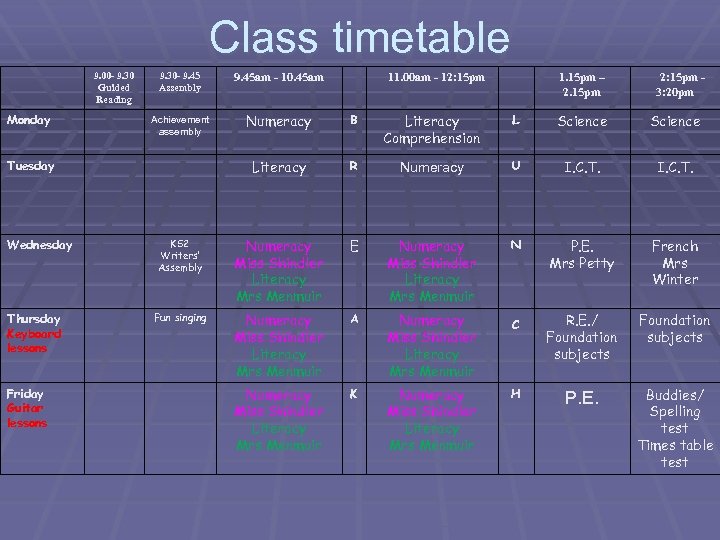 Class timetable 9. 00 - 9. 30 Guided Reading Monday 9. 30 - 9. 45 Assembly 9. 45 am - 10. 45 am Achievement assembly Numeracy B Literacy Comprehension L Science Literacy R Numeracy U I. C. T. KS 2 Writers’ Assembly Numeracy Miss Shindler Literacy Mrs Menmuir E Numeracy Miss Shindler Literacy Mrs Menmuir N P. E. Mrs Petty French Mrs Winter Fun singing Numeracy Miss Shindler Literacy Mrs Menmuir A Numeracy Miss Shindler Literacy Mrs Menmuir C R. E. / Foundation subjects Numeracy Miss Shindler Literacy Mrs Menmuir K Numeracy Miss Shindler Literacy Mrs Menmuir H P. E. Buddies/ Spelling test Times table test Tuesday Wednesday Thursday Keyboard lessons Friday Guitar lessons 11. 00 am - 12: 15 pm 1. 15 pm – 2. 15 pm 2: 15 pm 3: 20 pm
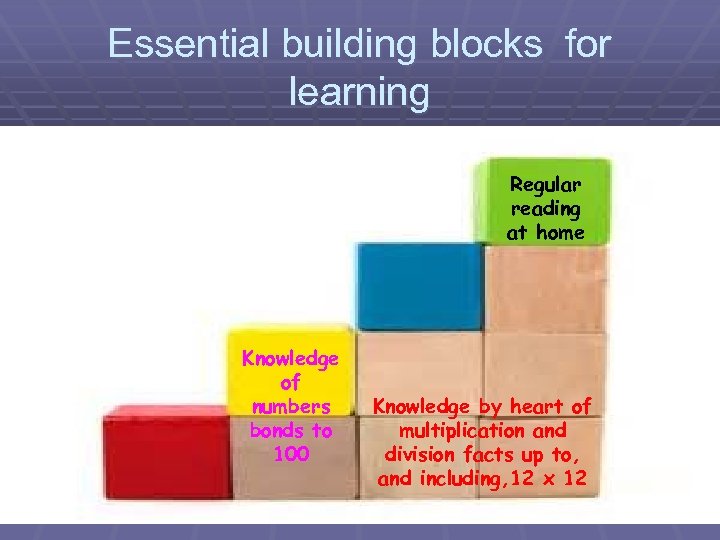 Essential building blocks for learning Regular reading at home Knowledge of numbers bonds to 100 Knowledge by heart of multiplication and division facts up to, and including, 12 x 12
 Year 6 Curriculum
 Curriculum subjects § § § Literacy inc. spelling and Pa. G Numeracy Science ICT History Geography R. E. MFL – French Art Music D. T P. E.
 Literacy lesson every day (1 hour). Focus can be: • writing (including spelling, punctuation and grammar) • speaking and listening including drama • reading comprehension • Guided Reading:
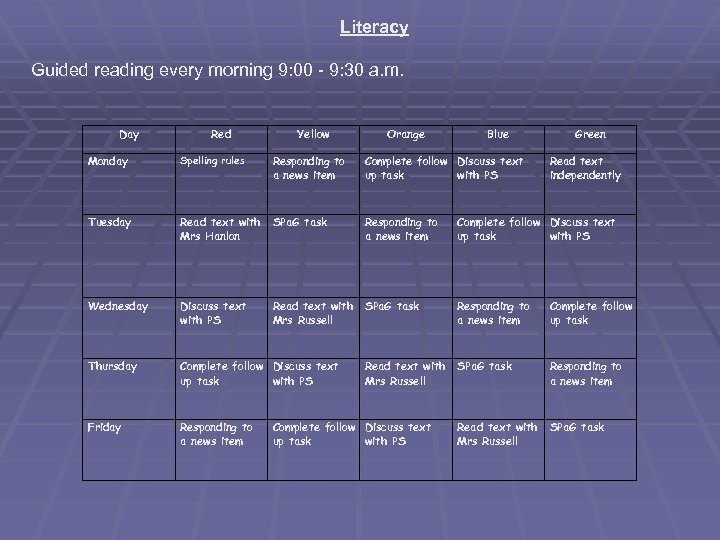 Literacy Guided reading every morning 9: 00 - 9: 30 a. m. Day Red Yellow Orange Blue Green Monday Spelling rules Responding to a news item Complete follow Discuss text up task with PS Tuesday Read text with Mrs Hanlon SPa. G task Responding to a news item Complete follow Discuss text up task with PS Wednesday Discuss text with PS Read text with Mrs Russell SPa. G task Responding to a news item Complete follow up task Thursday Complete follow Discuss text up task with PS Read text with Mrs Russell SPa. G task Responding to a news item Friday Responding to a news item Read text with Mrs Russell SPa. G task Complete follow Discuss text up task with PS Read text independently
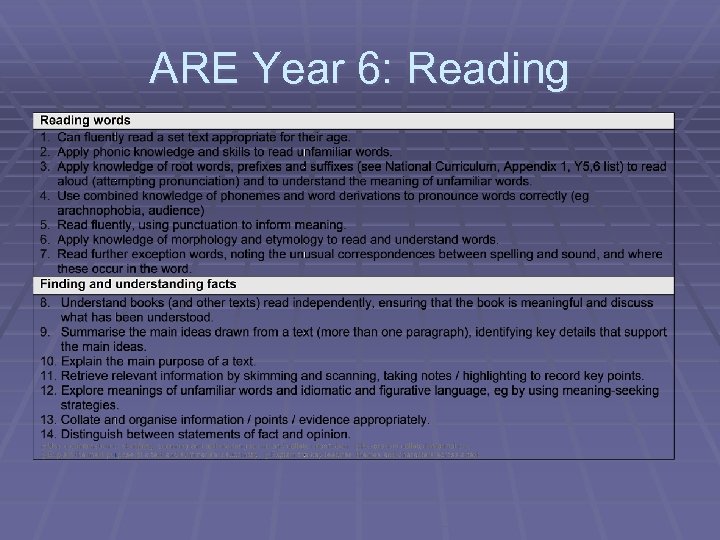 ARE Year 6: Reading
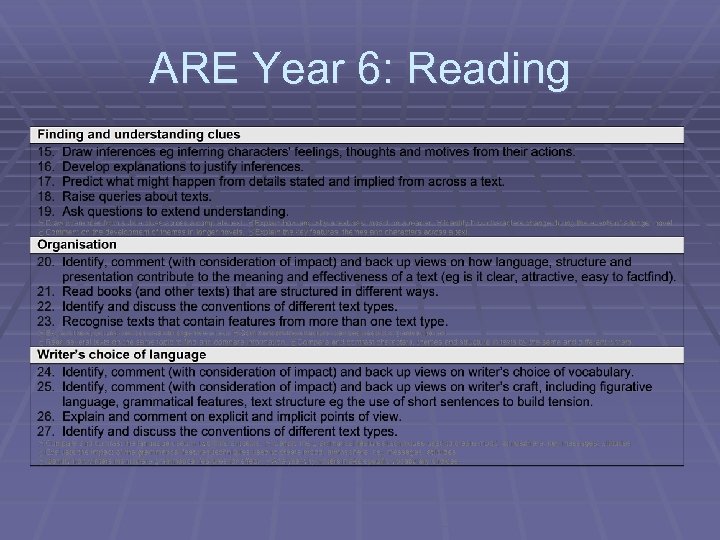 ARE Year 6: Reading
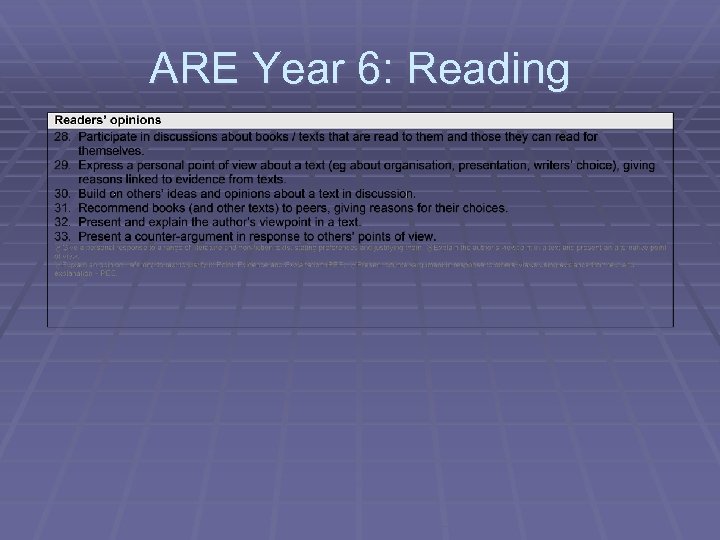 ARE Year 6: Reading
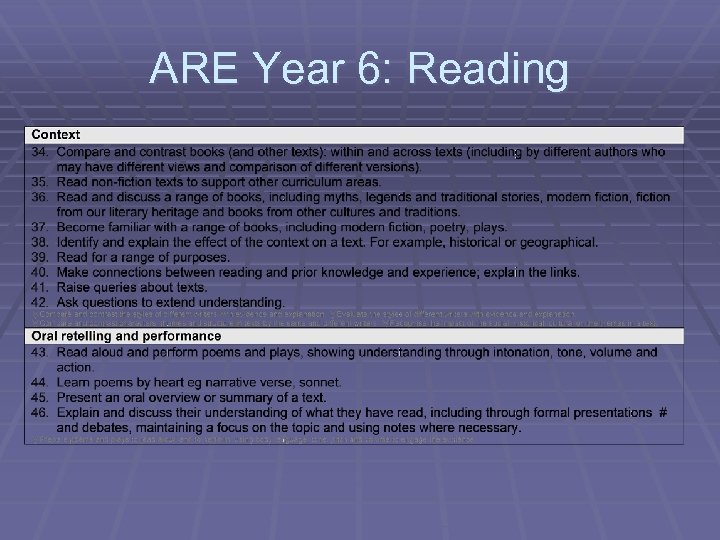 ARE Year 6: Reading
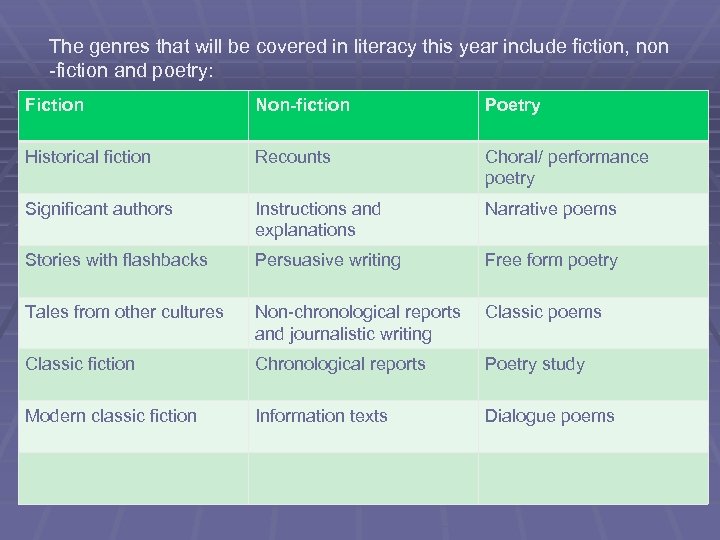 The genres that will be covered in literacy this year include fiction, non -fiction and poetry: Fiction Non-fiction Poetry Historical fiction Recounts Choral/ performance poetry Significant authors Instructions and explanations Narrative poems Stories with flashbacks Persuasive writing Free form poetry Tales from other cultures Non-chronological reports and journalistic writing Classic poems Classic fiction Chronological reports Poetry study Modern classic fiction Information texts Dialogue poems
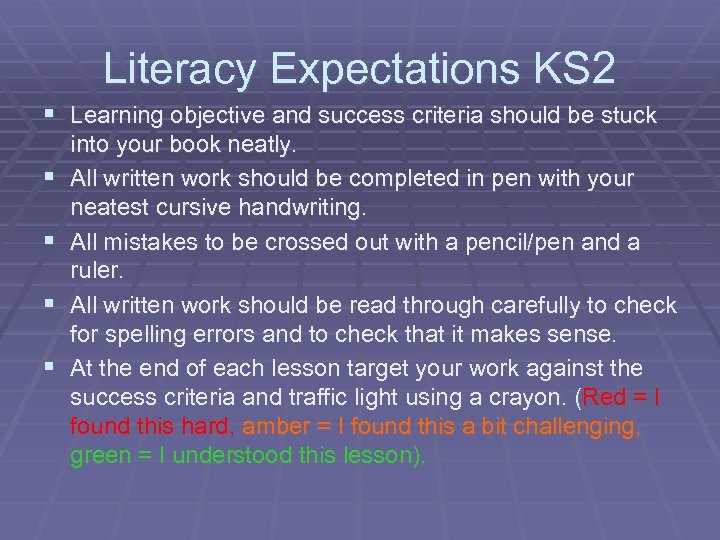 Literacy Expectations KS 2 § Learning objective and success criteria should be stuck § § into your book neatly. All written work should be completed in pen with your neatest cursive handwriting. All mistakes to be crossed out with a pencil/pen and a ruler. All written work should be read through carefully to check for spelling errors and to check that it makes sense. At the end of each lesson target your work against the success criteria and traffic light using a crayon. (Red = I found this hard, amber = I found this a bit challenging, green = I understood this lesson).
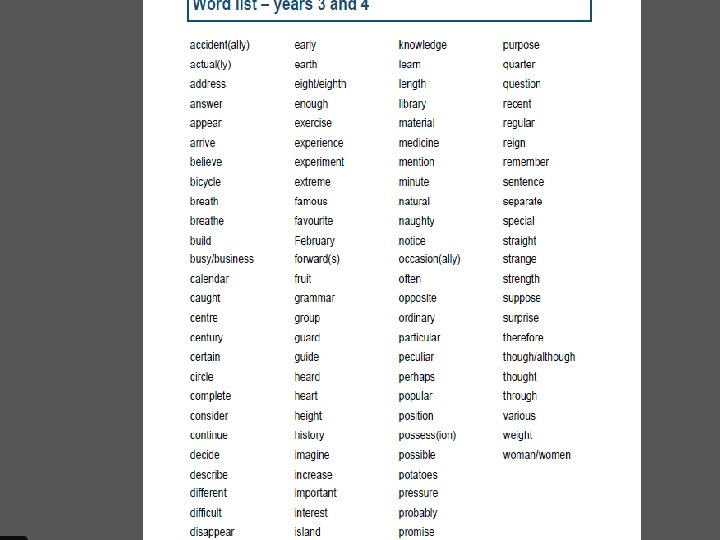
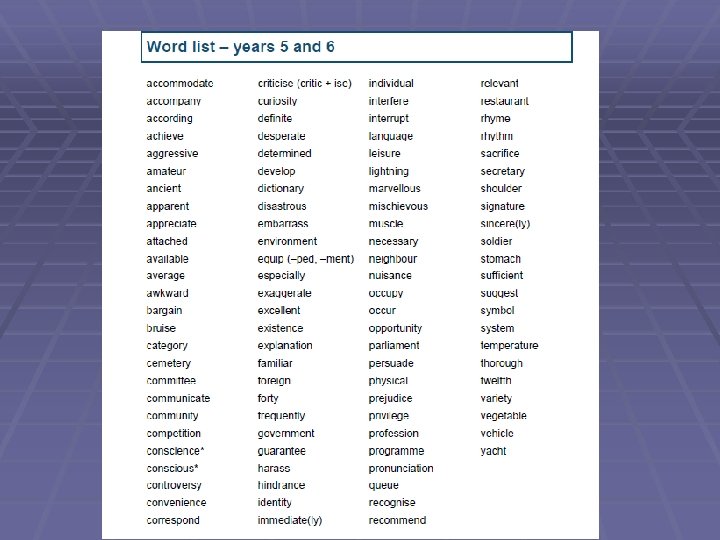
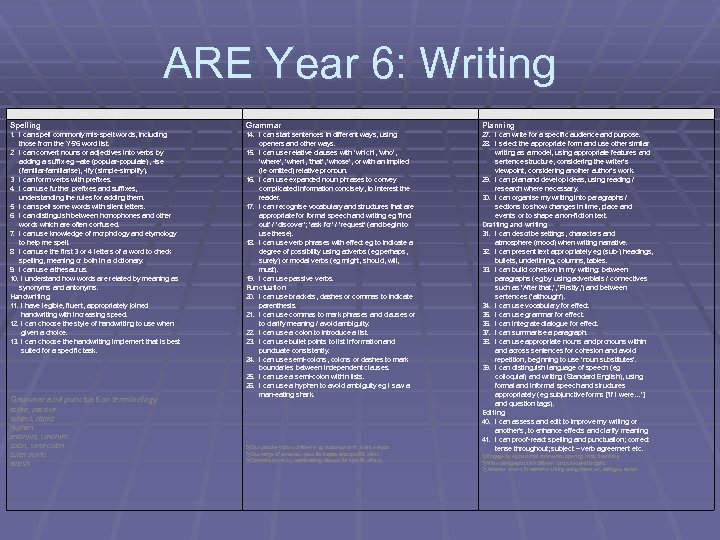 ARE Year 6: Writing Transcription and handwriting Spelling Vocabulary, grammar and punctuation Grammar Composition Planning 1. I can spell commonly mis-spelt words, including those from the Y 5/6 word list. 2. I can convert nouns or adjectives into verbs by adding a suffix eg –ate (popular-populate), -ise (familiar-familiarise), -ify (simple-simplify). 3. I can form verbs with prefixes. 4. I can use further prefixes and suffixes, understanding the rules for adding them. 5. I can spell some words with silent letters. 6. I can distinguish between homophones and other words which are often confused. 7. I can use knowledge of morphology and etymology to help me spell. 8. I can use the first 3 or 4 letters of a word to check spelling, meaning or both in a dictionary. 9. I can use a thesaurus. 10. I understand how words are related by meaning as synonyms and antonyms. Handwriting 11. I have legible, fluent, appropriately joined handwriting with increasing speed. 12. I can choose the style of handwriting to use when given a choice. 13. I can choose the handwriting implement that is best suited for a specific task. 14. I can start sentences in different ways, using openers and other ways. 15. I can use relative clauses with ‘which’, ‘who’, ‘where’, ‘when’, ‘that’, ‘whose’, or with an implied (ie omitted) relative pronoun. 16. I can use expanded noun phrases to convey complicated information concisely, to interest the reader. 17. I can recognise vocabulary and structures that are appropriate formal speech and writing eg ‘find out’ / ‘discover’; ‘ask for’ / ‘request’ (and begin to use these). 18. I can use verb phrases with effect eg to indicate a degree of possibility using adverbs (eg perhaps, surely) or modal verbs (eg might, should, will, must). 19. I can use passive verbs. Punctuation 20. I can use brackets, dashes or commas to indicate parenthesis. 21. I can use commas to mark phrases and clauses or to clarify meaning / avoid ambiguity. 22. I can use a colon to introduce a list. 23. I can use bullet points to list information and punctuate consistently. 24. I can use semi-colons, colons or dashes to mark boundaries between independent clauses. 25. I can use a semi-colon within lists. 26. I can use a hyphen to avoid ambiguity eg I saw a man-eating shark. 27. I can write for a specific audience and purpose. 28. I select the appropriate form and use other similar writing as a model, using appropriate features and sentence structure, considering the writer’s viewpoint, considering another author’s work. 29. I can plan and develop ideas, using reading / research where necessary. 30. I can organise my writing into paragraphs / sections to show changes in time, place and events or to shape a non-fiction text. Drafting and writing 31. I can describe settings, characters and atmosphere (mood) when writing narrative. 32. I can present text appropriately eg (sub-) headings, bullets, underlining, columns, tables. 33. I can build cohesion in my writing: between paragraphs (eg by using adverbials / connectives such as ‘After that, ’, ‘Firstly, ’) and between sentences (‘although’). 34. I can use vocabulary for effect. 35. I can use grammar for effect. 36. I can integrate dialogue for effect. 37. I can summarise a paragraph. 38. I can use appropriate nouns and pronouns within and across sentences for cohesion and avoid repetition, beginning to use ‘noun substitutes’. 39. I can distinguish language of speech (eg colloquial) and writing (Standard English), using formal and informal speech and structures appropriately (eg subjunctive forms [‘If I were…’] and question tags). Editing 40. I can assess and edit to improve my writing or another’s, to enhance effects and clarify meaning. 41. I can proof-read: spelling and punctuation; correct tense throughout; subject – verb agreement etc. Grammar and punctuation terminology active, passive subject, object hyphen antonym, synonym colon, semi-colon bullet points ellipsis _Use passive voice confidently eg suspense or in science report _Use range of sentence types for impact and specific effect _Control sentences, manipulating clauses for specific effects _Engage by eg personal comments, opening hook, flashback _Write paragraphs with different structures and lengths _Advance events in narrative writing using character, dialogue, action
 Numeracy lesson every day (1 hour). Children will follow the Mathematics National Curriculum: • Number inc. place value, four operations, fractions • Ratio and proportion • Algebra • Measurement • Geometry – properties of shape; position and direction • Statistics
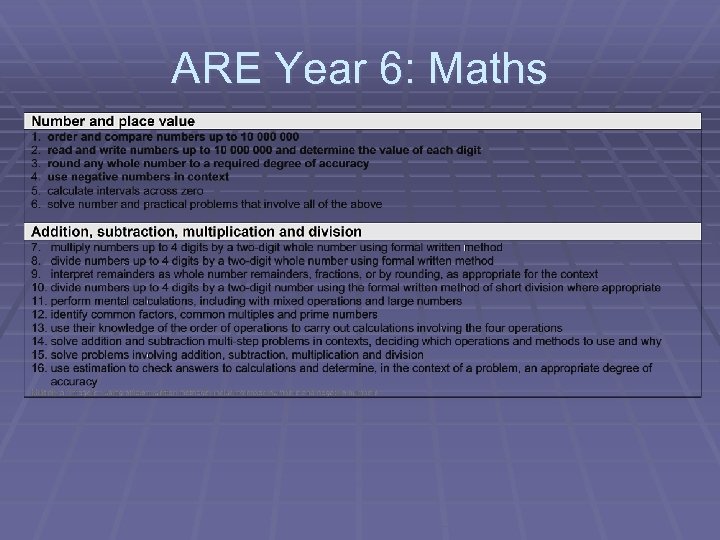 ARE Year 6: Maths
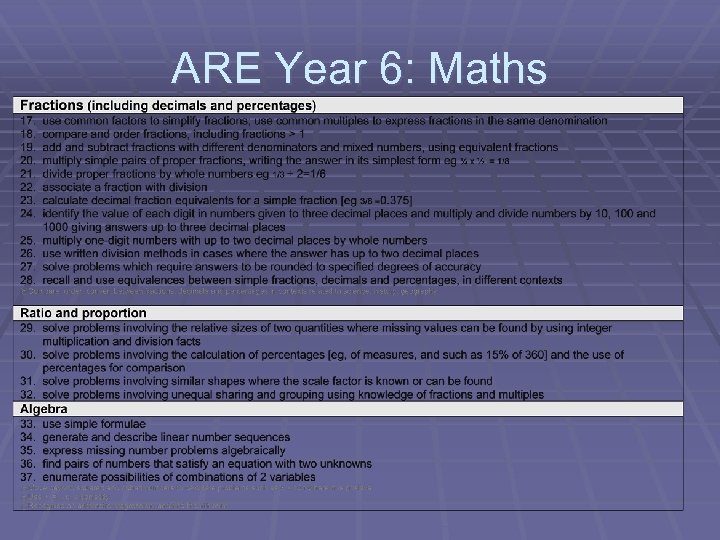 ARE Year 6: Maths
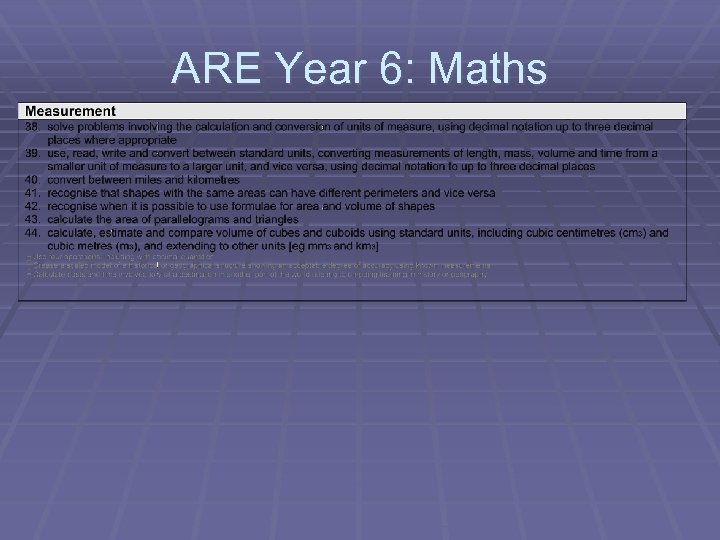 ARE Year 6: Maths
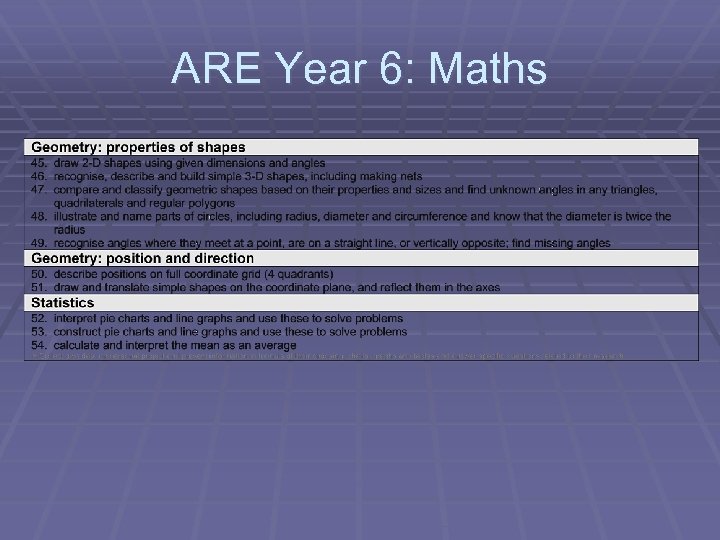 ARE Year 6: Maths
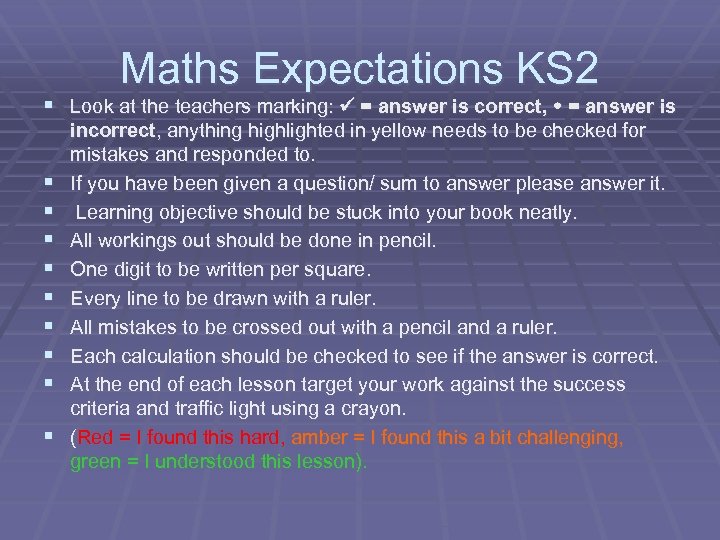 Maths Expectations KS 2 § Look at the teachers marking: = answer is correct, = answer is § § § § § incorrect, anything highlighted in yellow needs to be checked for mistakes and responded to. If you have been given a question/ sum to answer please answer it. Learning objective should be stuck into your book neatly. All workings out should be done in pencil. One digit to be written per square. Every line to be drawn with a ruler. All mistakes to be crossed out with a pencil and a ruler. Each calculation should be checked to see if the answer is correct. At the end of each lesson target your work against the success criteria and traffic light using a crayon. (Red = I found this hard, amber = I found this a bit challenging, green = I understood this lesson).
 Science Topics n. Sound n. Light n. Electricity n. Evolution and Inheritance n. Living things and their habitats n. Animals inc. humans (inc. SRE)
 History • The effect of World War II on Birmingham • Ancient Greece
 Geography To be able to use atlases, maps, grid references To understand geographical terminology e. g. longitude, latitude South America Describe and understand key aspects of physical and human characteristics
 Computing/ICT links will be made across the curriculum where possible. ICT will also be taught discretely e. g. coding.
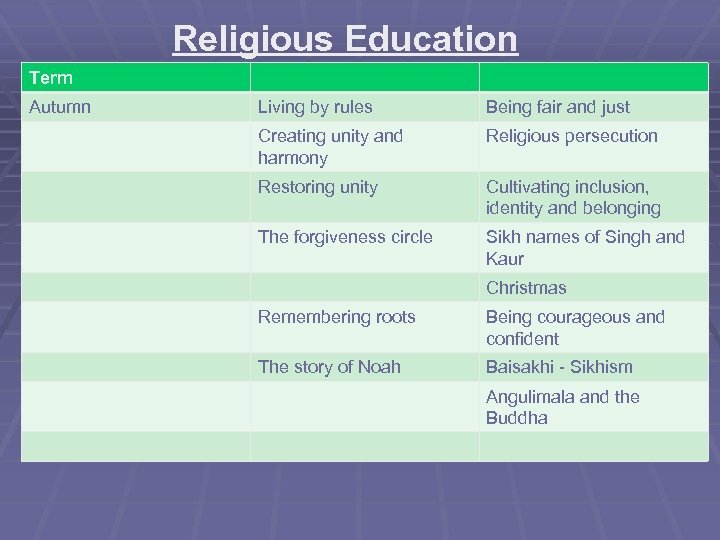 Religious Education Term Autumn Living by rules Being fair and just Creating unity and harmony Religious persecution Restoring unity Cultivating inclusion, identity and belonging The forgiveness circle Sikh names of Singh and Kaur Christmas Remembering roots Being courageous and confident The story of Noah Baisakhi - Sikhism Angulimala and the Buddha
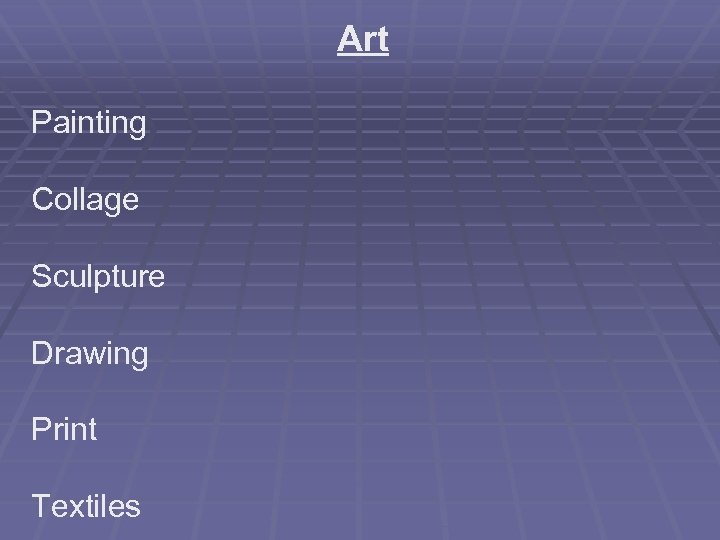 Art Painting Collage Sculpture Drawing Print Textiles
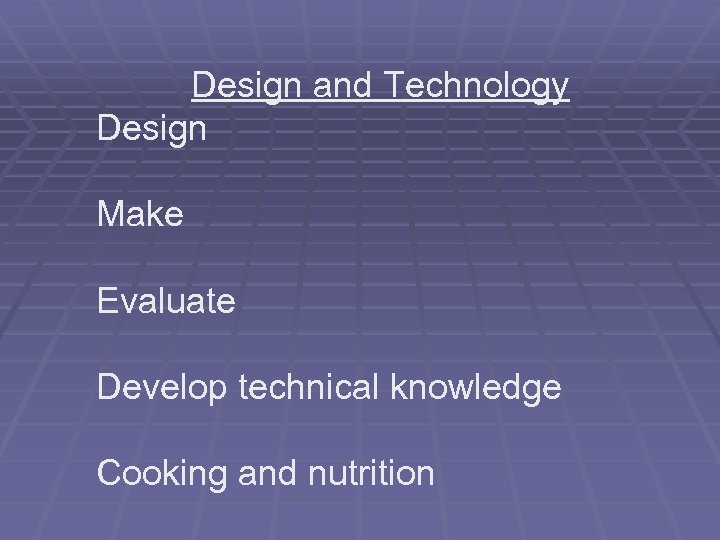 Design and Technology Design Make Evaluate Develop technical knowledge Cooking and nutrition
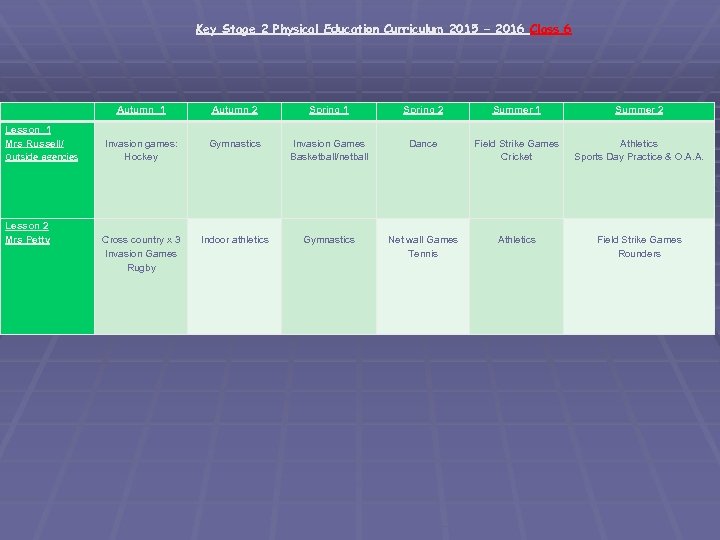 Key Stage 2 Physical Education Curriculum 2015 – 2016 Class 6 Autumn 1 Autumn 2 Spring 1 Spring 2 Summer 1 Summer 2 Lesson 1 Mrs Russell/ Outside agencies Invasion games: Hockey Gymnastics Invasion Games Basketball/netball Dance Field Strike Games Cricket Athletics Sports Day Practice & O. A. A. Lesson 2 Mrs Petty Cross country x 3 Invasion Games Rugby Indoor athletics Gymnastics Net wall Games Tennis Athletics Field Strike Games Rounders
 P. E and school teams § Natural ability for the sport – based upon application of skills / recorded times / distance + the considered opinion of the staff in charge of the training session (class lesson and/or after school club). § Where selection involves children of equal ability, preference will be given to the child in the older year group. § Children will be given the opportunity to represent their houses in half-termly inter-house competitions.
 Year 6 responsibilities Role models Duties inc. library, playtime door duties, tuck, wet play monitors, play leaders Buddies
 Working in class § Class agreement
 Working in Class § BLP – Reflective/ independent learners

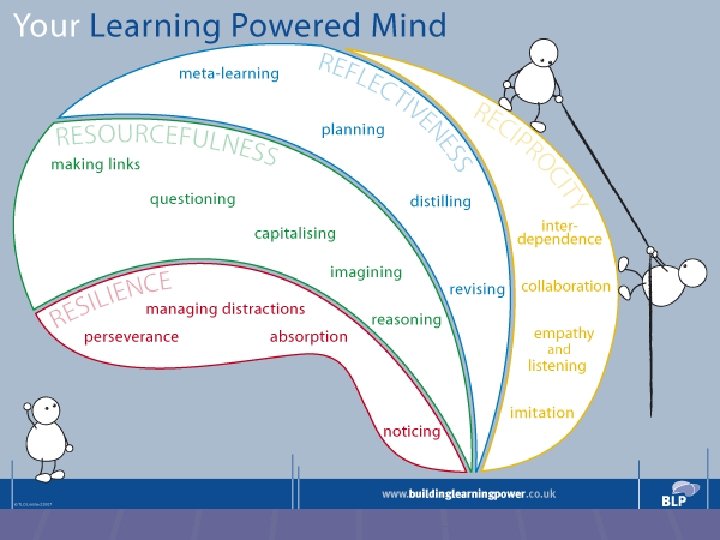
 Working in class § Working independently § Working in pairs or groups § Collaboration § Ability groups – flexibility § Use of Monkey Box
 Behaviour § All classes use the 7 Golden Rules which are displayed in each classroom and areas such as the hall and ICT suite. § Golden Plate § Each child will have a ‘plate’ template which is divided into 7 sections – each section will relate to a Golden Rule. § Children will be awarded a sticker for specific section when they have demonstrated that rule exceptionally well. § Children who complete their plate will receive an award at the end of each term.
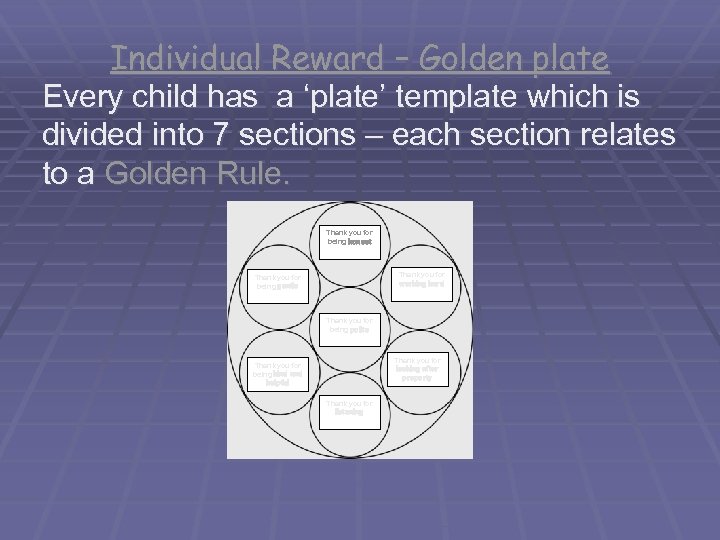 Individual Reward – Golden plate Every child has a ‘plate’ template which is divided into 7 sections – each section relates to a Golden Rule. Thank you for being honest Thank you for working hard Thank you for being gentle Thank you for being polite Thank you for looking after property Thank you for being kind and helpful Thank you for listening
 Individual Reward – Golden plate Children will be awarded a sticker for specific section when they have demonstrated that rule exceptionally well. Children who complete their plate will receive an award at the end of each term. § Plate 1 – certificate and Moor Hall pencil. § Plate 2 – certificate and Moor Hall pen § Plate 3 – certificate and Moor Hall ruler § If a child is awarded all 3 plates within an academic year they will be rewarded with a Moor Hall enamel badge.
 KS 2 Each class will use a ‘classometer’ ranging from -5 to 10 to monitor behaviour throughout the day. The classometer should return to 0 at the end of each day. Once the children reach 10 they should be rewarded with a golden coin (or equivalent). Class teachers to negotiate with the children their choice of reward once the class reach 5, 10, 15 and 20 golden coins.
 Consequences This staged approach will be used across a half-day session in KS 2 Stage One – Focus on Golden Rules Re-focus the child on the Golden Rule they are breaking. Positive reinforcement of the Golden Rules around the child who is breaking them. Stage 2 – Manage their Environment Staff will make a statement indicating that the behaviour is misplaced for that environment (classroom playground). Provide choices – change of location within that environment. Change the child’s location to a different environment. (This is referred to as Time Out – see Stage 3) Stage 3 – Putting it Right. The “Put It Right” sheet is a strategy to help children reflect upon negative behaviour, offer an opportunity to rectify mistakes, and move on. “Put It Right” sheets will be completed for any time-out period. Staff will review completed “Put It Right” sheet with the child before they can return to their original environment. “Put It Right” sheets should be kept in a class file for future reference
 Marking § House points awarded § Success criteria ticked § Learning objective highlighted § Teacher comment/ target marking – child to respond
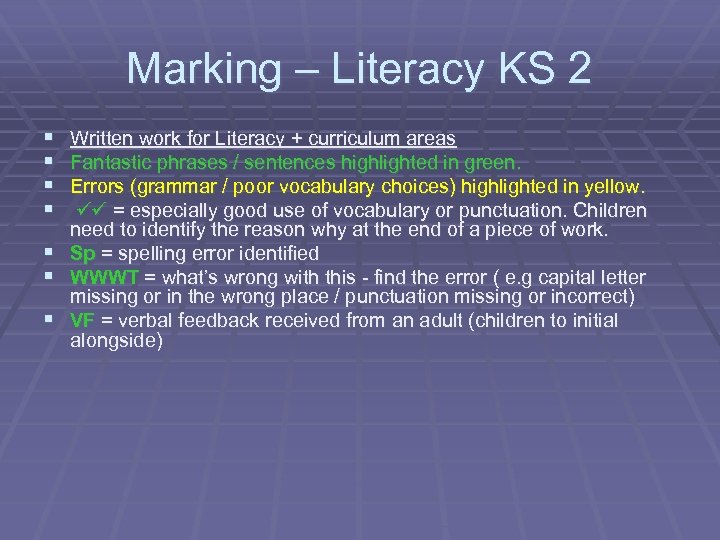 Marking – Literacy KS 2 § § § § Written work for Literacy + curriculum areas Fantastic phrases / sentences highlighted in green. Errors (grammar / poor vocabulary choices) highlighted in yellow. = especially good use of vocabulary or punctuation. Children need to identify the reason why at the end of a piece of work. Sp = spelling error identified WWWT = what’s wrong with this - find the error ( e. g capital letter missing or in the wrong place / punctuation missing or incorrect) VF = verbal feedback received from an adult (children to initial alongside)
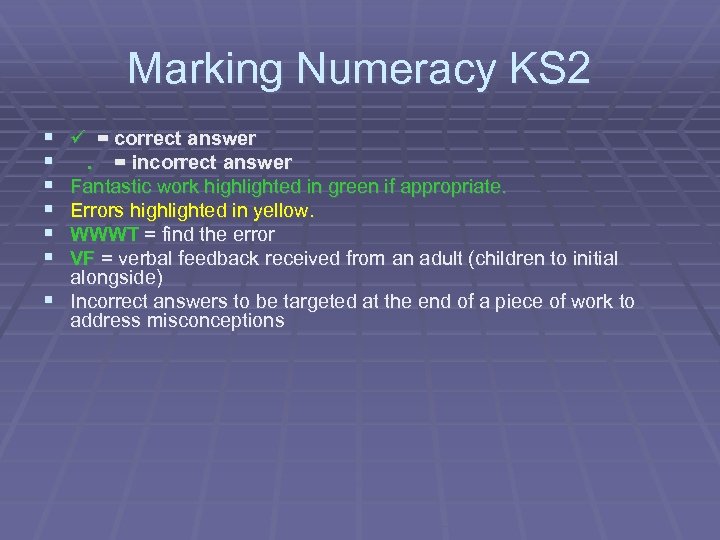 Marking Numeracy KS 2 § § § = correct answer . = incorrect answer Fantastic work highlighted in green if appropriate. Errors highlighted in yellow. WWWT = find the error VF = verbal feedback received from an adult (children to initial alongside) § Incorrect answers to be targeted at the end of a piece of work to address misconceptions
 Homework Year 5 & 6 Upper KS 2 homework……. . average of 2 hours per week may include: Spellings - weekly Maths task Literacy based activity Learning Log homework - weekly
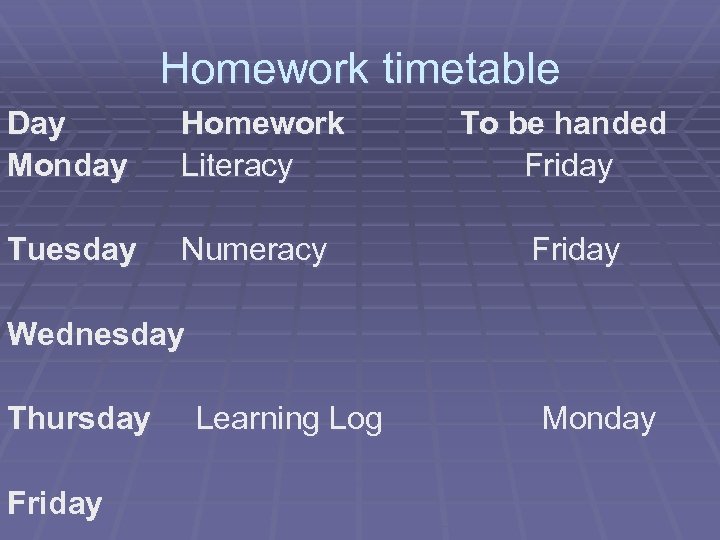 Homework timetable Day Homework To be handed Monday Literacy Friday Tuesday Numeracy Friday Wednesday Thursday Learning Log Monday Friday
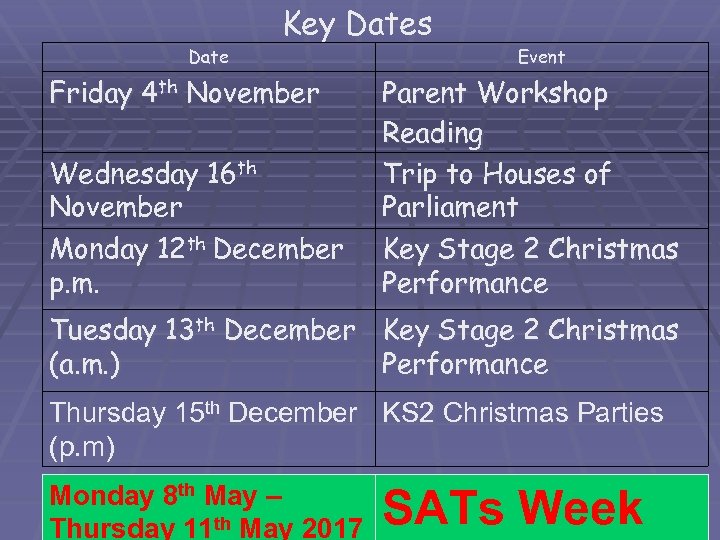 Date Key Dates Friday 4 th November Wednesday 16 th November Monday 12 th December p. m. Event Parent Workshop Reading Trip to Houses of Parliament Key Stage 2 Christmas Performance Tuesday 13 th December Key Stage 2 Christmas (a. m. ) Performance Thursday 15 th December KS 2 Christmas Parties (p. m) Monday 8 th May – Thursday 11 th May 2017 SATs Week
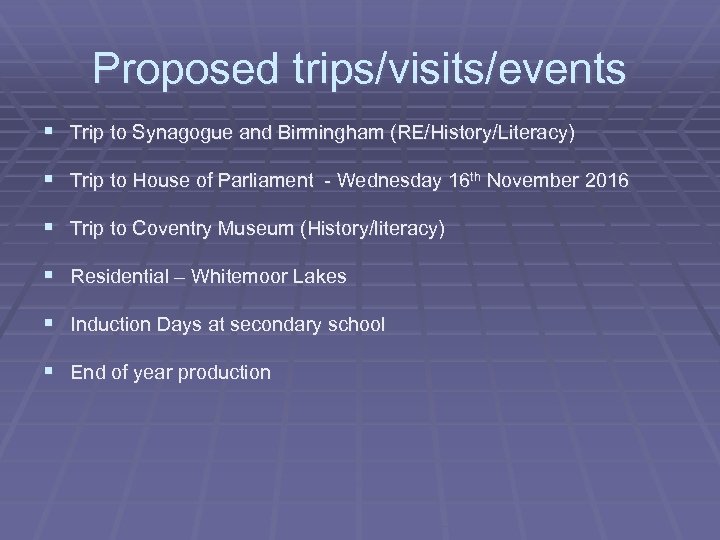 Proposed trips/visits/events § Trip to Synagogue and Birmingham (RE/History/Literacy) § Trip to House of Parliament - Wednesday 16 th November 2016 § Trip to Coventry Museum (History/literacy) § Residential – Whitemoor Lakes § Induction Days at secondary school § End of year production
 Safeguarding Moor Hall Primary School is committed to safeguarding and promoting the welfare of children and young people and expects all staff and volunteers to share this commitment. If your child is going home with another adult, we can only allow this if we have had prior written notification or a telephone message has been received by the school office. Any medication should be handed into the school office and the necessary documentation completed. School staff are no longer allowed to administer non prescription medicine. Please can you check expiry dates on all inhalers and Epipens. Risk assessments will be completed prior to visits etc.
 Uniform
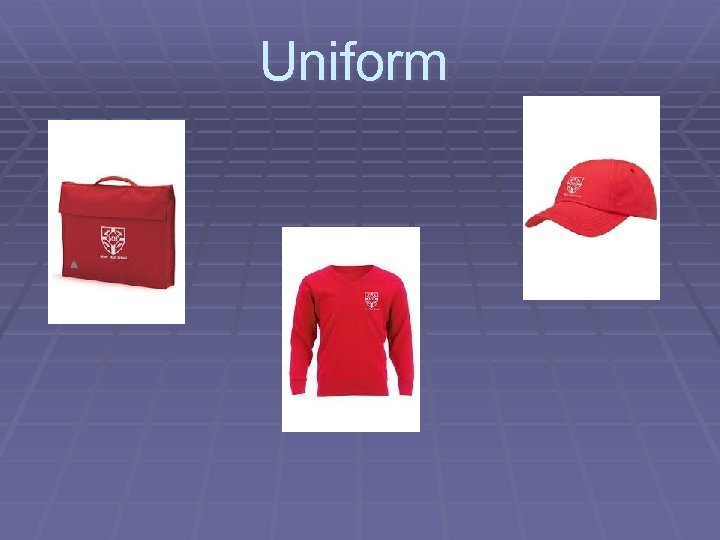
 Uniform §Please ensure that all items (clothing / bags / books etc) are named. §Long hair should be tied back, hairband should be in school colours. §Ties are compulsory for KS 2 §Jewellery – watch / small stud earrings, religious jewellery. § Trainers / tracksuits are required for outdoor activities
 PE Kit -Key Stage 2 § Red crested t-shirt / black shorts or skirt / white socks and trainers (all named please) § Plain black sweatshirt and joggers for cold weather. § Long hair must be tied back and earrings covered. § Shin pads are required for hockey, rugby and football.
 Key Stage 2 – Snacks Morning break § - fruit § - breakfast bar § Flexible break – afternoon play § Piece of fruit § Piece of cheese Please note – no crisps / chocolate / cake bars /sweets etc
 Snacks for KS 2 (Only water in water bottles please) No nut or peanut butter products please. Morning – toast / juice (available in school) - cereal bar / fruit flakes - yoghurt covered raisins Afternoon – piece of fruit or cheese - cereal bar / fruit flakes - yoghurt covered raisins (No crisps / biscuits / sweets etc please)
 Packed Lunches - suggestions No nut or peanut butter products please. A good portion of starchy food, e. g. wholegrain bap, thick sliced wholemeal bread, chapatti, pitta pocket, pasta or rice salad. Plenty of fruit and vegetables, e. g. an apple, satsuma, handful of cherry tomatoes or carrot sticks, mini-can of fruit chunks in natural juice or small box of raisins. A portion of semi skimmed milk or dairy food, e. g. individual cheese portion or pot of yoghurt. A portion of lean meat, fish or alternative, e. g. ham, chicken, beef, tuna, egg, or hummus. A drink, e. g. a fruit juice, semi skimmed milk or water. No sweets / chocolate bars or biscuits please.
 Thank you for coming. § We are looking forward to providing a rewarding year for your child. § If you need to discuss any issues / or concerns please phone school for an appointment or speak to me.
 Please feel free to ask me questions about anything I have shared with you this evening.