 Скачать презентацию Welcome to Year 6 Curriculum Evening Miss Wiblin
572cc1bb54daa0d227f2849454a966f9.ppt
- Количество слайдов: 64



Welcome to Year 6 Curriculum Evening Miss Wiblin Mrs Limer
What a start!!!! ☺ • Fantastic attitude and effort from all! Our aim: To provide a calm, caring learning atmosphere, where all children grow in confidence and develop a real desire to learn and improve. To develop the children’s social, emotional and academic abilities in preparation for their transition to secondary school. To produce some very happy and special
What we expect… A first-class attitude towards their learning throughout the year. An understanding that they know to ask for help when needed. A real effort to develop their organisational skills- in terms of handing in homework, reading records and spellings. To develop a real ownership of their work and to be able to identify personal targets throughout the year to work on.
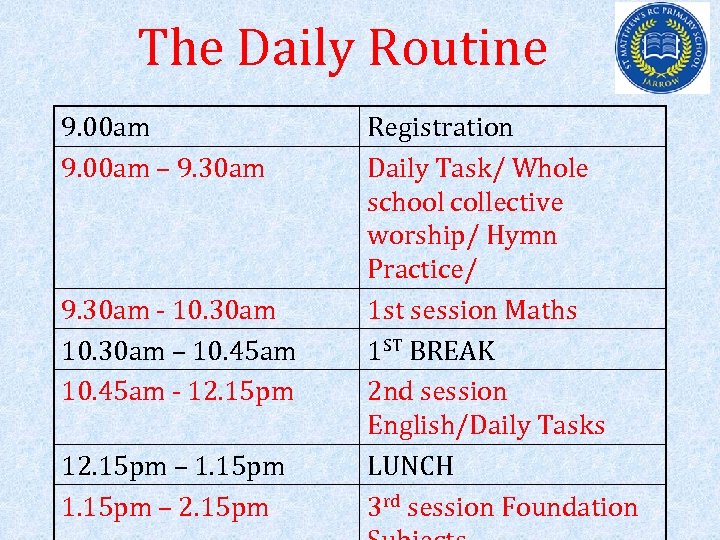
The Daily Routine 9. 00 am – 9. 30 am - 10. 30 am – 10. 45 am - 12. 15 pm – 1. 15 pm – 2. 15 pm Registration Daily Task/ Whole school collective worship/ Hymn Practice/ 1 st session Maths 1 ST BREAK 2 nd session English/Daily Tasks LUNCH 3 rd session Foundation
Water Bottles / Milk / Tuck shop • Children keep their water bottles on their desks. They can get a drink at playtime and when they come in from playtime. Children can also access their bottles for a drink during lessons. • They are encouraged to take them home each week to wash them (and please try and encourage this!) • If children receive milk at school they have this after morning break
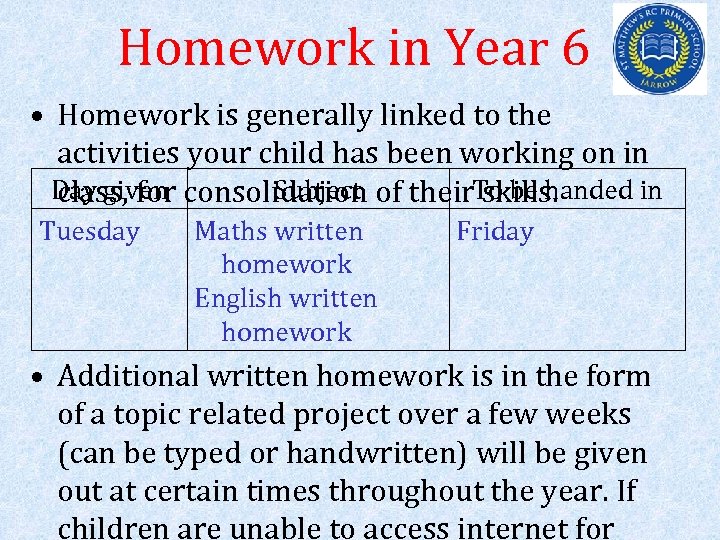
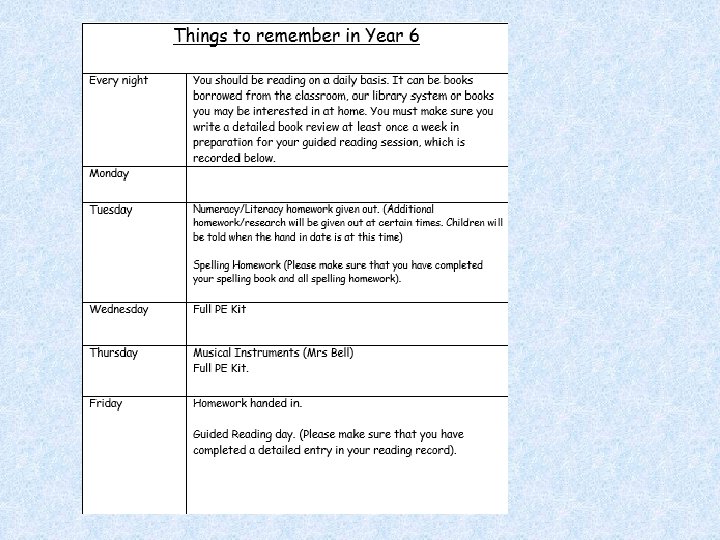
Homework in Year 6 • Homework is generally linked to the activities your child has been working on in Day given consolidation of their. To be handed in Subject class, for skills. Tuesday Maths written homework English written homework Friday • Additional written homework is in the form of a topic related project over a few weeks (can be typed or handwritten) will be given out at certain times throughout the year. If children are unable to access internet for
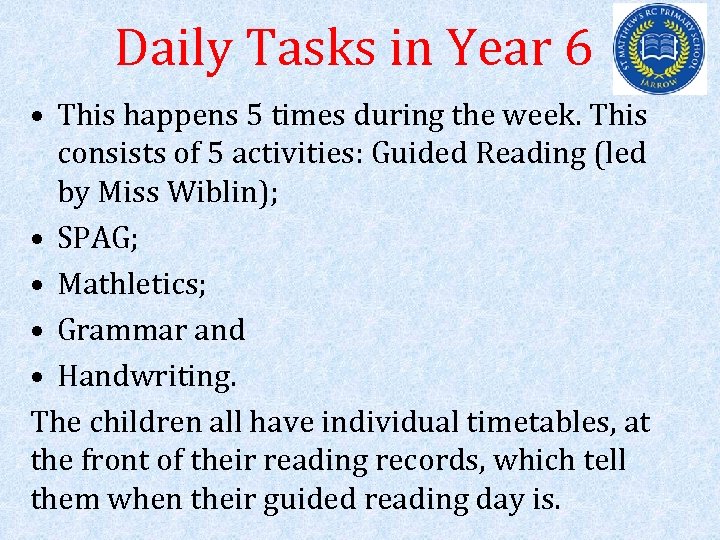
Daily Tasks in Year 6 • This happens 5 times during the week. This consists of 5 activities: Guided Reading (led by Miss Wiblin); • SPAG; • Mathletics; • Grammar and • Handwriting. The children all have individual timetables, at the front of their reading records, which tell them when their guided reading day is.
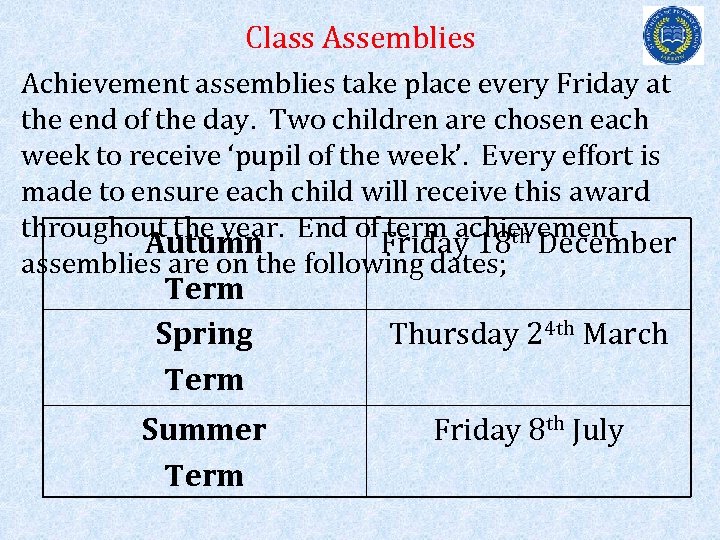
Class Assemblies Achievement assemblies take place every Friday at the end of the day. Two children are chosen each week to receive ‘pupil of the week’. Every effort is made to ensure each child will receive this award throughout the year. End of term achievement Autumn Friday 18 th December assemblies are on the following dates; Term Spring Term Summer Term Thursday 24 th March Friday 8 th July
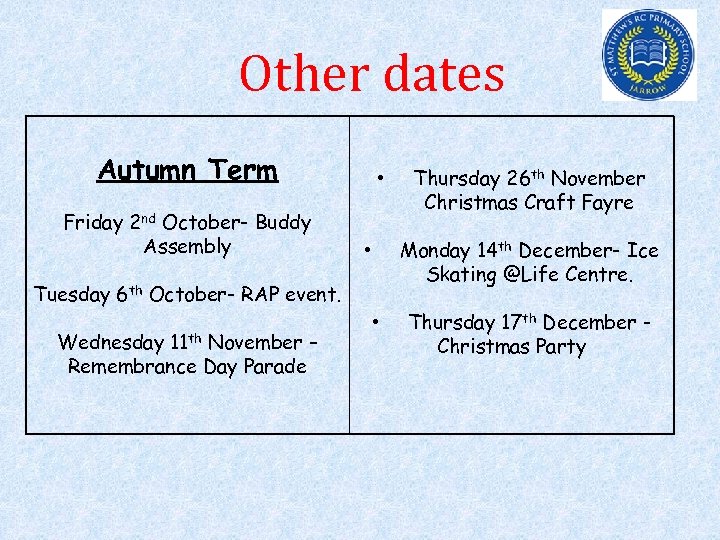
Other dates Autumn Term Friday 2 nd October- Buddy Assembly • Monday 14 th December- Ice Skating @Life Centre. • Tuesday 6 th October- RAP event. Wednesday 11 th November – Remembrance Day Parade Thursday 26 th November Christmas Craft Fayre • Thursday 17 th December Christmas Party
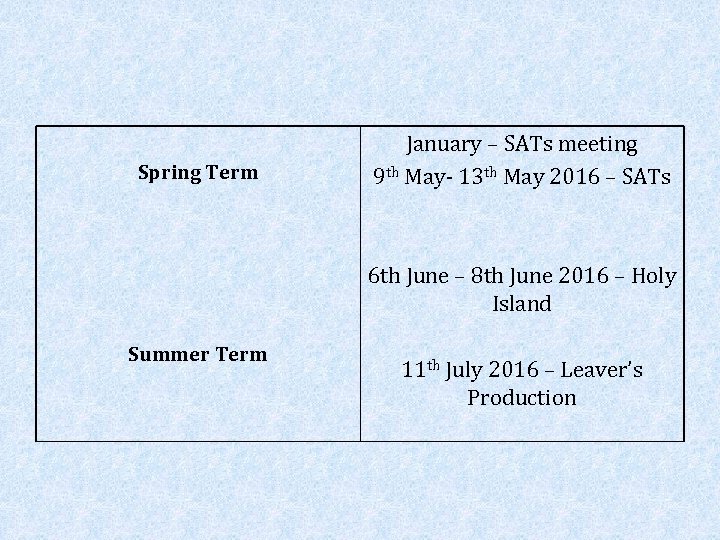
Spring Term January – SATs meeting 9 th May- 13 th May 2016 – SATs 6 th June – 8 th June 2016 – Holy Island Summer Term 11 th July 2016 – Leaver’s Production
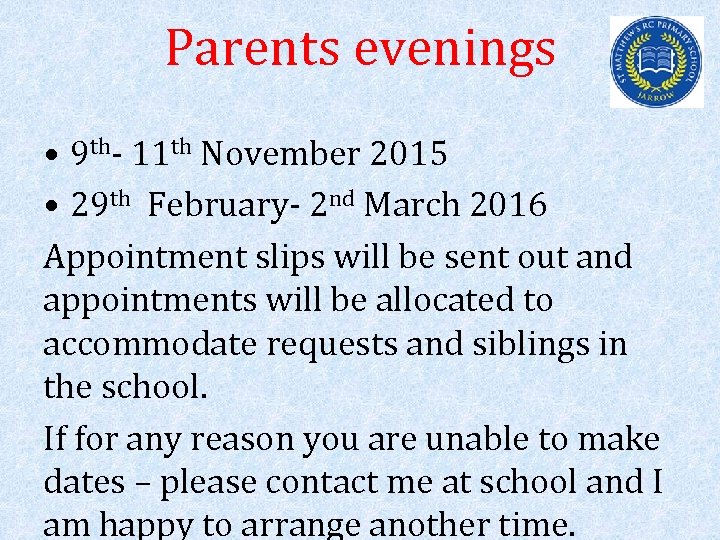
Parents evenings • 9 th- 11 th November 2015 • 29 th February- 2 nd March 2016 Appointment slips will be sent out and appointments will be allocated to accommodate requests and siblings in the school. If for any reason you are unable to make dates – please contact me at school and I am happy to arrange another time.
Year 6 Rewards • House points • Rainbow Ladder • Pupil of the week / Pupil of the term • Leaves • Fantastic 4: Writer of the week; Presenter of the week; Mathematician of the week and Overall student of the week.
Year 6 Curriculum * Core Subjects - English - Maths - Science Computi ng - RE * Foundation Subjects History Geography Art Design & Technology Music French PE
Lessons in Year 6 Children are taught in structured lessons, which consists of 4 main parts: - Sharing of WALT (we are learning to…) - Whole class teaching (smartboards / powerpoints / practical and interactive) - Independent work (individual / paired / small group) - Plenary (summary of lesson) Assessment is continuous and tracked to ensure that each child’s unique needs are catered for. There will also be an assessment week in the Autumn,
English Curriculum • Narrative- description, sentence types, character traits, stories, diaries, flashbacks. • Biographical (including auto-biographies) • Poetry – using personification • Journalistic • Non-chronological reports Phase 1 – reading about the • Persuasive Writing genre • Formal and Informal Letters Phase 2 – planning/editing • Shakespeare drafting
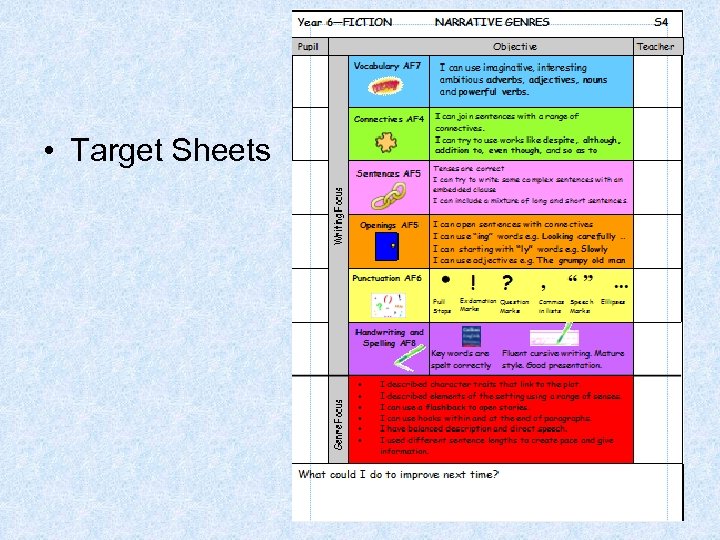
• Target Sheets
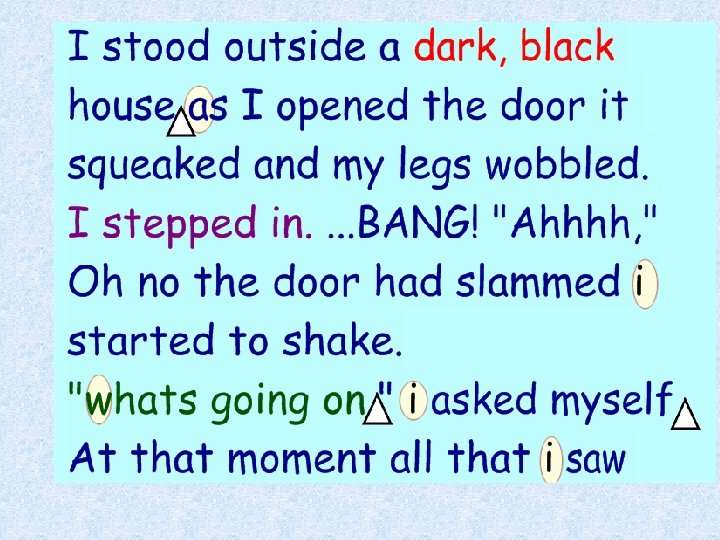
Writing Focus • Vocabulary – adjectives, similes, descriptive phrases, interesting and ambitious words, powerful, verbs and adverbs • Connectives – despite, although, consequently, on the one hand, on the other hand, nevertheless, even though, in addition, moreover, finally, subsequently. • Openings – using connectives, ly, ing and ed openers, using clauses and adjectives. • Varying sentence types –using a variety of sentence types to control the pace of their writing: simple, short, 2 a, de: de, dialogue, long, compound, complex.
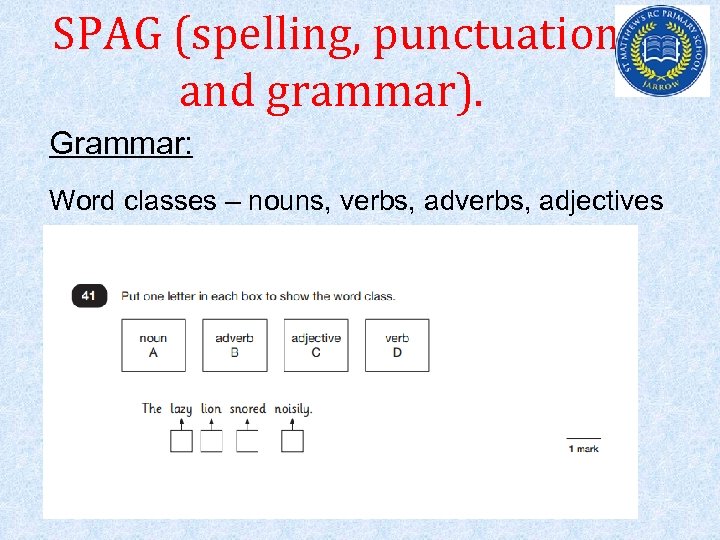
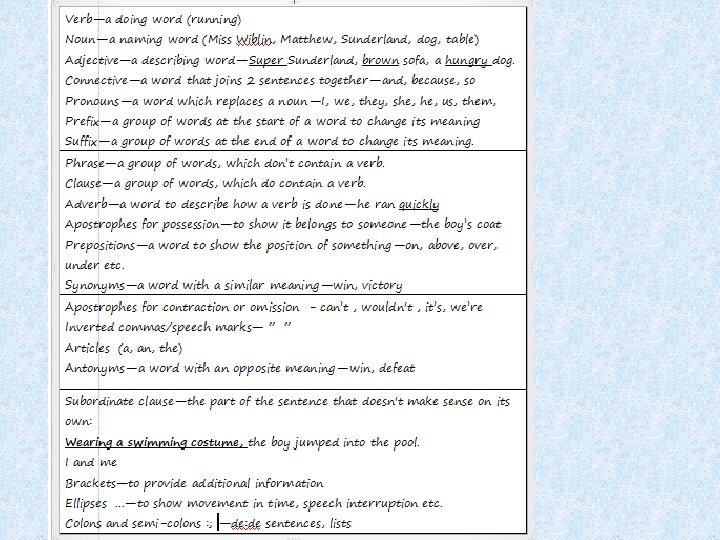
SPAG (spelling, punctuation and grammar). Grammar: Word classes – nouns, verbs, adjectives
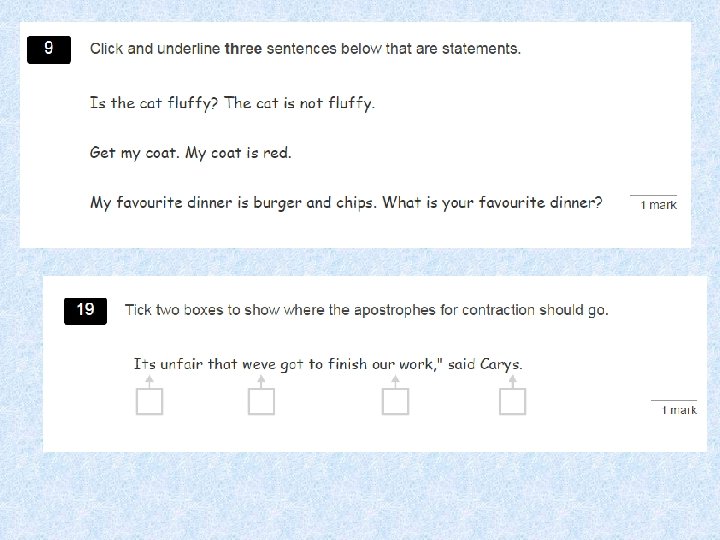
Grammar cont… • Tenses • Connectives • Types of sentences- statements, commands, questions • Phrases and clauses- main and subordinate • Articles • Prepositions • Pronouns • Punctuation • Choosing words with similar meanings. • Prefixes/Suffixes • Using I or me.
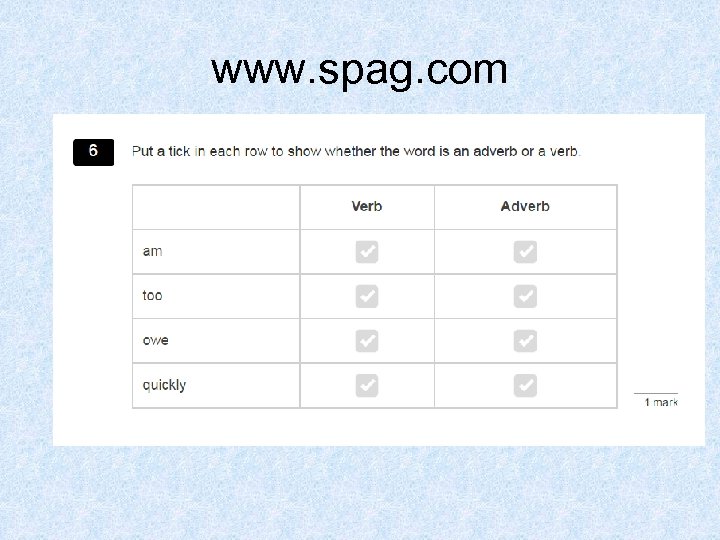
www. spag. com
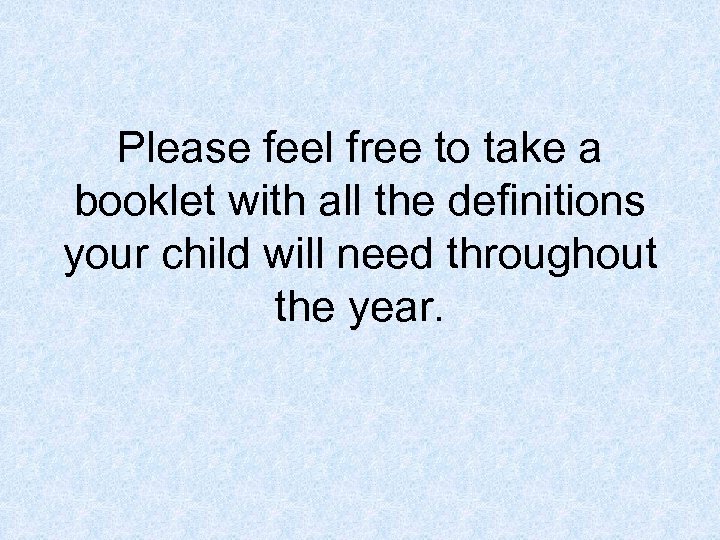
Please feel free to take a booklet with all the definitions your child will need throughout the year.
Spelling Currently children are working in 2 groups for spelling. One group will receive three 25 minute sessions per week and will focus on developing their confidence in spelling. We trialled this last year and we found spending 3 weekly sessions focussing on one particular spelling focus really helped improve the spelling ability of some children.
Spelling Cont… The other group will spend an initial 25 minute session focussing on a weekly spelling focus and then a further independent 25 minute session during our daily task time. The structure of the 1 st session is as follows: Spelling Test- using unseen words- where children have to look at words and determine the spelling focus for that week. Teacher led teaching of specific spelling rule with independent activity to follow. Children spend time during the following week, investigating the rule and completing some work. They are then retested on rule the following week. We feel that it is important that the children fully understand the rule, rather than simply learn a set number of spellings per week.
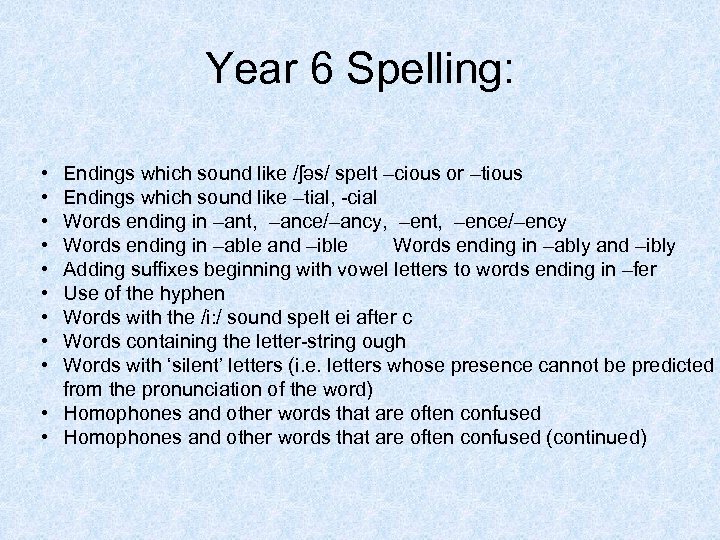
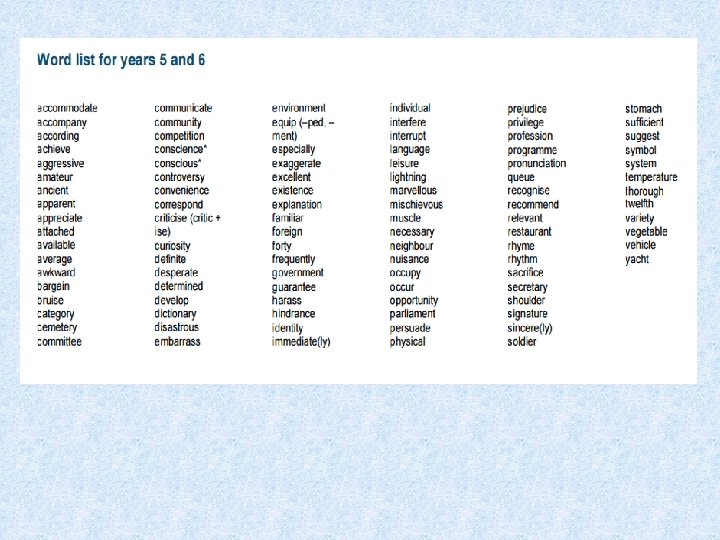
Year 6 Spelling: • • • Endings which sound like /ʃəs/ spelt –cious or –tious Endings which sound like –tial, -cial Words ending in –ant, –ance/–ancy, –ent, –ence/–ency Words ending in –able and –ible Words ending in –ably and –ibly Adding suffixes beginning with vowel letters to words ending in –fer Use of the hyphen Words with the /i: / sound spelt ei after c Words containing the letter-string ough Words with ‘silent’ letters (i. e. letters whose presence cannot be predicted from the pronunciation of the word) • Homophones and other words that are often confused (continued)
Guided Reading and Guided reading sessions last half an hour they are led by Miss Wiblin. Sessions will focus on different AF’s (assessment focus’) each week: Text retrieval; Deduce, refer, interpret information, events or ideas. Identify and comment on text structure and organisation. Look at the writer’s use of language.
Independent Reading Children choose a home reader each week, and are encouraged to pick a range of fiction and non-fiction texts. They should be aiming to be able to read this fluently but with some challenging words. EVERY NIGHT (10 minutes!!) Not necessary to hear every word but
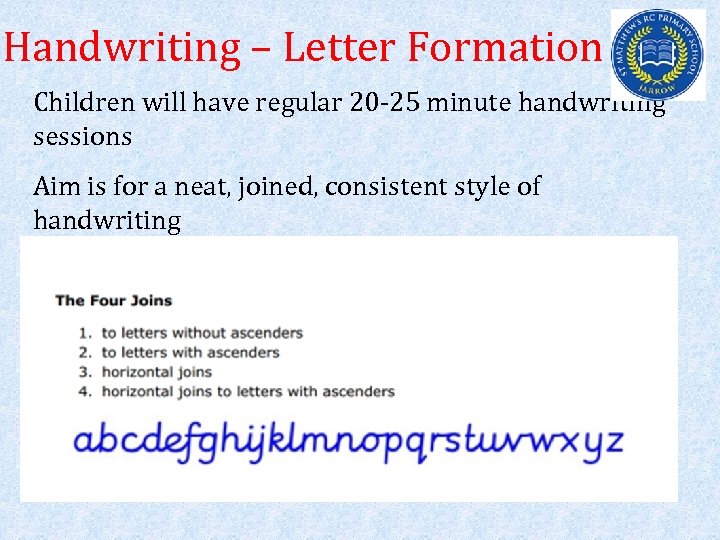
Handwriting – Letter Formation Children will have regular 20 -25 minute handwriting sessions Aim is for a neat, joined, consistent style of handwriting Pride in their presentation
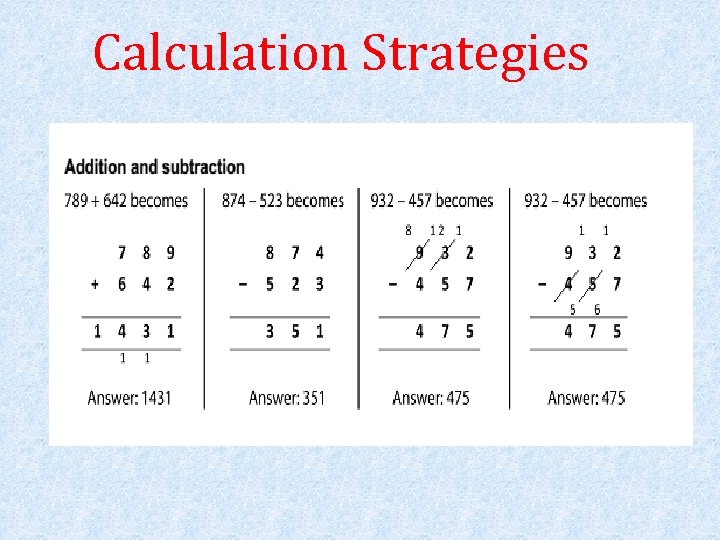
Maths Throughout the year the children will cover the 7 strands of mathematics ; • Using and applying mathematics • Counting and understanding number • Knowing and using number facts • Calculating • Understanding shape • Measuring • Handling data These 7 strands are taught each term.
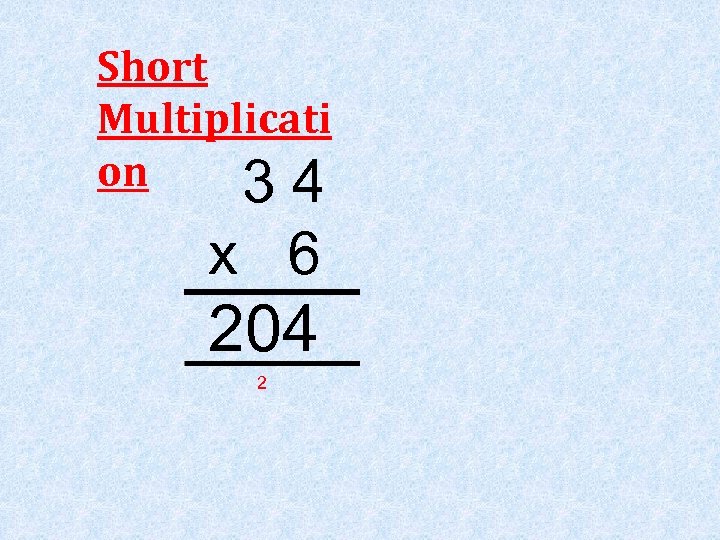
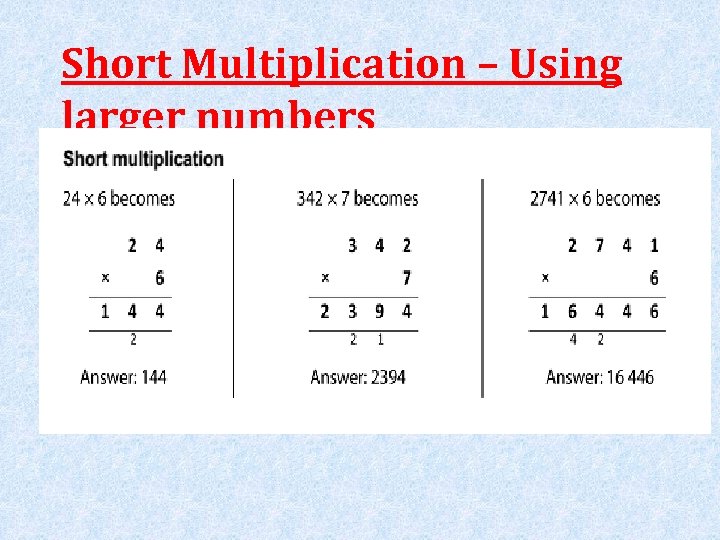
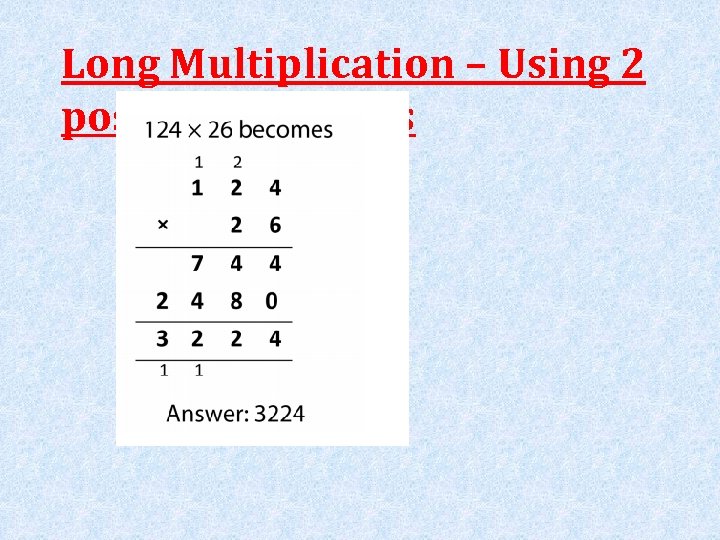
Maths New Curriculum • There will be a greater emphasis on arithmetic/mental skills – new paper during SATS. • The promotion of efficient written methods of long multiplication and
Key Maths Skills for Year 6 • Tables facts and division facts to 12 x 12 • Knowledge of place value (numbers to 1, 000) • Multiply and divide by 10, 1000 • Written methods of calculation for all four operations • Problem solving and application of skills
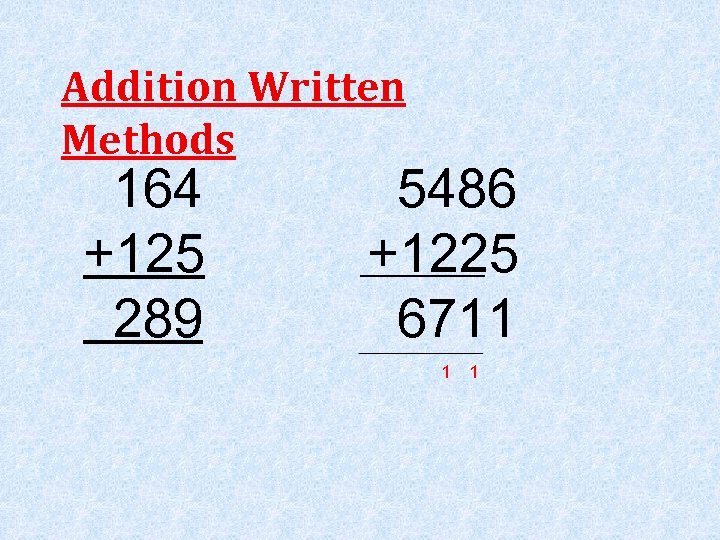
Addition Written Methods 164 +125 289 5486 +1225 6711 1 1
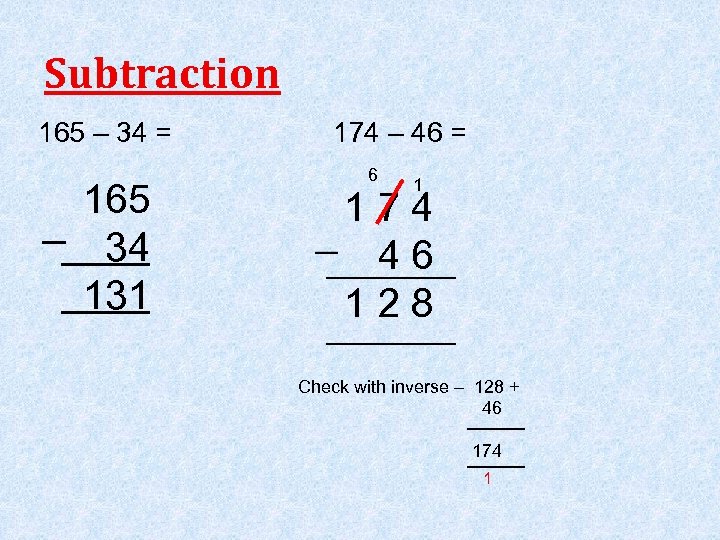
Subtraction 165 – 34 = 165 _ 34 131 174 – 46 = 6 1 174 46 128 Check with inverse – 128 + 46 174 1
Calculation Strategies
Short Multiplicati on 34 x 6 204 2
Short Multiplication – Using larger numbers
Long Multiplication – Using 2 possible methods
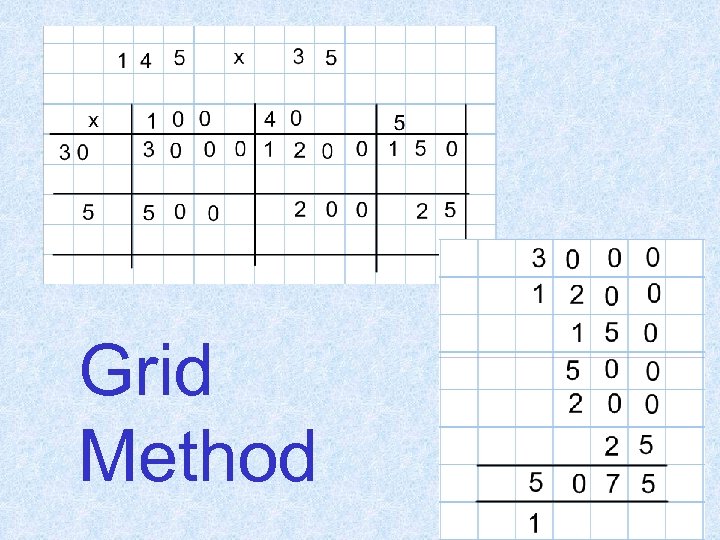
Grid Method
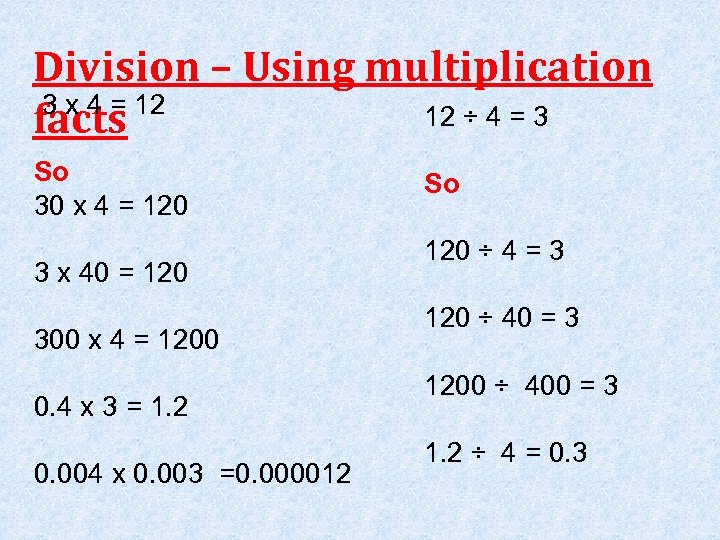
Division – Using multiplication 3 x 4 = 12 12 ÷ 4 = 3 facts So 30 x 4 = 120 3 x 40 = 120 300 x 4 = 1200 0. 4 x 3 = 1. 2 0. 004 x 0. 003 =0. 000012 So 120 ÷ 4 = 3 120 ÷ 40 = 3 1200 ÷ 400 = 3 1. 2 ÷ 4 = 0. 3
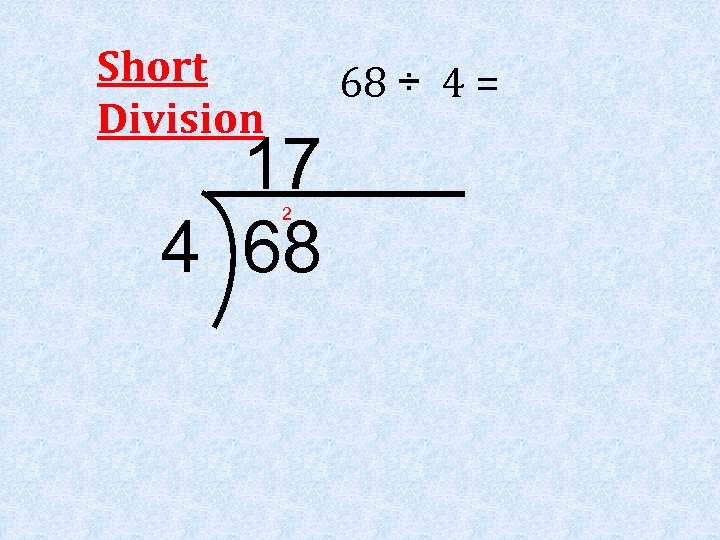
Short Division 68 ÷ 4 = 17 4 68 2
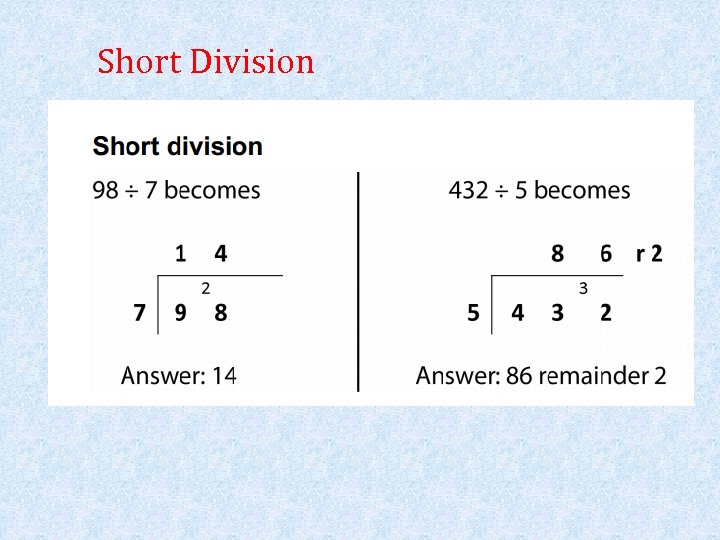
Short Division
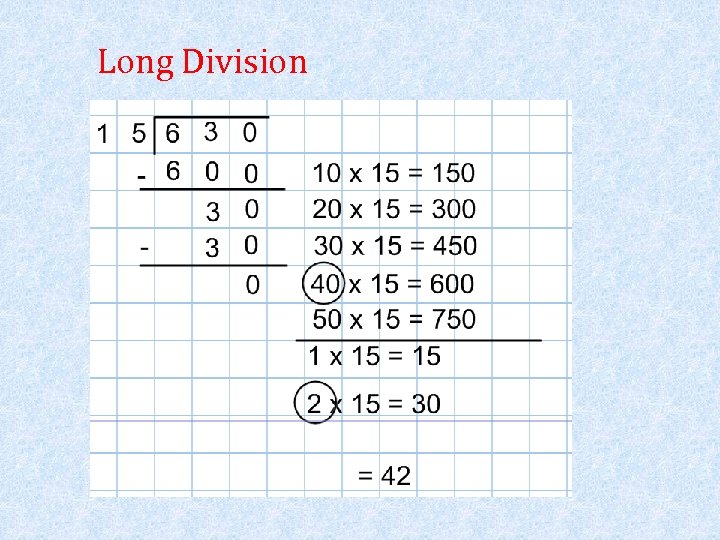
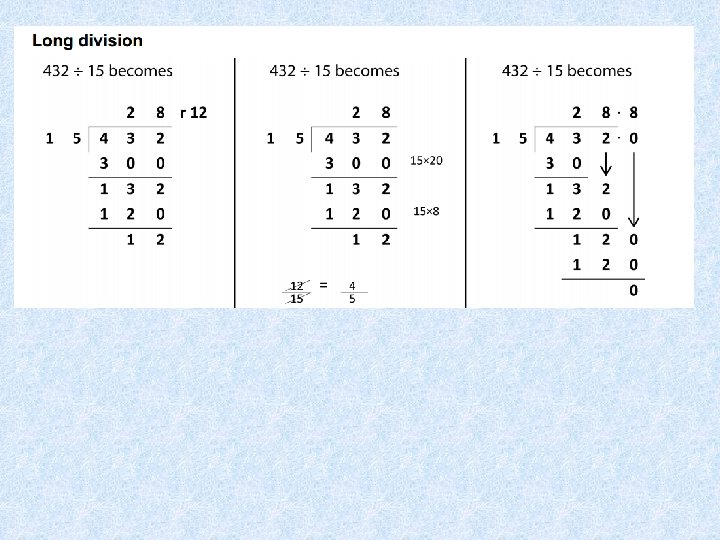
Long Division
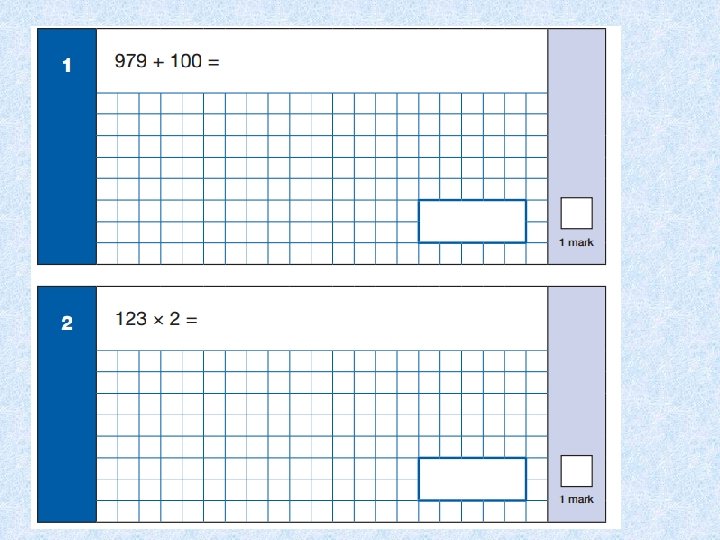
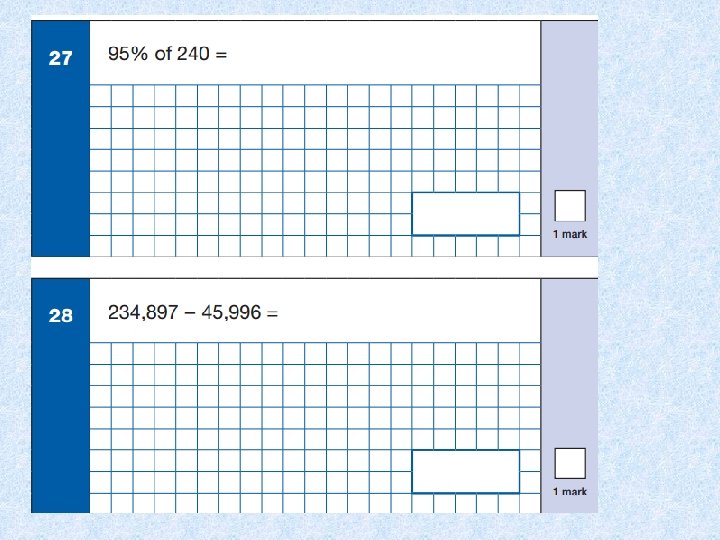
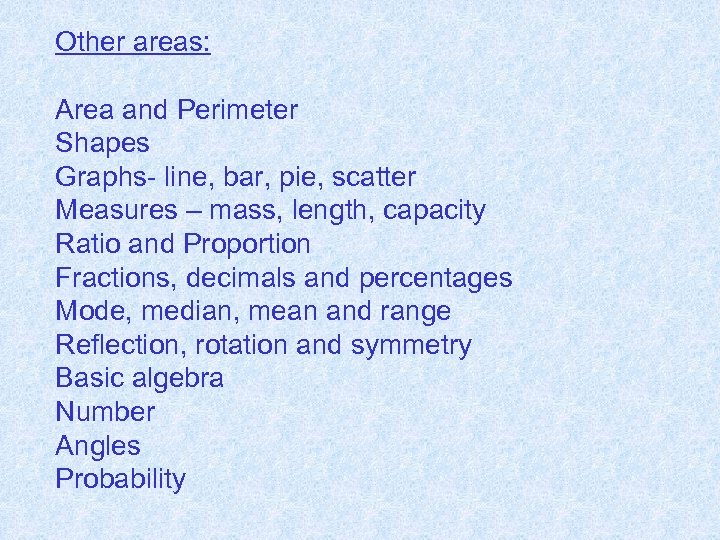
Other areas: Area and Perimeter Shapes Graphs- line, bar, pie, scatter Measures – mass, length, capacity Ratio and Proportion Fractions, decimals and percentages Mode, median, mean and range Reflection, rotation and symmetry Basic algebra Number Angles Probability
Booster Work All children will be monitored closely throughout the year. Additional opportunities to work with members of staff to improve the level they are working at if needed. Offers of additional support will be given after October Half term to those children we feel could do with a confidence booster in this area of the curriculum. Opportunities of additional support will also be offered to children, where Maths is a particular strength, after the Christmas break.
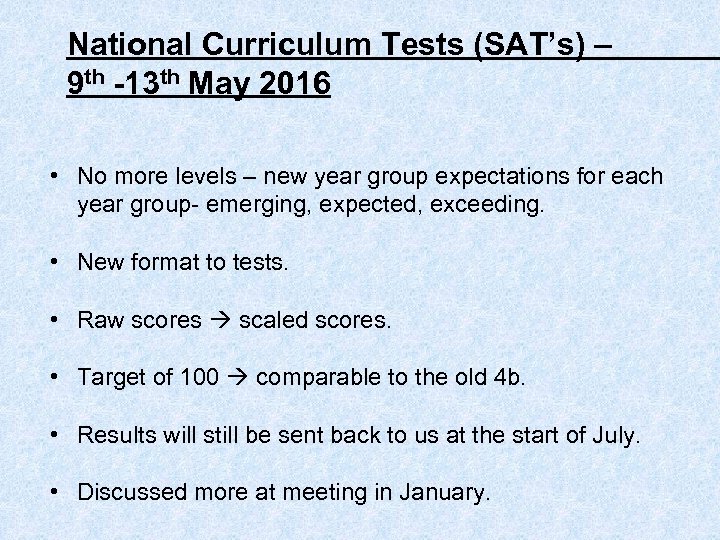
National Curriculum Tests (SAT’s) – 9 th -13 th May 2016 • No more levels – new year group expectations for each year group- emerging, expected, exceeding. • New format to tests. • Raw scores scaled scores. • Target of 100 comparable to the old 4 b. • Results will still be sent back to us at the start of July. • Discussed more at meeting in January.
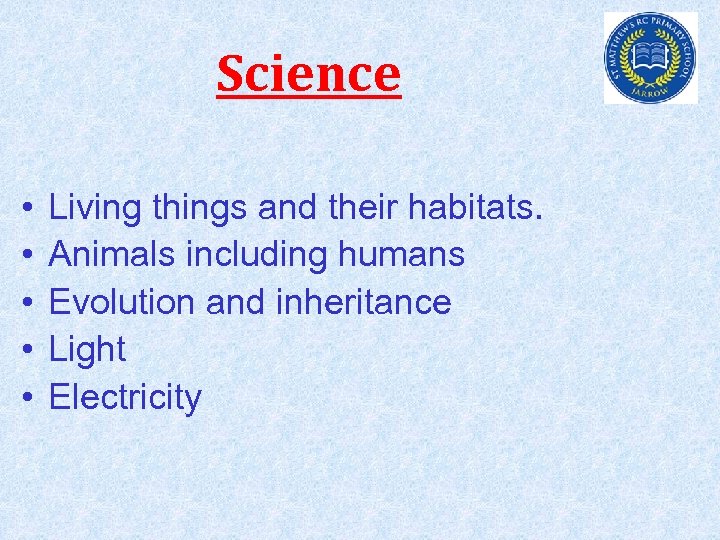
Science • • • Living things and their habitats. Animals including humans Evolution and inheritance Light Electricity
Computing The children have one computing lesson a week in the computing room. • E Safety – Safety online, Reporting issues, Social Media • Computer Science – Programming/Coding/Gaming • Digital Literacy – Multimedia, Comic Life,
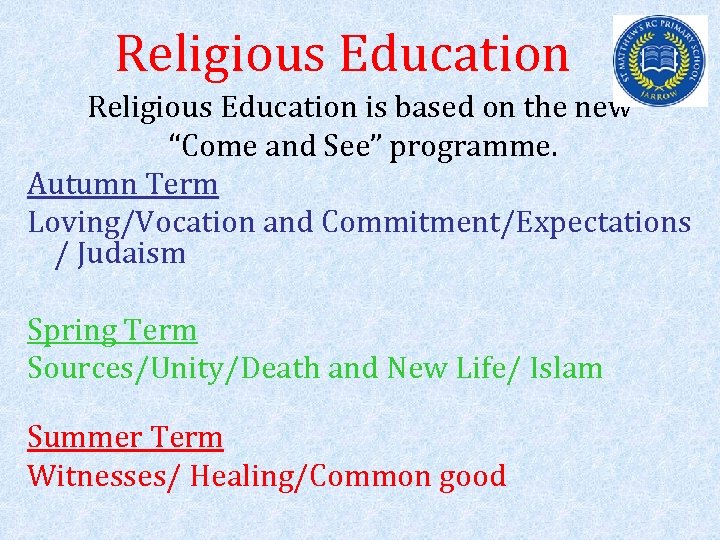
Religious Education is based on the new “Come and See” programme. Autumn Term Loving/Vocation and Commitment/Expectations / Judaism Spring Term Sources/Unity/Death and New Life/ Islam Summer Term Witnesses/ Healing/Common good
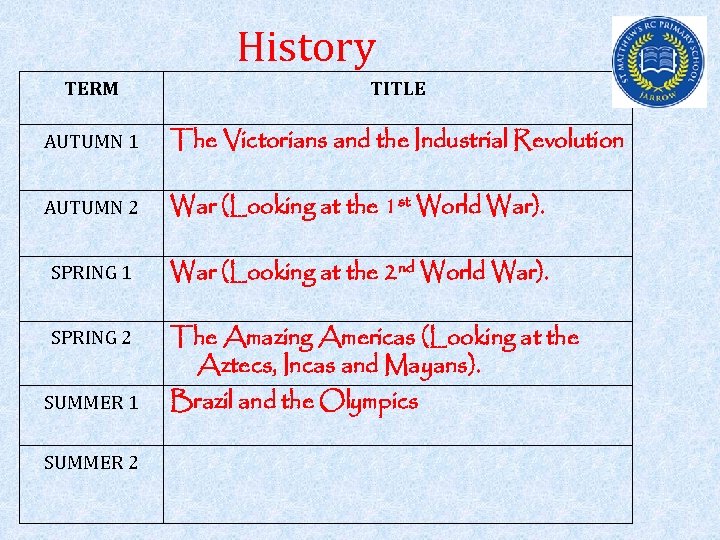
History TERM TITLE AUTUMN 1 The Victorians and the Industrial Revolution AUTUMN 2 War (Looking at the 1 st World War). SPRING 1 War (Looking at the 2 nd World War). SPRING 2 The Amazing Americas (Looking at the Aztecs, Incas and Mayans). Brazil and the Olympics SUMMER 1 SUMMER 2
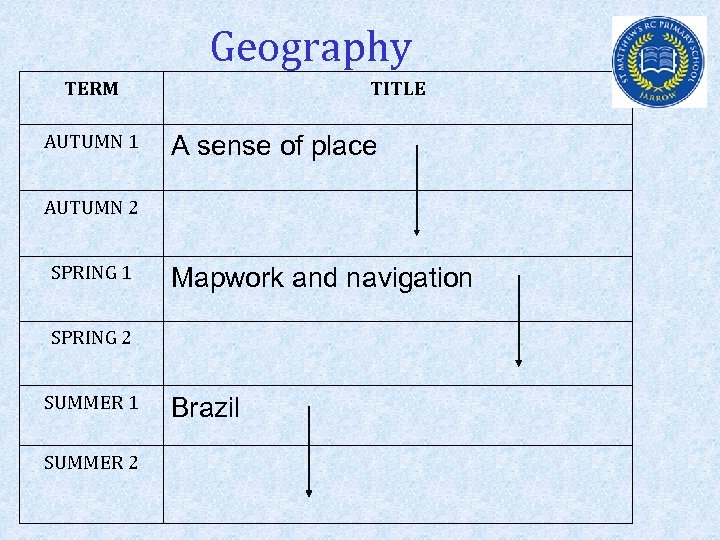
Geography TERM AUTUMN 1 TITLE A sense of place AUTUMN 2 SPRING 1 Mapwork and navigation SPRING 2 SUMMER 1 SUMMER 2 Brazil
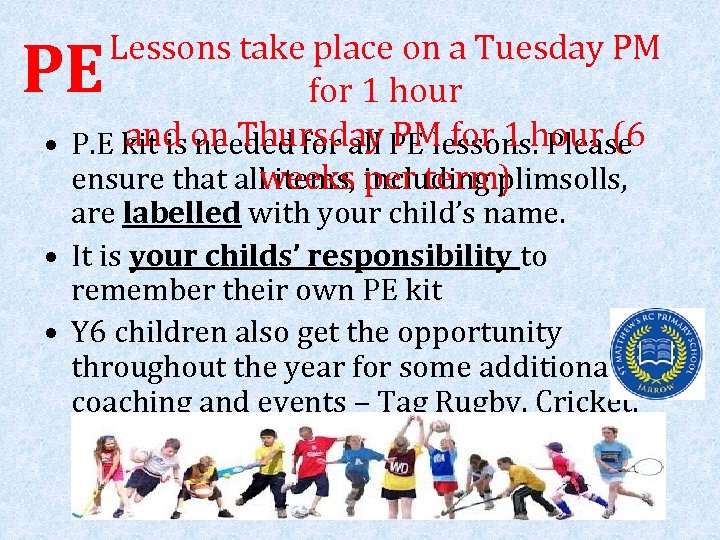
Lessons take place on a Tuesday PM for 1 hour and needed for all PM for 1 hour (6 • P. E kit is on Thursday PE lessons. Please weeks per term) ensure that all items, including plimsolls, PE are labelled with your child’s name. • It is your childs’ responsibility to remember their own PE kit • Y 6 children also get the opportunity throughout the year for some additional coaching and events – Tag Rugby, Cricket, Athletics etc.
• • • Autumn Term Games (Bounce Tennis, Benchball) Gymnastics Outdoor Pursuits (Thurston) Spring Term Dance Games (sit down volleyball) Summer Term Games (Cricket, Rounders) Athletics
French • The children have an hour of French every Wednesday morning. • This is taught by Mrs Thomas The children are taught oral and written skills in French on a range of subjects. Grammar: Conjugation of ‘er’ verbs. Preposition (‘a’), Connectives, Conjunctions, Partitive article (‘du’). Key questions and answers: Sports, Parts of the body, Clothing, Simple opinions.
Music • The children have a weekly music lesson with Mrs Bell • Elements of music, Keyboard skills, Pulse and Rhythm, composition and preparing for Year 6 Production. Individual instrument lessons are available for a small fee. • Mr Bourdiec provides a weekly ukulele lesson for Y 6 on a Monday afternoon.
TERM Art and DT TITLE AUTUMN 1 DT – Davey Lamp Work AUTUMN 2 Art – Mrs Limer SPRING 1 DT- Davey Lamp Work, Shelters SPRING 2 ART – Mrs Limer SUMMER 1 DT- Production Work SUMMER 2 ART – Mrs Limer
Marking • All children’s work is marked with 2 positive comments. • A challenge / next step is also identified.
Year 6 – “An open door” • I am in school most mornings by 8 15 am and usually leave around 6 pm. • Please come and see me about anything that is concerning or worrying you. • Contact the office to make an appointment.
Скачать презентацию Welcome to Year 6 Curriculum Evening Miss Wiblin
572cc1bb54daa0d227f2849454a966f9.ppt