


 Скачать презентацию Welcome to the School of Information and Communication
8a65be529aade9e83c4d620ae55aa7b0.ppt
- Количество слайдов: 13
 Welcome to the School of Information and Communication Technology Gold Coast
 ICT Programs ICT School Web-Site http: //www. griffith. edu. au/ict Bachelor of Information Technology (Junhu Wang) Bachelor of Information Technology – Hons (John Thornton) Bachelor of Multimedia (Jun Jo) Master of Information Technology (Ann Nguyen) Doctor of Philosophy (John Thornton) School of Information and Communication Technology 2
 Overview S The Bachelor of Information Technology degree program at the Gold Coast campus is focused on the future of Information Technology. S Graduates from the Bachelor of Information Technology will be eligible for membership of the Australian Computer Society. S You can then either progress into: S an honours year in preparation for higher degrees by research studies (a minimum GPA 5. 0 is required) S careers in the Information Technology industry as: Systems Analysts, Database Developers / Administrators, Computer Programmers, Data Communications Developers, Network Administrators, Multi-Media Developers School of Information and Communication Technology 3
 Courses S Students who have completed a relevant qualification (Certificate, Associate Diploma, degree studies) from an approved institution may be eligible for advance standing in the degree. S Students with a GPA of 6. 0 or better on completion of the first year courses are eligible to enrol in the Bachelor of Information Technology Advanced S Courses S Core and Electives S Prerequisites S Credit Points School of Information and Communication Technology 4
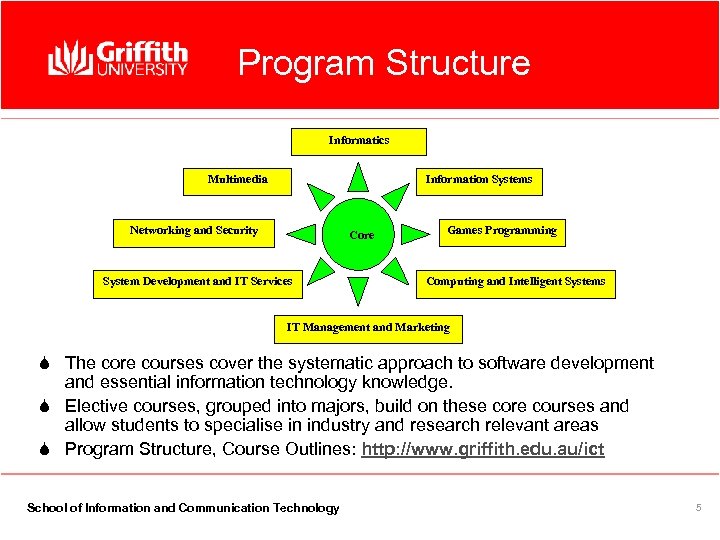 Program Structure Informatics Multimedia Information Systems Networking and Security Core System Development and IT Services Games Programming Computing and Intelligent Systems IT Management and Marketing S The core courses cover the systematic approach to software development and essential information technology knowledge. S Elective courses, grouped into majors, build on these core courses and allow students to specialise in industry and research relevant areas S Program Structure, Course Outlines: http: //www. griffith. edu. au/ict School of Information and Communication Technology 5
 First Year Courses S 1001 ICT Programming I: Ann Nguyen S 1002 ICT Discrete Structures: Ann Nguyen S 1420 ICT Systems Analysis and Design: Ovidiu Noran S 1621 CT Web Design and Development: Jun Jo S Each 10 CP course requires 10 hours of study per week, starting in week 1 – usually 3 -4 hours contact, 6 -7 hours self-study S Students who fail generally start failing by missing early assessment items – if you start falling behind please take action immediately School of Information and Communication Technology 6
 Writing Skills Courses S To complete the degree you must also complete three self-paced web-based writing skills courses: 1113 ICT, 1114 ICT and 1115 ICT. S It is up to you to enrol in these courses, study the material and take the exams – they are 0 credit point courses and do not attract fees but you still have to pass them (for details contact the convenor Marilyn Ford). S However, if you enrol in 1113 ICT and pass the exam you will gain a 5% credit towards your mark in 1004 ICT Foundations of Computing and Communication (if you complete 1113 ICT before or at the same time as 1004 ICT). School of Information and Communication Technology 7
 Program Requirements To graduate a student must acquire 240 CP as follows: – gain 110 CP for prescribed courses including 80 CP of prescribed first year courses – gain 60 CP for one major – gain 20 CP in the IT Project or the Industry Affiliates Program: – gain 50 CP for electives of which at least 20 CP are IT specific courses – complete the compulsory self-paced web-based Writing Skills courses (1113 ICT / 1114 ICT / 1115 ICT) – at least 60 CP of all courses undertaken must be at third year level (at least 40 CP must be ICT specific courses – which includes 30 CP core - to meet accreditation guidelines) – no more than 30 CP for courses in which the grade of Pass Conceded has been awarded can be counted towards the 240 CP required to complete the degree. – All students will be able to complete the program at their home campus. However, they can also take courses offered at other campuses which may assist their progression through the program or in completing a major not offered in its entirety at their home campus School of Information and Communication Technology 8
 Academic Staff Roles and Responsibilities S Tutors – understanding and application of knowledge S Lecturers – content and conduct of lectures S Course Convenors – overall course objectives and content, administration of course. S Program Convenor, BInf. Tech - administration of BInf. Tech, program structures. S Higher Management levels (Head School of ICT, Dean EIT, PVC …) School of Information and Communication Technology 9
 Conduct of Courses S Will be advised by course convenors, but generally: S S Lectures Tutorials, labs or both (1 - 2 hours per week) Various on-line support materials Assessment by a combination of assignments, mid semester and/or final examination S Most courses have point of contact through learning@griffith S Timetabling details: S http: //www. griffith. edu. au/ua/aa/sta/timetables. html School of Information and Communication Technology 10
 Tutorial/Lab Allocations S Initial allocation for some students S Logon as s 123456, ENABLE password S Will only be active for a particular course once you are formally enrolled in the course S If you can’t get your preferred allocation you can negotiate with another student or see your lecturer School of Information and Communication Technology 11
 Ethical Behaviour S Cooperation between students is often encouraged S Copying other students work is NOT! S Nor is Plagiarism (using source materials without reference) S Your attention is drawn to the University policy on Academic Misconduct School of Information and Communication Technology 12
 Finally… S We very much want you to succeed at Griffith University S If you have any issues at all please let us know as soon as possible School of Information and Communication Technology 13