


 Скачать презентацию Welcome to the Patient Financial Navigator Foundation Inc
3376bbb3e8bd5bce42a8d8bbd560a776.ppt
- Количество слайдов: 39
 Welcome to the Patient Financial Navigator Foundation, Inc. Presenting“INSURANCE 101” **An Idaho-Based Family Foundation** 1
 The PFNF Advisory Board is committed to attacking and transforming the hassle factor --thru education & outreach. Jodyi Wren, Director Day Egusquiza, Founder and President Jeremy Egusquiza, Director Karla Carter, Director Daryl Wert, Vice President Rosemary Fornshell, Ad-hoc Jenyfer Stokes, Director Special thanks to Kody/Facebook and Jeremy/Webpage Jayme Ketterling, Secretary Special thanks to the volunteers +CSI/strategic partner – location Collaboration = reducing anxiety thru education PFNF Education 2017 2
 A Community Outreach Program The Patient Financial Navigator Foundation, Inc with its home base in Twin Falls, Idaho, is thrilled to present free educational programs for patients to attack the hassle factor in healthcare…thru education. Day Egusquiza, President, with over 37 years’ experience in healthcare including 20 years at an Idaho hospital, will guide the Patient Financial Navigator Foundation which will create a pathway for patients with multiple educational efforts – thru employers, payers, boot camps– while developing networks including a Resource Library with local hospitals to help navigate thru the maze called healthcare. Transforming healthcare one patient at a time. An advocate for all! NO cost to the Employer for any employer programs. NO cost to the community for any community programs. NO cost to the community for the Boot camps 3
 Why create the Patient Financial Navigator Community Outreach Program No one really understands their healthcare insurance until they need it. No one realizes the ‘next steps’ once the medical incident has occurred/been ordered. When a family is in a healthcare crisis, their life is disrupted, scared and vulnerable coordination/communication is required to reduce the hassle factor. PFNF Education 2017 4
 The Patient Challenges with Health. Care • No one ‘asks’ to come to a hospital. • Patient’s lives are impacted – they are scared, they feel out of control, they are lost with the overwhelming factors of cost/unknown, multiple providers, and continuing frustration with ‘who knows all of this? ” • Patients are unaware of the many changes with their insurance, government programs, employer’s coverage and all the ‘rules’ associated with getting services paid. • Patients historically access hospitals once a year or less. Healthcare is very personal! 5
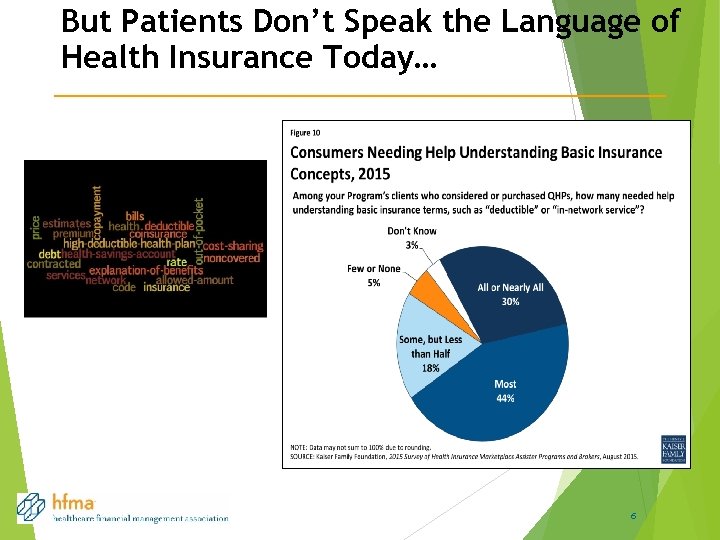 But Patients Don’t Speak the Language of Health Insurance Today… 6
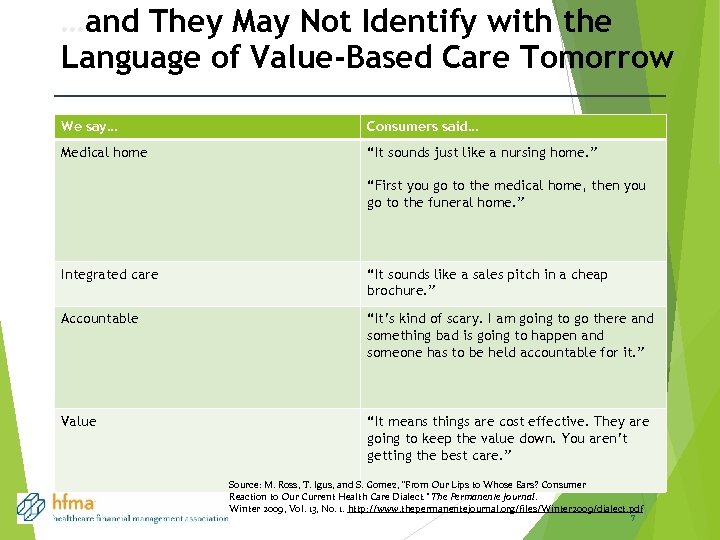 …and They May Not Identify with the Language of Value-Based Care Tomorrow We say… Consumers said… Medical home “It sounds just like a nursing home. ” “First you go to the medical home, then you go to the funeral home. ” Integrated care “It sounds like a sales pitch in a cheap brochure. ” Accountable “It’s kind of scary. I am going to go there and something bad is going to happen and someone has to be held accountable for it. ” Value “It means things are cost effective. They are going to keep the value down. You aren’t getting the best care. ” Source: M. Ross, T. Igus, and S. Gomez, “From Our Lips to Whose Ears? Consumer Reaction to Our Current Health Care Dialect. ” The Permanente Journal. Winter 2009, Vol. 13, No. 1. http: //www. thepermanentejournal. org/files/Winter 2009/dialect. pdf 7
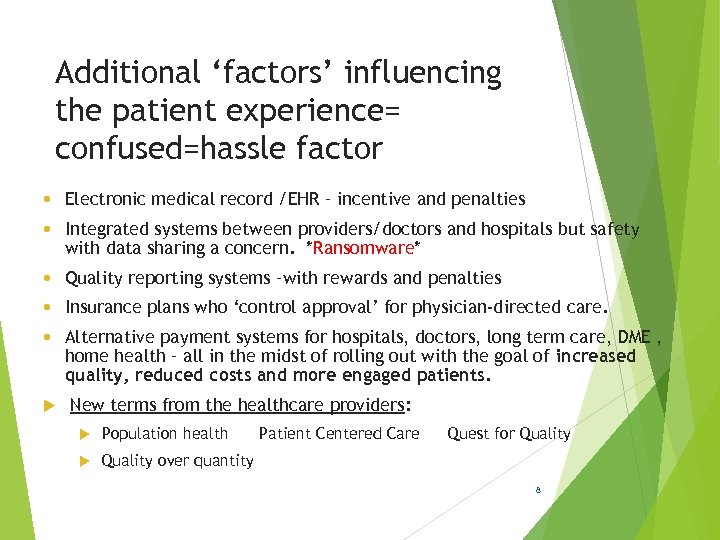 Additional ‘factors’ influencing the patient experience= confused=hassle factor Electronic medical record /EHR – incentive and penalties Integrated systems between providers/doctors and hospitals but safety with data sharing a concern. *Ransomware* Quality reporting systems –with rewards and penalties Insurance plans who ‘control approval’ for physician-directed care. Alternative payment systems for hospitals, doctors, long term care, DME , home health – all in the midst of rolling out with the goal of increased quality, reduced costs and more engaged patients. New terms from the healthcare providers: Population health Patient Centered Care Quest for Quality over quantity 8
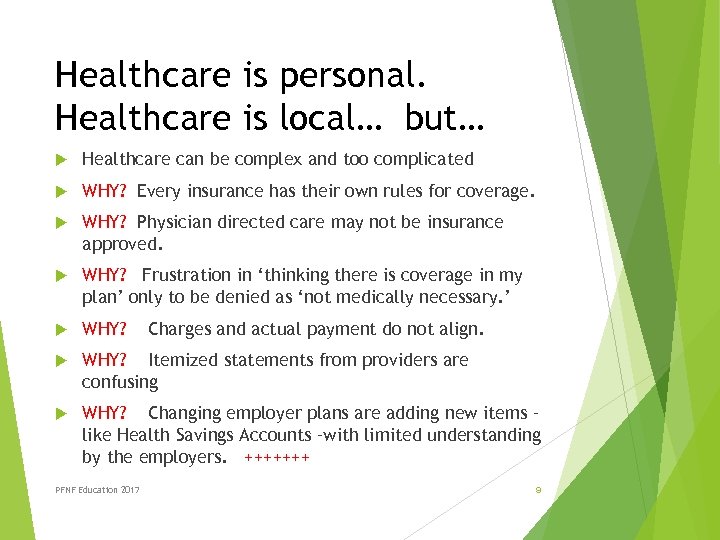 Healthcare is personal. Healthcare is local… but… Healthcare can be complex and too complicated WHY? Every insurance has their own rules for coverage. WHY? Physician directed care may not be insurance approved. WHY? Frustration in ‘thinking there is coverage in my plan’ only to be denied as ‘not medically necessary. ’ WHY? Itemized statements from providers are confusing WHY? Changing employer plans are adding new items – like Health Savings Accounts –with limited understanding by the employers. +++++++ PFNF Education 2017 Charges and actual payment do not align. 9
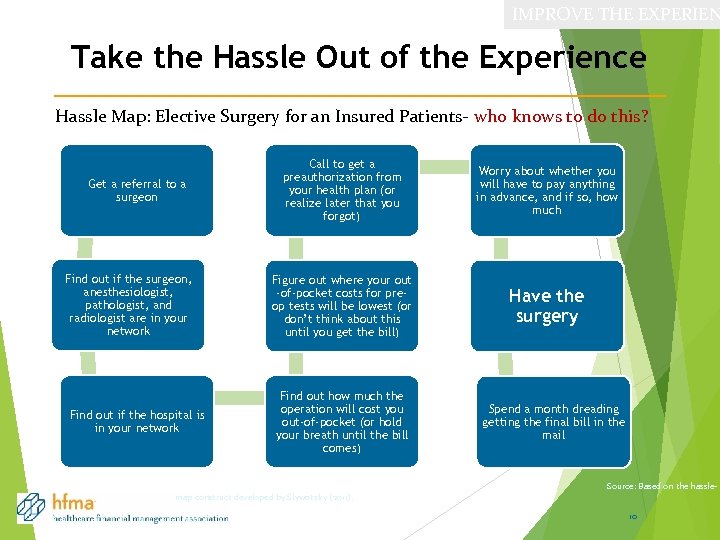 IMPROVE THE EXPERIEN Take the Hassle Out of the Experience Hassle Map: Elective Surgery for an Insured Patients- who knows to do this? Get a referral to a surgeon Find out if the surgeon, anesthesiologist, pathologist, and radiologist are in your network Find out if the hospital is in your network Call to get a preauthorization from your health plan (or realize later that you forgot) Worry about whether you will have to pay anything in advance, and if so, how much Figure out where your out -of-pocket costs for preop tests will be lowest (or don’t think about this until you get the bill) Have the surgery Find out how much the operation will cost you out-of-pocket (or hold your breath until the bill comes) map construct developed by Slywotzky (2011). Spend a month dreading getting the final bill in the mail Source: Based on the hassle 10
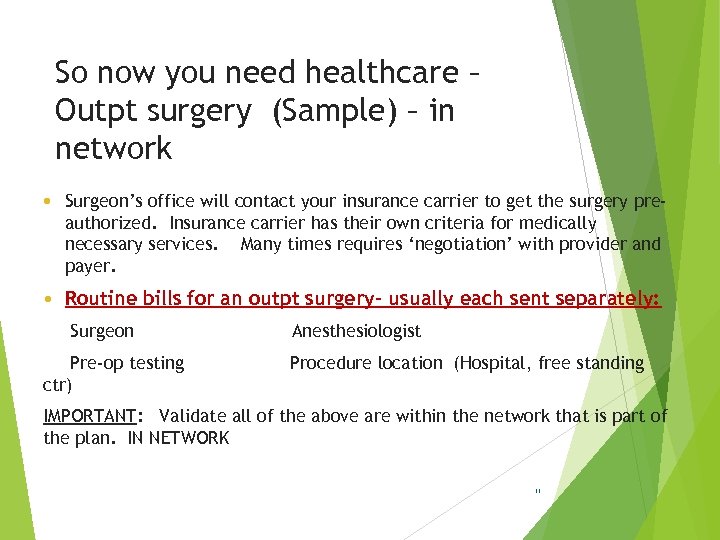 So now you need healthcare – Outpt surgery (Sample) – in network Surgeon’s office will contact your insurance carrier to get the surgery preauthorized. Insurance carrier has their own criteria for medically necessary services. Many times requires ‘negotiation’ with provider and payer. Routine bills for an outpt surgery- usually each sent separately: Surgeon Pre-op testing ctr) Anesthesiologist Procedure location (Hospital, free standing IMPORTANT: Validate all of the above are within the network that is part of the plan. IN NETWORK 11
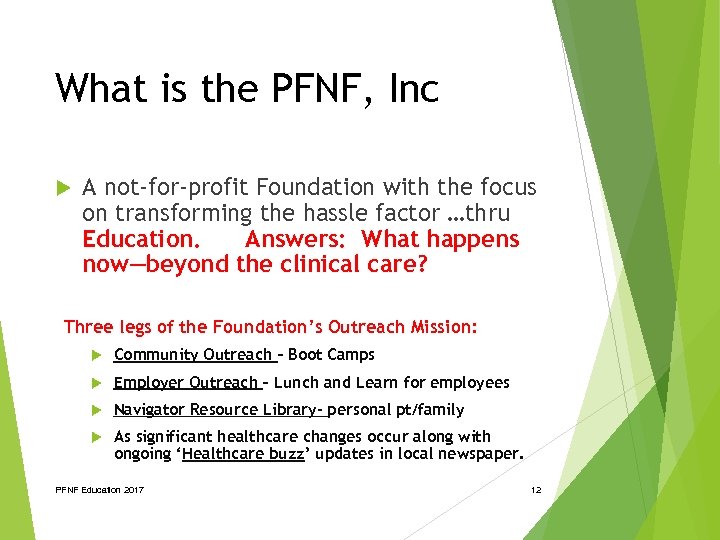 What is the PFNF, Inc A not-for-profit Foundation with the focus on transforming the hassle factor …thru Education. Answers: What happens now—beyond the clinical care? Three legs of the Foundation’s Outreach Mission: Community Outreach – Boot Camps Employer Outreach – Lunch and Learn for employees Navigator Resource Library- personal pt/family As significant healthcare changes occur along with ongoing ‘Healthcare buzz’ updates in local newspaper. PFNF Education 2017 12
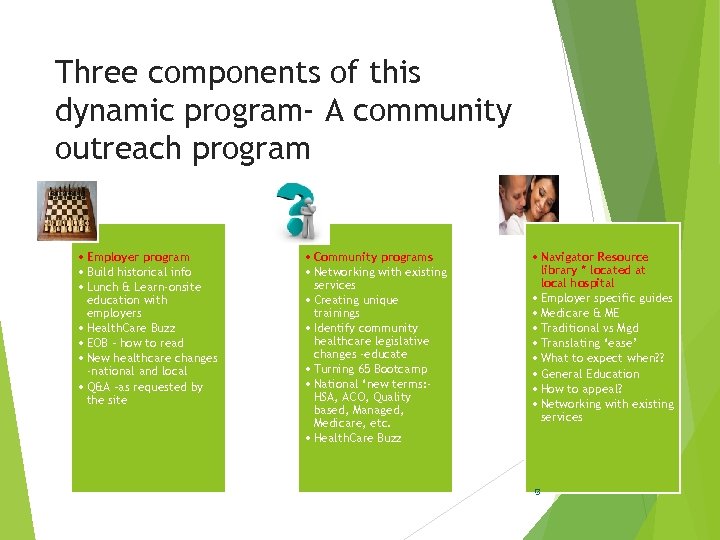 Three components of this dynamic program- A community outreach program • Employer program • Build historical info • Lunch & Learn-onsite education with employers • Health. Care Buzz • EOB – how to read • New healthcare changes -national and local • Q&A –as requested by the site • Community programs • Networking with existing services • Creating unique trainings • Identify community healthcare legislative changes -educate • Turning 65 Bootcamp • National ‘new terms: HSA, ACO, Quality based, Managed, Medicare, etc. • Health. Care Buzz • Navigator Resource library * located at local hospital • Employer specific guides • Medicare & ME • Traditional vs Mgd • Translating ‘ease’ • What to expect when? ? • General Education • How to appeal? • Networking with existing services 13
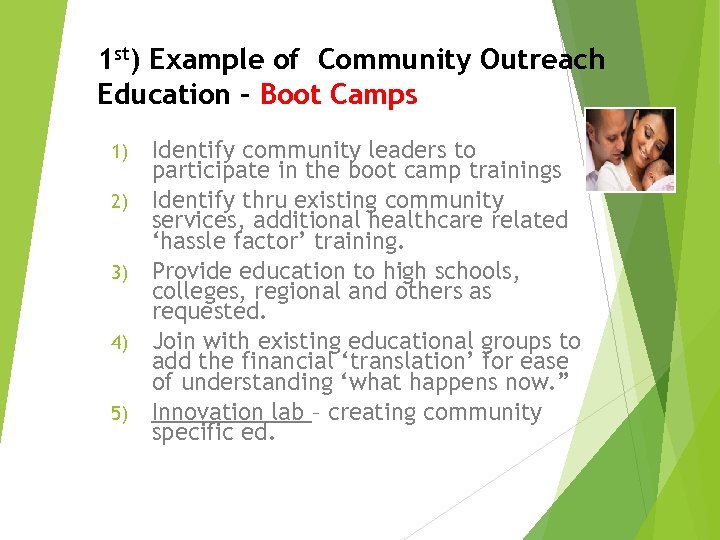 1 st) Example of Community Outreach Education – Boot Camps 1) 2) 3) 4) 5) Identify community leaders to participate in the boot camp trainings Identify thru existing community services, additional healthcare related ‘hassle factor’ training. Provide education to high schools, colleges, regional and others as requested. Join with existing educational groups to add the financial ‘translation’ for ease of understanding ‘what happens now. ” Innovation lab – creating community specific ed. 14
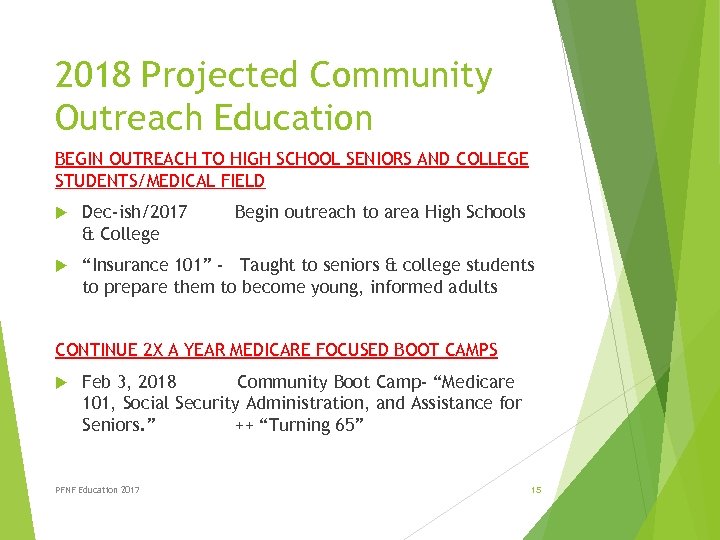 2018 Projected Community Outreach Education BEGIN OUTREACH TO HIGH SCHOOL SENIORS AND COLLEGE STUDENTS/MEDICAL FIELD Dec-ish/2017 & College Begin outreach to area High Schools “Insurance 101” - Taught to seniors & college students to prepare them to become young, informed adults CONTINUE 2 X A YEAR MEDICARE FOCUSED BOOT CAMPS Feb 3, 2018 Community Boot Camp- “Medicare 101, Social Security Administration, and Assistance for Seniors. ” ++ “Turning 65” PFNF Education 2017 15
 Trusted Health. Care Educator Participate: Office on Aging events Wellness Fairs Population Health dialogue/changes = ‘translator’ New transformations in healthcare Employer work place insurance initiatives Next generation of healthcare –with partners School outreach – high school, colleges Professional associations As requested 16
 2 nd) Example of Employer. Specific “Lunch & Learn” 1. Meet with the HR staff to learn about the employer’s insurance plan. 2. Outline the key elements for education to be covered during the 30 min employee ‘Lunch and Learn. ’ 3. Hot spots for education (usually): EOB education, out of network, what happens when you are scheduled for a surgery and ‘Health. Care Buzz’ ++ Q&A. 4. Innovation lab – taking the education to the employer. 17
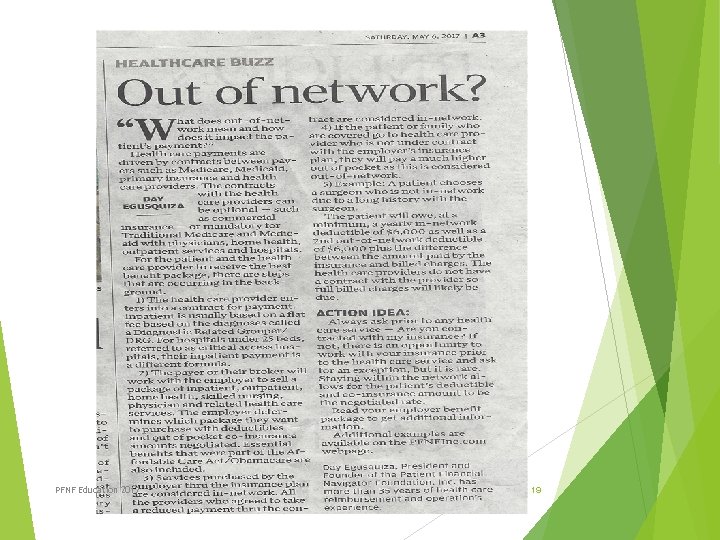
 Ongoing Education – thru “Health. Care Buzz” articles Times News /local bi-monthly educational articles All articles are available on our webpage: What does out of network look like? What is a portal and why do I care? Turning 65: Initial wellness visit Turning 65: How does a Medicare inpt actually pay? Turning 65: What is a Medicare Supplemental Insurance plan? Turning 65: What are the Medicare options? ** Turning 65: When is Medicare a 2 nd payer? ** Turning 65: Fall Medicare Mgd Care Enrollment PFNF Education 2017 18
 PFNF Education 2017 19
 3 rd) Examples from the Hospital Navigator Resource Library 1) 2) 3) 4) 5) 6) Thru employer specific meetings, build data base of insurance plans, how to read the EOB, deductibles, etc. 1 on 1 intervention with the patient/family – complete work paper Create glossary of terms Create reference guide for additional community resources Create networking ‘handoffs’ with existing hospital team payment options, social work, estimates, patient experience, physician offices, others Innovation Lab: After Hours Q&A – Weds 5: 00 -6: 00 p. m. ; using patient portal; tracking and trending improvements/feedback; integration with medical community; face to face and automation. 20
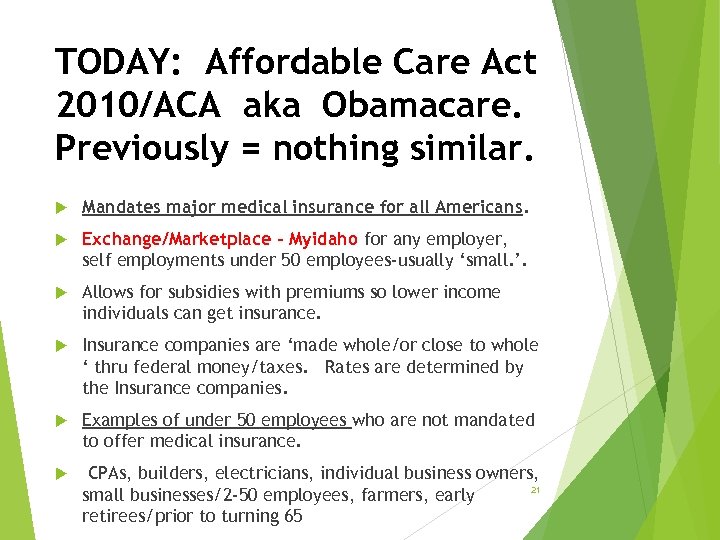 TODAY: Affordable Care Act 2010/ACA aka Obamacare. Previously = nothing similar. Mandates major medical insurance for all Americans. Exchange/Marketplace – Myidaho for any employer, self employments under 50 employees-usually ‘small. ’. Allows for subsidies with premiums so lower income individuals can get insurance. Insurance companies are ‘made whole/or close to whole ‘ thru federal money/taxes. Rates are determined by the Insurance companies. Examples of under 50 employees who are not mandated to offer medical insurance. CPAs, builders, electricians, individual business owners, 21 small businesses/2 -50 employees, farmers, early retirees/prior to turning 65
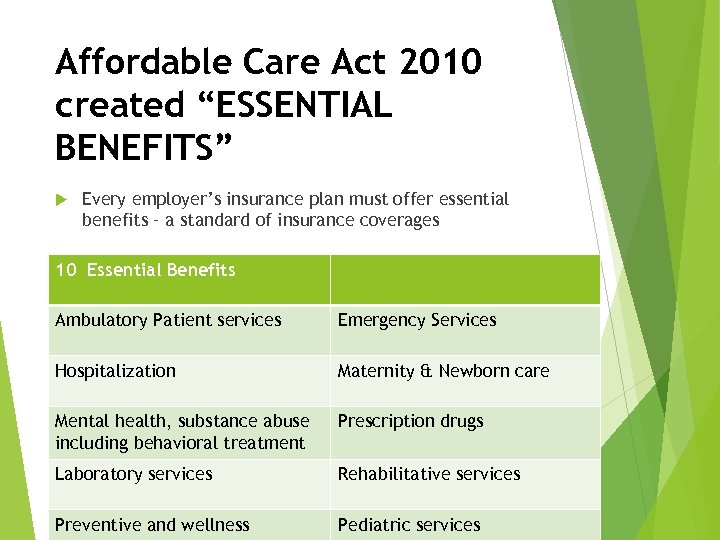 Affordable Care Act 2010 created “ESSENTIAL BENEFITS” Every employer’s insurance plan must offer essential benefits – a standard of insurance coverages 10 Essential Benefits Ambulatory Patient services Emergency Services Hospitalization Maternity & Newborn care Mental health, substance abuse including behavioral treatment Prescription drugs Laboratory services Rehabilitative services PFNF Education 2017 Preventive and wellness 22 Pediatric services
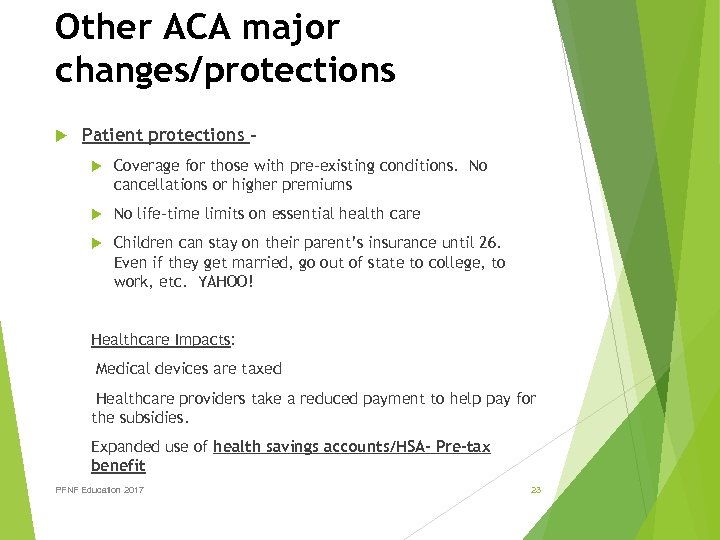 Other ACA major changes/protections Patient protections – Coverage for those with pre-existing conditions. No cancellations or higher premiums No life-time limits on essential health care Children can stay on their parent’s insurance until 26. Even if they get married, go out of state to college, to work, etc. YAHOO! Healthcare Impacts: Medical devices are taxed Healthcare providers take a reduced payment to help pay for the subsidies. Expanded use of health savings accounts/HSA- Pre-tax benefit PFNF Education 2017 23
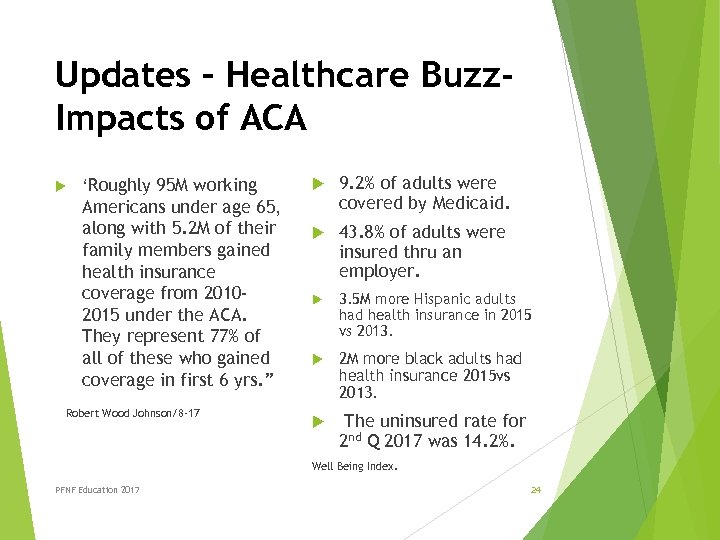 Updates – Healthcare Buzz. Impacts of ACA ‘Roughly 95 M working Americans under age 65, along with 5. 2 M of their family members gained health insurance coverage from 20102015 under the ACA. They represent 77% of all of these who gained coverage in first 6 yrs. ” Robert Wood Johnson/8 -17 9. 2% of adults were covered by Medicaid. 43. 8% of adults were insured thru an employer. 3. 5 M more Hispanic adults had health insurance in 2015 vs 2013. 2 M more black adults had health insurance 2015 vs 2013. The uninsured rate for 2 nd Q 2017 was 14. 2%. Well Being Index. PFNF Education 2017 24
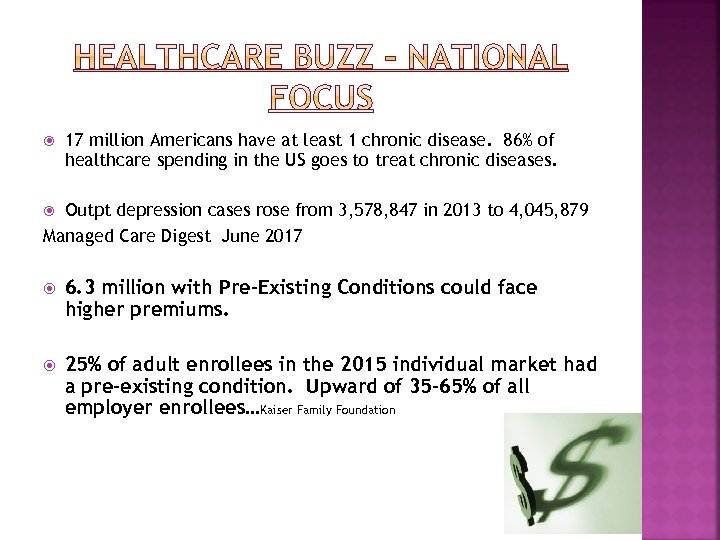 17 million Americans have at least 1 chronic disease. 86% of healthcare spending in the US goes to treat chronic diseases. Outpt depression cases rose from 3, 578, 847 in 2013 to 4, 045, 879 Managed Care Digest June 2017 6. 3 million with Pre-Existing Conditions could face higher premiums. 25% of adult enrollees in the 2015 individual market had a pre-existing condition. Upward of 35 -65% of all employer enrollees…Kaiser Family Foundation 25
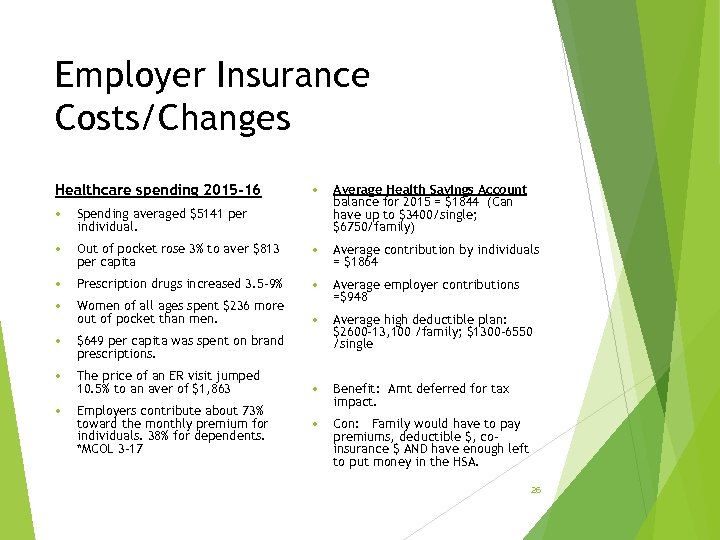 Employer Insurance Costs/Changes Healthcare spending 2015 -16 Average Health Savings Account balance for 2015 = $1844 (Can have up to $3400/single; $6750/family) Spending averaged $5141 per individual. Out of pocket rose 3% to aver $813 per capita Average contribution by individuals = $1864 Prescription drugs increased 3. 5 -9% Women of all ages spent $236 more out of pocket than men. Average employer contributions =$948 Average high deductible plan: $2600 -13, 100 /family; $1300 -6550 /single Benefit: Amt deferred for tax impact. Con: Family would have to pay premiums, deductible $, coinsurance $ AND have enough left to put money in the HSA. $649 per capita was spent on brand prescriptions. The price of an ER visit jumped 10. 5% to an aver of $1, 863 Employers contribute about 73% toward the monthly premium for individuals. 38% for dependents. *MCOL 3 -17 26
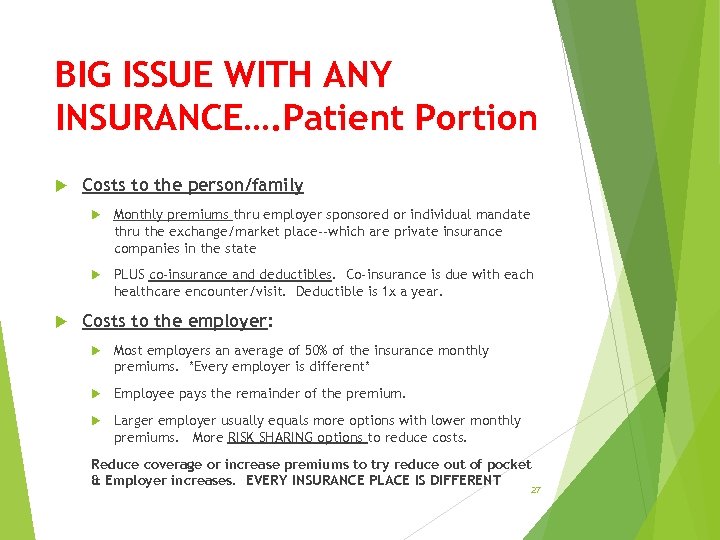 BIG ISSUE WITH ANY INSURANCE…. Patient Portion Costs to the person/family Monthly premiums thru employer sponsored or individual mandate thru the exchange/market place--which are private insurance companies in the state PLUS co-insurance and deductibles. Co-insurance is due with each healthcare encounter/visit. Deductible is 1 x a year. Costs to the employer: Most employers an average of 50% of the insurance monthly premiums. *Every employer is different* Employee pays the remainder of the premium. Larger employer usually equals more options with lower monthly premiums. More RISK SHARING options to reduce costs. Reduce coverage or increase premiums to try reduce out of pocket & Employer increases. EVERY INSURANCE PLACE IS DIFFERENT 27
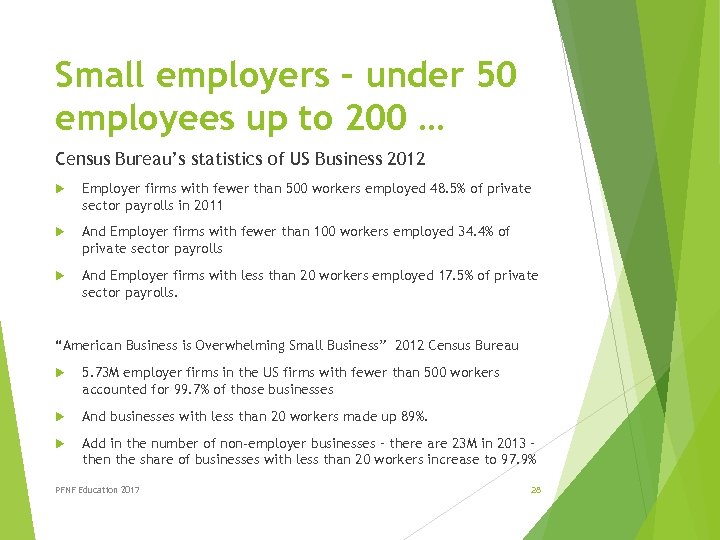 Small employers – under 50 employees up to 200 … Census Bureau’s statistics of US Business 2012 Employer firms with fewer than 500 workers employed 48. 5% of private sector payrolls in 2011 And Employer firms with fewer than 100 workers employed 34. 4% of private sector payrolls And Employer firms with less than 20 workers employed 17. 5% of private sector payrolls. “American Business is Overwhelming Small Business” 2012 Census Bureau 5. 73 M employer firms in the US firms with fewer than 500 workers accounted for 99. 7% of those businesses And businesses with less than 20 workers made up 89%. Add in the number of non-employer businesses – there are 23 M in 2013 – then the share of businesses with less than 20 workers increase to 97. 9% PFNF Education 2017 28
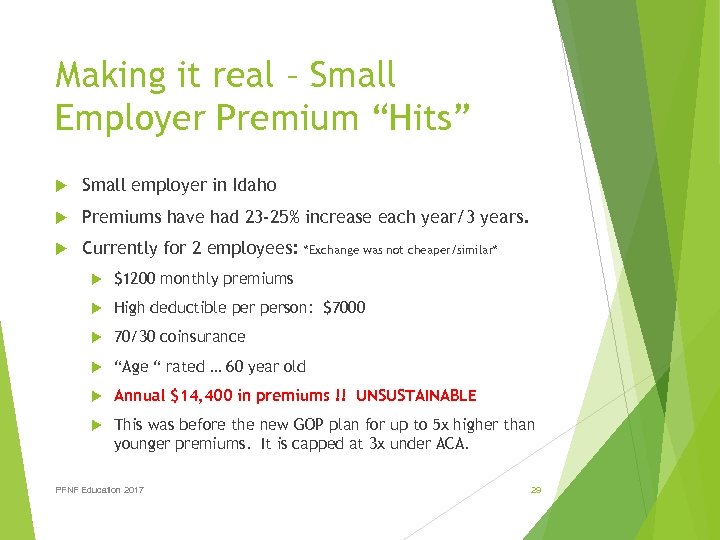 Making it real – Small Employer Premium “Hits” Small employer in Idaho Premiums have had 23 -25% increase each year/3 years. Currently for 2 employees: *Exchange was not cheaper/similar* $1200 monthly premiums High deductible person: $7000 70/30 coinsurance “Age “ rated … 60 year old Annual $14, 400 in premiums !! UNSUSTAINABLE This was before the new GOP plan for up to 5 x higher than younger premiums. It is capped at 3 x under ACA. PFNF Education 2017 29
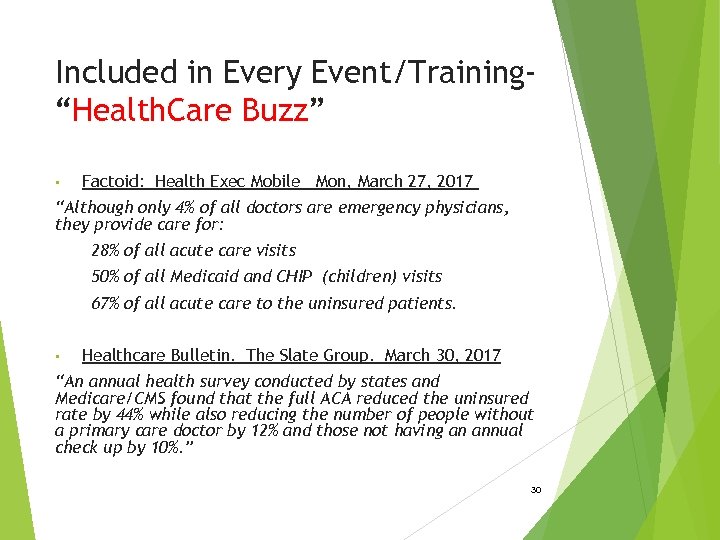 Included in Every Event/Training“Health. Care Buzz” • Factoid: Health Exec Mobile Mon, March 27, 2017 “Although only 4% of all doctors are emergency physicians, they provide care for: 28% of all acute care visits 50% of all Medicaid and CHIP (children) visits 67% of all acute care to the uninsured patients. • Healthcare Bulletin. The Slate Group. March 30, 2017 “An annual health survey conducted by states and Medicare/CMS found that the full ACA reduced the uninsured rate by 44% while also reducing the number of people without a primary care doctor by 12% and those not having an annual check up by 10%. ” 30
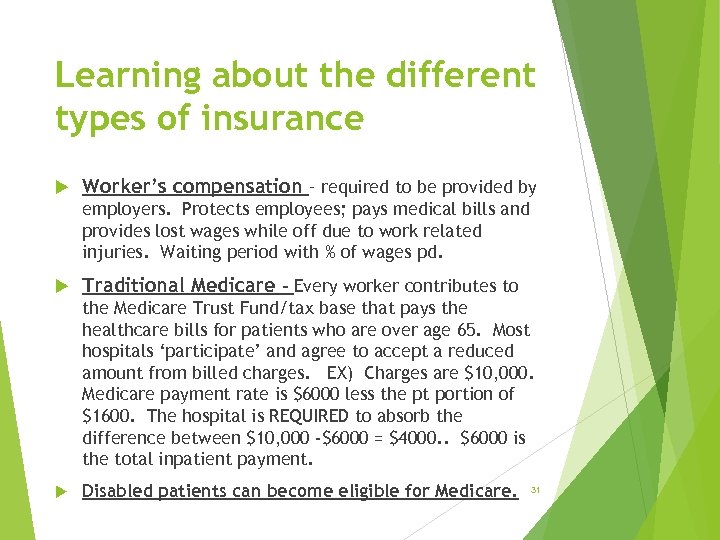 Learning about the different types of insurance Worker’s compensation – required to be provided by employers. Protects employees; pays medical bills and provides lost wages while off due to work related injuries. Waiting period with % of wages pd. Traditional Medicare – Every worker contributes to the Medicare Trust Fund/tax base that pays the healthcare bills for patients who are over age 65. Most hospitals ‘participate’ and agree to accept a reduced amount from billed charges. EX) Charges are $10, 000. Medicare payment rate is $6000 less the pt portion of $1600. The hospital is REQUIRED to absorb the difference between $10, 000 -$6000 = $4000. . $6000 is the total inpatient payment. Disabled patients can become eligible for Medicare. 31
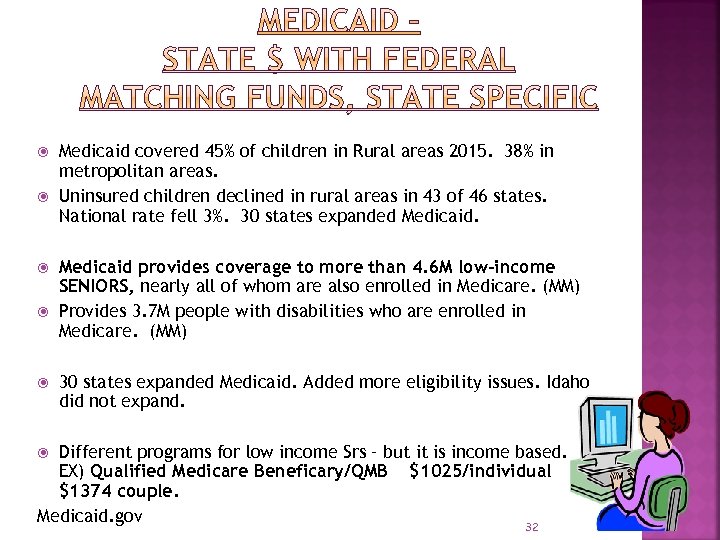 Medicaid covered 45% of children in Rural areas 2015. 38% in metropolitan areas. Uninsured children declined in rural areas in 43 of 46 states. National rate fell 3%. 30 states expanded Medicaid provides coverage to more than 4. 6 M low-income SENIORS, nearly all of whom are also enrolled in Medicare. (MM) Provides 3. 7 M people with disabilities who are enrolled in Medicare. (MM) 30 states expanded Medicaid. Added more eligibility issues. Idaho did not expand. Different programs for low income Srs – but it is income based. EX) Qualified Medicare Beneficary/QMB $1025/individual $1374 couple. Medicaid. gov 32
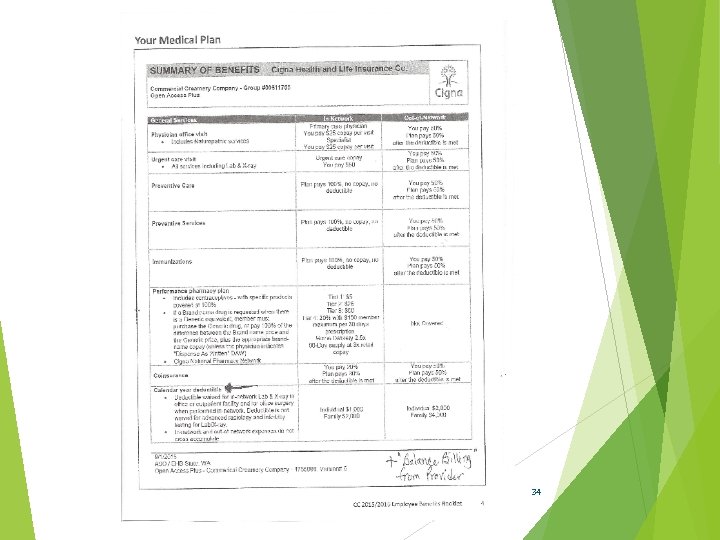
 Understanding today’s insurance world Benefit packages include in network and out of network payments. In network = Employer or individual insurance plan has contracted with healthcare providers. If you stay in network, there will be a reduction off billed charges. Patient still owes yearly deductible and each visit/hospitalization/outpt service has a co-insurance too. Out of network – a penalty as there is no contract so full billed charges are normally due. ALWAYS ask before going to see any healthcare provider. PLUS DISTRUPTIONS IN HEALTHCARE—Lots of new delivery choices… Web-based, individual businesses do 33 their own, etc.
 34
34
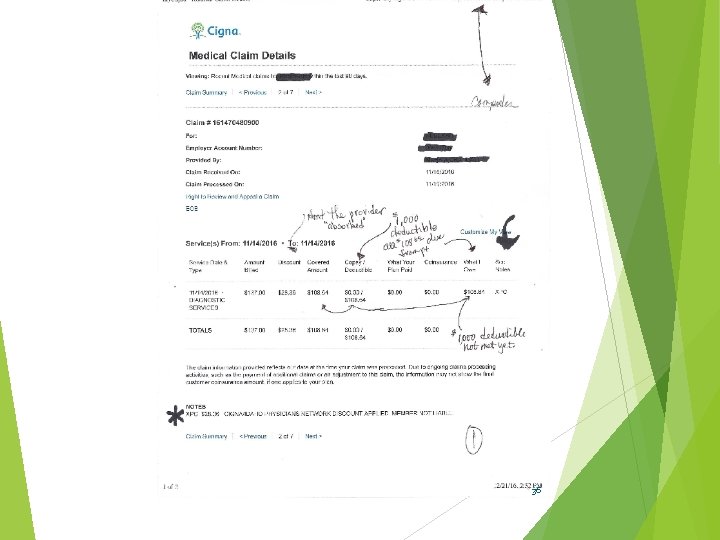
 PFNF Education 2017 COPY OF EXPLANATIN OF BENEFITS from the insurance 35
 36
36
 Looking forward to potential changes in healthcare. OPTIONS 22 members of the Organization for Economic Cooperation (OECD) including the US. The other 21 countries have some type of universal healthcare. US is the only industrialized country with the current insurance /employer system. The 21 countries fall into 3 categories. PFNF Education 2017 Insurance Mandate: Govt mandates that all purchase insurance. 5 countries= Austria, Germany, Switzerland Single Payers: Canada, Japan, Italy, United Kingdom. Two-Tiered: France, Israel, Netherlands. Reference: T. R Reid’s 2009 book – “The Healing of America: A Global Quest for Better, Cheaper, & Fairer Health Care. ” 37
 More Options “Medicare for All” – Bernie Sanders “Medicare –X Choice Act”-all buy into public option Repeal and Replace ACA- Congress and President Trump Multiple options to change pieces of ACA Expanded Medicaid discontinued; move to state only block grants with state’s administering all aspects of the program Discontinue coverage of birth control- DONE thru Executive Order “Skinny Coverage’ –’wellness only’; no essential benefits required Govt should not be part of healthcare. Repeal individual mandate- PENDING with Tax Reform Insurance companies question being a part of the Marketplace/Exchange due to uncertainty with ongoing govt support. At present, ACA remains the commercial insurance ‘rules’ PFNF Education 2017 38
 It is all doable. . • Have the vision and the passion to make a difference in the hassle factor in healthcare • Remember – all the automation does not replace the human touch. • Remember – our families are the core of healthcare. • It is very personal! Thanks, Day Egusquiza Founder/President. An Idaho-based Family Foundation. Webpage: Http: //PFNFInc. com Like us on Facebook. com/PFNFInc 39