


 Скачать презентацию Welcome to the Lee Memorial Health System Community
c218da73c324817567eaf68175711121.ppt
- Количество слайдов: 124
 Welcome to the Lee Memorial Health System Community Health Visioning 2017 Steering Committee Status Meeting October 9, 2008 1
 Purpose Convene Steering Committee of Community Health Visioning 2017 to review evolving market forces and progress toward achieving recommendations 2
 Desired Outcomes • Build understanding of key changes in market trends over the past year and review implications for Community Visioning 2017 recommendations • Build understanding of progress achieved in the eight prioritized recommendations • Celebrate national recognition of community engagement process • Consider feasibility of developing a community health scorecard • Discuss how to take the community engagement effort to the next level 3
 What a Difference a Year Makes October 2008 4
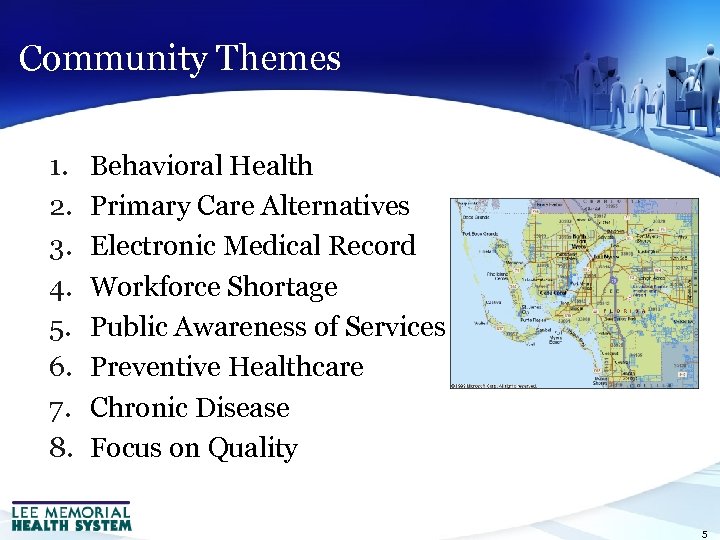 Community Themes 1. 2. 3. 4. 5. 6. 7. 8. Behavioral Health Primary Care Alternatives Electronic Medical Record Workforce Shortage Public Awareness of Services Preventive Healthcare Chronic Disease Focus on Quality 5
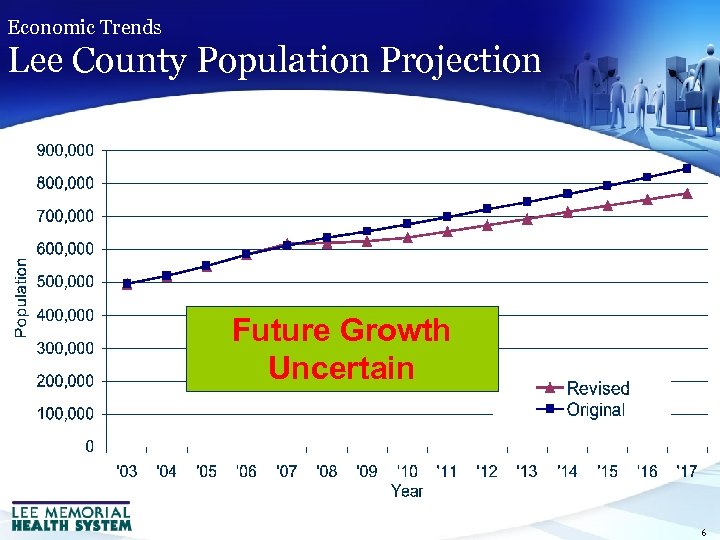 Economic Trends Lee County Population Projection Future Growth Uncertain 6
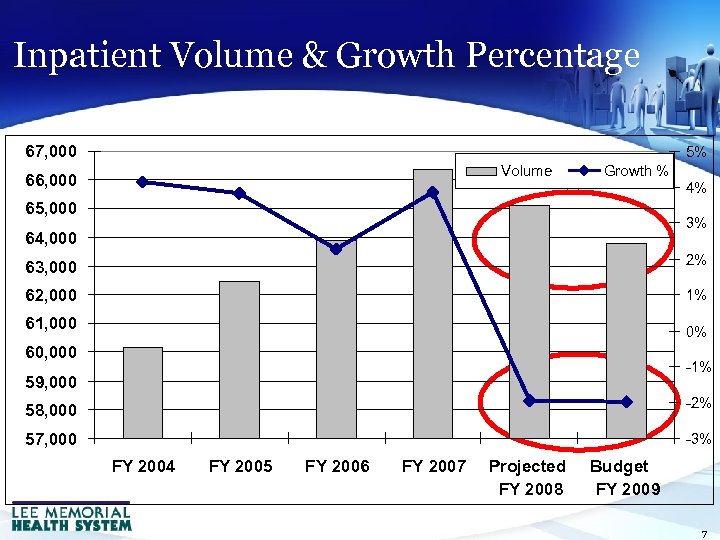 Inpatient Volume & Growth Percentage 67, 000 5% Volume 66, 000 Growth % 4% 65, 000 3% 64, 000 63, 000 2% 62, 000 1% 61, 000 0% 60, 000 -1% 59, 000 58, 000 -2% 57, 000 -3% FY 2004 FY 2005 FY 2006 FY 2007 Projected FY 2008 Budget FY 2009 7
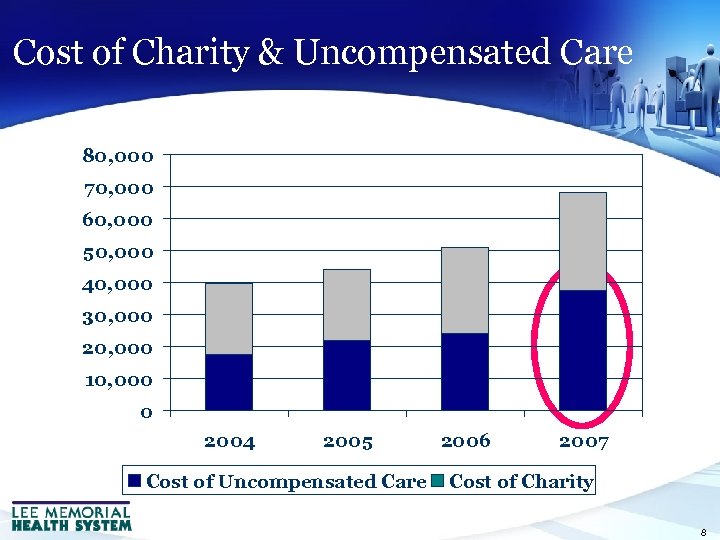 Cost of Charity & Uncompensated Care 80, 000 70, 000 60, 000 50, 000 40, 000 30, 000 20, 000 10, 000 0 2004 2005 Cost of Uncompensated Care 2006 2007 Cost of Charity 8
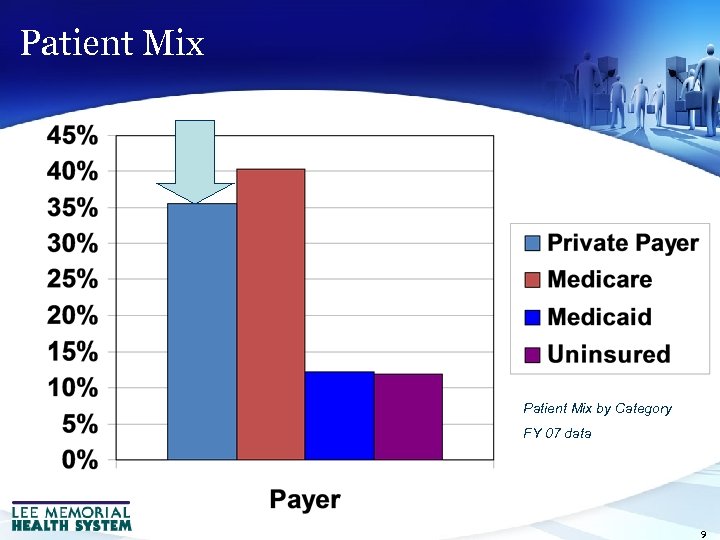 Patient Mix by Category FY 07 data 9
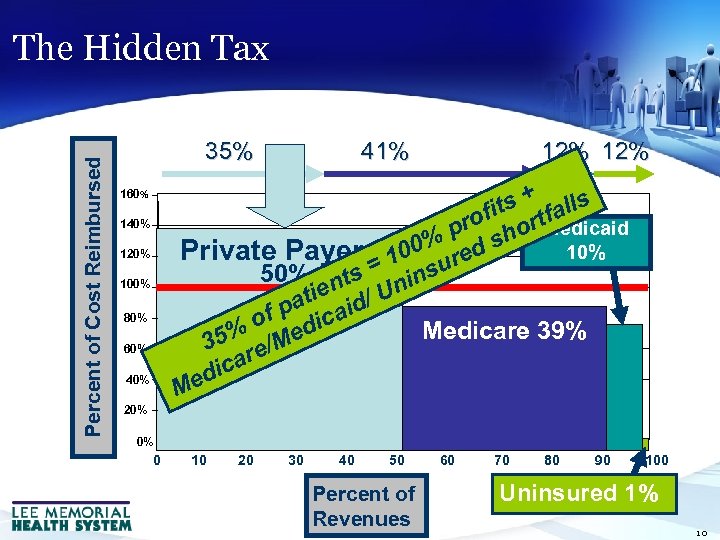 Percent of Cost Reimbursed The Hidden Tax 41% 35% 12% 41% ts + falls i rof ort. Medicaid % p d sh 10% Private Payer 100 ure 50% nts = nins atie id/ U f p ica Medicare 39% % o Med 35 re/ a dic Me 160% 140% 120% 100% 80% 60% 40% 20% 0% 0 10 20 30 40 50 Percent of Revenues 60 70 80 90 100 Uninsured 1% 10
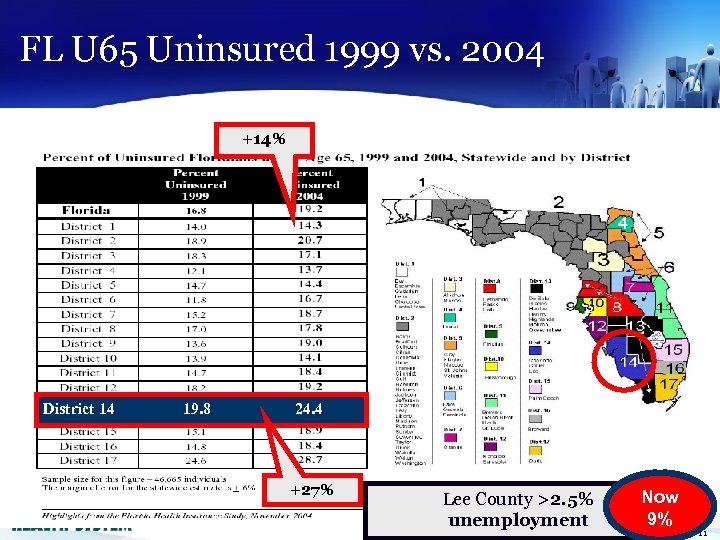 FL U 65 Uninsured 1999 vs. 2004 +14% District 14 19. 8 24. 4 +27% Lee County >2. 5% unemployment Now 9% 11
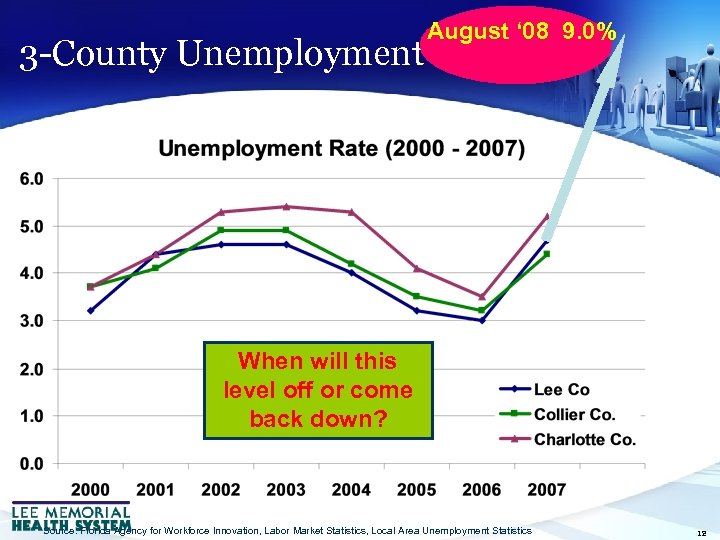 August ‘ 08 9. 0% 3 -County Unemployment Trend When will this level off or come back down? Source: Florida Agency for Workforce Innovation, Labor Market Statistics, Local Area Unemployment Statistics 12
 Lee County Uninsured • Uninsured increased 8% • Insured but unable to pay out-of-pocket expenses increased 23% • Uninsured emergency department patients increased by 4% (25% of all ED visits) 13
 Operating Margin Realistic? ? ? 14
 LMHS Turnover & Vacancy Rates 15
 Physician Shortage • 2004 Physician Need Study – Indicated need of 225 – Primary Care need - 63 – Medical need - 102 – Surgical need - 60 • New Study Complete – August 2008 – In collaboration with Lee County Medical Society – Results due next month – Initial feedback indicates an increase in need 16
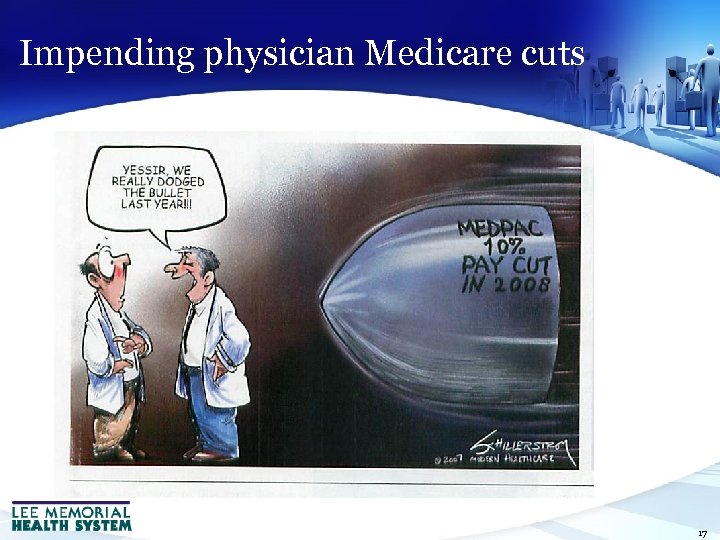 Impending physician Medicare cuts 17
 Declining Physician Reimbursement I can’t make a living “seeing” patients anymore. 18
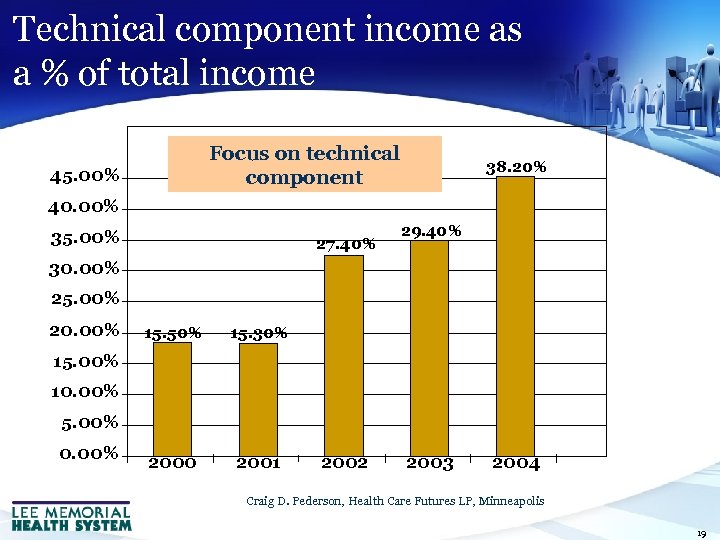 Technical component income as a % of total income Focus on technical component 45. 00% 38. 20% 40. 00% 35. 00% 27. 40% 29. 40% 30. 00% 25. 00% 20. 00% 15. 50% 15. 30% 2000 2001 15. 00% 10. 00% 5. 00% 0. 00% 2002 2003 2004 Craig D. Pederson, Health Care Futures LP, Minneapolis 19
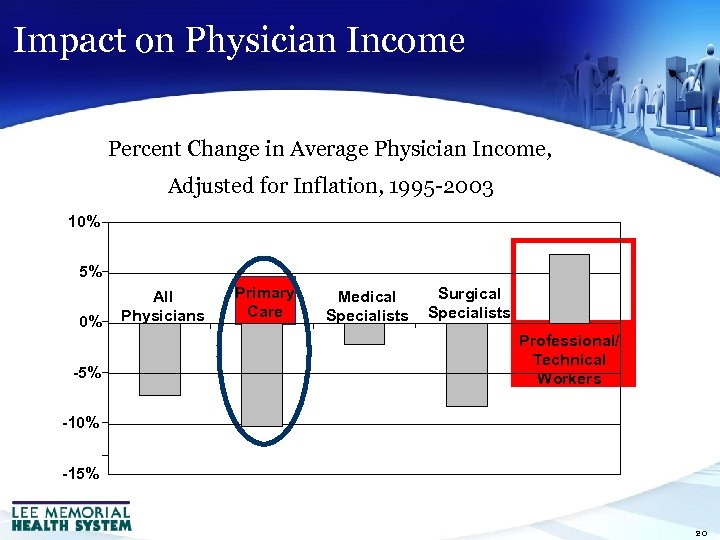 Impact on Physician Income Percent Change in Average Physician Income, Adjusted for Inflation, 1995 -2003 10% 5% 0% -5% All Physicians Primary Care Medical Specialists Surgical Specialists Professional/ Technical Workers -10% -15% 20
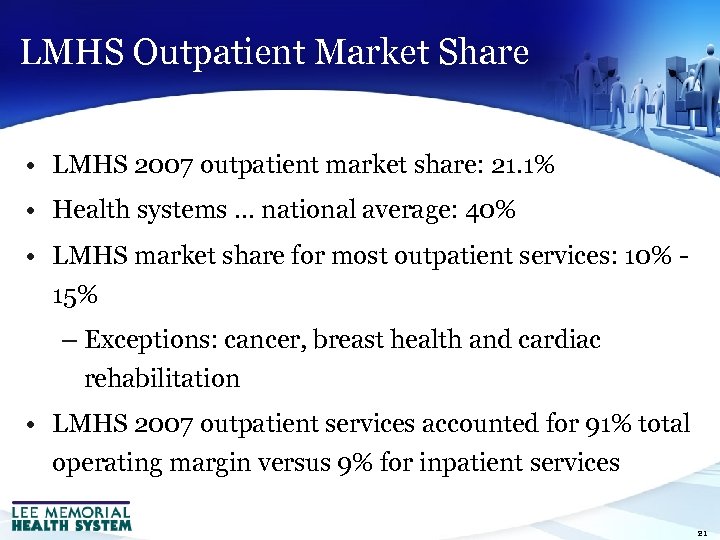 LMHS Outpatient Market Share • LMHS 2007 outpatient market share: 21. 1% • Health systems … national average: 40% • LMHS market share for most outpatient services: 10% - 15% – Exceptions: cancer, breast health and cardiac rehabilitation • LMHS 2007 outpatient services accounted for 91% total operating margin versus 9% for inpatient services 21
 22
22
 23
23
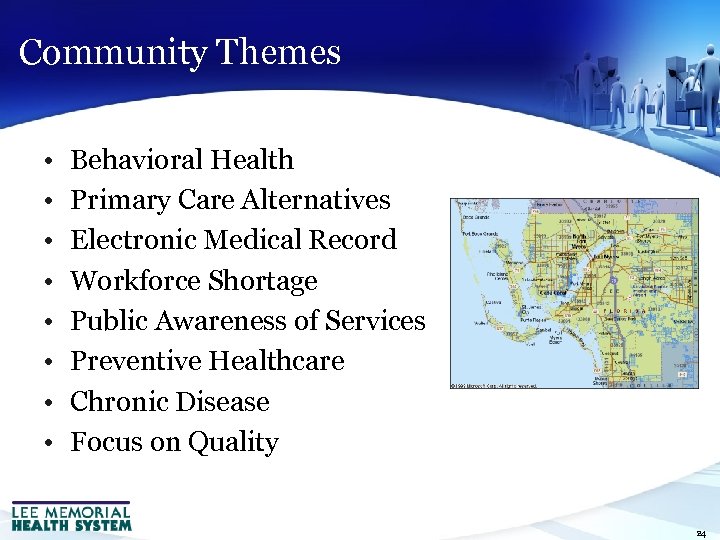 Community Themes • • Behavioral Health Primary Care Alternatives Electronic Medical Record Workforce Shortage Public Awareness of Services Preventive Healthcare Chronic Disease Focus on Quality 24
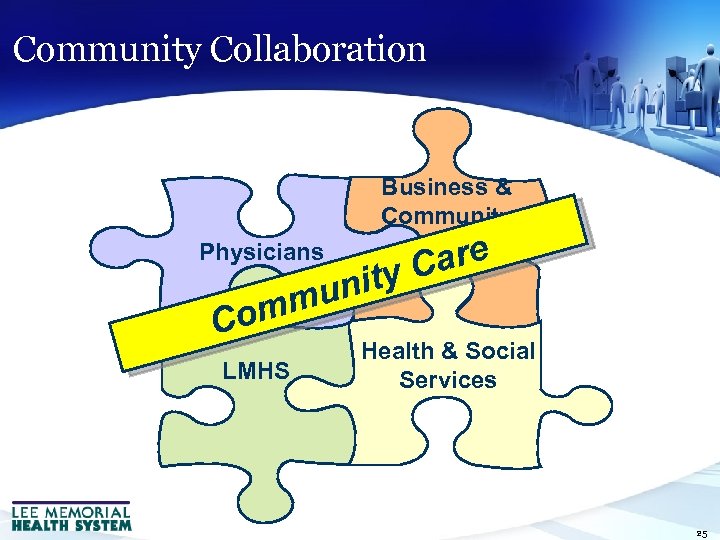 Community Collaboration Business & Community are ty C uni Physicians omm C LMHS Health & Social Services 25
 Community Health Visioning 2017 Presentations Brad Pollins, System Director, Organizational Effectiveness 26
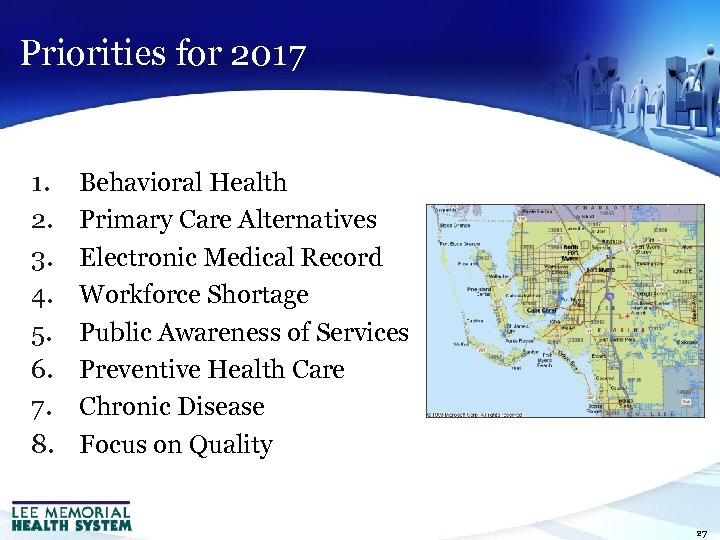 Priorities for 2017 1. 2. 3. 4. 5. 6. 7. 8. Behavioral Health Primary Care Alternatives Electronic Medical Record Workforce Shortage Public Awareness of Services Preventive Health Care Chronic Disease Focus on Quality 27
 Presentation Format • 12 minute presentation – Original Recommendation – Key Accomplishments – Barriers/Challenges – Critical Success Factors – Next Steps • 4 minute Question & Answer 28
 Community Health Visioning 2017 Behavioral Health Update Brian Lucas, Vice Chairman, Bonita Bay Group Greg Gardner, Vice President, Allocations & Planning, United Way 29
 Behavioral Health Convene a community collaborative to develop a comprehensive continuum of care for Behavioral Health, based on a current needs assessment for Lee County. The collaborative should identify a champion and incorporate successful models for both leadership structure and service. (Key elements may include inpatient beds, access to assessment, availability of medications, case management, supportive/affordable housing, staffing, criminal justice partners/resources, preventative care, and unique needs of adults , adolescents and children. ) 30
 Status Report: Key Accomplishments • • Assembled a community Mental Health and Addiction Coalition which chaired by Bob Janes, Jim Nathan, and Brian Lucas Developed a strategic plan for the coalition – Purpose: Improve the lives of individuals with mental health and addictions needs – Mission: Define workable solutions to end the mental health crisis in our community 31
 Status Report: Key Accomplishments Goals: 1. Implement a mental health and addictions delivery model to meet the existing and future needs of the consumers (Carol Conway) 2. Obtain and responsibly allocate funding adequate to meet the needs (Richard Riley) 3. Develop a community leadership group to implement the strategic plan (Bob Janes, Brian Lucas, Jim Nathan) 4. Create awareness of mental disorders as a serious health issue (Lance Mc. Kinney) 32
 Status Report: Key Accomplishments • Created a task force for each goal with community ownership • Implemented Triage Center • Converted 15 beds at Lee Memorial Hospital to a Geriatric Psychiatric program • Launching the development of The Pavilion at Health. Park • Expanded Services 33
 Status Report: Barriers/Challenges 1. Fragmented delivery of services and silos 2. Restructure of DCF leaving no local presence 3. Allocation and reallocation of funds to support the coalition goals 4. Lack of doctors 5. Merging of medical and recovery model of psychiatric care 6. Community understanding and treating mental illness as a legitimate medical condition 7. Ongoing community volunteer leadership to drive strategy implementation 8. Expanding Triage Center to a full 24/7 operation 9. CON approval of The Pavilion at Health. Park 34
 Status Report: Critical Success Factors 1. 2. 3. 4. 5. 6. 7. 8. Community awareness Leadership structure Boundarylessness of all providers Funding Merging of the models Appropriate number and type of psychiatric physicians Bed availability The structure of a Policy Board and a Management Council for the Triage Center 9. The Pavilion brings clinical competency, management experience, and new funding sources to Lee County for psychiatric care. 10. Waiting on Medicaid Provider number for reimbursement for Jennings Behavioral Health 35
 Status Report: Next Steps 1. Review and define the best practices for mental health delivery which will be driven by evidence-based psychiatric practices incorporating medical and recovery models 2. Develop and implement a comprehensive communication/marketing plan to build the desired level of awareness in our community 3. Complete and implement other details of the strategic plan 4. Expand leadership structure 36
 Status Report: Next Steps 5. Triage Center - Continue operational improvements, data collection and evaluation. Seek long term funding solutions. 6. LMHS Geriatric Psychiatric beds/The Pavilion - Complete construction and open in 2009. 7. Jennings Behavioral Health - Continued expansion from current 35 patients, 2 psychiatrists, and 4 therapist in O/P treatments. 37
 Questions & Answers 1. What are your top of mind reactions to what you have heard? 2. Are there other accomplishments for this area you would like to share? 38
 Community Health Visioning 2017 Primary Care Alternatives Lalai S. Hamric President/CEO Family Health Centers of Southwest Florida, Inc. 39
 Primary Care Alternatives Convene stakeholders to develop a comprehensive, community-based system of primary care alternatives to the Emergency Room, targeting areas of greatest need. (Key elements may include neighborhood centers/clinics, mobile units, 24/7 access, service for under/uninsured, and possible roles for retired physicians and major employers. ) Develop a method for educating non-emergent patients to use the appropriate care settings. 40
 Status Report: Key Accomplishments • Establishment of the Dunbar United Way House… • Opening of the East Fort Myers United Way House… • Renewal of Lee We Care as the Volunteer Health Care Connections specialty referral program serving patients living below poverty level… • Establishment of a pediatric Healthy Living and Weight Management Clinic utilizing fixed sites and a regional Ronald Mc. Donald mobile van… • Regional expansion of the Centering. Pregnancy pre-natal care program… • Launch of Area Health Education Centers smoking cessation program… • Institution of new emergency room patient follow-up referral process… • Doubling of breast and cervical cancer screenings for uninsured lowincome women under the Healthy Body-Healthy Soul Program… • Offering of pre-school dental exams and annual school physicals… • Launch of three First Choice Pediatrics offices in Lee County. 41
 Status Report: Barriers/Challenges • Current provider shortages, particularly for adult medicine, as a function of a physician “unfriendly” professional environment… • Rapid growth of the number of uninsured people in Lee County @ 30%+ • Rising level of uncompensated care given by primary care providers in Lee County (e. g. -LMHS = $68 million/FHC = $14. 2 million)… • Uncertainty of revenue sources to pay for uninsured patient care (e. g. - Low Income Pool, DSH, Medicare reimbursement, etc. )… • Lack of adult medicine specialists to provide care for working uninsured patients earning income just above the poverty level… • Lack of a regional electronic health records “network” to promote medical homes and access to preventive medical care for all patients… • Limited hours of primary care providers coupled with patient work schedule and transportation challenges. 42
 Status Report: Critical Success Factors • Establishing a local primary care “network” that maximizes the coordination and use of existing and future provider resources… • Development of a regional health information system that improves patient care and health outcomes through improved sharing of clinical data among local care givers… • Creation of the medical home concept that encourages all patients living in Lee County to have a local provider of primary, preventive and chronic disease care… • Building a community consensus on how best to fund uninsured patient care via existing and proposed public and private revenue streams… • Expansion of the specialist care network for uninsured patients… • Recruitment and retention of primary care physicians and critical area specialty providers (e. g. - orthopedics, cardiology, oncology/chemotherapy, dermatology, gastroenterology, rheumatology, endocrinology, etc. ). 43
 Status Report: Next Steps Convene a local stakeholder task force to create a model community-based primary care system by pursuing… • Achieve connectivity of existing electronic medical records systems utilized by local primary care providers… • Creation of a medical home initiative to include examination of appropriate emergency room use by all patients… • Study of how to finance care for the uninsured/working uninsured… • Examination of local provider service networks that use a capitated fee approach to providing managed care that allows residual funds to be used for uninsured patient care… • Expansion of existing neighborhood-based “clinics” to emphasize preventive medicine and chronic disease management programs… • Development of a regional physician recruitment/retention strategy. 44
 Questions & Answers 1. What are your top of mind reactions to what you have heard? 2. Are there other accomplishments for this area you would like to share? 45
 Community Health Visioning 2017 Electronic Medical Record Mike Smith Chief Information Officer, Lee Memorial Health System 46
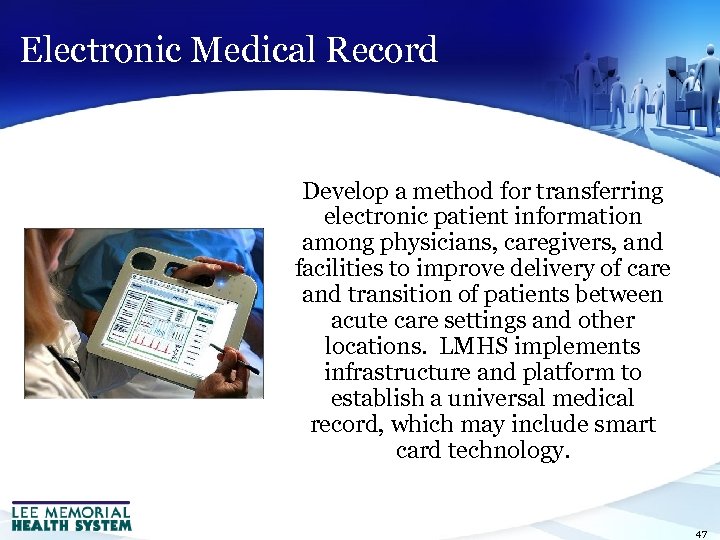 Electronic Medical Record Develop a method for transferring electronic patient information among physicians, caregivers, and facilities to improve delivery of care and transition of patients between acute care settings and other locations. LMHS implements infrastructure and platform to establish a universal medical record, which may include smart card technology. 47
 Status Report: The Broader Context • The Broader Context - – National focus on the issue of electronic medical records, interoperability across care settings – A critical success factor to improving patient safety, healthcare cost efficiency – Until recently, this couldn’t be accomplished – Much work being done nationally on this topic – Very complex – Integrated patient medical record more relevant, needed more than ever before 48
 Status Report: Challenges Nationally • No sustainable financial model for Regional Health Information Exchanges (RHIOs) • No appetite for a national patient identifier number • Concerns about competition/data sharing • Security/confidentiality concerns • Patient information custodial concerns • Inadequate focus on clinical intuitiveness/usability 49
 Status Report: Successes Locally • Community Communication Infrastructure Success with Embarq • County patient identifier numbering system – managed by LMHS - exists, 1 million + citizens, very high integrity • Managed, secure, reliable IT environment in place • Successful track record with physicians – Net Access, Heartlab, etc. • Community Healthcare IT Draft Strategy defined, Integrated Software Platform Selected - 1 st phase of the install underway – Epic for Lee Physician Group • Significant interest from some non-employed physicians to take advantage of the LMHS Next Generation integrated Electronic Medial Record in their practice • Additional strategy of building interfaces for non-integrated physician electronic records in our community • We have largely overcome the National RHIO challenges in our community 50
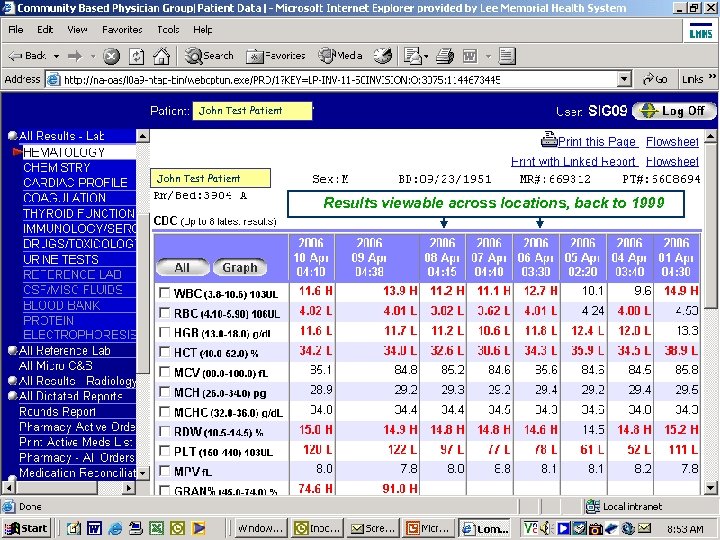 John Test Patient Results viewable across locations, back to 1999 51
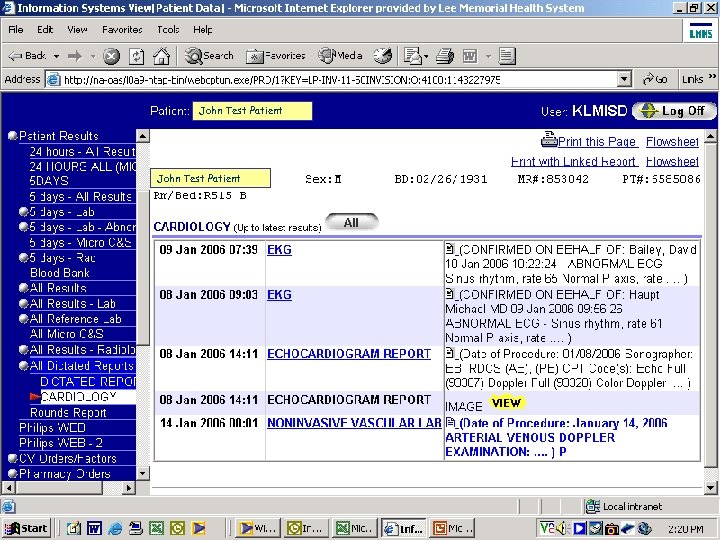 John Test Patient 52
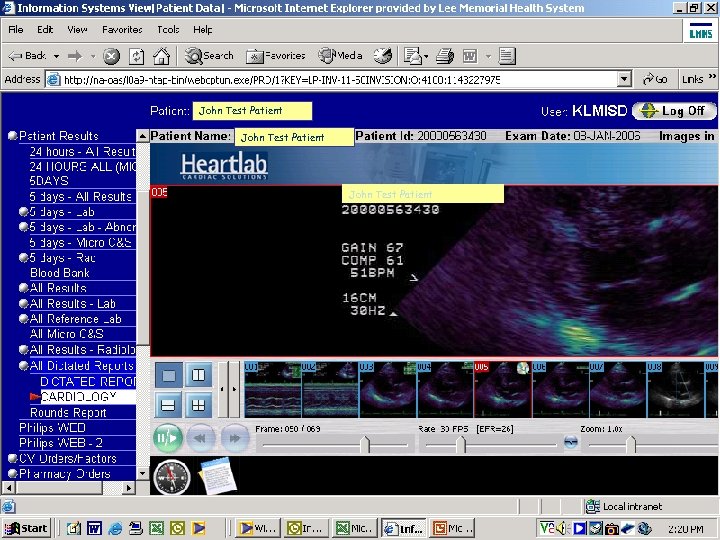 John Test Patient 53
 Status Report: Draft Community Healthcare EMR Strategy – Part 1 TRACK 1 Interconnectivity with LMHS hospitals Next Generation Electronic Medical Record (Epic) Implementation – PHASE I a) Standardize new system design for Clinical Documentation, Scheduling/Registration, Revenue Cycle, Pharmacy, EMAR, OR, etc. for all hospitals b) Gulf Coast Medical Center first c) Cape Coral d) LMH/HP – PHASE II - Implement advanced functionality – sequencing TBD - CPOE, Physician Documentation, Clinical alerts, etc. 54
 Status Report: Draft Community Healthcare EMR Strategy – Part 2 TRACK 2 Interconnectivity with care givers in the community – Interconnectivity with physicians offices who have a non -Epic Electronic Medical Record • Custom interfaces from LMHS electronic medical record to physician offices now • Use of newly formed Continuum of Care Record (CCR) for information interchange in the future – Epic to additional Outpatient Settings • Complete employed primary care Lee Physician Group rollout (approved/underway) • Lee Memorial Employed Specialists rollout • Community physicians – separate business structure • Make available to schools, county health department, EMS 55
 Status Report: Draft Community Healthcare EMR Strategy – Part 3 Track 3 • Implement Next Generation EMR for Direct to Patient Access – Deployment of Personal Health Record integrated with LMHS EMR (My. Chart) – scheduling, access to clinical information – Automated in-home clinical alerting • Implement Next Generation EMR for Home Health, Long Term Care 56
 Status Report: Barriers/Challenges • Funding, financial challenges • Working through the opportunities/issues with care providers in our community • Technical challenges with disparate electronic record systems 57
 Status Report: Next Steps • • Confirm Strategy Develop implementation plans Obtain funding Carry out manageable interim steps in the meantime – as resources and funding permits 58
 Questions & Answers 1. What are your top of mind reactions to what you have heard? 2. Are there other accomplishments for this area you would like to share? 59
 Community Health Visioning 2017 Workforce Shortage Dr. Denise Heinemann, Dean, College of Health Professions, FGCU 60
 Workforce Shortage Create a community collaborative to address the shortage of physicians, nurses, and other health care professionals. Consider impact of physician practices not accepting Medicare or Medicaid. Develop comprehensive array of community incentives to assist in recruiting health care professionals 61
 Status Report: Key Accomplishments • Health professions programs at all levels continue to receive more applications than the number of seats available. • Salaries continue to remain attractive to licensed professionals. • Edison State College will have the largest capacity for educating RNs. • New options include the Doctor of Physical Therapy Program at FGCU and the Acute Care Nurse Practitioner option. • Private universities continue to enter the SW Florida market with nursing, physician assistant, and health administration programs. • Clinical programs are embracing simulation as an educational strategy to prepare students to think critically before exposure to patients. – Simulation lab experience can maximize student performance in the limited clinical settings we share with all programs. 62
 • Status Report: Barriers/Challenges • Florida will need 7, 074 additional OTs by 2014. • By 2020, the Florida Center for Nursing predicts a shortage of 52, 000 RNs, most severe in SWFL. – We need to increase the 6000 FL RNs graduating this year by 15% a year. • Aging faculty, particularly in nursing, will retire in large numbers in the next decade, compounding the problem of retaining experienced faculty and grooming new faculty. • Southwest Florida’s nursing workforce is a year older that the rest of the State. Average Age by License: – ARNPs: 49. 5 Years – RNs: 48. 9 Years – LPNs: 46. 7 Years Source: Florida Center for Nursing, October 2008 63
 Status Report: Barriers/Challenges • Physician Manpower – Despite the development of new medical schools in Florida, the shortage of primary care physicians and selected specialties will continue. – Unless the number of residency slots in Florida increases significantly, we will continue to prepare physicians for a career elsewhere. • The increasing cost of education in public and private colleges and universities: – Reduces opportunities for increasing the diversity of our students – May raise expectations for salaries commensurate with the graduating student’s loan burden 64
 Status Report: Critical Success Factors • • Reliable Manpower Data Interagency Cooperation Flexible Interdisciplinary Care Models Recognition and Reward for the Challenges Generalist Practitioners Face in Practice • Full Scope of Practice for Nurse Practitioners 65
 Status Report: Next Steps • Reinvigorate Regional Planning and Cooperation among Programs Preparing Health Professionals – Limited State Funding Needs to be Spent Wisely • Optimize the Scope of Practice for all Providers – Florida is one of the last two states in the nation to restrict the prescriptive privileges of NPs • Reinvigorate the Public Health System • Lobby for Federal Programs to Support Practitioners Willing to Invest in Becoming University Faculty 66
 Questions & Answers 1. What are your top of mind reactions to what you have heard? 2. Are there other accomplishments for this area you would like to share? 67
 Community Health Visioning 2017 Public Awareness of Services Anne Rose Executive Director/System Director Business Development and Contracting LEE PHO System Communications Administrator Lee County Trauma Services District 68
 Public Awareness of Services Educate/inform the public about the availability and quality of key health care services/providers in collaboration with Lee County Medical Society, governmental agencies, health and human service agencies, schools, and others. Communicate why certain programs do not exist in Lee County. 69
 Status Report: Key Accomplishments • Lee County Medical Society: Over 237 members of the LMHS medical staff have been featured in Healthy News articles, video news releases and on www. leememorial. org • Government Agencies: 1 st Annual Injury Prevention Fair held in Lee County Sheriff’s Office; Healthy News publications delivered to Lee County EMS stations • Health & Human Services Agencies: Community Resource Fair for the uninsured • Schools: Child Advocacy Programs and Career Development Programs 70
 Status Report: Key Accomplishments • Others: – – – Local television stations for video news releases and earned media Local newspapers for Healthy News and earned media START materials Technology Expo News & Notes e-newsletter Revised home page content John Kanzius national media coverage Corporate wellness and health fairs with local businesses Parish Nurse Program Community Leadership Programs Health News Network (HNN) Speakers Bureau 71
 72
72
 Status Report: Barriers/Challenges • Funding for public awareness • Creating relevant and interesting health messages 73
 Status Report: Critical Success Factors • Strengthen community partnerships and physician partnerships • Strengthen partnerships with media outlets • Strengthen use of web technology – Surgical procedure animation – Podcasting of health stories – Video streaming of health news and breakthroughs 74
 Status Report: Next Steps • Continue refinement of communications and collaboration with community agencies 75
 Questions & Answers 1. What are your top of mind reactions to what you have heard? 2. Are there other accomplishments for this area you would like to share? 76
 Community Health Visioning 2017 Preventive Health Care Cliff Smith, President, United Way Sarah Owen, Executive Director, Community Cooperative Ministries Dr. John Iacuone, Executive Director Children’s Hospital 77
 Preventive Health Care Develop a community-wide program for preventive health care, considering childhood obesity, diabetes or prenatal care and distribute through schools and other community/neighborhood partners. (Key elements may include personal/parental responsibility, infrastructure for delivery of service, grassroots/door-to-door campaign using old Polio model or neighborhood champions. ) 78
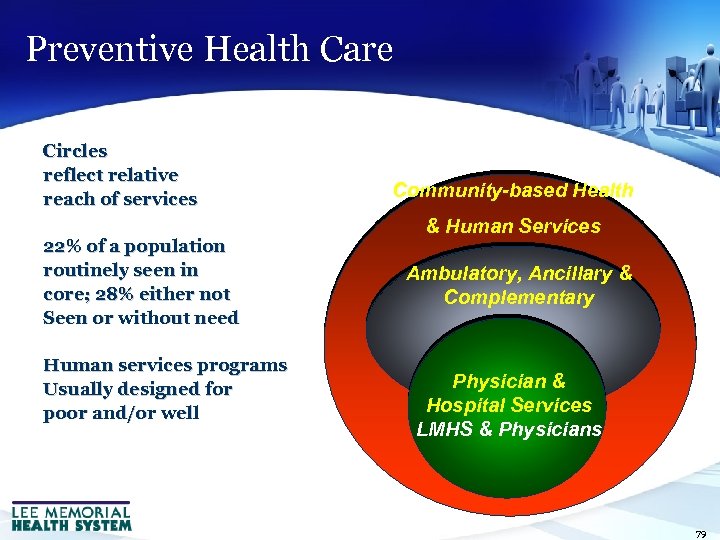 Preventive Health Care Circles reflect relative reach of services 22% of a population routinely seen in core; 28% either not Seen or without need Human services programs Usually designed for poor and/or well Community-based Health & Human Services Ambulatory, Ancillary & Complementary Physician & Hospital Services LMHS & Physicians 79
 Status Report: Accomplishments DUNBAR HOUSE • Lee Memorial Health System • Community Cooperative Ministries • United Way • Family Health Centers • National Alliance on Mental Illness • Hope Hospice • Lee County Human Services • Case Management/Follow-up/Systems 80
 Status Report: Barriers/Challenges • 30% of residents in N. Fort Myers & Fort Myers (Market Area 2) report experiencing “fair” or “poor” overall health. • Blacks, Hispanics and those at, or immediately above the federal poverty level, experience more than double the rate of “fair” or “poor” overall health vs. Lee County or U. S. overall • NOT trying to be all things to all people • NOT trying to always create a new program to meet the needs • Finding who has the expertise and learning to work together • Making partnerships more than a Memo of Understanding 81
 Status Report: Critical Success Factors • Lead with Food and clients follow to other needed services • United Way 211 referrals and tracking • LMHS "in-kind" rent as landlord • Lead agency concept • Large numbers of people are now being seen who were not seen before 82
 Status Report: Next Steps • Repeating the model at LMHS Medical Plaza IV on Palm Beach Blvd. • Seeking a N. Fort Myers location • Continued expansion in other profiled communities 83
 Status Report: Key Accomplishments • The Children’s Hospital Child Advocacy Program participated in over 18 community injury prevention programs in 2007. • The Children’s Hospital Child advocates checked 1, 010 car seats to ensure correct installation and participated in 10 community car seat fitting stations. • Child advocates distributed and fitted 800 free bicycle helmets throughout Lee County. • The Children’s Hospital Child Advocacy Program in partnership with community partners provided free parenting classes to help prevent child abuse to over 1215 parents in 2007. • Child advocates provided free disease prevention programs to over 5, 000 private and public kindergarten and first grade students in 2007. • The Children’s Hospital Child Advocates began offering the Safe Sitter Program to 11 – 13 year old children who are interested in becoming certified as babysitters. 84
 Questions & Answers 1. What are your top of mind reactions to what you have heard? 2. Are there other accomplishments for this area you would like to share? 85
 Community Health Visioning 2017 Chronic Disease Rebecca Linville, Chicos Community Outreach Coordinator Dr. John Iacuone, Executive Director Children’s Hospital 86
 Chronic Disease With community partners, develop community/neighborhood clinics for chronic disease prevention, education, management, such as sickle cell, diabetes, obesity, hypertension and asthma. Target populations with greatest need (e. g. , African Americans for diabetes). 87
 88
88
 Status Report: Key Accomplishments • START! Campaign - American Heart Association – – LMHS 3 -year Sponsorship Commitment Community Steering Committee of 20 organizations Co-chairs LMHS and Chico’s FAS, Inc. Purpose: Inspire Healthier Lifestyles in our Community through Start! – Mission: Achieve heart related risk factors better than state average. – Goals (3 year plan): • Increase Company Participation in Start! • Achieve Healthy People 2010 objective for leisure time physical activity • Increase START! brand awareness 89
 Status Report: Barriers/Challenges • Heart Disease is #1 leading cause of death in Lee County • Lee County adults: – 64% overweight or obese – 36% have high blood pressure – 38% have high blood cholesterol • Only 41% of Lee County adults meet physical activity recommendations (intensity/frequency/duration) • We have a long way to go – We have a good START! 90
 Status Report: Critical Success Factors • Identify & engage diverse target audiences – Create hub and spoke leadership structure to reach broad community (schools, corporations, small business, medical community, neighborhoods, government agencies, non-profit organizations, faith community) • Identify & share community resources for physical activity – Monitor use of AHA Start! website • Develop and implement comprehensive education and marketing plans 91
 Status Report: Next Steps • Corporate Challenge – October 2008 – Winner announced at Start Heart Walk Dec. 13 th • • Quarterly Steering Committee Meetings Recruit Leaders and Participants Implement the 3 -year plan INSPIRE CHANGE 92
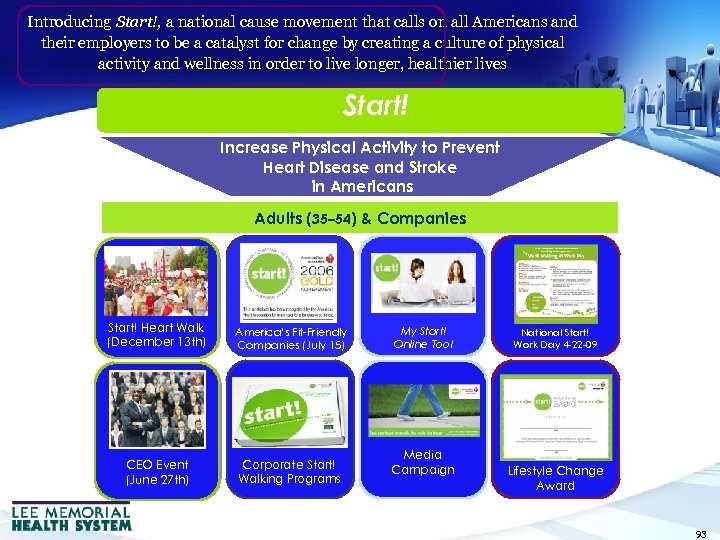 Introducing Start!, a national cause movement that calls on all Americans and their employers to be a catalyst for change by creating a culture of physical activity and wellness in order to live longer, healthier lives Start! Increase Physical Activity to Prevent Heart Disease and Stroke in Americans Adults (35– 54) & Companies Start! Heart Walk (December 13 th) America’s Fit-Friendly Companies (July 15) CEO Event (June 27 th) Corporate Start! Walking Programs Program My Start! Online Tool Media Campaign National Start! Work Day 4 -22 -09 Lifestyle Change Award 93
 Status Report: Key Accomplishments • As a State designated Regional Sickle Cell Referral Center, we have been able to reduce number of hospital admissions and length of stay. • The Children’s Hospital has initiated development of a community based Sickle Cell Clinic model for children. • The Children’s Hospital Child Advocacy Program has taught Mission Nutrition to over 2, 900 fourth and fifth grade students each year since 2007 in effort to impact childhood obesity. 94
 Status Report: Barriers/Challenges • The unforeseen economic downturn effecting both the state and local financial resources has presented challenges to the successful implementation of some community based initiatives. (e. g. Sickle Cell) • Similarly, drastic reduction in state funding to many of our community based safety net programs has driven a realignment and prioritization of services. (e. g. Safe Kids Florida) 95
 Status Report: Critical Success Factors • The Children’s Hospital Advocacy Program success can be directly attributed to seeking community partners to collaborate with and to avoid duplication of programs. • The Children’s Hospital Advocacy Program and its community partners provides non-revenue generating services to the children of SW Florida. Our ability to continue these needed programs will rely on increasing collaboration between community agencies and the Children’s Hospital/Lee Memorial Health System, to maintain existing funding and identify new grant and philanthropic opportunities. 96
 Status Report: Next Steps • Identify, prioritize and develop community forums in partnership with healthcare providers to initiate chronic disease management initiatives. • Develop a mechanism to more easily network our multiple isolated agency’s mandates into a coordinated system approach to manage chronic disease in our community. 97
 Questions & Answers 1. What are your top of mind reactions to what you have heard? 2. Are there other accomplishments for this area you would like to share? 98
 Community Health Visioning 2017 Focus on Quality Dr. Mark Greenberg, Medical Director, Lee Memorial Hospital 99
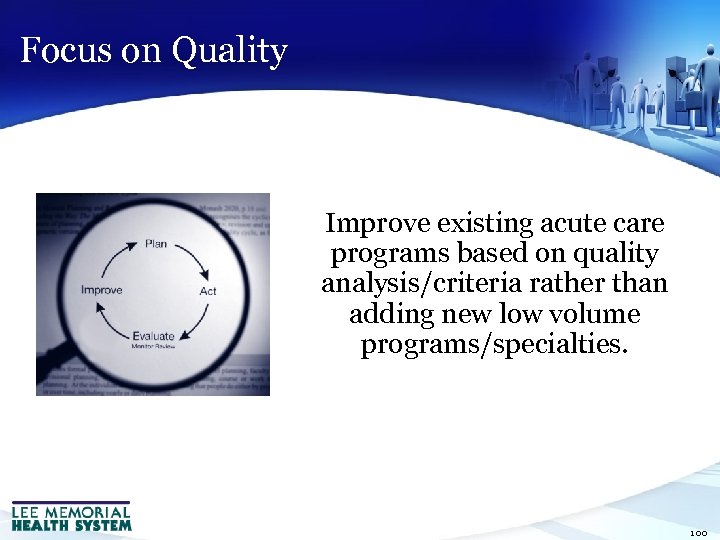 Focus on Quality Improve existing acute care programs based on quality analysis/criteria rather than adding new low volume programs/specialties. 100
 Status Report: Key Accomplishments • Implemented programs to reduce hospitalacquired infections – Increased education and awareness to enhance compliance with hand hygiene – Implemented methods to rapidly identify and reduce the spread of communityacquired multiple drug-resistant organisms – Implement preventive strategies (“bundles”) to reduce central line, ventilator-associated and urinary catheter-associated infections. 101
 Status Report: Key Accomplishments • Implemented programs to improve measurement, awareness and interventions to reduce falls and pressure ulcers. • Continued a relentless focus upon improving operative and medication safety through measurement and analysis of any system failure. • Develop a regionalization of surgical afterhours call to mitigate against the community shortage of general and vascular surgeons • Expanded Q-Life, a palliative care program supporting patients with end-of-life conditions 102
 Status Report: Key Accomplishments • Developed the LMHS transfer center in conjunction with Lee County EMS to prioritize and optimize transfers from the field, within the hospital system and to and from outlying healthcare facilities • Develop a inpatient neurology consultation service that increased timeliness and access to neurological care • Expanded the treatment options for stroke with endovascular interventional procedures 103
 Status Report: Key Accomplishments • Continued reductions in mortality secondary to expansion of multidisciplinary rounds and strategies to prevent complications to the CCH and SWR facilities. • Educated physicians on new evidence -based guidelines to improve the appropriate use of blood which in turn will reduce blood-associated complications and preserve supplies 104
 Status Report: Barriers/Challenges • Complexity of medical/surgical processes in the inpatient setting • Conflicting incentives of providers • Variation of provider practice patterns • Constantly changing clinical evidence 105
 Status Report: Critical Success Factors • • • Engaging physicians in a quality agenda Measurement for improvement Constant communication Leadership and innovation Partnership with nursing Commitment to continuous improvement in quality and safety • Education • Aligning incentives • Recognition of improvement 106
 Status Report: Next Steps • Develop Standards for Hospitalists within the LMHS • Educate physician on improving clinical integration through collaboration and aligned incentives • Continue to implement and strengthen core measure performance. • Succeed in meeting nationally-determined clinically appropriate performance standards that improve quality, save lives and strengthen patient safety • Continue standardization of clinical protocols using evidence-based medicine • Work on improving communications within the inpatient setting between hospitalist, Intensivists, emergency physicians and surgical and medical specialties • Develop innovative methods to improve quality and access to ED specialty care. • In conjunction with the Lee County Medical Society, identify underserved specialty shortages 107
 Questions & Answers 1. What are your top of mind reactions to what you have heard? 2. Are there other accomplishments for this area you would like to share? 108
 Break – 10 Minutes 109
 Community Health Visioning 2017 Recognition & Best Practices Larry Gage President, National Association of Public Hospitals NAPH Safety Net Award 110
 Community Health Visioning 2017 Community Health Scorecard and Community Engagement Kevin Newingham, System Director Planning & Strategy, LMHS Brad Pollins, System Director Organizational Effectiveness, LMHS 111
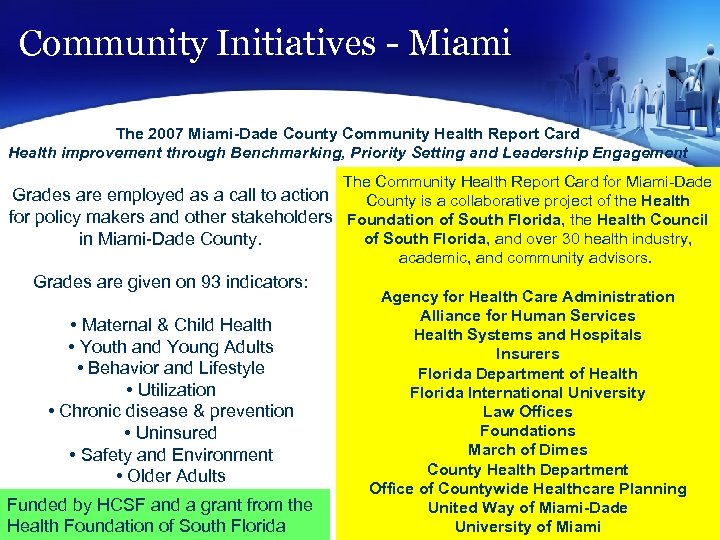 Community Initiatives - Miami The 2007 Miami-Dade County Community Health Report Card Health improvement through Benchmarking, Priority Setting and Leadership Engagement The Community Health Report Card for Miami-Dade Grades are employed as a call to action County is a collaborative project of the Health for policy makers and other stakeholders Foundation of South Florida, the Health Council of South Florida, and over 30 health industry, in Miami-Dade County. academic, and community advisors. Grades are given on 93 indicators: • Maternal & Child Health • Youth and Young Adults • Behavior and Lifestyle • Utilization • Chronic disease & prevention • Uninsured • Safety and Environment • Older Adults Funded by HCSF and a grant from the Health Foundation of South Florida Agency for Health Care Administration Alliance for Human Services Health Systems and Hospitals Insurers Florida Department of Health Florida International University Law Offices Foundations March of Dimes County Health Department Office of Countywide Healthcare Planning United Way of Miami-Dade University of Miami 112
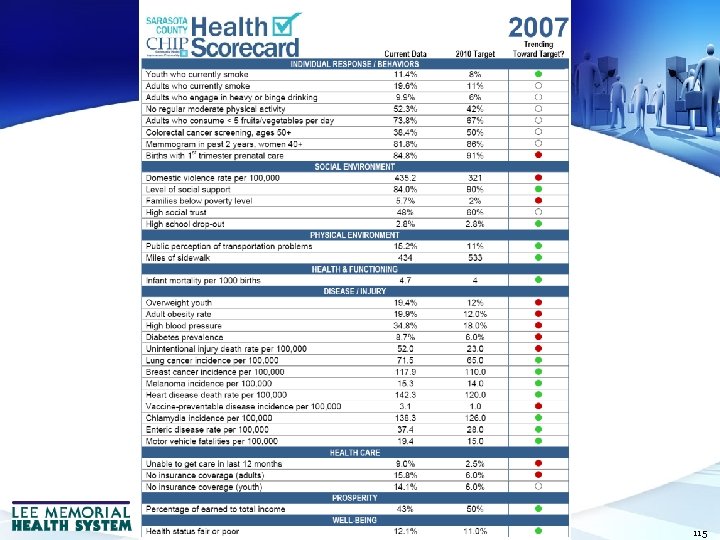
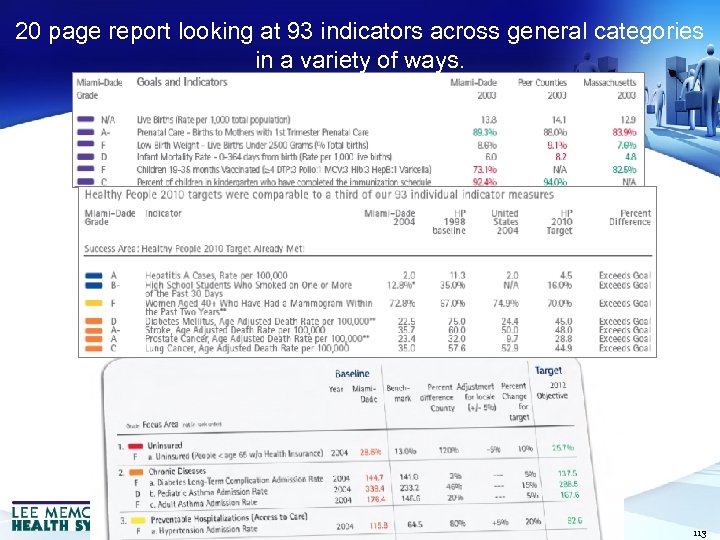 20 page report looking at 93 indicators across general categories in a variety of ways. 113
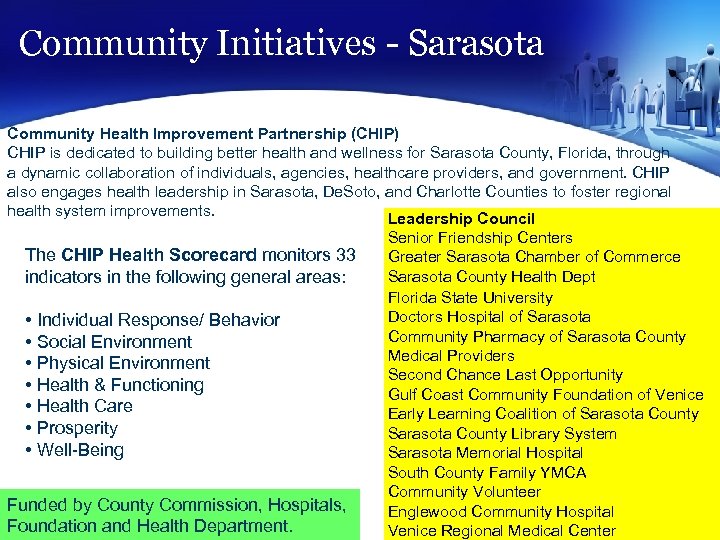 Community Initiatives - Sarasota Community Health Improvement Partnership (CHIP) CHIP is dedicated to building better health and wellness for Sarasota County, Florida, through a dynamic collaboration of individuals, agencies, healthcare providers, and government. CHIP also engages health leadership in Sarasota, De. Soto, and Charlotte Counties to foster regional health system improvements. Leadership Council The CHIP Health Scorecard monitors 33 indicators in the following general areas: • Individual Response/ Behavior • Social Environment • Physical Environment • Health & Functioning • Health Care • Prosperity • Well-Being Funded by County Commission, Hospitals, Foundation and Health Department. Senior Friendship Centers Greater Sarasota Chamber of Commerce Sarasota County Health Dept Florida State University Doctors Hospital of Sarasota Community Pharmacy of Sarasota County Medical Providers Second Chance Last Opportunity Gulf Coast Community Foundation of Venice Early Learning Coalition of Sarasota County Library System Sarasota Memorial Hospital South County Family YMCA Community Volunteer Englewood Community Hospital 114 Venice Regional Medical Center
 115
115
 Local Scorecard Concepts 116
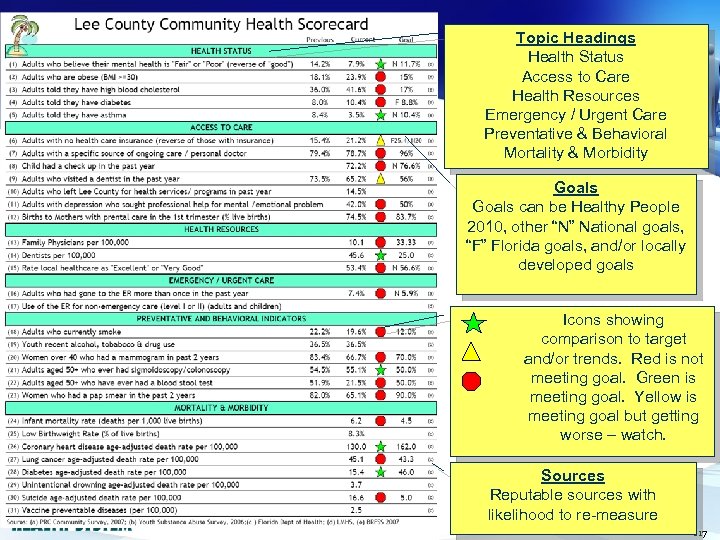 Topic Headings Health Status Access to Care Health Resources Emergency / Urgent Care Preventative & Behavioral Mortality & Morbidity Goals can be Healthy People 2010, other “N” National goals, “F” Florida goals, and/or locally developed goals Icons showing comparison to target and/or trends. Red is not meeting goal. Green is meeting goal. Yellow is meeting goal but getting worse – watch. Sources Reputable sources with likelihood to re-measure 117
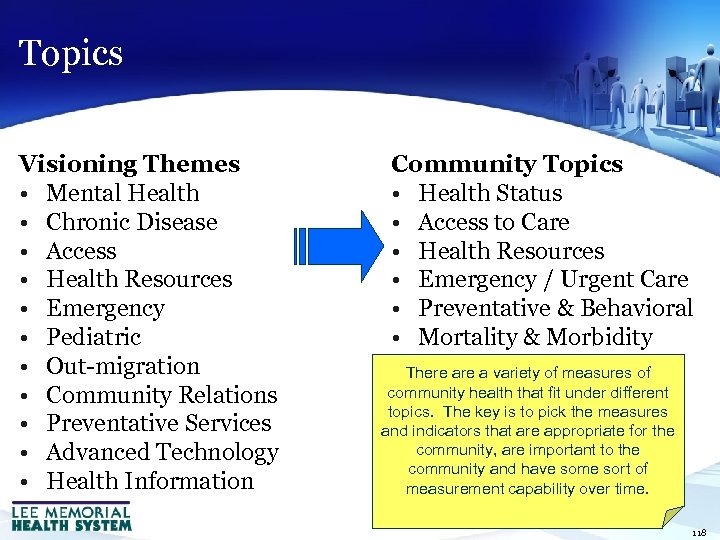 Topics Visioning Themes • Mental Health • Chronic Disease • Access • Health Resources • Emergency • Pediatric • Out-migration • Community Relations • Preventative Services • Advanced Technology • Health Information Community Topics • Health Status • Access to Care • Health Resources • Emergency / Urgent Care • Preventative & Behavioral • Mortality & Morbidity There a variety of measures of community health that fit under different topics. The key is to pick the measures and indicators that are appropriate for the community, are important to the community and have some sort of measurement capability over time. 118
 Facilitated Discussion Driving initiatives successfully (discipline of execution) to contribute to an improved health care delivery model (performance & value) by 2017 for our community. 119
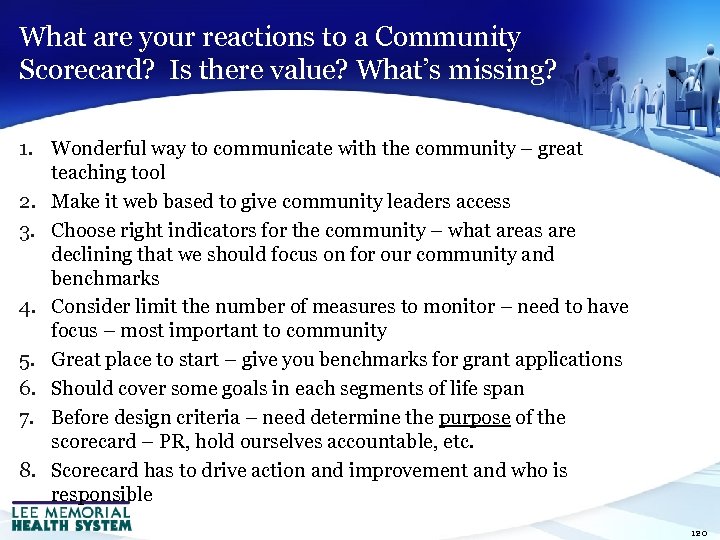 What are your reactions to a Community Scorecard? Is there value? What’s missing? 1. Wonderful way to communicate with the community – great teaching tool 2. Make it web based to give community leaders access 3. Choose right indicators for the community – what areas are declining that we should focus on for our community and benchmarks 4. Consider limit the number of measures to monitor – need to have focus – most important to community 5. Great place to start – give you benchmarks for grant applications 6. Should cover some goals in each segments of life span 7. Before design criteria – need determine the purpose of the scorecard – PR, hold ourselves accountable, etc. 8. Scorecard has to drive action and improvement and who is responsible 120
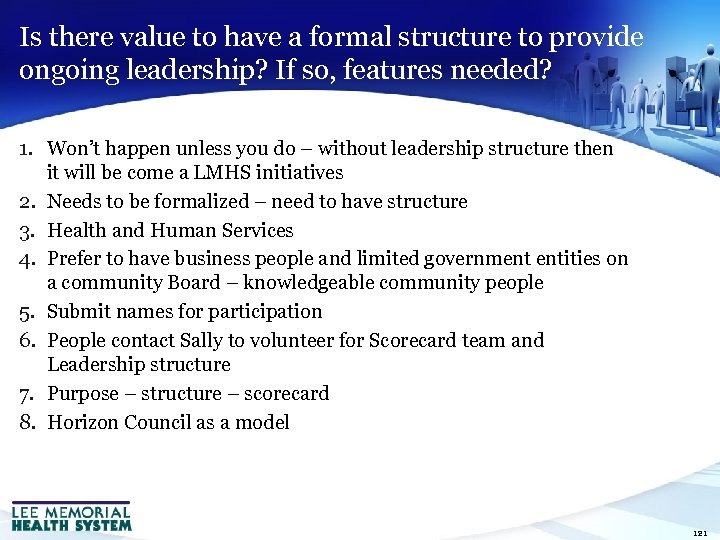 Is there value to have a formal structure to provide ongoing leadership? If so, features needed? 1. Won’t happen unless you do – without leadership structure then it will be come a LMHS initiatives 2. Needs to be formalized – need to have structure 3. Health and Human Services 4. Prefer to have business people and limited government entities on a community Board – knowledgeable community people 5. Submit names for participation 6. People contact Sally to volunteer for Scorecard team and Leadership structure 7. Purpose – structure – scorecard 8. Horizon Council as a model 121
 What entities would need permanent participation? • Insert here 122
 What else do we need to consider to sustain positive momentum and ensure effective implementation? 1. 2. 3. 4. 5. Involve EMS Involving school system There were common barriers across the 8 initiatives – there should be someway to get the common issues on the table and address Need to engage the media Who has interest in helping push this forward 123
 Community Health Visioning 2017 Next Steps & Closing Jim Nathan 124