


 Скачать презентацию Welcome to the first meeting of The Practitioners
50a1c890f76b0db71e4f74e3f28ad548.ppt
- Количество слайдов: 30
 Welcome to the first meeting of The Practitioners’ Forum (PF) of the Sustainable Procurement and Operations Board (SPOB) November 8 th 2007 Victoria
 A word from your Sponsor • Why PF is here • Governance stuff • The sponsor • TORs & KPIs • Outcomes
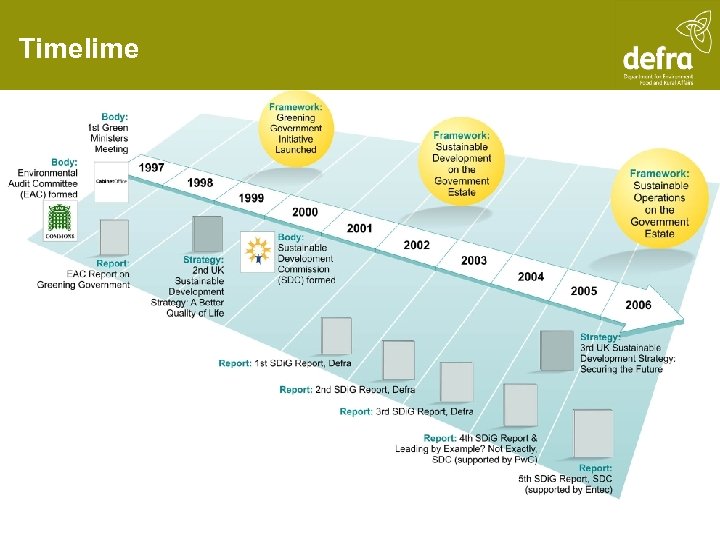 Timelime
 Cross Government Working: There is a real appetite on the part of government procurement specialists to work collaboratively and share best practice. PMDU Report 2007
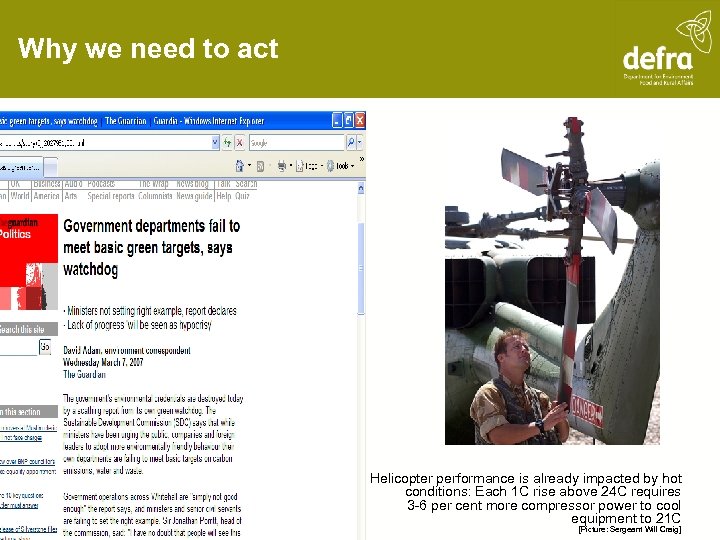 Why we need to act Helicopter performance is already impacted by hot conditions: Each 1 C rise above 24 C requires 3 -6 per cent more compressor power to cool equipment to 21 C [Picture: Sergeant Will Craig]
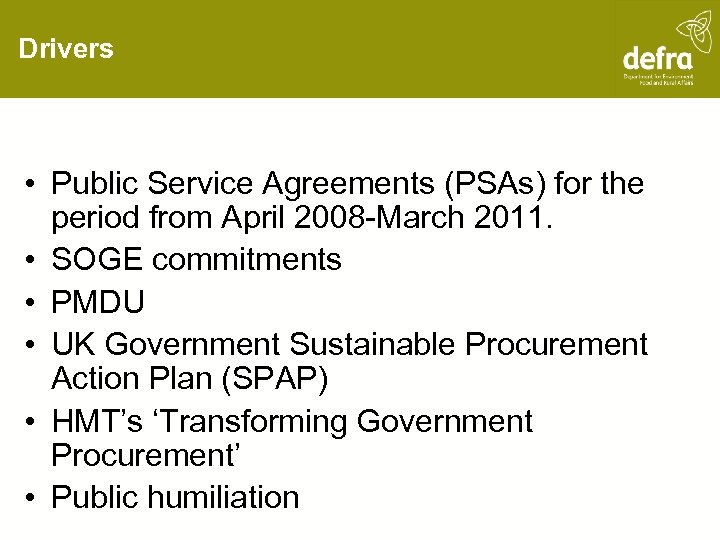 Drivers • Public Service Agreements (PSAs) for the period from April 2008 -March 2011. • SOGE commitments • PMDU • UK Government Sustainable Procurement Action Plan (SPAP) • HMT’s ‘Transforming Government Procurement’ • Public humiliation
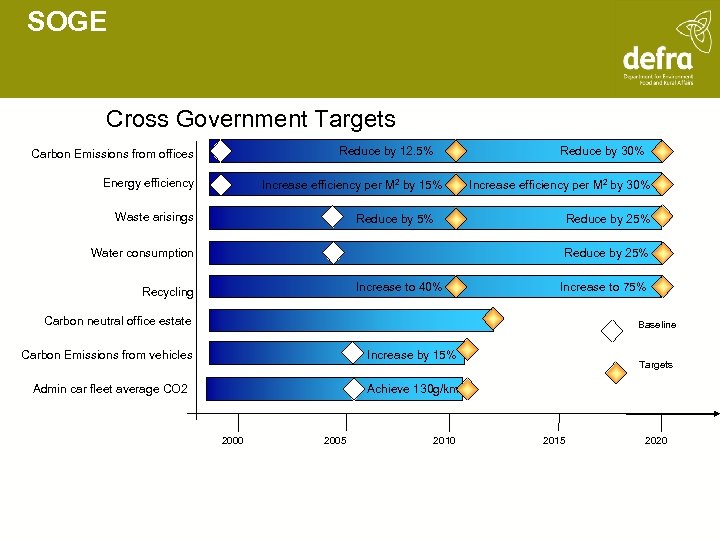 SOGE Cross Government Targets Reduce by 12. 5% Carbon Emissions from offices Energy efficiency Increase efficiency per M 2 by 15% Waste arisings Reduce by 30% Increase efficiency per M 2 by 30% Reduce by 5% Reduce by 25% Water consumption Increase to 40% Recycling Increase to 75% Carbon neutral office estate Baseline Carbon Emissions from vehicles Increase by 15% Admin car fleet average CO 2 Achieve 130 g/km 2000 2005 2010 Targets 2015 2020
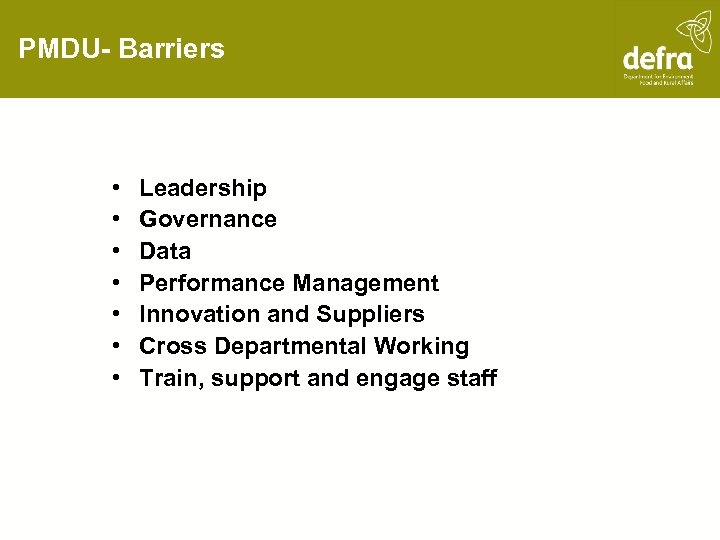 PMDU- Barriers • • Leadership Governance Data Performance Management Innovation and Suppliers Cross Departmental Working Train, support and engage staff
 PMDU - Levers • The Government is a key player in procurement with significant financial muscle it can flex. • Significant gains can be made by systematically implementing some relatively straight forward examples of best practice in every Department. • Cross Government Working: There is a real appetite on the part of government procurement specialists to work collaboratively and share best practice. • Every civil servant has a role to play and hence all staff need to be engaged – the evidence is that there is a significant body of staff who want to be involved. • There also lessons to be learnt from the private sector, in particular, about getting every part of an organisation aligned to drive forward progress.
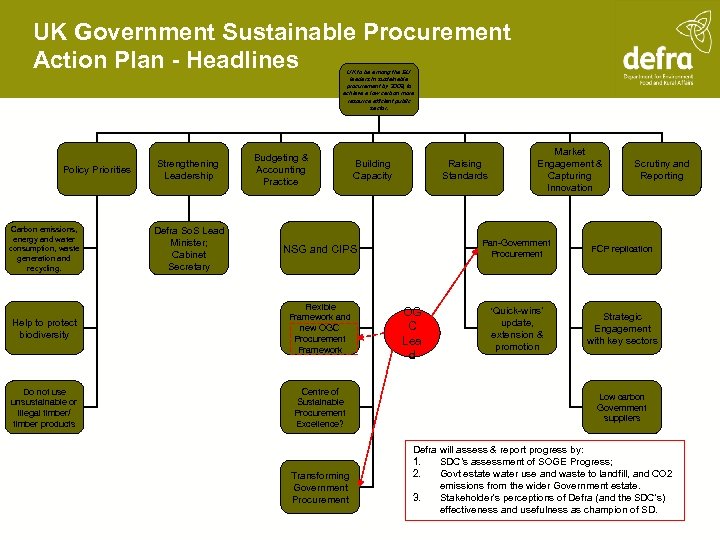 UK Government Sustainable Procurement Action Plan - Headlines UK to be among the EU leaders in sustainable procurement by 2009, to achieve a low carbon more resource efficient public sector. Policy Priorities Carbon emissions, energy and water consumption, waste generation and recycling. Strengthening Leadership Defra So. S Lead Minister; Cabinet Secretary Budgeting & Accounting Practice Building Capacity Raising Standards Pan-Government Procurement NSG and CIPS Help to protect biodiversity Flexible Framework and new OGC Procurement Framework Do not use unsustainable or illegal timber/ timber products Centre of Sustainable Procurement Excellence? Transforming Government Procurement Market Engagement & Capturing Innovation OG C Lea d ‘Quick-wins’ update, extension & promotion Scrutiny and Reporting FCP replication Strategic Engagement with key sectors Low carbon Government suppliers Defra will assess & report progress by: 1. SDC’s assessment of SOGE Progress; 2. Govt estate water use and waste to landfill, and CO 2 emissions from the wider Government estate. 3. Stakeholder's perceptions of Defra (and the SDC's) effectiveness and usefulness as champion of SD.
 How TGP and OGC address this High quality services at good value for money and in a sustainable way • Increased capability and skills • Pan-Gov frameworks offering sustainable solutions • Coherent framework of procurement policy and standards, including sustainability • Transforming estates management, including sustainability
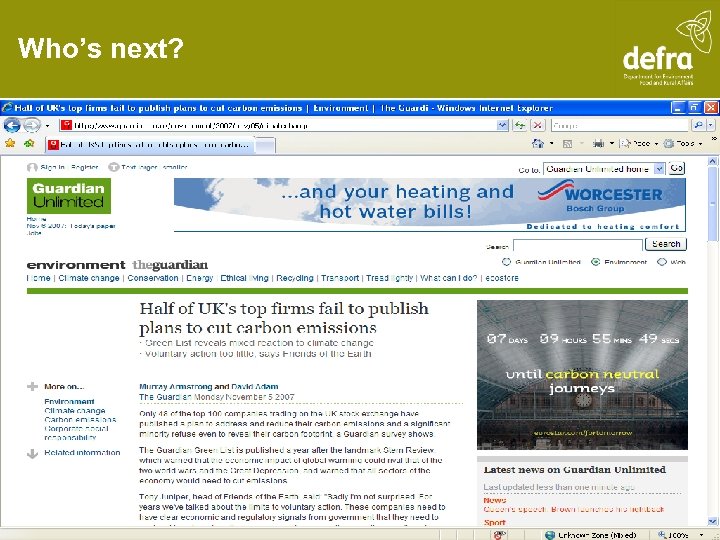
 Humiliation ‘…. . There is little hope that departments will meet the hugely challenging operational targets they now face……. Despite it green rhetoric, the government is clearly failing to put its own house in order. Edward Leigh MP, Chairman of the Committee of Public Accounts 20 April 2007
 Who’s next?
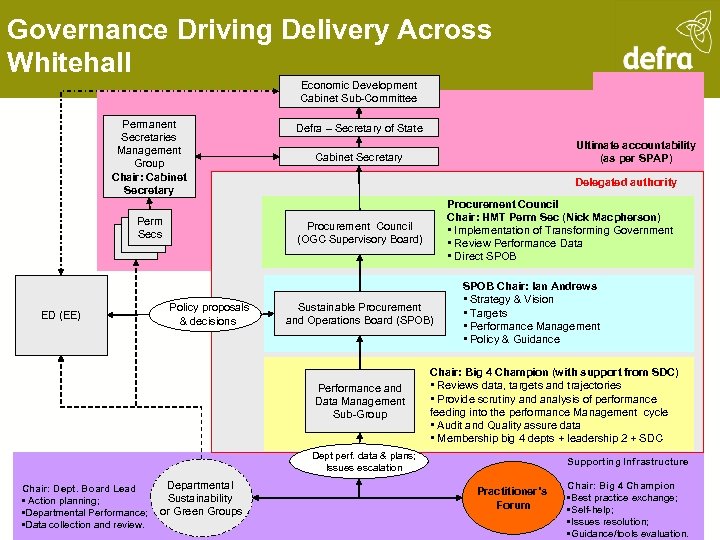 Governance Driving Delivery Across Whitehall Economic Development Cabinet Sub-Committee Permanent Secretaries Management Group Chair: Cabinet Secretary Perm Secs Perm Sec ED (EE) Defra – Secretary of State Ultimate accountability (as per SPAP) Cabinet Secretary Delegated authority Procurement Council Chair: HMT Perm Sec (Nick Macpherson) • Implementation of Transforming Government • Review Performance Data • Direct SPOB Procurement Council (OGC Supervisory Board) Policy proposals & decisions Sustainable Procurement and Operations Board (SPOB) Performance and Data Management Sub-Group SPOB Chair: Ian Andrews • Strategy & Vision • Targets • Performance Management • Policy & Guidance Chair: Big 4 Champion (with support from SDC) • Reviews data, targets and trajectories • Provide scrutiny and analysis of performance feeding into the performance Management cycle • Audit and Quality assure data • Membership big 4 depts + leadership 2 + SDC Dept perf. data & plans; Issues escalation Chair: Dept. Board Lead • Action planning; • Departmental Performance; • Data collection and review. Departmental Sustainability or Green Groups Supporting Infrastructure Practitioner’s Forum Chair: Big 4 Champion • Best practice exchange; • Self-help; • Issues resolution; • Guidance/tools evaluation.
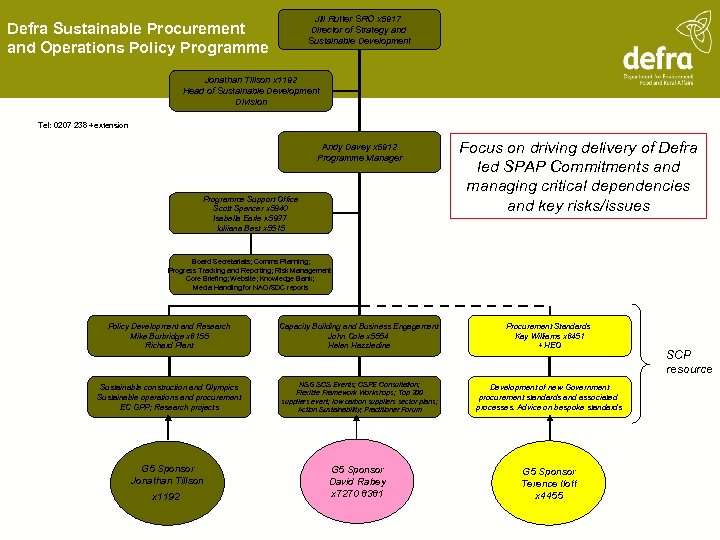 Jill Rutter SRO x 5917 Director of Strategy and Sustainable Development Defra Sustainable Procurement and Operations Policy Programme Jonathan Tillson x 1192 Head of Sustainable Development Division Tel: 0207 238 +extension Andy Davey x 5912 Programme Manager Programme Support Office Scott Spencer x 5940 Isabella Earle x 5937 Iuliiana Best x 5515 Focus on driving delivery of Defra led SPAP Commitments and managing critical dependencies and key risks/issues Board Secretariats; Comms Planning; Progress Tracking and Reporting; Risk Management; Core Briefing; Website; Knowledge Bank; Media Handling for NAO/SDC reports Policy Development and Research Mike Burbridge x 6155 Richard Plant Capacity Building and Business Engagement John Cole x 5554 Helen Hazzledine Procurement Standards Kay Williams x 6451 + HEO Sustainable construction and Olympics Sustainable operations and procurement EC GPP; Research projects NSG SCS Events; CSPE Consultation; Flexible Framework Workshops; Top 200 suppliers event; low carbon suppliers sector plans; Action Sustainability; Practitioner Forum Development of new Government procurement standards and associated processes. Advice on bespoke standards G 5 Sponsor Jonathan Tillson x 1192 G 5 Sponsor David Rabey x 7270 8381 G 5 Sponsor Terence Ilott x 4455 SCP resource
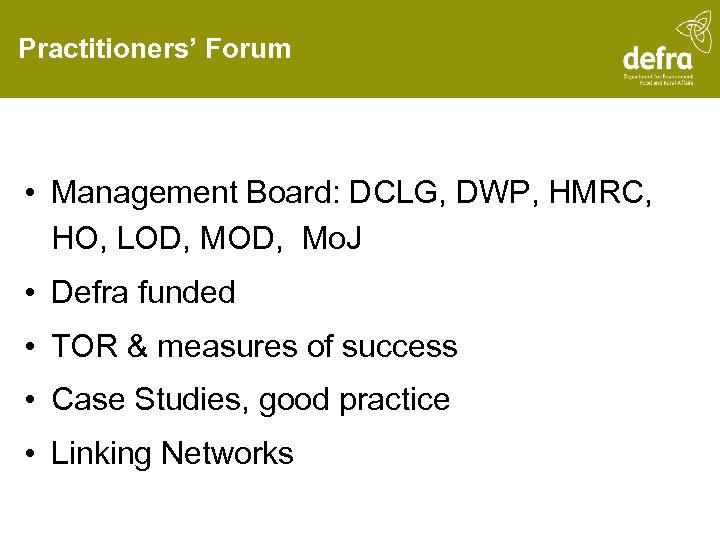 Practitioners’ Forum • Management Board: DCLG, DWP, HMRC, HO, LOD, MOD, Mo. J • Defra funded • TOR & measures of success • Case Studies, good practice • Linking Networks
 Draft The Sustainable Procurement and Operations Board Practitioners’ Forum (PF) will be an active self-help network to help drive Departments (etc. ) performance to meet or exceed the targets for sustainable operations on the Government estate and requirements set out in the Sustainable Procurement Action Plan and the PMDU report
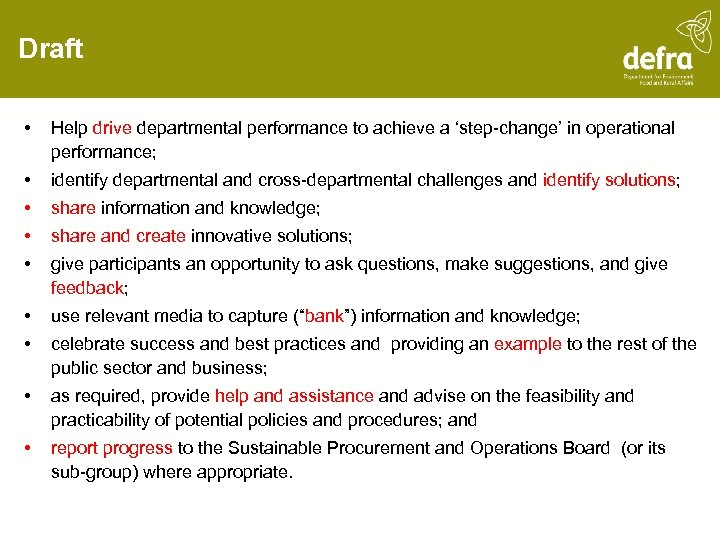 Draft • Help drive departmental performance to achieve a ‘step-change’ in operational performance; • identify departmental and cross-departmental challenges and identify solutions; • share information and knowledge; • share and create innovative solutions; • give participants an opportunity to ask questions, make suggestions, and give feedback; • use relevant media to capture (“bank”) information and knowledge; • celebrate success and best practices and providing an example to the rest of the public sector and business; • as required, provide help and assistance and advise on the feasibility and practicability of potential policies and procedures; and • report progress to the Sustainable Procurement and Operations Board (or its sub-group) where appropriate.
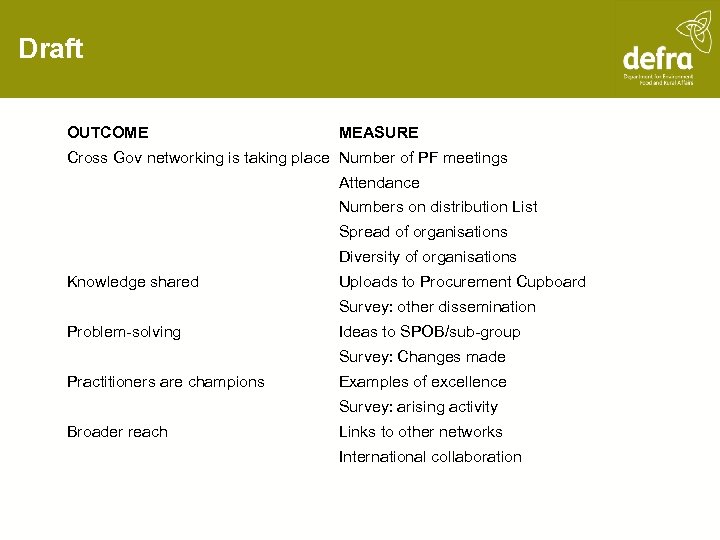 Draft OUTCOME MEASURE Cross Gov networking is taking place Number of PF meetings Attendance Numbers on distribution List Spread of organisations Diversity of organisations Knowledge shared Uploads to Procurement Cupboard Survey: other dissemination Problem-solving Ideas to SPOB/sub-group Survey: Changes made Practitioners are champions Examples of excellence Survey: arising activity Broader reach Links to other networks International collaboration
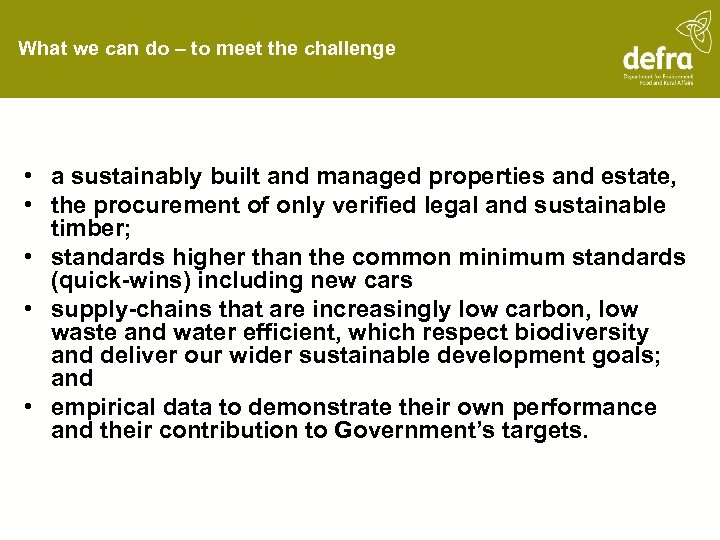 What we can do – to meet the challenge • a sustainably built and managed properties and estate, • the procurement of only verified legal and sustainable timber; • standards higher than the common minimum standards (quick-wins) including new cars • supply-chains that are increasingly low carbon, low waste and water efficient, which respect biodiversity and deliver our wider sustainable development goals; and • empirical data to demonstrate their own performance and their contribution to Government’s targets.
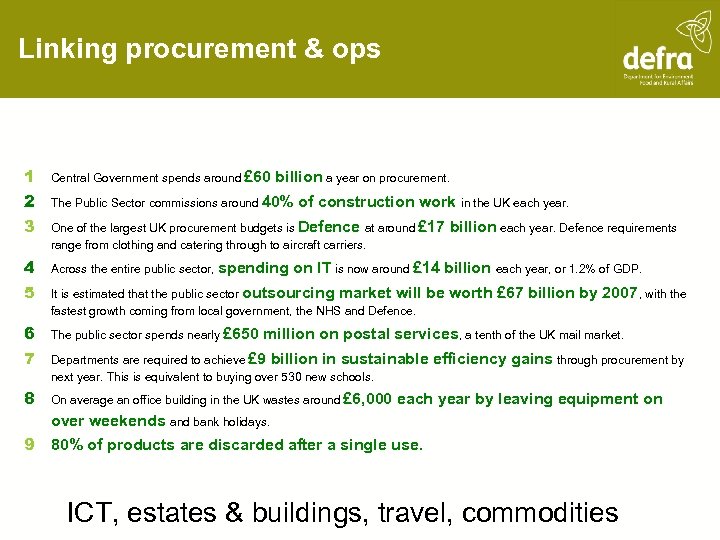 Linking procurement & ops 1 Central Government spends around £ 60 2 The Public Sector commissions around 40% 3 One of the largest UK procurement budgets is Defence at around £ 17 range from clothing and catering through to aircraft carriers. 4 Across the entire public sector, spending 5 It is estimated that the public sector outsourcing market will fastest growth coming from local government, the NHS and Defence. 6 The public sector spends nearly £ 650 7 Departments are required to achieve £ 9 billion in sustainable next year. This is equivalent to buying over 530 new schools. 8 On average an office building in the UK wastes around £ 6, 000 billion a year on procurement. of construction work in the UK each year. billion each year. Defence requirements on IT is now around £ 14 billion each year, or 1. 2% of GDP. be worth £ 67 billion by 2007, with the million on postal services, a tenth of the UK mail market. efficiency gains through procurement by each year by leaving equipment on over weekends and bank holidays. 9 80% of products are discarded after a single use. ICT, estates & buildings, travel, commodities
 Free Offers FREE “Sustainable Procurement” workshops based around the “flexible framework” FREE A Green Fair is to be held on 13 and 14 December 2007 Central Hall Westminister, Storey’s Gate, London SW 1 H 9 NH to support Defra’s Act on CO 2 campaign. Free Thank you
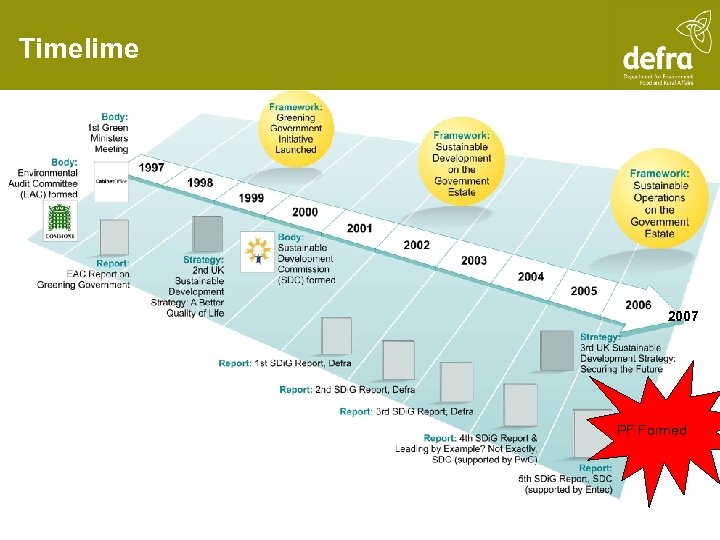 Timelime 2007 PF Formed

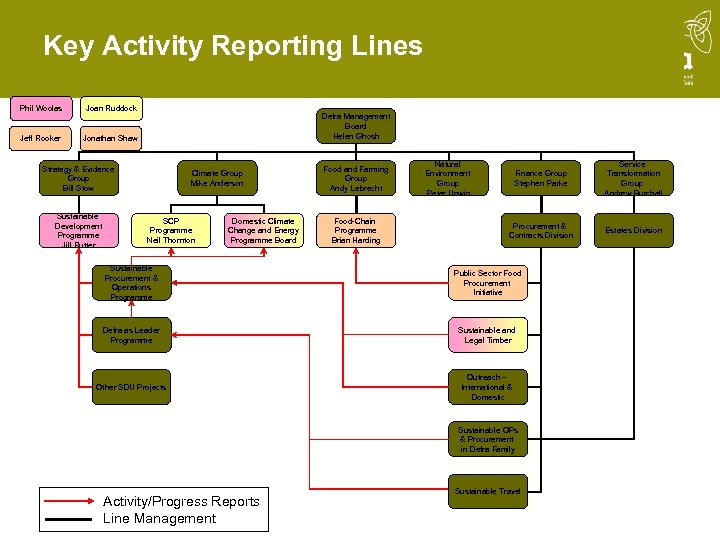 Key Activity Reporting Lines Phil Woolas Joan Ruddock Jeff Rooker Jonathan Shaw Defra Management Board Helen Ghosh Strategy & Evidence Group Bill Stow Sustainable Development Programme Jill Rutter Climate Group Mike Anderson SCP Programme Neil Thornton Domestic Climate Change and Energy Programme Board Food and Farming Group Andy Lebrecht Food-Chain Programme Brian Harding Finance Group Stephen Parke Service Transformation Group Andrew Burchell Procurement & Contracts Division Natural Environment Group Peter Unwin Estates Division Sustainable Procurement & Operations Programme Public Sector Food Procurement Initiative Defra as Leader Programme Sustainable and Legal Timber Other SDU Projects Outreach – International & Domestic Sustainable OPs & Procurement in Defra Family Activity/Progress Reports Line Management Sustainable Travel
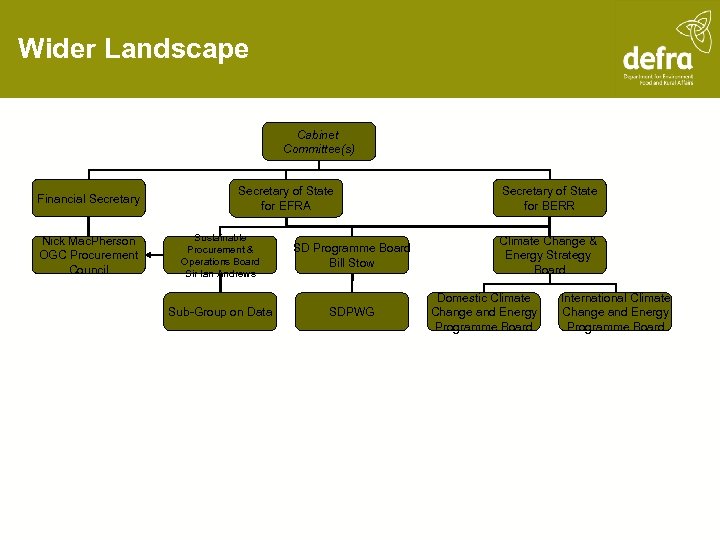 Wider Landscape Cabinet Committee(s) Financial Secretary Nick Mac. Pherson OGC Procurement Council Secretary of State for EFRA Sustainable Procurement & Operations Board Sir Ian Andrews Sub-Group on Data SD Programme Board Bill Stow SDPWG Secretary of State for BERR Climate Change & Energy Strategy Board Domestic Climate Change and Energy Programme Board International Climate Change and Energy Programme Board
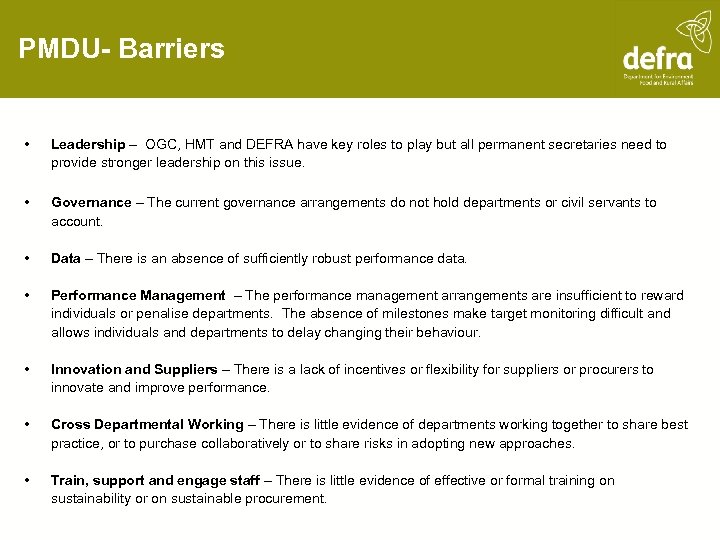 PMDU- Barriers • Leadership – OGC, HMT and DEFRA have key roles to play but all permanent secretaries need to provide stronger leadership on this issue. • Governance – The current governance arrangements do not hold departments or civil servants to account. • Data – There is an absence of sufficiently robust performance data. • Performance Management – The performance management arrangements are insufficient to reward individuals or penalise departments. The absence of milestones make target monitoring difficult and allows individuals and departments to delay changing their behaviour. • Innovation and Suppliers – There is a lack of incentives or flexibility for suppliers or procurers to innovate and improve performance. • Cross Departmental Working – There is little evidence of departments working together to share best practice, or to purchase collaboratively or to share risks in adopting new approaches. • Train, support and engage staff – There is little evidence of effective or formal training on sustainability or on sustainable procurement.
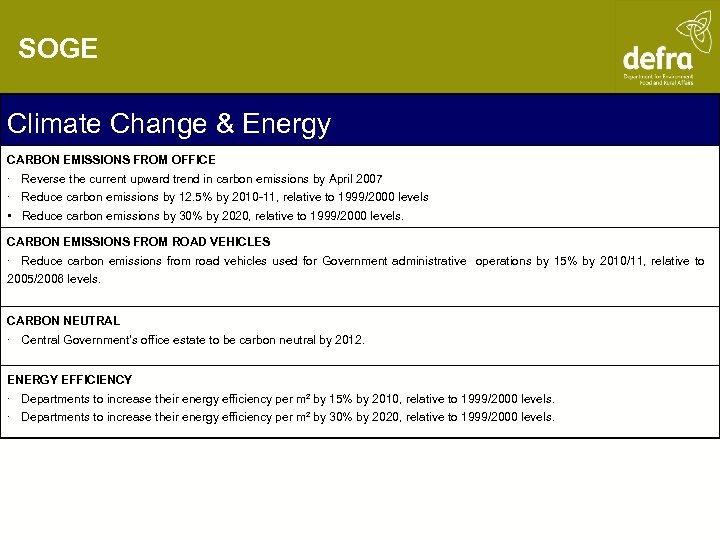 SOGE Climate Change & Energy CARBON EMISSIONS FROM OFFICE · Reverse the current upward trend in carbon emissions by April 2007 · Reduce carbon emissions by 12. 5% by 2010 -11, relative to 1999/2000 levels • Reduce carbon emissions by 30% by 2020, relative to 1999/2000 levels. CARBON EMISSIONS FROM ROAD VEHICLES · Reduce carbon emissions from road vehicles used for Government administrative operations by 15% by 2010/11, relative to 2005/2006 levels. CARBON NEUTRAL · Central Government’s office estate to be carbon neutral by 2012. ENERGY EFFICIENCY · Departments to increase their energy efficiency per m² by 15% by 2010, relative to 1999/2000 levels. · Departments to increase their energy efficiency per m² by 30% by 2020, relative to 1999/2000 levels.
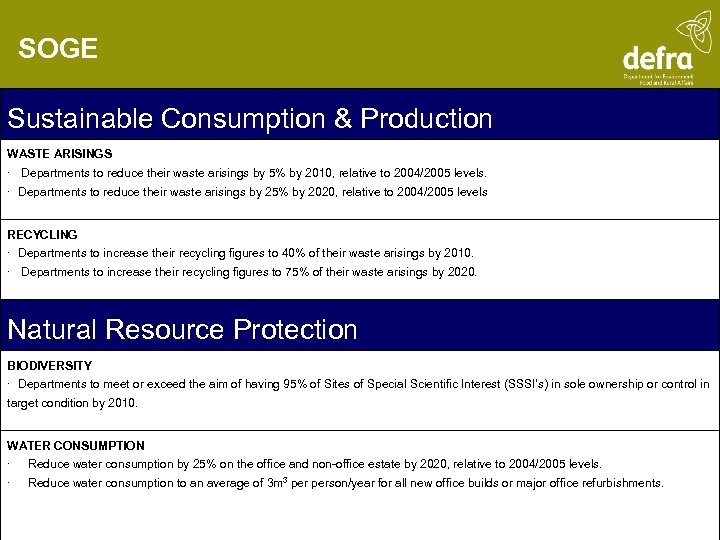 SOGE Sustainable Consumption & Production WASTE ARISINGS · Departments to reduce their waste arisings by 5% by 2010, relative to 2004/2005 levels. · Departments to reduce their waste arisings by 25% by 2020, relative to 2004/2005 levels RECYCLING · Departments to increase their recycling figures to 40% of their waste arisings by 2010. · Departments to increase their recycling figures to 75% of their waste arisings by 2020. Natural Resource Protection BIODIVERSITY · Departments to meet or exceed the aim of having 95% of Sites of Special Scientific Interest (SSSI’s) in sole ownership or control in target condition by 2010. WATER CONSUMPTION · Reduce water consumption by 25% on the office and non-office estate by 2020, relative to 2004/2005 levels. · Reduce water consumption to an average of 3 m 3 person/year for all new office builds or major office refurbishments.
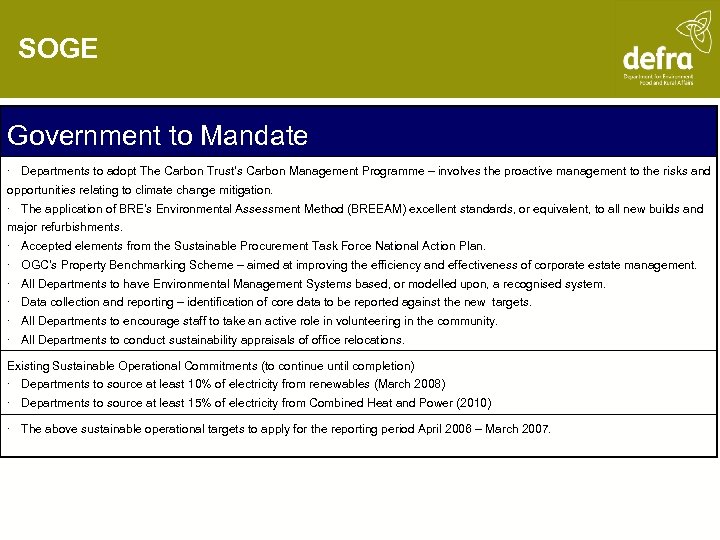 SOGE Government to Mandate · Departments to adopt The Carbon Trust’s Carbon Management Programme – involves the proactive management to the risks and opportunities relating to climate change mitigation. · The application of BRE's Environmental Assessment Method (BREEAM) excellent standards, or equivalent, to all new builds and major refurbishments. · Accepted elements from the Sustainable Procurement Task Force National Action Plan. · OGC’s Property Benchmarking Scheme – aimed at improving the efficiency and effectiveness of corporate estate management. · All Departments to have Environmental Management Systems based, or modelled upon, a recognised system. · Data collection and reporting – identification of core data to be reported against the new targets. · All Departments to encourage staff to take an active role in volunteering in the community. · All Departments to conduct sustainability appraisals of office relocations. Existing Sustainable Operational Commitments (to continue until completion) · Departments to source at least 10% of electricity from renewables (March 2008) · Departments to source at least 15% of electricity from Combined Heat and Power (2010) · The above sustainable operational targets to apply for the reporting period April 2006 – March 2007.