


 Скачать презентацию Welcome to STSc I New Employee Orientation Presented
1fd4e26f9c90d6a16933d96c67809996.ppt
- Количество слайдов: 34
 Welcome to STSc. I “New” Employee Orientation Presented by: Peg Stanley John Kaylor Greg Pabst Sheryl Bruff
 What we’ll cover • • STSc. I Values & Principles (10 min) Brief Missions and Org Overview (20 min) IT Information (15 min) Safety Information (10 min) HR Information (15 min) Your Feedback (10 min) Q & A (10 min)
 STSc. I Mission what we do … The mission of the STSc. I is to enable & accomplish breakthrough science. and how we do it … We enable excellence in astronomical research by optimizing the science from state of the art observatories in space.
 What do we value?
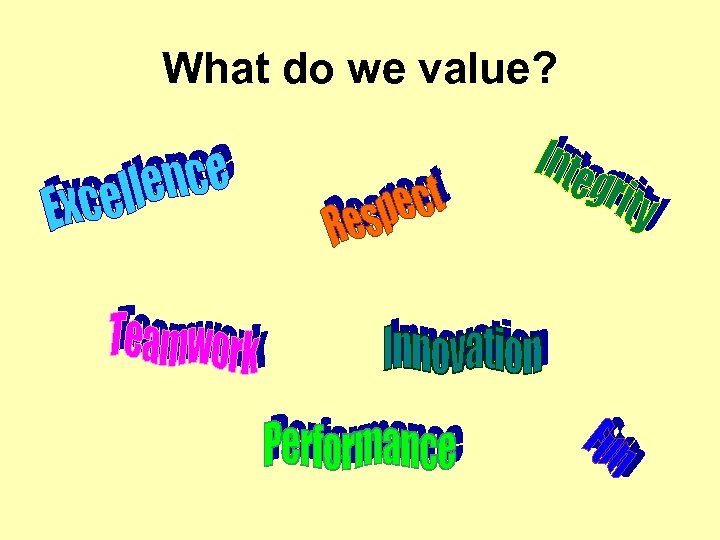
 Our Guiding Principles • 9 principles that remind us that – We are a service organization - to the astronomical community and NASA – Every skill and role is essential and important to achieving our mission – We should keep bureaucracy to a minimum – Getting “it” done is the real accomplishment – It’s all about teams – Diversity makes better teams – We do really cool things here!
 Missions Overview Hubble Space Telescope • HST is an observatory first dreamt of in the 1940 s, designed and built in the 1970 s and 80 s, and operational for 18 years (since April 1990). • HST was the first NASA mission designed as a longterm space-based serviceable observatory. – special grapple fixtures, 76 handholds, and is stabilized in all three axes. – Astronauts have been back to service it 4 times so far (SM 3 was split into 3 a and 3 b) with the 5 th servicing mission (SM 4) coming up in October 2008 • HST is a 2. 4 -meter in low-Earth orbit (353 miles), with a 96 minute orbit (~5 miles per second)
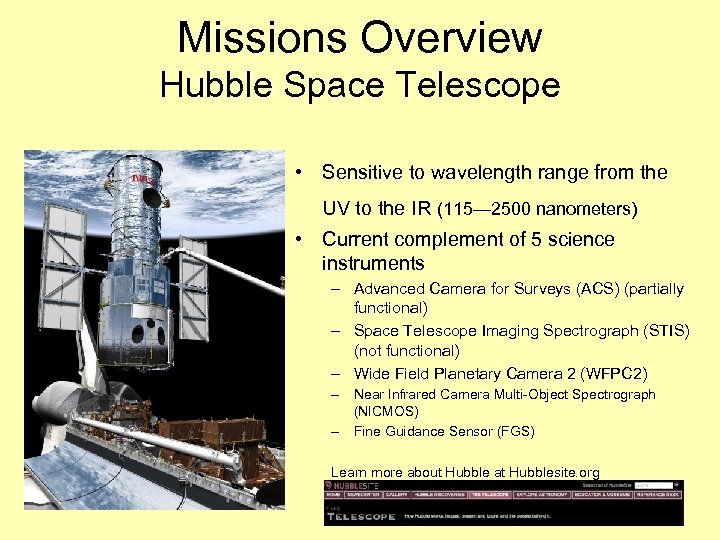 Missions Overview Hubble Space Telescope • Sensitive to wavelength range from the UV to the IR (115— 2500 nanometers) • Current complement of 5 science instruments – Advanced Camera for Surveys (ACS) (partially functional) – Space Telescope Imaging Spectrograph (STIS) (not functional) – Wide Field Planetary Camera 2 (WFPC 2) – Near Infrared Camera Multi-Object Spectrograph (NICMOS) – Fine Guidance Sensor (FGS) Learn more about Hubble at Hubblesite. org
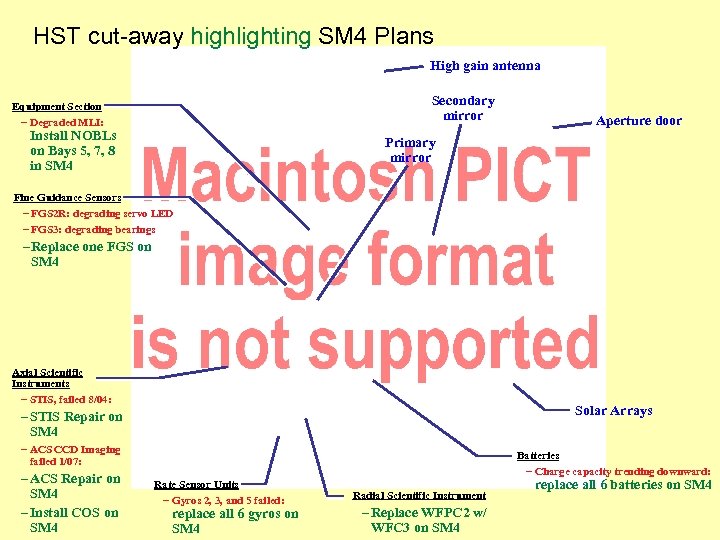 HST cut-away highlighting SM 4 Plans High gain antenna Secondary mirror Equipment Section – Degraded MLI: Install NOBLs on Bays 5, 7, 8 in SM 4 Aperture door Primary mirror Fine Guidance Sensors – FGS 2 R: degrading servo LED – FGS 3: degrading bearings – Replace one FGS on SM 4 Axial Scientific Instruments – STIS, failed 8/04: Solar Arrays – STIS Repair on SM 4 – ACS CCD Imaging failed 1/07: – ACS Repair on SM 4 – Install COS on SM 4 Batteries – Charge capacity trending downward: Rate Sensor Units – Gyros 2, 3, and 5 failed: replace all 6 gyros on SM 4 Radial Scientific Instrument – Replace WFPC 2 w/ WFC 3 on SM 4 replace all 6 batteries on SM 4
 Missions Overview James Webb Space Telescope • 1996 “Dressler” report recommended follow-on to HST optimized for the IR. • Concept of JWST was developed in “Next Generation Space Telescope Visiting a Time When Galaxies Were Young” (Stockman/STSc. I et al, 1997) • JWST is a cold observatory (40 Kelvin = 387º F) with a deployable 21 m (72 ft) x 12 m (39 ft) sunshade. • JWST has a 6. 5 -meter (21. 3 ft) deployable mirror and will be in orbit around L 2 - 940, 000 miles from Earth.
 Missions Overview James Webb Space Telescope • Sensitive to wavelength range from the Visible to mid-IR (600 -27000+ nanometers) • Science instruments – – Near IR Camera (NIRCam) NIR Multi-0 bject Spectrometer (NIRSpec) Mid-IR Camera/Spectrometer (MIRI) Tunable Filter Imager (TFI) Learn more about JWST at jwstsite. stsci. edu
 Missions Overview James Webb Space Telescope We are JWST Science & Operations Center
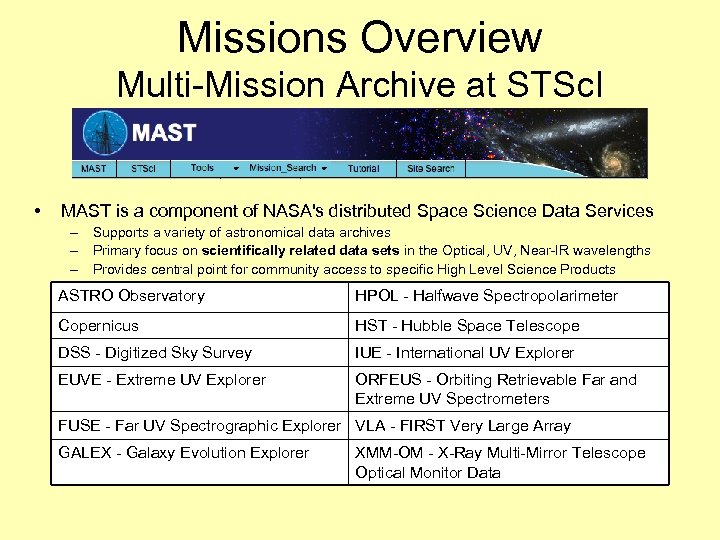 Missions Overview Multi-Mission Archive at STSc. I • MAST is a component of NASA's distributed Space Science Data Services – Supports a variety of astronomical data archives – Primary focus on scientifically related data sets in the Optical, UV, Near-IR wavelengths – Provides central point for community access to specific High Level Science Products ASTRO Observatory HPOL - Halfwave Spectropolarimeter Copernicus HST - Hubble Space Telescope DSS - Digitized Sky Survey IUE - International UV Explorer EUVE - Extreme UV Explorer ORFEUS - Orbiting Retrievable Far and Extreme UV Spectrometers FUSE - Far UV Spectrographic Explorer VLA - FIRST Very Large Array GALEX - Galaxy Evolution Explorer XMM-OM - X-Ray Multi-Mirror Telescope Optical Monitor Data
 Missions Overview Multi-Mission Archive at STSc. I • MAST data holdings total ~ 7 TB (Oct 2007) – dominated by 4. 7 TB of GALEX data – holds nearly 400 GB of community- contributed high-level science products that are “science ready” • Distributed over 5 TB of mission data between Jan-Oct 2007
 Missions Overview • Kepler is a NASA Discovery Mission – survey our region of the Milky Way to detect and characterize hundreds of Earth-size and smaller planets in or near the habitable zone. – The habitable zone -> the distances from a star where liquid water can exist on a planet's surface. • Launch February 2009 • STSc. I is the Kepler Data Management Center – processing, calibrating and archiving the Kepler scientific data – distributing the products to the users
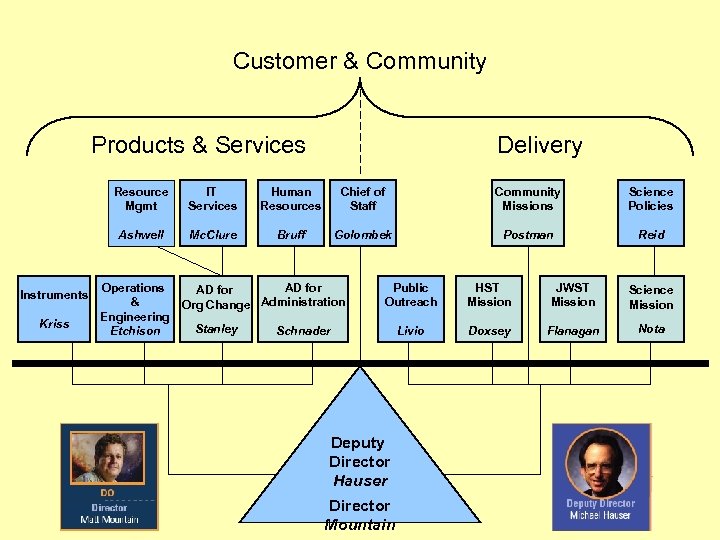 Customer & Community Products & Services Delivery Resource Mgmt Kriss Human Resources Chief of Staff Community Missions Science Policies Ashwell Instruments IT Services Mc. Clure Bruff Golombek Postman Reid Operations & Engineering Etchison AD for Org Change Administration Stanley Public Outreach HST Mission JWST Mission Science Mission Livio Doxsey Flanagan Nota Schnader Deputy Director Hauser Director Mountain
 Organization Overview Director’s Office • Director – Matt Mountain • Deputy Director – Mike Hauser • Chief of Staff – Dan Golombek • Associate Director for Administration – Val Schnader • Associate Director for Organizational Change – Peg Stanley • RMO – Judy Ashwell – Manages resource allocation for successful performance of the STSc. I’s projects and missions. Responsible for overall operating budget and the STSc. I business model including mission system and document configuration management.
 Organization Overview Mission Offices – Lead the missions, define mission strategies and requirements, maximize science from the missions, prioritize resources, prime interface to NASA/partners • HSTMO – Rodger Doxsey, Helmut Jenkner, Ken Sembach, Chris Blades, Brad Whitmore • JWSTMO – Kathy Flanagan, David Hunter, Massimo Stiavelli, Knox Long, Joe Pollizzi, John Isaacs • Community MO – Marc Postman, Carol Christian, Alberto Conti – Manages contractual obligations for small missions that the Institute supports or operates for the scientific community and the business process for new missions and for creating quality mission proposals • Science MO – Antonella Nota, Harry Ferguson, Neill Reid – Ensures the indivisibility of science and service, science performance management, science policies and time allocation, helps optimize science return of our mission
 Organization Overview Divisions - provide the people and expertise to support mission requirements definition and accomplishment. • BRC - Val Schnader, Ray Beaser – provides administrative and professional business services including accounting, administrative support, Human Resources, etc • INS – Jerry Kriss, Stefano Casertano – Expertise in the scientific and engineering performance and development for the HST and JWST science instruments and telescope and guiding elements • ITSD – Doris Mc. Clure, Glenn Miller, Marty Durkin – Develops and deploys the IT infrastructure and information services. Provides help desk, computing and web casting/”AV” services. • OED – Jim Etchison, Carl Johnson – Develops, maintains and operates the systems used to conduct the science missions at STSc. I. • OPO – Mario Livio, Stratis Kakadelis – Develops products and programs to share the discoveries and results of our missions.
 WELCOME to STSc. I April 2008 Our Goal – Enable a smooth transition to STSc. I
 New Employee Orientation on Computer Resources • Computer Support Information – John Kaylor • Web and A/V Services – Steve Dignan • IT Policies and Security – John Kaylor • Questions
 General Information • Backups • Visitor Network • Wireless Network • Remote Connections – VPN • ITSD Tech Updates Every 2 months in the Auditorium
 General Information How to Get Help Contact the Computer Support Help Desk – Send Email to support@stsci. edu ( Not help@stsci. edu ) – Call ext 4400 – Visit us in room 330 – Http: //www. stsci. edu/institute/itsd
 Web and A/V Services
 Web Services • Individual Homepages • Collaboration Tools (wikis, bulletin boards, blogs, etc. ) http: //www. stsci. edu/institute/itsd/collaboration • Web Proxy Server https: //ltdaccess. stsci. edu • Site Development, Maintenance, Support and Training http: //www. stsci. edu/institute/itsd/web
 A/V Services • Webcasting/Streaming – Live and after the fact event streaming: http: //www. stsci. edu/institute/itsd/information/streaming – Presentation tips, guidelines, templates, etc. : (found in the "Getting Started" box in RHN of above site) • Building your ppt (fonts, text-size, colors) to optimize video quality • Public speaking tips and presentation dry-runs – Hardware support for real-time events
 A/V Services (cont’d) • Video Conferencing http: //www. stsci. edu/institute/itsd/information/Video. Conferencing – High-end facilities in 2 separate conference rooms to conduct up to 4 -point video conferencing – Project currently underway to solidify STSc. I policy and supported configurations for desktop video conferencing • Teleconferencing Note: Support for both video and teleconferencing provided via email to support@stsci. edu.
 Security Unacceptable items on Institute Equipment • • • Inappropriate material File sharing software Web servers Disabled virus protection Non-STSc. I equipment on internal network NASA IT Security Training http: //www. stsci. edu/institute/itsd/it_security - Do not try to fix your own machine -
 QUESTIONS Later: Questions can be sent to: support@stsci. edu
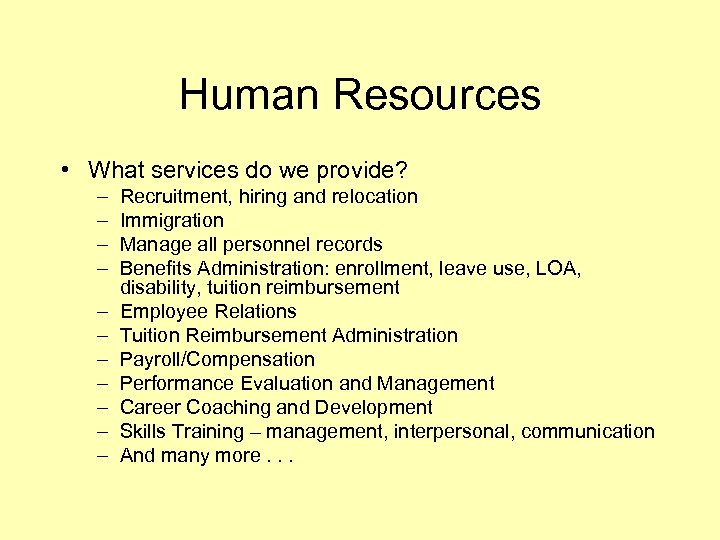 Human Resources • What services do we provide? – – – Recruitment, hiring and relocation Immigration Manage all personnel records Benefits Administration: enrollment, leave use, LOA, disability, tuition reimbursement Employee Relations Tuition Reimbursement Administration Payroll/Compensation Performance Evaluation and Management Career Coaching and Development Skills Training – management, interpersonal, communication And many more. . .
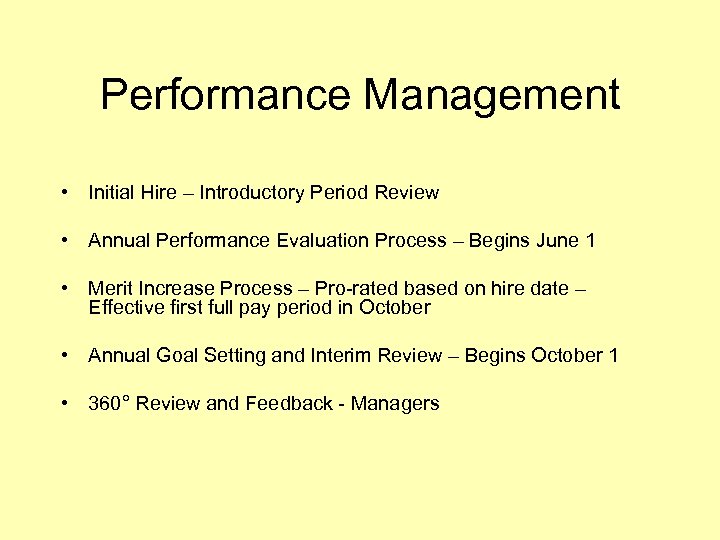 Performance Management • Initial Hire – Introductory Period Review • Annual Performance Evaluation Process – Begins June 1 • Merit Increase Process – Pro-rated based on hire date – Effective first full pay period in October • Annual Goal Setting and Interim Review – Begins October 1 • 360° Review and Feedback - Managers
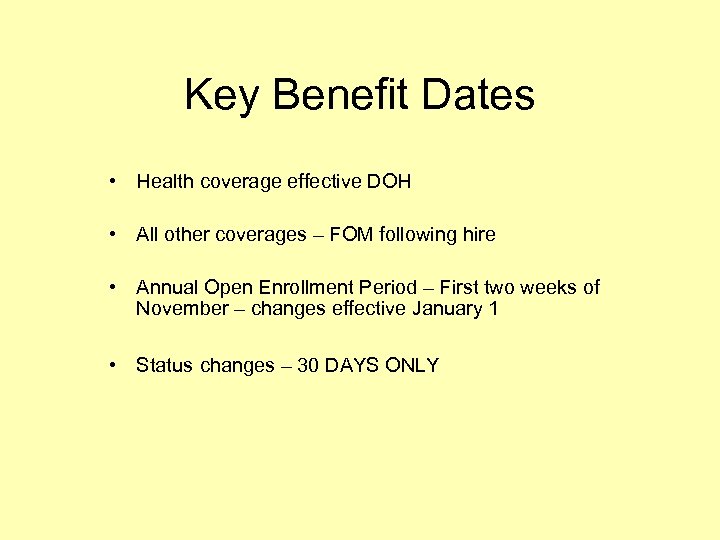 Key Benefit Dates • Health coverage effective DOH • All other coverages – FOM following hire • Annual Open Enrollment Period – First two weeks of November – changes effective January 1 • Status changes – 30 DAYS ONLY
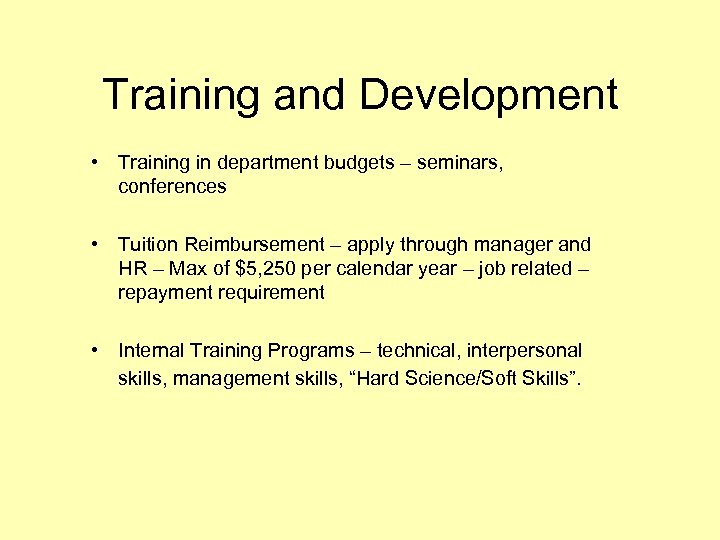 Training and Development • Training in department budgets – seminars, conferences • Tuition Reimbursement – apply through manager and HR – Max of $5, 250 per calendar year – job related – repayment requirement • Internal Training Programs – technical, interpersonal skills, management skills, “Hard Science/Soft Skills”.
 Resources • Lifeworks - On line resources and programs at www. lifeworks. com • EAP – 24/7 intervention and online counseling – 1 -888 -267 -8126 • Ombudsperson – Beth Spotts – bspotts@stsci. edu • Well. Advantage – exercise classes, birthday massage
 The Conversation on Civility and Diversity • Focus on interpersonal behavior – respect in the workplace • Openness to diverse ideas, opinions, backgrounds, experiences • Shared responsibility • Director’s blog: http: //blogs. stsci. edu/diversity/