


 Скачать презентацию Welcome To Our Cell Training Seminar Relax it s
55455413a62cc452f6bdd46cc5762008.ppt
- Количество слайдов: 104
 Welcome To Our Cell Training Seminar Relax, it’s Saturday! Pray that this will be a fantastic day! Introduce yourself to someone and find an expensive seat down front!
 Welcome To Our Cell Training Seminar Introduction

 Sunday School Bible Studies Small Groups!
 What Is A Cell Group? "The last thing many believers need today is to go to another Bible study. They already know far more than they are putting into practice. What they need are serving experiences in which they can exercise their spiritual muscles. ” – Rick Warren A Reality cell is a group of 3 to 15 people that meets weekly outside the church building for the purpose of evangelism, community and discipleship with the goal of multiplication. It’s a community of people who share in the journey of Christian Life. A Church within a Church. A Family! It’s The Place Where Ministry Occurs! A Cell Group is the Body of Christ in it’s smallest form.
 What Is A Cell Group? Cell Group Ministry is the basic Model of Discipleship as seen in the New Testament Church! Let’s take a look at just a few verses together
 Acts 8: 3 But Saul began to destroy the church. Going from house to house, he dragged off men and women and put them in prison.
 Acts 20: 20 You know that I have not hesitated to preach anything that would be helpful to you but have taught you publicly and from house to house.
 Acts 5: 42 Day after day, in the temple courts and from house to house, they never stopped teaching and proclaiming the good news that Jesus is the Christ.
 Acts 16: 40 After Paul and Silas came out of the prison, they went to Lydia’s house, where they met with the brothers and encouraged them. Then they left.
 Acts 28: 16, 30 -31 When we got to Rome, Paul was allowed to live by himself, with a soldier to guard him. 30 For two whole years Paul stayed there in his own rented house and welcomed all who came to see him. 31 Boldly and without hindrance he preached the kingdom of God and taught about the Lord Jesus Christ. 16
 Colossians 4: 15 Give my greetings to the brothers at Laodicea, and to Nympha and the church in her house.
 1 Corinthians 16: 19 The churches in the province of Asia send you greetings. Aquila and Priscilla greet you warmly in the Lord, and so does the church that meets at their house.
 How is a Cell Church Different from a Traditional Church? Cell Churches are more efficient than Traditional Churches. In the traditional church, only 10% to 15% of the membership are engaged in the tasks required to make the Church function. After the teachers, administrators, musicians, etc. , have been pulled out of the total membership, the rest are expected to be faithful members. In the Cell Church, EVERYONE is involved in ministry, even the Children!!!
 How is a Cell Church Different from a Traditional Church? Every Person Can Participate 1 Cor 14: 26 “What shall we say, brothers? When you come together, everyone has a hymn, or a word of instruction, a revelation, a tongue or an interpretation. All of this must be done for the strengthening of the Church. ” How can a congregation of 350 to 2000 come together and EVERYONE have a psalm, a word or instruction, a revelation…? Only In Small Groups!
 How is a Cell Church Different from a Traditional Church? Cell Churches are not limited by the size of their buildings. For some Traditional Churches, the original building is used for generations. For others, a spurt of growth requires a MASSIVE BUILDING FUND for just a small addition of space. Unfortunately, the success of a church is often measured by how packed the worship center is, rather than by the number of people whose lives are changed through a relationship with Christ.
 How is a Cell Church Different from a Traditional Church? More people cared for More accountability More people trained for ministry More people reaching out More people serving Less money for buildings Exponential growth
 What Is Reality? Reality is a cell-based ministry of First Church of Christ. We seek to fulfill the mission of the church by encouraging weekly commitment to and involvement in both a cell group and celebration. Mission: First Church of Christ exists to glorify God by leading people to know, worship & serve Jesus Christ. A Reality cell is a group of 3 to 15 people that meets weekly outside the church building for the purpose of evangelism, community and discipleship with the goal of multiplication. A celebration is the weekly gathering of the cells for the purpose of corporate teaching, praise and worship.
 What Is Reality? • Reality Ministries was built upon Four Core Values. – Worship - members developing their upward relationship with God – Community - members using their gifts and abilities to serve and encourage one another daily through Christ. – Outreach - meeting the needs of those outside the Church to show God’s love in practical ways. – Discipleship -equipping others to make disciples (Leadership Development)
 What Is Reality? The Great Commandment: Matthew 22: 37 -39 Jesus replied: " 'Love the Lord your God with all your heart and with all your soul and with all your mind. ‘ This is the first and greatest commandment. And the second is like it: 'Love your neighbor as yourself. ’” Love God (Worship) Love People (Community) The Great Commission : Matthew 28: 18 -20 Then Jesus came to them and said, "All authority in heaven and on earth has been given to me. Therefore go and make disciples of all nations, baptizing them in the name of the Father and of the Son and of the Holy Spirit, and teaching them to obey everything I have commanded you. And surely I am with you always, to the very end of the age. " Share the Gospel (Outreach) Make Disciples (Discipleship)
 COMMUNITY IN CELL LIFE
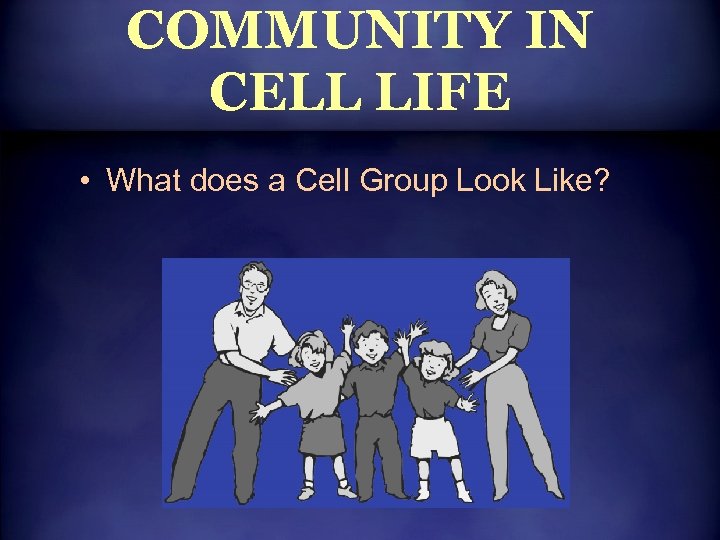 COMMUNITY IN CELL LIFE • What does a Cell Group Look Like?
 Community Acts 2: 42 -47 They devoted themselves to the apostles' teaching and to the fellowship, to the breaking of bread and to prayer. Everyone was filled with awe, and many wonders and miraculous signs were done by the apostles. All the believers were together and had everything in common. Selling their possessions and goods, they gave to anyone as he had need. Every day they continued to meet together in the temple courts. They broke bread in their homes and ate together with glad and sincere hearts, praising God and enjoying the favor of all the people. And the Lord added to their number daily those who were being saved.
 COMMUNITY IN CELL LIFE • Many Bible Study and Small Groups have great meetings, but the life of the group stops when the meeting is over. They stop just after they get started! They are missing out on life together! • The New Testament commands us to Interact with one another as the body of Christ. • The Family of God provides a solid metaphor for Body Life.
 COMMUNITY IN CELL LIFE • Families never stop being family. • Family members spend time together as they “rub shoulders. ” This means they get frustrated with one another. • They work out their differences. They accept one another. They serve one another for the benefit of the whole family! • We do not have time to be the family of God if we are limited to a weekly meeting.
 COMMUNITY IN CELL LIFE The Two Parts of a Cell Group The Part The Meeting Outside the Meeting Time 2 hours 6 days and 22 hours (166 hours) Place Home Everywhere Method Discussion Agenda Personal Interaction Requirement Attendance Love
 COMMUNITY IN CELL LIFE Importance of the Weekly Meeting It is a catalyst for Body Life • The Meeting gets Body Life going! Without a weekly meeting, people will not interact with one another. The meeting starts the process and gets people used to being around one another.
 COMMUNITY IN CELL LIFE Importance of the Weekly Meeting It provides a time for sharing about life outside the meeting. • God is at work in the lives of the cell members. The cell meeting is a great time to share what God is doing, the struggles of the week, future plans, etc.
 COMMUNITY IN CELL LIFE Importance of the Weekly Meeting It connects people who are unconnected in Body Life. • People do not need more meetings in their lives! They Need Relationships! • The Cell Meeting serves as an entry point for new people to get connected relationally.
 COMMUNITY IN CELL LIFE Importance of the Weekly Meeting It provides a place to celebrate what God is doing in the Group. • As the group interacts with one another outside the meeting, the meeting will become a place where members report on what God is doing, share how God is using them, and celebrate these victories together.
 COMMUNITY IN CELL LIFE Importance of the Weekly Meeting The Meeting IS NOT: • The meeting cannot be the place where “ALL” the ministry happens or the place where “ALL” the needs are met. • When groups operate this way, meetings tend to last three and four hours. Eventually people will stop coming!
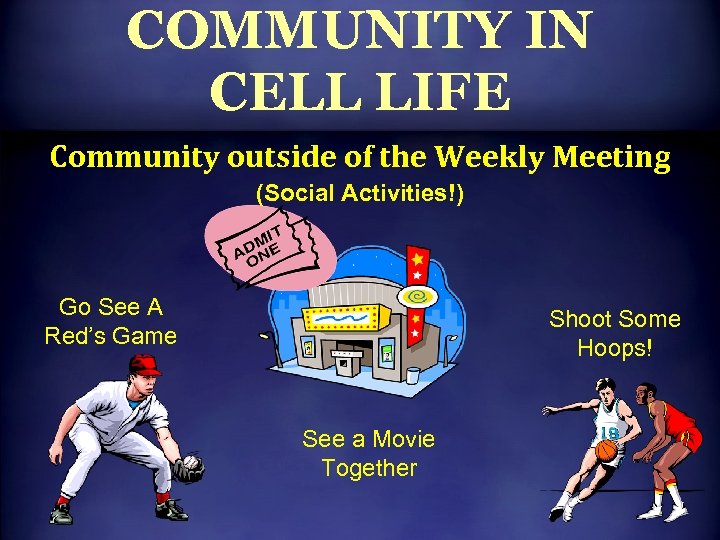 COMMUNITY IN CELL LIFE Community outside of the Weekly Meeting (Social Activities!) Go See A Red’s Game Shoot Some Hoops! See a Movie Together
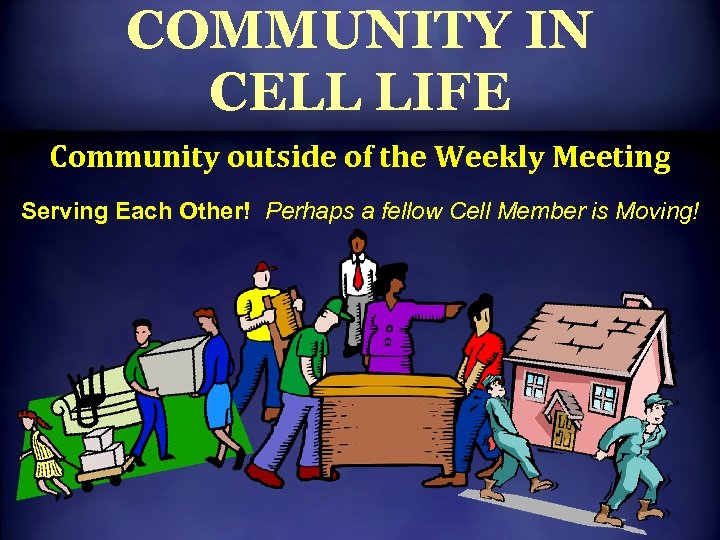 COMMUNITY IN CELL LIFE Community outside of the Weekly Meeting Serving Each Other! Perhaps a fellow Cell Member is Moving!
 COMMUNITY IN CELL LIFE Community outside of the Weekly Meeting In the Cell Church model, a Cell is understood as a Basic Christian Community. Any other groups that exist in a Cell Church would be a subgroup of a Cell group or sub group of multiple cells. These sub-groups do not exist independent of the Cell or Cells. The Cell is the basic building block for the Cell Church Model. It embodies the essence of all that the Bible says about “Church. ” Here people live in community and accountability with one another. In the Cell Group, the presence, power, and purpose of Christ is experienced. It is here, in the cell, that the saints are equipped for the work of the ministry. Periodically, all these Cell groups join together for times of large group meetings and celebration, but the focus and life of the Cell Church is in its Cells.
 COMMUNITY IN CELL LIFE Community outside of the Weekly Meeting The Cell group meeting is the most critical church meeting for a Christian in the Cell Church Model. The Cell is the fountain from which every value of the Christian’s life and every function of the church will find its source. Every member is a member of a Cell Group. While members may be involved in other groups (focus groups/discipleship groups/ministry teams) as well, this involvement never replaces their commitment to and involvement in the primary group, the Cell. There is a need for at least three types of “sub-groups” to be promoted within the cell structure of Reality Ministries, Focus Groups, Discipleship Groups, and Ministry Teams. I will attempt to define quickly the purpose of each of these three groups.
 COMMUNITY IN CELL LIFE Community outside of the Weekly Meeting What is a Focus Group? A Focus Group is a group that is started by a member or members of a cell or a group of cells. The purpose of this type of group is two-fold. First and foremost, this group should be evangelistic in nature, meaning that this group is not only open to non-churched, non-Christian people, but the members of this type of group are ENCOURAGED to reach out to those type of people to BRING THEM IN to the group for the purpose of building trusting relationships with its members. The primary purpose of a focus group is to have this group be a “first step” toward involvement in a cell group.
 COMMUNITY IN CELL LIFE Community outside of the Weekly Meeting What is a Focus Group? A Focus Group is a group that is started by a member or members of a cell or a group of cells. The purpose of this type of group is two-fold. The second purpose of a focus group is to help edify and build up the cell members and other participants, through relational community. This helps cell members to be a part of each others lives not only on a spiritual level, but also a very social level. It also encourages cell members to remember our goal is to reach out and build relationships with non-believers. Hebrews 3: 12 -14 (Encourage One Another Daily)
 COMMUNITY IN CELL LIFE Community outside of the Weekly Meeting What is a Focus Group? A Focus Group will revolve around a shared interest of some sort. It could be a started by a group of folks who enjoy mountain biking, fantasy sports, camping, crafts, cake decorating, even blogging, etc. The goal is to help people who share similar interests to get together to build and strengthen relationships around the shared interest and to find non-Christians who also share that same interest for the purpose of inviting them with the goal of getting them plugged into a cell group and ultimately into a saving relationship with our Lord and Savior, Jesus Christ.
 COMMUNITY IN CELL LIFE Community outside of the Weekly Meeting What is a Focus Group? In a Focus Group, we do not emphasize multiplication. In fact a focus group could end up having as many as 200 members, but could start out with as little as two members. A focus group could decide to multiply into two separate groups that revolve around the same interest if a larger group is not advantageous to that group’s interest. So while focus groups can multiply, the point is that there is no EMPHASIS on multiplication, the EMPHASIS is on EVANGELISM & Laid back social interaction.
 COMMUNITY IN CELL LIFE Community outside of the Weekly Meeting What is a Discipleship Group? Just like a focus group, a Discipleship Group can be started by a member or members of a cell or a group of cells. A Discipleship Group is different from a Focus Group in that the emphasis is NOT placed on inviting non-believers directly into the group as their first experience with the body of believers. Instead, the emphasis of a Discipleship Group is a deeper level of accountability and spiritual growth. Our cell meetings are designed to be an atmosphere where all who attend, including non-believers, can experience the Closeness of Christ. As one matures in their faith, a desire to move into a deeper understanding of who God is comes about.
 COMMUNITY IN CELL LIFE Community outside of the Weekly Meeting What is a Discipleship Group? One of the number one requests that I have had from cell members over the past several years is that they wished that our cell lessons were “More Intense” studies of the scripture. It has been amazing to see some reactions when I’ve shared with those who request this, that the cell meeting is not necessarily the best place for such intense study. The purpose of the cell lesson within our cell meeting is to facilitate discussion, to move people toward more transparent communication (getting real with one another), to get people to focus on God’s Word and to see how it relates to our daily lives. The desire is that this lesson will always be at a level that will provoke good communication from a group of mature believers. However, at the same time, the study must always be at a level where a non-Christian within our meetings can participate in the discussion, even visiting for the very first time.
 COMMUNITY IN CELL LIFE Community outside of the Weekly Meeting What is a Discipleship Group? So where does one turn to experience a deeper level of accountability and a study of God’s Word or principles? This is where the Discipleship Group comes into play. It’s a group of folks who might get together for eight weeks to study a book of the Bible. Perhaps a group of men will get together to discuss a book written on men’s topics. The same can be true of women getting together to study a book written on women’s topics. Perhaps a group of parents will get together for several weeks to study and discuss biblical parenting. The possibilities are great.
 COMMUNITY IN CELL LIFE Community outside of the Weekly Meeting What is a Ministry Team? A ministry team is also a sub-group of cells. It’s a group of people from a cell, or various cells, who choose to integrate their gifts and talents to perform ministry tasks within the church. An example of this might be a celebration set up team who helps set up everything for a Reality Celebration service. The effective use and administration of ministry teams will greatly increase the return on our ministry efforts as people will more effectively function in areas of ministry where their gifts and talents can be best utilized. This is a preferable way to plug people into ministry rather than having cell groups placed on a rotation schedule to perform these tasks.
 COMMUNITY IN CELL LIFE Community outside of the Weekly Meeting The ultimate goal is to add these groups to our “Cell STRUCTURE” to make sure that these groups continue to support the work of the Cells within the Church and to help avoid them from distracting anyone from involvement within a cell. These sub-groups should not exist independent of the Cell or Cells!
 COMMUNITY IN CELL LIFE Community outside of the Weekly Meeting • Eventually, 80% of your interaction with those in your cell group will occur outside of your weekly Cell Group Meeting. (8 Hours) • Cell Groups provide an atmosphere where a complete stranger today will seem like your closest family member in a very short span of time.
 Experiencing Jesus In Your Meeting We’ve Already Discussed the Following in Regards to a Cell Group Meeting It is a catalyst for Body Life It provides a time for sharing about life outside the meeting. It connects people who are unconnected in Body Life. It provides a place to celebrate what God is doing in the Group. So What does a Cell Meeting look like?
 Experiencing Jesus In Your Meeting So What does a Cell Meeting look like? A cell group meeting is a bit like the gathering of a large family. Like a family gathering, a cell group gathering is flexible. It's not always the same. While each Cell Meeting is flexible, there are few common agenda items that will be a part of most meetings.
 Experiencing Jesus In Your Meeting Typical Cell Group Meeting Agenda Food & Fellowship (10 -15 Minutes) This is a time for people to wind down from a long day. A time to just sit back and relax while talking about your day or week. Very informal setting. Announcements & Vision Casting (About 10 Minutes) This is a time to get everyone on the same page. To discuss future meeting locations, future events such as Serve Fest, Guys Night Out, Ladies Night, or any other Church Related events. Worship (About 10 Minutes) This is time for us to Praise God for all that He has done for us. This can be done by singing along with a Guitar or Worship CD, or it can be done by reading Scriptures that lift up and Exalt God, or it can be done by speaking your own words of worship, Praising God for what he has done for you!
 Experiencing Jesus In Your Meeting Typical Cell Group Meeting Agenda Prayer (Outreach Focused) (About 10 Minutes) This time of prayer is for those in our families or in our community that need prayer. This is where people can pray for a co-worker or a neighbor who needs salvation. This is also a time to pray for the needs of our families and for those who are on our invite list. Bible Discussion (About 45 Minutes) This is where we dig into God’s Word. This is where we seek God’s Will for our lives. This is where we discuss how the Scriptures relate to our daily lives. Application Time (Accountability Focused Prayer) (About 30 Minutes) This is a time for us to take God’s word and discuss, “What is the state of your life regarding this issue? ” This is where we make a commitment to apply God’s Word to our lives in a practical way. This is where Biblical Accountability Begins!
 Experiencing Jesus In Your Meeting Discussion Good Communication is Key to a Successful Cell Group Meeting
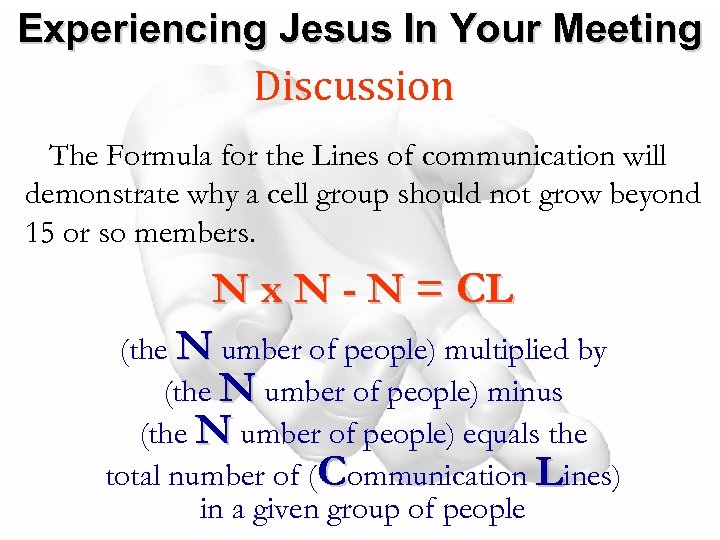 Experiencing Jesus In Your Meeting Discussion The Formula for the Lines of communication will demonstrate why a cell group should not grow beyond 15 or so members. N x N - N = CL (the N umber of people) multiplied by (the N umber of people) minus (the N umber of people) equals the total number of (Communication Lines) in a given group of people
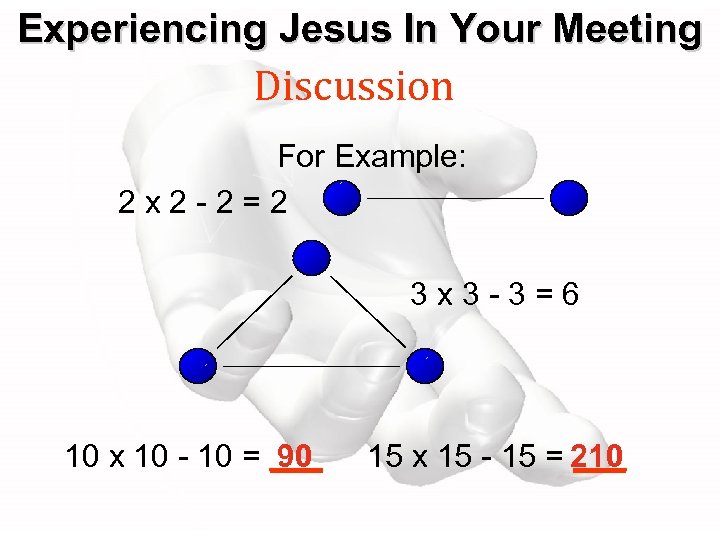 Experiencing Jesus In Your Meeting Discussion For Example: 2 x 2 -2=2 3 x 3 -3=6 10 x 10 - 10 = ___ 90 15 x 15 - 15 = 210 ___
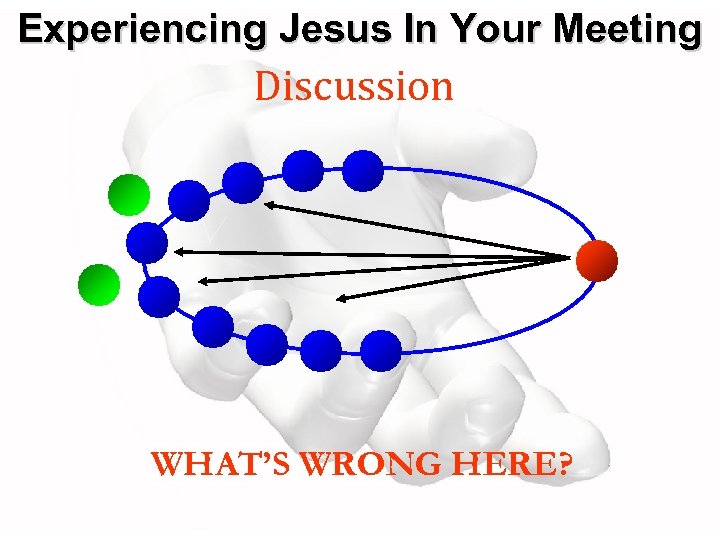 Experiencing Jesus In Your Meeting Discussion WHAT’S WRONG HERE?
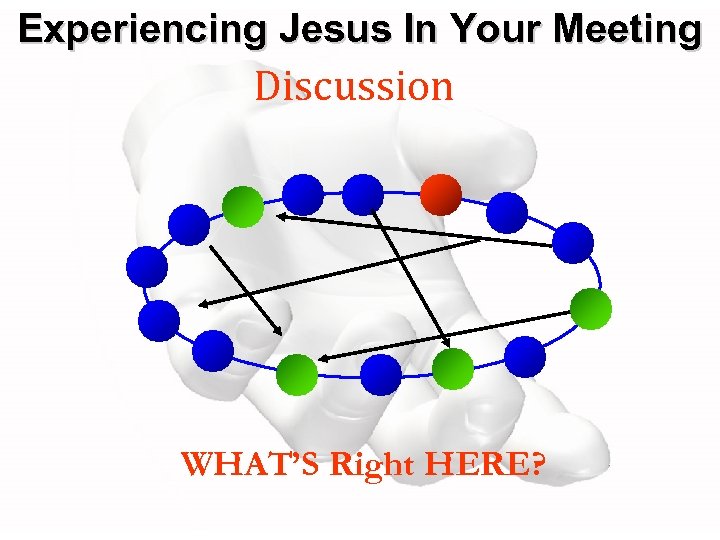 Experiencing Jesus In Your Meeting Discussion WHAT’S Right HERE?
 Experiencing Jesus In Your Meeting Five Levels of Communication 1. Surface Communication Talk About The Weather, Sports, Current Events, Church Activities, etc.
 Experiencing Jesus In Your Meeting Five Levels of Communication 1. Surface Communication 2. Factual Communication Reports Observable ideas or facts. For example, what someone did at work during the week! Or where someone went on vacation!
 Experiencing Jesus In Your Meeting Five Levels of Communication 1. Surface Communication 2. Factual Communication 3. Thought-Provoking Communication When a person reveals what he or she thinks or believes about something.
 Experiencing Jesus In Your Meeting Five Levels of Communication 1. 2. 3. 4. Surface Communication Factual Communication Thought-Provoking Communication Emotive Communication When a person reveals how he or she feels about something. For example, “I feel guilty about missing the cell meeting last week. ”
 Experiencing Jesus In Your Meeting Five Levels of Communication 1. 2. 3. 4. 5. Surface Communication Factual Communication Thought-Provoking Communication Emotive Communication Transparent Communication When people open themselves up to share their deepest fears, dreams, and thoughts. You might see this when someone confesses a hidden sin.
 Experiencing Jesus In Your Meeting Transparency: The First Door • Transparency happens when people take off their masks and let others see who they are. Most People put up guards to protect themselves from others. They will only let people see what they want them to see.
 Experiencing Jesus In Your Meeting Transparency: The First Door • Transparency happens when people take off their masks and let others see who they are. • Transparency requires honesty. Relationships are built upon honesty. Cell Groups are dependant upon relationships. Cell Groups must create an environment where people can be honest even if it is not pretty, nice, or even “Christian. ”
 Experiencing Jesus In Your Meeting Transparency: The First Door • Transparency happens when people take off their masks and let others see who they are. • Transparency requires honesty. • It is very difficult for a cell group meeting to continue over the long term, if group members are not willing to become transparent. Cell Groups without transparency are boring. They are like a garden that never gets tilled. Weeds sprout but they are ignored. Many act as if what is not discussed does not exist!
 Experiencing Jesus In Your Meeting Vulnerability: The Second Door • Transparency leads to vulnerability. Vulnerability happens when one person allows another to speak into their life. Many times people want to divulge issues in their lives, but they don’t want people to do anything about it. When a person walks through the door of vulnerability, they give permission to others to influence their life!
 Experiencing Jesus In Your Meeting Creating an Environment for Transparent Communication • Model openness and trust. Story: There was a cell leader who modeled transparency with her group for months, but no one else would share. She called her pastor and told him she would no longer risk her heart if others were not going to take the risk. They prayed together for a breakthrough. That night, a man who had contracted HIV during his former lifestyle revealed his condition to the group. Up to that point, no one in the church knew of his ailment. The group surrounded him and prayed for him over tears and hugs. Two ladies were visiting that night for the very first time. One stood up and said, “This is crazy. ” And she left. The other began to cry and share how she had been abused as a child. Through more tears, prayers, and hugs, this woman received Christ as her Savior and experienced a lot of healing for the first time!
 Experiencing Jesus In Your Meeting Creating an Environment for Transparent Communication • Model openness and trust. • Don’t fall into the perfection trap. Cell group leaders are not perfect! Don’t be afraid to let people know this! If your cell members believe that you are perfect, they will never step up to the call of leadership as they will feel that it is required that they be “perfect” like you before they can become leaders themselves.
 Experiencing Jesus In Your Meeting Creating an Environment for Transparent Communication • Model openness and trust. • Don’t fall into the perfection trap. • Be honest when you need prayer. When hurting, exhausted, or struggling, cell leaders should feel confident in asking their group members to pray for them. (With Discernment & Balance)
 Experiencing Jesus In Your Meeting • • Creating an Environment for Transparent Communication Model openness and trust. Don’t fall into the perfection trap. Be honest when you need prayer. Ask for help from group members. Don’t equate cell leadership with doing everything yourself. If you do, YOU WILL GET BURNED OUT! Delegate tasks to others. Most want to contribute to the group. This increases ownership as people contribute to the success of the group.
 Experiencing Jesus In Your Meeting • • • Creating an Environment for Transparent Communication Model openness and trust. Don’t fall into the perfection trap. Be honest when you need prayer. Ask for help from group members. Deal with hidden sin in your life. When a leader starts leading a cell group, Satan will start to areas that affect purity, integrity, and character to tear down his or her ministry and the entire cell group system. Don’t let these things take hold of your life, get with your Pastor or Accountability Partner Immediately!
 Experiencing Jesus In Your Meeting • • • Creating an Environment for Transparent Communication Model openness and trust. Don’t fall into the perfection trap. Be honest when you need prayer. Ask for help from group members. Deal with hidden sin in your life. Don’t hesitate to receive affirmation. True humility receives positive feedback along with constructive feedback. Statements like, “I take no credit, ” or “It’s All God and I am only a vessel, ” are often signs of false humility and create an environment where people cannot encourage one another. A simple “Thank You” is often the best response.
 Experiencing Jesus In Your Meeting Creating an Environment for Transparent Communication • Give permission for group members to reveal their struggles. It may seem trivial, but giving group members permission to reveal their struggles is important for cell leaders to do. It may even need to be done regularly until people begin to share openly.
 Experiencing Jesus In Your Meeting Creating an Environment for Transparent Communication • Give permission for group members to reveal their struggles. • Affirm those who share their struggles. “I’m really glad that you shared that. ”
 Experiencing Jesus In Your Meeting Creating an Environment for Transparent Communication • Give permission for group members to reveal their struggles. • Affirm those who share their struggles. • Lead the group to commit to confidentiality. If people feel that what is being shared will be shared elsewhere in the church, they will never share again. Leaders need to offer reminders of the need for confidentiality from time to time.
 Experiencing Jesus In Your Meeting Creating an Environment for Transparent Communication • Give permission for group members to reveal their struggles. • Affirm those who share their struggles. • Lead the group to commit to confidentiality. • Don’t give or allow others to give “pat” answers to problems. This is common in groups. People want to help, but they don’t know how. So they give easy answers. When this happens, something like this can be said. “Thanks for your input, Jamie, I hear that you are really struggling. Can we pray and see what the Lord wants to do in your life? ” This shifts the emphasis off the advice and puts it on the Lord.
 Experiencing Jesus In Your Meeting The Goal is not Transparency! The Goal is not Vulnerability! The Goal is Transformation! Transformation is the result of God’s movement as he leads people to edify one another and pray for one another so that people are healed. This is the Promise of James 5: 16… “Therefore confess your sins to each other and pray for each other so that you may be healed. The prayer of a righteous man is powerful and effective. “ Transparency + Vulnerability + Edification = Transformation
 Experiencing Jesus In Your Meeting A cell group Meeting is more than just another MEETING. It’s all about forming RELATIONSHIPS. The real power of the cell group gathering is that Jesus SHOWS UP! The purpose of the cell meeting is to reveal God’s CLOSENESS. To Experience Jesus!
 EVANGELISM AS A LIFESTYLE
 Evangelism Myths Realities Implications
 Myth #1 -Relationship Myth: Evangelism Means Reaching Strangers. Reality : Most People are Reached by Friends. Implication: Cell Members Will Focus their Love and Prayer on those Close to Them.
 Myth #2 -Evangelist Myth: Most People are Reached by Professional Preachers. Reality : Most People are Reached by Ordinary Christians. Implication: We Will Equip Everyone to Share Christ in Word and Deed.
 Myth #3 -Conversion Myth: Conversion is Normally Instantaneous. Reality : Conversion is Usually a Process. Implication: We will Provide Multiple Opportunities for People to Hear the Gospel.
 Myth #4 -Influence Myth: Evangelism Means Just Saying the Right Words. Reality : People are Won to Christ through Active Love and Words. Implication: We will Encourage Cell Members to Look for Felt Needs and Express Christ’s Love in Action and Words.
 EVANGELISM AS A LIFESTYLE Matthew 9: 36 -38 When he saw the crowds, he had compassion on them, because they were harassed and helpless, like sheep without a shepherd. Then he said to his disciples, "The harvest is plentiful but the workers are few. Ask the Lord of the harvest, therefore, to send out workers into his harvest field. " Cell Group Outreach Mission…
 EVANGELISM AS A LIFESTYLE Cell Group Outreach Mission… A. SEEK the LOST. B. CARE for them when we find them. C. Equip others to do THE SAME THING.
 EVANGELISM AS A LIFESTYLE Implementing Effective Outreach as a Cell Group A. MODEL IT. The other cell members must see you reaching out to understand! B. Remind members to EXTEND their circle of non-saved friends. C. Make a Cell Group PRAYER LIST having each member name two non-saved friends.
 EVANGELISM AS A LIFESTYLE Implementing Effective Outreach as a Cell Group D. Encourage each person to listen to the HOLY SPIRIT. E. Use TEAMWORK (Focus Groups & Events) F. Ask and pray with other Cell members about their call to outreach.
 WHAT’S A CELL LEADER ANYWAY?
 What Is a Cell Leader? A Cell Leader is NOT a Hired Hand! A Cell Leader is NOT someone who leads a meeting once a week. A Cell Leader IS someone who has been trained in the Cell Vision and has a passion to encourage others to use their gifts and talents for the benefit of the Church.
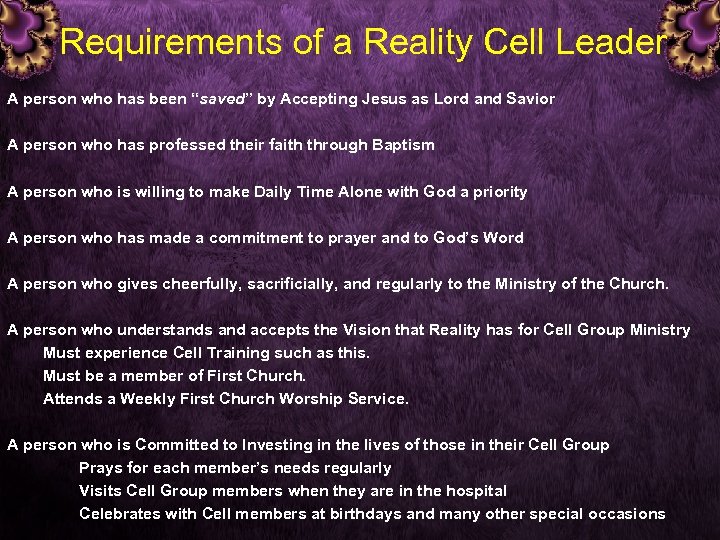 Requirements of a Reality Cell Leader A person who has been “saved” by Accepting Jesus as Lord and Savior A person who has professed their faith through Baptism A person who is willing to make Daily Time Alone with God a priority A person who has made a commitment to prayer and to God’s Word A person who gives cheerfully, sacrificially, and regularly to the Ministry of the Church. A person who understands and accepts the Vision that Reality has for Cell Group Ministry Must experience Cell Training such as this. Must be a member of First Church. Attends a Weekly First Church Worship Service. A person who is Committed to Investing in the lives of those in their Cell Group Prays for each member’s needs regularly Visits Cell Group members when they are in the hospital Celebrates with Cell members at birthdays and many other special occasions
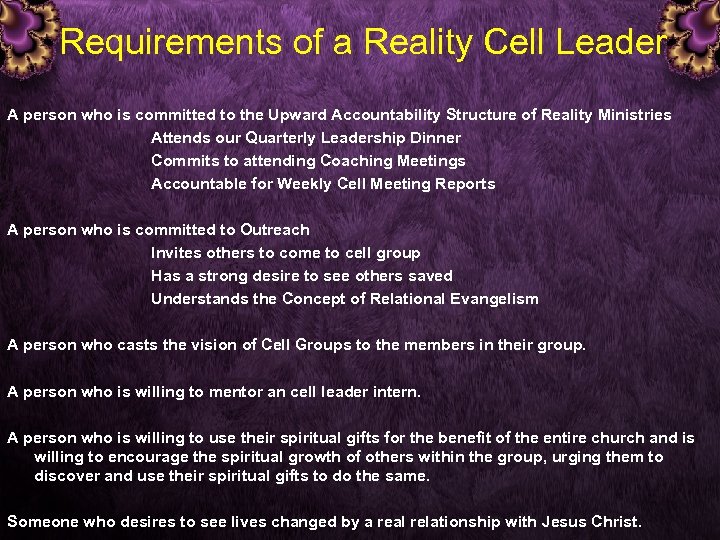 Requirements of a Reality Cell Leader A person who is committed to the Upward Accountability Structure of Reality Ministries Attends our Quarterly Leadership Dinner Commits to attending Coaching Meetings Accountable for Weekly Cell Meeting Reports A person who is committed to Outreach Invites others to come to cell group Has a strong desire to see others saved Understands the Concept of Relational Evangelism A person who casts the vision of Cell Groups to the members in their group. A person who is willing to mentor an cell leader intern. A person who is willing to use their spiritual gifts for the benefit of the entire church and is willing to encourage the spiritual growth of others within the group, urging them to discover and use their spiritual gifts to do the same. Someone who desires to see lives changed by a real relationship with Jesus Christ.
 Characteristics of a Reality Cell Leader What characteristics did I leave out that you might think would be important to Cell Leadership? Trick Question Prior Leadership Experience is not Required. Professional Ministry Training is not Required. You do not have to be a graduate of a Bible College or Seminary. Acts 4: 13 The members of the council were amazed when they saw the boldness of Peter and John, for they could see that they were ordinary men who had no special training. They also recognized them as men who had been with Jesus. (NLT)
 Multiply Yourself
 Multiply Yourself! Follow Me! “Follow my example, as I follow the example of Christ. ” — Paul (1 Corinthians 11: 1) Like The Apostle Paul, we are to Call others to follow in our footsteps. To train them to do the ministry that we do.
 Multiply Yourself! Jesus said to his disciples, “So pray to the Lord who is in charge of the harvest; ask him to send out more workers for his fields. ” 1. Pray! (Matthew 9: 38) 2. See everyone as a Potential Cell Leader. (Ask God for faith) 3. Constantly involve others in ministry. 4. Give people responsibilities BEFORE you ask them to be leaders. 5. Consult with those over you before giving any titles or positions.
 Multiply Yourself! 6. Take time to pray with others for a multiplication of leadership. 7. Look for those in your group who have a heart for people and a teachable spirit that demonstrates leadership potential. 8. Find ways that these potential leaders can be involved in ministry
 Multiply Yourself! 9. Pray and plan with your interns. 10. Ask before you correct. (James 1: 19) “My dear brothers, be quick to listen, slow to speak, and slow to get angry. ” 11. Encourage!
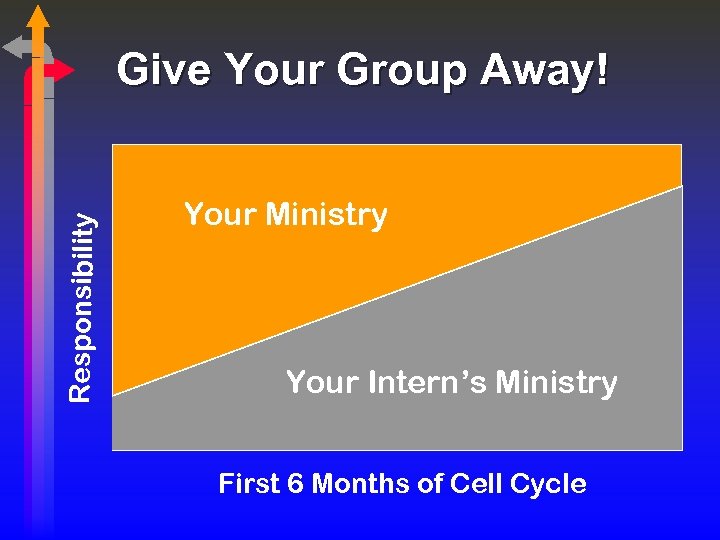 Responsibility Give Your Group Away! Your Ministry Your Intern’s Ministry First 6 Months of Cell Cycle
 Multiplying Your Group Why Should We Multiply? What To Do Before We Multiply? When Should We Multiply? How Should We Multiply? What After We Multiply?
 Multiplying Your Group Why Should We Multiply? Jesus Said “Go and make disciples of all nations. ” The existence of the Christian Church for future generations depends on the concept of reaching others for Christ and teaching them to do the same. If we don’t multiply, we will die.
 Multiplying Your Group What To Do Before We Multiply? Communicate the vision of Multiplication from the beginning and do it CONSISTENTLY. Pray for and look for more POTENTIAL CELL LEADERS from the very beginning. (See every Cell Member as a PCL) Recruit and train INTERNS.
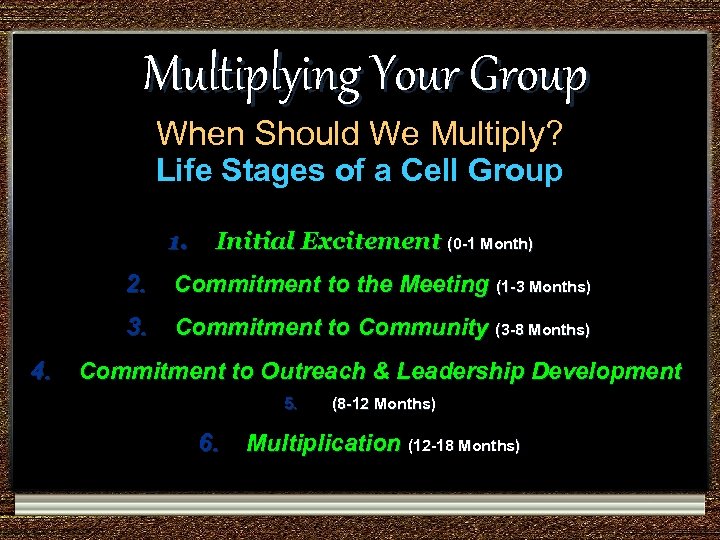 Multiplying Your Group When Should We Multiply? Life Stages of a Cell Group 1. Initial Excitement (0 -1 Month) 2. 3. 4. Commitment to the Meeting (1 -3 Months) Commitment to Community (3 -8 Months) Commitment to Outreach & Leadership Development 5. 6. (8 -12 Months) Multiplication (12 -18 Months)
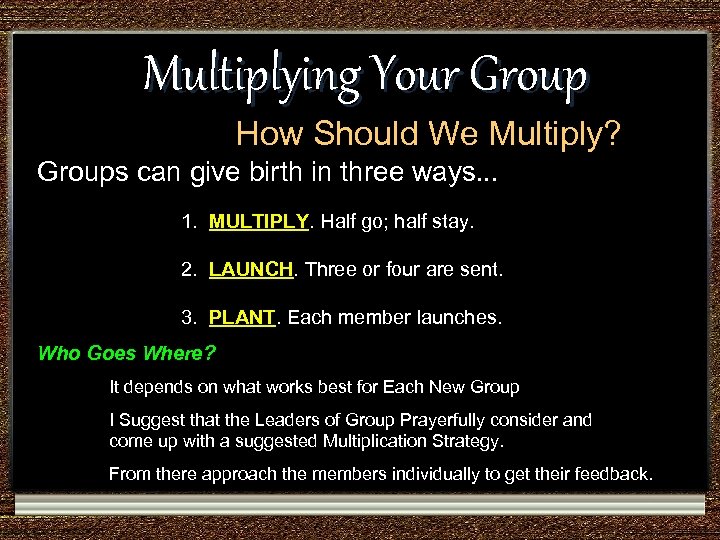 Multiplying Your Group How Should We Multiply? Groups can give birth in three ways. . . 1. MULTIPLY. Half go; half stay. 2. LAUNCH. Three or four are sent. 3. PLANT. Each member launches. Who Goes Where? It depends on what works best for Each New Group I Suggest that the Leaders of Group Prayerfully consider and come up with a suggested Multiplication Strategy. From there approach the members individually to get their feedback.
 Multiplying Your Group How Should We Multiply? Make this a BIG DEAL!!! BECAUSE IT IS!!! Have a Multiplication CELL-E-Bration! Throw A Party to Celebrate what God has done and is doing! Have a time where each member can share how God has used this cell group to bless their life Spend time in Worship Have Communion Together Look at Scriptures that instill the vision of outreach and multiplication. Lay Hands on & Bless the Leaders of each new group
 Multiplying Your Group What After We Multiply? Most Important thing to remember!!! We are a Family! This is not a divorce!!! Implement in advance ways that you are going to facilitate community with those in the other group. Focus Events Focus/Share Groups Discipleship Groups Reunion Dinners
 Where Do We Go From Here?