 Скачать презентацию Welcome To My Homepage Japanese Web Sites and
967d26c91712f3ea44097c6b9da435ea.ppt
- Количество слайдов: 131




“Welcome To My Homepage…”: Japanese Web Sites and Strategies for Defining Self
Todd Joseph Miles Holden Professor, Mediated Sociology Chair, Dept. of Multi-Cultural Societies Graduate School of International Cultural Studies Tohoku University Sendai, Japan
I. Introduction: Studying the Japanese Internet Research on the Internet in Japan has been conducted for over a half a decade now Yet it has received near total neglect in the English-speaking world. Partially, at least, this is likely due to the rather impermeable language barrier.
A Beginning That has begun to change with Gottleib and Mc. Lelland’s collection of fourteen studies (2003) on “Japanese cybercultures” And isolated studies, such as Katsuno and Yano (2002)
Other Suppressing Factors Slow propagation of the web in Japan In 1996, Internet access from households stood at a mere 3%; businesses at 6% By the year 2000, however, that figure had risen to 34% and 45%, respectively
A Slow Diffusion? Japan, as the second largest economy in the world, and the ninth most populous country, has only the 14 th most diffusion of Internet through its population Still, it enjoys the third highest rate of web access in Asia (behind Hong Kong and Singapore); and the fifth in Oceania (behind Australia and New Zealand)
Increasingly Webbed World With cell phone ownership now exceeding 70% (and with much of those devices Internet-enabled), web surfing and Internet communication have become everyday practice among Japanese.
Research Questions Enough for one to wonder: what do Japanese people do on the web and is it all that different than Internet users elsewhere?
Past Studies lifestyle usage: communication through email (e. g. Mc. Veigh 2003), social web-spinning (Holden and Tsuruki 2003), customizing and accessorizing of daily life (Hjorth 2003). information: Service function of web pages (e. g. Mackie 2003; Onosaka 2003) propagandistic/informational funciton (e. g. Kienle and Staemmler 2003)
Same Tack in Japan Li, Shibata and Ikeda (1998) have explored how the Internet has been used to create greater opportunities for social participation among those normally excluded: Due to education, economics, social position, geographic location, or lack of resources.
Identity and the Web Less observed by researchers – whether English-speaking or Japanese -- has been identity construction on the Japanese web. Gottlieb (2003: 190), for one, has recognized this as a salient issue. Though slow in terms of scale, “the process of virtual identity construction… in Japan … are just as absorbing (as in the United States and Australia)”
Japanese Identity Research For about a half decade now work on Identity on the Japanese Internet has been conducted. Yamashita (1997, 2002) Kawaura et al, 1998 Most of it has involved “web logs” – akin to what are known as “blogs” in the West
A Research Aim These are not the only web pages in which one can encounter personal statements of identity. The aim of the instant research is to seek out such pages and provide a cursory introduction to the kinds of identifications or identity statements Japanese are disseminating on-line today
II. On Identity
Hall: on Identity is “produced within specific historical and institutional sites within specific discursive formations and practices, by specific enunciative strategies, ” (1996: 4)
Claim The Internet is: an institutional site in which discursive formations concerning identity are gathered within which enunciative strategies can be discerned.

Kinds
The Compound Nature of Identity Individually Interactively Institutionally
Individually Here I intend Giddens (1991) idea of the “narrative of the self”: the story or stories by means of which self-identity is reflexively understood
Interactively Here I intend Woodward’s (1997: 1 -2) view: identity is “the interface between subjective positions and social and cultural situations (that) gives us an idea of who we are and of how we relate to others and to the world in which we live. ”
Contextalized Interactions Often narratives and interactions occur within bounded, or structured contexts. And nearly as often these narratives occur via media. As Gauntlett (2002) says: “The media disseminates a huge number of messages about identity and acceptable forms of self-expression, gender, sexuality, and lifestyle. ”
Institutionally Thus, the third view that institutions (such as commercial, information or entertainment media) play a prominent role in the construction and communication of these narratives at both individual and interactive levels
Levels refers to zones by which people arrange themselves in “social space”
Levels distinguish between four zones: l trans-national l group l individual
Levels These zones are often delimited by the institutions through which communication transpires
Levels: Example while the world wide web is generally a trans-national medium, web pages written in Japanese are above all intended for a particular language community – one that, though not perfectly so, is almost entirely national in configuration
Forms Relatively independent of these zones of social configuration are the specific media through which identity discourse passes
Media Formal organized, institutional structures and devices Examples: advertising, television, music, cell phones, web pages Informal systems of symbolization Examples: tattoos, body piercing, make-up and apparel
Content the wide array of themes, embodiments and ideas comprising identity discourse
Genres within each medium content is often packaged as genres Here, the genres that I focus on include: personal diaries travel logs fan pages designated by the title: “Welcome to My Home Page. ”
Mediated Identity Institutional, Individual, Interactive all at once
Mediated Identity: Institutional Site the mediations are ensconced in and disseminated via the web
Mediated Identity: Forms The specific page types constitute discursive formations
Mediated Identity: Interactive · communicated by individuals (most often) or groups to: other individuals (and less often groups)
Content these pages contain enunciative strategies concerning identity
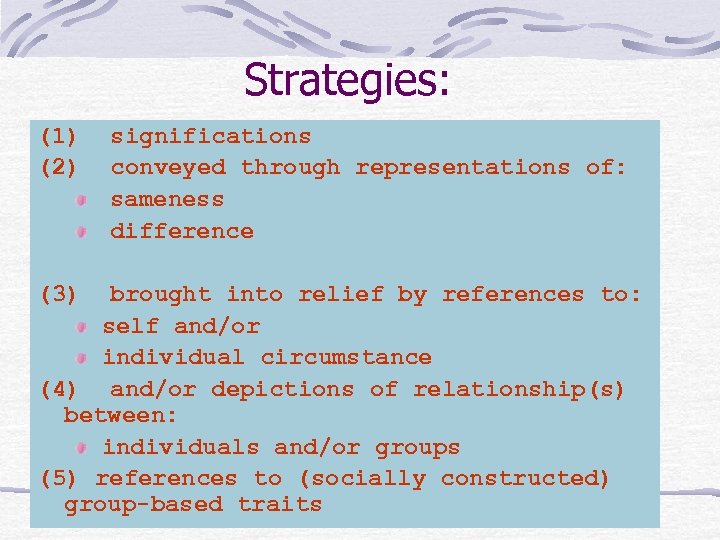
Strategies: (1) significations (2) conveyed through representations of: sameness difference (3) brought into relief by references to: self and/or individual circumstance (4) and/or depictions of relationship(s) between: individuals and/or groups (5) references to (socially constructed) group-based traits
The Road From Here This paper employs the above categories to sort and organize web page data as a means of capturing and evaluating contemporary Japanese identity discourse Before performing this operation, let’s explore the nature of Japanese identity
III. On Japanese Identity In this section I talk about 2 views of Japanese identity
Nihonjinron The first, immediately following the pacific war and well into the 1980 s was of ironclad uniformity There was a “myth of Japanese uniqueness” (Dale 1986) which clouded all analysis
Crumbling Consensus Since the 1980 s the position has been advanced that “the Japanese have rather developed, though different, concepts of privacy and the self… a close look at Japanese society will reveal healthy expressions of self-interest, nonconformity and the differentiation of one individual from another. ” -- Moeur and Sugimoto (1986: 210)
Identification: Collective or Individual? In contemporary Japan visible markers of collective identity abound But identity is rarely perfectly fixed and statements of individual difference can be easily located Even in situations in which uniforms or other collective markers are required
Holden (1994) Tokens of differentiation are employed to serve as “discreet statements of difference for those wishing to be considered as discrete statements. ”
Mc. Veigh (2003) Has labeled this phenomenon “personalized individualization. ”
Individuation and the Web We know from prior research (Holden and Tsuruki 2003) that Japanese employ peripheral web-tools to express individual self; Among these: Screen savers Personalized dial-tones Attached accessories
Individuation and the Web The nature of personal web sites not only lends itself to manifestations of individuation, but demands it. Statements of individual identity are almost unavoidable… even in “monolithic Japan”.
IV. On Method: Problems in Researching the Internet
1. Representativeness Does the Internet user population reflect the larger population? Early evidence suggested “No” technologically proficient males who work in computer, academic, or other professional fields Bradley 1999 Metha and Sivadas 1995 Tse 1998
Representativeness Does the Internet user population reflect the larger population? Rival evidence suggests “Yes” Smith and Leigh’s (1997) demographic characteristics of online and off-line populations differ in terms of age and gender however, not significantly different in terms of: sexual orientation marital status ethnicity education religiosity
Representativeness Recent evidence (Pew 2000) women are “surging to gender parity” in their use of the Internet Though this increase is expressed in ways that differ in fundamental ways from how men communicate (Boneva, Kraut and Frohlich 2001) Also, this is in America
2. Authenticity How truthful are claims that appear, and more, how is a researcher to know? Ciolek (1996): “WWW documents continue to be largely unattributed, undated, and unannotated. As a rule, information about the author and publisher is either unavailable or incomplete. ”
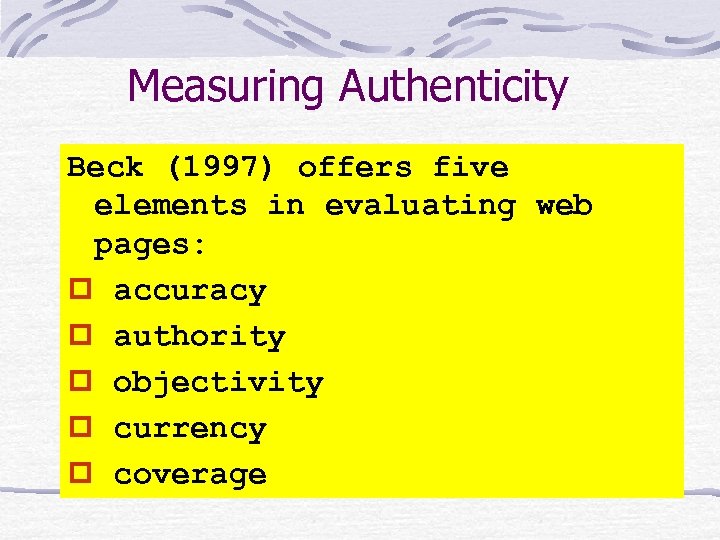
Measuring Authenticity Beck (1997) offers five elements in evaluating web pages: p accuracy p authority p objectivity p currency p coverage
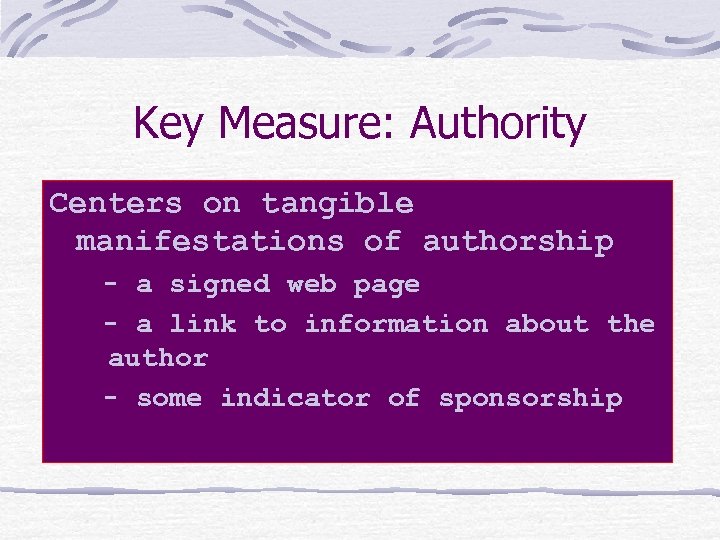
Key Measure: Authority Centers on tangible manifestations of authorship - a signed web page - a link to information about the author - some indicator of sponsorship
In this Study It is indicia of authorship – tokens of representation – that most capture our attention We aim at knowing whether the published identities bear any true correspondence to “reality”
In this Study There is good reason to believe that: many such “authoritative” communications can be gleaned (that is, author’s identity can be verified); and (2) these communications tend to rather closely reflect the actual lived lives of their creators in Japan (1)
3. Evaluating Pages Concern about researcher subjectivity in selecting pages for analysis leads to asking: By what criteria do we type and select web pages for coding and analysis?
Evaluating Pages In order for a document to be found it has to somehow be labeled Rather than sorting aimlessly through “untitled documents” it is best to use some system of classification
Self-Evaluation as Methodology Rely on how web creators label their pages upon submission either to a search engine or for inclusion on an established site as a link Brandt: “This… method tends to be highly selective and thus somewhat evaluative. ” Note: It is the system employed by Yahoo!, the search engine used here
4. Creating Categories Still, left with the problem of how to select pages that will then be harvested for identity content Random sampling of the entire universe of pages is possible, but discarded: less efficient favors “numeracy”
Another Approach presumes that identity discourse can be discovered on web pages Further, proposes that certain types of pages will more likely and profitably be sampled to determine both the extent and nature of identity discourse
Past Models Aoki (2000): comparative content analysis of the top fifty rated sites in both the U. S. and Japan categorizing sites into one of six types: Portal ISP Shopping Service Content provision Corporate customer support) Content in both countries ranks fourth out of the five categories 14% trafficked in the U. S. ; 6% in Japan
Past Models Pew (2001): user activity in the U. S. “the vast majority of those who are online during a typical day read and send email” 29% engage in “fun” things -- such as browse, send instant messages, play games, and obtain information about hobbies 33% use the web as an “information utility” – such as obtaining news, financial information, and product or travel information 21% use it to perform “important life activities” – such as gather health information, do work- or school-related research, and find leads about new jobs
A Focus on Content Pages Defined: pages that enable one to browse for fun, to gather information for work, research, travel or investment
Searching for Identity We also seek out pages generally designed by individuals as a means of communicating narratives of self.
Types of Content Pages A wide array of “content” pages exist. The question then becomes which category or categories should pages be selected for assessment?
Past Identity Studies: Yamashita (1997) Distinguished between three types: business journal-style biographical style The latter two fit the definition of "content pages".
Types of Content Pages Diaries Travel Diaries Fan Sites “Welcome to My Home Page…”
Diaries: defined Those pages in which web-designers record details of their daily lives Similar to "blogs" in the Englishspeaking world Numerous provider-sites offer a software application affording easy daily up-dating Emphasis on thoughts and daily activities Features feedback from web-surfers
Diaries: Examples “se-rusu doraiba no haitatsu nikki" (Sales-driver delivery diary) “shihosyusei no tsuma nikki” (diary of the wife of a lawyer in training) “seiji ka tsuma miyuki no nikki” (The diary of Miyuki, politician’s wife) “denkiyasan no honne” (True feelings/thoughts of a electrician) “sarakin kimmu nisshi” (The work diary of a loan shark)
Travel Diaries: Defined Pages that record visits made by web crafters to locales (generally) away from where they live Such pages often include photos, foreign vocabulary, maps, food menus and travel itineraries The locales can be distinguished into foreign and domestic, although some pages blend the two.
Foreign Travel Diaries: Examples “BULA Fijii riyokouki" (Wandering aimlessly, Fiji travel diary) “Santa no Toruko hikki” (Santa’s Turkish Diary) “jounetsu wa sekai wo kakeru” (Dashing with Passion Around the World) “shiteki Guatemara, Beri-zu, Mekishiko ryokouki” (Private travel diary of Guatemala, Belize, Mexico) “nyuu karedonia no shokai” (Introducing New Caledonia) “AMERICA DRIVE”
Domestic Travel Diaries: Examples "edokko sanpo nikki" (An Edo-an walking diary) "kansai suke-ta- M. S. no pe-ji" (Kansai Skater M. S. 's Page)
Fan Sites: Defined · Tthose pages that pay tribute to a particular person or group or event associated, in the main, with popular culture. Most common site categories include singers, athletes, actors and comedians, and comic characters. Those being paid homage to are generally -though not exclusively -- domestic figures.
Fan Sites: Examples Matsuda Seiko, Hamasaki Ayumi and Utada Hikaru (Japanese female singers) SMAP and Bon Jovi (male pop groups) Doraemon and Sailor Moon (animation characters).
“Welcome to My Home Page…” · Web sites which begin with this salutation The themes are variable
![“Welcome to My Home Page…”: Examples "Indojinttenowa…” [An Indian is…] "bike watashi no Ho-mu](https://present5.com/presentation/967d26c91712f3ea44097c6b9da435ea/image-75.jpg "“Welcome to My Home Page…”: Examples \"Indojinttenowa…” [An Indian is…] \"bike watashi no Ho-mu")
“Welcome to My Home Page…”: Examples "Indojinttenowa…” [An Indian is…] "bike watashi no Ho-mu Pe-ji e youkoso" [Bike, welcome to my home page] "kaze to hikari to toritachi to. . . " [With wind and lights and birds]
The Data The emphasis was not on drawing a large enough sample to generalize about identity within any category The aim was to select pages which might yield a sampling of the types of identity discourse "out there“ In short, representation, rather than representativeness was sought
2 Distinct Groups of Data Pages separate into 2 distinct sets: Diaries, Travel Diaries and "Welcome to My Home Page. . . " on the one hand, and Fan Sites on the other.
2 Distinct Groups The former are pages that -regardless of theme -- are grouped by Yahoo! as a complete, hermetic set (i. e. Travel Pages) The latter are more meaningfully separated by Yahoo! in terms of specific sub themes For instance, the category “Fan Sites” yields only 128 pages in English; 187 in Japanese
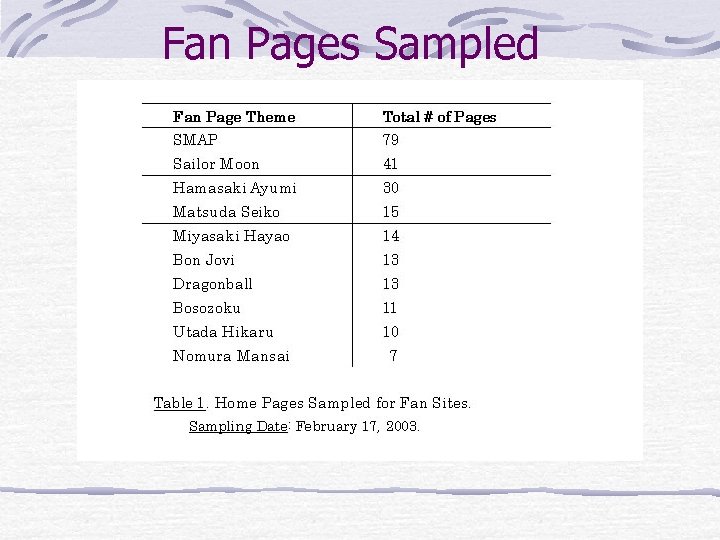
Fan Pages Sampled
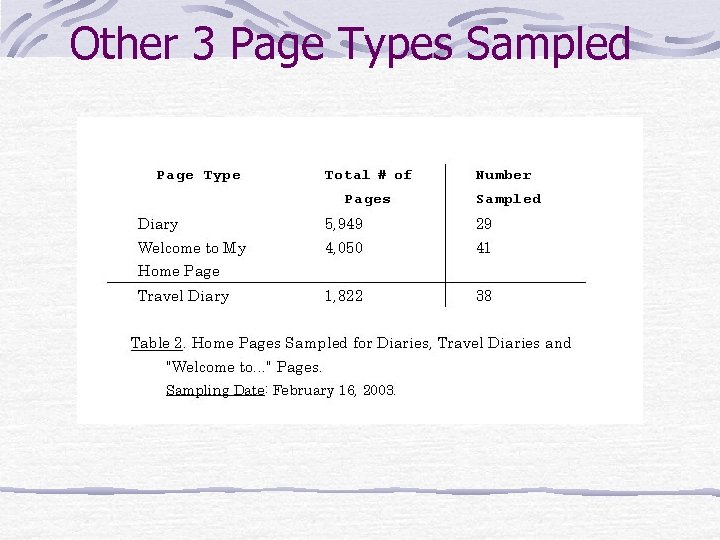
Other 3 Page Types Sampled
Analysis Even given these four types of web pages, there are still thousands of pages available for analysis As a preliminary means of coding, I sorted web pages in terms of the definition of mediated identity offered earlier
1. significations In numerous pages, icons (pictorial representations) are employed to serve as indicia of the web crafter's identity For instance, in "diary of a mad hotelier" a cartoon figure depicts a smiling concierge near the page's header.
Significations Individual identifications are created via the conjuring of (here, linguistic) signs which serve to intentionally communicate meanings. "The Diary of an Edo Walker“ "The Diary of an IBM worker in Beijin” "AMERICA DRIVE” These titles reflect not only theme, but carefully cogitated manifestations of self So too with the choice of font, of language, institutional designation, historical location
2. representations of sameness Narrations of self tend to demarcate the writer as a distinct entity Via presentations of children, cars, pets, work, hobbies, passions, and specific lived situations Implicitly they speak to difference. Thus, little discourse on web pages focuses on sameness.
2. representations of sameness When similarity appears it tends to emerge in travel pages in particular, foreign travel There, web crafters are brought face -to-face with the practices, values and ideas that are ostensibly alien to their own Upon reflection, though, lifestyles end up seeming little different than one's own.
2. representations of sameness: Example "Ajia no kishi" (Asian knight): the writer says that after traveling to Vietnam, Taiwan and New York, it appears that life in Tokyo and New York are not very different. Admittedly, such a statement is less a narrative of the self, than a consideration of geographical and social condition.
3. representations of difference Semiotic theory holds that meaning is often generated via the juxtaposition of opposites. Travel diaries offer many opportunities for opposition to arise: Given that various foreign practices provide web designers with fodder for reflecting on their values and practices, as well as those of groups from which their conception of self is derived.
3. representations of difference: Examples In "Ajia no kishi" the author speaks of differences discernible between: himself and tourists from western countries locals and visitors from the west
More Examples of Difference So, too, in the conception and naming of certain pages is difference foregrounded: "ha-remu nikki" (Harlem diary) "Noruue- nikki" (Norway Diary) "Taipei shou ryokouki" (Taipei short trip diary)“ "Indojinttenowa? " (What is an Indian? ) Each page presents the subject as if it is an exotic culture, viewed from the outside. The author's understanding and experience of self is refracted through these contrasted ethnic and national cultures
4. references to self The self-reflexivity of pages begins with the page name It serves as frame for definition, presentation narration of self. the and
References to Self: Examples "Yujirouno ho-mu pe-ji (Yujiro’s home page) " “seiji ka tsuma miyukino nikki (The diary of ” Miyuki, politician’s wife) "watashino ryokou kaban (My travel bag) " "Naranbo no shiuri nikki " (Naranbo’s handyman diary) "kisshi no udon nikki (Kissy’s udon [noodle] " diary)
Self-Reflexivity in Content Pages are rife with descriptions of attributes of the self Such as the page that introduces an unconventional teacher (due to long hair and dress) So, too, explanations of feelings and motivationz for visiting these locales Words like "special feelings", "inspiration", and "admiration" for the people met and places visited appear.
5. references to individual circumstance Numerous pages make reference to the situation in which one’s life is embedded Often this entails defining oneself institutionally – as mother or worker Individuals thus seek to locate themselves within distinct groups. Examples include “mama’s café” or the “diary of an IBM worker in Beijin” or “Diary of a Mad Hotelier”.
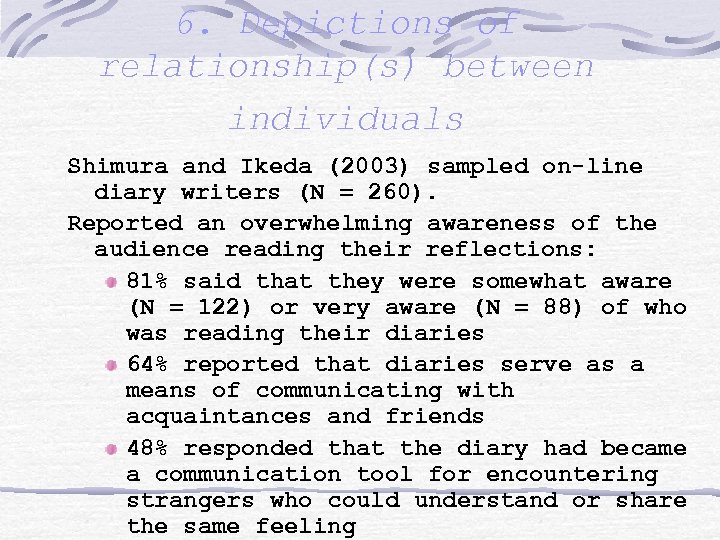
6. Depictions of relationship(s) between individuals Shimura and Ikeda (2003) sampled on-line diary writers (N = 260). Reported an overwhelming awareness of the audience reading their reflections: 81% said that they were somewhat aware (N = 122) or very aware (N = 88) of who was reading their diaries 64% reported that diaries serve as a means of communicating with acquaintances and friends 48% responded that the diary had became a communication tool for encountering strangers who could understand or share the same feeling
Interpreted In short, the feedback or chat function of web diaries work as a means of exchange between individuals
Applied Importantly, though, it is not only on web diary pages, but on "Welcome to. . . " pages which contain bulletin boards, as well as fan sites.
Evidence Thus one finds: many comments to mothers about how beautiful their children are constructive comments about their child -rearing practices On fan sites: there is a heavy emphasis on exchanging opinion and forging connection between web creator and reader use of specialized terminology, slang and motivated exchange of opinion providing clear evidence of (two-way) identification narrative
7. depictions of relationship(s) between groups Role is evident in numerous pages - from work designations to status as wife, mother, husband, parent. The effect is to ground the narrative of self within the larger social context a context that is socially constructed, filtered, interpreted, and acted on.
Socially-Constructed Groups: Examples Pages devoted to parenting: “fufu de ikuji by Wakita Sakiko” (husband wife child-rearing by Wakita Sakiko) “mama's cafe” (mother's cafe) “ikuji ororo, wahhahha” (Child-rearing: trouble and happiness) In addition to social attributes in the titles, web content forwards a narration of self founded on childrearing and status as parent, mother and/or spouse.
8. references to (socially constructed) group-based traits
Summarizing thus far On balance, despite the reference to socially constructed traits, there is less overt discourse about group identity than individually-defined identity. Some web site titles, however, do indicate the web master’s social or economic location in society. For example, on the page “aru shogakko kou kyoiin no mainichi” (The daily life of that elementary
Discussion Aside from the discrete aspects of the definition of "Mediated Identity", other ways of coding and assessing identity discourse can also be discerned. Here I wish to highlight three…
Identification Via Form and Content Web sites represent strategies for self-definition and expression. One way is the selection of a category of web site (a form) This has the effect not only of determining content, but also of pre -selecting the discursive strategies -- the significations, the tropes for representation -- which bear on the communication of the narrative of the self.
Examples Compare a tribute to Doraemon (a comic character) to daily life in IBM in Beijin or the a denizen of "ancient Tokyo" (an “Edo-an”) or else the middle aged husband wife team who immortalize their travels in Australia. In each case, the creators are showing something personal or unique of themselves which won’t as easily emerge from the tribute pages.
Contrasted More so than simple fan pages, travel and diary pages almost demand the insertion of self. Personal photos, including children, pets, cars, bikes, or other possessions (such as guitars or cooking utensils), end up in travel, diary and “Welcome to…” pages. The only comparable demonstration of self in the fan pages is the use of personal opinion and slang.
Form not completely determinative. The crafters of the more self-expressive pages often make the deliberate choice to employ their real names or else nicknames given to them by intimates, rather than merely invoking “handles” as is customary on fan sites). In this way certain discursive strategies may be employed capable of overcoming the potential personalization inhibiting limitations of form.
Page Type and Level of Identification In general, identification was found extensively in the pages that were surveyed. However, of the four types of web page assessed, fan sites generally embodied much less identification than the other three page types.
Fan Sites The talent or object of attention is centered. Rather than providing information about oneself, the web designer provides information about the subject. For example, a search of the 79 pages devoted to the singing group SMAP failed to generate even one photo of the web-masters or their surroundings on any of those sites.
Fan Pages Rather than self-disclosure or selfnarration, then, it is providing information about the subject of the page that is a priority. The page creator's main aim appears to be to provide information to the web-surfer about the highlighted topic. The only glimmers of self come through the comments about the subject and exchanges with surfers on the bulletin boards.
Fan Pages the tenor of chat or exchange between the web creators and their "publics" is relatively frank employing slang and speaking in confidential, conversational, even intimate tones Still, this appears to be the extent of self-narration Very little revealing of intimacies Merely a conspiratorial or intimate rhetorical tone
Comparatively: The webmasters of the three other forms (Diaries, Travel Diaries and "Welcome to. . . ") appear more willing to present themselves. There are often photographs of web creators, their families and their surroundings.
Comparatively The sense of self-narration, of self-identification is explicit. Mothers not only display their children and homes, but offer specific opinions, advice and philosophies about child-rearing A school teacher explains that he is not the typical middle school instructor, as he wears his hair long and dresses out-of-type.
Two Booms 1. The “jibunshi (self-history) boom” 2. The "purikura" craze among the teenage generation a few years ago One of the typical acts was to leave evidence of self behind (i. e. pasting self-portraits in the booths) These past trends bear some resonance to what is being seen on these identification-laden home pages This evidence of self, and commemoration of one's history seems most apparent in pages that communicate the life of one's chid/ren or else in places that have been visited and experiences had
Degrees of Identification Ranges from: very little self-narration as in the case of fan sites aimed at recording the details of the life of a distant other To: extreme amounts with travel logs reading almost like family photo albums or else diary entries that include intimate glimpses of one's inner world
Soft Versus Strong Identification In between are pages that might be distinguished in terms of strong and soft identifications Associated (most) with Travel Pages
Strong Identification Emphasis on comparative lives: “Tabibito” as a social type Lives more full, interesting, and rewarding than the lives of "ordinary" sararimen and OLs ("office ladies") Strong identification clearest by comparison to those who travel as a hobby
Soft identification These pages view travel less in terms of a way of life and a reflection on one's existential condition and social status More in terms of fun or perhaps titillation Travel is one way to distinguish oneself from the horde; to create definition In such cases what is displayed are merely photos of places visited and rather perfunctory descriptions of what the web creator saw, heard, smelled, or tasted.
Softer requires Inference More inference of individual existence and self-narration than those pages which display: children family pets hobbies interiors of homes or cars in which they travel the neighborhoods in which they live the places in which they work the specific tasks that they perform on the job.
Examples messages of identity can be found in virtually every page: Naranbo no shiuri nikki [Naranbo’s handyman diary] kisshi no udon nikki [Kissy’s udon (noodle) diary] Shu-kun no HIPHOP nikki [Shu-kun’s HIPHOP diary]) But also true of cases in which a certain page has been selected for sustained investment of time and energy (i. e. SMAP, Sailor Moon, Miyasaki Hayao).
Conclusion: Hall I have relied on Hall (1996) to talk about how identity is: embedded in institutional contexts is produced and reproduced via specific discursive practices
Conclusion: Mediated Identity suggests that the Internet is one such institutional site the various types of home pages serve as discursive forms within which specialized tropes, language and communication strategies are employed to convey what Giddens (1991) has called "narratives of self".
Stages or Multiples? Yamashita (1997), appropriating Erickson, has spoken in terms of "ego-identity“ a psychologically-based concept which had its origins in understanding the "crisis of youth" Yamashita argues that recent social history has made it that the search no longer is confined to the young.
Stages Yamashita: the crisis has been prolonged individuals continue to raise such queries as their children grow, change jobs, or else during the normal process of life events.
Stages This is most evident in the many pages by mothers and parents, who seek to: immortalize the lives of their fastgrowing children also their moments as nurturers and responsible parents of these growing beings Concretizing the ever-changing stages of the narrative of the self underlies some of the creation of and content in web pages.
Multiples: Turkel (1995) Studying users, Turkel forwards the notion that identities (particularly in cyberspace) are multiple. She writes: “When people assume online personas, they tend to play different aspects of themselves… They find ways to think about a healthy self not as single and unitary, but rather as having many aspects…”
Questioning Multiples While Turkel sees the Internet as “challeng(ing)” users to think about self as multiples, this research questions that. Sampling of Japanese home pages in four focused areas has found evidence of rather unified selves.
Unified Selves: Examples A hotelier reports on his life on his job A woman describes her travels across America in a rented car in detail complete with photos of deserts and casinos and the car that took her there A grieving brother recounts in detail the misdiagnosis that led to his sister's slow, painful, irreversible demise.
Substantial Selves What page after page across an array of web types shows us may only be partial selves, yet these are deep, inner, true and rather substantial selves, nonetheless. The Internet is being used as a medium of choice to communicate these substantial selves to the public for consumption (recognition, possibly validation).
Final Thoughts, Next Steps Aoki (2000) has opined: “Internet users in Japan are novices compared to U. S. users; they ha(ve) not realized the full potential of what the Internet (can) offer. ” Yet, in looking at the pages here, one can not concur. It does not appear that Japanese web crafters lack skill or fluency in weaving complex discourses about self.
Open Questions What this study cannot determine, however, is how sophisticated this discourse is relative to that of other language communities, resident in other contexts. Expressed the other way around: how much of what has been reported on these pages is emblematic of Japan how much of this is universal to all web sites, irrespective of geographic and social location?
To be continued… These questions can’t be answered in the instant research They certainly demand attention The answers may tell us as much about: the nature of identity discourse in general the nature of Japanese identity discourse, in particular, in contemporary mediated society.
Скачать презентацию Welcome To My Homepage Japanese Web Sites and
967d26c91712f3ea44097c6b9da435ea.ppt