 Скачать презентацию Welcome to Market Worx Shaun van den Berg
bad711c2575cae56f28aa5703776dfbf.ppt
- Количество слайдов: 113




Welcome to Market. Worx Shaun van den Berg Head of Client Education at PSG Online Tuesday, 25 October 2011
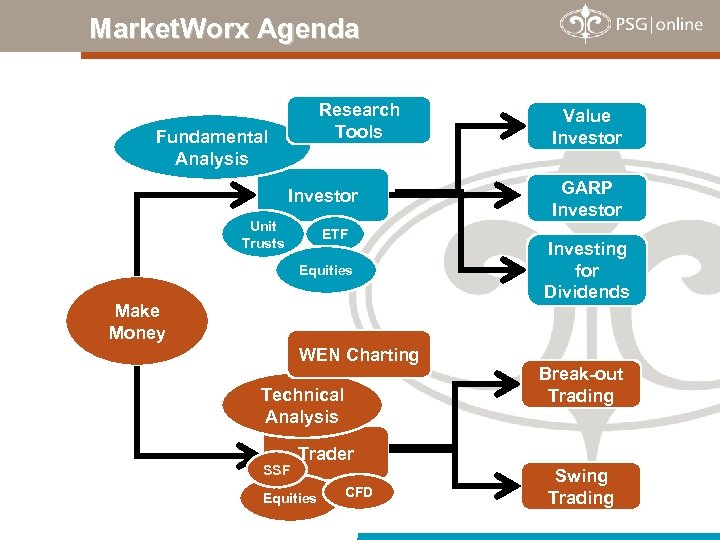
Market. Worx Agenda Research Tools Fundamental Analysis Investor Unit Trusts ETF Equities Make Money WEN Charting Technical Analysis SSF Value Investor GARP Investor Investing for Dividends Break-out Trading Trader Equities CFD Swing Trading
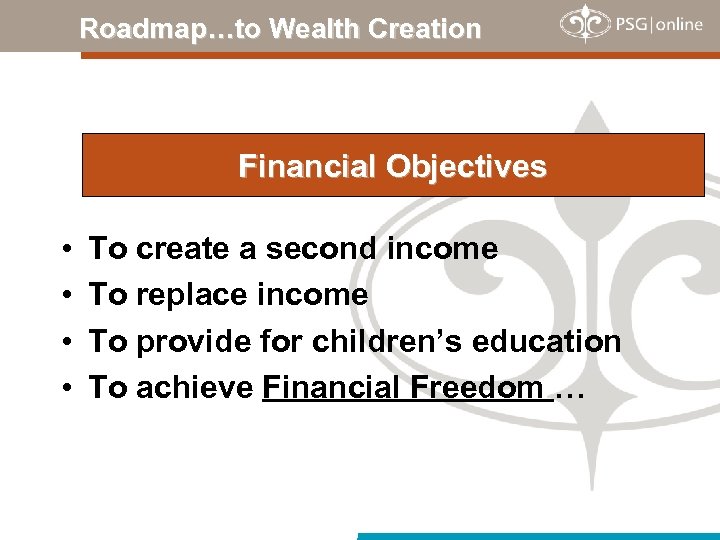
Roadmap…to Wealth Creation Financial Objectives • • To create a second income To replace income To provide for children’s education To achieve Financial Freedom …
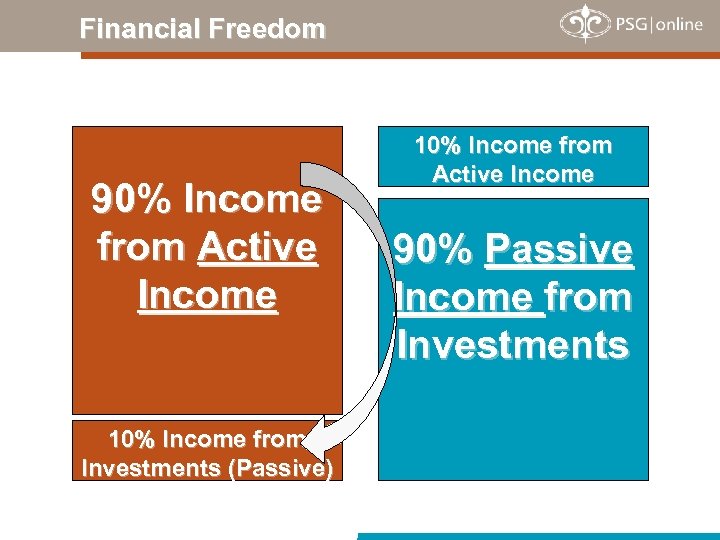
Financial Freedom 90% Income from Active Income 10% Income from Investments (Passive) 10% Income from Active Income 90% Passive Income from Investments
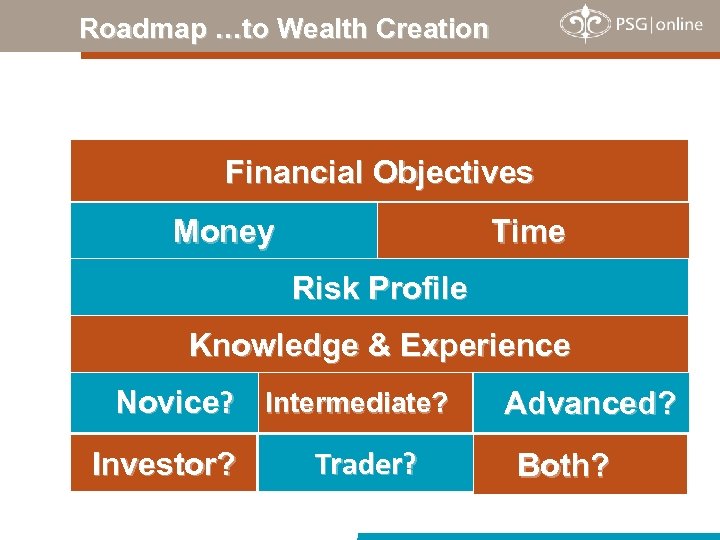
Roadmap …to Wealth Creation Financial Objectives Money Time Risk Profile Knowledge & Experience Novice? Intermediate? Investor? Trader? Advanced? Both?
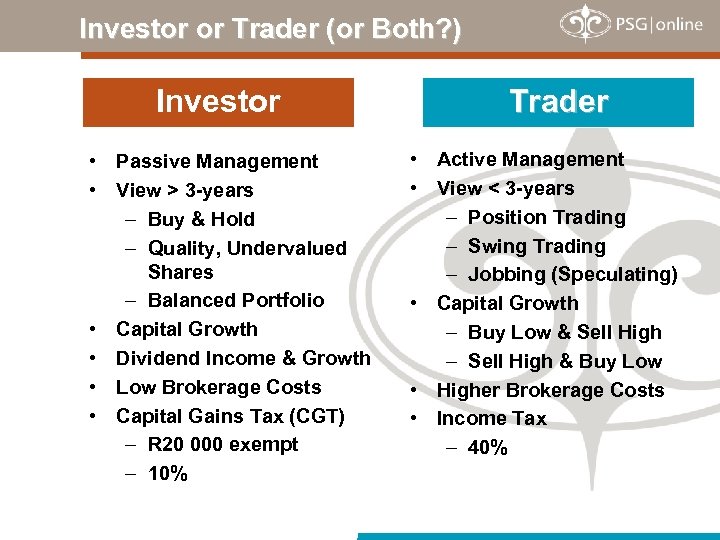
Investor or Trader (or Both? ) Investor • Passive Management • View > 3 -years – Buy & Hold – Quality, Undervalued Shares – Balanced Portfolio • Capital Growth • Dividend Income & Growth • Low Brokerage Costs • Capital Gains Tax (CGT) – R 20 000 exempt – 10% Trader • Active Management • View < 3 -years – Position Trading – Swing Trading – Jobbing (Speculating) • Capital Growth – Buy Low & Sell High – Sell High & Buy Low • Higher Brokerage Costs • Income Tax – 40%
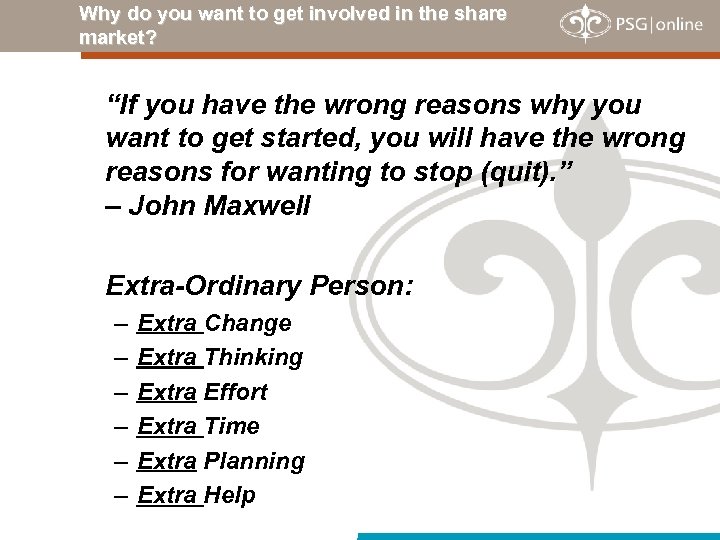
Why do you want to get involved in the share market? “If you have the wrong reasons why you want to get started, you will have the wrong reasons for wanting to stop (quit). ” – John Maxwell Extra-Ordinary Person: – – – Extra Change Extra Thinking Extra Effort Extra Time Extra Planning Extra Help

PSG Online website

PSG Online
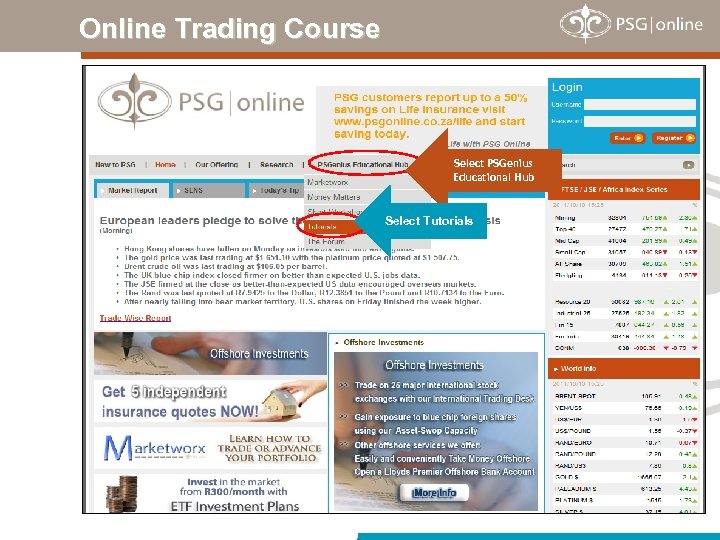
Online Trading Course Select PSGenius Educational Hub Select Tutorials
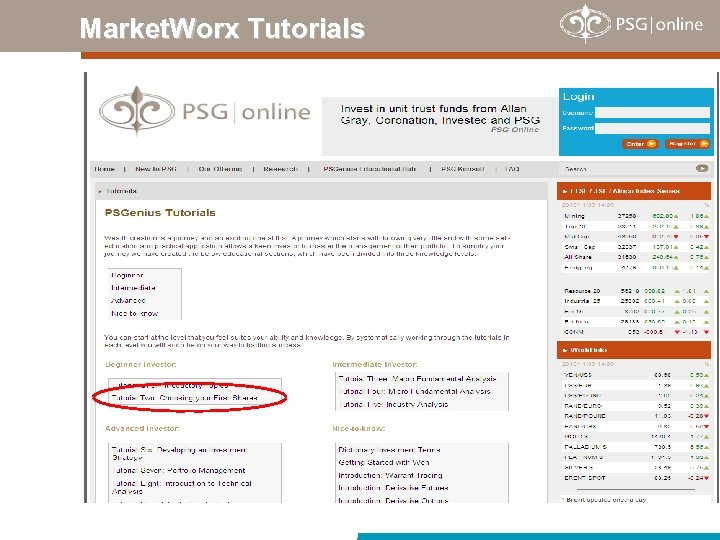
Market. Worx Tutorials
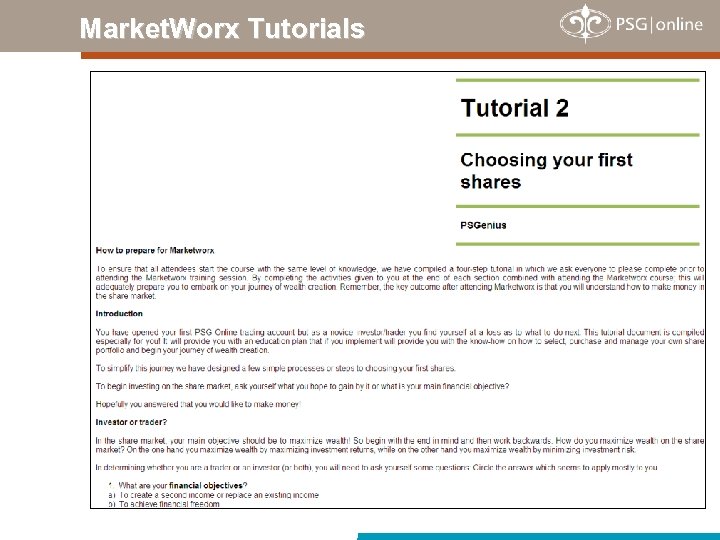
Market. Worx Tutorials
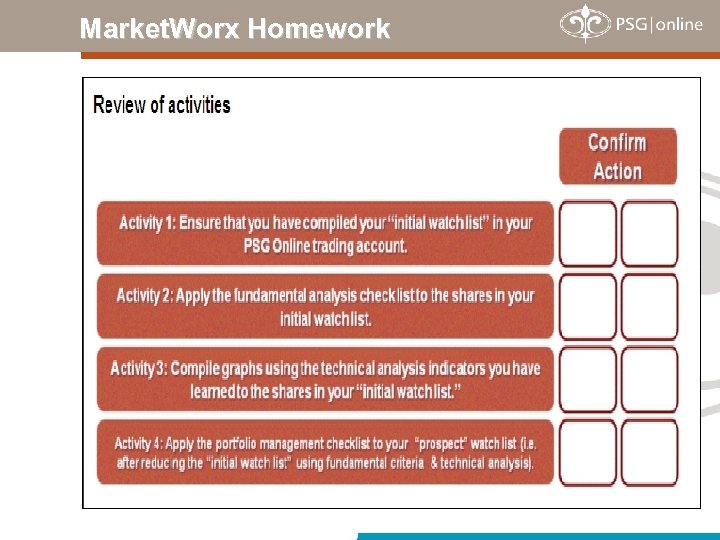
Market. Worx Homework
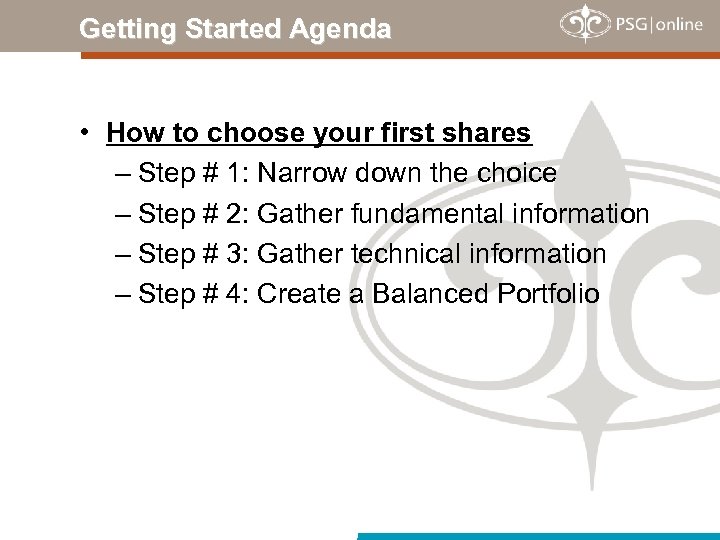
Getting Started Agenda • How to choose your first shares – Step # 1: Narrow down the choice – Step # 2: Gather fundamental information – Step # 3: Gather technical information – Step # 4: Create a Balanced Portfolio
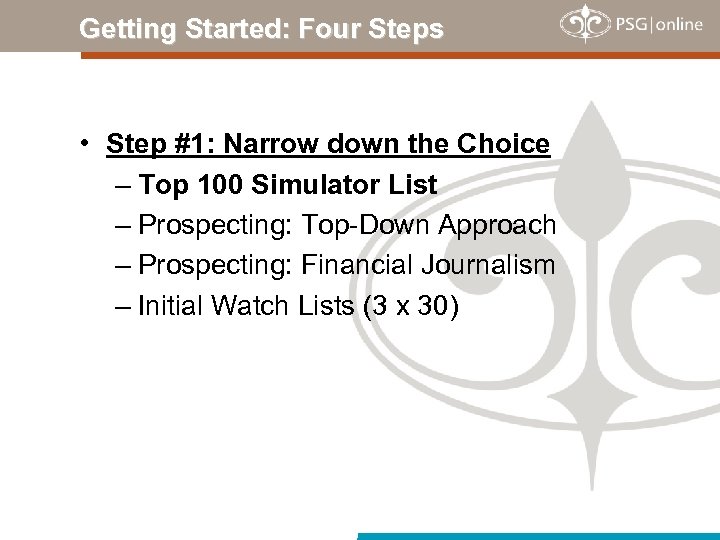
Getting Started: Four Steps • Step #1: Narrow down the Choice – Top 100 Simulator List – Prospecting: Top-Down Approach – Prospecting: Financial Journalism – Initial Watch Lists (3 x 30)
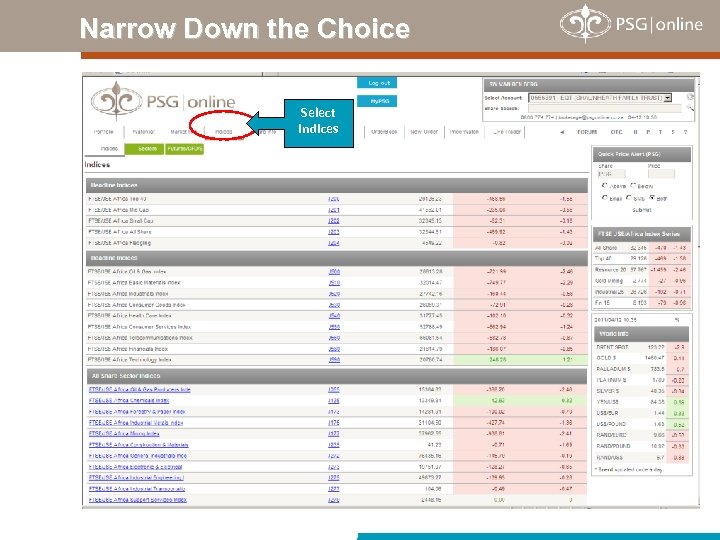
Narrow Down the Choice Select Indices
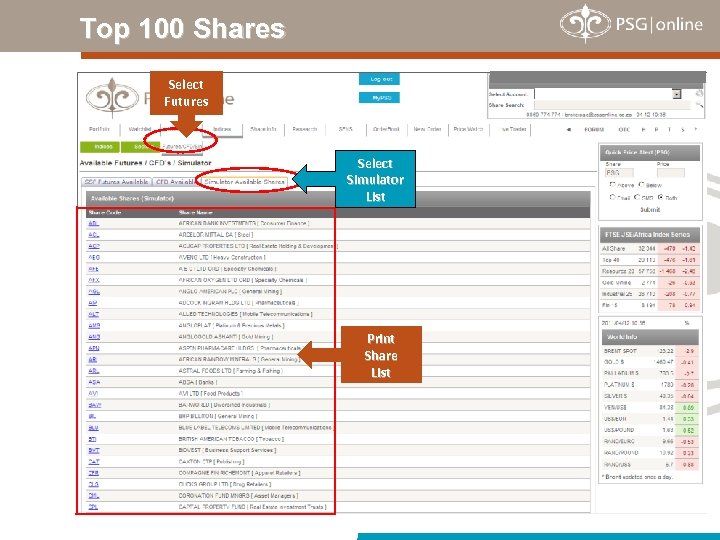
Top 100 Shares Select Futures Select Simulator List Print Share List
Getting Started: Four Steps • Step #1: Narrow down the Choice – Prospecting: Top-Down Approach – Prospecting: Financial Journalism – Initial Watch Lists (3 x 30)
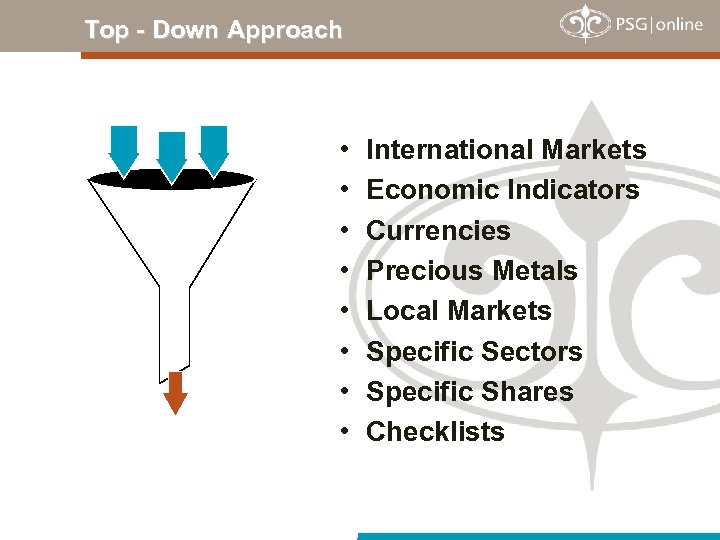
Top - Down Approach • • International Markets Economic Indicators Currencies Precious Metals Local Markets Specific Sectors Specific Shares Checklists
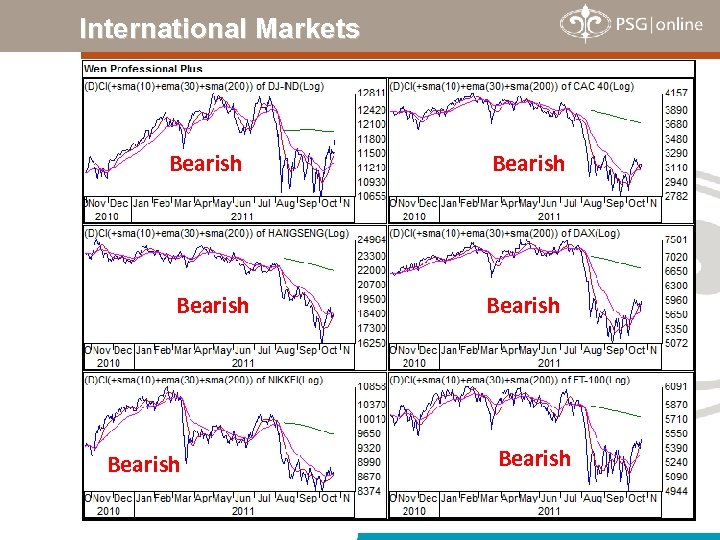
International Markets Bearish Bearish
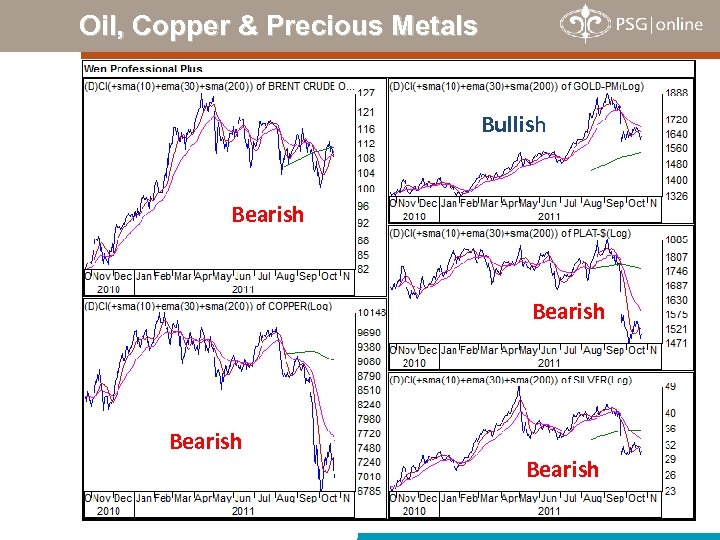
Oil, Copper & Precious Metals Bullish Bearish
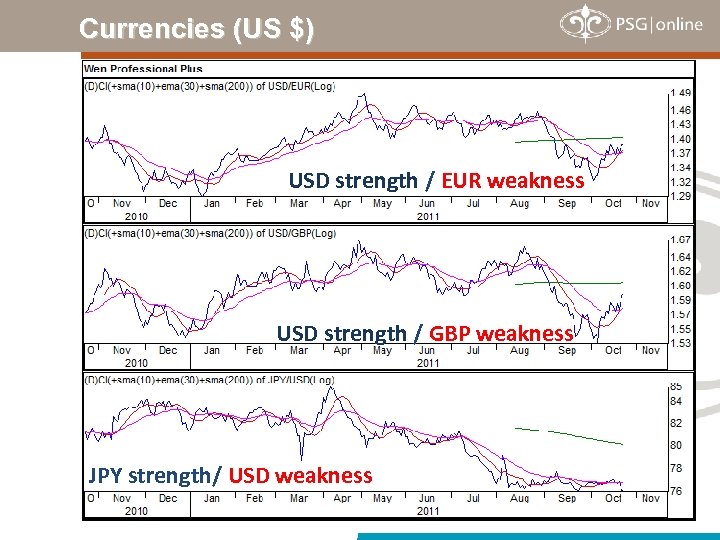
Currencies (US $) USD strength / EUR weakness USD strength / GBP weakness JPY strength/ USD weakness
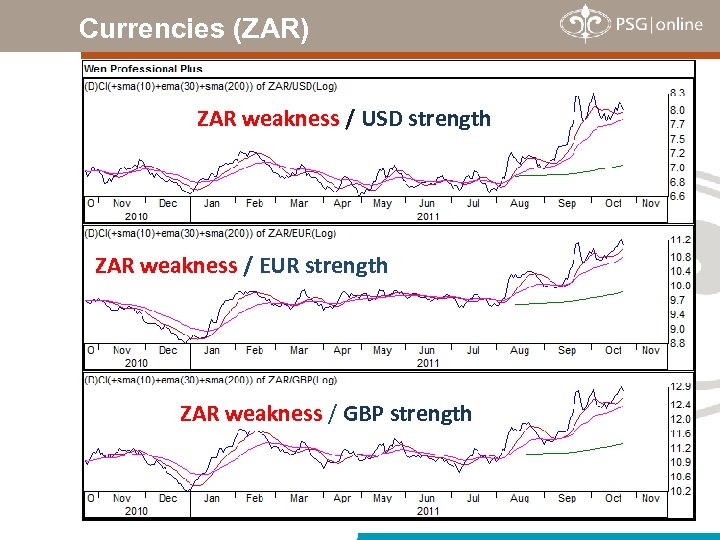
Currencies (ZAR) ZAR weakness / USD strength ZAR weakness / EUR strength ZAR weakness / GBP strength
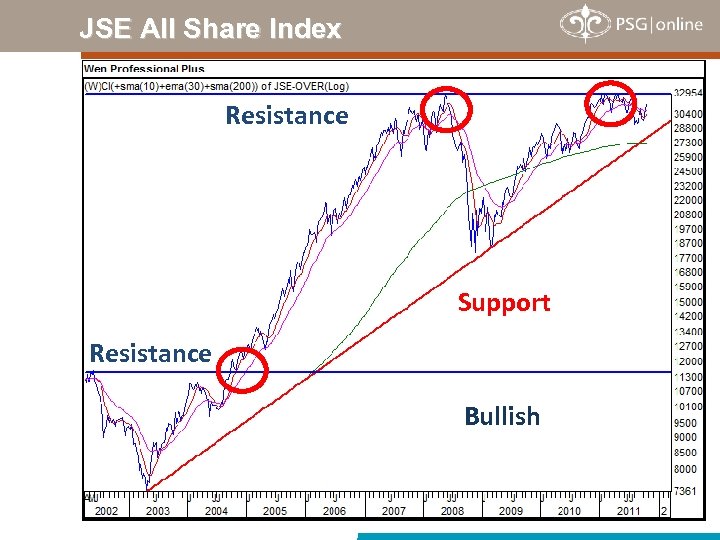
JSE All Share Index Resistance Support Resistance Bullish
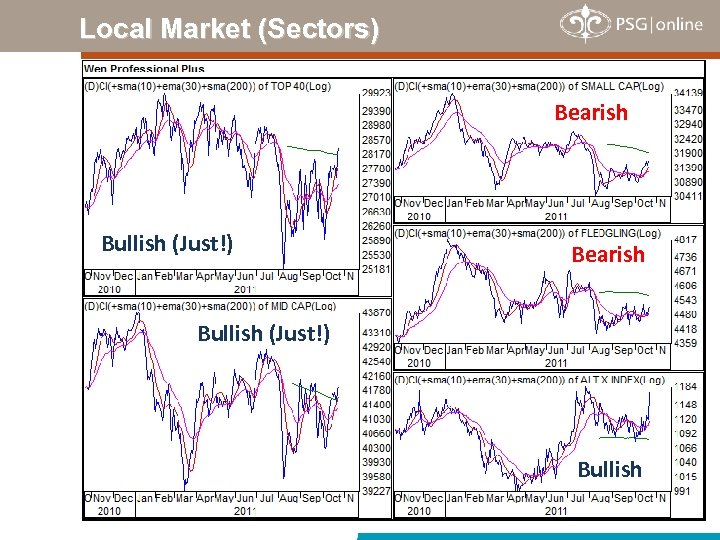
Local Market (Sectors) Bearish Bullish (Just!) Bullish
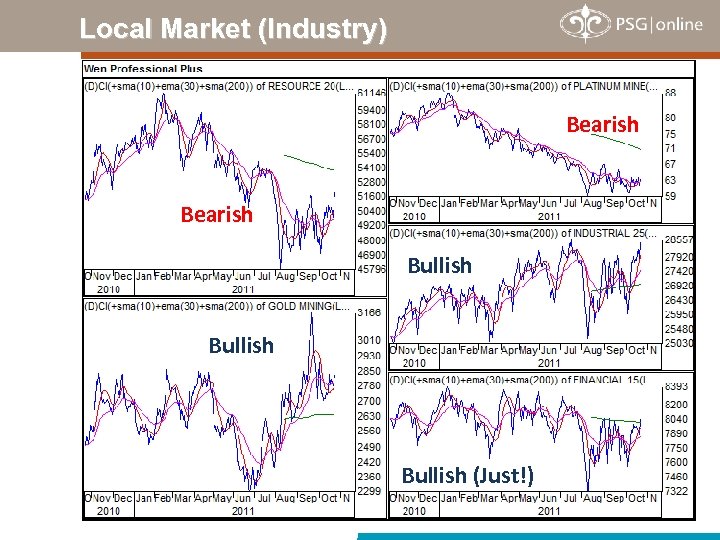
Local Market (Industry) Bearish Bullish (Just!)
Financial Journalism • Read! – Bloomberg / Reuters/ CNN Money – Business Day / Business Report/ Sake – Financial Mail / Fin. Week – PSG Online / Money. Web / Fin 24 • Beware Analysis Paralysis • Scan Headlines – Shares you know • Look for Bad News
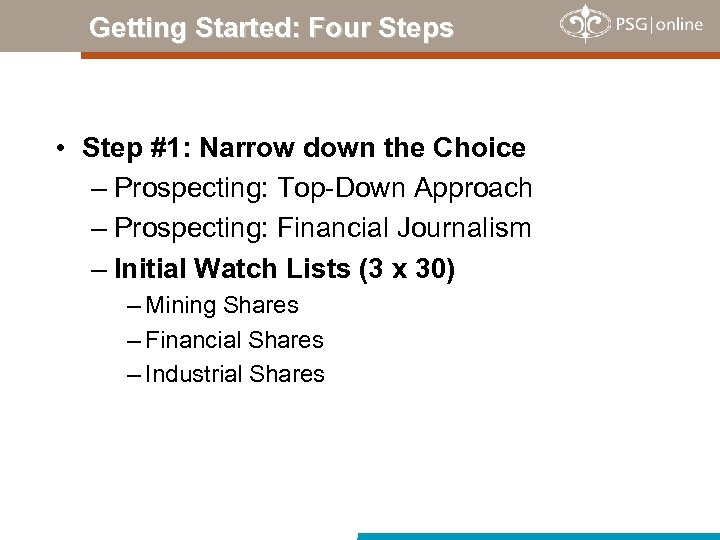
Getting Started: Four Steps • Step #1: Narrow down the Choice – Prospecting: Top-Down Approach – Prospecting: Financial Journalism – Initial Watch Lists (3 x 30) – Mining Shares – Financial Shares – Industrial Shares

Creating a Watch List
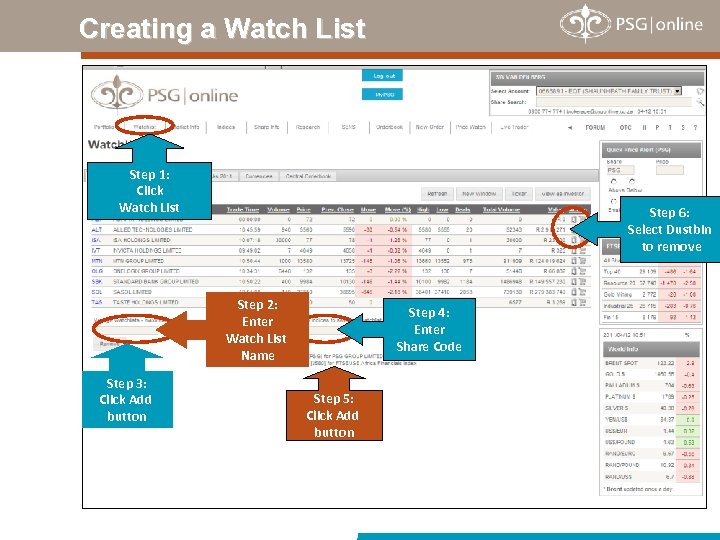
Creating a Watch List Step 1: Click Watch List Step 6: Select Dustbin to remove Step 2: Enter Watch List Name Step 3: Click Add button Step 4: Enter Share Code Step 5: Click Add button
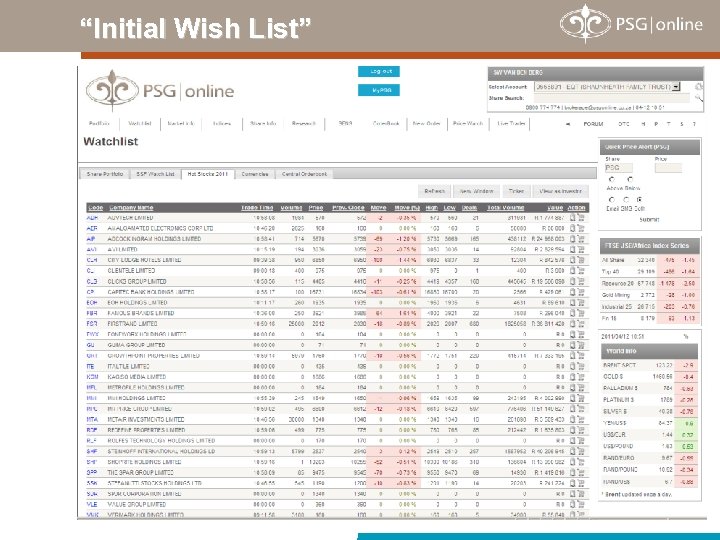
“Initial Wish List”
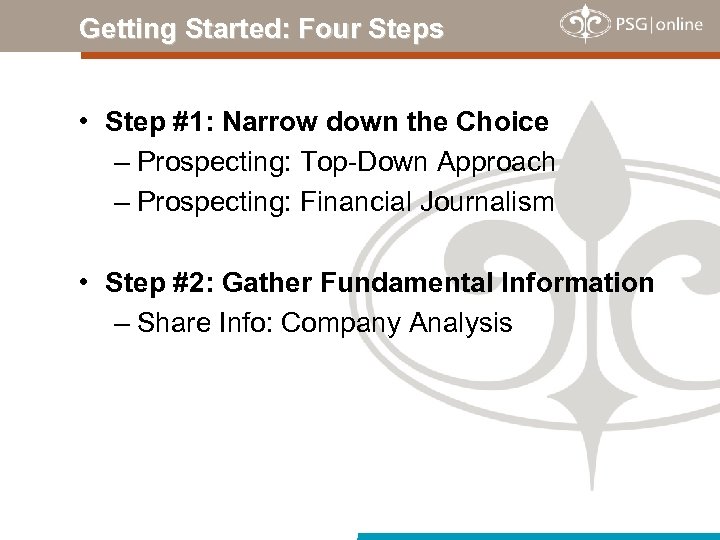
Getting Started: Four Steps • Step #1: Narrow down the Choice – Prospecting: Top-Down Approach – Prospecting: Financial Journalism • Step #2: Gather Fundamental Information – Share Info: Company Analysis
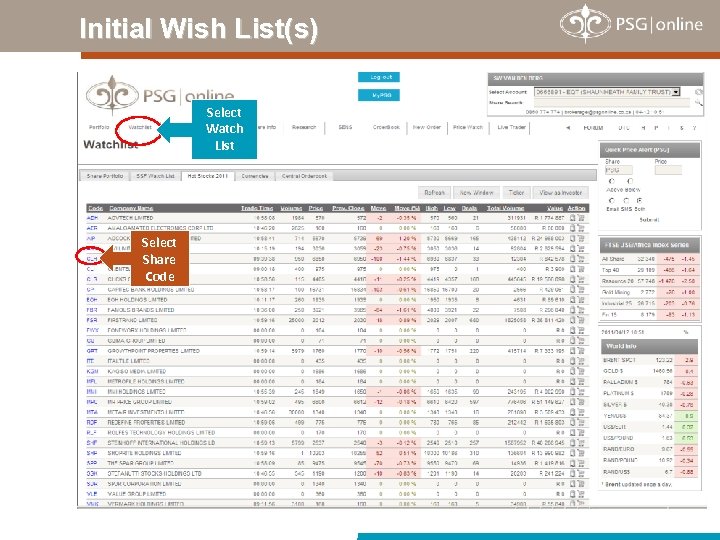
Initial Wish List(s) Select Watch List Select Share Code
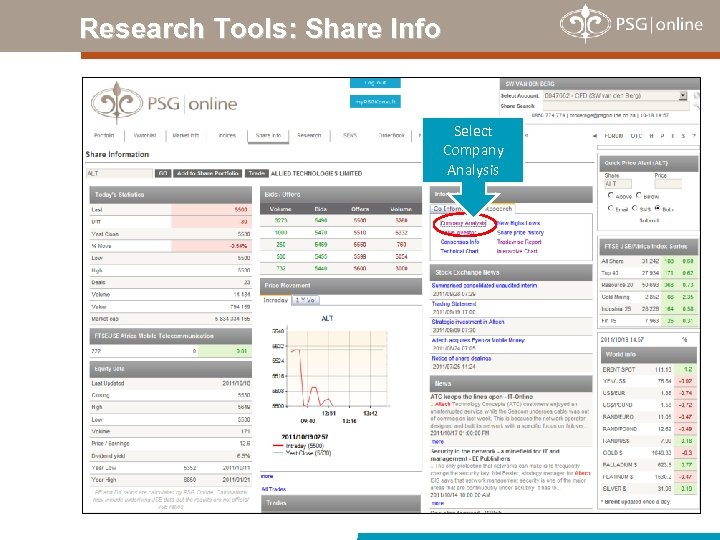
Research Tools: Share Info Select Company Analysis
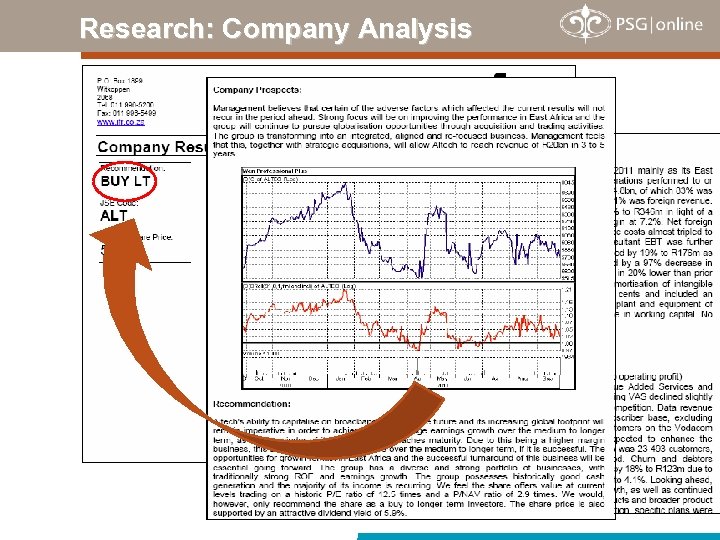
Research: Company Analysis
Getting Started: Four Steps • Step #1: Narrow down the Choice – Prospecting: Top-Down Approach – Prospecting: Financial Journalism – Initial Watch Lists (3 x 30) • Step #2: Gather Fundamental Information – Share Info: Company Analysis • Step #3: Gather Technical Information – Technical Chart / Interactive Chart
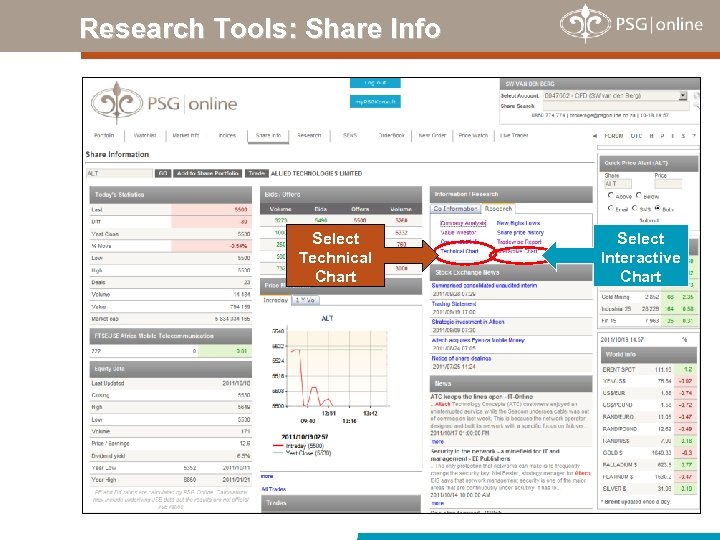
Research Tools: Share Info Select Technical Chart Select Interactive Chart
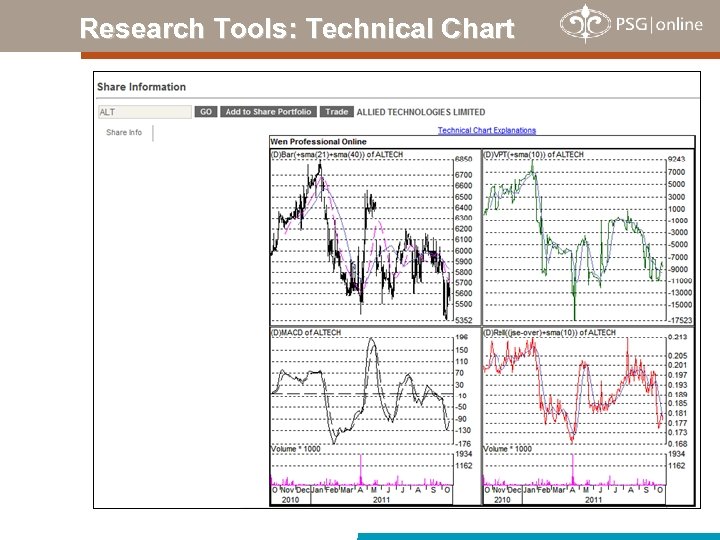
Research Tools: Technical Chart
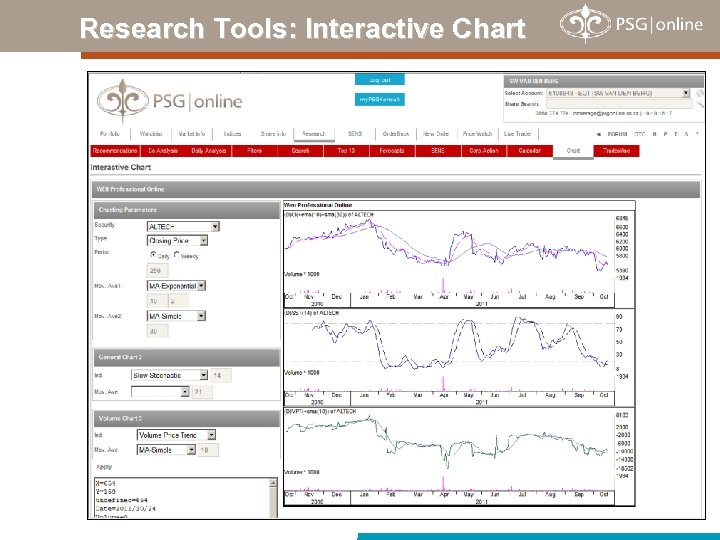
Research Tools: Interactive Chart
Getting Started: Four Steps • Step #1: Narrow down the Choice • Step #2: Gather Fundamental Information • Step #3: Gather Technical Information • Step #4: Create a Balanced Portfolio – Spread – Structure – Stop Loss?
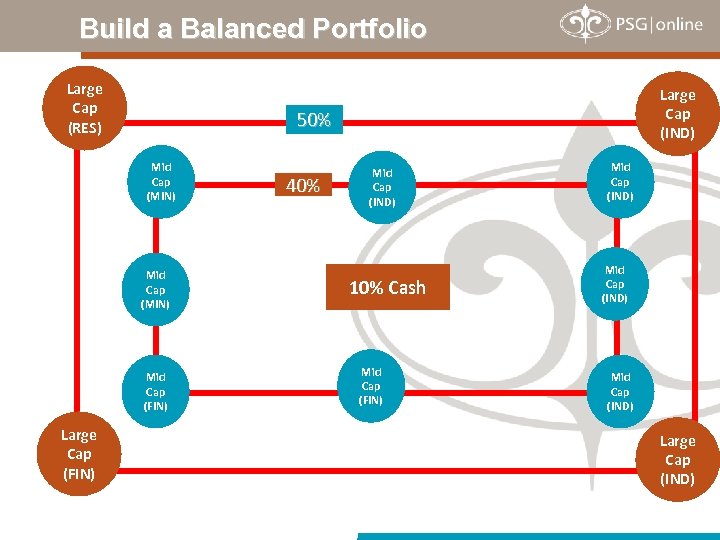
Build a Balanced Portfolio Large Cap (RES) 50% Mid Cap (MIN) Mid Cap (FIN) Large Cap (IND) 40% Mid Cap (IND) 10% Cash Mid Cap (FIN) Mid Cap (IND) Large Cap (IND)
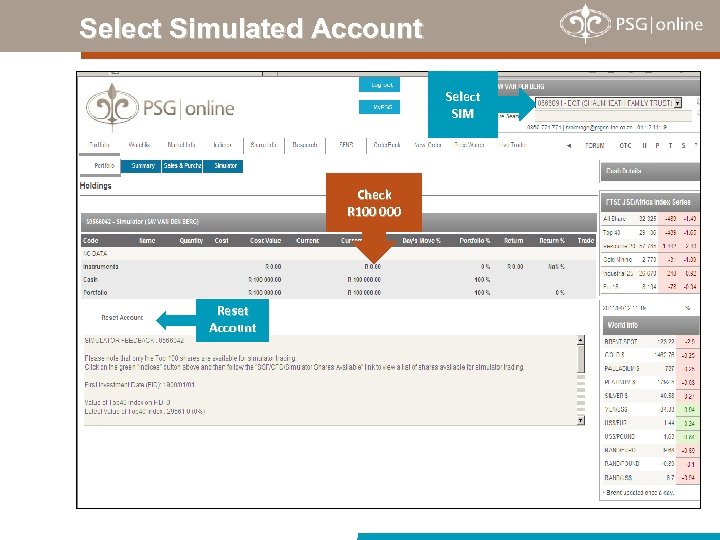
Select Simulated Account Select SIM Check R 100 000 Reset Account
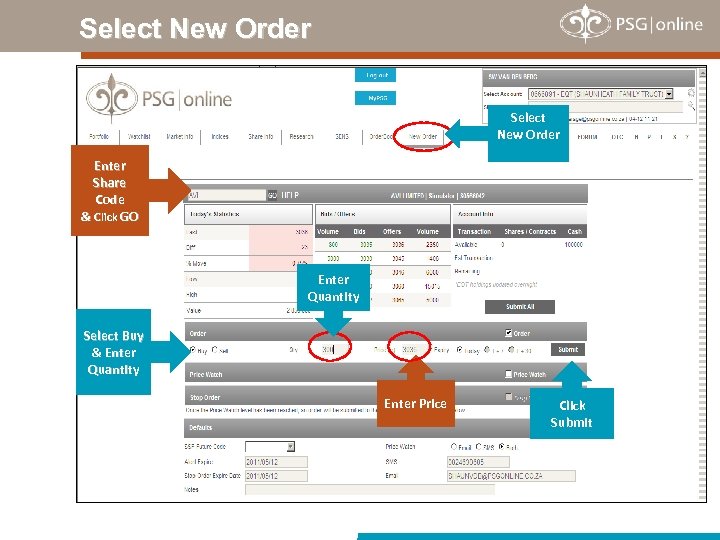
Select New Order Enter Share Code & Click GO Enter Quantity Select Buy & Enter Quantity Enter Price Click Submit
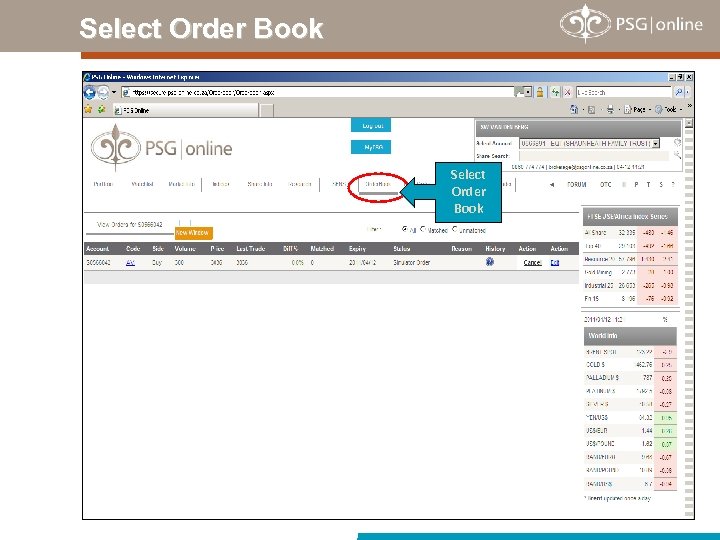
Select Order Book
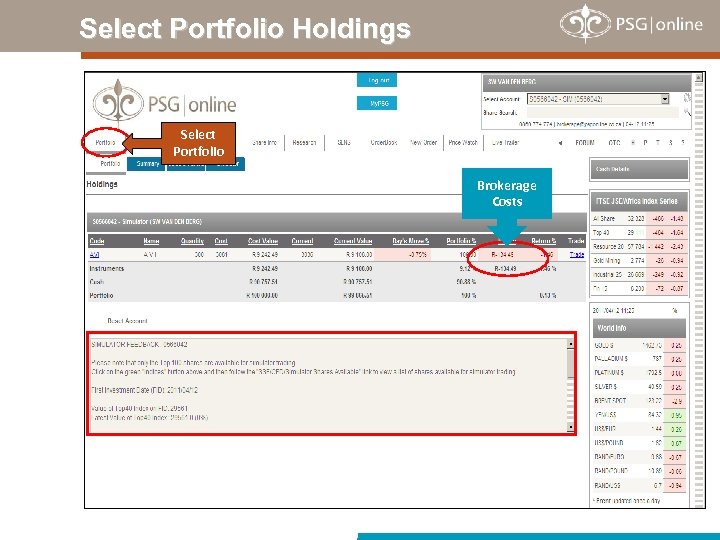
Select Portfolio Holdings Select Portfolio Brokerage Costs
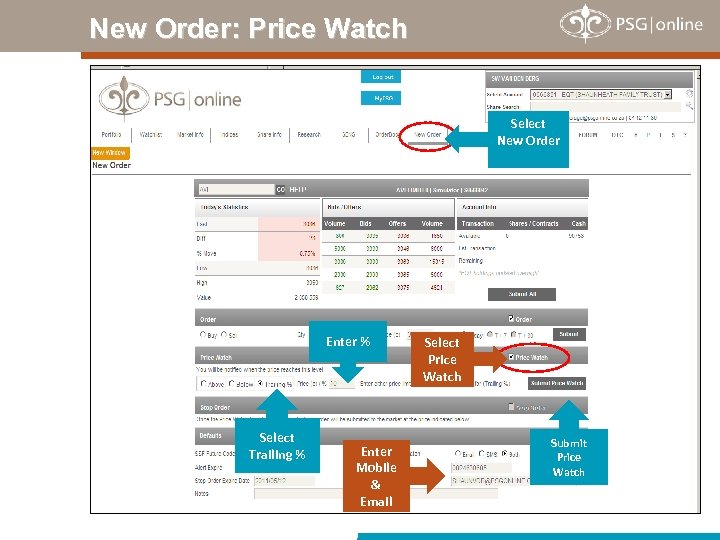
New Order: Price Watch Select New Order Enter % Select Trailing % Enter Mobile & Email Select Price Watch Submit Price Watch
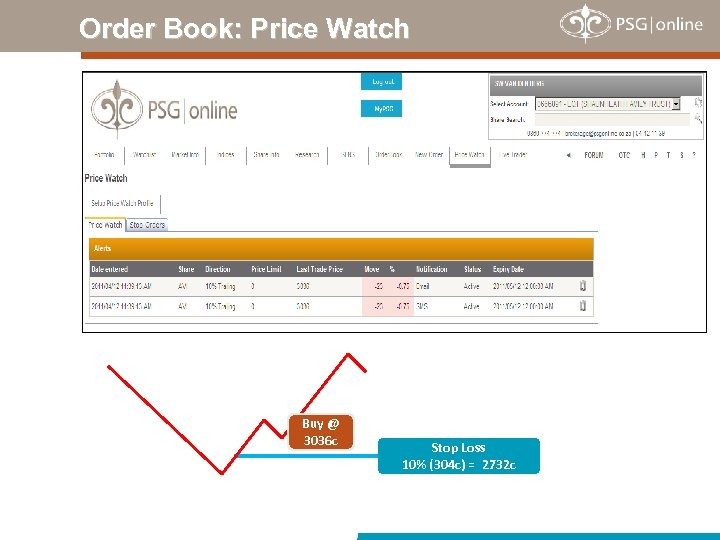
Order Book: Price Watch Buy @ 3036 c Stop Loss 10% (304 c) = 2732 c

Macro Fundamentals (Economic Analysis)
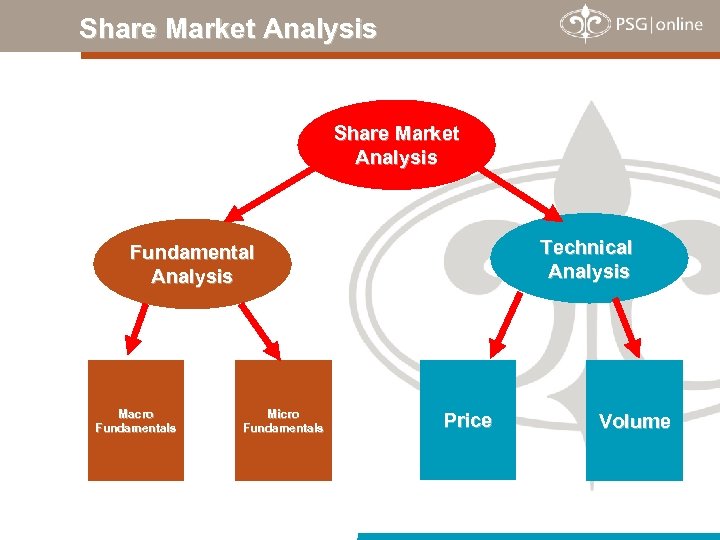
Share Market Analysis Technical Analysis Fundamental Analysis Macro Fundamentals Micro Fundamentals Price Volume
Economic Analysis • General Economic Influences – Gross Domestic Product (GDP) – Fiscal & Monetary Policy – Inflation Rate – Interest Rates – The Exchange Rate • The Investment Cycle
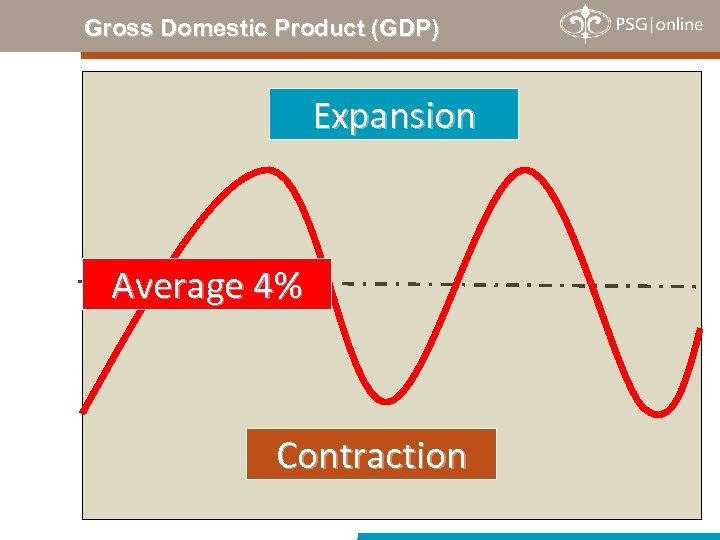
Gross Domestic Product (GDP) Expansion Average 4% Contraction
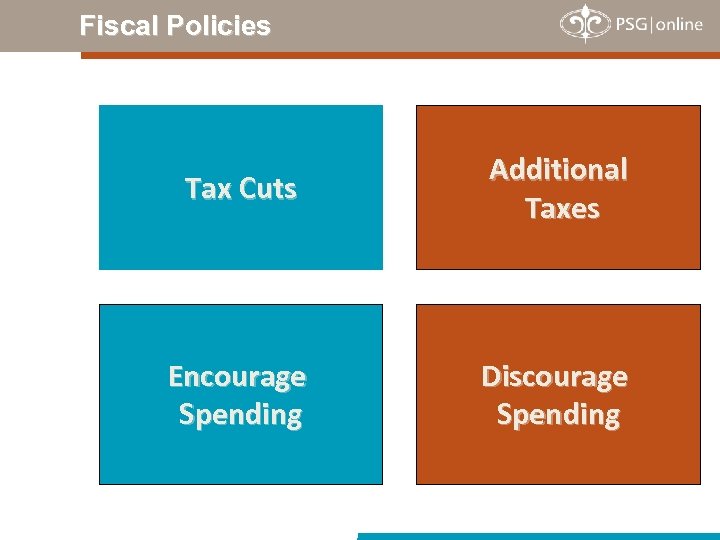
Fiscal Policies Tax Cuts Additional Taxes Encourage Spending Discourage Spending
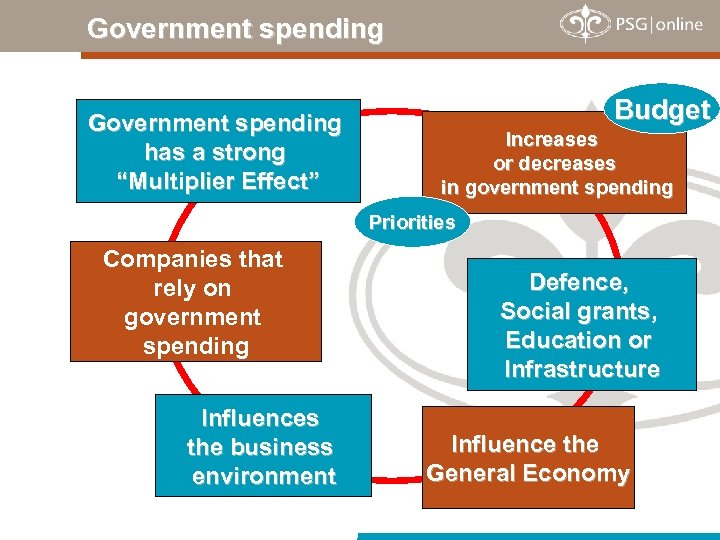
Government spending has a strong “Multiplier Effect” Budget Increases or decreases in government spending Priorities Companies that rely on government spending Influences the business environment Defence, Social grants, Education or Infrastructure Influence the General Economy
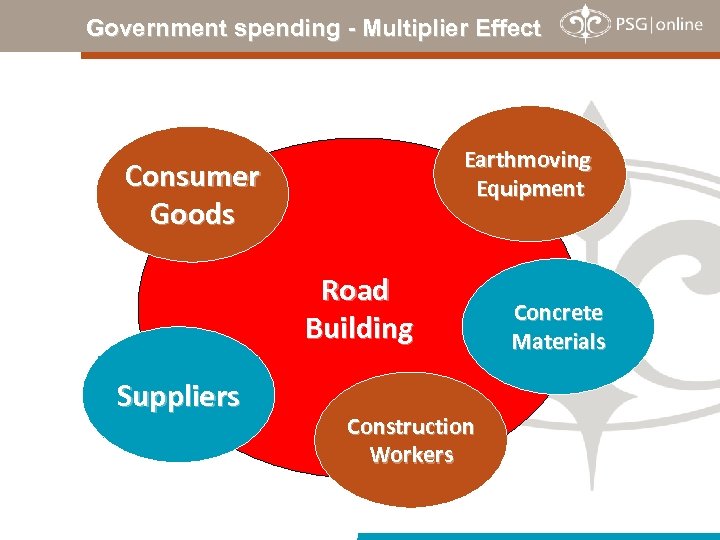
Government spending - Multiplier Effect Earthmoving Equipment Consumer Goods Road Building Suppliers Construction Workers Concrete Materials
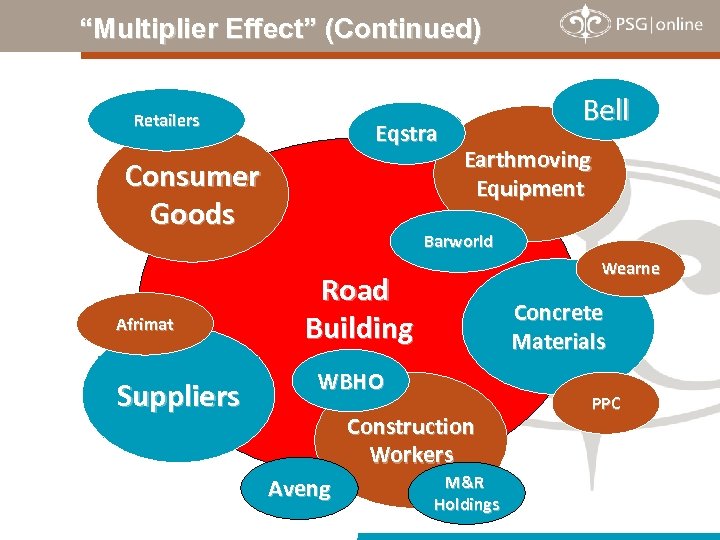
“Multiplier Effect” (Continued) Retailers Eqstra Consumer Goods Afrimat Suppliers Bell Earthmoving Equipment Barworld Wearne Road Building Concrete Materials WBHO Construction Workers Aveng M&R Holdings PPC
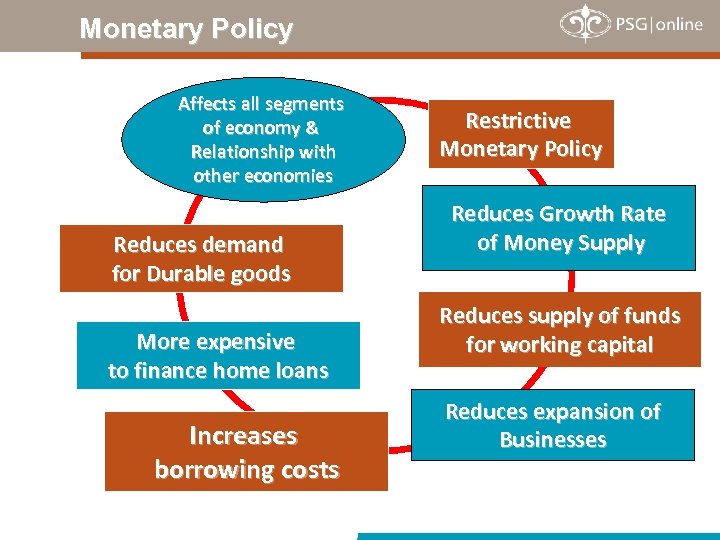
Monetary Policy Affects all segments of economy & Relationship with other economies Reduces demand for Durable goods More expensive to finance home loans Increases borrowing costs Restrictive Monetary Policy Reduces Growth Rate of Money Supply Reduces supply of funds for working capital Reduces expansion of Businesses
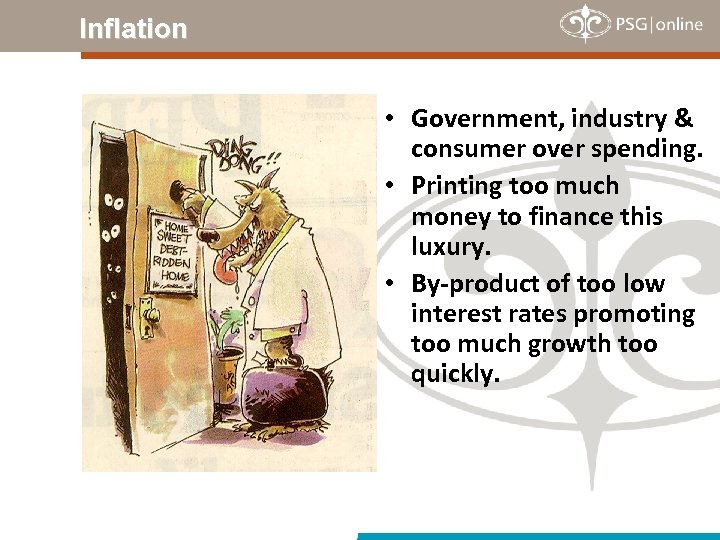
Inflation • Government, industry & consumer over spending. • Printing too much money to finance this luxury. • By-product of too low interest rates promoting too much growth too quickly.
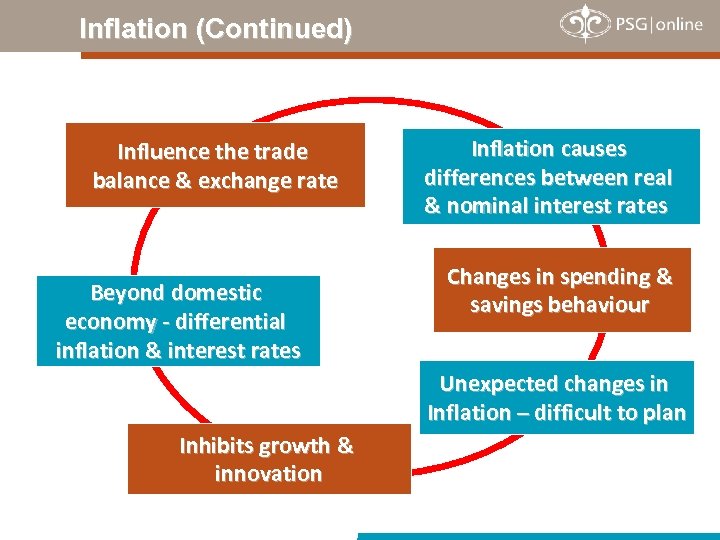
Inflation (Continued) Influence the trade balance & exchange rate Beyond domestic economy - differential inflation & interest rates Inflation causes differences between real & nominal interest rates Changes in spending & savings behaviour Unexpected changes in Inflation – difficult to plan Inhibits growth & innovation
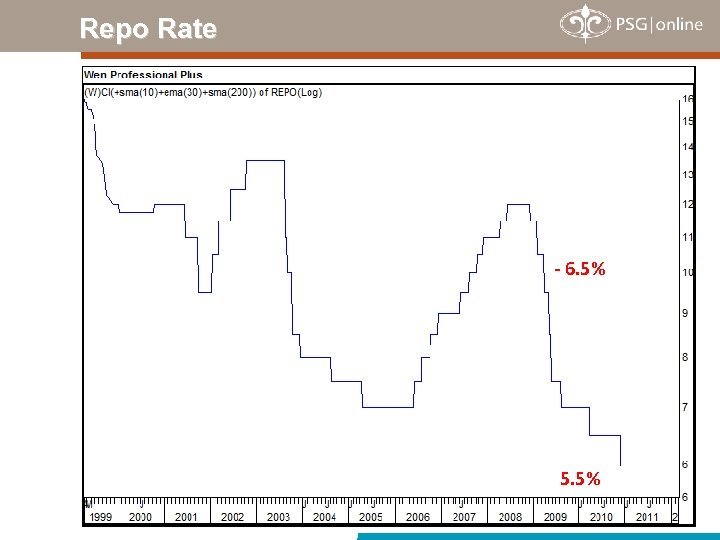
Repo Rate - 6. 5% 5. 5%
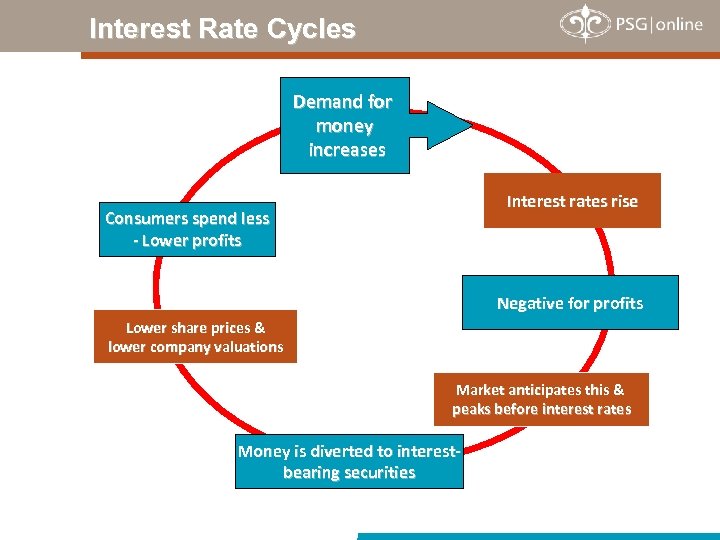
Interest Rate Cycles Demand for money increases Interest rates rise Consumers spend less - Lower profits Negative for profits Lower share prices & lower company valuations Market anticipates this & peaks before interest rates Money is diverted to interestbearing securities
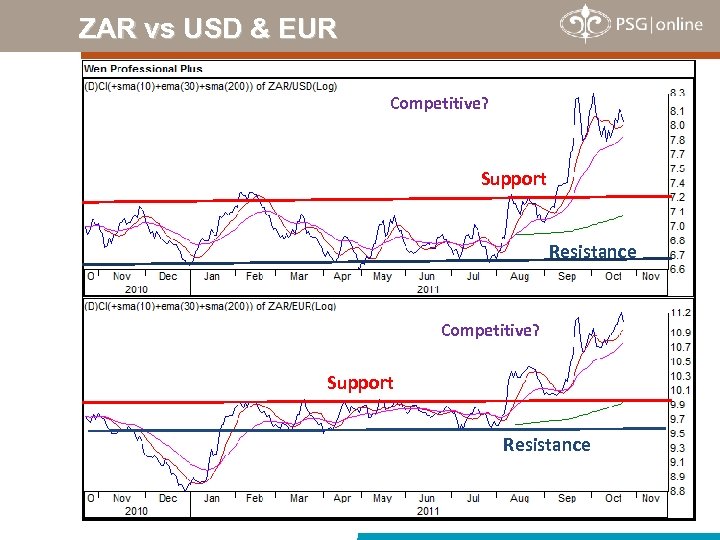
ZAR vs USD & EUR Competitive? Support Resistance
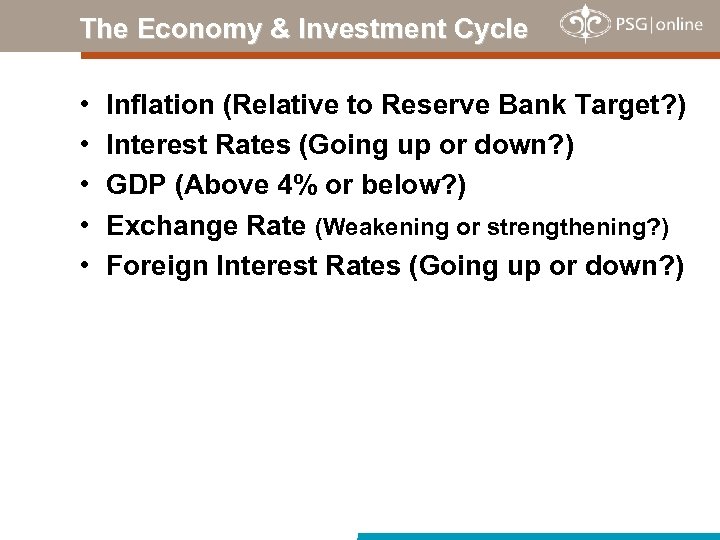
The Economy & Investment Cycle • • • Inflation (Relative to Reserve Bank Target? ) Interest Rates (Going up or down? ) GDP (Above 4% or below? ) Exchange Rate (Weakening or strengthening? ) Foreign Interest Rates (Going up or down? )
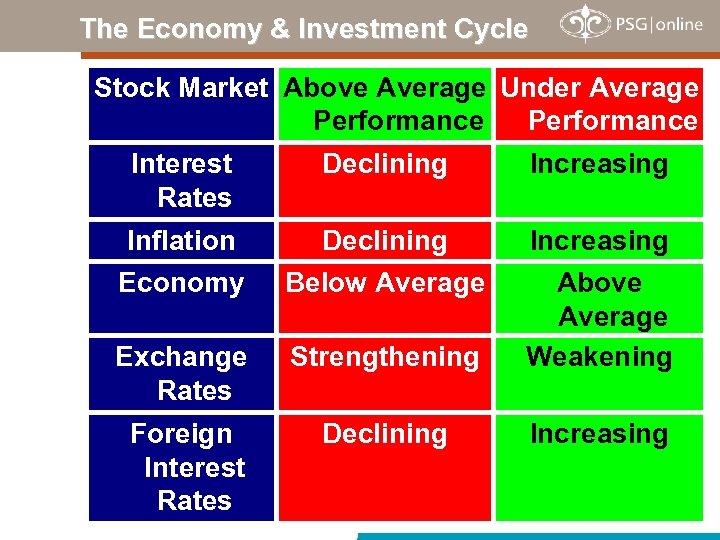
The Economy & Investment Cycle Stock Market Above Average Under Average Performance Interest Rates Declining Increasing Inflation Economy Declining Below Average Exchange Rates Strengthening Increasing Above Average Weakening Foreign Interest Rates Declining Increasing
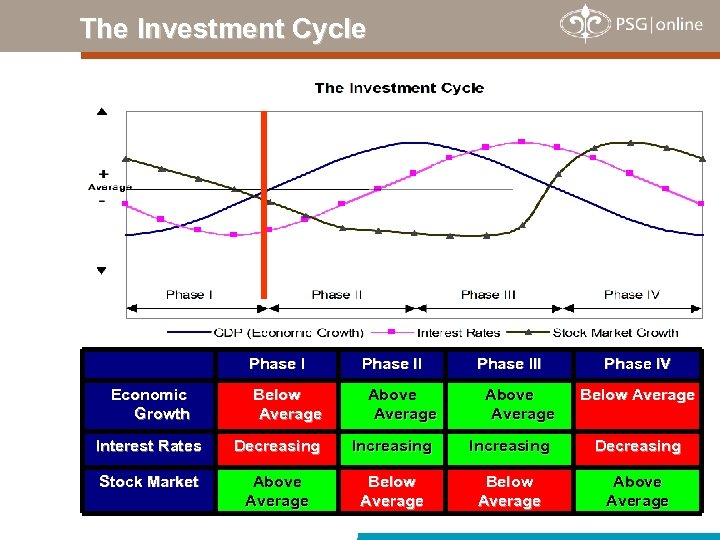
The Investment Cycle Phase I Economic Growth Below Average Phase II Above Average Phase IV Below Average Interest Rates Decreasing Increasing Decreasing Stock Market Above Average Below Average Above Average
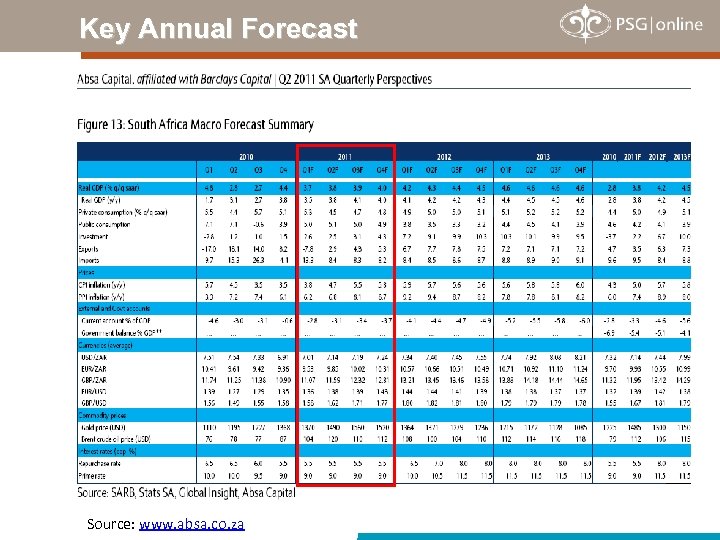
Key Annual Forecast Source: www. absa. co. za
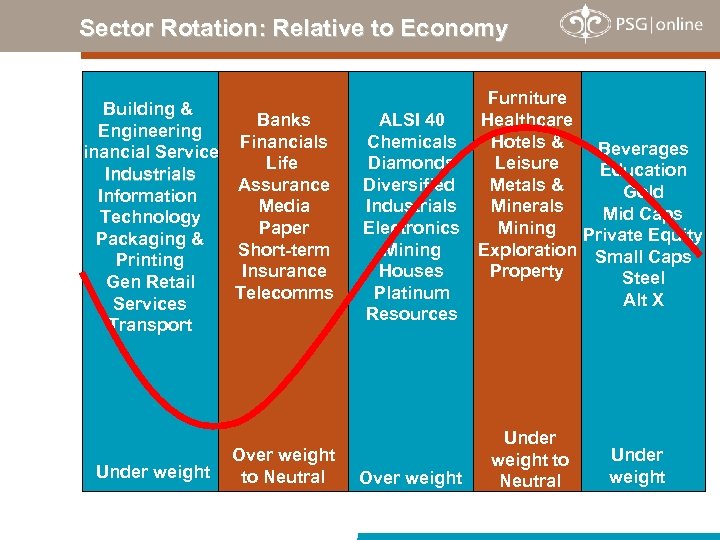
Sector Rotation: Relative to Economy Building & Engineering Financial Services Industrials Information Technology Packaging & Printing Gen Retail Services Transport Under weight Banks Financials Life Assurance Media Paper Short-term Insurance Telecomms Furniture ALSI 40 Healthcare Chemicals Hotels & Beverages Diamonds Leisure Education Diversified Metals & Gold Industrials Minerals Mid Caps Electronics Mining Private Equity Mining Exploration Small Caps Houses Property Steel Platinum Alt X Resources Over weight to Neutral Under weight to Neutral Over weight Under weight
Financial Statements Income Statement Balance Sheet Cash Flow Statement
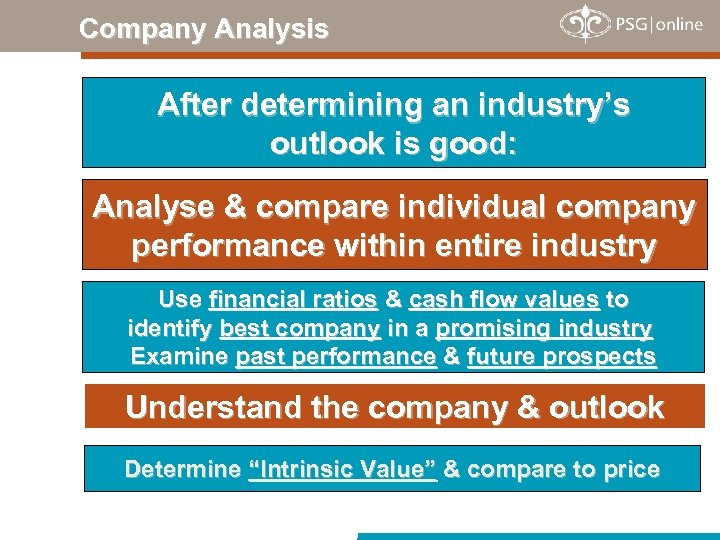
Company Analysis After determining an industry’s outlook is good: Analyse & compare individual company performance within entire industry Use financial ratios & cash flow values to identify best company in a promising industry Examine past performance & future prospects Understand the company & outlook Determine “Intrinsic Value” & compare to price
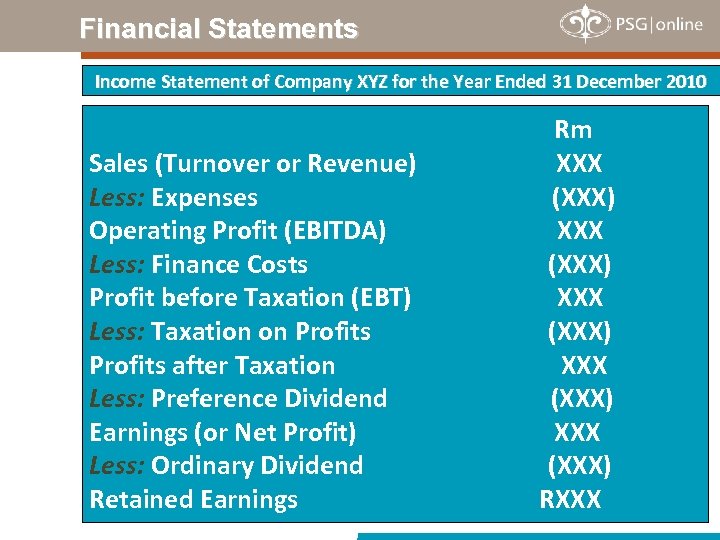
Financial Statements Income Statement of Company XYZ for the Year Ended 31 December 2010 Sales (Turnover or Revenue) Less: Expenses Operating Profit (EBITDA) Less: Finance Costs Profit before Taxation (EBT) Less: Taxation on Profits after Taxation Less: Preference Dividend Earnings (or Net Profit) Less: Ordinary Dividend Retained Earnings Rm XXX (XXX) XXX (XXX) RXXX
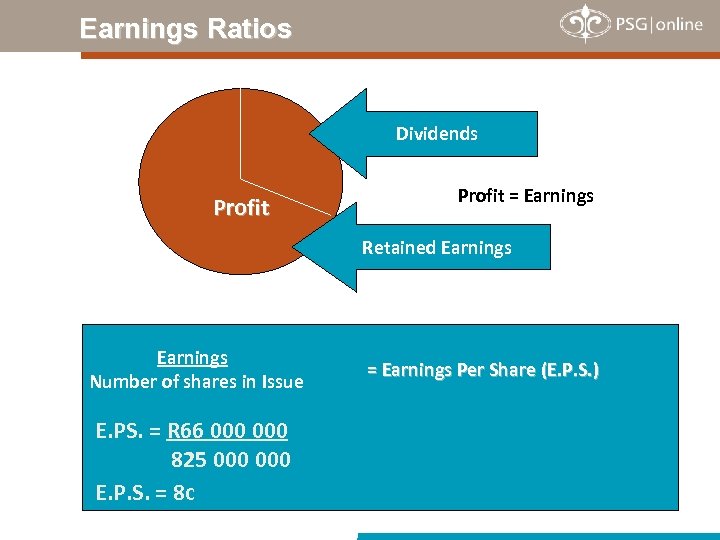
Earnings Ratios Dividends Profit = Earnings Retained Earnings Number of shares in Issue E. PS. = R 66 000 825 000 E. P. S. = 8 c = Earnings Per Share (E. P. S. )
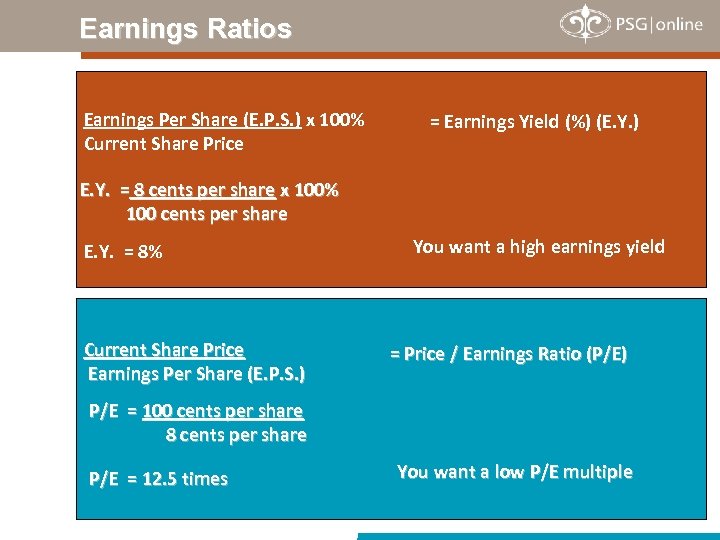
Earnings Ratios Earnings Per Share (E. P. S. ) x 100% Current Share Price = Earnings Yield (%) (E. Y. ) E. Y. = 8 cents per share x 100% 100 cents per share E. Y. = 8% Current Share Price Earnings Per Share (E. P. S. ) You want a high earnings yield = Price / Earnings Ratio (P/E) P/E = 100 cents per share 8 cents per share P/E = 12. 5 times You want a low P/E multiple
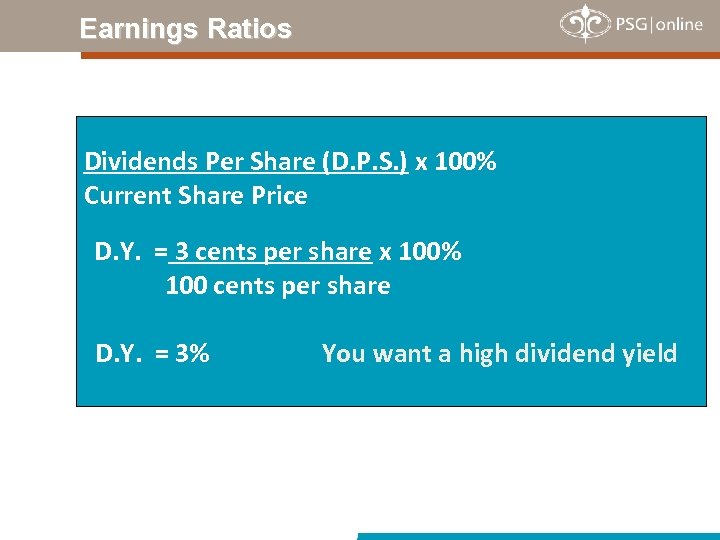
Earnings Ratios = Dividend Yield (%) (D. Y. ) Dividends Per Share (D. P. S. ) x 100% Current Share Price D. Y. = 3 cents per share x 100% 100 cents per share D. Y. = 3% You want a high dividend yield
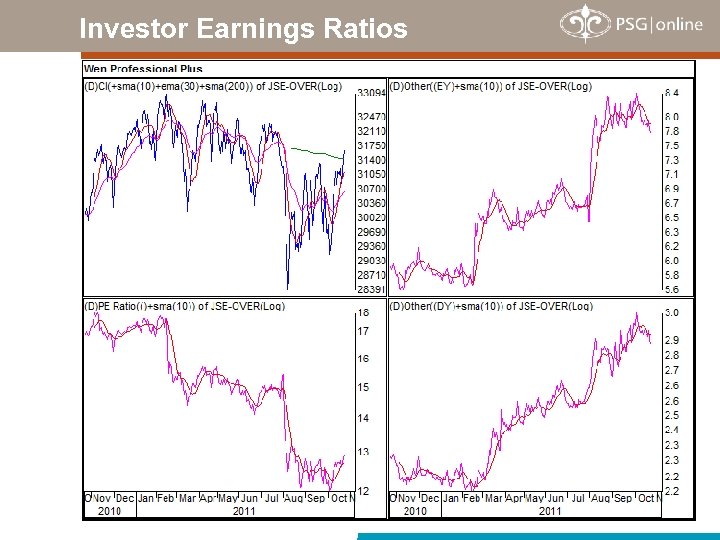
Investor Earnings Ratios
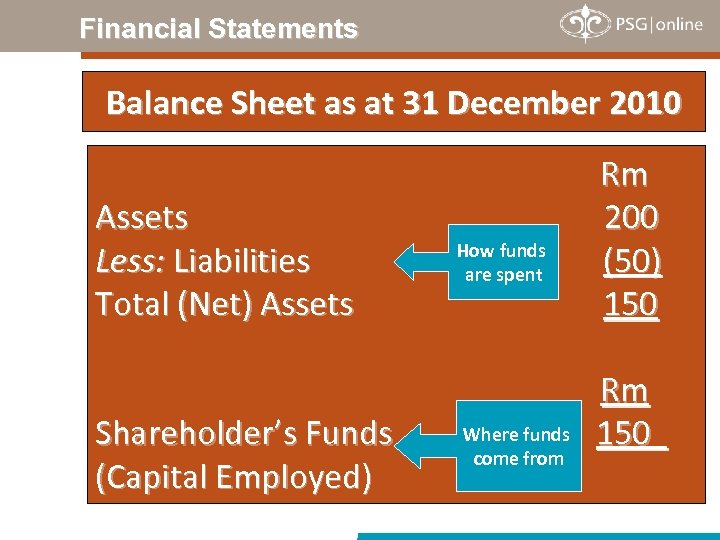
Financial Statements Balance Sheet as at 31 December 2010 Assets Less: Liabilities Total (Net) Assets Shareholder’s Funds (Capital Employed) How funds are spent Where funds come from Rm 200 (50) 150 Rm 150
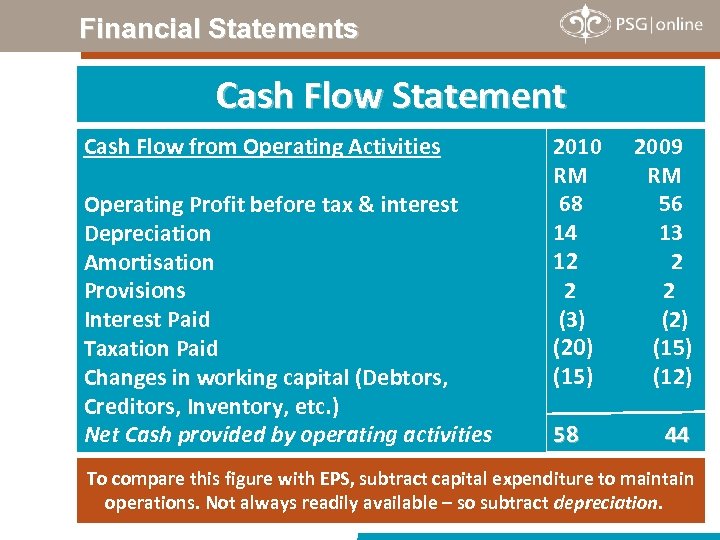
Financial Statements Cash Flow Statement Cash Flow from Operating Activities Operating Profit before tax & interest Depreciation Amortisation Provisions Interest Paid Taxation Paid Changes in working capital (Debtors, Creditors, Inventory, etc. ) Net Cash provided by operating activities 2010 RM 68 14 12 2 (3) (20) (15) 58 2009 RM 56 13 2 2 (2) (15) (12) 44 To compare this figure with EPS, subtract capital expenditure to maintain operations. Not always readily available – so subtract depreciation.
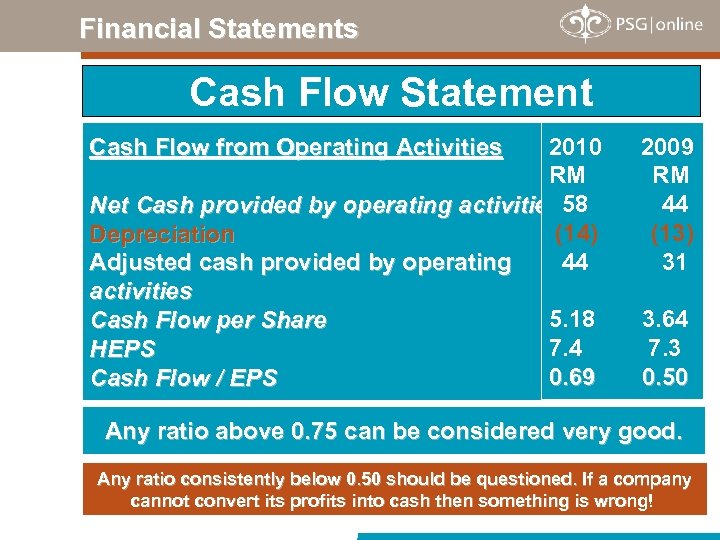
Financial Statements Cash Flow Statement 2010 RM Net Cash provided by operating activities 58 (14) Depreciation 44 Adjusted cash provided by operating activities 5. 18 Cash Flow per Share 7. 4 HEPS 0. 69 Cash Flow / EPS Cash Flow from Operating Activities 2009 RM 44 (13) 31 3. 64 7. 3 0. 50 Any ratio above 0. 75 can be considered very good. Any ratio consistently below 0. 50 should be questioned. If a company cannot convert its profits into cash then something is wrong!
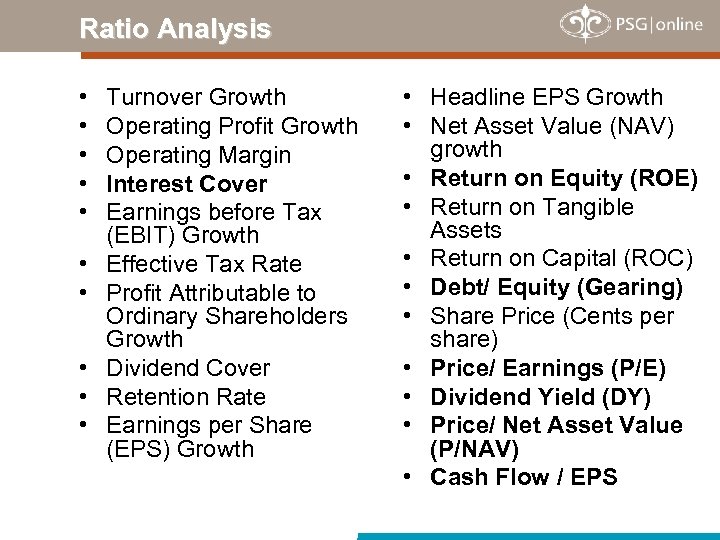
Ratio Analysis • • • Turnover Growth Operating Profit Growth Operating Margin Interest Cover Earnings before Tax (EBIT) Growth Effective Tax Rate Profit Attributable to Ordinary Shareholders Growth Dividend Cover Retention Rate Earnings per Share (EPS) Growth • Headline EPS Growth • Net Asset Value (NAV) growth • Return on Equity (ROE) • Return on Tangible Assets • Return on Capital (ROC) • Debt/ Equity (Gearing) • Share Price (Cents per share) • Price/ Earnings (P/E) • Dividend Yield (DY) • Price/ Net Asset Value (P/NAV) • Cash Flow / EPS
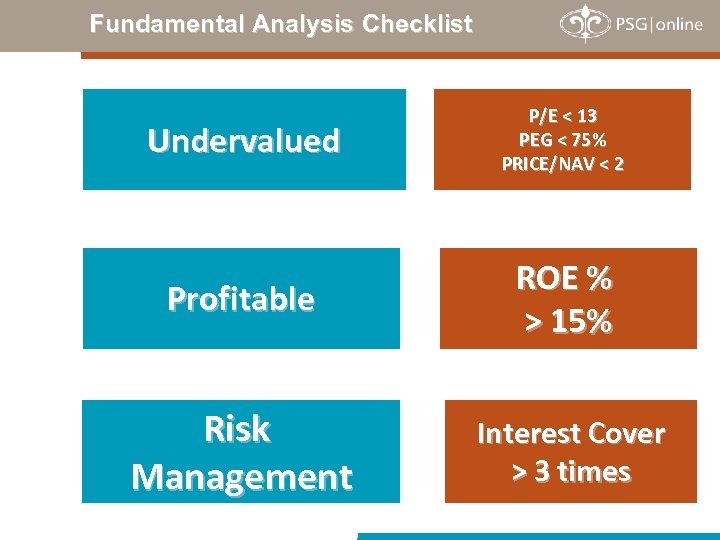
Fundamental Analysis Checklist Undervalued P/E < 13 PEG < 75% PRICE/NAV < 2 Profitable ROE % > 15% Risk Management Interest Cover > 3 times
Valuation: PEG Ratio
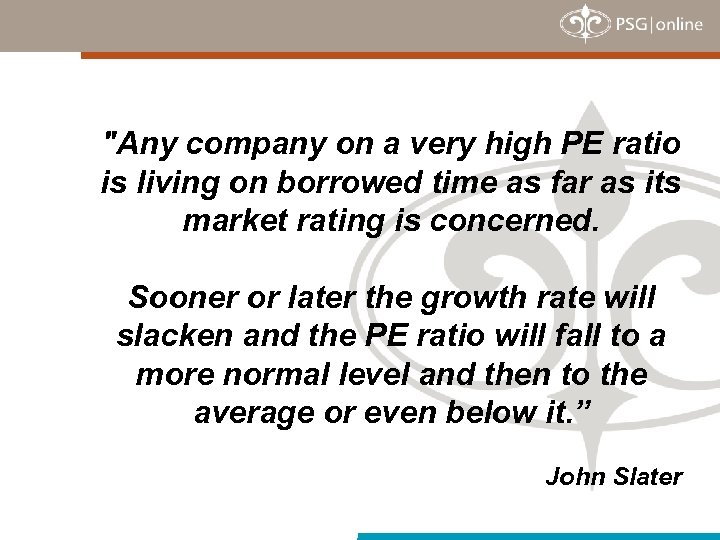
"Any company on a very high PE ratio is living on borrowed time as far as its market rating is concerned. Sooner or later the growth rate will slacken and the PE ratio will fall to a more normal level and then to the average or even below it. ” John Slater
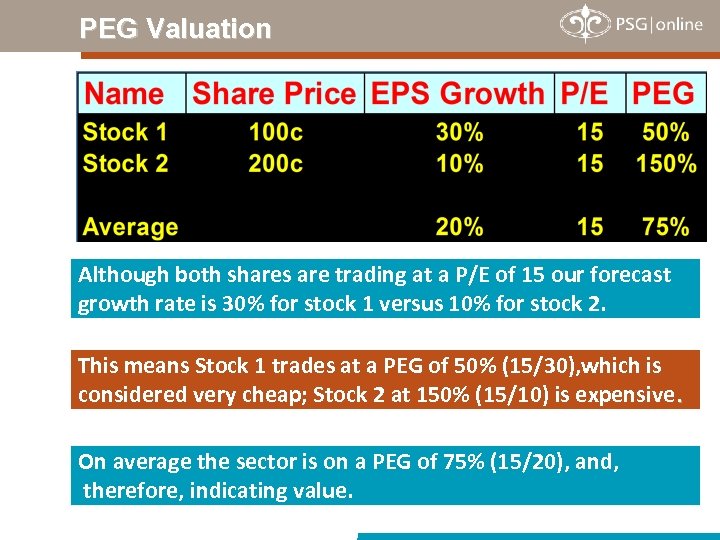
PEG Valuation Although both shares are trading at a P/E of 15 our forecast growth rate is 30% for stock 1 versus 10% for stock 2. This means Stock 1 trades at a PEG of 50% (15/30), which is considered very cheap; Stock 2 at 150% (15/10) is expensive. On average the sector is on a PEG of 75% (15/20), and, therefore, indicating value.
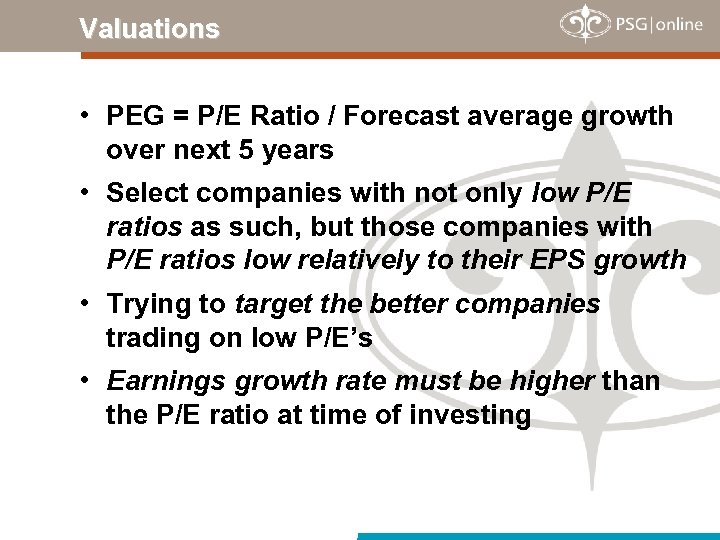
Valuations • PEG = P/E Ratio / Forecast average growth over next 5 years • Select companies with not only low P/E ratios as such, but those companies with P/E ratios low relatively to their EPS growth • Trying to target the better companies trading on low P/E’s • Earnings growth rate must be higher than the P/E ratio at time of investing

Valuation: Net Asset Value (NAV)
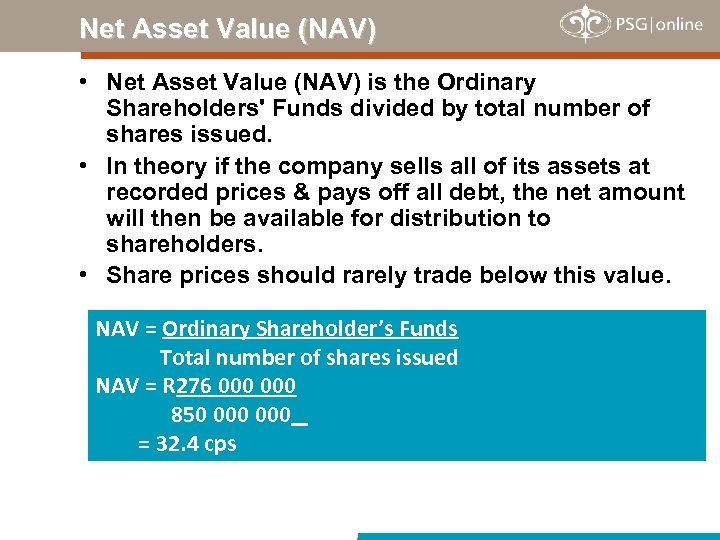
Net Asset Value (NAV) • Net Asset Value (NAV) is the Ordinary Shareholders' Funds divided by total number of shares issued. • In theory if the company sells all of its assets at recorded prices & pays off all debt, the net amount will then be available for distribution to shareholders. • Share prices should rarely trade below this value. NAV = Ordinary Shareholder’s Funds Total number of shares issued NAV = R 276 000 850 000 = 32. 4 cps
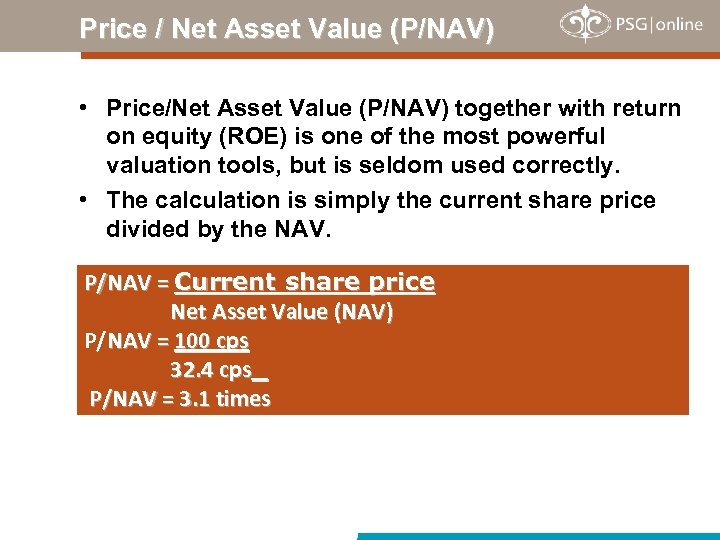
Price / Net Asset Value (P/NAV) • Price/Net Asset Value (P/NAV) together with return on equity (ROE) is one of the most powerful valuation tools, but is seldom used correctly. • The calculation is simply the current share price divided by the NAV. P/NAV = Current share price Net Asset Value (NAV) P/NAV = 100 cps 32. 4 cps P/NAV = 3. 1 times
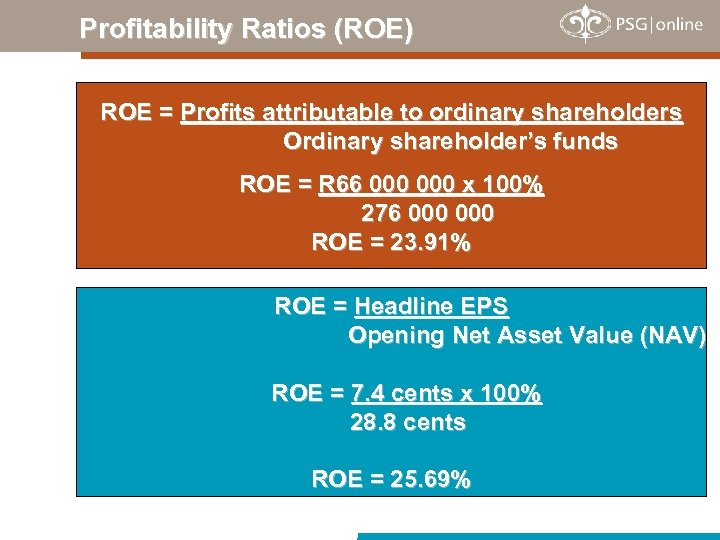
Profitability Ratios (ROE) ROE = Profits attributable to ordinary shareholders Ordinary shareholder’s funds ROE = R 66 000 x 100% 276 000 ROE = 23. 91% ROE = Headline EPS Opening Net Asset Value (NAV) ROE = 7. 4 cents x 100% 28. 8 cents ROE = 25. 69%
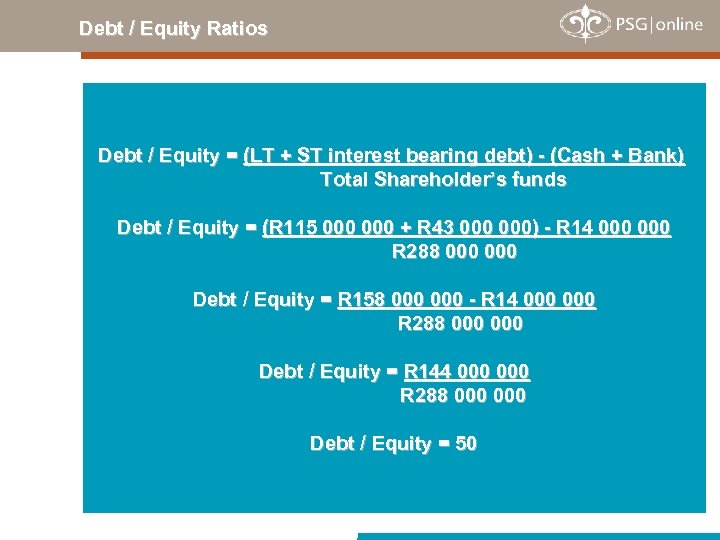
Debt / Equity Ratios Debt / Equity = (LT + ST interest bearing debt) - (Cash + Bank) Total Shareholder’s funds Debt / Equity = (R 115 000 + R 43 000) - R 14 000 R 288 000 Debt / Equity = R 158 000 - R 14 000 R 288 000 Debt / Equity = R 144 000 R 288 000 Debt / Equity = 50
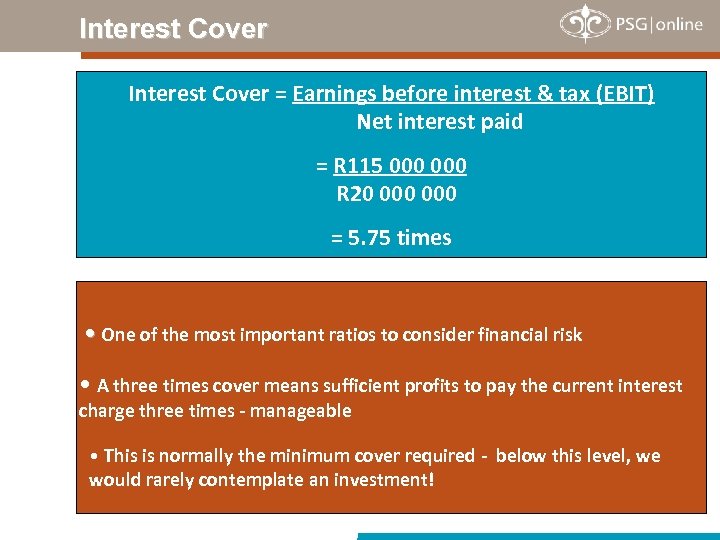
Interest Cover = Earnings before interest & tax (EBIT) Net interest paid = R 115 000 R 20 000 = 5. 75 times • One of the most important ratios to consider financial risk • A three times cover means sufficient profits to pay the current interest charge three times - manageable • This is normally the minimum cover required - below this level, we would rarely contemplate an investment!

Company Analysis
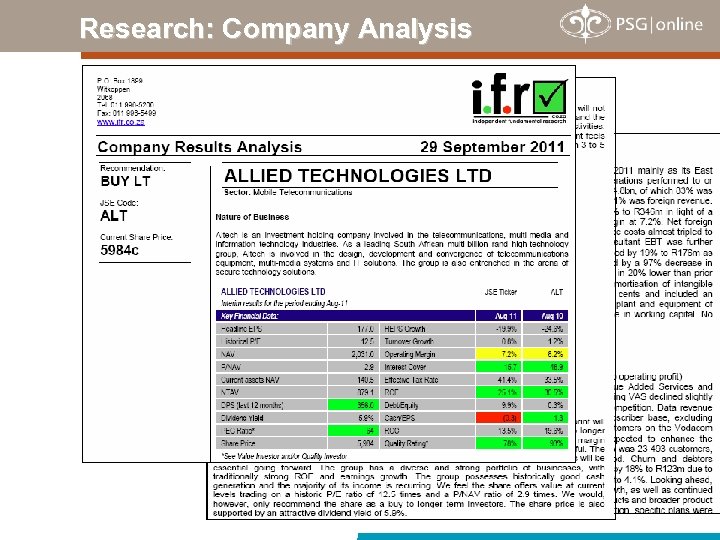
Research: Company Analysis
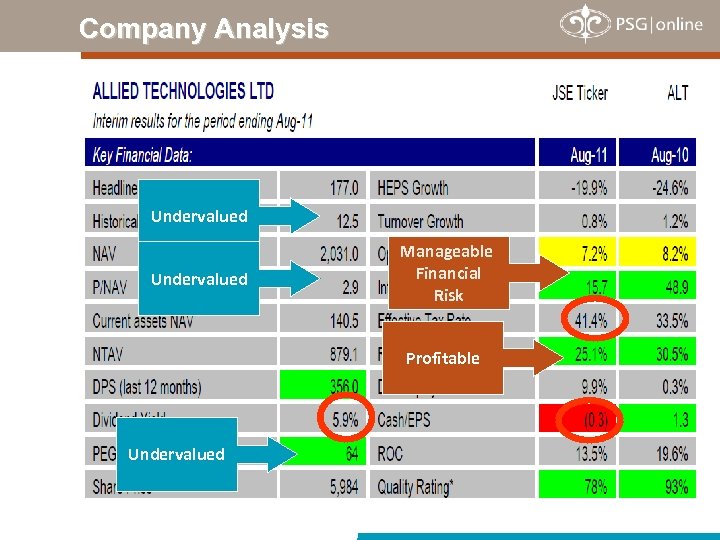
Company Analysis Undervalued Manageable Financial Risk Profitable Undervalued
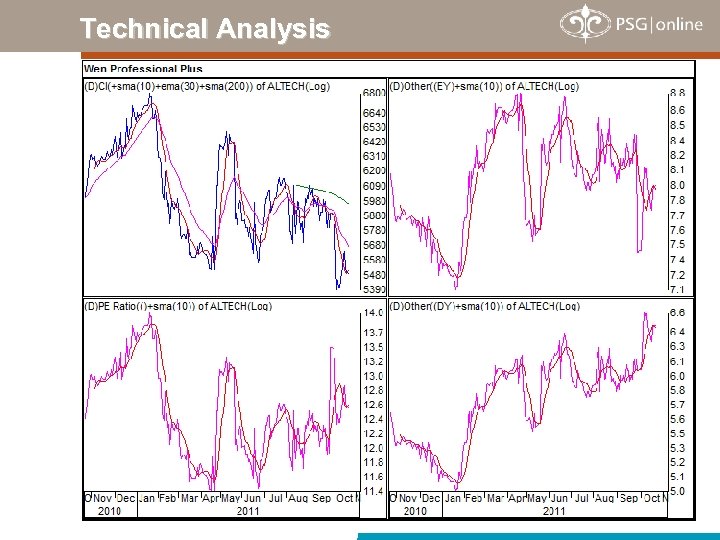
Technical Analysis
Summary: Fundamental Benchmarks • Big Picture – Economy (GDP growth) – Inflation & Interest Rates • Company Analysis: – HEPS Growth & Turnover Growth > 10% – Valuation: • Price/NAV < 2 / PEG > 35 and < 75 (Undervalued) – Profitable: • ROE > 15% – Manageable Financial Risk • Interest Cover > 3 times – Cash Flow • Cash /HEPS > 0. 75

Investment Strategies
Investment Strategy • Overall investment stance or view (Philosophy) – Short, medium or long-term investing? • Top-down approach – Overview of economy, industry & best sectors, companies with best prospects of earnings growth • Structure of portfolio – Spread over 3 -5 sectors – Between 8 - 12 shares • Choice (or quality) of shares in portfolio – Large, Mid or Small cap shares? • Timing of purchases & sales • Level of liquidity
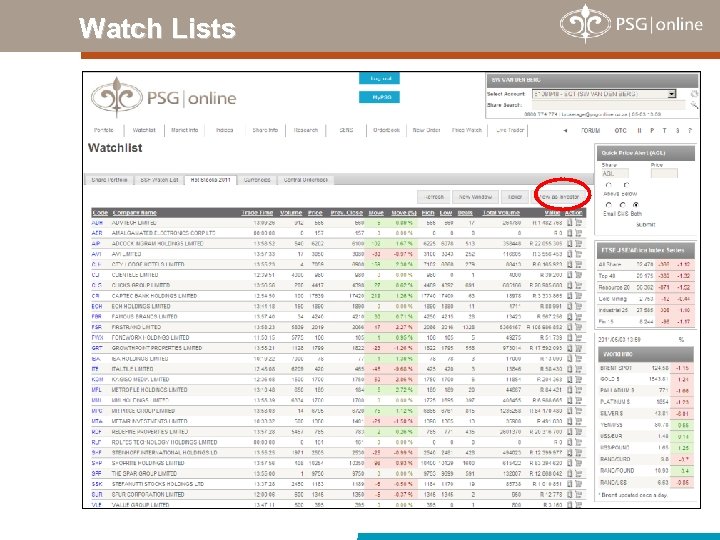
Watch Lists
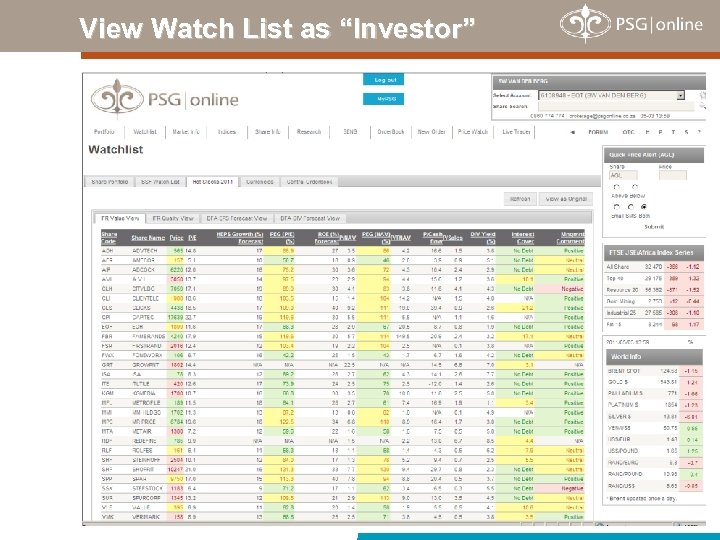
View Watch List as “Investor”
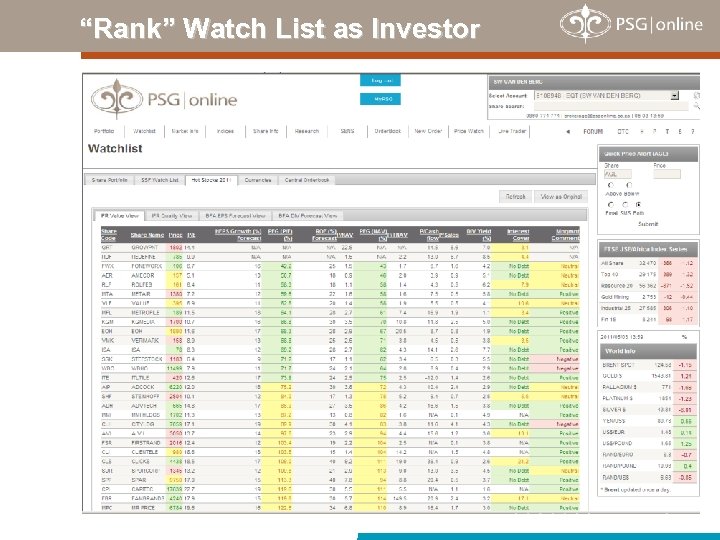
“Rank” Watch List as Investor

Strategy: Value Investing
“Price is what you pay, value is what you get” Warren Buffet
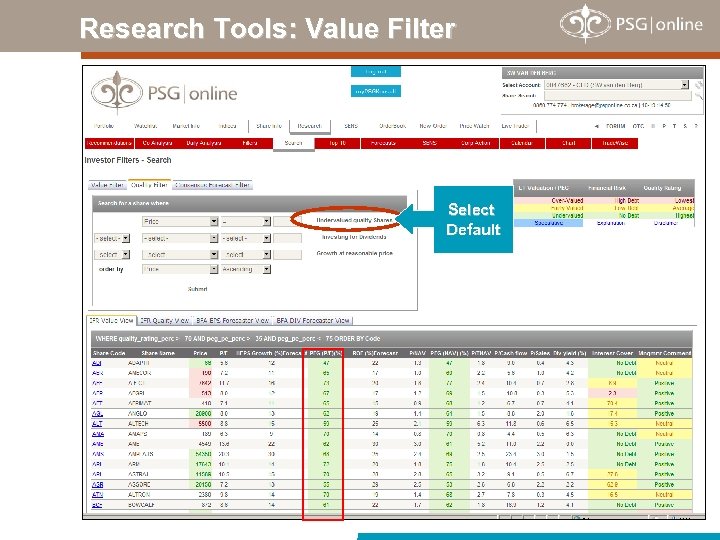
Research Tools: Value Filter Select Default
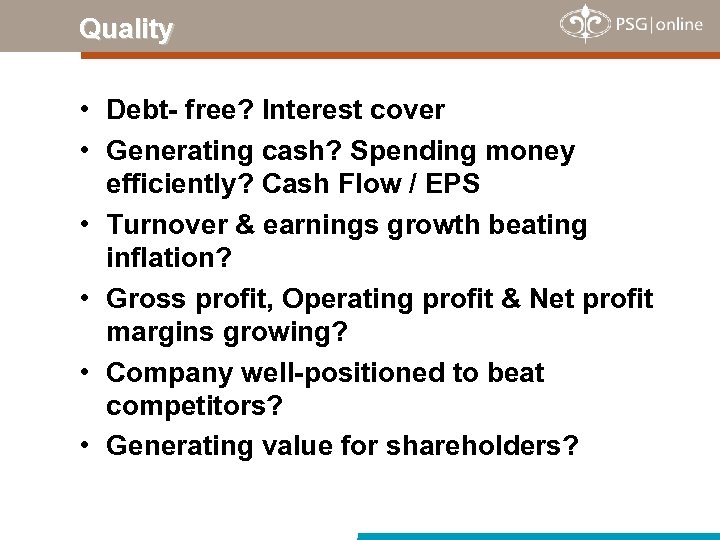
Quality • Debt- free? Interest cover • Generating cash? Spending money efficiently? Cash Flow / EPS • Turnover & earnings growth beating inflation? • Gross profit, Operating profit & Net profit margins growing? • Company well-positioned to beat competitors? • Generating value for shareholders?
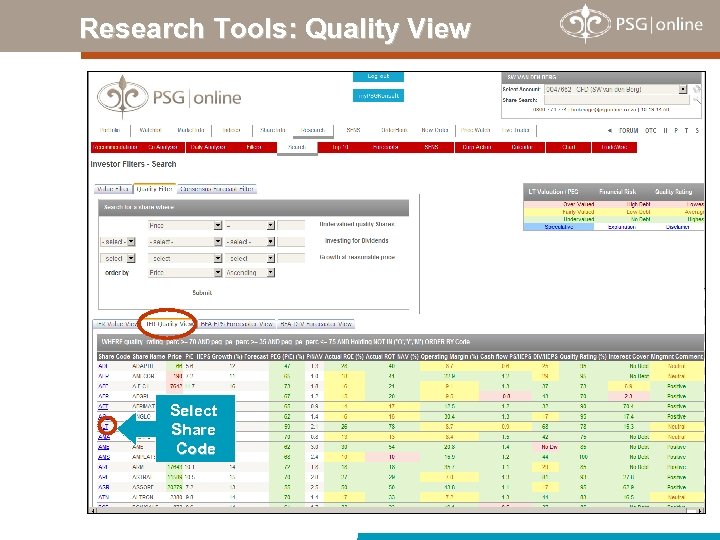
Research Tools: Quality View Select Share Code

Growth at a Reasonable Price (G. A. R. P. ) Peter Lynch
Successful Investor: Peter Lynch “Go for a business that any idiot can run, because, sooner or later, any idiot probably is going to run it. ” Peter Lynch
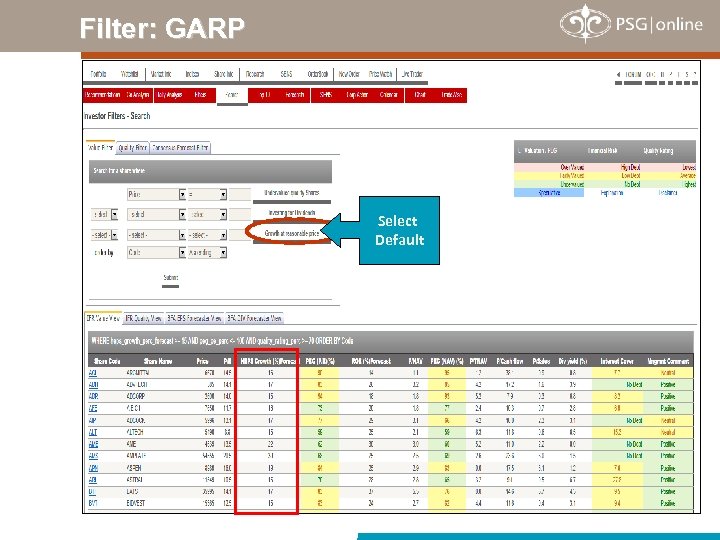
Filter: GARP Select Default

Strategy: Investing for Dividends
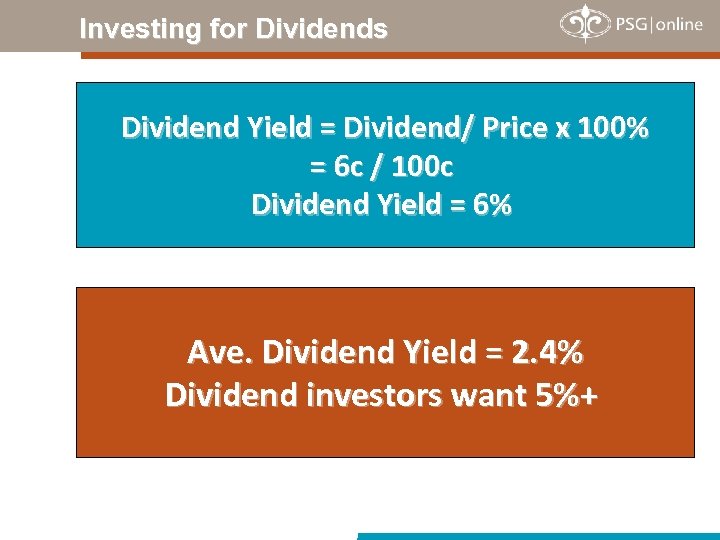
Investing for Dividends Dividend Yield = Dividend/ Price x 100% = 6 c / 100 c Dividend Yield = 6% Ave. Dividend Yield = 2. 4% Dividend investors want 5%+
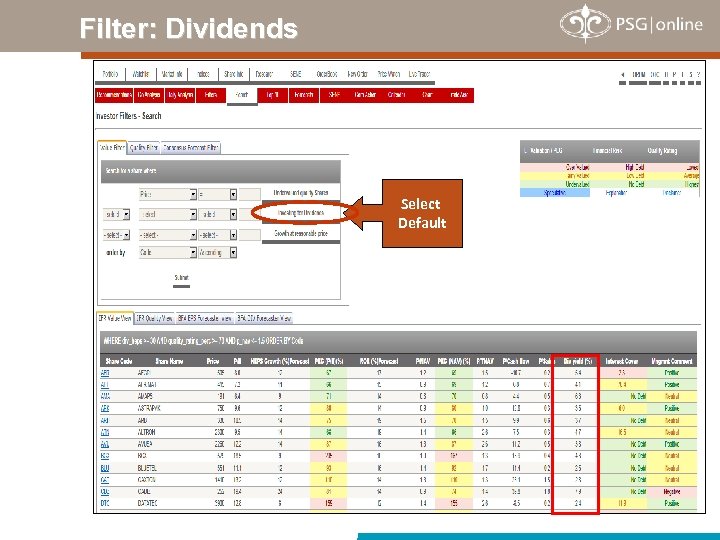
Filter: Dividends Select Default
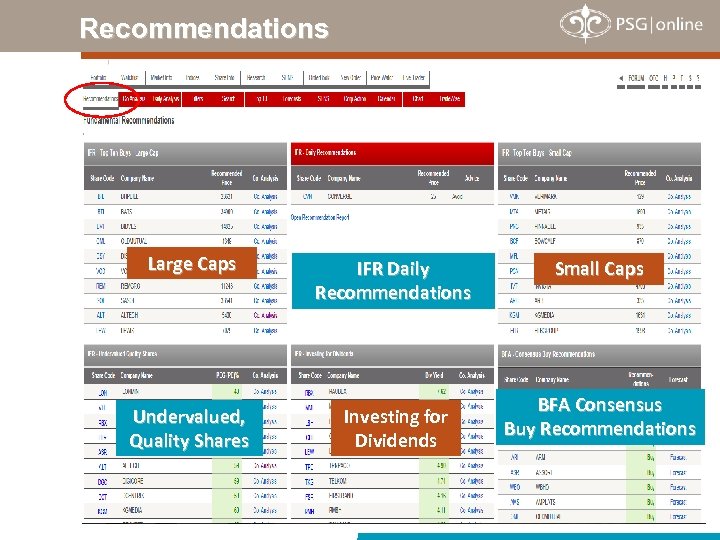
Recommendations Large Caps IFR Daily Recommendations Undervalued, Quality Shares Investing for Dividends Small Caps BFA Consensus Buy Recommendations
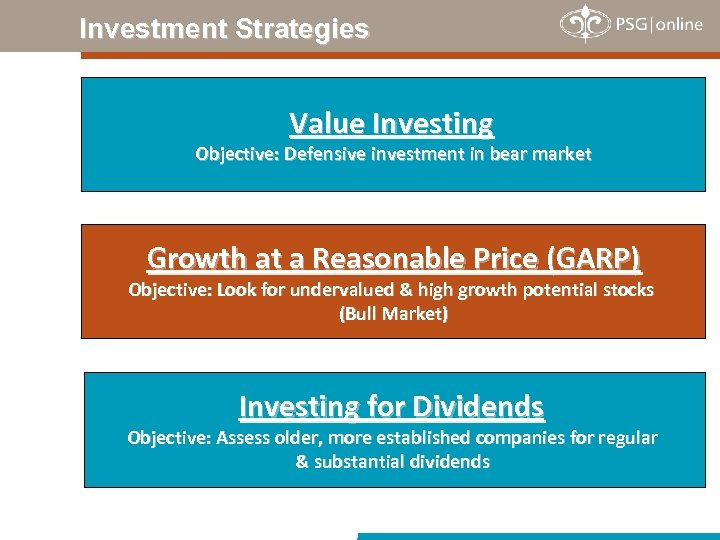
Investment Strategies Value Investing Objective: Defensive investment in bear market Growth at a Reasonable Price (GARP) Objective: Look for undervalued & high growth potential stocks (Bull Market) Investing for Dividends Objective: Assess older, more established companies for regular & substantial dividends
Conclusion: Investing • Develop your own style of investing – Match investment strategy to your personality • “It is far better to buy a fine company at a fair price, than a fair company at a fine price. ” • Decided, based on fundamental analysis a share is a good investment … • The next question is … when to buy?

Contact us Thank You shaunvdb@psgonline. co. za 011 996 5324
Скачать презентацию Welcome to Market Worx Shaun van den Berg
bad711c2575cae56f28aa5703776dfbf.ppt