


 Скачать презентацию Welcome to Malaysia Worlds ome f From the
WUDC 2015 Briefing Presentation.pptx
- Количество слайдов: 58
 Welcome to Malaysia Worlds! ome f From the WUDC 2015 Adjudication Core: Shafiq Bazari, Jonathan Leader Maynard, Engin Arikan, Brett Frazer, Madeline Schultz, Sebastian Templeton, and Danique van Koppenhagen
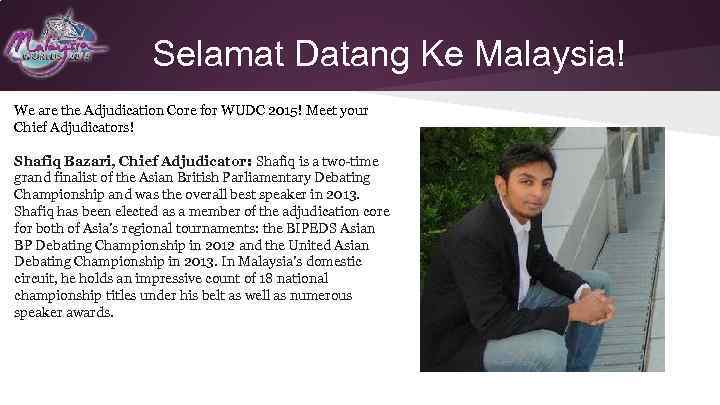 Selamat Datang Ke Malaysia! We are the Adjudication Core for WUDC 2015! Meet your Chief Adjudicators! Shafiq Bazari, Chief Adjudicator: Shafiq is a two-time grand finalist of the Asian British Parliamentary Debating Championship and was the overall best speaker in 2013. Shafiq has been elected as a member of the adjudication core for both of Asia's regional tournaments: the BIPEDS Asian BP Debating Championship in 2012 and the United Asian Debating Championship in 2013. In Malaysia's domestic circuit, he holds an impressive count of 18 national championship titles under his belt as well as numerous speaker awards.
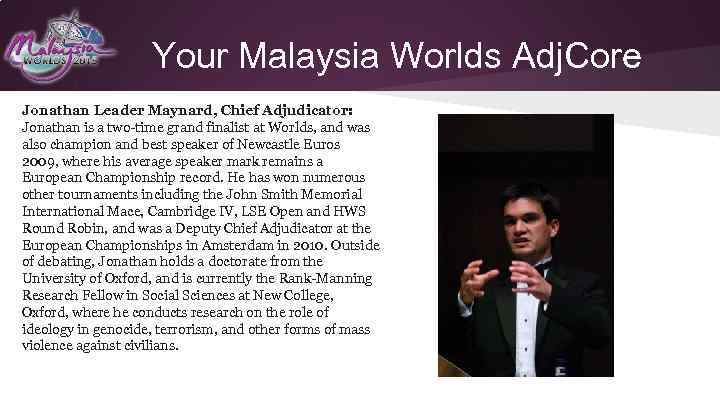 Your Malaysia Worlds Adj. Core Jonathan Leader Maynard, Chief Adjudicator: Jonathan is a two-time grand finalist at Worlds, and was also champion and best speaker of Newcastle Euros 2009, where his average speaker mark remains a European Championship record. He has won numerous other tournaments including the John Smith Memorial International Mace, Cambridge IV, LSE Open and HWS Round Robin, and was a Deputy Chief Adjudicator at the European Championships in Amsterdam in 2010. Outside of debating, Jonathan holds a doctorate from the University of Oxford, and is currently the Rank-Manning Research Fellow in Social Sciences at New College, Oxford, where he conducts research on the role of ideology in genocide, terrorism, and other forms of mass violence against civilians.
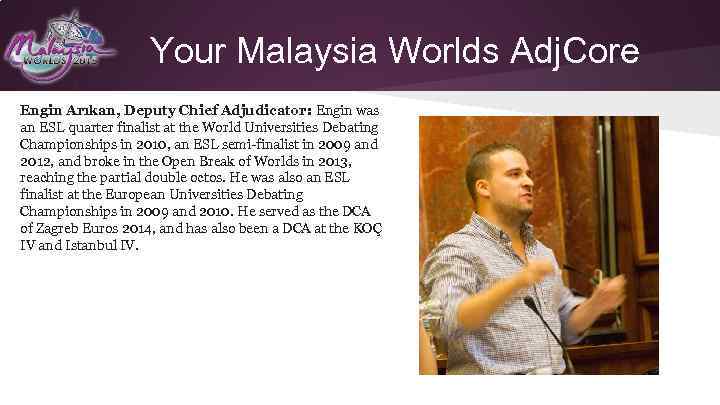 Your Malaysia Worlds Adj. Core Engin Arıkan, Deputy Chief Adjudicator: Engin was an ESL quarter finalist at the World Universities Debating Championships in 2010, an ESL semi-finalist in 2009 and 2012, and broke in the Open Break of Worlds in 2013, reaching the partial double octos. He was also an ESL finalist at the European Universities Debating Championships in 2009 and 2010. He served as the DCA of Zagreb Euros 2014, and has also been a DCA at the KOÇ IV and Istanbul IV.
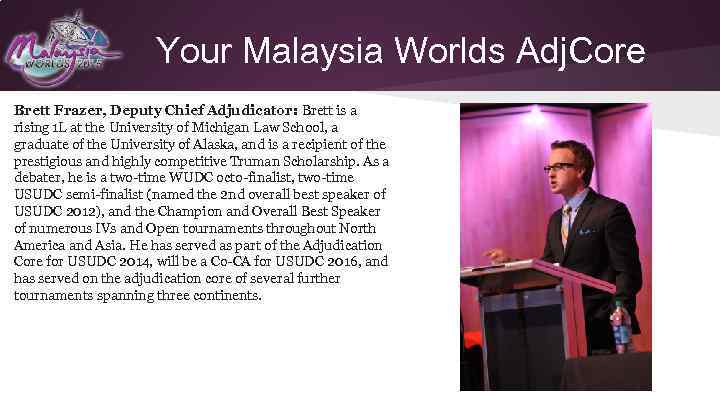 Your Malaysia Worlds Adj. Core Brett Frazer, Deputy Chief Adjudicator: Brett is a rising 1 L at the University of Michigan Law School, a graduate of the University of Alaska, and is a recipient of the prestigious and highly competitive Truman Scholarship. As a debater, he is a two-time WUDC octo-finalist, two-time USUDC semi-finalist (named the 2 nd overall best speaker of USUDC 2012), and the Champion and Overall Best Speaker of numerous IVs and Open tournaments throughout North America and Asia. He has served as part of the Adjudication Core for USUDC 2014, will be a Co-CA for USUDC 2016, and has served on the adjudication core of several further tournaments spanning three continents.
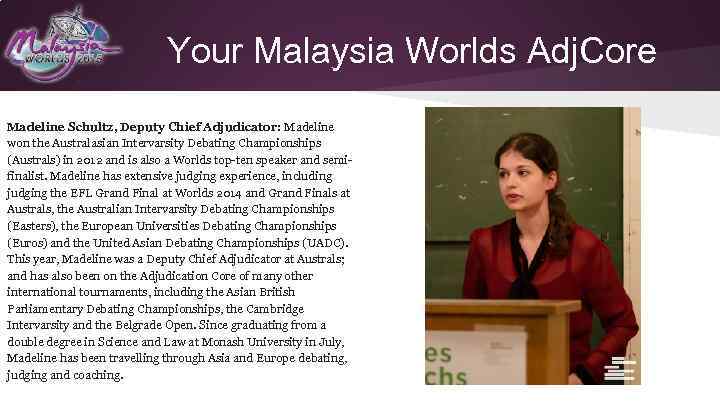 Your Malaysia Worlds Adj. Core Madeline Schultz, Deputy Chief Adjudicator: Madeline won the Australasian Intervarsity Debating Championships (Australs) in 2012 and is also a Worlds top-ten speaker and semifinalist. Madeline has extensive judging experience, including judging the EFL Grand Final at Worlds 2014 and Grand Finals at Australs, the Australian Intervarsity Debating Championships (Easters), the European Universities Debating Championships (Euros) and the United Asian Debating Championships (UADC). This year, Madeline was a Deputy Chief Adjudicator at Australs; and has also been on the Adjudication Core of many other international tournaments, including the Asian British Parliamentary Debating Championships, the Cambridge Intervarsity and the Belgrade Open. Since graduating from a double degree in Science and Law at Monash University in July, Madeline has been travelling through Asia and Europe debating, judging and coaching.
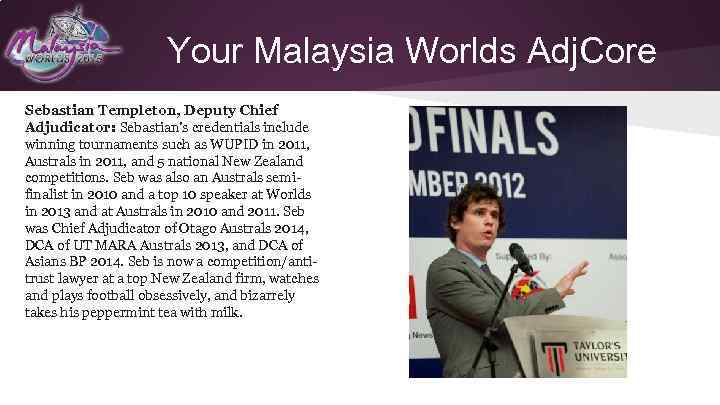 Your Malaysia Worlds Adj. Core Sebastian Templeton, Deputy Chief Adjudicator: Sebastian’s credentials include winning tournaments such as WUPID in 2011, Australs in 2011, and 5 national New Zealand competitions. Seb was also an Australs semifinalist in 2010 and a top 10 speaker at Worlds in 2013 and at Australs in 2010 and 2011. Seb was Chief Adjudicator of Otago Australs 2014, DCA of UT MARA Australs 2013, and DCA of Asians BP 2014. Seb is now a competition/antitrust lawyer at a top New Zealand firm, watches and plays football obsessively, and bizarrely takes his peppermint tea with milk.
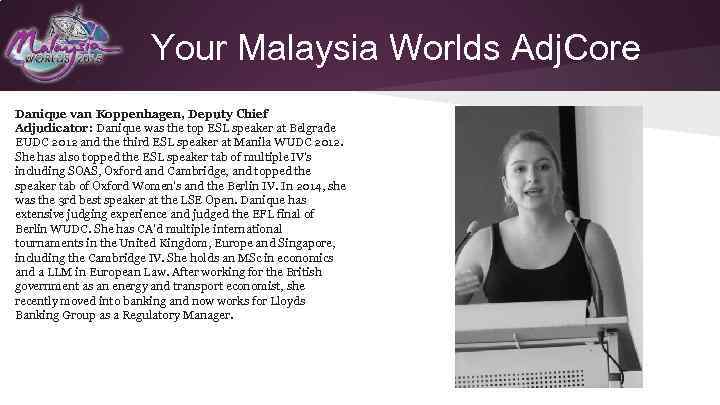 Your Malaysia Worlds Adj. Core Danique van Koppenhagen, Deputy Chief Adjudicator: Danique was the top ESL speaker at Belgrade EUDC 2012 and the third ESL speaker at Manila WUDC 2012. She has also topped the ESL speaker tab of multiple IV's including SOAS, Oxford and Cambridge, and topped the speaker tab of Oxford Women's and the Berlin IV. In 2014, she was the 3 rd best speaker at the LSE Open. Danique has extensive judging experience and judged the EFL final of Berlin WUDC. She has CA'd multiple international tournaments in the United Kingdom, Europe and Singapore, including the Cambridge IV. She holds an MSc in economics and a LLM in European Law. After working for the British government as an energy and transport economist, she recently moved into banking and now works for Lloyds Banking Group as a Regulatory Manager.
 The WUDC Debating and Judging Manual We strongly advise all debaters and judges to give the manual at least a quick read-through, and ask all but the most experienced judges to read it thoroughly
 The WUDC Debating and Judging Manual is broken into two sections. 1) Rules are obligatory requirements of BP debating, most of which are found in the WUDC Constitution – breaching these rules is impermissible, though in many cases the infraction might be small, not especially reprehensible, and easily remedied. 2) Guidance constitutes general advice from the authors of this manual to debaters or judges -- much like tips or advice a coach would give -- which they are free to follow or abandon as they wish. Crucially, a team should never be penalised for failing to follow any guidance offered in this manual simply “because it’s the guidance offered in the manual. ” Put another way: judges have to judge how persuasive teams are according to the rules, not how well the teams follow our guidance.
 How We Evaluated and Will be Managing Adjudicators ● ● ● Minimal Adj. Core opinion CV, Video Test, Multiple Choice Broad Bands Regional balancing on panels Rotation Feedback
 Results from the Adjudication Test: Video Debate Thank you for sitting the test. Those who haven’t have now run out of time.
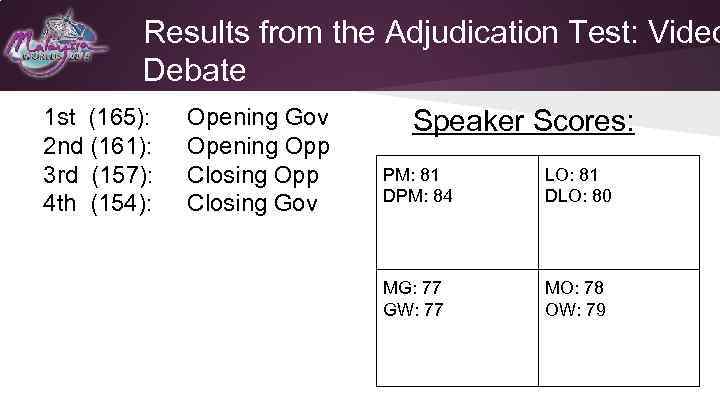 Results from the Adjudication Test: Video Debate 1 st (165): 2 nd (161): 3 rd (157): 4 th (154): Opening Gov Opening Opp Closing Gov Speaker Scores: PM: 81 DPM: 84 LO: 81 DLO: 80 MG: 77 GW: 77 MO: 78 OW: 79
 How we saw the debate ● ● ● ● OG showed a substantial problem in the SQ where a number, and certain types, of policies were not likely to be high priority for elected parties OO relied predominantly on problems with the mechanism - inferior legislation, limited information, contradictory policies OG was able to defeat these claims. The proposal was shown to be better than nothing, and problems with quality of legislation and information were able to be integrated, through use of the legislative process, into the proposal OO also attempted to show that people elect representatives, rather than select policies, but this also failed to defeat the marginal benefits of the OG’s proposal The additions from the closing teams were not particularly unique and rather were heavily reliant on their opening teams. The key issues in the debate remained the clash between OG and OO CO didn’t make the top half because: o the extension, in particular at Member, ignored significant substantive from OG which has not been defeated in the opening half CG lost out to CO because: o the CG extension was fairly derivative of OG. The new material was closer to a new context than new material, and wasn’t sufficiently unpacked or made relevant o CG lost out in direct clash with CO on the issue of oppression - illustrated well by CO’s POI and example about likely discrimination towards Rohingyas
 Other calls ● We saw there being two other strong calls in this debate: o Flipping the closing half - giving CG third and CO fourth o Flipping the opposition bench - giving CO second and OO third ● Several judges flipped the opening half and put OO first and OG second. We still awarded some points for this, and judges who did so were not significantly penalised where their reasoning was good ● It was possible to receive close to full marks on reasoning, even where your ranking was completely opposed to ours
 Results from the Adjudication Test: Multiple Choice Section 1. Which of the following warrants a team being ranked fourth regardless of the quality of their argumentation? Tick as many as apply, it is possible none will ● ● Contradicting another team or speaker on your side of the debate Failing to take any POIs Breaching tournament equity policy Offering an invalid definition of the motion Answer: None of the Above From the WUDC Manual (Sec. 3. 1): Teams cannot win or lose debates for isolated things they did, like setting up the debate well or contradicting another team on their side. Crucially, there are no such things as ‘automatic fourths’ or ‘automatic firsts’.
 Results from the Adjudication Test: Multiple Choice Section 2. Which of the following are duties of the Opening Opposition? Tick as many as apply, it is possible none will. ❏ To engage with the arguments of Opening Government. ❏ To provide substantive arguments that the motion should be opposed. ❏ To summarise their case in the Deputy Opposition Leader speech (second speech). ❏ To offer a counter-proposal as to how they would solve the problem identified by Opening Government. ❏ To take at least one POI during each of their speeches. Answer: (1) To engage with the arguments of Opening Government. (2) To provide substantive arguments that the motion should be opposed. (5) To take at least one POI during each of their speeches. For more about role fulfillment, please refer to section 2. 5 of the WUDC manual.
 Results from the Adjudication Test: Multiple Choice Section 3. When should a Chair intervene in a speaker’s speech to enforce the rules of debating? Tick as many as apply, it is possible none will. ❏ When a speaker is still talking after 7 minutes. ❏ When a speaker is still talking after 8 minutes. ❏ When a debater is repeatedly offering POIs immediately after being rejected by the current speaker. ❏ When a speaker has failed to analyse an argument they have presented. ❏ When a speaker is approaching 6 minutes and has not yet taken a POI. ❏ When a debater continues to deliver a POI after having been told to sit back down by the speaker. ❏ When a debater other than the current speaker is talking in an audible volume or otherwise generating distracting noise, except where offering a POI. ❏ Where a speaker is speaking too loudly or too quietly during their speech. Answer: (2) When a speaker is still talking after 8 minutes (3) When a debater is repeatedly offering POIs immediately after being rejected by the current speaker (6) When a debater continues to deliver a POI after having been told to sit back down by the speaker (7) When a debater other than the current speaker is talking in an audible volume or otherwise generating distracting noise, except where offering a POI
 Breaches of Order From the WUDC Manual (Sec. 1. 6): Breaches of Order For the debate to be able to proceed properly, and for all speakers to have a fair chance to deliver their speeches, all debaters (and anyone else in the debate room) are required to refrain from disrupting the debate. Any of the following activities are considered to be disrupting the debate: ● talking beyond eight minutes ● barracking/badgering ● when not delivering a speech or a POI, talking in an audible volume or otherwise generating distracting noise ● engaging in other highly distracting behaviour ● offering POIs in any way other than those described in section 1. 4 ● using props (any physical object, diagram, etc. ) ● continuing to offer a POI after being cut off by the speaker speaking or by the Chair. These are not only breaches of the rules and/or appropriate debate conduct as it is commonly understood but are also breaches of order. Unlike other breaches of the rules (which simply damage a team’s chance of getting a good result in the debate), breaches of order should be enforced by the Chair of the debate by calling order. Calling Order: When the Chair of a debate utters “order”, it is a demand that all speakers immediately cease any of the breaches of order listed above. This should not happen often. Provided debaters adhere to the call to order, no further action is taken. A Chair should never call order for a breach of the rules which is not a breach of order. Chairs should know they are permitted to stop the clock in circumstances wherein the debate is so disrupted that time is taken away from a speaker.
 Results from the Adjudication Test: Multiple Choice Section 4. Which of the following, in principle, count as 'extension material' in a Government Member or Opposition Member speech? Tick as many as apply, it is possible none will. ❏ ❏ ❏ Offering new arguments which have not yet been made in the debate. Offering new rebuttal to arguments that have been made by other teams. Offering new analysis of, or explanation to support, an argument made by their opening half team. Rephrasing an argument made by an opening half team in more rhetorically pleasing or eloquent language. Taking an argument from their opening half team and applying it to a different set of cases or examples. Answer: (1) Offering new arguments which have not yet been made (2) Offering new rebuttal to arguments that have been made by other teams (3) Offering new analysis of, or explanation to support, an argument made by their opening half team (5) Taking an argument from their opening half team and applying to a different set of cases or examples
 Extension Speeches From the WUDC Manual (Sec. 2. 8): Extension Speeches The Government Member and Opposition Member are each responsible for contributing an ‘extension’ to the debate. An extension is defined as anything that hasn't yet been said by that side of the debate. An extension can take a number of forms including: (1) new arguments which have not yet been made in the debate, whether additive to their own case or responsive to material raised by the other side, (2) new examples, (3) new analysis or explanation of existing arguments, (4) new applications of existing argumentation (e. g. if the Member points out that one of their opening half’s arguments is able to defeat a new argument from the other side). In short, saying almost anything other than a word-for-word repetition of first-half's material will in some sense constitute an extension. In that sense, role fulfilment here is fairly easy and most extension speakers will succeed in fulfilling the bare minimum requirements of their role.
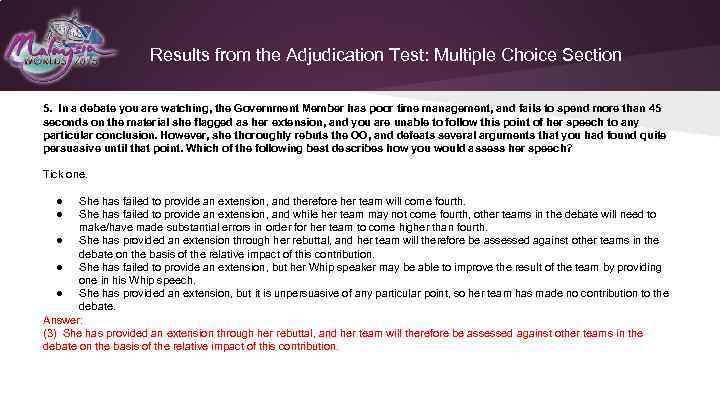 Results from the Adjudication Test: Multiple Choice Section 5. In a debate you are watching, the Government Member has poor time management, and fails to spend more than 45 seconds on the material she flagged as her extension, and you are unable to follow this point of her speech to any particular conclusion. However, she thoroughly rebuts the OO, and defeats several arguments that you had found quite persuasive until that point. Which of the following best describes how you would assess her speech? Tick one. ● ● She has failed to provide an extension, and therefore her team will come fourth. She has failed to provide an extension, and while her team may not come fourth, other teams in the debate will need to make/have made substantial errors in order for her team to come higher than fourth. ● She has provided an extension through her rebuttal, and her team will therefore be assessed against other teams in the debate on the basis of the relative impact of this contribution. ● She has failed to provide an extension, but her Whip speaker may be able to improve the result of the team by providing one in his Whip speech. ● She has provided an extension, but it is unpersuasive of any particular point, so her team has made no contribution to the debate. Answer: (3) She has provided an extension through her rebuttal, and her team will therefore be assessed against other teams in the debate on the basis of the relative impact of this contribution.
 Rebuttal From the WUDC Manual (Sec 2. 3): Rebuttals, Engagement, and Comparisons Rebuttal consists of any material offered by a speaker which demonstrates why arguments offered by teams on the other side of the debate are wrong, irrelevant, comparatively unimportant, insufficient, inadequate, or otherwise inferior to the contributions of the speaker’s own side of the debate. Rebuttal need not be explicitly labelled ‘rebuttal’ (though it may be sensible for speakers to do so), and it may occur at the beginning, end, middle or through the entirety of a speech. Material labelled as rebuttal can be constructive as well as rebuttal, and material labelled as constructive can also function as rebuttal. Rebuttal does not, therefore, denote some special sort of argument or analysis – it simply refers to any material that engages directly with arguments raised by the other side.
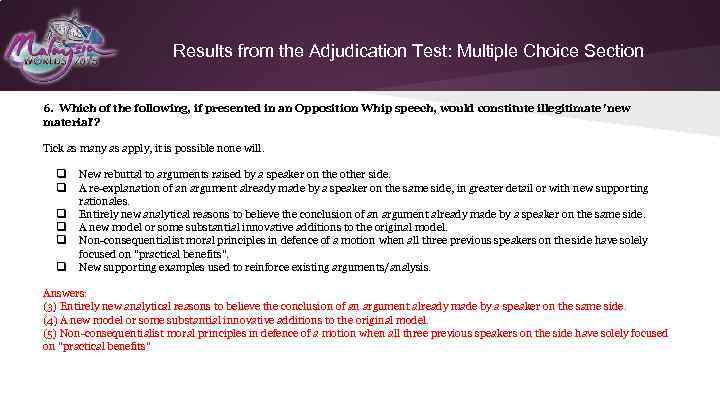 Results from the Adjudication Test: Multiple Choice Section 6. Which of the following, if presented in an Opposition Whip speech, would constitute illegitimate 'new material'? Tick as many as apply, it is possible none will. ❏ ❏ ❏ New rebuttal to arguments raised by a speaker on the other side. A re-explanation of an argument already made by a speaker on the same side, in greater detail or with new supporting rationales. Entirely new analytical reasons to believe the conclusion of an argument already made by a speaker on the same side. A new model or some substantial innovative additions to the original model. Non-consequentialist moral principles in defence of a motion when all three previous speakers on the side have solely focused on "practical benefits". New supporting examples used to reinforce existing arguments/analysis. Answers: (3) Entirely new analytical reasons to believe the conclusion of an argument already made by a speaker on the same side. (4) A new model or some substantial innovative additions to the original model. (5) Non-consequentialist moral principles in defence of a motion when all three previous speakers on the side have solely focused on "practical benefits"
 Whip Speeches From the WUDC Manual (Sec. 2. 9): Summarizing the Debate: Whip Speeches It is not the role of either whip speaker to add new arguments to their side. This is strongly prohibited in the rules of Worlds for the Opposition Whip, since no one will have a chance to respond to that speech. New material is officially permitted in Government Whip speeches, but new arguments raised there should still really have been raised in the Government Member speech, and do not help the Government Whip to summarise the debate persuasively. Both Whip speakers have the same fundamental role – to summarise the debate, rather than add new arguments.
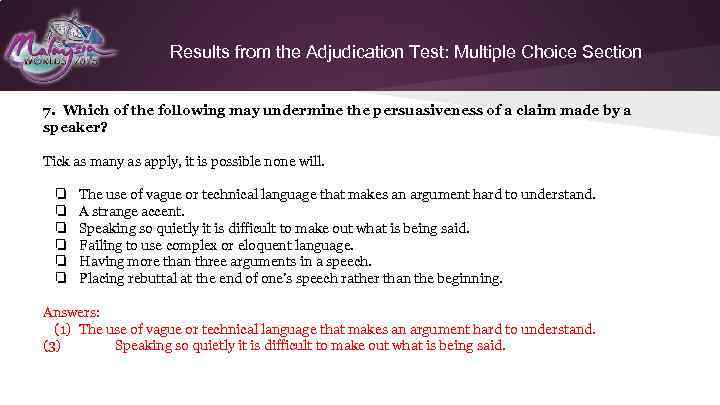 Results from the Adjudication Test: Multiple Choice Section 7. Which of the following may undermine the persuasiveness of a claim made by a speaker? Tick as many as apply, it is possible none will. ❏ ❏ ❏ The use of vague or technical language that makes an argument hard to understand. A strange accent. Speaking so quietly it is difficult to make out what is being said. Failing to use complex or eloquent language. Having more than three arguments in a speech. Placing rebuttal at the end of one's speech rather than the beginning. Answers: (1) The use of vague or technical language that makes an argument hard to understand. (3) Speaking so quietly it is difficult to make out what is being said.
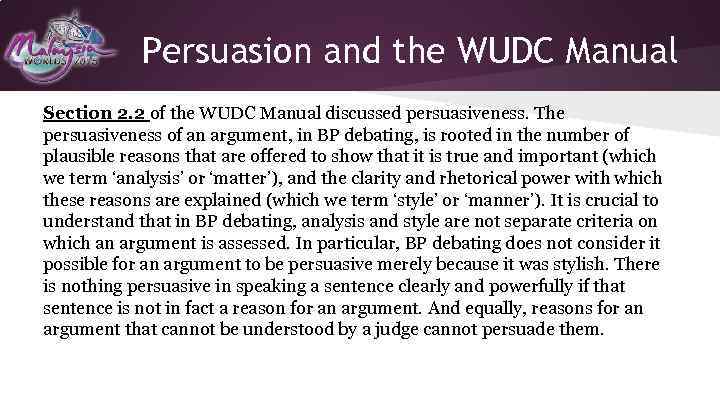 Persuasion and the WUDC Manual Section 2. 2 of the WUDC Manual discussed persuasiveness. The persuasiveness of an argument, in BP debating, is rooted in the number of plausible reasons that are offered to show that it is true and important (which we term ‘analysis’ or ‘matter’), and the clarity and rhetorical power with which these reasons are explained (which we term ‘style’ or ‘manner’). It is crucial to understand that in BP debating, analysis and style are not separate criteria on which an argument is assessed. In particular, BP debating does not consider it possible for an argument to be persuasive merely because it was stylish. There is nothing persuasive in speaking a sentence clearly and powerfully if that sentence is not in fact a reason for an argument. And equally, reasons for an argument that cannot be understood by a judge cannot persuade them.
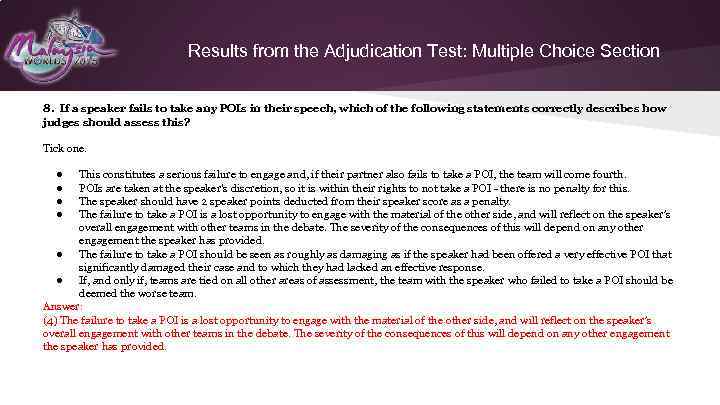 Results from the Adjudication Test: Multiple Choice Section 8. If a speaker fails to take any POIs in their speech, which of the following statements correctly describes how judges should assess this? Tick one. ● ● This constitutes a serious failure to engage and, if their partner also fails to take a POI, the team will come fourth. POIs are taken at the speaker's discretion, so it is within their rights to not take a POI - there is no penalty for this. The speaker should have 2 speaker points deducted from their speaker score as a penalty. The failure to take a POI is a lost opportunity to engage with the material of the other side, and will reflect on the speaker’s overall engagement with other teams in the debate. The severity of the consequences of this will depend on any other engagement the speaker has provided. ● The failure to take a POI should be seen as roughly as damaging as if the speaker had been offered a very effective POI that significantly damaged their case and to which they had lacked an effective response. ● If, and only if, teams are tied on all other areas of assessment, the team with the speaker who failed to take a POI should be deemed the worse team. Answer: (4) The failure to take a POI is a lost opportunity to engage with the material of the other side, and will reflect on the speaker’s overall engagement with other teams in the debate. The severity of the consequences of this will depend on any other engagement the speaker has provided.
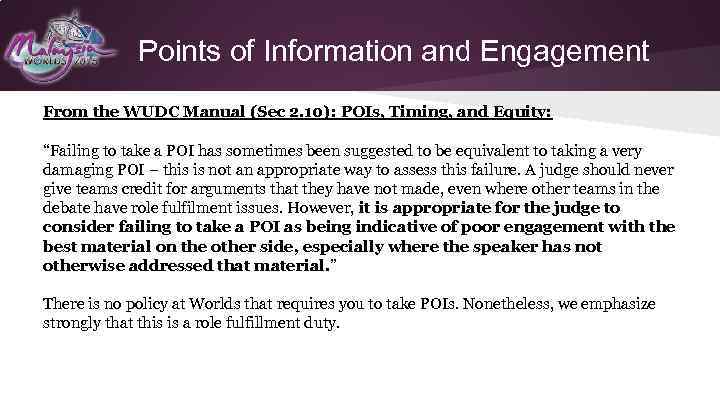 Points of Information and Engagement From the WUDC Manual (Sec 2. 10): POIs, Timing, and Equity: “Failing to take a POI has sometimes been suggested to be equivalent to taking a very damaging POI – this is not an appropriate way to assess this failure. A judge should never give teams credit for arguments that they have not made, even where other teams in the debate have role fulfilment issues. However, it is appropriate for the judge to consider failing to take a POI as being indicative of poor engagement with the best material on the other side, especially where the speaker has not otherwise addressed that material. ” There is no policy at Worlds that requires you to take POIs. Nonetheless, we emphasize strongly that this is a role fulfillment duty.
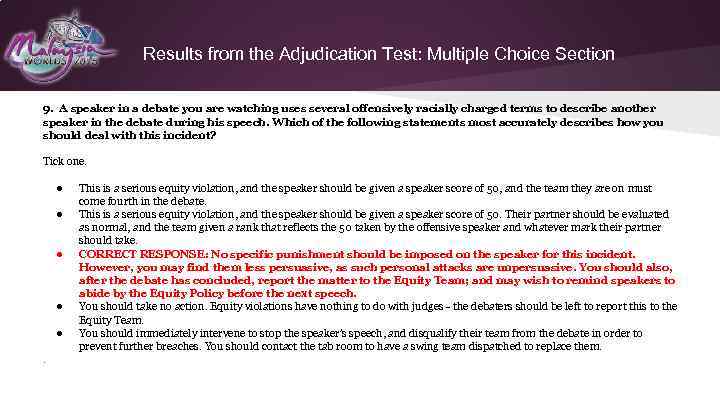 Results from the Adjudication Test: Multiple Choice Section 9. A speaker in a debate you are watching uses several offensively racially charged terms to describe another speaker in the debate during his speech. Which of the following statements most accurately describes how you should deal with this incident? Tick one. ● ● ●. This is a serious equity violation, and the speaker should be given a speaker score of 50, and the team they are on must come fourth in the debate. This is a serious equity violation, and the speaker should be given a speaker score of 50. Their partner should be evaluated as normal, and the team given a rank that reflects the 50 taken by the offensive speaker and whatever mark their partner should take. CORRECT RESPONSE: No specific punishment should be imposed on the speaker for this incident. However, you may find them less persuasive, as such personal attacks are unpersuasive. You should also, after the debate has concluded, report the matter to the Equity Team; and may wish to remind speakers to abide by the Equity Policy before the next speech. You should take no action. Equity violations have nothing to do with judges - the debaters should be left to report this to the Equity Team. You should immediately intervene to stop the speaker’s speech, and disqualify their team from the debate in order to prevent further breaches. You should contact the tab room to have a swing team dispatched to replace them.
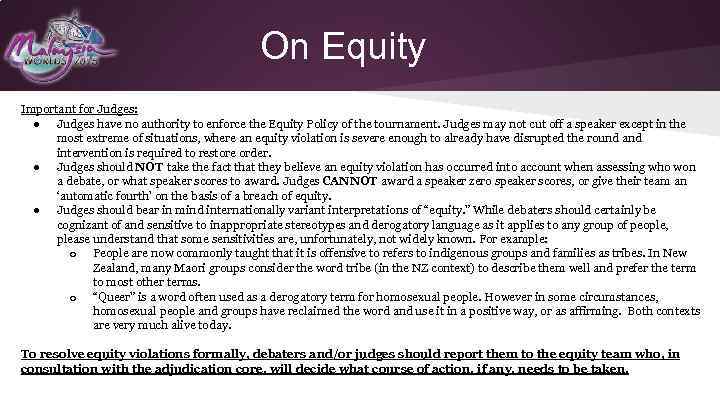 On Equity Important for Judges: ● Judges have no authority to enforce the Equity Policy of the tournament. Judges may not cut off a speaker except in the most extreme of situations, where an equity violation is severe enough to already have disrupted the round and intervention is required to restore order. ● Judges should NOT take the fact that they believe an equity violation has occurred into account when assessing who won a debate, or what speaker scores to award. Judges CANNOT award a speaker zero speaker scores, or give their team an ‘automatic fourth’ on the basis of a breach of equity. ● Judges should bear in mind internationally variant interpretations of “equity. ” While debaters should certainly be cognizant of and sensitive to inappropriate stereotypes and derogatory language as it applies to any group of people, please understand that some sensitivities are, unfortunately, not widely known. For example: o People are now commonly taught that it is offensive to refers to indigenous groups and families as tribes. In New Zealand, many Maori groups consider the word tribe (in the NZ context) to describe them well and prefer the term to most other terms. o “Queer” is a word often used as a derogatory term for homosexual people. However in some circumstances, homosexual people and groups have reclaimed the word and use it in a positive way, or as affirming. Both contexts are very much alive today. To resolve equity violations formally, debaters and/or judges should report them to the equity team who, in consultation with the adjudication core, will decide what course of action, if any, needs to be taken.
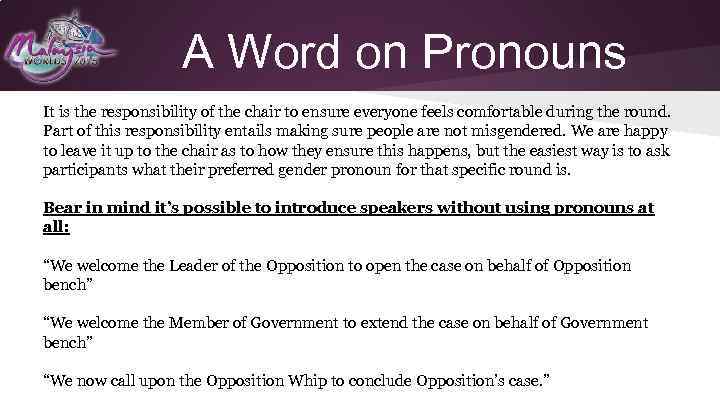 A Word on Pronouns It is the responsibility of the chair to ensure everyone feels comfortable during the round. Part of this responsibility entails making sure people are not misgendered. We are happy to leave it up to the chair as to how they ensure this happens, but the easiest way is to ask participants what their preferred gender pronoun for that specific round is. Bear in mind it’s possible to introduce speakers without using pronouns at all: “We welcome the Leader of the Opposition to open the case on behalf of Opposition bench” “We welcome the Member of Government to extend the case on behalf of Government bench” “We now call upon the Opposition Whip to conclude Opposition’s case. ”
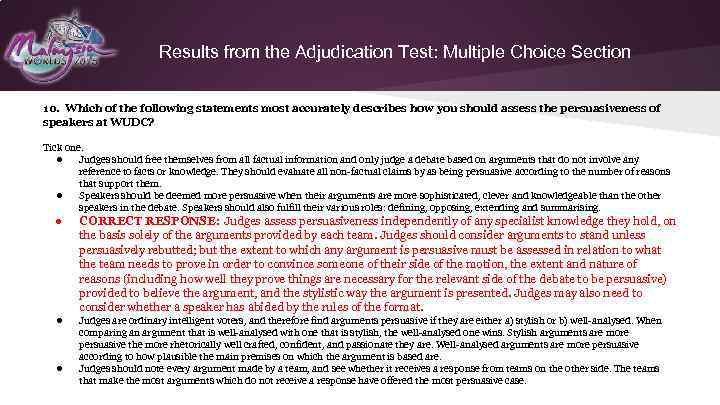 Results from the Adjudication Test: Multiple Choice Section 10. Which of the following statements most accurately describes how you should assess the persuasiveness of speakers at WUDC? Tick one. ● Judges should free themselves from all factual information and only judge a debate based on arguments that do not involve any reference to facts or knowledge. They should evaluate all non-factual claims by as being persuasive according to the number of reasons that support them. ● Speakers should be deemed more persuasive when their arguments are more sophisticated, clever and knowledgeable than the other speakers in the debate. Speakers should also fulfill their various roles: defining, opposing, extending and summarising. ● CORRECT RESPONSE: Judges assess persuasiveness independently of any specialist knowledge they hold, on the basis solely of the arguments provided by each team. Judges should consider arguments to stand unless persuasively rebutted; but the extent to which any argument is persuasive must be assessed in relation to what the team needs to prove in order to convince someone of their side of the motion, the extent and nature of reasons (including how well they prove things are necessary for the relevant side of the debate to be persuasive) provided to believe the argument, and the stylistic way the argument is presented. Judges may also need to consider whether a speaker has abided by the rules of the format. ● Judges are ordinary intelligent voters, and therefore find arguments persuasive if they are either a) stylish or b) well-analysed. When comparing an argument that is well-analysed with one that is stylish, the well-analysed one wins. Stylish arguments are more persuasive the more rhetorically well crafted, confident, and passionate they are. Well-analysed arguments are more persuasive according to how plausible the main premises on which the argument is based are. Judges should note every argument made by a team, and see whether it receives a response from teams on the other side. The teams that make the most arguments which do not receive a response have offered the most persuasive case. ●
 The Ordinary Intelligent Voter From the WUDC Manual (Sec 2. 1): Winning a Debate: “The hypothetical ordinary intelligent voter doesn’t have pre-formed views on the topic of the debate and isn’t convinced by sophistry, deception or logical fallacies. They are well informed about political and social affairs but lack specialist knowledge. They are openminded and concerned to decide how to vote – they are thus willing to be convinced by the debaters who provide the most compelling case for or against a certain policy. They are intelligent to the point of being able to understand assess contrasting arguments (including sophisticated arguments), that are presented to them; but they keep themselves constrained to the material presented unless it patently contradicts common knowledge or is otherwise wildly implausible. ”
 Results from the Adjudication Test: Multiple Choice Section 11. In a debate on "This House would elect senior judges", OG make the following argument: “Under our policy, we expect that almost all candidates who will get elected will be highly legally qualified, because legal qualifications are going to be important to voters, who recognise that senior judges fill important and complex roles in society. If a few aren't that well qualified, we think that's not a huge problem given the overwhelming benefits of our policy. ” Which of the following claims, if made by the Government Member, would constitute 'knifing'? Tick as many as apply, it is possible none will. ❏ ❏ "OG have suggested that most judges who will get elected will be highly qualified, and we agree. We're going to show the fact that some judges who are not legally qualified get elected is actually still a beneficial outcome for our side of the House. " "OG have argued that most judges who get elected will be legally qualified. We're going to show even if OG are wrong, and most judges are in fact poorly legally qualified, this motion should still be supported, because the democratic legitimacy of judges is more important than their competence. ” ❏ CORRECT RESPONSE: "This motion should pass because the bulk of judges who will be elected will be ordinary people like you and me who are better placed than ivory-tower members of the legal profession to judge the truly just outcomes in each case. Most of those who get elected won't have had their minds clouded by law degrees and legal training and institutionalisation, so they won't just represent elite interests. ” ❏ "OG have said that top elected judges will still be highly qualified - we're going to show you why. As when they use Doctors and Lawyers and Accountants on a professional basis, voters will look for one thing first: proven qualifications, because they understand the weight and authority these represent. "
 “Knifing” ● Member speeches (and also Whip speeches) need to be consistent with other speeches made on their side of the debate – indirectly contradicting other teams/speakers on their side of the debate or flatly stating that their arguments were false is termed ‘knifing’. ● This policy is true for both government AND opposition bench. It is neither advisable nor permissible for closing opposition to knife opening opposition.
 “Knifing” From the WUDC Constitution: 3. 2. 4 Matter should be consistent. Members should ensure that the matter they present is consistent within their speech, their team and the remainder of their side of the debate (subject to clauses 2. 3. 4, 2. 3. 5 or 2. 3. 6 of these rules). 2. 3. 4 Where the definition of the Opening Government is unreasonable and an alternative definition is substituted by the Opening Opposition, the Closing Government may introduce matter which is inconsistent with the matter presented by the Opening Government and consistent with the definition of Opening Opposition. 2. 3. 5 If the Opening Opposition has substituted a definition that is also unreasonable, the closing Government may challenge the definition of the Opening Opposition and substitute an alternative definition. 2. 3. 6 If the Closing Government has substituted a definition that is also unreasonable (in addition to the unreasonable definition of the Opening Government and Opening Opposition, the Closing Opposition may challenge the definition of the Closing Government and substitute an alternative definition
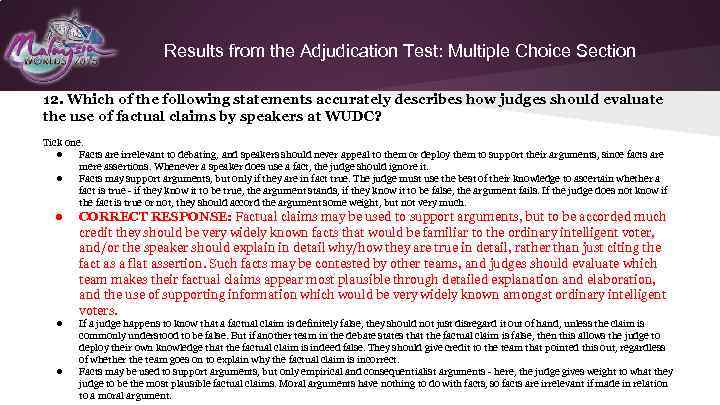 Results from the Adjudication Test: Multiple Choice Section 12. Which of the following statements accurately describes how judges should evaluate the use of factual claims by speakers at WUDC? Tick one. ● Facts are irrelevant to debating, and speakers should never appeal to them or deploy them to support their arguments, since facts are mere assertions. Whenever a speaker does use a fact, the judge should ignore it. ● Facts may support arguments, but only if they are in fact true. The judge must use the best of their knowledge to ascertain whether a fact is true - if they know it to be true, the argument stands, if they know it to be false, the argument fails. If the judge does not know if the fact is true or not, they should accord the argument some weight, but not very much. ● CORRECT RESPONSE: Factual claims may be used to support arguments, but to be accorded much credit they should be very widely known facts that would be familiar to the ordinary intelligent voter, and/or the speaker should explain in detail why/how they are true in detail, rather than just citing the fact as a flat assertion. Such facts may be contested by other teams, and judges should evaluate which team makes their factual claims appear most plausible through detailed explanation and elaboration, and the use of supporting information which would be very widely known amongst ordinary intelligent voters. ● If a judge happens to know that a factual claim is definitely false, they should not just disregard it out of hand, unless the claim is commonly understood to be false. But if another team in the debate states that the factual claim is false, then this allows the judge to deploy their own knowledge that the factual claim is indeed false. They should give credit to the team that pointed this out, regardless of whether the team goes on to explain why the factual claim is incorrect. Facts may be used to support arguments, but only empirical and consequentialist arguments - here, the judge gives weight to what they judge to be the most plausible factual claims. Moral arguments have nothing to do with facts, so facts are irrelevant if made in relation to a moral argument. ●
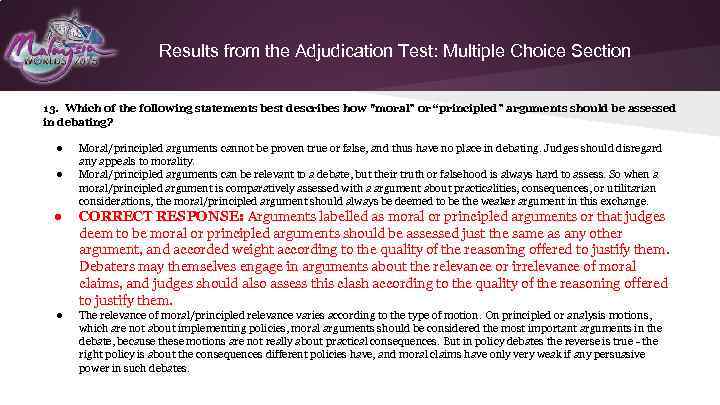 Results from the Adjudication Test: Multiple Choice Section 13. Which of the following statements best describes how "moral” or “principled” arguments should be assessed in debating? ● ● Moral/principled arguments cannot be proven true or false, and thus have no place in debating. Judges should disregard any appeals to morality. Moral/principled arguments can be relevant to a debate, but their truth or falsehood is always hard to assess. So when a moral/principled argument is comparatively assessed with a argument about practicalities, consequences, or utilitarian considerations, the moral/principled argument should always be deemed to be the weaker argument in this exchange. ● CORRECT RESPONSE: Arguments labelled as moral or principled arguments or that judges deem to be moral or principled arguments should be assessed just the same as any other argument, and accorded weight according to the quality of the reasoning offered to justify them. Debaters may themselves engage in arguments about the relevance or irrelevance of moral claims, and judges should also assess this clash according to the quality of the reasoning offered to justify them. ● The relevance of moral/principled relevance varies according to the type of motion. On principled or analysis motions, which are not about implementing policies, moral arguments should be considered the most important arguments in the debate, because these motions are not really about practical consequences. But in policy debates the reverse is true - the right policy is about the consequences different policies have, and moral claims have only very weak if any persuasive power in such debates.
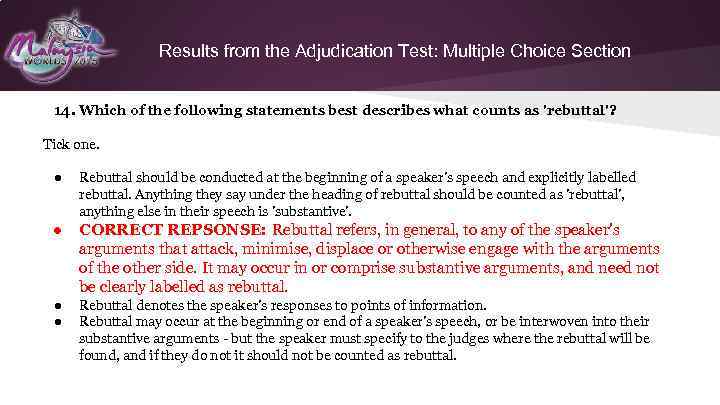 Results from the Adjudication Test: Multiple Choice Section 14. Which of the following statements best describes what counts as 'rebuttal'? Tick one. ● Rebuttal should be conducted at the beginning of a speaker's speech and explicitly labelled rebuttal. Anything they say under the heading of rebuttal should be counted as 'rebuttal', anything else in their speech is 'substantive'. ● CORRECT REPSONSE: Rebuttal refers, in general, to any of the speaker's arguments that attack, minimise, displace or otherwise engage with the arguments of the other side. It may occur in or comprise substantive arguments, and need not be clearly labelled as rebuttal. ● ● Rebuttal denotes the speaker's responses to points of information. Rebuttal may occur at the beginning or end of a speaker's speech, or be interwoven into their substantive arguments - but the speaker must specify to the judges where the rebuttal will be found, and if they do not it should not be counted as rebuttal.
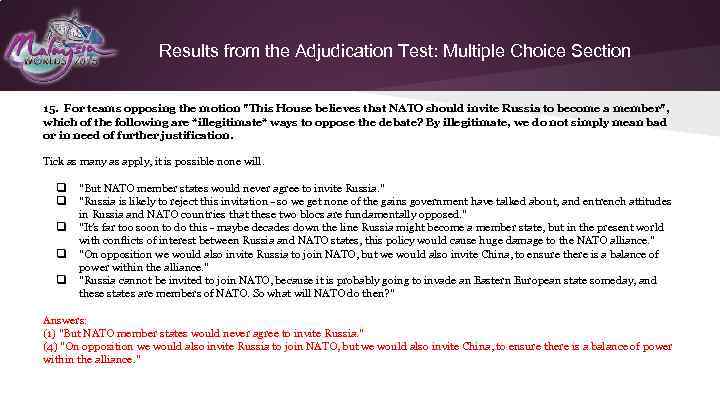 Results from the Adjudication Test: Multiple Choice Section 15. For teams opposing the motion "This House believes that NATO should invite Russia to become a member", which of the following are *illegitimate* ways to oppose the debate? By illegitimate, we do not simply mean bad or in need of further justification. Tick as many as apply, it is possible none will. ❏ ❏ ❏ "But NATO member states would never agree to invite Russia. " "Russia is likely to reject this invitation - so we get none of the gains government have talked about, and entrench attitudes in Russia and NATO countries that these two blocs are fundamentally opposed. " "It’s far too soon to do this - maybe decades down the line Russia might become a member state, but in the present world with conflicts of interest between Russia and NATO states, this policy would cause huge damage to the NATO alliance. " "On opposition we would also invite Russia to join NATO, but we would also invite China, to ensure there is a balance of power within the alliance. " "Russia cannot be invited to join NATO, because it is probably going to invade an Eastern European state someday, and these states are members of NATO. So what will NATO do then? " Answers: (1) "But NATO member states would never agree to invite Russia. " (4) "On opposition we would also invite Russia to join NATO, but we would also invite China, to ensure there is a balance of power within the alliance. "
 Mutual Exclusivity ● It is not Opposition’s burden to commit themselves to a specific alternative course of action to the Government policy. They may, however, in the Leader of Opposition speech, commit to defend an alternative policy or course of action if they wish – this is often referred to as a “counter-proposal, ” or “counter-prop. ” ● A counterprop which is not mutually exclusive with the Government model/case is not necessarily invalid. Opening Opposition teams choosing to run a non-mutually exclusive counter-proposal should not receive an automatic “fourth. ” ● That said, a non-mutually exclusive counter-prop is likely to be unhelpful in explaining why the Government policy should not be adopted – as intuitively, both could be done side-by-side. Rather, an OO that elects to present an alternative model should explain not only why their model is preferable to that of the OG, but also why it would be preferable to adopt their model to the exclusion of that of the OG.
 Government Fiat In British Parliamentary Debate, Government teams are the relevant agent who may implement a policy. Governments may stipulate their policy will be implemented -- something sometimes known as “Government Fiat. ” For example, for the motion “THW abolish the United States Senate, ” Government teams may declare, by fiat, that this will, in fact, actually occur. In other words, it is illegitimate for an opposition to argue, “but doing so would violate the U. S. Constitution and thus would never actually happen. ” Governments may stipulate a sensible approach to implementation, but may not stipulate success.
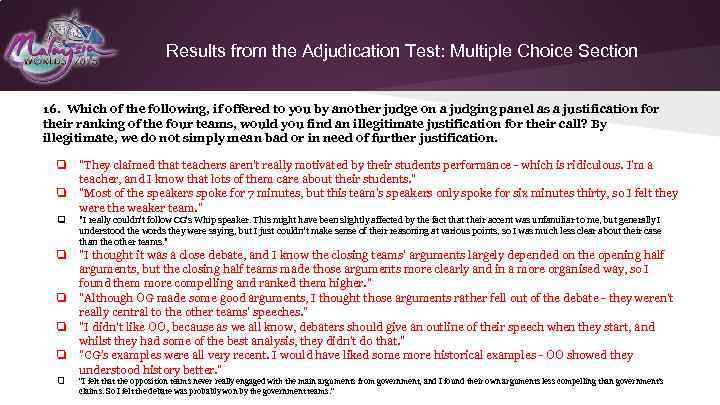 Results from the Adjudication Test: Multiple Choice Section 16. Which of the following, if offered to you by another judge on a judging panel as a justification for their ranking of the four teams, would you find an illegitimate justification for their call? By illegitimate, we do not simply mean bad or in need of further justification. ❏ "They claimed that teachers aren't really motivated by their students performance - which is ridiculous. I'm a teacher, and I know that lots of them care about their students. " ❏ "Most of the speakers spoke for 7 minutes, but this team's speakers only spoke for six minutes thirty, so I felt they were the weaker team. " ❏ "I really couldn't follow CG's Whip speaker. This might have been slightly affected by the fact that their accent was unfamiliar to me, but generally I understood the words they were saying, but I just couldn't make sense of their reasoning at various points, so I was much less clear about their case than the other teams. " ❏ "I thought it was a close debate, and I know the closing teams' arguments largely depended on the opening half arguments, but the closing half teams made those arguments more clearly and in a more organised way, so I found them more compelling and ranked them higher. " ❏ "Although OG made some good arguments, I thought those arguments rather fell out of the debate - they weren't really central to the other teams' speeches. " ❏ "I didn't like OO, because as we all know, debaters should give an outline of their speech when they start, and whilst they had some of the best analysis, they didn't do that. " ❏ "CG's examples were all very recent. I would have liked some more historical examples - OO showed they understood history better. " ❏ "I felt that the opposition teams never really engaged with the main arguments from government, and I found their own arguments less compelling than government's claims. So I felt the debate was probably won by the government teams. "
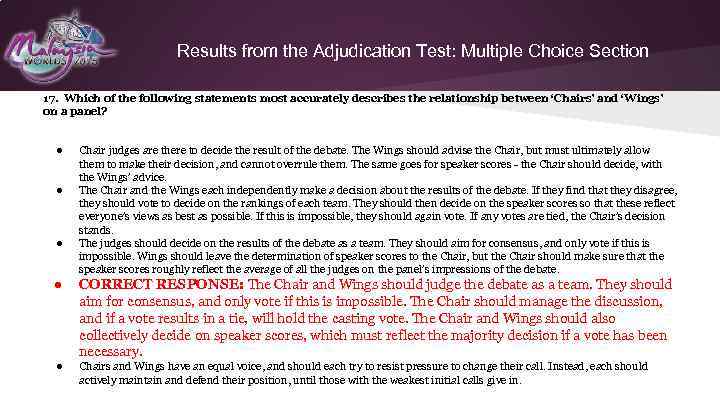 Results from the Adjudication Test: Multiple Choice Section 17. Which of the following statements most accurately describes the relationship between ‘Chairs’ and ‘Wings’ on a panel? ● ● ● Chair judges are there to decide the result of the debate. The Wings should advise the Chair, but must ultimately allow them to make their decision, and cannot overrule them. The same goes for speaker scores - the Chair should decide, with the Wings’ advice. The Chair and the Wings each independently make a decision about the results of the debate. If they find that they disagree, they should vote to decide on the rankings of each team. They should then decide on the speaker scores so that these reflect everyone’s views as best as possible. If this is impossible, they should again vote. If any votes are tied, the Chair’s decision stands. The judges should decide on the results of the debate as a team. They should aim for consensus, and only vote if this is impossible. Wings should leave the determination of speaker scores to the Chair, but the Chair should make sure that the speaker scores roughly reflect the average of all the judges on the panel’s impressions of the debate. ● CORRECT RESPONSE: The Chair and Wings should judge the debate as a team. They should aim for consensus, and only vote if this is impossible. The Chair should manage the discussion, and if a vote results in a tie, will hold the casting vote. The Chair and Wings should also collectively decide on speaker scores, which must reflect the majority decision if a vote has been necessary. ● Chairs and Wings have an equal voice, and should each try to resist pressure to change their call. Instead, each should actively maintain and defend their position, until those with the weakest initial calls give in.
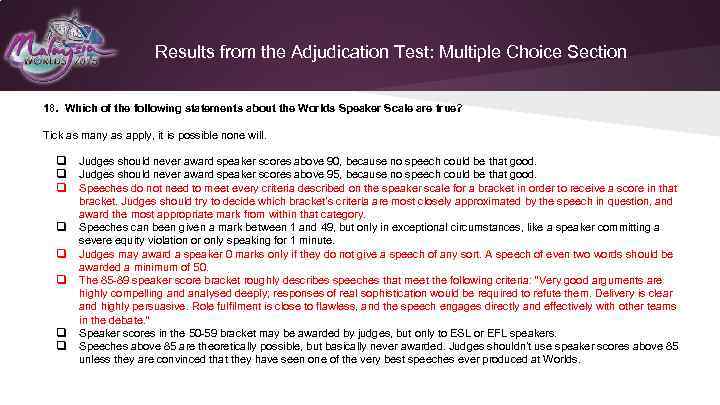 Results from the Adjudication Test: Multiple Choice Section 18. Which of the following statements about the Worlds Speaker Scale are true? Tick as many as apply, it is possible none will. ❏ ❏ ❏ ❏ Judges should never award speaker scores above 90, because no speech could be that good. Judges should never award speaker scores above 95, because no speech could be that good. Speeches do not need to meet every criteria described on the speaker scale for a bracket in order to receive a score in that bracket. Judges should try to decide which bracket’s criteria are most closely approximated by the speech in question, and award the most appropriate mark from within that category. Speeches can been given a mark between 1 and 49, but only in exceptional circumstances, like a speaker committing a severe equity violation or only speaking for 1 minute. Judges may award a speaker 0 marks only if they do not give a speech of any sort. A speech of even two words should be awarded a minimum of 50. The 85 -89 speaker score bracket roughly describes speeches that meet the following criteria: “Very good arguments are highly compelling and analysed deeply; responses of real sophistication would be required to refute them. Delivery is clear and highly persuasive. Role fulfilment is close to flawless, and the speech engages directly and effectively with other teams in the debate. ” Speaker scores in the 50 -59 bracket may be awarded by judges, but only to ESL or EFL speakers. Speeches above 85 are theoretically possible, but basically never awarded. Judges shouldn’t use speaker scores above 85 unless they are convinced that they have seen one of the very best speeches ever produced at Worlds.
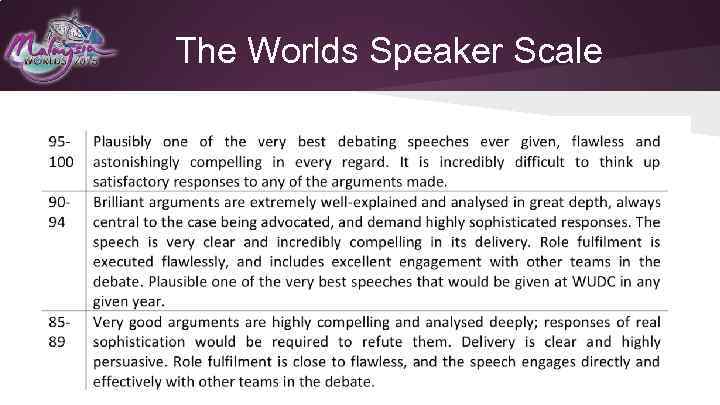 The Worlds Speaker Scale
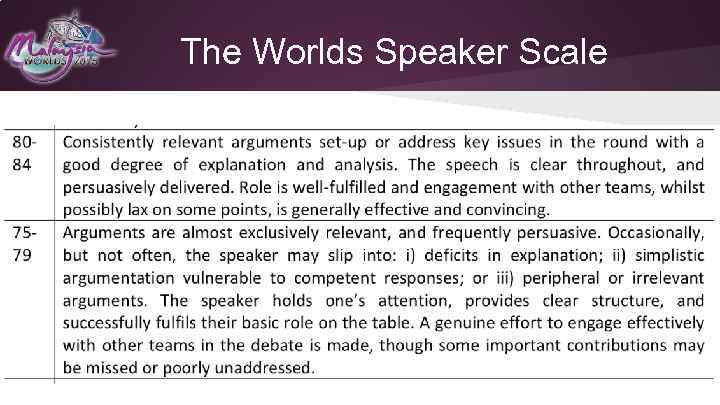 The Worlds Speaker Scale
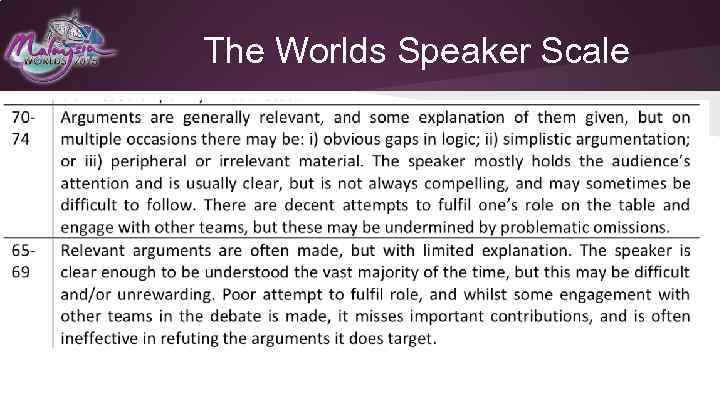 The Worlds Speaker Scale
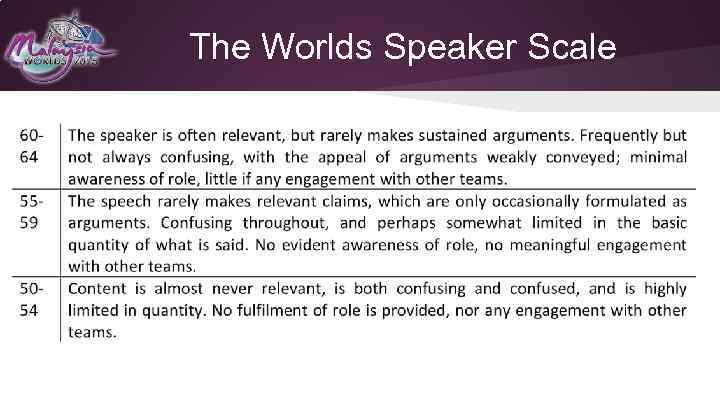 The Worlds Speaker Scale
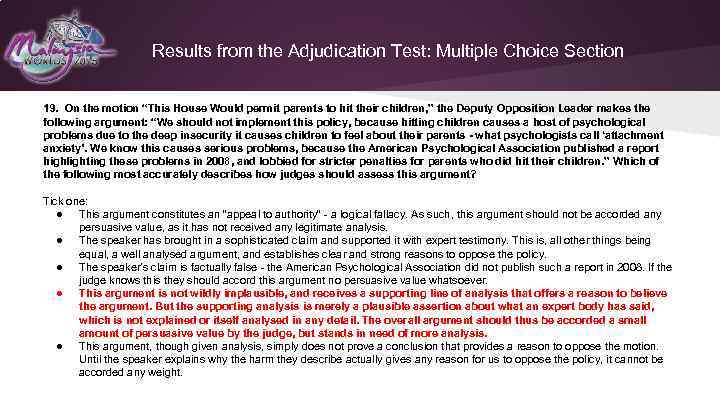 Results from the Adjudication Test: Multiple Choice Section 19. On the motion “This House Would permit parents to hit their children, ” the Deputy Opposition Leader makes the following argument: “We should not implement this policy, because hitting children causes a host of psychological problems due to the deep insecurity it causes children to feel about their parents - what psychologists call ‘attachment anxiety’. We know this causes serious problems, because the American Psychological Association published a report highlighting these problems in 2008, and lobbied for stricter penalties for parents who did hit their children. ” Which of the following most accurately describes how judges should assess this argument? Tick one: ● This argument constitutes an “appeal to authority” - a logical fallacy. As such, this argument should not be accorded any persuasive value, as it has not received any legitimate analysis. ● The speaker has brought in a sophisticated claim and supported it with expert testimony. This is, all other things being equal, a well analysed argument, and establishes clear and strong reasons to oppose the policy. ● The speaker’s claim is factually false - the American Psychological Association did not publish such a report in 2008. If the judge knows this they should accord this argument no persuasive value whatsoever. ● This argument is not wildly implausible, and receives a supporting line of analysis that offers a reason to believe the argument. But the supporting analysis is merely a plausible assertion about what an expert body has said, which is not explained or itself analysed in any detail. The overall argument should thus be accorded a small amount of persuasive value by the judge, but stands in need of more analysis. ● This argument, though given analysis, simply does not prove a conclusion that provides a reason to oppose the motion. Until the speaker explains why the harm they describe actually gives any reason for us to oppose the policy, it cannot be accorded any weight.
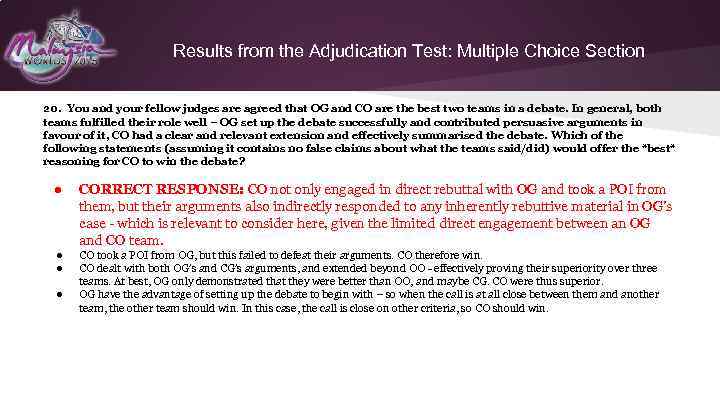 Results from the Adjudication Test: Multiple Choice Section 20. You and your fellow judges are agreed that OG and CO are the best two teams in a debate. In general, both teams fulfilled their role well – OG set up the debate successfully and contributed persuasive arguments in favour of it, CO had a clear and relevant extension and effectively summarised the debate. Which of the following statements (assuming it contains no false claims about what the teams said/did) would offer the *best* reasoning for CO to win the debate? ● CORRECT RESPONSE: CO not only engaged in direct rebuttal with OG and took a POI from them, but their arguments also indirectly responded to any inherently rebuttive material in OG’s case - which is relevant to consider here, given the limited direct engagement between an OG and CO team. ● ● CO took a POI from OG, but this failed to defeat their arguments. CO therefore win. CO dealt with both OG’s and CG’s arguments, and extended beyond OO - effectively proving their superiority over three teams. At best, OG only demonstrated that they were better than OO, and maybe CG. CO were thus superior. OG have the advantage of setting up the debate to begin with – so when the call is at all close between them and another team, the other team should win. In this case, the call is close on other criteria, so CO should win. ●
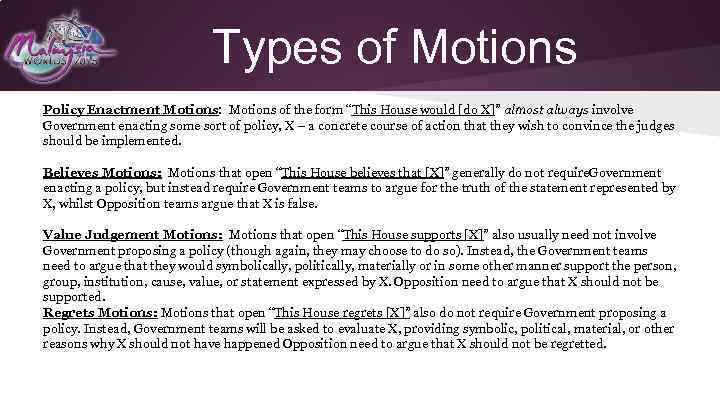 Types of Motions Policy Enactment Motions: Motions of the form “This House would [do X]” almost always involve Government enacting some sort of policy, X – a concrete course of action that they wish to convince the judges should be implemented. Believes Motions: Motions that open “This House believes that [X]” generally do not require. Government enacting a policy, but instead require Government teams to argue for the truth of the statement represented by X, whilst Opposition teams argue that X is false. Value Judgement Motions: Motions that open “This House supports [X]” also usually need not involve Government proposing a policy (though again, they may choose to do so). Instead, the Government teams need to argue that they would symbolically, politically, materially or in some other manner support the person, group, institution, cause, value, or statement expressed by X. Opposition need to argue that X should not be supported. Regrets Motions: Motions that open “This House regrets [X]” also do not require Government proposing a policy. Instead, Government teams will be asked to evaluate X, providing symbolic, political, material, or other reasons why X should not have happened Opposition need to argue that X should not be regretted.
![Types of Motions: Actor Motions: motions that open “This House would, as [Y], do](https://present5.com/presentation/3981183_357900639/image-54.jpg "Types of Motions: Actor Motions: motions that open “This House would, as [Y], do") Types of Motions: Actor Motions: motions that open “This House would, as [Y], do [X]” are somewhat special. These motions take place from the perspective of the entity expressed as Y about what they should do, with all teams arguing from actor Y’s perspective.
Types of Motions: Actor Motions: motions that open “This House would, as [Y], do [X]” are somewhat special. These motions take place from the perspective of the entity expressed as Y about what they should do, with all teams arguing from actor Y’s perspective.
 Models “Squirreling” Unless specified in the motion, as in an Actor Motion, do not place-set the debate in bizarre or counter-intuitive locations. Debates are presumed to interrogate issues as they exist globally. For example, the motion “THB the assassination of political leaders is a legitimate tactic in warfare” would presumably ask whether the assassination of any political leader is legitimate. Specifying that the debate only applies to the assassination of political leaders in Eastern Europe would be an inappropriate limitation on the debate. A much less common form of squirrelling is ‘timesetting’ – setting a motion in some particular time. For example, if the motion is “This House would allow abortion”, OG cannot define the debate as being about whether the judges in the key US case of Roe v Wade should have reached the decision they did at the time of that case. Unless directly implicated by the motion, timesetting is also an invalid definition of a motion, and motions should be set in the present day.
 Important Information for Judges ● Gambling on teams is strictly prohibited. If we find out you’re betting on teams, you will be prohibited from judging ● Chairs need to be in the vicinity of the debate room prior to the expiration of prep time. Please report to floor managers so they may sign off on your arrival. ● Judges are obliged to treat other judges, debaters, and runners with respect. We will not tolerate judges being rude or disrespecting tournament staff or participants. ● Trainees do not have a vote. That said, we ask that chairs not ignore trainees. We are eager to appoint qualified trainees to wing positions, so please communicate with and provide feedback on trainees.
 Clash Policy
 Enjoy the Tournament!