


 Скачать презентацию Welcome to Macroeconomics Chapter 24 Measuring Domestic Output
2d384c99002a9edf2163657bef953298.ppt
- Количество слайдов: 31
 Welcome to Macroeconomics! Chapter 24: Measuring Domestic Output and National Income You will learn: What is GDP and how is it measured? NI, PI, DI GDP Price Index Nominal GDP vs. Real GDP Limitations of GDP
 National Income Accounting Measures economy’s overall performance (is the pie getting bigger? ) Aggregate output Provides “economic pulse” of the nation Helps Govt. formulate economic policy Fiscal Policy (spending & taxing) Monetary Policy (interest rates & money supply)
 Gross Domestic Product Calculated quarterly by the Bureau of Economic Analysis (BEA, part of Dept. of Commerce) Definition: the total market value of all final goods and services produced within a country in a given year.
 GDP cont. GDP includes g/s produced by citizen supplied and foreign supplied resources within a particular nation’s geographic borders. (Fords and Hondas produced domestically. ) Monetary measure (necessarily calculated in nominal or current dollars) and then adjusted for inflation (or constant dollars) to measure real gains/losses over time.
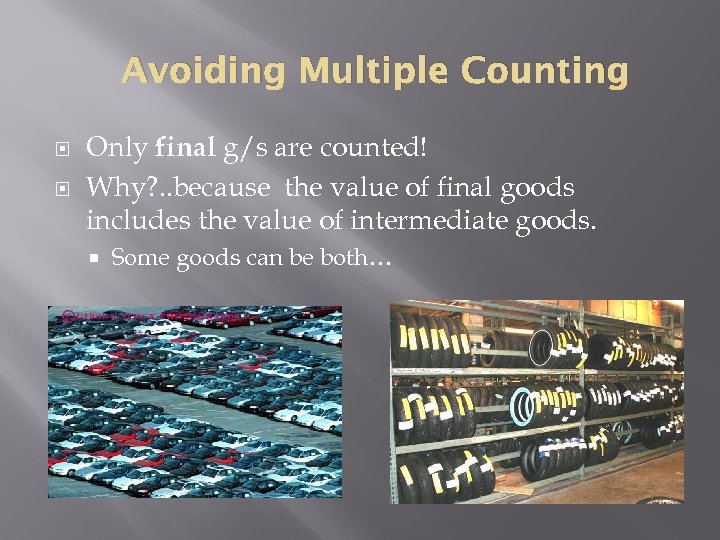 Avoiding Multiple Counting Only final g/s are counted! Why? . . because the value of final goods includes the value of intermediate goods. Some goods can be both…
 GDP Excludes Nonproduction Transactions IF NOTHING IS CONTRIBUTED TO CURRENT PRODUCTION, IT’S NOT IN GDP!! Financial Transactions excluded: Public transfer payments (SS, welfare, vets) Private transfer payments (gifts, allowances) Security transactions (stocks, bonds) Secondhand sales (thrift stores, e. Bay, most real estate)
 Two Ways of Calculating GDP: GDP can be determined either by: 1) adding up all the spending on this year’s total output (expenditures approach, ) or by: 2) adding up all the incomes derived from the production of this year’s total output (income approach. ) “one person’s spending is another person’s income!” Remember chapter 2’s model…
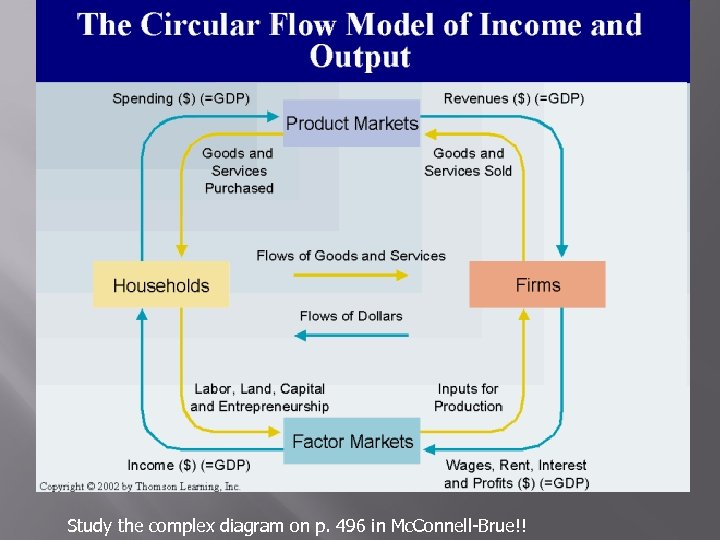 Study the complex diagram on p. 496 in Mc. Connell-Brue!!
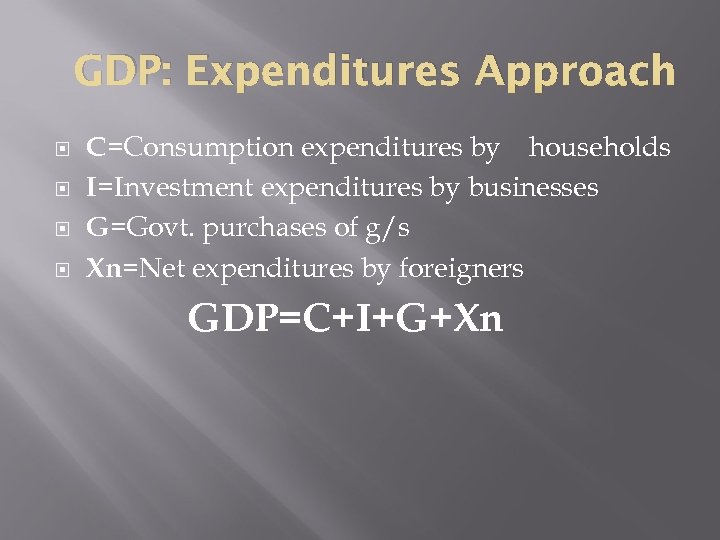 GDP: Expenditures Approach C=Consumption expenditures by households I=Investment expenditures by businesses G=Govt. purchases of g/s Xn=Net expenditures by foreigners GDP=C+I+G+Xn
 Consumption C=Personal Consumption Expenditures Accounts for approx. 70% of GDP Durable Goods (expected to last 3 yrs. or more Non Durable Goods Services
 Investment Ig=Gross Private Domestic Investment Final purchases of machinery, equipment, and tools by businesses All construction (including residential housing) Changes in inventories Goods produced but not yet sold Can be negative—”drawing down”
 Ig does NOT include transfers of financial assets or mergers/acquisitions. Depreciation is the amount of capital worn out (consumed) in producing GDP Ig > depreciation = positive net investment => expanding production capacity or increasing capital stock, which is a good indicator of future economic growth. Power. Point Presentations
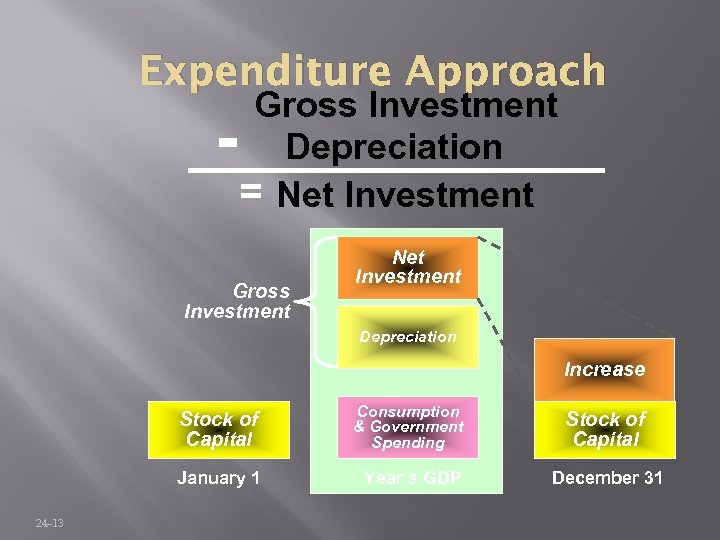 Expenditure Approach - Gross Investment Depreciation = Net Investment Gross Investment Net Investment Depreciation Increase Stock of Capital January 1 24 -13 Consumption & Government Spending Year’s GDP Stock of Capital December 31
 Government G=Government Purchases, including federal, state, and local spending on finished g/s and direct purchases of resources. Does NOT include transfer payments like social security or welfare checks!
 Net Exports Xn = exports (X) – imports (M) Where was it produced? Where was it counted? Currently negative, reflecting a trade deficit. Add up the 4 “spenders” in an economy and you have GDP!
 GDP: Is It Counted and Where? You spend $8. 00 to go to a movie, and it stinks. A family pays a contractor $200, 000 for a house she built for them this year. A family pays $185, 000 for a house built three years ago. An accountant pays a tailor $300 to sew a new suit for her. The federal government increases its defense expenditures by $1 billion. The government makes a $1100 Social Security payment to a newly retired person.
 You buy 100 shares of Apple in the stock market. At the end of the year, a box manufacturer finds that its inventories of boxes are $10, 000 above the amounts of its inventories at the beginning of the year. A homemaker cares for his children and spouse and cooks, cleans, irons, gardens and knits scarves. Ford Motor Co. buys new welding robots. You pay $600 a month to rent an apartment. Kellogg builds a new factory in Oregon.
 Exxon buys control of Mobil to form Exxon Mobil Corp. You buy a new BMW motorcycle that was made in Germany. You pay tuition to attend college.
 GDP: Income Approach National Income: the sum of wages compensation, rents, interest, and profits (WRIP) Add them all up (with some accounting adjustments) and you get the income earned from the factors (resources) used in the production of GDP. Power. Point Presentations
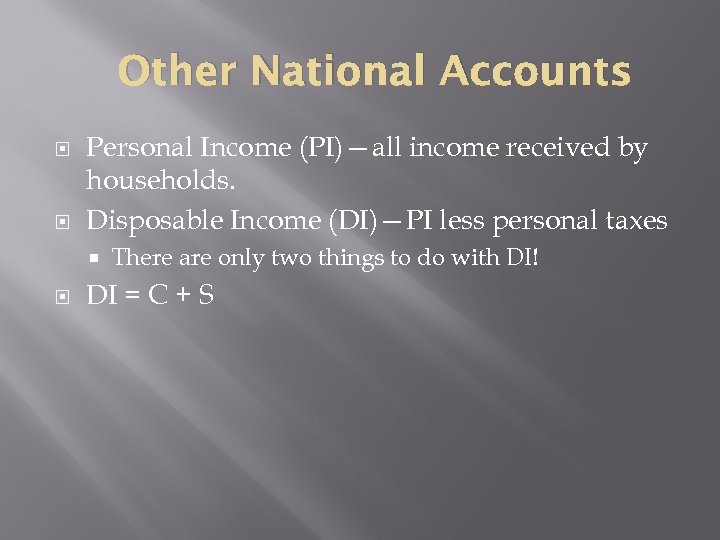 Other National Accounts Personal Income (PI)—all income received by households. Disposable Income (DI)—PI less personal taxes There are only two things to do with DI! DI = C + S
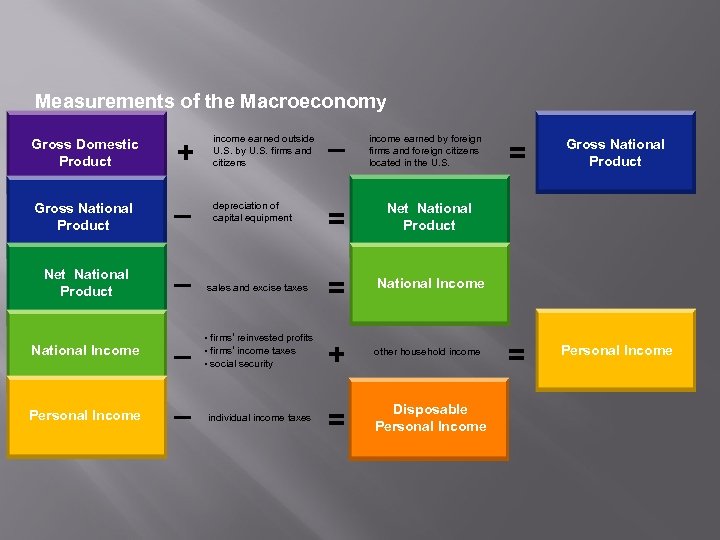 Measurements of the Macroeconomy Gross Domestic Product + income earned outside U. S. by U. S. firms and citizens Gross National Product – depreciation of capital equipment Net National Product – National Income Personal Income – income earned by foreign firms and foreign citizens located in the U. S. = = – + other household income – individual income taxes = Disposable Personal Income = Personal Income National Income • firms‘ reinvested profits • firms‘ income taxes • social security Gross National Product Net National Product sales and excise taxes =
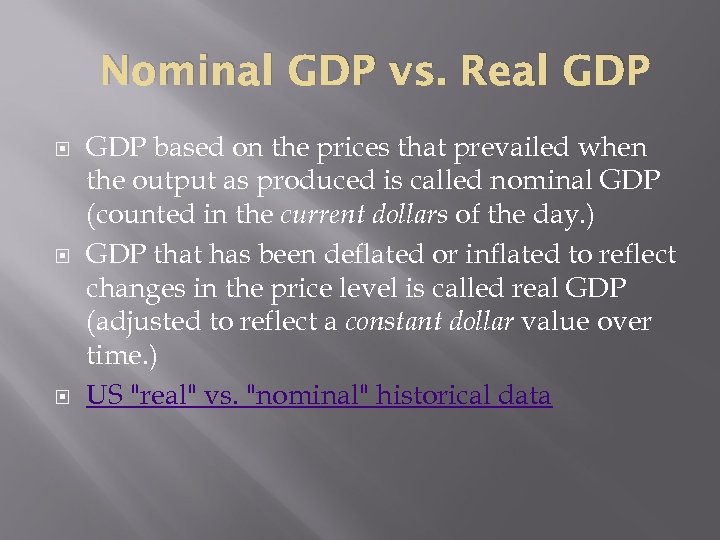 Nominal GDP vs. Real GDP based on the prices that prevailed when the output as produced is called nominal GDP (counted in the current dollars of the day. ) GDP that has been deflated or inflated to reflect changes in the price level is called real GDP (adjusted to reflect a constant dollar value over time. ) US "real" vs. "nominal" historical data
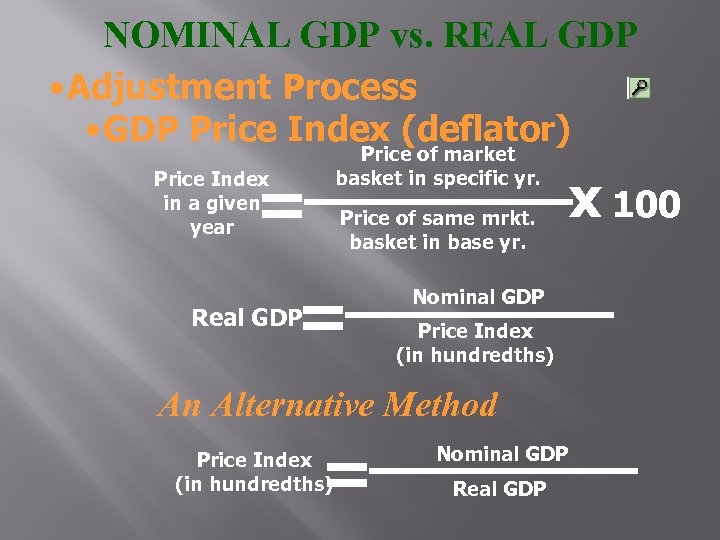 NOMINAL GDP vs. REAL GDP • Adjustment Process • GDP Price Index (deflator) Price of market basket in specific yr. = Price Index in a given year Price of same mrkt. basket in base yr. = Real GDP Nominal GDP Price Index (in hundredths) An Alternative Method = Price Index (in hundredths) Nominal GDP Real GDP x 100
 GDP Rank by Country GDP per capita rank by country Most Recent GDP release from BEA. gov
 World Wealth Map
 Shortcomings of GDP It is not a measure of economic or social wellbeing (total utility) It does not account for all output or all productive activities It does not account for “goods” such as reduced crime or violence, increased leisure time It does not distinguish between expenditures on bombs or theme parks.
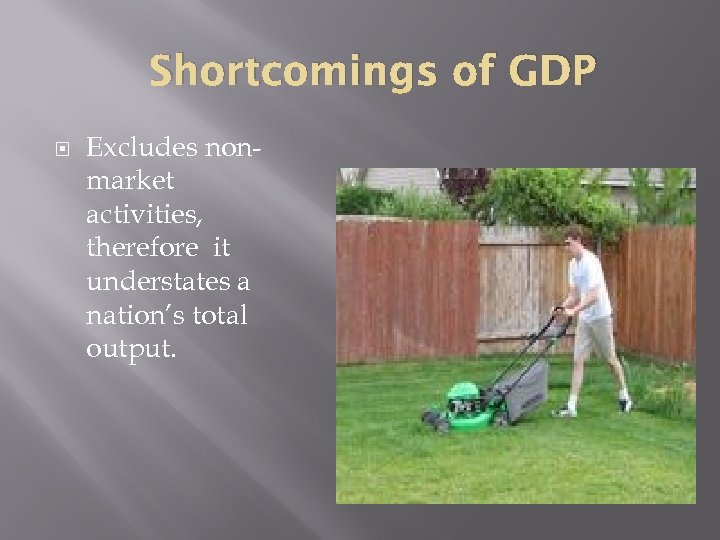 Shortcomings of GDP Excludes nonmarket activities, therefore it understates a nation’s total output.
 Shortcomings of GDP Not counted: “black market" activities or the underground economy estimated to be almost 10% of the recorded GDP in the U. S. ex. : cash-only jobs, bartering, illegal transactions,
 Shortcomings of GDP Unintended negative side effects such as pollution in the production of output has a cost which is not reflected in GDP. Does this overstate or understate GDP? Noise, congestion, crime, infant mortality, life expectancy, etc. How is this accounted for? Who are the “happiest” people on the planet? Which country pursues a goal of increasing its GDH (Gross Domestic Happiness)?