


 Скачать презентацию Welcome to Kindergarten With The Kindergarten Team Mrs
59cecdba80f65abebb33a8e94192c80a.ppt
- Количество слайдов: 32
 Welcome to Kindergarten! With The Kindergarten Team… Mrs. Jeanne Cano Ms. Stephanie Casper Ms. Nancy Randolph Mrs. Satya Kennedy A new adventure begins!
 Principal/Parent/ Teacher/Student Contracts: Ø All parents must have a signed contract on file in the office. Ø Parents/guardians may choose to sign the form and turn them right back to the teacher TONIGHT! Ø [Third Graders will also receive a letter about MOWR for folks at home. ]
 3 B’s of Good Behavior Be safe. Be respectful. Be responsible.
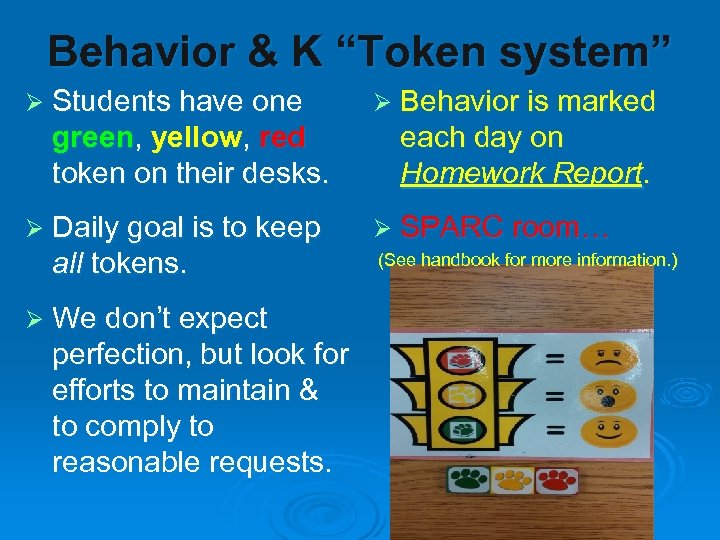 Behavior & K “Token system” Ø Students have one green, yellow, red token on their desks. Ø Daily goal is to keep all tokens. Ø We don’t expect perfection, but look for efforts to maintain & to comply to reasonable requests. Ø Behavior is marked each day on Homework Report. Ø SPARC room… (See handbook for more information. )
 Rewards… ØVerbal praise ØStickers and stamps Ø 3 B coupons ØSpecial privileges ØExtra explore time ØExtra computer time ØFun Friday Activities
 Morning Class Responsibilities Ø Empty backpacks at table independently. Ø Student puts water bottles & snacks in proper place. Ø Student gets out lunchbox for lunch count & place lunchboxes in basket/bin. Ø Put library books in basket/bin. Ø Take out daily blue KTA folder to be reviewed (with completed homework). Ø Zip backpacks & put away backpacks in cubbies.
 Arizona College and Career Readiness Standards Ø Increased academic rigor Ø Goal setting & tracking progress Ø Helps to identify learning styles & strengths Ø Promotes independence & responsibility as well as cooperation & collaboration skills Ø Promotes communication skills Ø Preparation for Standardized Testing
 Spalding Ø Daily Oral Phonogram Practice (OPR) l Students will receive phonogram practice cards to use for homework at home (keep in your “kit. ”) Ø Daily Written Phonogram Practice (WPR) Ø Grammar and Language Use Ø Text Structure and Literary Appreciation Ø Quizzes on Friday on phonograms and dictation words (beginning around Nov. ) Ø In class spelling notebooks will be used
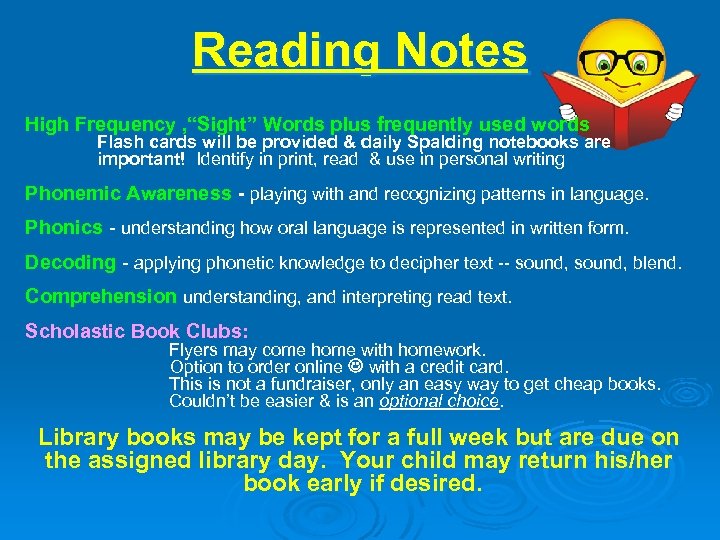 Reading Notes High Frequency , “Sight” Words plus frequently used words Flash cards will be provided & daily Spalding notebooks are important! Identify in print, read & use in personal writing Phonemic Awareness - playing with and recognizing patterns in language. Phonics - understanding how oral language is represented in written form. Decoding - applying phonetic knowledge to decipher text -- sound, blend. Comprehension understanding, and interpreting read text. Scholastic Book Clubs: Flyers may come home with homework. Option to order online with a credit card. This is not a fundraiser, only an easy way to get cheap books. Couldn’t be easier & is an optional choice. Library books may be kept for a full week but are due on the assigned library day. Your child may return his/her book early if desired.
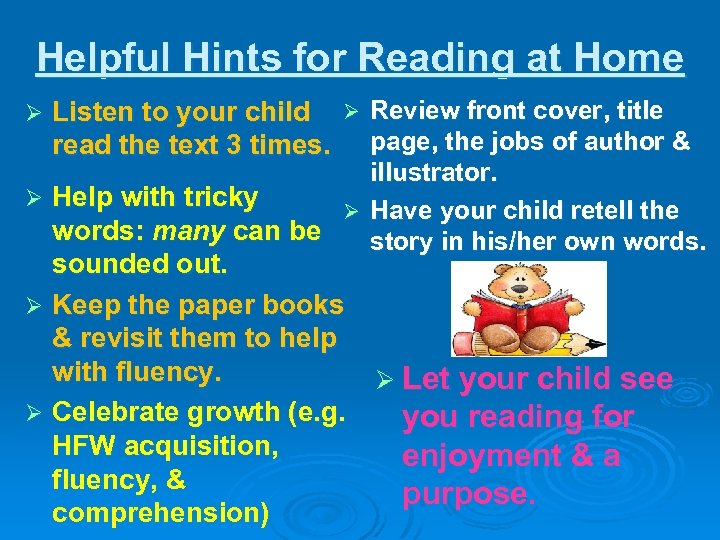 Helpful Hints for Reading at Home Review front cover, title page, the jobs of author & illustrator. Ø Help with tricky Ø Have your child retell the words: many can be story in his/her own words. Ø Listen to your child read the text 3 times. Ø sounded out. Ø Keep the paper books & revisit them to help with fluency. Ø Let your child see Ø Celebrate growth (e. g. you reading for HFW acquisition, enjoyment & a fluency, & purpose. comprehension)
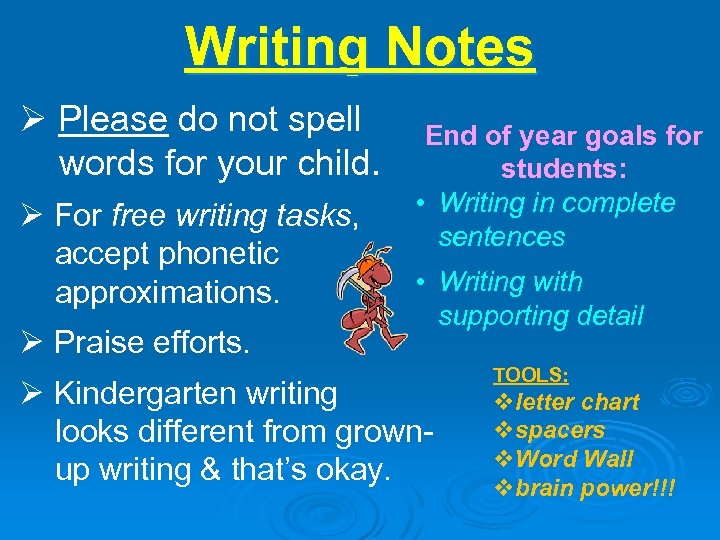 Writing Notes Ø Please do not spell words for your child. Ø For free writing tasks, accept phonetic approximations. Ø Praise efforts. End of year goals for students: • Writing in complete sentences • Writing with supporting detail Ø Kindergarten writing looks different from grown- up writing & that’s okay. TOOLS: vletter chart vspacers v. Word Wall vbrain power!!!
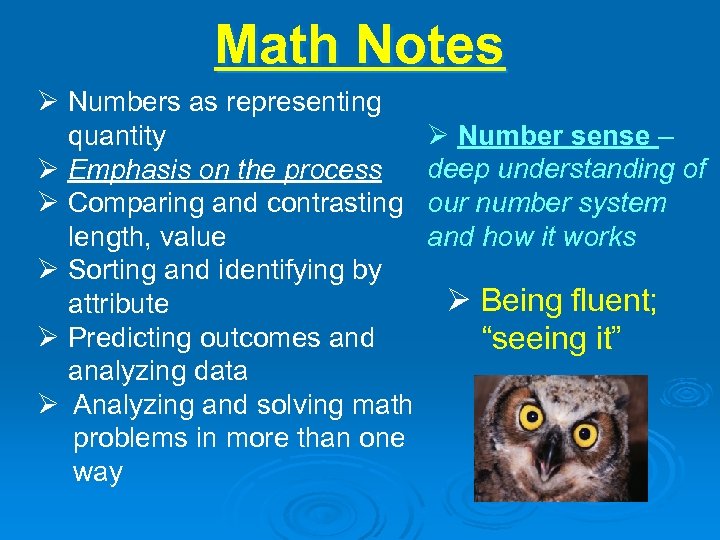 Math Notes Ø Numbers as representing Ø Number sense – quantity deep understanding of Ø Emphasis on the process Ø Comparing and contrasting our number system and how it works length, value Ø Sorting and identifying by Ø Being fluent; attribute Ø Predicting outcomes and “seeing it” analyzing data Ø Analyzing and solving math problems in more than one way
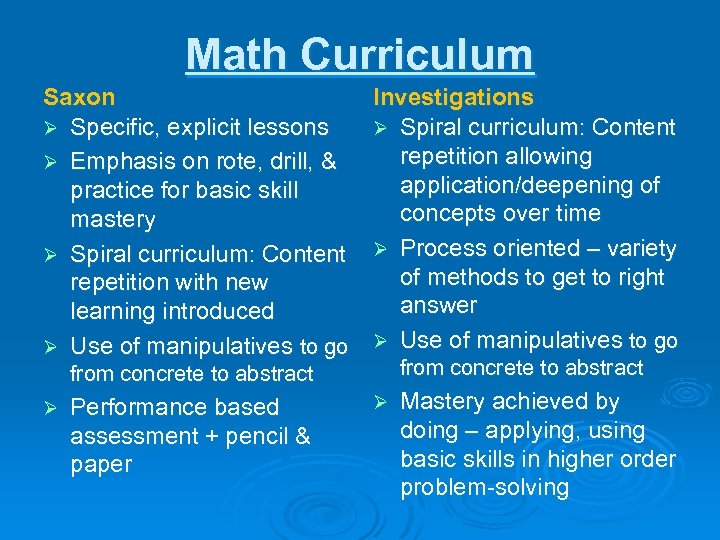 Math Curriculum Saxon Ø Specific, explicit lessons Ø Emphasis on rote, drill, & practice for basic skill mastery Ø Spiral curriculum: Content repetition with new learning introduced Ø Use of manipulatives to go Investigations Ø Spiral curriculum: Content repetition allowing application/deepening of concepts over time Ø Process oriented – variety of methods to get to right answer Ø Use of manipulatives to go from concrete to abstract Ø Performance based assessment + pencil & paper Ø Mastery achieved by doing – applying, using basic skills in higher order problem-solving
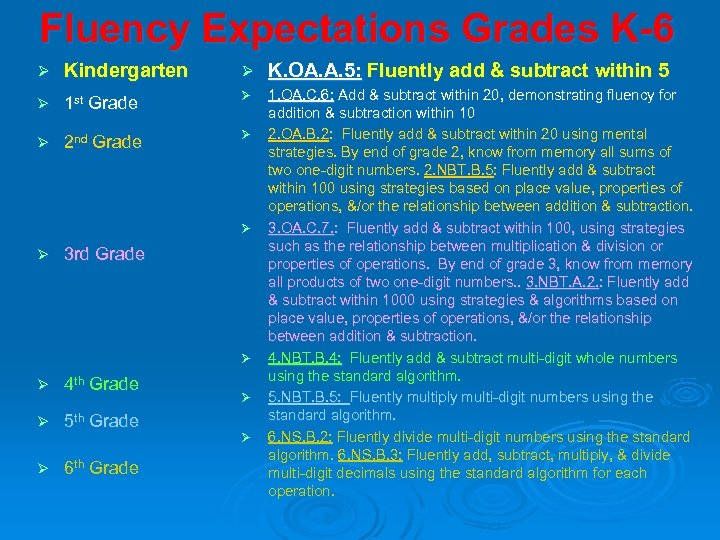 Fluency Expectations Grades K-6 Ø Kindergarten Ø K. OA. A. 5: Fluently add & subtract within 5 Ø 1 st Grade Ø Ø 2 nd Grade Ø 1. OA. C. 6: Add & subtract within 20, demonstrating fluency for addition & subtraction within 10 2. OA. B. 2: Fluently add & subtract within 20 using mental strategies. By end of grade 2, know from memory all sums of two one-digit numbers. 2. NBT. B. 5: Fluently add & subtract within 100 using strategies based on place value, properties of operations, &/or the relationship between addition & subtraction. 3. OA. C. 7. : Fluently add & subtract within 100, using strategies such as the relationship between multiplication & division or properties of operations. By end of grade 3, know from memory all products of two one-digit numbers. . 3. NBT. A. 2. : Fluently add & subtract within 1000 using strategies & algorithms based on place value, properties of operations, &/or the relationship between addition & subtraction. 4. NBT. B. 4: Fluently add & subtract multi-digit whole numbers using the standard algorithm. 5. NBT. B. 5: Fluently multiply multi-digit numbers using the standard algorithm. 6. NS. B. 2: Fluently divide multi-digit numbers using the standard algorithm. 6. NS. B. 3: Fluently add, subtract, multiply, & divide multi-digit decimals using the standard algorithm for each operation. Ø Ø 3 rd Grade Ø Ø 4 th Grade Ø 5 th Grade Ø 6 th Grade Ø Ø
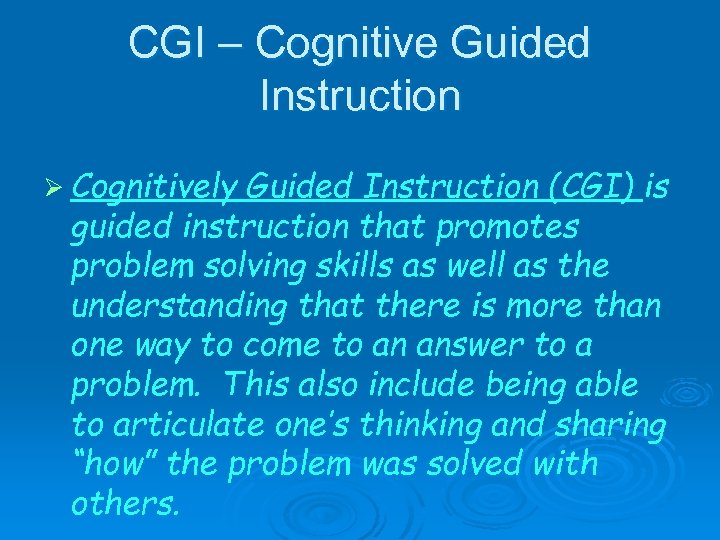 CGI – Cognitive Guided Instruction Ø Cognitively Guided Instruction (CGI) is guided instruction that promotes problem solving skills as well as the understanding that there is more than one way to come to an answer to a problem. This also include being able to articulate one’s thinking and sharing “how” the problem was solved with others.
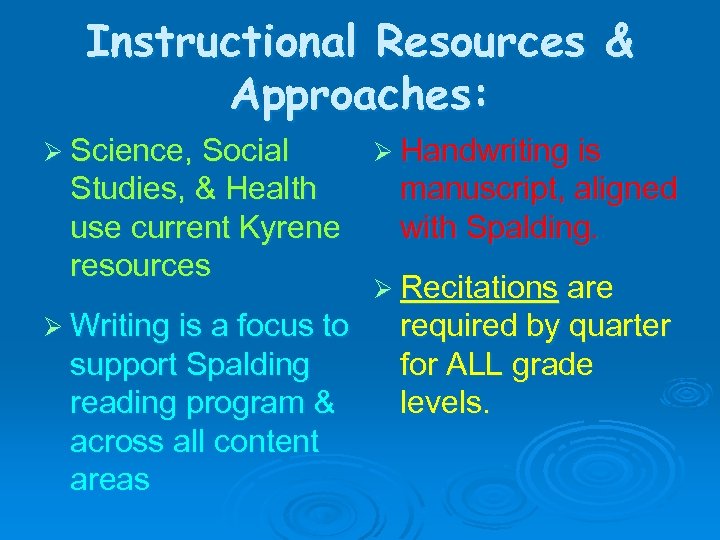 Instructional Resources & Approaches: Ø Science, Social Studies, & Health use current Kyrene resources Ø Writing is a focus to support Spalding reading program & across all content areas Ø Handwriting is manuscript, aligned with Spalding. Ø Recitations are required by quarter for ALL grade levels.
 l, oo l, C oo ol! C Co Technology Ø Smartboard interactive presentation tool Ø 5 laptops in classroom + stand alone Ø Computer lab time each week + Your child will login using a username & password, access approved websites, practice skills, word process, create a slide show presentation, & more.
 HOMEWORK ü Read to, or with, your child for 10 -15 minutes, every night. ü Check the weekly newsletter, e-mails and homework folder for additional assignments and practice opportunities. ü Homework Kit is a kindergarten resource for you to keep & use at home. Please save all games & other learning tools from school together in the folder. ü Homework comes home Ø Please, contact us if you M-Th & is due the next day. have any questions. (Confusion is a curable condition. )
 Homework is Identified in KTA folder: o o o Content areas/subjects are designated by days of the week… Parents are asked to check completed work for accuracy Teachers are looking for: Ø Parent signature daily on Homework Report. Ø Work completed to best of ability – including a quality effort AND all colored. Ø Student writes name on Parent signature is ALL work to receive required daily for acknowledgement of credit. homework & student Ø “Kit” work completion. behavior (Let’s check it out!)
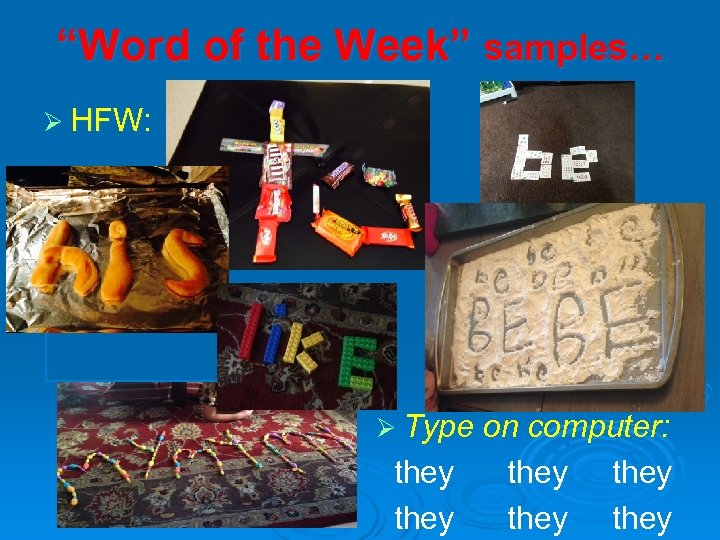 “Word of the Week” samples… Ø HFW: Ø Type on computer: they they
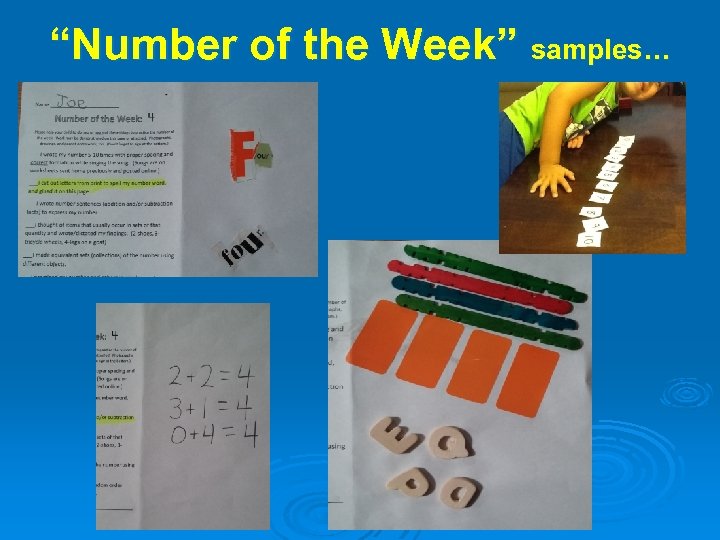 “Number of the Week” samples…
 PLEASE, WRITE YOUR CHILD’S NAME ON ALL THINGS THAT COME TO SCHOOL! (Snacks, lunchboxes, water bottles, backpacks, homework, jackets, etc…)
 Absences… Ø Call the absence line. Ø Keep sick kids at home. Ø Schedule vacations & doctor appointments around school hours as much as possible. Ø Missed Kindergarten Spalding practice & review needs to be “made up” when returning to school. Ø Parents may need to assist with support of missed work needing to be completed by the student.
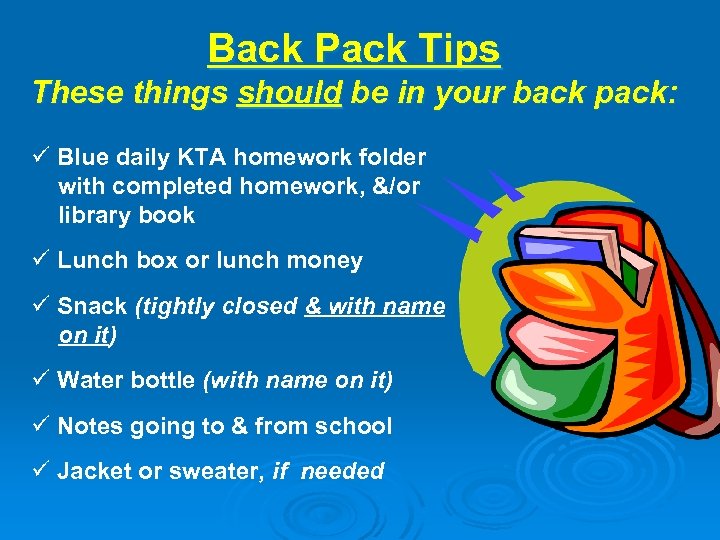 Back Pack Tips These things should be in your back pack: ü Blue daily KTA homework folder with completed homework, &/or library book ü Lunch box or lunch money ü Snack (tightly closed & with name on it) ü Water bottle (with name on it) ü Notes going to & from school ü Jacket or sweater, if needed
 Personal Skills to Practice üIndependent üZipping, buttoning, bathroom use snapping, buckling üBlowing nose üPutting on jackets, effectively sweatshirts, coats, üOpening/closing & sweaters snack & lunch ü Covering mouths containers when sneezing or üTying or fastening coughing shoes
 Healthy Snacks ØSnacks are optional & should be separate as well as marked with student’s name. (Some children are fine waiting until lunch. ) ØRemember that our breaks are short & snacks should not be a meal, but just a little something to hold the child over until lunch, If needed. ØPlease choose nutritious items. (NO cookies, chips, candies, etc. ) ØChoose snacks that your child can eat without much adult assistance. ØLabel the snack with your child’s name. ØWe will collect snacks first thing in the morning & keep in the snack bin for our break/snack/AM recess time. Ø NO NUTS in class or at AM recess!! We have students with severe food allergies!!
 Lunch Reality • Kids choose their entrees when buying lunch. • Children sit, eat, & clean up their own messes. • It can be loud. There approximately 100 children eating in there & not all speak quietly. • The assistants do their best to organize lunches, assist children, in an orderly fashion. ** If you have any questions about pricing, please see the school website
 Drinks and Bathrooms Ø Before school Ø Exploration time Ø Quiet work time Ø Playground time Ø If you have an “emergency” Ø There is a bathroom in each Kindergarten classroom (Student water bottles remain accessible to students. )
 TALK! Talk with child about: ü school ü friends ü stories ü songs & poems ü class work ü homework ü numbers ü patterns ü family ü interests ü goals q With Oral language development, parents are the best teachers of language skills. q Be patient, help & encourage your little one to express complete thoughts & ideas by speaking & responding in full sentences.
 We LOVE Volunteers! Ø Kindergarten in class volunteers will start in October. Ø The PALS program (Parents Aiding Learning in School) is happening NOW! Feel free to sign up TONIGHT! Ø P. T. O. Events sign up is in the hallway near the MPR. First meeting Thurs. , Aug. 20 th. Ø Per the Handbook, each family is expected to complete a minimum of 5 volunteer hours.
 Follow KTA On Social Media: Ø Facebook: facebook. com/ktasureno Ø Twitter: @KTASureno Pull out your phones & follow us!
 More Information Ø COLLECT BOXTOPS for EDUCATION stamps Ø Kyrene School District: www. kyrene. org Ø KTA Main Office 541 -5400 Ø Our Kindergarten class webpages: q www. kyrene. org/staff/jcano q www. kyrene. org/staff/scasper q www. kyrene. org/staff/nrandolph q www. kyrene. org/staff/lsine Ø Phone (room 7) 541 -5507 (Mrs. Cano voice mail) Ø Phone (room 8) 541 -5508 (Ms. Casper voice mail) Ø Phone (room 9) 541 -5509 (Mrs. Kennedy voice mail) Ø Phone (room 11) 541 -5511 (Ms. Randolph voice mail) Ø E-mail (Mrs. Cano) - jcano@kyrene. org Ø E-mail (Ms. Casper) - scasper@kyrene. org Ø E-mail (Ms. Randolph) - nrandolph@kyrene. org Ø E-mail (Mrs. Kennedy) - skennedy@kyrene. org